
Released: June 2019 | Developer: Red Tiger Gaming (Evolution Group) | Grid: 8×6 | Paylines: 30 fixed | RTP: 96.22% | Volatility: Medium-High | Max Win: 1,941.5× stake | Bet Range: €0.10–€40
Seven years is an eternity in iGaming. Frameworks age, player expectations shift, and mechanics that once read as inventive become the wallpaper everyone stopped noticing. And yet here is Phoenix Fire Power Reels — a Red Tiger title from the summer of 2019 — still appearing in lobby highlights at regulated operators across Europe, still pulling session data, still attracting the specific type of player who finds a giant reel grid aesthetically satisfying. Whether that staying power reflects genuine design quality or simple inertia is the question worth answering in 2026.
What follows is not a promotional synopsis. It is a structured assessment of what this game actually does, how it does it relative to its siblings in the Power Reels catalogue, and what a player with a working understanding of slot mathematics should expect from it over a meaningful session.
The Power Reels Concept: What an 8×6 Grid Actually Changes
Start with the physical reality. Most contemporary video slots operate on a 5×3 matrix — five reels, three rows, somewhere between 10 and 25 fixed paylines, or a Megaways engine with variable row counts. Red Tiger’s Power Reels format throws that convention out by expanding the reel field dramatically. Phoenix Fire Power Reels uses eight reels and six rows, producing a game window that is imposing by any standard. It looks like a spreadsheet built by someone who genuinely loves fire imagery.
The critical architectural question: does more physical space mean more winning opportunity? The short answer is — not in the way the visual impression suggests.
The game runs 30 fixed paylines. That number is identical to what many 5×3 slots offer, and considerably less than the 243 ways or 1,024 ways structures that became standard in the years after this game’s release. The grid is large, but the route map through it is not. Those 30 lines thread across eight reels, meaning the density of payline coverage per reel column is actually lower than in a tightly structured five-reel game.
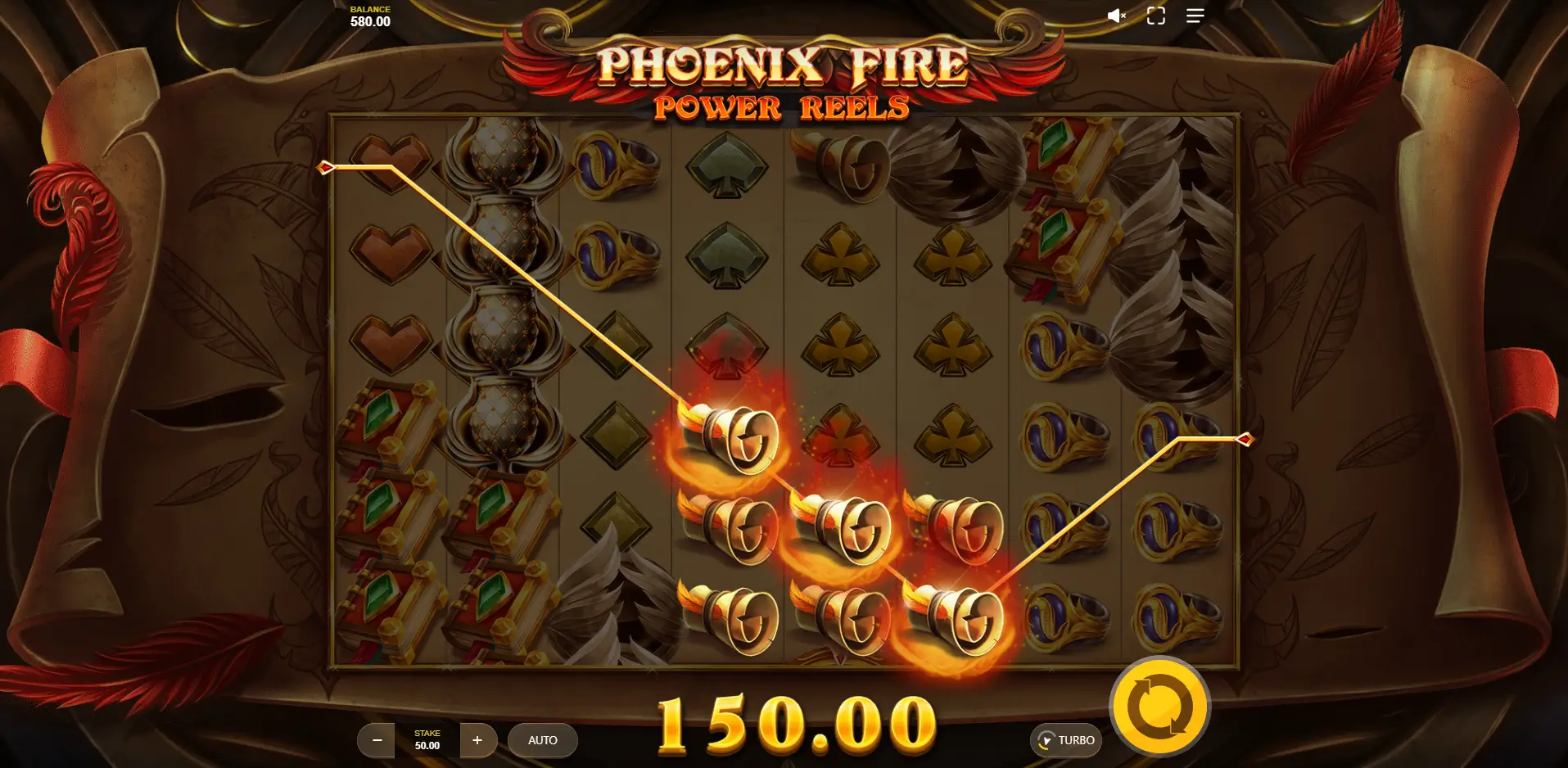
What the format does change is the Adjacent Pays mechanic — Red Tiger’s terminology for the fact that winning combinations do not have to begin on the leftmost reel. Any three matching symbols connecting along a payline from left to right can start on any reel in the set. This is a meaningful structural difference from classic left-anchored pay mechanics. In practice, it increases the frequency of partial contributions: symbols landing in the middle of the grid can still generate value, which would be wasted positions in a conventional setup. You will notice more small wins during base game play for this reason — the game does not feel as dry as a straightforward high-volatility title might over a short session.
However, the Adjacent Pays mechanic also creates an optical illusion. The vast reel territory implies a high hit rate, when in reality the 30-payline constraint is doing the heavy mathematical lifting. Players new to the format occasionally overestimate their coverage. The game is not a ways-to-win engine — it is a conventional payline game wearing unusually large clothing.
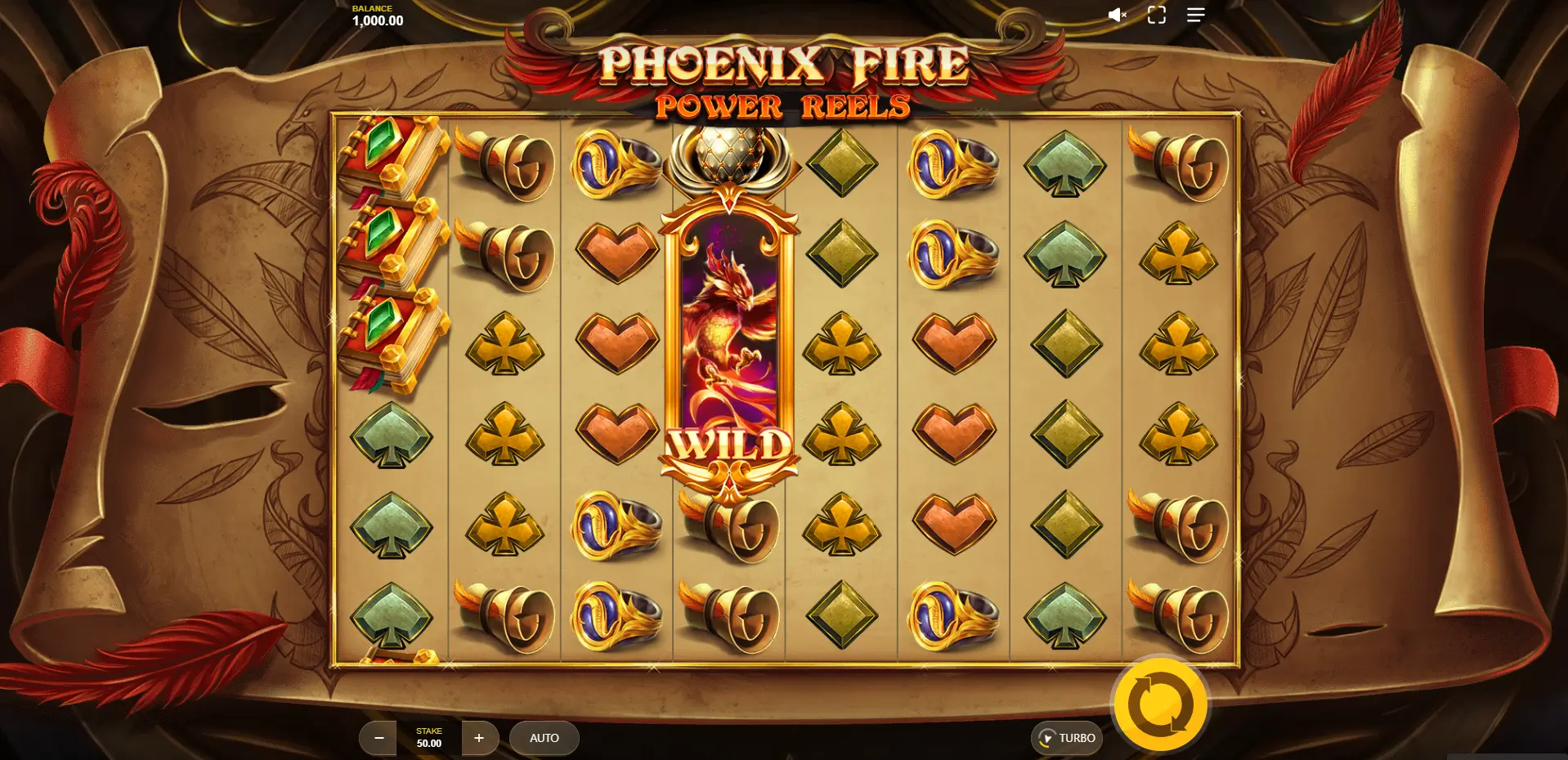
The reel expansion does serve one genuine purpose: stacked symbol architecture. With six rows per reel, the Phoenix Wild symbol (which occupies a 1×3 footprint) can appear multiple times across the grid in the free spins mode — up to three simultaneously — creating dense coverage that a 5×3 grid simply cannot accommodate. This is where the format genuinely earns its footprint.
Phoenix Wilds & Wing Features: The Mechanism in Detail
The game’s primary identity comes from two interlinked features built around the Phoenix and its associated winged symbols.
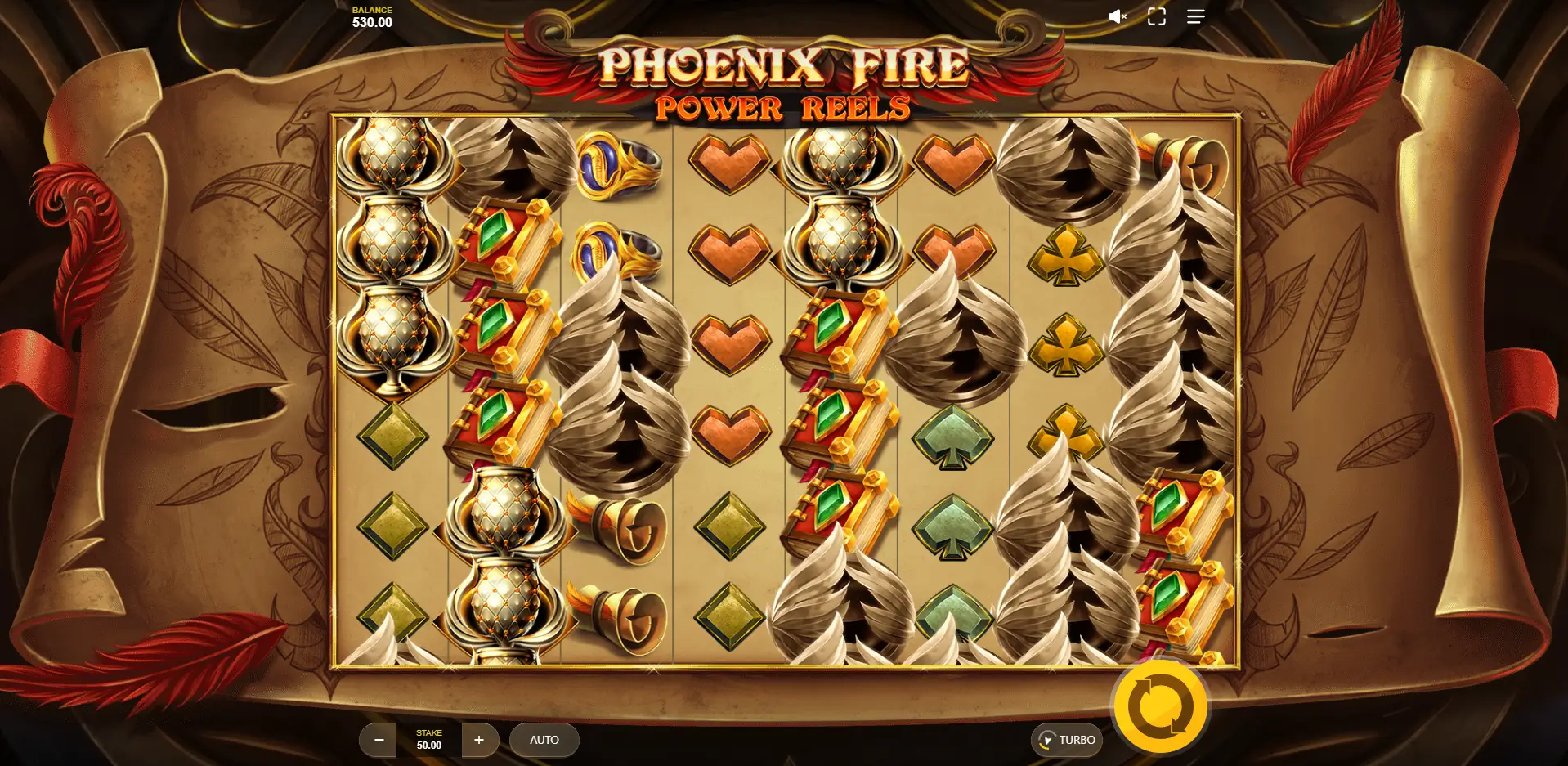
Winged Symbols are the background actors here. They occupy positions around the reel edges and appear stacked, filling entire reel columns. Critically, they carry no independent payout value. A reel full of winged symbols is, in isolation, worth nothing. Their entire purpose is conditional: they become Wilds only when a Phoenix Wild lands adjacent to them.
The Phoenix Wild is a 1×3 vertically stacked Wild symbol — meaning it covers three consecutive rows on a single reel when it lands. Its substitution function is standard. What makes it notable is the chain activation: when a Phoenix Wild appears, every winged symbol on adjacent reels immediately converts to Wild. Depending on positioning and how many winged symbols are present across the visible grid, this can produce a significant cluster of Wild coverage.
There is an important distinction between the two modes in which this activation occurs:
- Standard base game activation: The Phoenix Wild lands organically on the reels. A maximum of one Phoenix Wild can appear per base game spin. Adjacent winged symbols convert. The effect is localised and proportional to that single Wild’s position.
- Phoenix Wildfire random event: On any spin where no Phoenix Wild is present on the reels, the Phoenix itself may appear as a random flyover — not as a landed symbol, but as an animation event. When this triggers, all winged symbols currently visible on the grid convert to Wilds simultaneously, regardless of their position. This is the game’s most impactful base game event and the source of the larger single-spin returns you will occasionally see in base play. It is genuinely random and cannot be engineered.
The distinction matters because the Wildfire event is not the Phoenix Wild landing — it is a separate probabilistic trigger. During extended base game sessions, you can experience many spins where the Phoenix Wild lands but produces modest results due to limited winged symbol presence, and then occasionally see the Wildfire event wash the entire grid in Wilds. The variance within the base game is therefore notable even before the free spins bonus is considered.
Symbol hierarchy: The paytable runs from card suits (Clubs, Diamonds, Hearts, Spades — all paying identically, at 0.3× for three-of-a-kind up to 8× for eight-of-a-kind) through scrolls, rings, books, and the Silver Cup at the top of the standard symbol hierarchy. Eight Silver Cup symbols on a payline returns 50× your stake. The Phoenix Wild itself pays 50× for eight on a line, matching the top standard symbol. Nothing in this paytable is particularly aggressive, which is consistent with the game’s medium-high (rather than extreme) volatility rating.
Free Spins Volatility: The Honest Assessment
The free spins bonus is triggered by landing three scatter symbols — jade green gems marked “Free Spins” — anywhere in view. The positional freedom of the scatter trigger (no need for specific reel columns) is consistent with the game’s Adjacent Pays philosophy and means the bonus is somewhat easier to land than in conventionally structured slots.
Initial award: 7 free spins. Retrigger: Landing three further scatters during the bonus adds another 7 free spins, and this can be repeated without an explicit cap, meaning theoretically unlimited retriggers.
The meaningful mechanical upgrade in the bonus round is the enhanced Phoenix Wild frequency. Where the base game limits you to a single Phoenix Wild per spin, the free spins mode allows up to three Phoenix Wilds to land simultaneously on a single spin. Combined with winged symbol conversions, this creates the structural conditions for the game’s larger payouts.
Here is where a clear-eyed read of the numbers becomes necessary.
Three 1×3 Phoenix Wilds distributed across the eight-reel grid, combined with full winged symbol conversion via the Wildfire event, can generate widespread Wild coverage. But the ceiling is 1,941.5× your stake. For context: this figure is low. It is not egregiously low for a medium-high volatility game with a 96.22% RTP, but against the backdrop of the market in 2026 — where 5,000× and 10,000× caps are standard at comparable volatility ratings — the maximum payout potential is the game’s most visible structural limitation.
What does this mean for free spins sessions in practice?
- Small and medium wins land frequently during free spins. The elevated Wild density means you are unlikely to exit a bonus round empty-handed. Wins in the 10×–80× range per spin are achievable when positioning aligns.
- The pathway to the theoretical maximum is narrow. Reaching 1,941.5× requires optimal Wild stacking across multiple paylines simultaneously, which is genuinely rare. The game’s 30-payline architecture remains the constraint — even with six columns covered by Wilds, you are restricted to the payline routes rather than all possible symbol combinations.
- Additional Wild spawning does not compound multiplicatively. There is no multiplier on the Wild conversions — each converted winged symbol pays at standard symbol value, not at an amplified rate. The game’s reward mechanism is additive rather than exponential, which caps the excitement curve.
The retrigger mechanic is the free spins feature’s strongest selling point. A session that chains multiple 7-spin sets creates extended bonus exposure, and the probability of at least one high-Wild-density spin across a 21- or 28-spin bonus set is meaningfully better than across a standard 7-spin set. Patient players who hold through lower-value triggers to accumulate retriggers will see the game’s best outputs.
Overall free spins assessment: Enjoyable, reasonably frequent wins, structurally sound — but the bonus is not a mechanical showpiece. It does not introduce new rules, multipliers, or collecting mechanics. It is the base game with elevated Wild frequency. For players who value clarity over complexity, this is fine. For those expecting a distinct bonus mode with its own logic, this will disappoint.
2026 Competitive Landscape: The Power Reels Family in Context
Phoenix Fire Power Reels was the format’s flagship title in 2019. By 2026, Red Tiger’s Power Reels catalogue has expanded considerably, and the internal comparisons are instructive.
Dragon’s Luck Power Reels operates on a different philosophical footing. It dispenses with the free spins bonus entirely and concentrates all variance on mystery symbol reveals and the Mega Coin mechanic. The absence of a bonus round is a deliberate design choice that keeps the base game as the sole arena for significant wins. This makes Dragon’s Luck more volatile in feel — longer dry periods punctuated by large mystery reveals — while Phoenix Fire delivers more textured base game activity through its Adjacent Pays and Wildfire events.
Zeus Lightning Power Reels is the more significant internal competitor. Released post-Phoenix Fire, Zeus Lightning operates on a 7×6 grid (slightly smaller reel field), carries a 97.73% RTP — substantially higher than Phoenix Fire’s 96.22% — and reaches a maximum win potential that dramatically exceeds Phoenix Fire’s ceiling. The Zeus expanding symbol mechanic during free spins, where the Zeus icon selects one symbol type and converts multiple reels to that value, is a more visually dramatic and mathematically impactful feature than Phoenix Fire’s Wild chain conversions. If a player is choosing between the two games today purely on mathematical merit, Zeus Lightning wins the comparison without ambiguity.
Totem Lightning Power Reels and Leprechaun’s Magic Power Reels follow similar structural patterns — oversized grids, modest payline counts, feature mechanics built around symbol transformation. None of them have introduced mechanical innovations that fundamentally change the Power Reels proposition since Phoenix Fire first articulated it.
The honest read on the Power Reels series in 2026 is that it occupies a specific and shrinking niche. The format was conceived as Red Tiger’s answer to Megaways — a proprietary mechanic that could create large visual footprints and differentiated gameplay. It never achieved Megaways-level market penetration for two reasons: first, the 30-payline cap prevents the exponential win paths that made Megaways genuinely distinctive; second, the reel expansion creates visual complexity without a proportional increase in mechanical depth. Players who came to Phoenix Fire in 2019 looking for the feel of a large game found it. Players in 2026, accustomed to Megaways, Cluster Pays, Tumble mechanics, and multiplier trails, will find the format relatively austere.
That said, Phoenix Fire Power Reels has one advantage over many of its contemporaries: it is readable. The rules are not complex. The bonus trigger is straightforward. The Wild mechanic is logical and easy to track visually. In a market increasingly populated by slots with rule sheets that run to five pages, there is a legitimate audience for a game that can be understood in three minutes and played with a clear head.
The Phoenix in Mythology — and the Slot Market
The Phoenix as a slot theme is crowded territory. The bird that immolates itself and rises renewed from the ash is practically a software archetype — it has been rendered by every major studio at least once, often with diminishing creative returns. A brief survey of the competition illustrates the challenge Phoenix Fire Power Reels faces on pure aesthetic distinctiveness.
Pragmatic Play has revisited the phoenix motif repeatedly — most notably in titles like Fire Strike and various Hot series entries where the bird appears as a high-pay symbol rather than a feature driver. EGT’s long-running Phoenix franchise packages Eastern European market preferences into a retro visual language utterly unlike Red Tiger’s approach. Playtech’s older Phoenix-themed entries target a different demographic entirely. And Hacksaw Gaming has approached fire and rebirth themes from an angular, almost brutalist design direction that contrasts sharply with Red Tiger’s lush, scroll-and-lacquer aesthetic.
What Red Tiger achieved with Phoenix Fire Power Reels is a genuinely specific visual identity. The reel set is framed within an ancient scroll, gold-edged and textured, with phoenix imagery worked into the border design in a way that avoids the garish fire-on-black palette that cheaper implementations default to. The high-definition assets hold up reasonably well in 2026 — they were built to HTML5 standards from launch and render cleanly at modern display resolutions. The warm amber and crimson palette is consistent and deliberate; the animations during the Phoenix Wildfire event are fluid rather than janky. This is a studio that understood that a giant reel grid needed visual coherence to avoid looking like a debugging screen.
The audio design is appropriately understated. A continuous ambient theme — strings, distant percussion, light Eastern instrumentation — plays during base game spins without demanding attention. The Phoenix Wildfire activation receives a distinct audio cue that genuinely signals the moment without being aggressively theatrical. Red Tiger has always been competent in this department; Phoenix Fire is no exception.
Whether this visual and audio quality is sufficient to compete with the production values of 2025 and 2026 releases is a different question. The answer is: it remains respectable rather than impressive. High-definition assets from 2019 are not the same as high-definition assets designed for contemporary hardware expectations. The game does not embarrass itself on a modern screen, but it does not dazzle either.
The Red Tiger Math Problem: RTP, Operator Customisation, and Long-Run Expectations
Here is where the review requires the most precision, because the numbers circulating for this game are not consistent — and the reasons for that inconsistency are themselves informative.
Confirmed base RTP: 96.22%. This is the figure validated across multiple regulated markets and certified testing records. It positions the game in the upper-middle tier of the market — above the 94%–95% range that some operators deploy on high-footfall titles, below the 97%+ figures that mathematically sophisticated players actively seek.
However, the figure you will see advertised can vary significantly:
- Paddy Power’s UK deployment: 93.23% — a meaningfully lower return, achieved through Red Tiger’s operator customisation capability. Red Tiger, as part of the Evolution Group, provides operators with adjustable RTP configurations. The theoretical maximum RTP and the deployed RTP are not the same thing. Operators in competitive markets sometimes deploy at maximum; others adjust downward to improve margin on high-volume titles.
- Multiple third-party sites: Figures of 95.13%, 96.47%, and 96.22% all appear in circulation, reflecting different operator configurations or source errors.
What does this mean for the player? It means the RTP figure on a game’s information panel — particularly in unregulated or grey-market environments — requires scrutiny. The certified 96.22% return is real, but only at that configuration. A 93.23% deployment is not fraudulent, but it represents a meaningfully different mathematical proposition: the expected return per €100 wagered drops from €96.22 to €93.23 — a difference of €2.99, compounding over extended sessions.
Players in licensed European markets should verify the actual deployed RTP via the game’s information screen, which reputable operators are required to make accessible. Players in markets without this regulatory requirement are operating on less certain ground.
Volatility rating: Medium-High (approximately 4/5 on standard five-point scales). This classification is accurate and worth unpacking. The game’s Adjacent Pays mechanic and 30-line structure produce a base game hit rate that is higher than pure high-volatility titles — the frequent small wins from adjacent connections give the impression of a livelier game. But the presence of significant variance in the bonus round (dependent on Phoenix Wild density and winged symbol positioning) means that session outcomes swing materially. Two identical 100-spin sessions on this game can produce radically different results, which is characteristic of medium-high volatility rather than medium.
Maximum win: 1,941.5× stake. At a €1 bet, this represents a potential return of €1,941.50 — achievable, but requiring the confluence of three Phoenix Wilds, maximum winged symbol conversion, and favourable payline alignment. At a €40 maximum bet, the same event would return €77,660. These are numbers worth knowing before assuming this game belongs in the same risk category as titles with 5,000× or 10,000× caps.
Long-run expectation: At 96.22%, a player wagering €5 per spin over 500 spins (€2,500 total outlay) expects a theoretical return of approximately €2,405.50. The operative word is theoretical — volatility means actual returns will distribute around that figure with significant variance. Over 5,000+ spins, the game’s true mathematical character asserts itself. At that distance, the medium-high volatility profile means you should expect meaningful downswings balanced by occasional bonus consolidations. The game is not a bankroll destroyer for patient players at appropriate stakes, but it is not a reliable grind vehicle either. The 30-payline structure and capped maximum win make it unsuited for players who use slot sessions as a high-variance lottery ticket.
Expert Verdict
Phoenix Fire Power Reels is a well-executed 2019 slot that has aged into respectability without achieving timelessness. Its 8×6 grid with Adjacent Pays remains a visually distinctive format, but the 30-payline constraint means the architectural ambition exceeds the mathematical delivery. The Phoenix Wildfire mechanic is genuinely engaging — the random Wildfire event in the base game creates genuine anticipation — and the free spins bonus is playable and clear, even if it lacks the layered complexity that 2025-era players increasingly expect from a feature mode.
The RTP at 96.22% is honest for the configuration in which it was designed. Operator-adjusted deployments at 93%–95% erode that case. The maximum win ceiling of 1,941.5× is the most significant structural limitation in 2026 — against a market where comparable volatility ratings regularly deliver 5,000×–10,000× potential, this game asks for tolerance of a compressed upside.
Play it if: You want readable mechanics, genuine visual craft, and a medium-high variance experience that produces regular small wins alongside periodic bonus consolidation. It works well as a session filler or a change of pace from mechanically complex titles.
Avoid it if: Your primary motivation is maximum win potential or bonus mode depth. Zeus Lightning Power Reels in the same series delivers a higher certified RTP and a larger max win. The broader Megaways market offers ways-to-win structures that make Phoenix Fire’s 30 fixed paylines feel narrow.
Overall: A solidly crafted title that earned its reputation in 2019 and retains enough character to justify occasional revisits in 2026. The phoenix rises — but not to extraordinary heights.