Belatra Games released Piggy Bank Scratch in 2020, spinning off one of their most recognisable land-based slot IPs into the instant-win scratch card format. That was a deliberate move, not a throwaway — the original Piggy Bank slot (2014) had built genuine brand equity in Eastern European and CIS markets, and Belatra wanted to port that recognition into a format that requires zero learning curve. The scratch card version keeps the bank-robbery narrative, the hammer-smashing bonus, and the Wheel of Fortune jackpot mechanic that made the slot’s land-based cabinet feel alive. What it strips out is the reel-spinning, the paylines, and the extended session arc. What you get instead is a 3×3 ticket, a match-three win condition, and a two-stage bonus that occasionally pays well.
The question now, six years on, is whether the game holds up in a scratch card market that has changed dramatically around it.
In 2026, online scratch cards are no longer the quiet backwater of the casino lobby they once were. Hacksaw Gaming turned the category into its primary battleground. BTG’s Bonanza Tapcards launched with a 96.45% RTP and a 25,000× max win ceiling. The standards have moved. So where does Piggy Bank Scratch actually sit? The RTP question alone is messier than the aggregators want you to believe — and that inconsistency is worth examining before you put money on a single ticket.
Math model and mechanics
RTP — a figure that depends on who you ask
Here is the honest position on Piggy Bank Scratch’s RTP: sources disagree, and that matters.
The majority of aggregators — CasinoLandia, SlotsMate, and the Belatra game description on SlotCatalog — cite 95% RTP. That is a reasonable figure for a scratch card with a Wheel of Fortune progressive mechanic layered on top. LiveBet, however, lists 85% RTP for the same title. That is a 10-percentage-point gap, which is not noise — it is the difference between a competitive game and one that returns less than a roulette wheel.
The most likely explanation is operator-configured RTP. Belatra, like most B2B game suppliers, provides operators with configurable RTP ranges rather than a single locked figure. The 95% version is likely the default or high-end configuration; the 85% figure may reflect a lower-bracket configuration deployed by specific operators. This is standard practice — Pragmatic Play does the same with their slots — but it has a practical implication: the RTP you get depends on which casino you play at, not which game you pick. Before depositing, it is worth checking whether the operator publishes their configured RTP for this title in the game information panel or paytable. Many do not. Most players do not check. That is the gap the lower configurations exploit.
For the purposes of this review, the 95% figure is treated as the baseline, since it is the most widely cited and aligns with what Belatra’s own promotional positioning suggests for their premium-tier distribution.
Volatility
Multiple sources classify Piggy Bank Scratch as high volatility. That classification is worth thinking about in the context of a scratch card. High volatility in a slot means long dry spells punctuated by large wins; the same model applied to a scratch card means you will burn through tickets without matching three symbols more often than you would expect, and the significant payouts will be clustered in infrequent bonus activations. It is not the constant-win scratch card that casual players often expect from the format. If you sit down with £20 expecting to stay in play for 30 minutes, high volatility will likely end your session early.
Grid structure and ticket mechanics
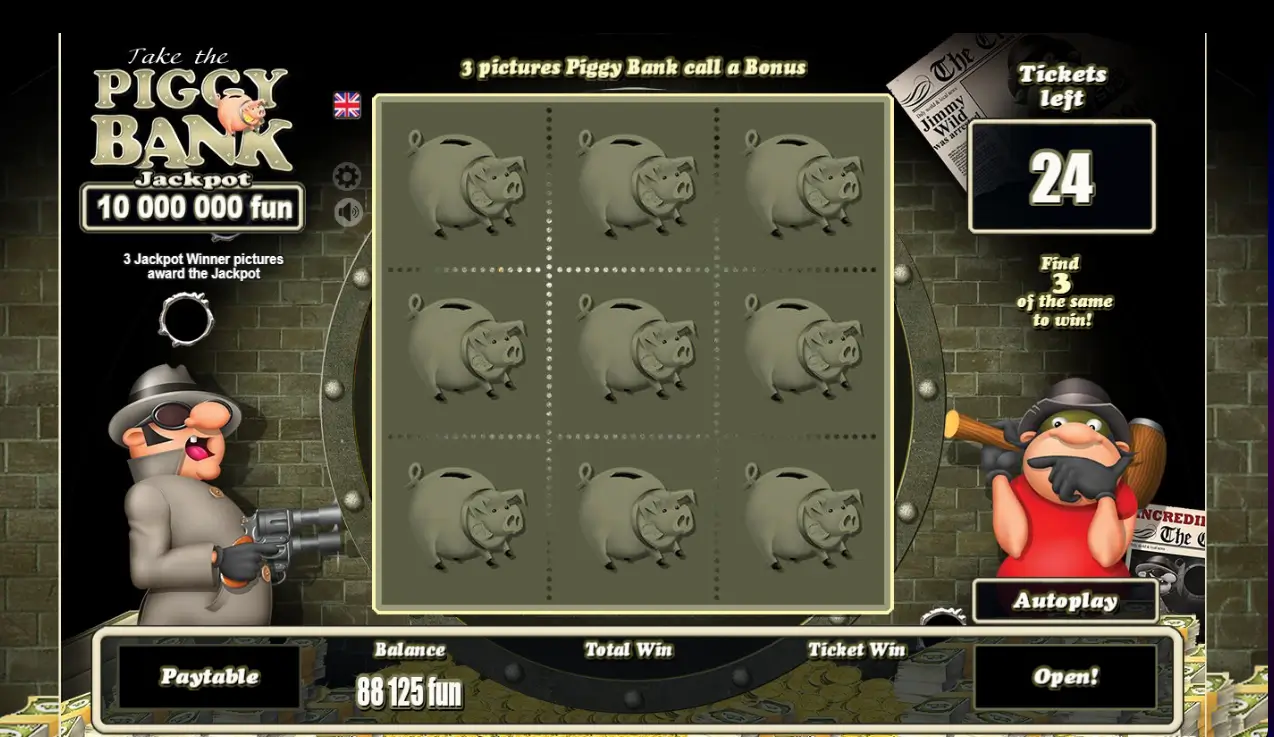
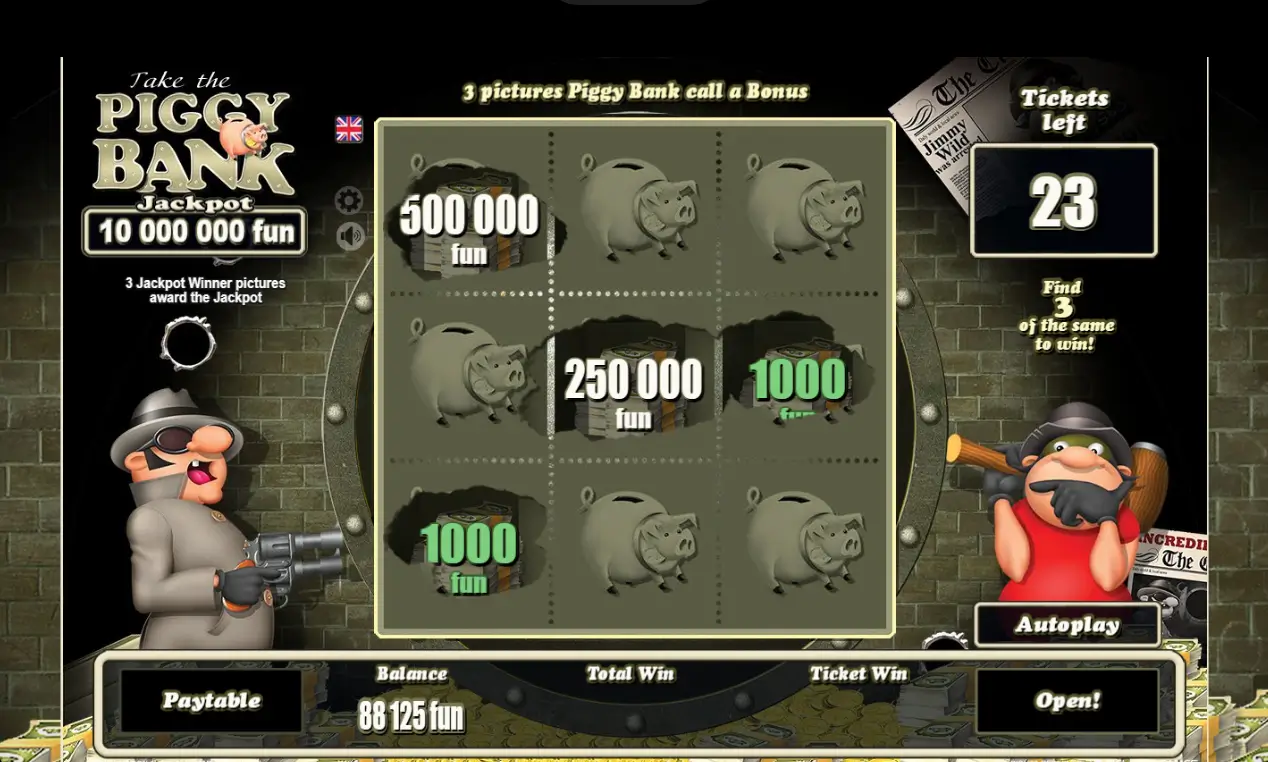
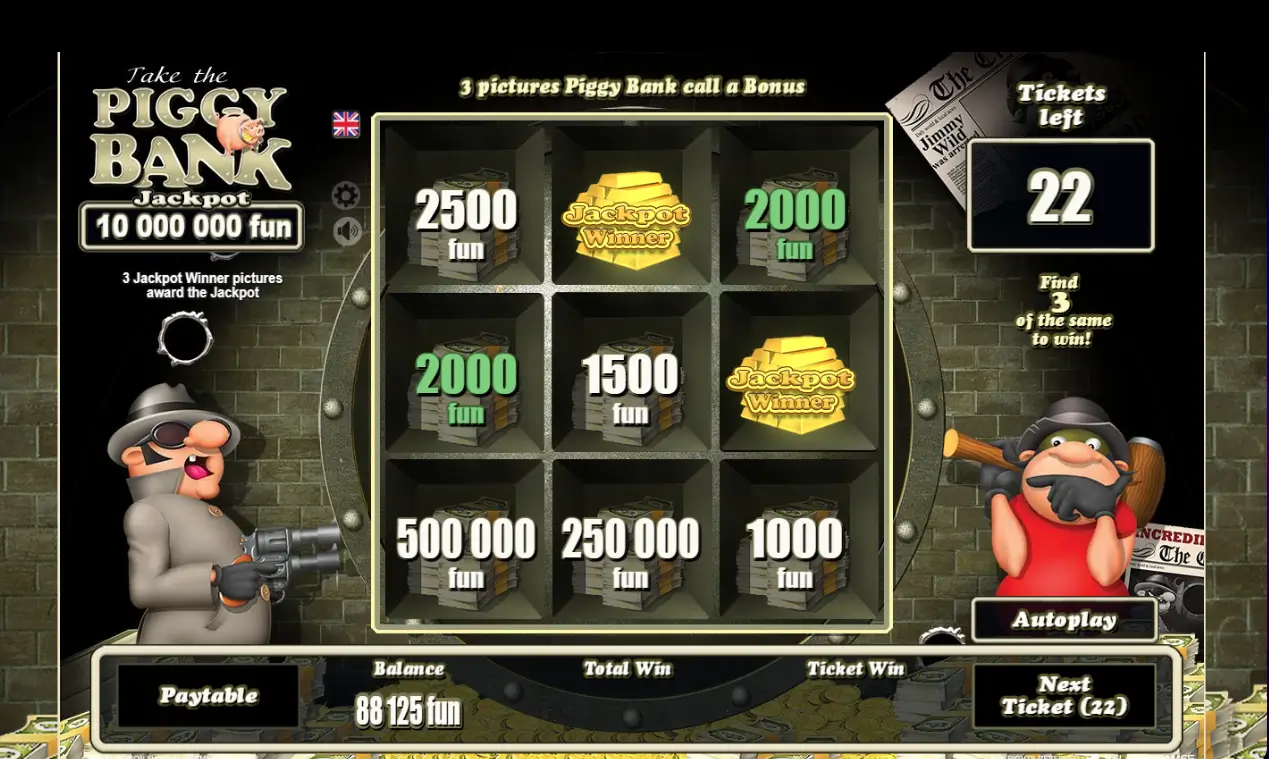
The playing field is a 3×3 grid of nine cells. Each cell conceals either a cash value or a piggy bank symbol. The win condition is simple: reveal three identical cash amounts across the nine cells, and you collect that amount. If three piggy bank symbols appear, the Stage 1 Bank Robbery Bonus activates automatically.
Ticket pricing is structured around a bulk-purchase incentive. Rather than a fixed per-ticket price, the game uses a discount mechanism — the more tickets you buy in a single purchase, the lower the effective cost per ticket. According to Belatra’s own documentation on comparable titles, purchasing 10 tickets at once delivers a 3% discount; 50 tickets delivers a 10% discount. This system pushes players toward higher-volume sessions than a single-ticket purchase model would, which has obvious implications for bankroll management.
Max win
The confirmed maximum prize for Piggy Bank Scratch is €100,000, cited by the 247pokies competitive analysis of scratch card titles. One aggregator (casinoreviews.net) references 25,000× stake as the ceiling for Belatra’s scratch card line broadly — but since Belatra doesn’t publish a standardised min-bet per ticket for Piggy Bank Scratch across all operators, the stake-multiplier figure cannot be independently verified. The €100,000 figure is treated here as the hard ceiling.
In context: €100,000 is a meaningful top prize for an instant-win game, but it is not a record-breaker in 2026. Hacksaw’s scratch titles regularly exceed this at the top of their range. The BTG Bonanza Tapcards ceiling sits at 25,000× with a 96.45% RTP. On the raw prize ceiling, Piggy Bank Scratch is competitive; on the RTP-adjusted expected value, it underperforms if you are playing a low-configured-RTP version.
Feature breakdown
Bank Robbery Bonus — Stage 1
Trigger condition: Three piggy bank symbols appear simultaneously on the 3×3 scratch card.
Stage 1 drops you into Belatra’s signature mini-game format, familiar from the original Piggy Bank slot. Your character — the robber Jimmy — uses a large hammer to smash open a series of piggy banks. Each piggy bank conceals either a cash prize or a key. The cop mechanic introduces a stop condition: if the cop appears during your smashing sequence, the bonus round ends. However, a brick-over-the-cop event can neutralise the interruption and allow the sequence to continue.
What this actually means mechanically: the Stage 1 bonus is a pick-and-reveal under a thin narrative wrapper. You are clicking on piggy banks in sequence, hoping each one yields the key rather than an early cop stop. The cash prizes you collect during this stage add up toward your bonus total, with the key representing the gateway to the more valuable Stage 2.
The honest limitation here is the cop mechanic. It introduces a stop condition that can end the bonus sequence at low cash values if the cop appears early. The Stage 1 payout range is variable — you might collect three small cash values before a cop stops the run, or you might chain several reveals before finding the key. There is no published data on average Stage 1 payout as a proportion of max win.
Bank Robbery Bonus — Stage 2
Trigger condition: Finding the key during Stage 1.
Stage 2 is described by Belatra as win-guaranteed — no cop can interrupt this stage. You are presented with five safes and must choose one to open. Each safe contains a different cash amount. The mechanic is a straightforward one-pick-from-five selection, with the outcome determined before you make the selection (standard RNG). Belatra describes this stage as “win-win,” meaning any safe you open yields a prize — you cannot pick a zero outcome.
The implication: Stage 2 is where the meaningful bonus money lives, but you can only reach it by successfully navigating Stage 1 through to the key reveal. The two-stage structure means the highest prizes require the bonus to run its full course. In sessions where Stage 1 terminates early via the cop stop, Stage 2 is never reached.
One thing to note about Stage 2: five safes, one pick, no second chance. The variance within the bonus is high — the difference between picking the highest-value safe and the lowest-value safe is significant, and you only get one shot. Players hoping for consistent bonus outcomes will find this frustrating.
Jackpot Wheel of Fortune
This is the most distinctive mechanic in Piggy Bank Scratch, and the one that most clearly signals the game’s land-based DNA.
Trigger condition: Automatic — activates when the JP points indicator reaches threshold.
After every ticket purchase (every bet made), JP points accumulate on a visible indicator bar. When the bar fills, the Wheel of Fortune jackpot drawing launches automatically — you do not need to trigger it deliberately. The jackpot is two-stage: the first wheel spin determines the prize tier; the second spin (where applicable) determines the super jackpot outcome.
The mechanic is borrowed directly from Belatra’s land-based slot hardware, where progressive jackpot meters and wheel drawings are common. In the online scratch card context, it adds a layer of ongoing engagement that compensates for the relatively passive base game. Every ticket you purchase contributes to the jackpot meter, which creates a sense of accumulating progress even when individual tickets return small wins or blanks.
The practical limitation: the JP trigger threshold is not published, nor is the average number of tickets required to reach the wheel. This makes it impossible to calculate the effective cost of reaching the jackpot draw. Based on available player reports, the wheel triggers periodically rather than frequently — it is an aspirational feature rather than a reliable bonus-session mechanism.
The super jackpot top prize connects to the €100,000 ceiling cited above. Whether the full jackpot is available at all operator configurations, or only at the 95% RTP tier, is not confirmed.
How to play Piggy Bank Scratch: practical approach
Session management for a high-volatility scratch card
Most scratch card guidance online is useless because it treats the format as a simple luck exercise with no structure. Piggy Bank Scratch is high volatility, which means the standard advice — “play conservatively, enjoy the ride” — actively sets players up for disappointing sessions.
The bulk-buy discount mechanic changes the calculus. When you commit to purchasing 50 tickets in a session, you receive a 10% discount on the effective ticket price. That matters because 10% off a losing session is not much comfort, but 10% off a session where you trigger the Bank Robbery Bonus multiple times is meaningful — it reduces your effective cost base for the same number of opportunities at the bonus. If you are going to play the game at all, the bulk-buy route gives better expected value per ticket than one-at-a-time purchases.
There is a counterargument: committing to 50 tickets in a single sitting forces a larger session than many players intend, and the high volatility means you could go through all 50 tickets without a bonus trigger. The discount benefit is real, but the bankroll requirement is also real. A session of 50 tickets at Belatra’s typical ticket price point is not a casual five-minute experiment.
The practical recommendation: decide your session limit before you open the game. If you are allocating £50, know that high volatility may produce zero bonus triggers across that entire budget. Set a figure you are comfortable losing entirely, not a figure you expect to recoup through bonus wins.
Reading the RTP configuration before you play
This is the single most actionable thing you can do before committing real money to Piggy Bank Scratch, and most players never do it.
In regulated markets — UK, Netherlands, Malta — operators are required to disclose the configured RTP of games in the game information panel or paytable screen. Open the game, find the information tab (usually a question mark or ‘i’ icon), and check what RTP figure is displayed. If it reads 95%, you are in the standard configuration. If it reads a lower figure, you are looking at a lower-bracket deployment and the expected-value calculation changes significantly. A 10-point drop from 95% to 85% means that for every £100 you wager across multiple tickets, you are expected to get back £85 instead of £95 — a £10 difference per £100 through volume. Across a 50-ticket session, that is not trivial.
In unregulated markets, this disclosure may not be available. If you cannot find the RTP figure in the game interface and the operator does not publish it, that in itself is information worth acting on.
Managing the Wheel of Fortune jackpot mechanic
The Wheel of Fortune jackpot accumulates JP points with every ticket purchase. The threshold at which the wheel activates is not published. This creates a scenario that is structurally identical to a must-drop jackpot minus the “must drop” part: the jackpot draw could trigger on your tenth ticket or your two-hundredth ticket, and you have no way of knowing which session will deliver it.
This is not a flaw in design — it is the same tension mechanism that underpins every progressive jackpot. But it does mean you should not plan your session around a jackpot trigger. The JP bar is a background mechanic, not a session structure. If it activates, it activates. Planning to play until it does would require an indefinitely open bankroll commitment.
If you are specifically chasing the super jackpot, the honest answer is that a scratch card is not the optimal vehicle for that pursuit. Dedicated jackpot slots — even Belatra’s own Big Wild Buffalo, which carries jackpot payouts alongside its medium-high volatility slot mechanics — give you more transparent jackpot-building information and player-controlled session structure.
2026 perspective
The sequel question
Belatra has not released a direct sequel to Piggy Bank Scratch as of 2026. The sister title in their scratch card portfolio is King of Jumping Scratch (released January 2021), which uses the same 3×3 grid, the same bulk-buy discount mechanic, and a structurally identical two-stage bonus format — just with a frog/pond theme instead of the bank-robbery universe. King of Jumping carries a 95% RTP (matching the consensus figure for Piggy Bank Scratch) and a cited max win of €30,000, significantly below Piggy Bank Scratch’s €100,000 ceiling. On raw prize ceiling, Piggy Bank Scratch wins that comparison clearly.
What King of Jumping Scratch does not do is fix anything that was weak in Piggy Bank Scratch. Both games share the same structural limitations: no buy-bonus equivalent, no player-controlled jackpot entry, and an RTP that may or may not match the headline figure depending on operator configuration. The sibling titles are iterations of the same template, not improvements on it.
Competitive context
Bonanza Tapcards by Big Time Gaming (2025): 96.45% RTP, 25,000× max win. This is the most directly comparable launch in the scratch card segment. BTG borrowed the Megaways brand equity to drive a scratch card that outperforms Piggy Bank Scratch on both RTP (by 1.45 percentage points, which is meaningful over volume) and max win ceiling. The knock against Bonanza Tapcards is availability — it is newer and not yet on every platform. But as a benchmark, it sets the standard Piggy Bank Scratch is being measured against in 2026.
Scratch Match by Evoplay (2019): 97.25% RTP, 500× max win per ticket. Evoplay’s title has a higher RTP than Piggy Bank Scratch’s consensus figure by over two percentage points, but the 500× ceiling is dramatically lower — it is a fundamentally different risk/reward profile aimed at recreational players who want frequent small returns. Not a direct competitor for jackpot-hunters.
Monopoly Scratchcard Empire by Roxor Gaming: 93% RTP, 3,000× max win. Lower on both RTP and ceiling than Piggy Bank Scratch’s best figures. The brand recognition advantage is enormous (Monopoly is a household name), but on pure math, Piggy Bank Scratch compares favourably.
What emerges from this competitive picture is that Piggy Bank Scratch sits in a defensible but not dominant position — it beats the brand-name titles on pure math, loses to the 2025-era technical leaders, and occupies a middle tier that requires the operator to be running the 95% configuration for the positioning to hold. The €100,000 jackpot ceiling is the strongest argument in the game’s favour. That is a number that registers. Bonanza Tapcards may have better RTP, but its 25,000× ceiling requires a minimum bet that not all players are prepared to meet to access the same absolute prize. If you are playing with modest ticket amounts, Piggy Bank Scratch’s fixed €100,000 top prize may be numerically larger than 25,000× your actual stake.
The scratch card category in 2026 is genuinely bifurcated: on one side, the high-spec instant-win titles from Hacksaw and BTG targeting experienced players with transparent math, high buy-in floors, and 10,000–25,000× ceilings; on the other, the accessible, theme-driven scratch experiences from Belatra, Evoplay, and Spinomenal that trade on recognisable themes and fixed jackpot amounts. Piggy Bank Scratch sits clearly in the second camp. That is not a death sentence — plenty of players prefer a fixed €100,000 jackpot and a familiar brand to a 10,000× multiplier on a £0.20 stake. But it is useful to know which camp you are entering.
Buy-bonus and progressive jackpot — the critical absences
There is no buy-bonus equivalent in Piggy Bank Scratch. You cannot pay a premium to guarantee entry into the Bank Robbery Bonus. In 2026, with buy-bonus features now standard across the major slot providers, the absence of any equivalent mechanism in a scratch card context means that players who specifically want to target the bonus game are entirely at the mercy of the base-game match-three draw. If the piggy bank symbols don’t show up, the bonus doesn’t run. Full stop.
The Wheel of Fortune jackpot is progressive in the sense that it accumulates across sessions, but it is not a progressive jackpot in the traditional sense — the top prize appears to be capped at the €100,000 headline figure rather than growing indefinitely. For players attracted by the jackpot headline, this is important context. You are chasing a fixed ceiling, not an ever-growing network jackpot.
Is this a recreational, high-roller, or dead-weight game in 2026?
Piggy Bank Scratch occupies an awkward middle ground. The €100,000 top prize is large enough to attract players who want meaningful prize potential from an instant-win format. The high volatility and two-stage bonus structure mean those prizes are not easy to reach. But the ticket-based format (rather than a bet-per-spin model) and the bulk-discount mechanic create a natural push toward sustained sessions — this is not a game designed for a quick five-ticket flutter.
It is also not a game that high rollers with an appetite for slots will find satisfying. The absence of a buy-bonus equivalent, the opacity around the jackpot threshold, and the variable RTP configuration risk make it difficult to play with analytical precision. High rollers in 2026 want buy-bonus options and transparent math. Piggy Bank Scratch doesn’t offer either.
The player it suits best: someone with moderate bankroll, comfortable with the scratch card format, interested in the occasional bonus chase, and not obsessively concerned with optimal RTP. Someone who enjoyed the original Piggy Bank slot and wants a lower-intensity version of the same universe. That is a narrower audience than Belatra may have intended when they launched the title.
Verdict
Piggy Bank Scratch
The 95% RTP, if that is the configuration your operator is running, is acceptable by scratch card standards — not exceptional, but defensible. The €100,000 jackpot ceiling gives it genuine prize ambition. The two-stage bonus is more engaging than a single pick-and-reveal, and the Wheel of Fortune jackpot adds a persistent progression element that keeps sessions from feeling entirely static.
But three problems persist in 2026. First, the RTP configuration opacity: you may or may not be playing at 95%. Second, the high volatility combined with a scratch card format means your session can end cold before the bonus ever appears. Third, the market has moved — Bonanza Tapcards and similar titles now offer 96.45% RTP at higher max-win ceilings, and the gap is wide enough to matter.
Play it if: you have an affinity for the Piggy Bank universe, you are comfortable with a scratch card that does not guarantee frequent small wins, and you have confirmed you are playing at the 95% configuration. Approach the Wheel of Fortune jackpot as a lottery-tier aspiration rather than a realistic session target.
Skip it if: you are primarily a slots player looking for scratch card crossover mechanics, you want transparent RTP information from your operator, or you are comparing it directly against Bonanza Tapcards on pure expected value — Belatra loses that comparison cleanly.
King of Jumping Scratch (the sibling)
King of Jumping Scratch solves nothing that Piggy Bank Scratch gets wrong. Same RTP, same mechanic, lower max win ceiling. The frog/pond theme is lighter and arguably more charming, but charm does not make up for a €30,000 top prize versus the €100,000 you are theoretically chasing in the original. If you are choosing between the two Belatra scratch cards, Piggy Bank Scratch is the better bet on raw prize potential alone. King of Jumping is for players who find the bank-robbery theme off-putting or want a lower-pressure session without the high-ceiling jackpot drawing.