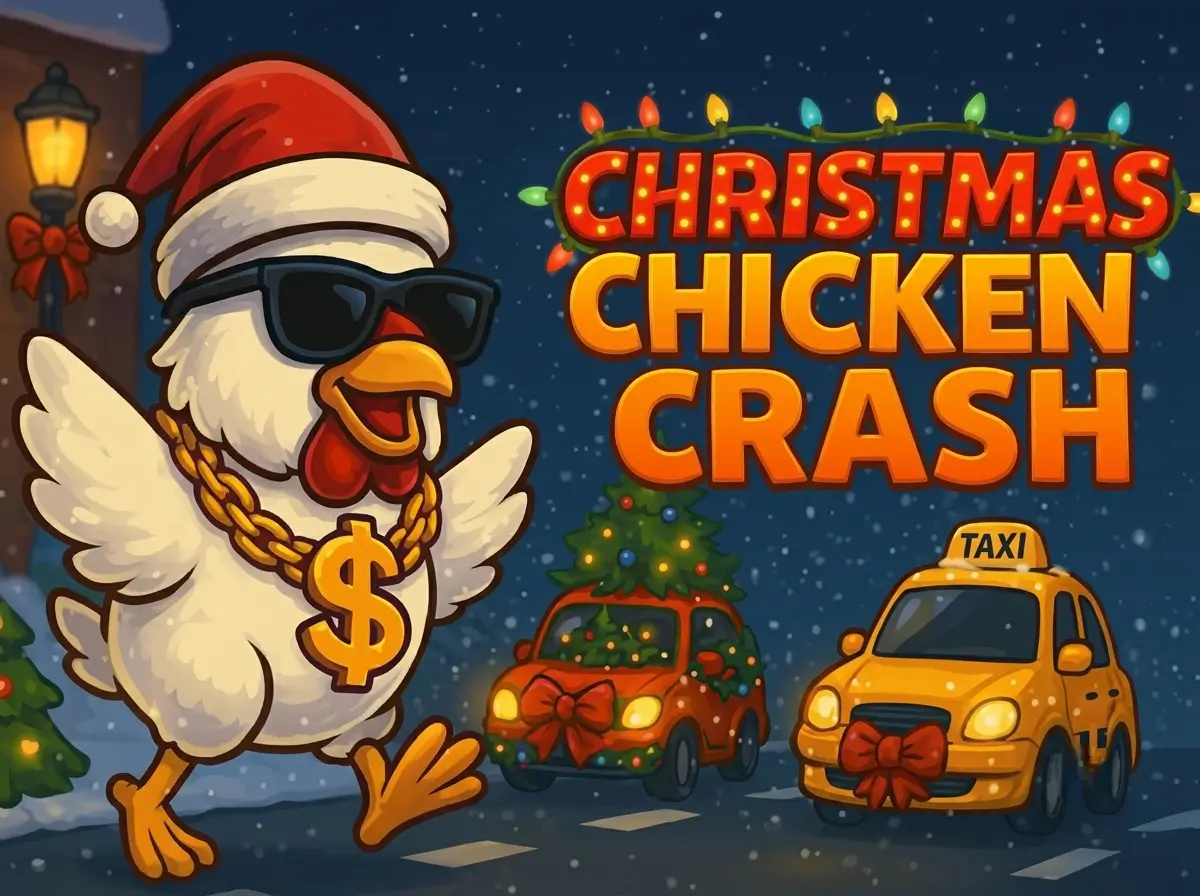
Astriona Games has made a habit of reskinning its chicken-on-a-road crash formula for seasonal occasions. Christmas Chicken Crash, released in 2025, wraps the studio’s step-multiplier mechanic in snow, baubles, and whatever audio the sound team felt appropriate for December. It is, functionally, the same bird — just wearing a Santa hat.
That framing is not a complaint. It’s a question worth asking before you deposit: does the Christmas edition change anything meaningful under the hood, or is this a palette swap on top of the same math model that powers the original Chicken Crash? The answer has real implications for how you approach it, especially given the conflicting RTP figures that circulate across affiliate sites. Astriona is a young studio — founded in 2025, a catalogue of roughly 20 titles by mid-2026 — and its documentation footprint is thinner than what you’d find from an established provider. Before we get into the multipliers and the lanes, let’s sort out what the numbers actually say.
Math model and mechanics
RTP — a genuine conflict worth documenting
Here is the problem with reviewing a young title from a small provider: the data environment is messy. For the core Chicken Crash title, affiliate sites including Chicken-Crash.co and ChickenCrash.net publish an RTP of 96.50%. SlotCatalog, which aggregates official provider data and is generally the more reliable source, lists the RTP at 98%.
That is a meaningful gap. The difference between 96.5% and 98% over a £1,000 session is £15 in expected player return — roughly 1.5 sessions worth of a recreational bet. If you’re playing at volume, that matters.
The most likely explanation: Astriona operates its games on a configurable RTP model, where operators can select from a range of values when they license the title. The 98% figure is probably the default or maximum setting; the 96.5% figure likely reflects a lower configuration deployed by some casino partners. Neither figure is wrong — they describe different versions of the same game running at different settings.
What this means for you: the RTP you experience depends on which casino you’re playing at. Most lobbies don’t publish which RTP configuration they’re running. That’s an industry-wide problem, not specific to Christmas Chicken Crash, but it’s worth flagging upfront. Assume you are playing at the lower end unless the operator explicitly states otherwise.
For the Christmas variant specifically, Astriona has not published independent RTP documentation at the time of writing. Given the studio’s pattern with sibling titles (Snowstorm uses the same 98% rate as the original), the Christmas Chicken Crash almost certainly shares the same base math model. I’m treating it as 98% at default configuration, with the operator-dependent caveat above in full effect.
The step-multiplier structure
Christmas Chicken Crash uses the step-multiplier mechanic that Astriona built its crash library around. There are no reels, no paylines, no spin button in the traditional sense. Instead, picture a road with 49 lanes of traffic. Your chicken starts at one end. Each time you send it forward, it crosses another lane — and either survives (collecting a multiplier increment) or gets hit by a car (losing the bet).
The multiplier is not a smooth curve like Aviator’s plane. It increases in discrete steps, one per lane crossed. Each safe crossing adds to your running multiplier. Cash out after crossing five lanes and you lock in whatever multiple the game assigns to step five. Stay in the road until step forty-nine and the ceiling opens up — the original Chicken Crash caps at 67,065× on the Hard difficulty setting, according to SlotCatalog.
That number is notably competitive. For context, Aviator by Spribe — the market benchmark in crash gaming — caps its theoretical multiplier far lower in most operator implementations, with a practical ceiling around 10,000× at bet maximum. A 67,065× ceiling on a step-multiplier format is a different animal entirely. The caveat is that reaching it requires surviving 49 consecutive traffic-filled lanes on Hard, which is statistically brutal.
Difficulty settings and what they actually do
One of the more interesting mechanical decisions Astriona made is the adjustable difficulty system. Players choose from three settings — Low, Medium, and Hard — before each round. The choice is not cosmetic.
Low: Fewer vehicles in the lanes. The road is quieter. Multiplier increments per step are smaller. The game is survivable for more steps on average, but the ceiling is reduced proportionally. The Hard ceiling of 67,065× does not apply here.
Medium: A balanced traffic density. Multiplier increments are mid-range. This is where most recreational players will spend their time, because the volatility feels manageable without feeling toothless.
Hard: Maximum traffic, maximum multiplier increments, maximum ceiling. According to LiveBet Casino’s game data, Hard mode on the original Chicken Crash delivers the published 67,065× maximum potential. The road is substantially more lethal.
What this means in practice: the difficulty selector is effectively a volatility toggle. At Low, the game behaves more like a medium-volatility slot — steady, relatively frequent small wins, low variance. At Hard, the game is punishing; most rounds will end early with a loss or a minor return, punctuated occasionally by a run that goes deep enough to produce something memorable. I’ve seen extended Hard mode sessions drain a £50 balance across 80+ rounds without hitting lane 20. That is the experience you’re buying.
The Christmas variant applies the same three-tier structure. The festive theme alters the visual language of the road — snowdrifts, Christmas trees as obstacles, seasonal decoration on the multiplier display — but the underlying lane-and-traffic logic is identical to the base game.
Bet range and session math
The original Chicken Crash runs from €0.10 to €100 per round. The Christmas version carries the same range, consistent with Astriona’s studio-wide standards. At €0.10 minimum, this is accessible for casual players watching their bankroll. At €100 maximum, the ceiling is modest compared to high-roller crash options like Aviator’s €200 maximum or certain JetX configurations.
The practical implication: a £50 session at £0.10 per round gives you 500 attempts to find a multiplier you’re happy with. At Hard difficulty, 500 rounds will statistically produce a handful of deep runs and a lot of short ones. At Low difficulty, the same budget produces more medium-length runs with smaller multiplier increments. Neither format is objectively better — it depends entirely on whether you’re here for the rare big number or the steadier experience.
Feature breakdown
The core mechanic: step-by-step lane crossing
Trigger: Begins each round when the player clicks forward/advance (or activates auto-advance).
What it does: the chicken moves into the next traffic lane. The game’s RNG determines whether a vehicle occupies that lane position. If the lane is clear, the chicken survives and the multiplier increments. If a vehicle is present, the round ends and the bet is lost. Players can cash out at any step before advancing, locking in the current multiplier.
The honest limitation here: unlike traditional crash games where the curve rises predictably and players make one decision (when to cash out), Chicken Crash requires an active decision at every step. This changes the psychological profile. You’re not watching a line; you’re clicking forward repeatedly and deciding after each safe crossing whether to continue. For some players that active involvement is exactly what they want. For others, it’s fatiguing across a long session.
Auto-advance feature
Players can enable automatic advancement, letting the game run through lanes without manual confirmation after each step. This effectively converts the step mechanic into something closer to a traditional crash curve — set your target, let it run, cash out or bust.
Auto-advance has a set-and-forget quality that’s useful for players who find the click-by-click approach exhausting, but it does change the feel significantly. You lose the moment-to-moment micro-decisions. The Christmas edition includes this feature.
Auto-cashout
Separate from auto-advance: this allows players to set a target multiplier, at which point the game automatically cashes out regardless of whether there are more lanes to cross. Standard in the crash genre; Astriona’s implementation is clean. A player running a low-multiplier strategy (cash out at 1.5× every round) can automate the whole process. The ceiling on auto-cashout is not published for the Christmas variant specifically, but the original supports auto-cashout up to the game’s maximum multiplier.
One catch worth noting: auto-cashout strategies that target very low multipliers (1.2×, 1.3×) require the chicken to survive only one or two lanes. At Hard difficulty, that is still not guaranteed. At Low difficulty, it’s very achievable — but the payoff per round is minimal. The maths on repeated low-multiplier auto-cashout is straightforward: you’re essentially grinding down your stake by the edge (whatever the operator’s configured RTP is), while minimising variance. It works until it doesn’t.
Fast Play button
A session-pace tool that accelerates the animation between rounds. No mechanical effect on outcomes. Useful if you find the festive animation loop charming for about three minutes and then want to get on with it.
Provably Fair technology
The original Chicken Crash carries Provably Fair certification, which is Astriona’s stated verification that round outcomes are cryptographically auditable. The Christmas variant should carry the same, though the specific audit chain for the seasonal release has not been independently confirmed in public documentation at the time of writing.
Strategies and how to approach the lane system
Let’s be clear on one thing before this section starts: no strategy changes the underlying RTP. Whatever Astriona (or your operator) has configured — 96.5% or 98% — that number applies to your session over the long run regardless of whether you’re using a preset cashout target or clicking lane by lane on instinct. What strategy does change is how you distribute your variance across a session, and how much control you feel you have over the outcome.
The fixed-target approach
The most common strategy in step-multiplier crash games is setting a consistent cashout target and applying it every round without deviation. Pick a multiplier — say 2× or 3× — and cash out every time you hit it, regardless of how many lanes remain.
At 2×, the chicken typically needs to survive somewhere between three and seven lanes depending on the difficulty setting and the specific multiplier increments that round delivers. On Low difficulty, that’s achievable with moderate frequency. On Hard, even a 2× target is not guaranteed — the lanes are lethal enough that you’ll bust before reaching it in a material percentage of rounds.
The arithmetic on fixed-target play is straightforward. If you’re targeting 2× and you succeed in 55% of rounds (a rough estimate for Low difficulty), your expected return per pound staked is 2 × 0.55 − 1 × 0.45 = 0.65p profit per pound before the house edge is factored in. The RTP closes that gap over time. This is not a profitable strategy in the long run — it never is — but it produces a steady, manageable session rhythm that many players find preferable to the boom-and-bust pattern of Hard mode.
The escalating risk approach
Some players start each session on Low difficulty and progressively switch to Medium or Hard as they accumulate profit from earlier rounds. The logic: you’re playing subsequent high-difficulty rounds with winnings rather than starting capital, which psychologically (not mathematically) reduces the sting of a bust sequence.
This works best with auto-cashout set at a consistent early target for the Low difficulty rounds, transitioning to manual control for the higher-difficulty legs where the stakes — and the potential multiplier — are more significant. The practical catch is that Christmas Chicken Crash (like its siblings) doesn’t track cumulative session winnings in any formal way. The discipline of the escalating risk approach lives entirely in the player’s own record-keeping.
Two-bet split
Astriona’s crash titles don’t natively support simultaneous multi-bet entries in the way Aviator does (where you can place two separate bets in a single round, cashing each out at different multiplier targets). Christmas Chicken Crash is a single-chicken single-bet per round mechanic. If you want to approximate the two-bet hedging strategy common in Aviator — where one bet exits early and the other rides for a big multiplier — you can’t do it within a single round here. You’d have to alternate round strategies manually, which is a looser approximation.
This is a genuine mechanical limitation versus Aviator’s dual-bet system. For players who run that strategy as their primary approach to crash games, the absence of simultaneous bet entries in Astriona’s format is worth knowing before you commit.
The demo-first rule
Christmas Chicken Crash has a free demo on SlotsLaunch and several other aggregator platforms. Use it. Specifically: run 30–40 rounds on Hard difficulty without auto-advance. This is the clearest way to calibrate how aggressive the traffic density actually feels at that setting before you commit real money. The Hard mode early-bust frequency is higher than most players expect when they read about the 67,065× ceiling. The ceiling is real; the path to it is extraordinarily narrow.
2026 perspective: where Christmas Chicken Crash sits in a crowded market
The Astriona family of crash titles
By mid-2026, Astriona has built a recognisable crash ecosystem. The studio was founded in 2025 and already carries nearly 20 titles in its catalogue, according to SlotCatalog. It launched with Halloween Reels as its debut slot, then moved quickly into crash-format and keno titles. The original Chicken Crash established the step-multiplier formula. Chicken Crash Snowstorm came next as a winter reskin — SlotCatalog lists its max win at x836,785, which is either a calculation error, a theoretical extreme case at the highest difficulty across all 49 lanes, or something the studio’s mathematicians can explain better than I can. Christmas Chicken Crash occupies the same seasonal bracket as Snowstorm but appears to be a distinct release rather than a rename of it.
What the Snowstorm title changed versus the original: the betting floor rose from €0.10 to €1, and the ceiling rose from €100 to €200. If Christmas Chicken Crash follows the same pattern, recreational players on very small stakes (€0.10 rounds) should verify the bet floor before loading the game.
The studio also has titles like Beer Crash, Cargo Tower, and Flappy Rise in its portfolio, which suggests an ongoing commitment to the crash format with rotating themes. The Christmas release is consistent with this pattern: a seasonal window title that captures search traffic around December–January and gives the core mechanic a different visual identity.
Against the market standard: Aviator by Spribe
Aviator remains the reference point for the crash genre whether we like it or not. Its RTP sits at 97% — below Astriona’s stated 98% default. Its multiplier curve is continuous rather than step-based, which makes it feel fundamentally different despite the same core mechanic (bet, watch multiplier rise, cash out before crash). The practical max win in most Aviator implementations is 10,000× — substantially below Chicken Crash’s 67,065× ceiling at Hard.
One contextual factor worth noting: as of October 2025, Spribe was suspended from operating in the UK by the UK Gambling Commission due to a licensing oversight. For UK players specifically, Aviator is currently unavailable, which makes alternatives like Astriona’s crash catalogue more relevant than they might otherwise be. That situation is subject to change, but it’s the reality as of writing.
JetX by SmartSoft Gaming
JetX runs on a 98% RTP and uses a continuous curve mechanic similar to Aviator rather than the step-by-step format. It’s arguably the closest competitor to Astriona’s crash titles on pure math terms, though the mechanics and presentation differ substantially. JetX has no difficulty toggle — the volatility is fixed. Astriona’s adjustable difficulty gives Christmas Chicken Crash a genuine edge here for players who want to modulate risk explicitly rather than through bet sizing alone.
Chicky Run by PG Soft
PG Soft entered the chicken-crossing genre with Chicky Run in June 2024. Low volatility, low max win, a fundamentally different risk profile. It’s targeting a different player. A casual player who wants light entertainment with minimal downside variance would find Chicky Run more comfortable. Christmas Chicken Crash Hard mode and Chicky Run occupy opposite ends of the risk spectrum despite sharing a theme.
Buy-bonus and progressive jackpot: both absent
Neither feature exists in Astriona’s Chicken Crash family. In 2026, buy-bonus has become a near-standard expectation for crash games and slots that carry meaningful bonus features. Astriona’s crash titles don’t have bonus features to buy into — the mechanic is the mechanic — so the absence is structural rather than a meaningful omission. But players who habitually use feature-buy to shortcut their way to higher-variance play won’t find that option here.
No progressive jackpot either. The win ceiling is fixed by the difficulty setting and the mathematical structure of the 49-lane road. For players whose primary motivation is jackpot hunting, this is the wrong game.
Demo availability and mobile performance
Christmas Chicken Crash has a free demo mode accessible through SlotsLaunch and several other aggregator platforms without registration. This is worth flagging because it’s one of the more useful things Astriona does right: the demo reflects the actual game mechanic faithfully. You get the same lane structure, the same difficulty settings, and the same auto-cashout functionality as the real-money version. The only difference is the stakes are imaginary.
Mobile performance is strong. Astriona builds its crash titles specifically for mobile-first use — the interface scales cleanly to smaller screens, the advance/cashout buttons are large enough for thumb navigation, and the animation overhead is low enough that the game runs smoothly on mid-range devices. The Christmas visual layer (snow effects, seasonal obstacles) adds some visual complexity to the standard road animation, but not enough to cause performance issues on a current Android or iOS device.
There is no dedicated app for Christmas Chicken Crash or Astriona’s titles generally. Play is through the casino’s mobile browser or native app — the game loads via the casino’s game library. Given the mobile-first design philosophy, this is not a meaningful limitation.
Verdict
Christmas Chicken Crash
This is a well-executed seasonal variant on a crash mechanic that works. The step-by-step lane structure differentiates it from Aviator meaningfully — more active decision-making, more granular risk management per session, and a volatility dial that lets you choose your experience rather than having it imposed.
The RTP situation remains the main concern. If your casino is running a lower-configured version of this game, the gap between 96.5% and 98% across a long session is real money. The provider is young, documentation is thin on the Christmas-specific release, and most casinos won’t tell you which configuration they’re running. Play a demo session first. Most platforms carry one.
This game makes sense for players who: want crash-format gameplay with genuine step-by-step control; like the option to dial volatility up or down explicitly; and aren’t tied to the smooth-curve aesthetic of Aviator. The Christmas theme is competently done and time-limited — it’s worth trying during its window simply to see the seasonal production, which is better than the average festive reskin.
Avoid Christmas Chicken Crash on Hard mode with a small bankroll. A £20 stake at £0.50 per round gives you 40 attempts. Hard mode will eliminate a meaningful portion of those attempts in the first one or two lanes. The ceiling of 67,065× is theoretical; reaching it requires surviving 49 consecutive high-traffic lanes, which is a low-probability event by design.
Original Chicken Crash vs Christmas Chicken Crash
The honest position: the original Chicken Crash and its Christmas reskin are functionally the same game. If you’ve played one, you’ve played the other. The seasonal wrapper adds atmosphere, not mechanics. Astriona’s approach to seasonal titles is consistent across its catalogue — change the visual identity, keep the math. That’s a defensible product decision; it also means the Christmas edition offers nothing analytically new.
The only scenario where the Christmas edition is strictly the better choice is if your casino attaches a seasonal promotion to it — a bonus, free rounds, a tournament entry with a prize pool. Operators do this with festive game releases, and it’s worth checking your casino’s promotions tab around the December window. A cashback offer linked specifically to Christmas Chicken Crash rounds changes the effective RTP materially. Outside of that, the choice between this and the original is purely aesthetic. Pick whichever visual identity you prefer and apply the same strategy either way.
The one spec difference potentially worth checking: Chicken Crash Snowstorm expanded the maximum bet ceiling from €100 to €200 relative to the original. If Christmas Chicken Crash follows the same pattern — and Astriona’s seasonal releases seem to iterate the specs modestly upward — high-stakes players have more room to work with than the base game allows. Verify the bet range at your specific casino before committing to a higher-stakes session. The game page in the casino lobby will show it; don’t assume it matches the original’s €100 ceiling.