
There’s a long list of jungle-themed slots fighting for shelf space in online casinos, and frankly, most of them are forgettable. Vine backdrops, drum loops, some cartoon ape grinning at you — you’ve seen it a thousand times. So when Red Tiger dropped Primate King back in April 2021, the real question wasn’t whether it looked good (it does — Red Tiger always looks good), but whether the game had anything underneath the fur worth talking about.
Three years of real-money sessions, player feedback, and watching the upgrade meter fill and collapse more times than I care to count later, I can tell you: yes, there’s something here. It’s not perfect, it has a real flaw baked into the math model that I’ll get into, and it absolutely won’t suit everyone. But it’s a more interesting machine than the screenshot suggests. Let’s get into it.
The Setup: What You’re Actually Looking At
Primate King runs on a 5-reel, 4-row grid with 30 fixed paylines. That’s your starting point. The reels sit inside a wood-framed structure deep in a murky, animated jungle — and when I say animated, I mean it actually moves. The foliage shifts, mist rolls through the background, and there’s a stone gorilla mouth cave off to the left that gives the whole thing a distinctly Skull Island atmosphere. On the right side of the reels you’ll see skulls on spikes, stone snake heads, and general evidence that you’ve wandered somewhere you probably shouldn’t have. It looks like someone took Kong: Skull Island seriously as a design brief, and the result is a lot better than most competitors manage with the same source material.
The soundtrack keeps a low profile — some gentle percussion, ambient jungle sounds — which is actually a deliberate and smart choice. It’s there, it adds atmosphere, but it doesn’t turn into the kind of intrusive loop that makes you reach for the mute button after ten minutes.
Bet range: €0.10 to €10 per spin. That’s the confirmed range across major casino operators as of early 2026. Not particularly wide — it suits casual and mid-level players more than high rollers, who’ll find the ceiling limiting.
Maximum win: 3,800x your stake. The game’s official page at redtiger.com confirms this figure.
Paylines: 30, fixed. Wins pay left to right with three or more matching symbols required.
The reels can expand to 6×4 when the game’s core mechanic kicks in fully, but more on that in a moment.
First Impressions and the Competition Context
Before getting into mechanics, it’s worth placing Primate King in context. The jungle-and-apes subgenre of slots is crowded. King Kong Cash from Blueprint, Gorilla Gold Megaways from Blueprint again, various Playtech and NetEnt efforts — gorillas and tropical settings have been done repeatedly and with varying degrees of conviction. Most of them go cartoon-colourful, leaning into the absurdity of the premise.
Red Tiger went the opposite direction. Primate King is dark, brooding, atmospheric. The setting is more temple ruins in a forbidden jungle than friendly zoo. The gorilla on the reels isn’t comic — he looks genuinely territorial, like you’ve wandered into a place that belongs to someone else and they haven’t decided yet whether to tolerate you. It’s a tone that works, and it makes the game stand out on a casino lobby page next to its brighter competitors.
The release date on Red Tiger’s official page is confirmed as 19 April 2021 (some sources cite 13 May 2021 for certain market rollouts). Either way, it’s been in rotation for several years now and has maintained a steady presence on major casino platforms — which tells you something about its staying power in a market that churns through new releases constantly.
Symbol Breakdown: Bones, Chains, and Jungle Loot
The lower end of the paytable is populated with card suit symbols — clubs, diamonds, hearts, spades — but they’re dressed up in jungle materials: bone carvings, chains, rusted metal. They do their job without being interesting, which is more or less all you want from low-pays.
Premium symbols are where the theme earns its keep. The high-value icons include snakes, maps, compasses, and treasure chests — the kind of gear an ill-fated explorer would have had on them before the Primate King’s crew got to them. These are nicely rendered with genuine depth and detail, which matters when you’re staring at them for extended sessions.
The gold treasure chest tops the premium paytable. On a 5×4 grid with five in a line, it pays 15x the stake. When the sixth reel unlocks (again, patience), a six-of-a-kind chest combination jumps to 30x. Those figures stack with wild multipliers, which is where real money starts moving.
The Primate Wild — the gorilla symbol itself — substitutes for all paying symbols and is the engine room of everything interesting in this game.
The Upgrade Mechanic: Red Tiger’s Signature Move
Here’s where Primate King separates itself from the average jungle slot, and honestly, it’s worth explaining carefully because this is the mechanic the entire game is built around.
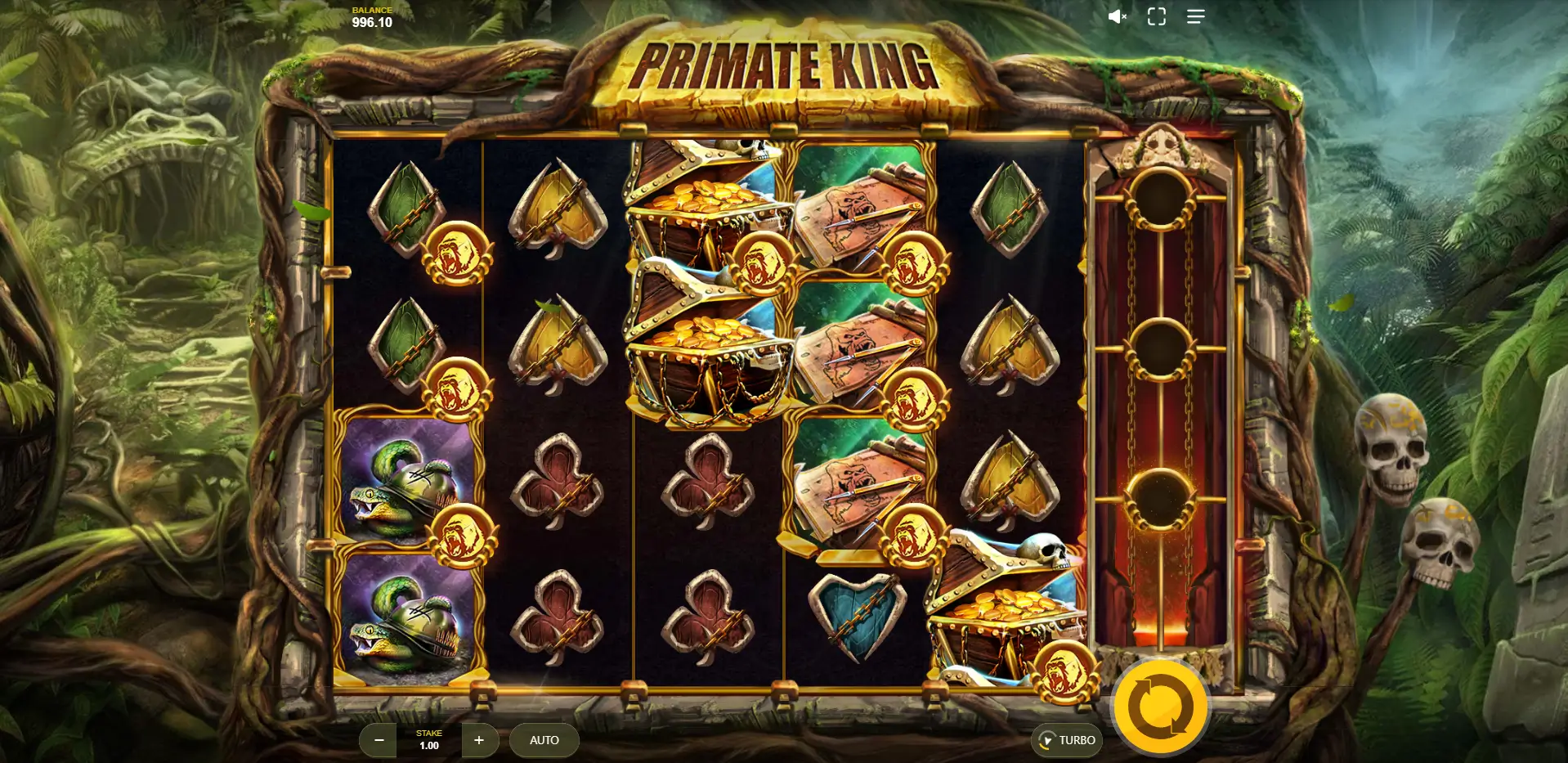
During any spin, regular symbols can land with a small gold coin displayed in their bottom-right corner. Whenever these coin-carrying symbols appear on the same spin as a Primate Wild, the coins get collected and loaded into the Primate Wild Progress Bar — a three-tier meter running down the right side of the grid.
This mechanic is borrowed from Red Tiger’s earlier release Pirates Plenty: The Sunken Treasure, which used a similar reel-unlocking structure. Red Tiger found something that worked and ran with it. Whether that’s lazy or smart is a debate for another day; what matters is how it plays out.
The three upgrade tiers work as follows:
Upgrade 1 — Stacked Wild: The regular Primate Wild, which starts as a standard single-symbol substitute, transforms into a full 1×4 stacked wild, covering an entire reel column. This is the first meaningful shift in the game’s win potential.
Upgrade 2 — Multiplier Wild: Once enough additional coins are collected, a random multiplier is attached to the full-reel stacked wild. The multiplier is assigned randomly when the wild lands — it’s not fixed, and the range isn’t published in the paytable, so you’re working with what the game gives you.
Upgrade 3 — Sticky Multiplier Wild: This is the top tier. The stacked multiplier wild becomes sticky — meaning it locks in place for multiple spins. Crucially, for each consecutive winning spin it participates in, the multiplier value increases. The sticky status resets after the first non-winning spin following at least one win.
Once all three upgrades are activated, the Progress Bar itself converts into a sixth reel. On this extra reel, only high-paying symbols can land — no low-value card suits cluttering up potential combinations. This reel addition is permanent as long as you continue playing at the same stake level at the same casino. Change your bet or switch platforms, and the progression resets.
That last detail is worth pausing on. The sixth reel is tied to both your stake size and the specific casino you’re playing at. It’s a design decision that encourages session continuity and loyalty to a bet level, which is either smart retention engineering or an annoying constraint depending on your perspective. I’ve seen players frustrated by this more than once.
Primate Smash: The Consolation Feature
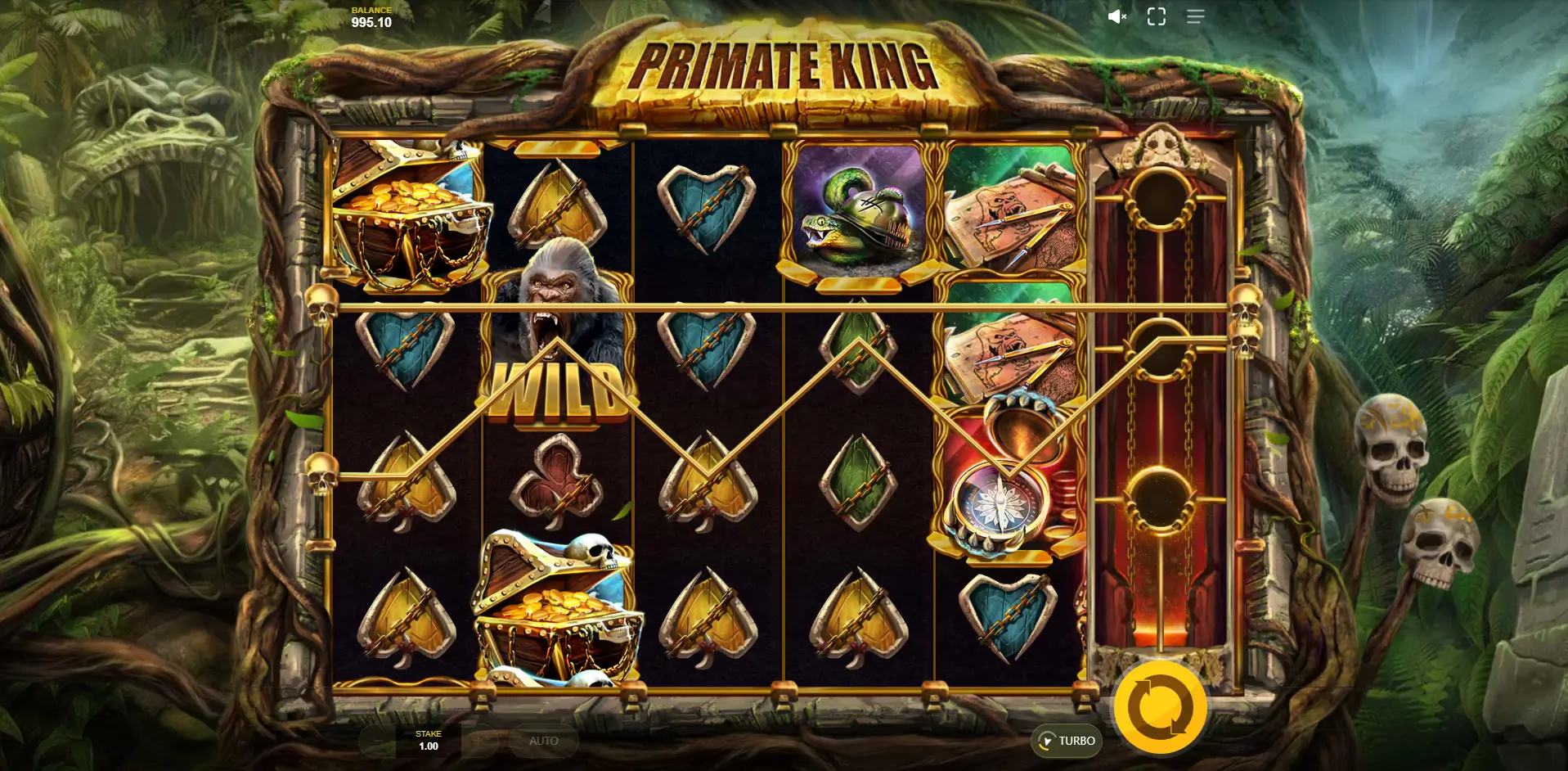
There’s a secondary feature called Primate Smash that triggers randomly on losing spins where a wild symbol is present. When it fires, the gorilla physically crashes onto the reels and destroys all low-paying symbols. The gaps left behind are filled only by high-value symbols dropping down.
This feature is guaranteed to produce a win — the game explicitly states this in its mechanics documentation. It’s a nice safety valve for the stretches where the main upgrade meter is filling slowly and the base game feels like it’s going nowhere. It doesn’t carry multipliers or anything elaborate, but it does break the losing run in a tangible way.
It’s also visually satisfying in a way that’s hard to overstate. Watching a giant gorilla smash your card-suit symbols into oblivion has a cathartic quality that gameplay designers clearly understood.
The RTP Question (And Why You Should Care)
This is where I have to be direct with you, because there’s a discrepancy across sources that’s worth naming clearly.
SlotCatalog — one of the most reliable spec databases in the industry — lists the default RTP at 95.66%, with operators able to adjust it downward to 94.68% or further depending on their licence. The game features customizable RTP ranges, meaning the figure you see in theory might not match what’s active at your specific casino.
Other review sources, including johnslots.com and bigwinboard.com, reference a 96% RTP. This figure also appears on some casino operator pages.
The most likely explanation is that 96% represents a specific RTP variant that some operators deploy, while 95.66% is the default or most commonly active setting. Without access to the specific configuration running at your casino, you don’t know which version you’re playing on.
This matters for a practical reason: Red Tiger uses customizable RTP ranges across its portfolio, and Primate King is not exempt. The difference between 95.66% and 94.68% is meaningful over extended play. If RTP fidelity matters to you — and it should — check whether your casino publishes the specific RTP for this title. Most don’t, which is a broader industry problem that individual games can’t solve.
What’s confirmed across all sources is that this RTP, whatever exact figure applies, is above the typical Red Tiger average for standard releases, which tends to hover around 95.8% or below for most of their catalogue. So in relative terms, Primate King is on the better end of the Red Tiger range — just don’t assume you’re getting 96% unless your operator explicitly confirms it.
Volatility: Not What the Labels Say
Most sources label Primate King as medium volatility. SlotCatalog goes further and calls it high volatility. After extended play, my assessment leans closer to the high end of medium, tipping into high territory once the upgrades are active.
Here’s what that means practically:
In the base game with no upgrades active, the variance is genuinely moderate. Wins come at a reasonable clip, but they’re small — the kind that keep the balance ticking over without doing anything dramatic. Paylines hitting on card suits don’t move the needle.
Once the Upgrade 1 stacked wild is in play, the variance profile shifts noticeably. The stacked wild covers an entire reel, which means when it lands in a useful position, it generates multiple payline wins simultaneously. Hit rate stays similar but win sizes jump.
With the Upgrade 2 multiplier active, you’re now playing a materially different game. The random multiplier attached to a full-reel wild means individual spins can produce outsized results without warning. This is also where bad luck becomes more visible — when the multiplier wild lands in isolation with nothing meaningful to connect to, the miss stings more.
Upgrade 3 with the sixth reel active is where the top end of the 3,800x potential lives. Sticky multiplier wilds accumulating across consecutive winning spins, with a sixth reel generating only premium symbols — on paper, this is the machine fully unleashed. In practice, reaching this state takes time, and the sticky wild can disappear after a single non-winning spin before the multiplier has built to anything meaningful.
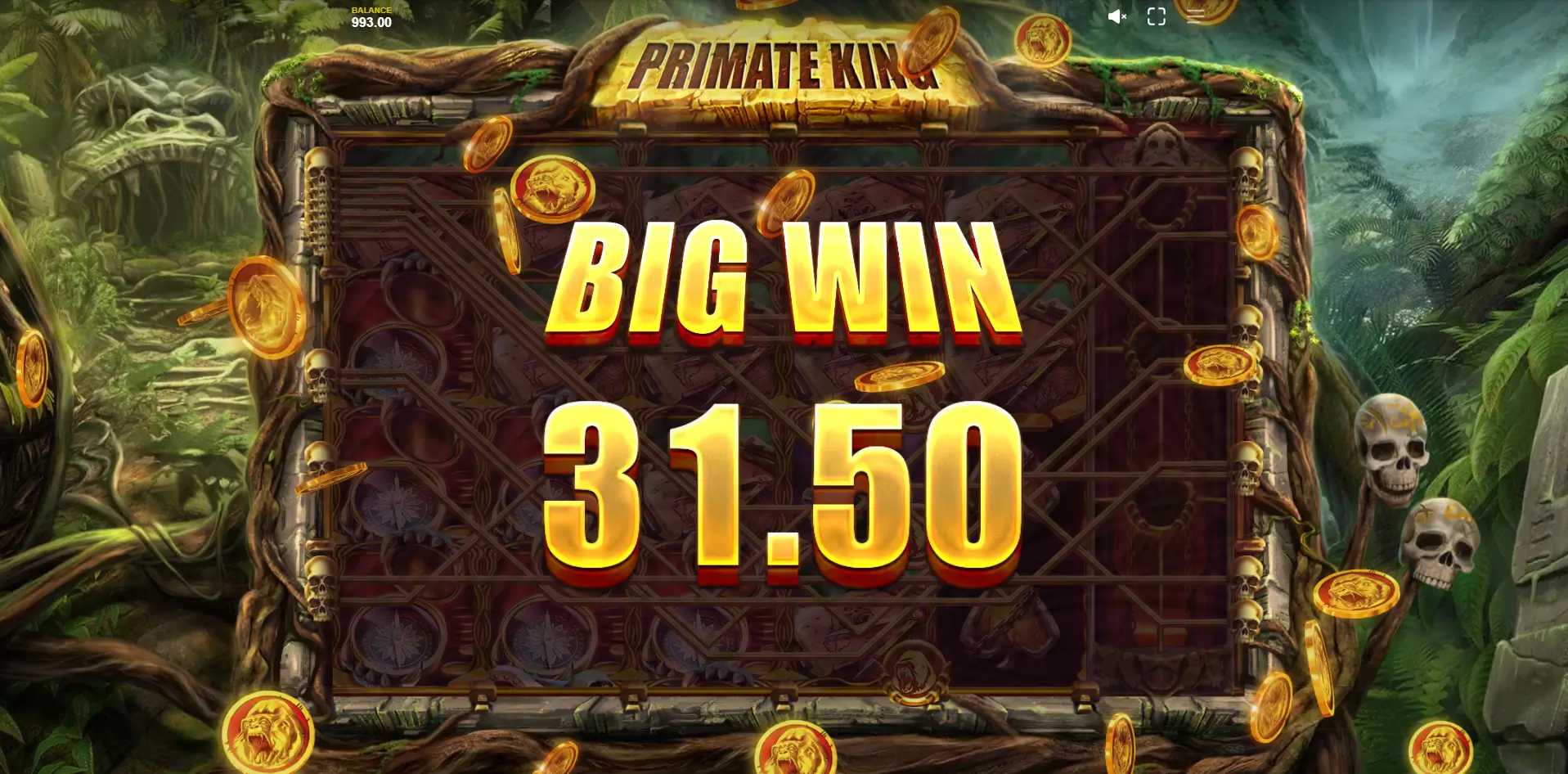
The 3,800x ceiling is real but requires multiple factors to align: fully upgraded wilds, the sixth reel active, and a favorable multiplier landing at the right moment. It’s achievable — players have hit it — but you’re not going to casually blunder into it.
No Free Spins: Is That a Problem?
Short answer: for most players, yes. Long answer: it depends on what you’re looking for.
Primate King has no free spins bonus round. None. Not a scatter symbol, not a bonus trigger, nothing. In a market where virtually every slot above a certain quality threshold has some form of free spin activation, Red Tiger made a deliberate choice to go the other direction.
Their justification is built into the design: the upgrade mechanic provides a continuous sense of progression that free spins typically deliver in a condensed burst. Rather than grinding through base game spins waiting to trigger a bonus, you’re steadily building toward a permanent upgrade that reshapes the game’s win potential.
Whether that trade-off works depends entirely on your psychology as a player. If you’re someone who plays slots for the anticipation of hitting a bonus trigger — the three scatter symbols landing, the screen going dark, the free games starting — Primate King will feel incomplete. That dopamine hit simply doesn’t exist here.
If you’re more patient and process-oriented, the upgrade mechanic scratches a different kind of itch. There’s genuine satisfaction in watching the progress bar fill, knowing that the stacked wild is about to turn into a multiplier wild, and positioning yourself for what comes next. It’s less about peaks and valleys and more about sustained engagement.
The Primate Smash feature helps fill some of the gap — it provides sudden, visual disruption to losing streaks — but it’s not a substitute for a proper bonus round in terms of win potential.
The Sixth Reel: Red Tiger’s Cleverest Trick
Let me spend a moment on the sixth reel because it’s genuinely the most interesting design element in the game, and I think it gets undersold in most reviews.
When you unlock Upgrade 3 and the progress bar converts into a reel, you’ve effectively changed the game’s architecture. A 5×4 grid with 30 paylines becomes a 6×4 grid where the extra column can only produce premium symbols. You haven’t just added a feature — you’ve made the game structurally better.
The decision to make this permanent (tied to bet level and casino) is smart from a retention standpoint. Once you’ve invested the sessions needed to unlock the sixth reel, there’s a real incentive to return to that specific game instance rather than starting fresh somewhere else. Red Tiger is essentially rewarding loyalty with a permanently improved version of the product.
This was borrowed from Pirates Plenty: The Sunken Treasure, and it worked there too. It’s a mechanic that other developers haven’t fully copied, which is surprising given how effective it is at creating session continuity.
Mobile Performance
Primate King is built in HTML5 and runs on Android and iOS without a dedicated app requirement. The game adapts to both portrait and landscape orientations, with controls scaling cleanly to touch input.
The animated jungle background — the same element that makes the desktop version visually distinctive — behaves well on mobile. It doesn’t hammer performance the way some particle-heavy animations do. The progress bar remains legible on smaller screens, which matters because it’s the most important information the game displays.
Control layout on the mobile version mirrors desktop: stake button bottom-left, settings top-right, paytable accessible through the menu. There’s nothing counterintuitive about the layout.
This is standard Red Tiger quality for mobile — consistently competent, occasionally excellent. Primate King sits in the consistently competent category, which is higher praise than it sounds given how badly some competitors handle the transition.
Who Should Play Primate King (And Who Shouldn’t)
After extended time with this game, the player profile that suits it is fairly specific.
You’ll enjoy Primate King if:
You have patience with progression mechanics and find satisfaction in building toward an improved game state rather than waiting for a random bonus trigger. You’re comfortable with medium-to-high variance and understand that the base game without upgrades is deliberately underwhelming — that’s intentional, not a flaw. You play consistent bet sizes within a single session, since the upgrade persistence is tied to your stake level. You appreciate visual quality and atmospheric design without needing flashy animations on every spin.
Primate King probably isn’t for you if:
You’re a bonus hunter who plays slots primarily for the free spins trigger. The absence of any bonus round activation will feel like a missing limb. You like to move between casinos frequently or adjust your bet size mid-session — both behaviors reset your upgrade progress, which will be maddening if you’ve invested significant spins building to Upgrade 3. You’re working with a very limited bankroll — the time needed to build meaningful upgrades requires enough runway to absorb the base game’s variance.
Playing It Practically: Session Strategy and Bankroll Notes
I don’t do strategy guides in the standard sense — slots are random number generators and no betting system changes the underlying math. But Primate King has structural features that make session planning more relevant than usual.
Stick to one stake level. This isn’t preference, it’s mechanical. The upgrade progression and sixth reel are tied to your specific bet size at your specific casino. If you open a session at €1 per spin, build to Upgrade 2, and then drop to €0.50 because you’re down a bit — you’ve reset to Upgrade 2 at the new stake level with nothing carried over from your €1 session. The game treats different stake levels as effectively different sessions. This is the single most important practical thing to understand about Primate King.
Give it enough runway. The coin collection mechanic fills at a rate determined by how often coin-carrying symbols land alongside the Primate Wild. This isn’t guaranteed on every spin — it’s a random occurrence. In practice, reaching Upgrade 1 takes a reasonable number of spins, but Upgrade 3 can take considerably longer depending on run of play. Going into a session with 30 spins of budget will not demonstrate what this game actually is. It needs room to breathe.
The demo is genuinely useful here. Unlike many games where the demo is a formality, Primate King’s free play version runs the complete upgrade sequence with virtual credits. Spending time in demo mode to feel how fast the meter fills, when the Primate Smash triggers, and how the multiplier wild behaves across a winning streak is legitimate preparation for real-money play. It won’t tell you when wins come — that’s random — but it will show you the architecture clearly.
Know your exit conditions. If you hit Upgrade 3 and unlock the sixth reel on a particular session, you’ve created a genuinely favourable game state. That’s not an invitation to stay indefinitely — variance is still variance — but it’s context worth having. The game has done what you needed it to do to reach its upper potential. What happens from there is down to the reels.
Verdict
Primate King is a game that rewards understanding. Play it with no context, spinning aimlessly through the base game, and it looks like a moderately pretty jungle slot with nothing in particular to distinguish it. Play it knowing what the upgrade mechanic does, respecting the stake consistency requirement, and giving it the session length it needs — and it becomes something more coherent.
Red Tiger made a deliberate bet that a progression-based design could replace the free spins trigger as the primary engagement loop. For a certain type of player, that bet pays off. For the larger portion of the market that’s conditioned to chase bonus rounds, it doesn’t fully land.
The RTP ambiguity is a real mark against it. Confirmed range of 95.66% down to 94.68% with operator customization is not a great look, and the 96% figure that circulates online is either a specific variant or, in some cases, just imprecise sourcing. Know what you’re playing before you stake real money.
The 3,800x max win is achievable but requires the stars to align — full upgrade path completed, sixth reel active, sticky multiplier building across consecutive wins. It’s not a number that will happen casually.
What Primate King does well: the visual design is among Red Tiger’s best, the upgrade mechanic creates genuine strategic texture, the Primate Smash feature delivers at exactly the right moment, and the sixth reel unlock is one of the more elegant progression rewards in the market.
What it doesn’t do: free spins, scatter triggers, or any of the standard activation cues that most players are conditioned to expect.
If you want to test the waters before committing real money, virtually all major casinos hosting Red Tiger titles offer a demo version that runs through the full upgrade sequence with virtual credits. The demo is the full experience, no restrictions on features — use it to clock the coin collection speed and get a feel for how the variance sits across a real session length.