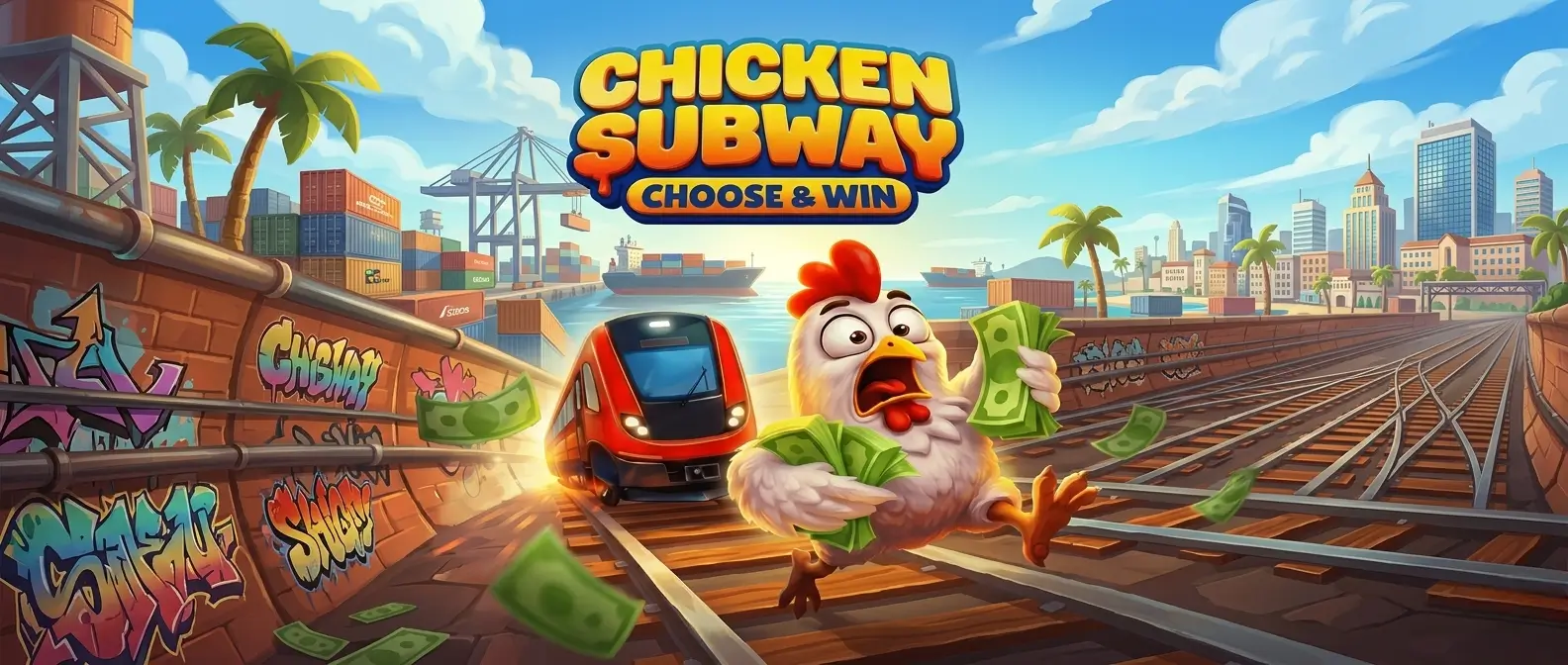
100HP Gaming dropped Chicken Subway in late 2025. As of early 2026, it’s already one of the more talked-about instant games in South Asian casino lobbies — and for good reason. The premise is simple: a cartoon chicken runs across subway tracks, you pick a lane at each step, the multiplier climbs, and you cash out before a train turns your bird into railway history. The game’s published max multiplier sits at x55,000. The actual payout cap is $10,000.
That gap tells you most of what you need to know before we go any further.
For players in Bangladesh, this genre has become the dominant format in online casino lobbies over the past two years. Crash games, step multipliers, and instant-win formats have overtaken slots in terms of session frequency on mobile — and Chicken Subway is a direct response to that demand. Whether it delivers enough to justify your ৳500 deposit over the half-dozen other chicken-themed games already out there is the actual question. Here’s the honest answer.
Math model and mechanics
RTP — there’s a conflict worth knowing about
Multiple sources cite different RTP figures for Chicken Subway, and I’m not going to pick one arbitrarily. Here’s what the evidence actually shows.
97% is the figure cited by gamechickensubway.com, chicken-subway-win.org (the official-looking 100HP promotional site), and gamechickensubway.com. 98% appears on chickensubway.gg and chickencrash.games. The 100HP Gaming official studio page at 100hp-games.com states a portfolio average RTP of 98% across core titles. One source — chicken-subway.games — claims a dynamic range of 97–99%, suggesting the figure is player-influenced by cashout behaviour.
That last point is worth understanding. In a step multiplier game, a player who consistently cashes out early (at x1.2–x1.5) experiences a different effective return than one chasing x100+ runs. The published RTP is a long-run statistical average. Whether your actual session lands at 97% or 99% effective return depends entirely on how aggressively you play.
The authoritative figure is whatever appears in the game’s information panel inside whichever casino you’re playing at, because operators can configure RTP ranges. Check that before your first spin.
The practical implication: on a ৳1,000 session, the difference between 97% and 98% RTP is ৳10. That’s not a decision-altering number. What matters far more is volatility — which this game hands control of directly to you.
Volatility and risk modes
Chicken Subway runs on four difficulty settings: Low, Medium, High, and Extreme. This is the mechanic that sets it apart from traditional crash games where volatility is fixed by the math model.
Low risk targets frequent, small multipliers — consistent x2–x4 returns with high win frequency. You’ll rarely crash early, but you’ll also rarely see double digits. Medium opens up better multipliers at the cost of more frequent mid-run crashes. High delivers multipliers reaching into three or even four figures, but most runs end before you expected them to. Extreme is where the x55,000 ceiling theoretically lives — and where most runs end within the first two or three steps.
For a ৳500 deposit on a Redmi Note 12 playing through a Grameenphone connection, Low mode is the only setting that makes structural sense. At ৳20 per round in Low mode, you get roughly 25 rounds before you’re out — and Low mode’s win frequency is high enough that you’ll extend that meaningfully if you cash out at x2 or x3 consistently. Extreme mode with a thin bankroll is how ৳500 becomes ৳0 in under three minutes. The math doesn’t care about your strategy; it cares about round count, and Extreme mode generates crashes fast.
Volatility in this game is binary at the round level: either the chicken survives the next step or it doesn’t. There’s no partial payout, no scatter equivalent. The multiplier at cashout is your entire result for that round.
One practical note on the mobile experience: Chicken Subway is built on HTML5 with an optimised build size under 2MB — 100HP explicitly targets fast loading on low-bandwidth connections, which matters for players in Bangladesh accessing the game via Grameenphone or Banglalink mobile data rather than home WiFi. The game launched in late 2025 and has been confirmed to run without issues on mid-range Android devices including the Samsung Galaxy A series and Redmi Note line. There is no standalone app in the Google Play Store; you access it through the casino’s mobile browser or native casino app, depending on which operator carries the 100HP library.
Grid, bet range, and the $10,000 cap
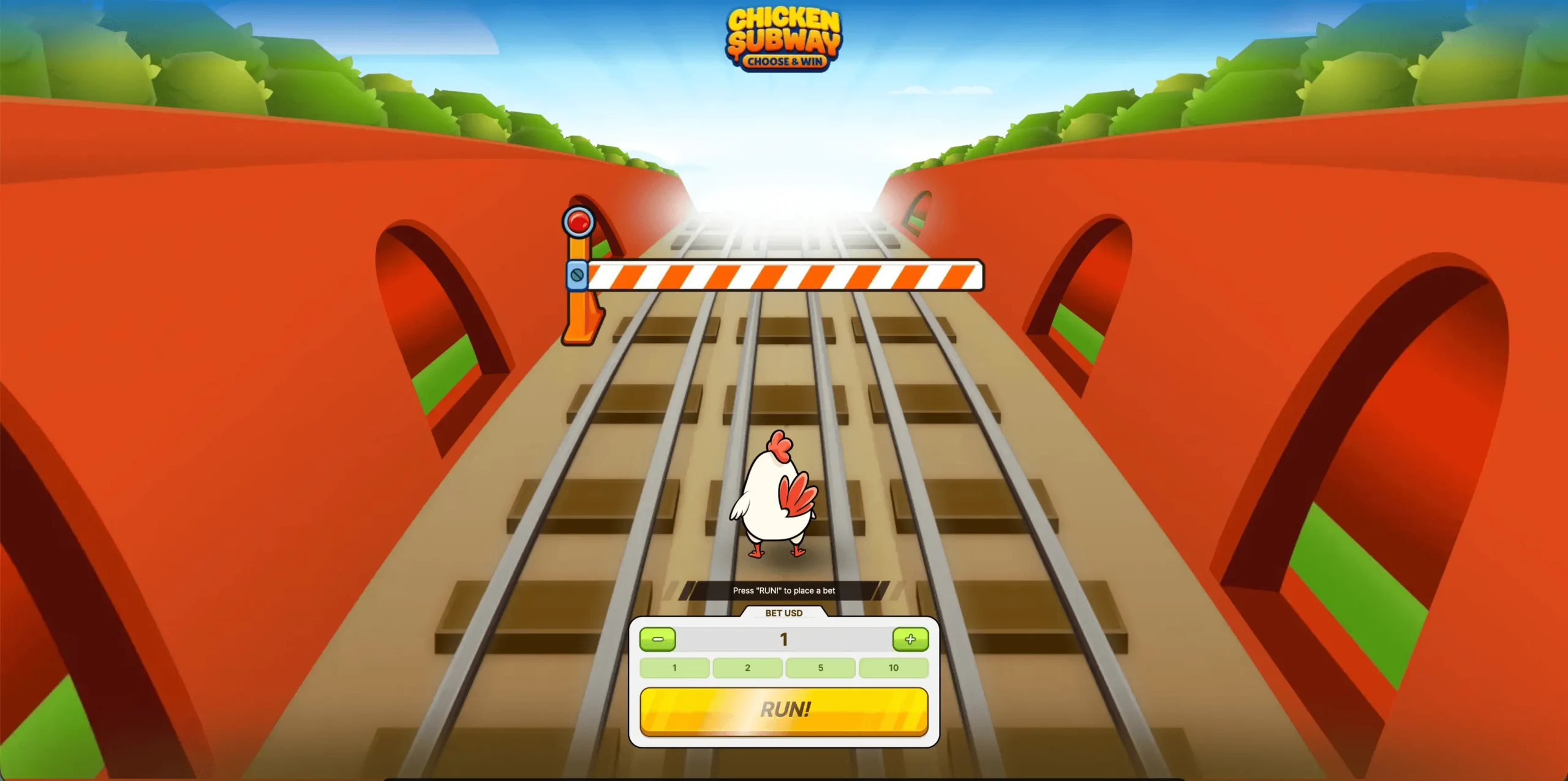
There’s no traditional grid here. Chicken Subway runs on a three-lane track: left, centre, right. Each step forward presents three path options with different multiplier values attached. You pick one, the chicken moves, and if the path is clear, the multiplier updates. If a train is on your chosen lane, the round ends and your stake is lost.
Bet range: ৳0.10 minimum to ৳150 maximum per round (displayed in USD/BDT equivalent depending on the casino). That minimum makes it genuinely accessible on a low-recharge session.
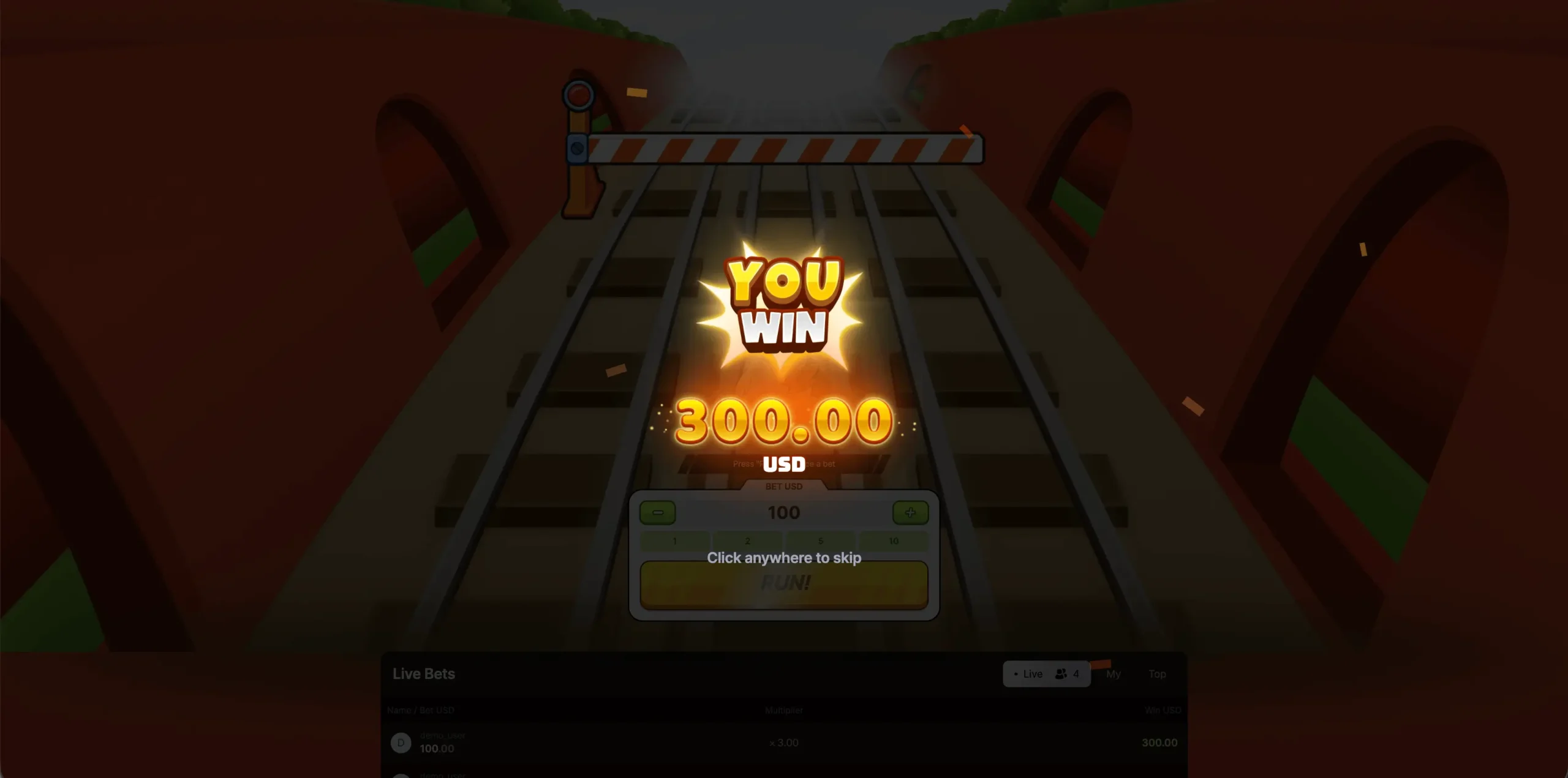
The $10,000 payout cap is the figure that requires the most attention. The headline x55,000 maximum multiplier is real — on Extreme mode, the math model can theoretically generate a result that large. But a single cashout return cannot exceed $10,000, regardless of the multiplier achieved. At a ৳150 maximum bet (roughly $1.35 at current rates), even a x7,400 multiplier would hit that $10,000 ceiling. You’re never actually playing for x55,000. You’re playing for whatever multiple of your stake gets you to $10,000 — and that’s a much smaller number for most Bangladeshi players betting ৳50–200 per round.
This isn’t a scam — it’s standard industry practice for instant games. But it is worth understanding before you mentally anchor to the x55,000 headline.
Feature breakdown
Lane selection — the core mechanic
Lane selection is not a passive feature. It is the entire game. Each step presents three paths; each path displays a different multiplier increment. The differences between options at each step are small (the multiplier progression is calculated by the server before the round begins), but the act of choosing creates psychological ownership over the outcome — which is exactly what 100HP designed for.
Trigger condition: automatic at each step. You select left, centre, or right. The result is revealed instantly.
What it does mechanically: each successful selection advances the chicken one step and updates the active multiplier based on the pre-set progression table for your chosen difficulty mode. The multiplier growth is not linear — it accelerates as you move deeper into a run, which is why late-stage cashouts feel disproportionately valuable. A run that reaches step 15 on High mode is worth substantially more per additional step than the same run at step 3.
Maximum activation: there is no fixed maximum number of steps published by 100HP for Chicken Subway specifically. Based on the companion title Chicken Train, which runs 20–40 track segments, Chicken Subway appears to follow a similar structure, but the exact step count in Extreme mode before the theoretical max is reached has not been independently confirmed in public sources.
Honest limitation: lane selection looks like skill, but the train positions are determined server-side before your choice is made. The SHA-256 provably fair system confirms the pre-determined result. In practice, this means: before you pick left, centre, or right, the server has already resolved which lanes are clear and which contain a train. You can verify this post-round — take the server’s seed hash and run it through any SHA-256 checker online. The decoded output matches the round result. For players in Bangladesh who are reasonably skeptical about whether an unfamiliar game from a young studio is rigged, this is a concrete trust mechanism. It puts verification in the player’s hands rather than asking you to take the casino’s word for it.
Choosing left over right does not change your probability of surviving a step. The selection mechanic is engagement design, not a skill element. That’s not a criticism of the game; it’s worth understanding before you develop theories about which lane to “trust.”
Cashout control
Cashout is available at any point after a successful step. This is the one decision in the game that has genuine impact on outcomes.
What it does: locks your current multiplier and converts it to a payout calculated as stake × current multiplier, subject to the $10,000 per-round cap.
There is no auto-cashout feature confirmed for Chicken Subway in available sources. The companion game Chicken Train includes a Bonus Run feature; whether Chicken Subway includes a similar mechanic has not been confirmed independently. I’ve excluded it here rather than fabricate a feature.
Honest limitation: there is no universally correct cashout point. The RTP is a long-run statistic. A preset cashout rule — “I always cash out at x3 in Medium mode” — is more defensible than reactive decisions made while watching a multiplier climb. Players who try to read a “hot streak” from recent round history are pattern-matching on independent events. Each round resets.
Difficulty mode switching
Players can switch between Low, Medium, High, and Extreme before any new round. This is the most genuinely useful feature in the game.
What it does: changes the underlying probability table for each step, altering the crash frequency and the multiplier ceiling available per step. Low mode crashes less often; Extreme mode crashes often but accumulates multiplier value faster when it doesn’t.
Maximum activation: unlimited switching between rounds.
Honest limitation: switching modes mid-session based on emotional state — going from Low to Extreme after a losing streak in Low — is the fastest way to deplete a bankroll. Mode selection should be set based on bankroll size before the session starts, not adjusted reactively.
2026 perspective: where Chicken Subway sits in a crowded genre
The 100HP chicken family
100HP Gaming has built its portfolio almost entirely on chicken-themed step multiplier games. Chicken Subway launched in late 2025. Chicken Train, the companion title, operates with a 97% RTP, a max multiplier of x55,833 across 20–40 track segments, and four volatility tiers with published per-tier multiplier ceilings: Low tops at x62.93, Medium at x267.56, High at x10,308.99, Extreme at x55,833. The payout cap is identical: $10,000.
Chicken Train is more mechanically transparent than Chicken Subway. The published step progression and per-mode multiplier tables give players clearer bankroll planning data. If you’re choosing between the two, Chicken Train offers more documented structure. Chicken Subway offers a slightly different visual identity and the three-lane selection format rather than a single-path progression — which creates more perceived player control per round, even if the underlying math is comparable.
Chicken Pirate (97% RTP, x55,000+ max) adds a Bonus Run feature that Chicken Subway appears to lack — though this has not been independently confirmed as absent from Subway specifically. SlotCatalog’s review of Chicken Pirate cited the absence of auto features as the one significant drawback across the 100HP lineup. That observation applies to Chicken Subway as well based on available information.
Direct competitors
Uncrossable Rush by Evoplay is the most direct competitor in the step multiplier crash genre. RTP: 96% (fixed, no operator variation). Max win: x10,000 per round on Hardcore mode (24 lanes, Hardcore completion). The payout cap is up to $750,000 at a ৳2,000 maximum stake — substantially higher than Chicken Subway’s $10,000. Uncrossable Rush’s RTP is 1–2 percentage points below Chicken Subway’s published figures, which matters over extended sessions. On a ৳10,000 session, that 1% difference is ৳100. On the other hand, the x10,000 multiplier ceiling in Uncrossable Rush is mechanically achievable on a standard bet (24 successful crossings in Hardcore mode has occurred — there’s a documented x5,000 payout from June 2025 on record). The x55,000 ceiling in Chicken Subway is theoretical; whether it has been achieved in documented play is not confirmed.
Chicken Road 2 by Inout Games: 95.5% RTP, BDT-native support, widely available at Bangladesh-facing casinos including bKash and Nagad integration. The lower RTP is a real disadvantage over a long session — on ৳10,000 wagered, that’s ৳150–250 more returned by Chicken Subway at 97–98% versus Chicken Road 2 at 95.5%. RTP matters more in this game format than in traditional slots because you cycle through rounds fast.
Aviator by Spribe: the benchmark of the crash genre. 97% RTP, no step selection mechanic, pure multiplier-climb-and-cashout. Aviator’s social features — live bets, live cashouts, in-game chat — are absent from Chicken Subway. For players who use social proof as a decision input (“someone just cashed out at x14.3, so maybe this is a good run”), Aviator delivers that context. Chicken Subway is a more isolated experience.
Buy-bonus and progressive jackpot
No buy-bonus mechanic. There is no option to purchase access to a bonus state or guaranteed feature trigger in Chicken Subway. For players who want to use a casino bonus wagering requirement to push through a high-multiplier round efficiently, the absence of bonus buy is a structural limitation. You play rounds at standard pace.
No progressive jackpot. The $10,000 cap is the ceiling. There is no accumulating prize pool that grows across players. If you’re coming from jackpot slot content expecting a life-changing single payout above $10,000, this game won’t deliver it.
Is this a 2026-relevant game for Bangladeshi players?
The honest answer is: yes, with conditions.
The genre is right. Step multiplier crash games dominate the casual casino sessions among players in Bangladesh. Mobile-first, fast rounds, low minimum bets, the ability to play a ৳20 stake and cash out in under 30 seconds — that’s the format that works on a Grameenphone connection in Dhaka or Chittagong. The game loads quickly, runs on HTML5, and has been optimised for low-bandwidth environments — 100HP explicitly targets sub-2MB game builds.
The RTP range of 97–98% is genuinely good for the format. Chicken Road 2’s 95.5% looks weaker by direct comparison. Uncrossable Rush’s 96% fixed RTP is also below Chicken Subway’s published range.
The limitations are also real. The $10,000 hard cap means the x55,000 headline is effectively decorative for any player betting under ৳50 per round. At ৳20 per round (roughly $0.18), you’d need a x55,000 result to hit the $10,000 cap — and you’re not going to hit x55,000. At that stake, your realistic ceiling on a great Extreme-mode run is whatever x-multiplier corresponds to ৳900,000, which is still a life-changing sum but is not the x55,000 advertised. At ৳150 per round (roughly $1.35), a x7,400 multiplier hits the cap. That’s achievable in Extreme mode — but most Extreme-mode runs end before step 5.
The absence of a buy-bonus, auto-cashout, or progressive jackpot means this is a pure-round game. There are no shortcuts to a big outcome. There is no feature that changes the math between rounds.
Distribution is still limited in early 2026. 100HP Gaming holds a Curaçao licence and is integrated via SOFTSWISS, Hub88, and EvenBet. Casino availability in Bangladesh-facing markets is growing but not universal. Check whether your preferred casino carries 100HP Gaming in its instant games lobby before planning a session around this title.
Depositing and playing in Bangladesh
Chicken Subway is accessible through 100HP Gaming’s operator network at casinos serving Bangladesh. At those platforms, deposit and withdrawal via bKash and Nagad are typically supported — both standard agent-based transactions and in some cases direct app integration. Deposits via bKash or Nagad are generally credited within minutes. Withdrawals take longer, usually a few hours to 24 hours for mobile wallet payouts.
The minimum bet of $0.10 per round translates to roughly ৳11 at current rates. You can run a meaningful practice session — enough rounds to understand how each difficulty mode actually behaves — on ৳200–300. That’s a real advantage over games with higher minimum stakes. The maximum bet of $150 (~৳16,500) puts serious play within reach, though at that stake the $10,000 payout cap becomes the binding constraint rather than the multiplier.
A practical note on bonuses: many casino welcome bonuses in Bangladesh include instant games in their wagering eligibility. If you’re clearing a bonus at ৳2,000 through ৳20 stakes in Low mode, Chicken Subway is a viable vehicle — Low mode’s high win frequency means you recycle stakes faster than High mode, which is what bonus wagering requires. The caveat applies here that some operators exclude specific providers from bonus eligibility; verify the bonus terms for 100HP Gaming titles before assuming eligibility.
Practical session strategies for Bangladeshi players
There is no strategy in Chicken Subway that changes the underlying math. The game is provably fair, the crash probabilities are preset server-side, and past round results don’t influence future ones. What strategies can do is help you structure your session so that the variance doesn’t end your play in two minutes flat.
Fixed cashout discipline. Set a target multiplier before you start a session — “I cash out at x3 in Medium mode, no exceptions” — and don’t move it during play. Watching a multiplier climb past your target and staying in is the core loss mechanism in crash-style games. The second you deviate from a preset rule because the current run “feels different,” you’ve removed the one form of control you actually have.
Mode selection by bankroll. A simple framework: ৳500 deposit → Low mode only, ৳20–30 stake, x2–x2.5 cashout target. ৳1,000–2,000 → Medium mode viable, ৳50 stake, x3–x4 cashout target. ৳5,000+ → High mode becomes reasonable for a portion of the session with a defined loss limit. Extreme mode needs a bankroll that survives 30–50 consecutive crashes at your stake, because that’s the realistic failure scenario at that volatility level.
Demo before deposit. 100HP’s demo mode runs the same math as real money play. Spend 20–30 rounds in each difficulty mode in demo before switching to real money. The pacing of multiplier growth and crash frequency genuinely differs between modes, and understanding that pacing in advance prevents the most common mistake: starting in Extreme because the multipliers look attractive, losing the deposit in ten rounds, and not understanding why.
Round pace and session limits. Chicken Subway rounds resolve in 20–30 seconds. At ৳50 per round in Medium mode, a one-hour session represents 120+ rounds and ৳6,000+ in total stakes — even if your net position at the end is small. The volume of rounds is high. Set a session stake limit before you start, not after you’ve already played for an hour.
Chicken Subway — play or skip?
Play, with clear expectations. This is a well-built instant game with a better-than-average RTP for its format and a mechanic that gives you genuine session-length control through mode selection. The three-lane format adds perceived engagement that single-path crash games lack, even if the underlying probabilities are similar.
For players in Bangladesh depositing ৳500–2,000 via bKash or Nagad: Low or Medium mode, preset cashout discipline, and treat the $10,000 cap as the actual ceiling — not the x55,000 headline. The game is genuinely enjoyable for short, fast sessions on a phone. It is not designed for grinding through a ৳10,000 bonus wagering requirement; the round speed and variance make that a rough exercise, though Low mode’s high win frequency makes it more viable than most crash titles for that purpose.
The 100HP Gaming brand is new and distribution is limited. If you’re reading this at a casino that doesn’t currently carry Chicken Subway in its instant games lobby, that’s a real availability issue — you can’t force the operator to add it, and the casino choice should come before the game choice. Check your preferred casino’s 100HP availability before building a session plan around this title.
Skip if you want Aviator’s social features and tournament integration, Uncrossable Rush’s premium 3D presentation, or a game with documented wide distribution at Bangladesh-facing platforms. The player profile for whom Chicken Subway works best: comfortable with crash game mechanics, playing on a mobile device, wants more perceived decision-making than a standard multiplier climb, and is treating this as entertainment rather than income.
The one number that most limits the game is $10,000 — the hard payout cap per round. Until 100HP raises that ceiling or increases the maximum stake beyond $150, Chicken Subway will remain a casual-play instant game regardless of what the x55,000 multiplier implies. Play it for what it is: a fast, fair, mobile-optimised crash title with a good RTP and a format that suits the way players in Bangladesh actually use casino apps.
The x55,000 is marketing. The $10,000 is the game.
Chicken Train (the companion title) — the more documented option
If you’re specifically interested in the 100HP step multiplier format and want clearer published mechanics, Chicken Train is the better-researched choice. The per-mode multiplier ceilings are published, the step count is documented (20–40 segments), and SlotCatalog has reviewed it with the full structural analysis. The RTP is identical at 97%, the payout cap is identical at $10,000, and the Bonus Run feature adds a layer that Chicken Subway currently lacks based on available information.
Neither title is a primary game for a serious session. Both are secondary options — fast, accessible, fair by the math, and capped at a level that keeps them in the entertainment category for most players.