Lucky Color Game launched in 2022. Three years on, it occupies a peculiar position in JDB’s catalogue — it is not really a slot at all, and that distinction matters more in 2026 than it did at release.
The game strips away reels, paylines, and spinning symbols entirely. You pick a colour. You watch the result. You either win or you don’t. JDB calls it an arcade game, and for once that label fits. The question worth asking now is whether this simplicity remains appealing in a lobby full of Megaways titles and crash mechanics, or whether it has quietly aged into the background.
The numbers give a reasonable starting point. One source cites a 97% RTP — above the industry average for most slot categories. Volatility is low. Max win is reported at 2,000× by one operator site. Whether those figures hold across different casino configurations is, as always, the real story. We’ll get to that.
Math model and mechanics
RTP
The 97% figure comes from a single operator-facing source (OKBet). SlotCatalog — typically the most reliable reference for certified RTP data — does not list a confirmed RTP for Lucky Color Game. That gap is worth acknowledging directly: when only one party publishes a figure, and it happens to be the casino promoting the game, treat it as directional rather than definitive.
What does 97% mean in practice? For a £50 maximum bet session of 100 rounds, the theoretical return is £4,850 from £5,000 wagered. Over a short session, variance will dominate. Over thousands of rounds, the math converges. At 97%, the house edge is 3% — approximately half the edge on a standard slot running 94–95% RTP.
RTP disclosure note: If you are playing Lucky Color Game at a licensed European casino, check the game’s information panel before betting. RTP is frequently operator-configurable. A casino running the game at a lower setting will produce worse outcomes than the headline figure suggests, and there is currently no publicly available data on the typical configured range for this title.
Volatility
Low volatility is confirmed across multiple sources and is consistent with the game’s design. You are placing bets on one of six colour outcomes per round. With six options and no additional reels or symbol combinations creating complex probability distributions, the math produces frequent, modest outcomes. Long dry spells — the hallmark of high-volatility play — are structurally unlikely here.
The practical implication: a £10 session at minimum stake will last considerably longer with Lucky Color Game than with a high-volatility slot like Pragmatic Play’s Gates of Olympus. You are trading the chance of a transformative single win for consistency of return. That is not good or bad in isolation — it depends entirely on what kind of session you want.
Hit frequency
Low volatility in a colour-prediction format operates differently from low volatility in a traditional slot. In a standard slot, low volatility means the paytable is structured to return frequent small wins from standard symbol combinations. In Lucky Color Game, the fundamental mechanic is a 1-in-6 colour draw per round. Even before any bonus features enter the equation, the base win probability on a single colour selection is approximately 16.7% per round — roughly one win in every six attempts, assuming equal probability across colours.
The multi-colour simultaneous betting option complicates this. A player covering two colours with split stakes has approximately a 33% chance of one of their bets resolving as a winner each round. The net economics depend on payout ratios per outcome, which are not published in verified form for this title. But the structural logic is sound: this is a game designed to return something frequently, not to accumulate tension over long dry stretches before a single large event.
For session planning: at minimum stakes, this game runs through budget slowly. At €0.10 per round resolving every 10 seconds, 60 rounds per minute, a full hour of play at minimum stake costs approximately €1.80 in theoretical expected loss at a 3% house edge — assuming the 97% RTP holds. That is a meaningfully low cost-per-hour compared to any high-volatility slot at equivalent stakes.
Bet range
Minimum bet is €0.10 per round. Maximum is €50. That €50 ceiling is relevant: if the 2,000× max win figure is accurate, a maximum-stake hit produces a €100,000 return. In practice, that ceiling makes this accessible to casual players and appropriate for low-stakes sessions without alienating mid-stakes players entirely. High rollers wanting €100+ spins will not find that range here.
The €0.10 minimum also matters for markets where session budgets are tight — South Asian players on mid-range Android devices frequently approach casino games at the lowest possible stake, particularly on unfamiliar titles. Lucky Color Game accommodates that behaviour without forcing a higher entry point.
Max win
2,000× is the figure cited by one operator source. That is a reasonable ceiling by arcade game standards — comparable to what you would expect from games in this category. How frequently it is achievable in practice depends on the Lucky Bonus Game trigger rate, which is not published in verified form anywhere. The 2,000× figure should be treated as theoretical maximum, not typical expectation.
For comparison: JDB’s own Birds Party Deluxe claims a 40,000× max win, and their crash-adjacent titles operate on entirely different probability models. Within the colour-prediction arcade format, 2,000× is consistent with what the genre offers.
Feature breakdown
Six-colour selection mechanic
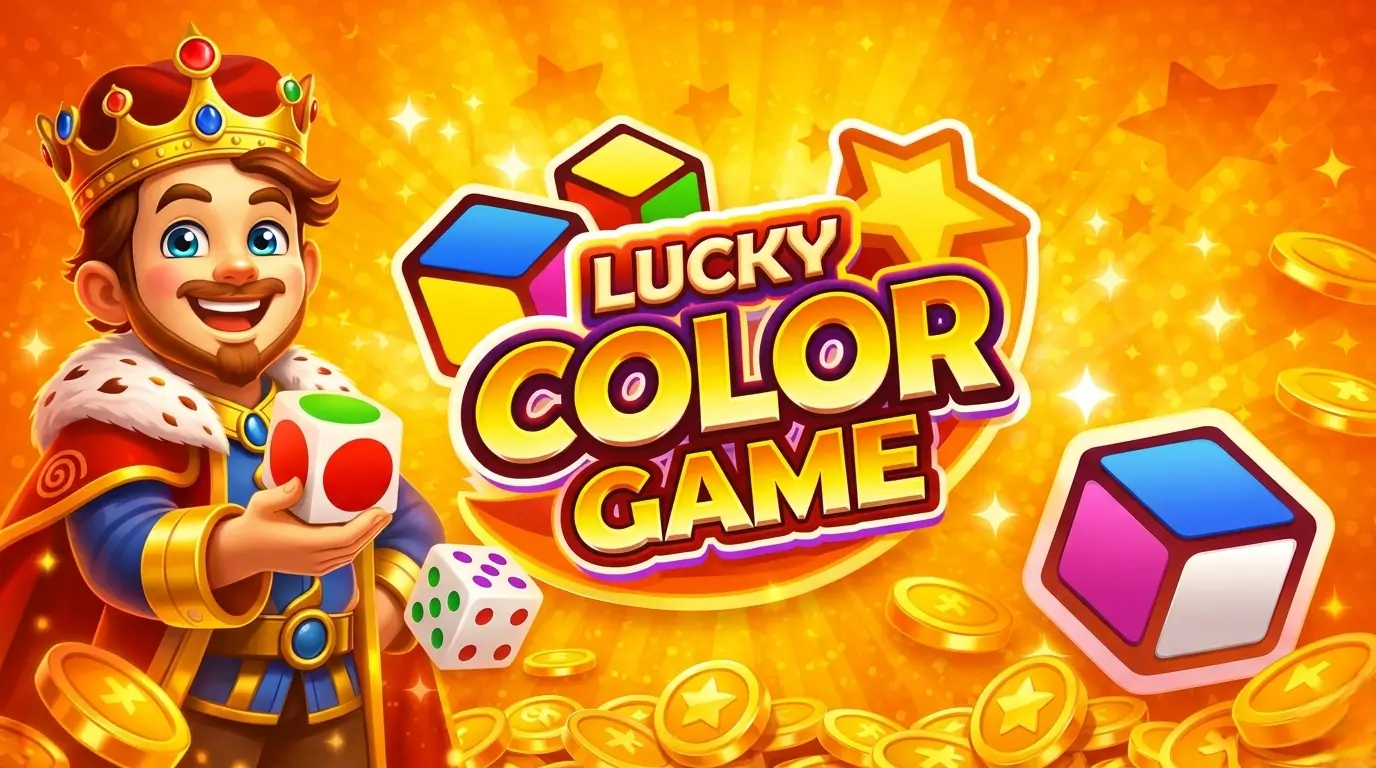
How it works: Each round, the player bets on one or more of six colours — Red, Blue, Green, Yellow, Purple, and Orange. JDB’s format allows placing different bet sizes on different colour options simultaneously, meaning a player could hedge across multiple colours in a single round. The winning colour is determined by RNG each round. Rounds resolve approximately every 10 seconds, giving the game a fast-paced, near-continuous feel.
The simultaneous multi-colour betting option is the key structural feature. A player who bets €1 on Red and €0.50 on Blue has a partial hedge — one of those colours resolving as a winner returns profit on that specific stake while the other is lost. This creates a basic risk management layer that purely random games like coin flips do not offer. How much control this actually gives the player is a different question. The RNG does not know or care what colours you have covered.
Limitation: There is no skill component here whatsoever. Pattern recognition, hot streaks, and colour history are statistically irrelevant to future outcomes. The game’s simplicity is also its ceiling.
One thing worth flagging for players coming from grey-market colour prediction apps: those platforms sometimes use non-transparent RNG systems, weighted draws, or historical result manipulation. Lucky Color Game, being a licensed RNG-certified product from JDB168, operates on a provably random basis — each round is independent. The psychological habits that “work” on unregulated platforms (tracking streaks, avoiding recently drawn colours, bet-doubling systems) have no statistical validity here. That is not a criticism of the game. It is a correction to a commonly imported misconception.
The 10-second round interval also deserves specific attention. At that pace, a player betting €1 per round spends €360 per hour in action — not €360 in loss, but €360 in total throughput. At 97% RTP, the theoretical expected loss is €10.80 per hour of continuous play. At 94% RTP (a more conservative estimate given unconfirmed operator configurations), the expected loss rises to €21.60 per hour. Both figures are modest by slot standards. Both can deteriorate rapidly if a player chases losses or increases stake size mid-session.
Lucky Bonus Game
Trigger: Activated when the player matches the correct combination on a given round — the precise trigger condition (specific colour combination, specific number of matching outcomes) is not detailed in publicly available documentation. JDB describes it as unlocking when the player “gets the right combination.”
What it does: The Lucky Bonus Game is a secondary round that provides elevated payout potential beyond the standard colour-match outcome. Multipliers are available during this bonus round, with JDB’s own promotional materials indicating multiplier ranges exist within the feature.
Limitation: The trigger frequency for the Lucky Bonus Game is not published anywhere in verified documentation. Without that figure, it is impossible to assess whether the bonus contributes meaningfully to session value or whether most players complete dozens of rounds without encountering it. This is a genuine data gap, not a minor omission — the Lucky Bonus Game is the primary driver of the game’s upside, and its absence from public spec sheets is a transparency problem that matters when you are deciding how much to stake.
Compare this to how providers like Pragmatic Play document their games: Gates of Olympus publishes a base game hit frequency, a free spins trigger probability, and a bonus buy cost relative to stake. Lucky Color Game publishes none of the equivalent. For a Tier 1 or Tier 2 market, that opacity would be a serious mark against it.
Guaranteed prize mechanic
JDB markets Lucky Color Game with a “guaranteed prize” element — described as: every player wins something, every round. In practice, this likely means the minimum payout for any result is above zero. The game may implement a floor payout structure where even non-matching colours return a fraction of the stake.
Limitation: “Guaranteed prize” without stated minimum values is marketing language. If the floor payout is 0.01× stake, the practical value is negligible. This mechanic would need direct testing or official documentation to assess honestly, and neither is currently available.
Round multipliers
Some rounds include multipliers that increase the winning amount. Kingmaker’s competing Colour Game product (using three dice) explicitly caps its bonus multiplier at 10× and ties it to a 2× feature trigger. JDB’s Lucky Color Game does not publish equivalent specifics.
What this means for players: Multipliers exist. Their range, trigger probability, and interaction with the Lucky Bonus Game are not documented in verified sources. Expect them to appear occasionally — treat them as upside, not as a structural feature you can build a session strategy around.
2026 perspective: where does this fit now?
The format question: arcade games in 2026
Colour prediction as a game format peaked in cultural relevance around 2022–2023, when the grey-market app ecosystem across India, Bangladesh, and the Philippines expanded dramatically. That ecosystem — built on informal betting pools, referral-driven growth, and UPI or bKash payments — had little to do with licensed casino software. But it created a large player base familiar with the core mechanic: pick a colour, wait 10 seconds, collect or lose.
JDB’s Lucky Color Game sits in an interesting position relative to that trend. It is a licensed, RNG-certified version of the same mechanic, deployable by regulated operators who want to capture the colour-prediction audience without touching unlicensed platforms. That value proposition is real. Whether it has converted into significant player numbers on licensed casino platforms is a different question, and the available data does not answer it clearly.
The game’s continued listing across 106+ casino markets on SlotCatalog suggests it has not been delisted or abandoned — a basic quality signal. But the absence of a sequel and the thin documentation available suggest it has not become a flagship JDB title either.
The sequel question
No sequel, Megaways variant, or Power Reels version of Lucky Color Game appears to exist as of 2026. JDB has not followed up this title with an evolved version. That is notable — most successful arcade or slot titles from 2022 now have at least one iteration. The absence of a sequel suggests either that the game has not driven sufficient demand to warrant development investment, or that JDB is satisfied with the original format. Neither interpretation is particularly flattering.
Competitive context
The colour-prediction arcade format has fragmented significantly since 2022. The relevant competitors are not traditional slots — they are other colour-betting mechanics and fast-bet arcade titles.
Kingmaker’s Colour Game: Uses three physical-style dice rather than a pure RNG colour draw. Betting options expand across colour combinations, giving more strategic surface area. The 2× bonus feature offers multipliers up to 10×. No confirmed RTP is publicly available. Available in 1 market according to SlotCatalog — meaning distribution is extremely limited. Within licensed casino platforms, Lucky Color Game has broader availability than Kingmaker’s version.
JDB’s own Birds Party Deluxe: Not a colour game, but worth the comparison for players considering JDB titles. 40,000× max win. Elimination-mechanic slot. Fundamentally different gameplay. For players who want the JDB aesthetic with higher win potential, Birds Party Deluxe is the stronger mathematical proposition — assuming its distribution matches that claim.
The wider colour-prediction market: A substantial grey-market ecosystem of colour prediction apps operates across South Asia and Southeast Asia — Daman Games, BDG Win, WinZO, and similar platforms. These are unregulated, operate outside licensed casino frameworks, and function more like peer-to-peer betting pools than RNG-certified casino games. Lucky Color Game’s advantage over these alternatives is verifiable RNG and licensed casino context. Its disadvantage is that the grey-market alternatives often offer faster payouts, mobile-native UX, and local payment method integration that licensed casino platforms frequently do not match.
The practical implication for operators: Lucky Color Game is most valuable in a lobby serving players who came from that grey-market background and are transitioning to licensed play. It speaks their format language while offering the regulatory cover that the apps do not. Used as a lobby entry point rather than a primary revenue driver, its positioning makes sense.
JDB Birds Party Deluxe as a frame of reference: Within JDB’s own catalogue, Birds Party Deluxe operates at 40,000× max win with a puzzle-elimination mechanic. It is a fundamentally different experience — higher skill surface, higher variance, much higher win ceiling. If Lucky Color Game’s 2,000× max win feels modest, it is because JDB’s own flagship titles make it look that way. The two games are not really competing for the same player, but they share a lobby, and the comparison is unavoidable.
Demo availability and mobile performance
Demo mode is available for Lucky Color Game. SlotCatalog and LiveBet Casino both confirm free-play access without registration. For a game this simple in mechanic, demo mode is genuinely useful — not to learn complex features, but to verify that the round speed, the colour selection interface, and the visual feedback work properly on your specific device before committing real money.
JDB168 builds primarily for mobile. The studio’s product catalogue is optimised for portrait-mode play on Android devices, which aligns directly with the game’s primary audience in South and Southeast Asia. Lucky Color Game’s minimalist interface — no elaborate animations, no layered bonus presentations — loads fast on mid-range hardware. On a Redmi Note or Samsung Galaxy A-series device running a 4G connection, the 10-second round interval should not produce loading delays. On a 3G connection or during peak network hours, the pace may occasionally stall, though the game’s low graphical complexity makes this unlikely to be a persistent issue.
Desktop play works, but nothing about the experience is optimised for it. The game was not designed for a 1440p monitor or a trackpad. It will function — but if you are evaluating it from a desktop browser, understand that the product intent is mobile.
Buy-bonus
Not available. Lucky Color Game does not appear to offer a bonus purchase mechanic. In 2026, this matters for a specific player profile — experienced players who want direct access to the bonus feature and are willing to pay a cost-per-entry premium. Lucky Color Game does not serve that player.
For casual players, the absence of buy-bonus is irrelevant. Rounds resolve every 10 seconds. The pace is already fast enough that waiting for a natural Lucky Bonus Game trigger is not a significant friction point — assuming the trigger rate is reasonable.
Progressive jackpot
No progressive jackpot. The 2,000× ceiling is fixed. For players whose primary objective is life-changing payouts, this game is not the right format regardless of RTP.
Is this a recreational game, a high roller game, or dead weight in 2026?
It is a recreational game. Full stop. The €50 max bet, low volatility, and simple mechanic are calibrated for players who want a fast, low-pressure session. It is the casino equivalent of a scratch card — immediate feedback, manageable stakes, no complex feature-chasing.
Whether it is dead weight depends on the operator’s lobby. In a Southeast Asian or South Asian market where colour prediction as a format has cultural traction, this game fills a real niche and carries legitimate appeal. In a European lobby dominated by high-variance video slots and progressive jackpots, it risks being invisible — not because it is a bad game, but because it is aimed at a player profile that European slot lobbies do not traditionally prioritise.
Verdict
Who is JDB168 and does that matter here?
JDB168 is a Taiwanese developer founded in 2010, operating primarily across Asian markets. The studio covers five product categories: traditional slots, 3D slots, arcade games, multiplayer fishing games, and lottery-style products. Lucky Color Game sits in the arcade category — correctly placed.
JDB titles circulate primarily through Asian-facing licensed operators. Western European lobbies carry JDB content rarely, partly because the studio’s design language is built for Asian cultural preferences (colour, speed, fortune mechanics) and partly because JDB has not aggressively pursued MGA or UKGC-licensed operator relationships the way Pragmatic Play or Red Tiger have. If you are reading this from a UK or Netherlands casino account, you may not even find Lucky Color Game in your lobby. If you are playing through a casino licensed under Curacao eGaming or a comparable offshore jurisdiction targeting South or Southeast Asia, you are far more likely to encounter it.
That GEO specificity is not a weakness — it is the game’s positioning. JDB knows its audience. Lucky Color Game is not trying to compete with Gates of Olympus in a European lobby. It is trying to be the go-to colour-prediction option for licensed operators serving markets where that format has genuine roots.
Lucky Color Game (original, 2022)
This is a clean, well-executed version of the colour-prediction format within a licensed, RNG-certified context. The reported 97% RTP is strong — if it holds across all operator configurations, which cannot be confirmed from public data. Low volatility means you will not drain a session bankroll in 10 minutes. Rounds are fast. The guaranteed payout mechanic and multi-colour betting option give the game more structure than a pure binary bet.
The ceiling is the problem. 2,000× from a maximum €50 stake gives you a theoretical maximum of €100,000. Most sessions will produce nothing close to that. The Lucky Bonus Game trigger rate is unknown, the multiplier ranges are not documented, and the competitive landscape in 2026 has moved beyond what this game offers.
Recommend it for: casual players who want fast sessions without feature complexity, players in South Asian or Southeast Asian markets where the colour-game format is familiar, and anyone who finds high-volatility slot mechanics frustrating. Also suitable as a low-stakes warm-up or wind-down game. Players transitioning from grey-market colour prediction apps to licensed platforms will find the mechanic immediately legible — and the RNG integrity significantly more trustworthy than what those apps offer.
The 97% RTP, if accurate, is genuinely good. Most casual-facing slots do not deliver that figure. The low-volatility structure means the RTP has a better chance of approximating real session experience than high-variance equivalents where a single bad session can massively deviate from theoretical return. That combination is worth something, even if the feature documentation leaves a lot to be desired.
Do not recommend it for: high rollers (bet ceiling too low), bonus hunters (no buy-bonus), players seeking high win potential (2,000× does not compete with Megaways or cluster titles), or anyone wanting detailed mechanical documentation before they play (the data gaps in this game are real and should not be dismissed).
Sequel verdict
No sequel exists to evaluate. If JDB releases one, the key improvement to look for would be a verified RTP from SlotCatalog, a documented Lucky Bonus Game trigger rate, and buy-bonus availability. Without those additions, an evolved version would be structurally identical to what already exists.
The one number that most limits this game: 2,000× max win. Until that ceiling rises and the documentation catches up, Lucky Color Game sits comfortably in the mid-tier of its own niche — and nowhere near the top tier of the wider lobby.