Minesweeper has been live since April 2016, which makes it roughly a decade old — a genuine veteran in a genre that mostly took off after 2020. It predates Spribe’s Mines by four years and did so without the exponential multiplier curve that now defines the category. That matters, because the entire mines genre has since reorganised itself around one number: how high can the multiplier climb before you cash out? BGaming’s answer, still, is 15.11x. In 2026, against competitors offering four-figure and five-figure ceilings, that single data point frames everything else in this review.
BGaming built this before “mines” was a recognised casino category — back when it was still marketed as a casual, timekiller-adjacent title rather than a high-stakes RNG grind. That origin shows in the design: five fixed board sizes, a stepped stake ladder, and a multiplier curve that was clearly calibrated for steady, frequent small wins rather than for the exponential jackpot-chasing that defines Spribe’s version of the same idea. Whether that’s a strength or a liability in 2026 depends entirely on what a player is looking for, and this review works through both the math and the competitive picture to answer that properly.
Math model and mechanics
BGaming’s own game page lists a flat RTP of 98.4%. Third-party aggregators — SlotCatalog, Stake.com’s game listing, and AskGamblers’ write-up of the sister title Minesweeper XY — all cite a range instead: 97.8% to 98.4% (Stake rounds it to 97.88%–98.4%), depending on the field size selected before the round starts. This is a real discrepancy, not a rounding error, and it matters practically: BGaming’s marketing page quotes the ceiling figure, not the average a player will actually see across grid choices. Treat 98.4% as the best-case number, not the guaranteed one, and check the operator’s own game info panel before assuming which end of the range applies.
Either figure is high. At 97.8%, the house edge is 2.2%; at 98.4%, it drops to 1.6%. Over a realistic £500 session at £5 per round (100 rounds), the gap between those two numbers is the difference between losing roughly £11 and roughly £8 on average — not enough to change your decision to play, but enough that the marketing figure shouldn’t be treated as fixed.
Volatility is where sources genuinely disagree. BGaming’s own copy describes the game as low volatility with “frequent payouts.” SlotsJudge, an independent aggregator, classifies it as medium. Both can be defended: cash-out-anytime mechanics naturally produce more frequent small wins than a standard slot, which supports the “low” label, but the field-size selection genuinely changes the risk profile — a 2×3 board with wide safe margins plays nothing like a 6×15 board with narrow ones. Functionally, volatility here is player-selected rather than fixed, and neither label alone tells the full story.
Hit frequency follows the same logic. On the smallest board (2×3, meaning 2 columns of 3 squares each), each row typically shows more safe squares than mines, so early cash-outs land often. On the largest board (6×15), the multiplier grows the same way but the number of correct picks required to reach the ceiling climbs to fifteen, and one wrong pick anywhere along that run ends the round at zero.
Why does any of this matter if the headline RTP is strong either way? Because RTP is a long-run average across thousands of rounds — it tells you nothing about how a single session will feel. A player grinding the 6×15 board for the full 15.11x will bust out far more often than one cashing out on the 2×3 board after two picks, even though both boards are engineered to pay back roughly the same percentage over time. The board-size choice is really a choice about how much variance you want packed into each individual round, not a choice that changes your long-term expected return in any meaningful way.
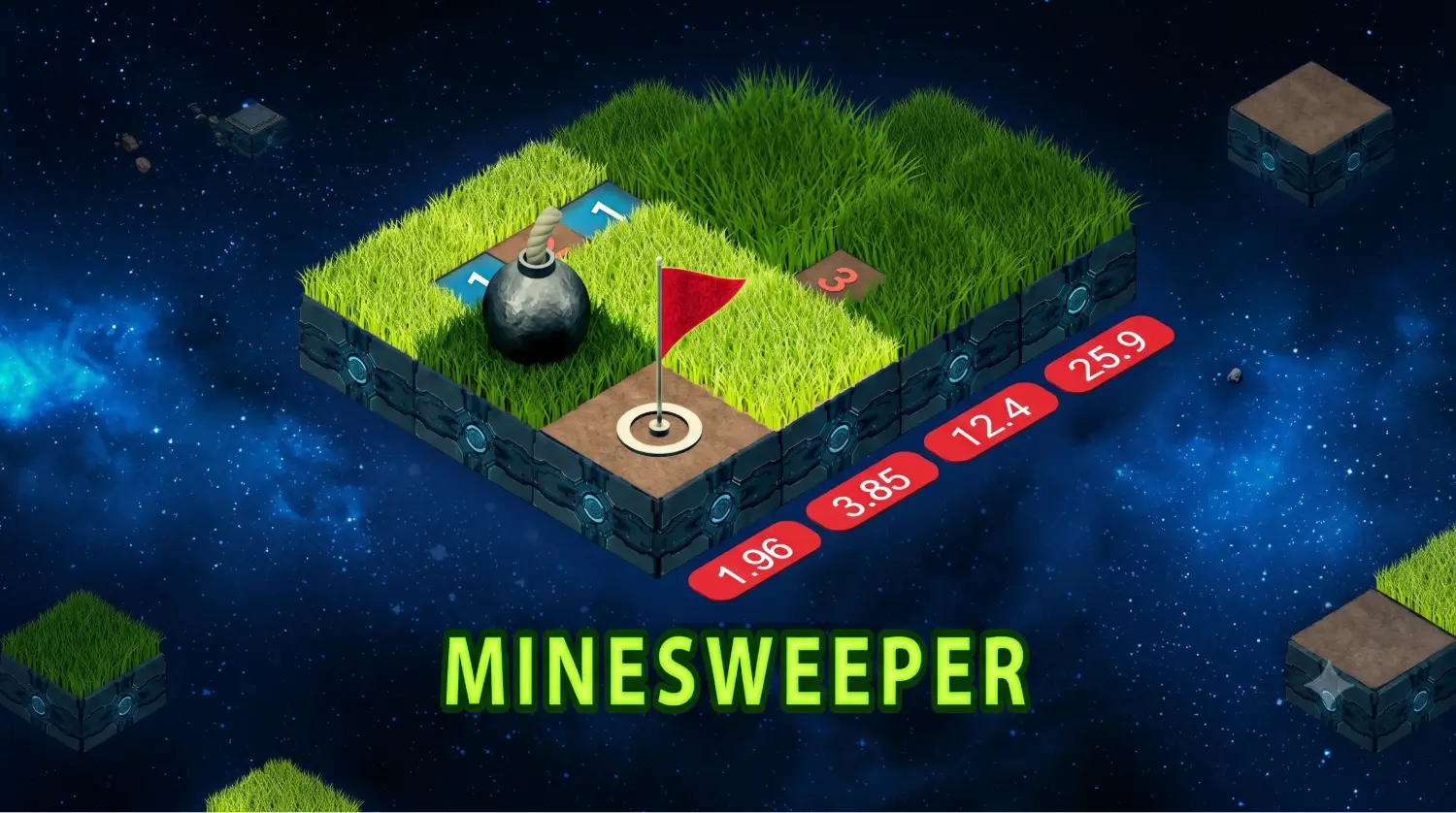
There are no reels and no paylines in the conventional sense. Instead, the field is a grid of rows: each row holds between 2 and 6 squares, exactly one of which hides a mine. You clear a row by picking any square without a mine, the multiplier ticks up, and you either continue to the next row or press Collect. Five field configurations are available — 2×3, 3×6, 4×9, 5×12, and 6×15 — and each has its own documented ceiling: 7.85x on the smallest, rising to 11.17x, 13.07x, 14.28x, and topping out at 15.11x on the full 6×15 board.
That ceiling is the number worth sitting with. On a smaller mines board with fewer, wider rows, 15.11x sounds reasonable. Set against where the rest of the genre has gone since 2020, it looks conservative — and the comparison section below explains exactly how conservative.
Look at the shape of the multiplier curve across the five boards and a pattern emerges: the ceiling roughly doubles from the smallest board (7.85x) to the largest (15.11x), but the number of correct picks required to reach it goes up far more steeply — from as few as 2-3 rows on a 2×3 board to a full 15 rows on a 6×15 board. In practical terms, each additional row you clear on the largest board is worth progressively less multiplier than the equivalent row on a smaller board. You might ask: why would a player choose the harder board at all, if the per-row reward shrinks? Because the smaller boards also carry a worse squares-to-mines ratio per pick — on some 2×3 configurations you’re choosing between as few as 2-3 squares with one mine hidden among them, which is a materially riskier single decision than a 6×15 row offering more squares per pick. The trade-off isn’t ceiling versus nothing; it’s risk-per-pick versus number-of-picks-required.
Worked example: on the 6×15 board, reaching the full 15.11x from a £5 stake pays out £75.55 — but only after fifteen consecutive correct picks, each one a genuine chance to lose the stake outright. On the 2×3 board, the same £5 stake caps out at £39.25 (7.85x), reachable in as few as two or three correct picks depending on the exact configuration BGaming uses for that size. For a player who wants to bank a modest win quickly and move on, the small board does that job better than the large one, even though its printed ceiling is lower.
None of the five board sizes come with a jackpot or a progressive element layered on top of the standard multiplier table — what you see printed as the ceiling for each configuration is the actual, hard ceiling for that round. There’s no rare bonus trigger that occasionally pushes a payout beyond the documented figures, which is worth knowing going in: the numbers above aren’t a floor for what’s possible, they’re the whole story.
Feature breakdown
Field size selection
The five field sizes — 2×3, 3×6, 4×9, 5×12, and 6×15 — are chosen before the round begins, not adjusted mid-play. Smaller fields mean fewer total rows to clear (as few as 2) but a higher ratio of mines to safe squares per row, since some configurations only offer 2-3 squares per pick. Larger fields spread the same one-mine-per-row ratio across more rows, which lowers the risk on any single pick but demands more consecutive correct picks to reach the top multiplier. Practical read: this is the volatility control BGaming didn’t otherwise build into the game — pick your board size, pick your risk.
Trigger condition: selected from a menu before staking, locked for the duration of that round. Mechanical effect: determines both the number of rows to clear and the squares-per-row ratio, which together set the realistic odds of reaching any given multiplier. Maximum activation: one board size per round — there’s no mid-round switching. Realistic contribution: most sessions will see players gravitate toward the smaller boards for faster, more frequent cash-outs, reserving the 6×15 board for the rare session where reaching the full 15.11x is the specific goal. Honest limitation: BGaming doesn’t publish the exact mine-to-square ratio for every intermediate size (3×6 and 4×9 in particular), so players choosing those boards are relying on the documented ceiling figures rather than a transparent breakdown of the odds behind them.
Bet range
SlotCatalog lists five fixed stake steps: $1, $5, $10, $25, and $100 (or the local-currency equivalent depending on the operator). That’s a stepped structure, not a free-form slider, which rules out granular staking strategies like Martingale — BGaming’s own documentation notes this directly. Some operator integrations (Stake among them) advertise a wider $0.10–$100 range, so confirm the actual stake steps on your chosen platform before assuming BGaming’s default ladder applies.
Trigger condition: set once, before the round starts, from the operator’s available stake menu. Mechanical effect: the stake is the multiplier base — every payout is stake × the multiplier reached at cash-out, with no separate side bets or feature-buy stakes layered on top. Maximum activation: a single stake per round; there’s no way to increase or top up a stake mid-play once picks have started. Realistic contribution: the fixed-step structure means bankroll management has to happen between rounds, not within them — you can’t scale a bet down mid-session the way you could on a slot with a continuous stake slider. Honest limitation: five fixed steps is a narrow range compared to most modern instant games, which typically offer continuous staking from a few pence up to three or four-figure sums.
Step-and-collect mechanic
Every round is a straight walk forward. Pick a safe square in the current row, the multiplier updates, move to the next row. The Collect button locks in whatever multiplier you’ve reached at any point — there’s no requirement to finish the board. This is the entire feature set. There are no wilds, no scatters, no free spins, and no bonus round layered on top; BGaming’s own FAQ confirms it. If you’re coming from a slot background expecting a bonus buy option or a separate feature round, there isn’t one here — the risk-and-reward mechanic is the whole game, not a wrapper around it.
Trigger condition: automatic, every row, for the duration of the round. Mechanical effect: one correct pick advances the multiplier and the row counter; one incorrect pick (landing on a mine) ends the round and forfeits the stake immediately, with no insurance or partial-refund mechanism. Maximum activation: capped by the chosen board’s row count — 2 to 15 successful picks depending on field size. Realistic contribution: in extended play, most rounds end well short of the ceiling; the multiplier structure rewards players who cash out early and often rather than those chasing the final row. One honest limitation: because the multiplier per row is fixed by the board size, there’s no way to accelerate the ceiling. A run of good luck on a 6×15 board still requires fifteen correct picks in sequence for the maximum 15.11x — the game offers no shortcut, no re-trigger, and no way to bank partial progress if you back out and restart.
Provably fair verification
BGaming was among the first major providers to ship provable fairness as standard, and Minesweeper runs on it. Before the round starts, the outcome (mine positions) is generated and hashed using SHA-256, and that hash is shown to the player before any picks are made. Players can also submit their own client seed rather than accept a system-generated one. After the round, the original seed is revealed, letting anyone verify the hash matches and confirm the outcome wasn’t altered mid-play.
Trigger condition: runs automatically on every round; the client-seed option is opt-in for players who want to supply their own. Mechanical effect: the mine positions are fixed before the first pick is made, meaning nothing about the player’s choices during the round can influence where the mines are — the risk is entirely front-loaded into the shuffle, not adjusted reactively. Maximum activation: unlimited — every round can be verified independently. Realistic contribution: this is a genuine trust mechanic, not marketing dressing — it’s independently checkable, which is more than most RNG-based slots offer. Honest limitation: verifying a hash requires a basic understanding of SHA-256 and a willingness to run the check yourself; BGaming doesn’t build an in-client one-click verifier, so in practice, most players will never actually use the feature even though it’s there.
The 2026 perspective
BGaming has actually released a second version of this exact game: Minesweeper XY, live since March 2022. Here’s the catch — BGaming’s own official pages for the two games use nearly identical marketing copy, the same field-size range (2×3 to 6×15), the same “3 to 15 moves” structure, and the same 98.4% headline RTP. The meaningful difference, per AskGamblers’ hands-on review, is presentational: XY runs on a 3D board rather than the original’s flat 2D field. This is not a mechanical sequel in the way a Megaways conversion reworks a base slot’s math model. It’s a visual refresh wearing a new game ID.
That’s worth being blunt about, because “XY” in a title often signals expanded mechanics elsewhere in BGaming’s catalogue. Here it doesn’t. If you’ve played the original, you already know how XY plays — the only question is whether you prefer the 3D presentation.
BGaming also runs a third, related title in the same family: Mine Gems, live since 2024, built on a fixed 5×12 grid where each row hides 4 diamonds and 1 dynamite tile, topping out at a 14.28x ceiling and the same 98.4% RTP. It’s closer to a themed variant than a genuine evolution — worth knowing it exists if you like the mechanic and want a change of skin, but it doesn’t move the ceiling conversation forward either. Between the three, BGaming has now built essentially one math model wearing three different outfits, rather than iterating the actual mechanic.
That ceiling conversation is where the real 2026 comparison happens, and it’s not close. Spribe’s Mines — the game most players now associate with the genre — launched in 2020 on a 5×5, 25-cell grid where the player chooses how many of the 24 possible mine slots are active before the round starts. RTP sits at a flat 97%, lower than Minesweeper’s, but the multiplier scales exponentially with mine count and consecutive safe picks, and the documented ceiling runs as high as 24,000x. Hacksaw Gaming’s Mines Dare2Win runs a 98% RTP with a 10,000x ceiling. Even Stake’s in-house Mines Original, at a reported 99% RTP, still pairs that with unlimited, player-set risk rather than a fixed 15x cap.
The structural reason for that gap is worth spelling out, because it isn’t just marketing bravado on the competitors’ part. Spribe’s model lets the player choose how many mines sit on the board — from 1 up to 24 out of 25 cells — before a single pick is made. Choosing a high mine count means each successful pick is genuinely unlikely, so the multiplier has to climb steeply to keep the math fair, which is what produces those five-figure ceilings. BGaming’s Minesweeper never gives the player that lever. The mine-per-row ratio is fixed by the board size you picked, not adjustable pick by pick, so the multiplier curve was always going to stay flatter and the ceiling was always going to stay lower. This is a genuine design choice, not an oversight — it trades win potential for predictability.
Set next to those, BGaming’s Minesweeper wins on RTP and loses badly on ceiling. 15.11x against 10,000x or 24,000x isn’t a close call — it’s a different category of game. What BGaming is actually selling here isn’t win potential; it’s a tighter, more frequent, lower-variance version of the same core idea, closer in spirit to the original Windows game than to a high-stakes crypto-casino multiplier chase.
Worth noting for context: BGaming itself operates in the same crypto-friendly, provably-fair space that made Spribe’s version so popular — the games run on the same category of platforms (Stake, BitStarz, Roobet, and similar crypto-first casinos, per BGaming’s own partner list). That makes the ceiling gap even more pointed, because Minesweeper and Spribe’s Mines are frequently sitting in the same lobby, aimed at the same player, and one of them offers roughly 1,600 times the maximum win potential of the other for a comparable stake.
There’s no buy-bonus option on Minesweeper, and there’s no progressive jackpot — neither exists anywhere in this sub-genre, so their absence isn’t a mark against the game specifically. What it does mean is there’s no mechanism here for a player to skip the grind toward a bigger multiplier the way a bonus buy lets you skip a slot’s base game. The ceiling is the ceiling, and there’s no paid shortcut to it.
So: high roller’s game, recreational pick, or dead weight in a 2026 lobby? Not a high roller’s game — the fixed $1–$100 stake ladder and 15x cap make that category a non-starter next to Spribe or Hacksaw’s offerings, where a single lucky round can pay out thousands of times the stake. A player with a genuinely large bankroll and an appetite for risk has no real reason to choose this over its competitors; the ceiling simply isn’t built for them. It’s not dead weight either — the RTP is genuinely strong, the provably fair system is a real trust signal rather than decoration, and the mechanic is instantly readable even to a player who’s never touched a mines-style game before, which lowers the barrier to entry considerably compared to games with configurable mine counts and less intuitive multiplier curves. It lands as a recreational, low-commitment pick — best suited to short sessions, mobile play between other games, and players who value frequent small cash-outs over chasing a life-changing multiplier.
Verdict
Minesweeper (original): Play it if you want a straightforward, high-RTP mines game with genuinely low barriers to entry — the fixed $1–$100 stake ladder and instantly readable step mechanic make this one of the easier games in the genre to pick up cold. It particularly suits a player who wants something to fill five or ten minutes between other games, values a 98.4%-class RTP over a shot at a headline win, and would rather cash out at 3x on the small board four times in a session than chase a single big multiplier and bust out. Skip it if you’re chasing anything resembling a big multiplier; a 15.11x ceiling is the number that limits this game more than any other factor, and it will disappoint anyone arriving from Spribe’s Mines or Hacksaw’s Dare2Win expecting four-figure win potential. This is a recreational, small-stakes game, not a high-variance hunting ground, and no strategy or board-size choice changes that fundamental limit.
Minesweeper XY: Play it only if you specifically prefer the 3D board presentation — mechanically, stake range, RTP, and ceiling all match the original exactly, so there is no functional reason to choose one over the other beyond visual taste. Skip the idea that “XY” means more features or a higher ceiling; per BGaming’s own game pages, it doesn’t. Treat this as a skin choice, not an upgrade, and pick whichever board style you find easier to read at a glance — that’s genuinely the only decision on the table between the two versions.
The one number to remember from this whole review: 15.11x. If that ceiling works for the kind of session you want to play, everything else about Minesweeper — the RTP, the provably fair system, the low entry stakes — supports a decent, honest recreational game. If it doesn’t, no amount of board-size tinkering will change the math, and the mines genre has plenty of other 2026 options built specifically for players chasing a bigger number.