Released on 2 February 2026, SpinRA has had barely five months to establish itself. That’s enough time to tell whether a new format has legs — or whether it’s a one-week novelty that casino lobbies will quietly retire before the year is out. 100HP Gaming positioned this as an instant game rather than a slot, and that distinction matters more than it sounds. The mechanics here do not have much in common with reels and paylines. They borrow from crash games and decision-based titles, dress the whole thing in ancient Egyptian mythology, and ask you to make a live judgement call every single spin. Whether that format justifies a place in your rotation is what this review is here to answer.
RTP: Sources cite 96% (developer’s own pages, Spanish and Dutch markets) and 97% (third-party affiliate sites). The 96% figure appears on official spin-ra.games regional pages and is treated here as the verified baseline. Check your casino’s specific version — operator-configurable RTP is standard across the industry, and the gap between 96% and 97% over a long session is meaningful. Volatility: High. Max win: The three-ring multiplier system has a published ceiling of 300× stake per session — one Dutch affiliate source cites 21,100× as a theoretical maximum for combined cluster outcomes, but that figure has not been confirmed on official developer documentation and is treated as unverified here.
Quick stats
| Attribute | Value |
|---|---|
| Provider | 100HP Gaming |
| Game type | Instant game / wheel multiplier |
| Theme | Ancient Egypt |
| RTP | 96% (official developer pages) / 97% (some affiliate sources) — verify in-game |
| Max win | 300× (confirmed) / 500× (one source, unverified) |
| Volatility | High |
| Bet range | $0.01 – $150 per spin |
| Session max payout | $10,000 |
| Release date | Pre-release 26 Jan 2026 / global launch 2 Feb 2026 |
| Provably Fair | Yes |
| Buy-bonus | No |
| Progressive jackpot | No |
| Demo available | Yes (via select casino operators) |
| Markets | 54 countries; excludes US New Jersey |
100HP Gaming: who is behind this?
100HP Gaming is a small independent developer — the kind of studio that has historically depended on one breakout title to establish distribution and from there, build a catalogue. SpinRA appears to be that breakout attempt. The developer’s prior output is not widely documented in English-language trade sources, and their profile on major aggregator platforms was limited before SpinRA’s February 2026 launch.
That limited footprint matters for a few reasons. First, regulatory track record: established providers like Spribe, SmartSoft, or BGaming have years of operator audits and player dispute histories that have been resolved (or not) publicly. 100HP Gaming does not have that paper trail yet. The Provably Fair implementation mitigates some of this concern — it provides cryptographic verification that does not depend on trusting the developer — but it does not eliminate it entirely.
Second, distribution: SpinRA being available in 54 countries sounds substantial. Against Aviator’s presence across several hundred casino operators globally, it’s early-stage. Not all of those 54 markets will include well-regulated operators, and players should do the usual due diligence — check the casino’s licence, not just the game’s pedigree.
Third, update trajectory: a game from a small developer launched in February 2026 has no update history. The ring mechanics, symbol distribution, and Anubis bonus frequency may all change as 100HP Gaming iterates on the product. The RTP and max win figures cited now may not match the version in deployment six months from now. Verifying the current version in the game’s info panel before each session is not paranoia — it’s sound practice with any new provider’s catalogue.
The math model: what 96% actually costs you
The RTP disagreement between sources is the first thing to flag. Spin-ra.games — which appears to be the official developer-backed promotional site — states 96% consistently across Spanish, Dutch, and English pages. A third-party WordPress affiliate site (spinra.org) lists 97%. A content farm piece cites 96.1%. Without access to a certified PAR sheet, the gap between 96% and 97% cannot be silently resolved.
Why does it matter? Over a £1,000 session at £1 per spin, the difference between a 96% RTP and a 97% RTP game is roughly £10 in expected losses. That’s not dramatic in isolation, but SpinRA sessions can extend to many hundreds of spins once you factor in the Amun neutral outcomes — spins that cost you a bet without advancing or retreating the rings. At the 96% baseline, the house edge is 4%. At 97%, it’s 3%. Neither is among the lowest in the instant-game category. Aviator by Spribe, the most widely played comparable title, operates at 97% with operator-configurable floors as low as 94%. BGaming’s Crash game runs at 99% RTP, which is the most competitive figure in the genre.
The volatility classification is high, and that’s not marketing language here. The three-ring progress system creates extended sequences where Anubis symbols set you back multiple stages, wiping progress built over several spins. A player at medium stakes — say, £2 per spin — can plausibly run through £20 to £30 before the rings reach a cashout-worthy position. That’s the nature of the format. It’s not a bug in the design; it’s the entire tension model. But you should go in knowing that short sessions under £30 deposits will frequently produce no cashout moment at all.
Bet range runs from $0.01 to $150 per spin, which covers both casual play and serious action. The session cap of $10,000 in stated maximum payouts (from official sources) is relevant for high-roller considerations — at £150 per spin with a 300× multiplier ceiling, a maximum theoretical win would land at £45,000. Whether that $10,000 session cap represents a daily limit or per-round ceiling is not made clear in available documentation.
The game does not behave like a standard slot where every spin produces an independent outcome with a fixed probability of winning. SpinRA is session-based — the rings carry state between spins, and the value at risk on any given spin depends on how much accumulated progress is already sitting in those rings. This is a design feature, not a quirk. It means the concept of “hit frequency” as applied to slots does not map neatly onto SpinRA. A more useful frame is expected number of spins to reach a cashout-worthy ring position, and that figure is not published by 100HP Gaming.
What is observable from documented play patterns: reaching the outer ring’s completion threshold (300× free payout) requires sustained positive outcomes across many spins. In a game where Amun costs a full bet with zero ring advancement and Anubis erases progress, the realistic session length for a 300× cashout attempt is long. Players with £50 session bankrolls at £2 per spin have 25 spins. That is almost certainly insufficient to reach maximum ring completion. At £1 per spin with a £50 bankroll, 50 spins provide more runway, but Anubis regressions can still reset meaningful progress within that budget.
The practical recommendation: treat SpinRA as a title requiring session bankrolls of at least 40–50× your per-spin stake. At £1 per spin, that means £40–£50 minimum before a session has realistic coverage for both Amun runs and Anubis regressions without prematurely forcing an early cashout at a low multiplier.
Feature breakdown
The three progress rings
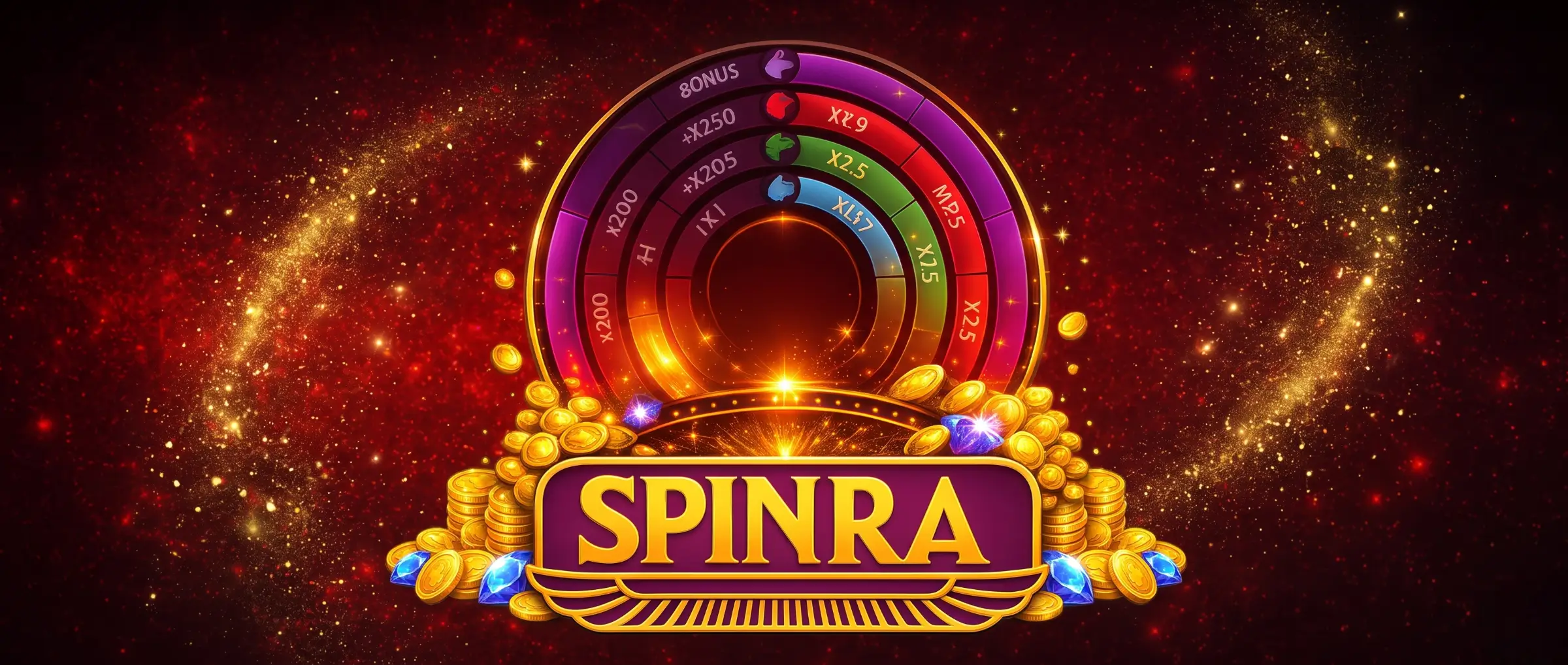
The core mechanic is three concentric rings, each tracking progress through multiple segments. The outer ring (associated with Ra) delivers multipliers up to 200× on completion, with a 300× free cashout available for a full completion. The inner rings (Sobek and Bastet) progress alongside it, with lower individual multipliers that compound with the outer ring’s position. Filling all three simultaneously is the path to the highest payouts.
Each spin of the sacred wheel lands on one of five god symbols. Ra, Sobek, and Bastet advance their corresponding rings. That’s the clean outcome — you pay the bet, progress increases, multiplier rises. The limitation: no single god symbol guarantees which ring advances and by how much. The distribution of progress increments is not published in available materials, which is a transparency issue.
The outer red ring (Ra) carries multipliers from approximately 3.9× in early segments up to 200× on completion, with the 300× reward tied to full three-ring simultaneous completion. The spinra.org affiliate site also cites a 500× max win figure, though this conflicts with the 300× stated on official developer pages. The discrepancy has not been resolved in available documentation — both figures are noted here, and players should verify the active version in the game’s own information panel before playing at real money stakes.
The practical multiplier most players will cash out at sits between 10× and 40×, based on the progression structure and the realistic frequency of Anubis interruptions. Reaching the 100× threshold requires multiple rings to be substantially filled simultaneously, which means multiple consecutive positive spins without regression. The 200×–300× ceiling is a theoretical target rather than a typical session outcome. That is not a criticism unique to SpinRA — it applies to crash games generally — but it needs stating plainly.
Amun: the neutral outcome
Amun is the outcome experienced players will dread most. When the wheel lands on Amun, your bet for that spin is lost, but the rings stay exactly where they are. No regression, no advancement. On paper, this sounds almost neutral. In practice, it means you can lose multiple consecutive bets — paying £2 each time — with zero change in the ring positions. The rings retain their value, but your balance takes consecutive hits. The more progress you’ve accumulated, the more this outcome stings, because you’re sitting on a strong multiplier position that Amun refuses to let you cash out (you can always cash out at any point, but Amun’s bet cost still applies for that spin).
The realistic implication: in extended sessions, expect multiple Amun runs. This is not speculation — the high volatility classification implies exactly this pattern of unproductive spins punctuated by progress bursts.
Anubis and the bonus ring
Anubis is the mechanic that divides opinion. When the wheel lands on Anubis, the rings regress — one or more segments are lost. That’s the bad news. The good news is that each Anubis outcome fills a separate bonus ring. When that bonus ring completes, a mini-slot triggers.
The mini-slot runs three reels with a single payline. Matching symbols — Ra, Sobek, Bastet, and Wild — advance the main rings. The Wild symbol appears to accelerate progress across multiple rings simultaneously, though the exact advancement rules per symbol combination are not confirmed in public documentation.
The Anubis compensation loop is the genuinely interesting design decision here. Instead of Anubis being purely punishing, it feeds a recovery mechanism. In extended sessions where Anubis hits multiple times, the bonus ring charges faster, and the mini-slot fires more frequently. Whether this compensation is statistically meaningful depends on the frequency of the mini-slot and the average ring advancement it delivers — figures that are not available in verifiable form. The design intention is clear; the confirmed math is not.
Payout and Part Payout
After each spin (except Amun, where the bet is simply lost), you choose: cash out now, or continue. The Payout button exits the session at the current multiplier. Part Payout lets you withdraw a portion of the accumulated win while keeping the ring positions for the next spin. This is the strategic layer that distinguishes SpinRA from simpler crash games.
The practical use case for Part Payout: you’ve reached a 40× ring position and want to lock in some return while still pursuing the outer ring’s 200× ceiling. Part Payout requires at least two segments filled per ring before it becomes available. The mechanic is genuinely useful for bankroll discipline — it prevents the all-or-nothing session dynamic that burns players in standard crash formats.
Demo availability and where to play
A demo version exists. SlotCatalog lists SpinRA in 54 countries but had not enabled demo play on their platform as of late February 2026. The official developer site spin-ra.games links through to casino operators rather than hosting an embedded demo directly. In practice, accessing the demo means finding a casino that carries 100HP Gaming’s catalogue and offers a free-play mode — and not all operators do.
The absence of a universally accessible browser demo is a friction point for a game that has a genuinely non-obvious mechanic. SpinRA’s three-ring system and the Payout/Part Payout decision structure take several spins to understand. Running the demo for 30–50 spins before depositing is not a nicety here — it’s the only way to internalise the ring mechanics before real money is at stake. If your chosen casino does not offer free play on this title, find one that does before you commit a deposit.
Casinos with confirmed SpinRA availability across European markets include operators holding MGA licences. The game is not available in the US New Jersey market per SlotCatalog’s scanning data. UK availability should be verified directly with the operator given the evolving regulatory picture for newer instant-game providers in that market.
Playing SpinRA: what the decision points actually mean
The cash-out mechanics are the most analysed aspect of SpinRA in player forums, and the discussion usually misses the point. Most players treat the cash-out decision as a gut-feel moment — do I feel lucky, or do I want to lock in? That framing is wrong, and it costs money.
The correct frame for the Payout decision is: how many additional Amun runs can my current bankroll absorb while still preserving this ring position? If you have 40× on the outer ring and £6 left in your session balance at £1 per spin, you can absorb six more Amun runs before the balance is exhausted. Six Amun runs without positive progress could destroy the cashout opportunity. In that position, cashing out at 40× and rebasing is likely correct, even though 100× is theoretically close.
Part Payout changes this calculation by letting you extract partial value while continuing. The minimum condition of two filled segments per ring before Part Payout becomes available means it is not always accessible at the moment you want it. This is worth understanding before assuming Part Payout is always available as a safety valve.
The Anubis runs are the most emotionally difficult aspect for players coming from crash games. In Aviator, a crash ends the round immediately and you start fresh. In SpinRA, Anubis erases progress you’ve accumulated over multiple spins and bets. The regression is visible, tracked by the ring system, and feels punishing in a way that a crash termination does not. The compensation via the bonus ring is real but delayed — the mini-slot fires after multiple Anubis hits, not immediately. Psychologically, managing that delay is the challenge the game actually tests.
A practical session discipline that applies to SpinRA specifically: set a cash-out target multiplier before you start a session and stick to it. If your target is 15×, cash out at 15× regardless of how close the rings look to 50×. The most common session loss pattern in ring-progression games is players talking themselves out of planned cash-outs because the next threshold seems reachable. The rings are not aware of how much you’ve already spent to reach them.
SpinRA in 2026: how it sits in the instant-game market
SpinRA is not a sequel to anything. It launched in February 2026 as 100HP Gaming’s first title to gain meaningful casino distribution — currently available in 54 countries, though notably absent from the US New Jersey market and from Spribe’s dominant global footprint. No variant, Power Reels, or Megaways version exists at the time of writing.
The comparison that matters most is not against other Egyptian-themed slots but against the crash-and-instant-game category that SpinRA effectively competes in.
Aviator (Spribe): 97% RTP, bet range $0.10–$200, max $10,000 per bet. Provably Fair via SHA-512. Available at hundreds of casinos globally, including most regulated European markets. No buy-bonus, no progressive jackpot. In the UK market, Spribe’s UKGC licence was suspended in late 2025 — UK players should verify current availability before committing. Aviator’s core advantage over SpinRA is volume: larger player communities, more casino integration points, and a longer track record of verified payouts. It is also a fundamentally simpler game — one multiplier, rising continuously, cash out before the crash. There is no ring management, no Amun neutrality cost, no Part Payout to configure. That simplicity is a feature, not a limitation, for players who want a clean single-variable decision.
JetX (SmartSoft Gaming): 97% RTP, multipliers up to 25,000× (operator-configurable), three simultaneous bets per round. Wider max win ceiling than SpinRA’s published 300× and significantly more established in regulated markets. The high-roller proposition here is considerably stronger. JetX also allows up to three parallel bets per round, enabling hedging strategies not available in SpinRA’s single-stake format. For players whose primary interest is chasing high multipliers, JetX is the more direct comparison and offers a structurally superior ceiling.
BGaming Crash: 99% RTP, the most competitive return in the crash genre. Simpler mechanic — watch the curve, cash out, no ring system. No strategic overlay, but the math is clearly in the player’s favour over long sessions. At 99% RTP versus SpinRA’s 96%, a player wagering £1,000 across sessions expects to lose £10 with BGaming Crash versus £40 with SpinRA. That gap narrows if SpinRA’s 97% version is the one your casino carries, but it does not disappear.
Cash or Crash (Evolution): A live game show format with a live host, rising multiplier from a blimp ascent, and a multi-option cash-out system. RTP sits around 96.5% in standard play. The live format adds social texture that SpinRA’s single-player ring system cannot replicate. For players who value the live dealer atmosphere alongside the crash mechanic, Evolution’s version is a direct alternative at a similar RTP.
SpinRA’s 300× ceiling looks modest against JetX’s 25,000× potential and BGaming Crash’s effectively open-ended multiplier. The three-ring system adds strategic texture, and the Anubis compensation mechanic reduces the pure-frustration sessions common in crash titles. But strategic complexity only justifies a lower ceiling if the player values that interaction layer above raw potential. Many do not.
There is no buy-bonus feature — you cannot shortcut to the bonus ring with a fixed purchase. There is no progressive jackpot. For high rollers weighing SpinRA against alternatives, the absence of a buy-in mechanic is a real limitation.
The Provably Fair implementation is confirmed across sources, which puts SpinRA on solid ground compared to titles that rely entirely on operator trust. The <2.5MB client weight means near-instant loading on mobile, and the game runs across all devices without a dedicated app. These are practical advantages in markets where casino lobbies are slot-heavy and instant games load faster than most video slots.
Verdict
SpinRA as a standalone game: For players who find crash games too passive — watching a curve with no input except the cashout timing — SpinRA offers something different. The three-ring system, the Payout versus Part Payout decision, and the Anubis compensation loop create a format that rewards session management. You’re not just clicking one button and hoping. The interaction is genuine, and that genuineness is the game’s strongest selling point.
The ceiling is the limiting factor. At 300× confirmed max win per ring system (with an unconfirmed 500× figure on one affiliate and an unverified 21,100× theoretical maximum that does not appear on official documentation), SpinRA does not compete with JetX or crash titles on raw win potential. The 96% RTP baseline — if that’s the version your casino runs — sits 1–3% below several key competitors in the same category. That gap compounds across long sessions and represents the most significant structural disadvantage the game carries.
The Provably Fair implementation is a genuine plus. For a title from a small independent developer with a limited track record, Provably Fair verification is more important than it would be for a Pragmatic Play or Evolution product with years of regulatory scrutiny behind them. You can verify individual spin outcomes cryptographically, which provides a layer of assurance that standard RNG certification alone does not.
Mobile performance is a practical positive. The sub-2.5MB client means SpinRA loads fast on mid-range devices and 4G connections, which matters in markets where casino games often compete against slow network conditions. The game runs without a dedicated app download, directly in the mobile browser at any supporting casino.
Who this game makes sense for: players with experience of crash and instant games who want more decision points per session, comfortable with high volatility, playing at stakes of £1–£10 per spin with session bankrolls of at least 40–50× per-spin stake. Part Payout is the feature to use aggressively — it’s the one mechanic that separates disciplined SpinRA players from those who simply run the rings until an Anubis regression forces a difficult decision.
Who this game doesn’t suit: high rollers chasing session maximums above 500× stake. Players who want a straightforward cashout-before-crash format without the ring management complexity. Anyone on a tight session budget under £30, where the Amun neutral runs and Anubis regressions can consume the bankroll before a meaningful cashout position develops. And players on platforms where the 96% RTP version is active rather than 97% — the difference is small per spin but real across hundreds of sessions.
On sequels and variants: None exist. The game launched five months ago. If 100HP Gaming follows the trajectory of other instant-game developers, a higher-volatility variant or a simplified version may appear in 2026–2027. There is nothing to compare yet.
At a 96% RTP with a 300× ceiling and no buy-bonus, SpinRA is a niche product with genuine ambition: interesting format, real strategic depth, limited ceiling. It belongs in rotation as a secondary title for instant-game enthusiasts — not a replacement for the established crash titles it is competing against.