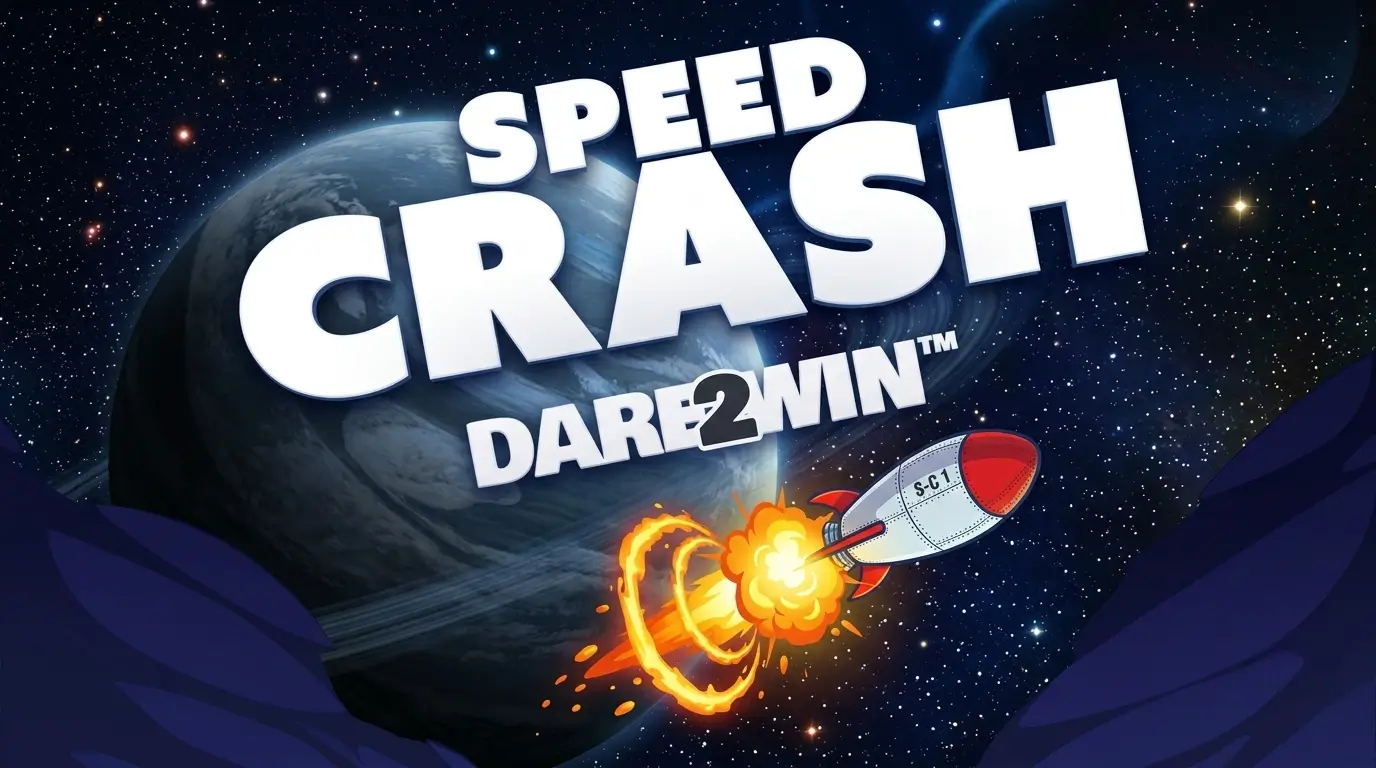
Speed Crash landed in Hacksaw Gaming’s Dare2Win catalogue in August 2024. Less than two years on the market, and it’s already competing in what might be the most crowded genre in iGaming right now. Crash games are everywhere — every provider wants a piece of what Spribe built with Aviator, and the result is a market full of rockets, planes, and multipliers that feel interchangeable. Hacksaw had a choice: bring something genuinely different, or ship a competent follower. Speed Crash is largely the latter.
The core mechanic inverts the standard crash game tension: instead of watching a multiplier climb and deciding when to cash out under pressure, you commit your target in advance. The rocket either reaches it or it doesn’t. No decisions under fire, no emotional cash-out errors. That single design choice separates Speed Crash from most of its competitors in a way that actually matters — though whether it separates it in the right direction depends entirely on your play style.
The 88%–98% RTP range is the number that actually determines whether this game belongs in your rotation, and the zero provably fair implementation is a gap that gets harder to ignore in 2026. Let’s work through what this game is, what it isn’t, and who it actually suits.
Math model and mechanics
RTP: the number that matters most, and the reason to read carefully
Here is where Speed Crash gets complicated. RTP is operator-configurable, and the published range is 88% to 98%. That 10-percentage-point spread is not a footnote — it is the most important fact in this review.
Multiple sources cite different figures. SlotCatalog lists 97%. CrashGaming.guru and CasinoWow report 98%. FluffySpins, a UK-regulated operator, shows 92% as their configured rate. GoodLuckMate’s analysis documents the full 88%–98% range tied to different game IDs.
What does that mean in practice? At 98% RTP, the house edge is 2% — competitive for the crash genre. At 92%, the edge jumps to 8%. At 88%, you are playing a game that returns less than most low-end slots. The difference between a 98% RTP session and an 88% RTP session at £10 per round over 200 rounds is roughly £200 in expected loss vs £24. That is not a minor configuration detail. Always check which RTP your specific operator has configured before depositing — most will publish this in the game’s paytable or help section.
Volatility: variable by design, not by accident
Speed Crash describes its volatility as “variable,” which sounds like marketing language but is technically accurate here. The reason: volatility is not fixed at the game engine level. It scales directly with your chosen target multiplier.
Set your target at 1.05x and you are playing low volatility. The rocket almost always reaches 1.05x — returns are frequent and tiny. Set your target at 1,000x and you are playing extremely high volatility. Most rounds will return nothing; when the target hits, the payoff is massive. The practical implication: your bankroll management approach needs to change based on what multiplier you are targeting, not just your bet size.
This is one of Speed Crash’s genuinely smart design decisions. Most crash games force you to choose volatility at the cash-out moment under pressure. Speed Crash lets you commit your target in advance, which removes the emotional decision-making from the equation.
To put the volatility spectrum in concrete terms: at a 2x target, your probability of winning on any given round is roughly 50% (minus the house edge). At 10x, it is roughly 10%. At 100x, around 1%. At 1,000x, you are looking at approximately one hit in a thousand rounds. A 1,000-round Autoplay session at £1 per round (£1,000 total at risk) would statistically return around one 1,000x win — £1,000 — but that is a statistical expectation across millions of sessions, not a guarantee within any individual 1,000-round block. In practice, variance at those multiplier levels means you could hit in round five or round 998. Most sessions at high targets end without a hit.
The takeaway: players who target high multipliers should size bets at a fraction of their total session bankroll — ideally 0.5%–2% per round — to survive the dry spells that the math guarantees will come. Players targeting low multipliers (2x–5x) face a different problem: a single bad streak at 5x (where the crash happens at 1.05x repeatedly) drains a session faster than the steady returns suggest. Neither approach is safe against a poorly configured RTP. Which brings us back to checking your operator’s rate.
Grid, paylines, and win conditions
There are no reels and no paylines. Speed Crash is an instant-win crash game. The mechanic is straightforward:
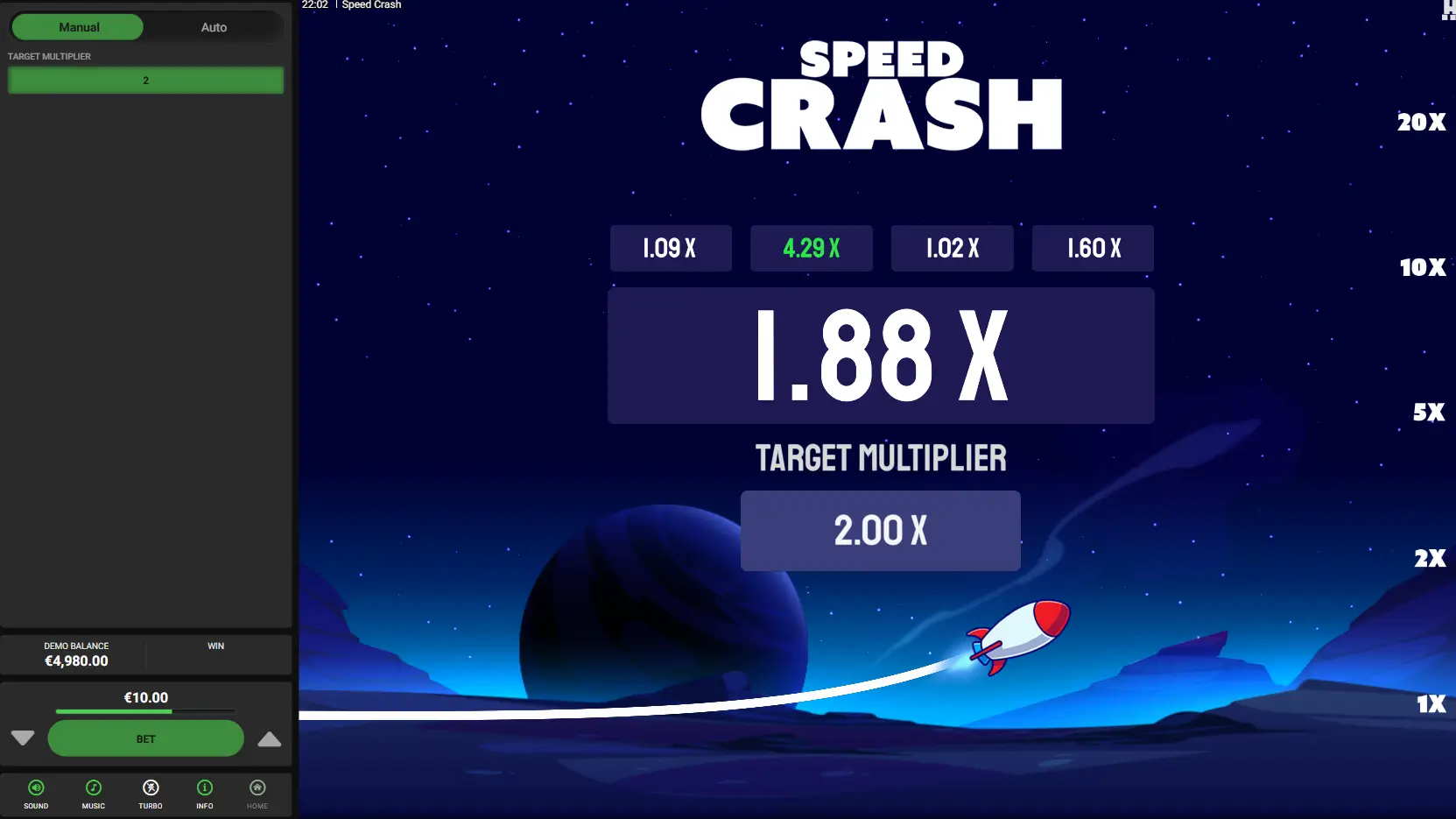
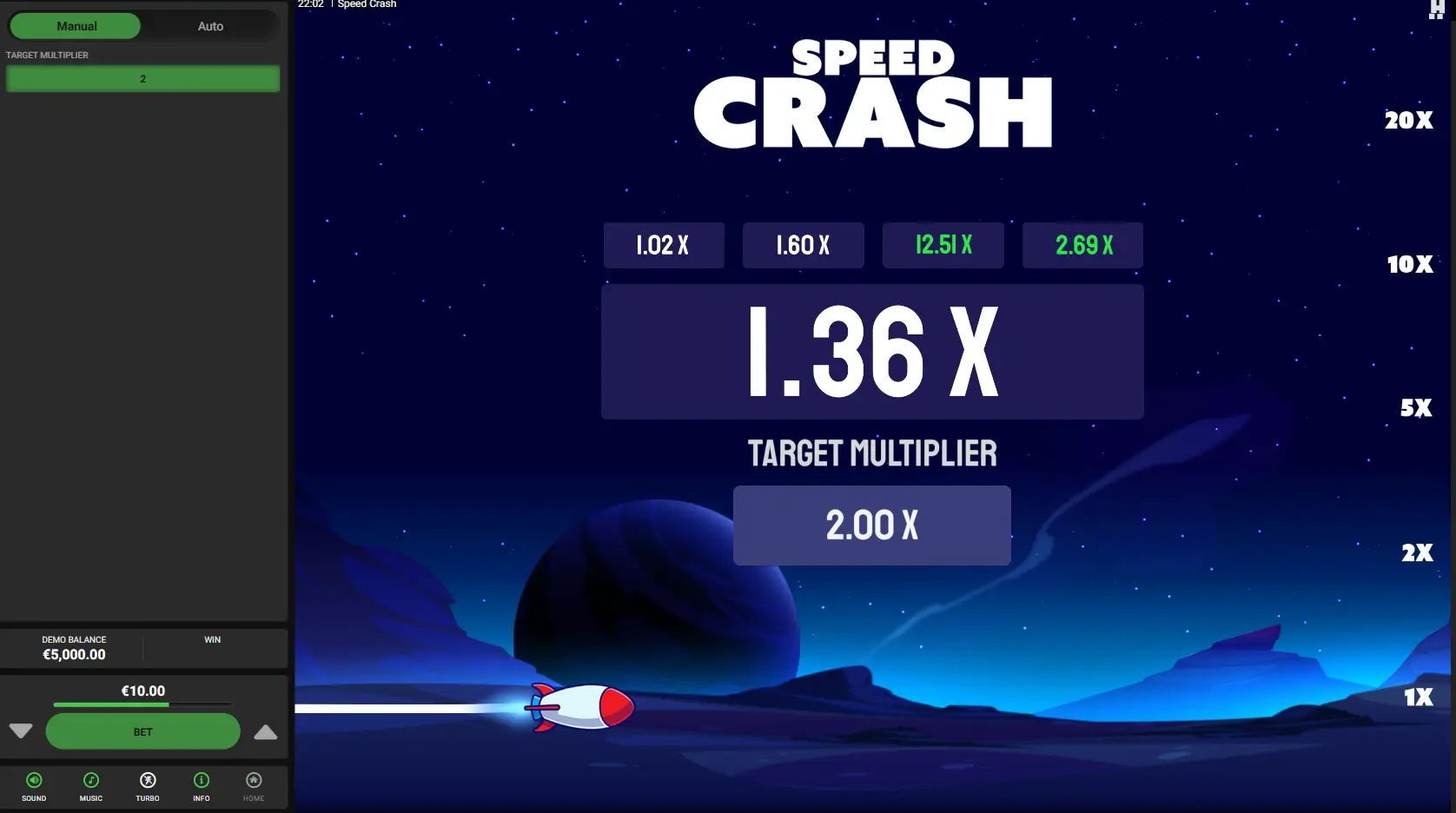
You select a target multiplier between 1.05x and 10,000x and a bet amount between £0.10 and £100. Press Bet. A large number climbs from 1.00x upward. If it reaches or exceeds your target before crashing, you win: bet × target multiplier. If the number crashes below your target, the bet is lost.
The “increasing multiplier” is the only mechanical feature — it is the core of the game, not a bonus layer on top of something else. There are no bonus rounds, no scatter triggers, no side games. The game does exactly one thing.
Max win ceiling and competitive context
10,000x max win on a maximum bet of £100 produces a theoretical ceiling of £1,000,000. In isolation, that sounds impressive.
In context, it is competitive but not dominant. Aviator by Spribe technically has no hard multiplier cap (the highest recorded outcome exceeded 50,000x in 2024). JetX by SmartSoft is also casino-capped rather than hard-coded. BGaming Crash sets a ceiling of 1,000,000x with a published 99% RTP. Space XY caps at 500x but lets you partial cash-out.
Speed Crash’s 10,000x is a real ceiling — at the target multiplier maximum. It is higher than Spaceman’s 5,000x ceiling, roughly equivalent to most regulated crash titles, and meaningfully lower than the uncapped alternatives. For a player chasing genuinely extreme long-shot multipliers, this is not the game.
Feature breakdown
Increasing multiplier
Trigger: automatic on every round — no condition to activate, no player action required.
The multiplier starts at 1.00x and climbs upward. The speed and pattern of that climb are determined by the certified RNG. There is no predictable pattern. If your pre-set target is reached before the crash event, your bet is settled at that multiplier. If not, the round ends as a loss.
The practical ceiling is set by your target, not by the multiplier itself. If you target 10x and the multiplier reaches 8,482x before crashing — you win 10x, not 8,482x. This is an important distinction that some new players miss. You are not cashing out at the live multiplier. You are committing to a target in advance.
One limitation: you cannot change your target mid-round. Once you press Bet, the target is locked. This is philosophically opposite to how most crash games work (where manual cash-out is the primary tension mechanic). Speed Crash removes that tension by design — which some players will find calming and others will find frustrating.
Autoplay
Trigger: player-activated before the first round.
Autoplay allows you to pre-set a number of rounds and a fixed target multiplier, then let the game run without manual input. The maximum Autoplay session is 1,000 rounds — among the highest in the crash genre (CrashGambler.io notes that competitors like Aero cap at 100 rounds).
The Autoplay implementation includes configurable win and loss limits: preset caps of 10x, 20x, or 75x your bet, or a custom limit. This matters for responsible bankroll management — a 1,000-round Autoplay session at £5 per round on a missed target would cost £5,000 without loss limits. The tool is there; use it.
The honest limitation: Autoplay here is static. You set one target multiplier for the entire session. Competitors like JetX allow three simultaneous bets per round with independent targets — a tactically richer approach. Speed Crash’s Autoplay is functional but basic.
Turbo Play
Trigger: player-activated. Availability varies by operator and jurisdiction.
Turbo Play accelerates round speed. It does not change RTP, volatility, or any mechanic — it just runs rounds faster. For players doing Autoplay sessions, this reduces the real-time duration without affecting the expected mathematical outcome.
The caveat: Turbo Play is not available in all markets. CasinoWow explicitly notes it is restricted to “select operators within select jurisdictions.” UK-facing operators under UKGC rules have historically restricted speed-up features. Check your operator’s game build before counting on it.
Strategies and how to approach Speed Crash
The honest starting point: no strategy changes the underlying math. Speed Crash runs on a certified RNG — each round is independent, and no sequence of previous outcomes tells you anything about what happens next. The crash point at 1.05x on round 50 does not make a 100x outcome more likely on round 51. It never does. Anyone describing “pattern recognition” for crash games is selling snake oil.
What strategy can do is manage variance within the expected return. Here is how the main approaches actually work in practice.
Fixed low-multiplier targeting
Choose a target between 1.5x and 3x. Set Autoplay for 100–500 rounds. The idea: hit frequently, accumulate small returns, leave before variance turns against you. At 2x, you win roughly half the time (minus the house edge). At the 98% RTP configuration, this gives you a long-run expected loss of 2% of total turnover — manageable for entertainment purposes.
The catch: at 2x targeting, a bad streak of 15–20 consecutive losses is statistically normal and will happen. On £5 bets, that is £75–£100 gone before a single win. Players who have not prepared for that psychologically often abandon the strategy at the worst moment.
High-multiplier single-round targeting
Set a target of 100x or higher. Place a small bet — 0.5%–1% of your session bankroll. Run a capped Autoplay (50–100 rounds). Accept that most sessions will result in total loss of that bankroll, with the occasional large hit that compensates across many sessions.
In practice: £1 per round at 100x target. 100 rounds = £100 total at risk. Expected statistical hit frequency: roughly 1 in 100 rounds. One session in 100 might return £100. Across 100 sessions at this profile, the math roughly breaks even at 97%–98% RTP, with heavy negative skew possible in any individual block.
This is the highest-variance approach Speed Crash supports. At the 88% RTP configuration, the same math returns approximately £88 per £100 wagered over time. Not worth running at a low-RTP operator.
The split target approach (what Speed Crash does not offer)
Worth naming explicitly because players coming from JetX will expect it: Speed Crash does not support simultaneous bets at different multipliers within the same round. You can only hold one active target at a time. The ability to hedge — a conservative 2x bet alongside a speculative 50x bet in the same round — is not available.
If that feature matters to your play style, Speed Crash is not the right game. JetX is the alternative.
Autoplay session limits — the most underrated tool
Whatever targeting strategy you use, set explicit win and loss limits in the Autoplay configuration. Speed Crash allows custom limit settings. A session that runs past sensible bankroll thresholds without limits is simply the game draining your deposit on autopilot.
Practical setup: on a £100 session bankroll at £1 per round, a loss limit of £50 (50% of bankroll) and a win limit of £50 profit (stop if session bankroll reaches £150) creates a defined outcome envelope. The game will stop automatically at either boundary. This is not strategy in the game theory sense — but it is the single most effective tool for keeping speed crash sessions within intended parameters.
Sequels and variants
As of mid-2026, Hacksaw Gaming has not released a sequel or variant to Speed Crash within the Dare2Win catalogue. No Megaways version, no Power Reels equivalent, no Speed Crash 2. The game stands alone as Hacksaw’s single crash title.
This matters for long-term lobby relevance. Pragmatic Play continually expands Spaceman’s presence through operator integrations. Spribe has released multiple follow-up titles (Balloon, Chicken, Mines) to complement Aviator’s ecosystem. Hacksaw has Wanted Dead or a Wild and Chaos Crew dominating their slot portfolio — Speed Crash appears to be a catalogue addition rather than a franchise investment.
Direct competitor comparison
Aviator — Spribe RTP: 97% (operator-configurable to as low as 88%). No hard max multiplier cap; highest recorded outcome 50,000x+. Core differentiator: social layer (live chat, rain promos, player feed showing others’ wins). Provably fair via blockchain verification. The most-played crash game globally in 2026.
Speed Crash comparison: Speed Crash’s RTP ceiling (98%) beats Aviator’s standard 97%. Speed Crash’s max win at 10,000x falls well below what Aviator can theoretically produce. Speed Crash has no social features whatsoever — single-player only. Aviator’s provably fair model gives it a trust advantage with crypto-native players.
Spaceman — Pragmatic Play RTP: 96.56%. Max multiplier: 5,000x. Core differentiator: 50% partial cash-out — you can recover half your stake on a losing round. Available at regulated operators in most European markets.
Speed Crash comparison: Speed Crash’s RTP ceiling beats Spaceman’s 96.56% under the right operator configuration, but the gap closes or reverses under a low RTP game ID. Spaceman’s partial cash-out is a genuine mechanical innovation that Speed Crash does not match. Spaceman’s brand recognition and lobby placement at major European operators is significantly stronger.
JetX — SmartSoft Gaming RTP: 97%. No hard multiplier cap (casino-defined). Core differentiator: three independent bets per round with separate auto-cashout settings. Progressive jackpot linked across casinos. Available widely in Asian and emerging markets.
Speed Crash comparison: JetX’s multi-bet system offers strategic depth Speed Crash simply does not have. The progressive jackpot layer adds a community-pull that single-player crash titles lack. Speed Crash’s advantage is cleaner UI and potentially higher RTP at the right operator. JetX’s maximum win is theoretically unlimited; Speed Crash caps at 10,000x. JetX has also built a stronger footprint in South Asian markets — Bangladesh, India — where crash games have a dedicated following that Speed Crash is still building.
Evolution Cash or Crash — Evolution Gaming RTP: up to 99.59%. Max win: 50x (hard cap). This is the outlier: the highest published RTP in the crash game category, paired with the lowest win ceiling. If you are purely optimising for house edge, Evolution’s offering returns more in expected value. If you want any real upside, 50x is restrictive.
Speed Crash sits between these poles — 98% RTP potential, 10,000x ceiling. The actual best combination of RTP and win ceiling in the market depends entirely on your operator configuration. But the theoretical pairing (98% + 10,000x) is genuinely competitive against everything except BGaming’s outlier 99% + 1,000,000x product.
Buy-bonus mechanic
Speed Crash has no buy-bonus option. In 2026, for crash games, this is mostly irrelevant — the concept does not translate from slots to crash mechanics, since there are no bonus rounds to purchase access to. The absence should not be counted as a weakness. It is simply not applicable to the format.
Progressive jackpot
No progressive jackpot. This is a genuine differentiator versus JetX, which runs linked progressive pools across casino partners. Players motivated by jackpot potential should note the gap. Speed Crash’s 10,000x max win is fixed and player-specific — it does not accumulate across sessions or players.
Mobile and demo availability
Speed Crash is built in HTML5 and runs in-browser on iOS and Android without a dedicated app requirement. The game size is 5.7MB — lightweight enough to load cleanly on mid-range Android devices under mobile data conditions. Hacksaw’s production quality carries over: the interface scales correctly on smaller screens, and the single-action betting mechanic (one target multiplier input, one Bet button) suits touch controls better than games with more complex interfaces.
Demo play is available at most aggregator and review sites without registration. This is worth using not because the demo teaches you anything about the live RNG (it does not — demo mode often uses a different statistical model from the real-money game) but because it lets you test the UI, understand how the target input works, and confirm whether the Turbo Play feature is available on your intended operator’s build.
One note on the demo: some operators surface the game under the “Speed Crash Dare2Win” label, referencing the Dare2Win catalogue branding. It is the same game.
The crash game category has matured. In 2024, Hacksaw’s entry into the genre was a reasonable catalogue decision. In 2026, the question is whether Speed Crash earns active player time or quietly populates the “crash” filter without getting clicks.
Honestly: it sits in the middle tier. The RTP ceiling is competitive. The max win is real. The game does what it promises. What it lacks is a reason to choose it over Aviator if you want social play, over Spaceman if you want partial cash-out flexibility, over JetX if you want strategic multi-bet control, or over BGaming Crash if RTP is your primary metric.
Hacksaw’s real value proposition here is brand trust among players who already play Wanted Dead or a Wild and Chaos Crew — and want a crash option from the same house. That is a legitimate, if narrow, audience.
Verdict
Speed Crash — who it actually suits
The right player for this game: Someone who already trusts Hacksaw Gaming from their slot portfolio and wants a crash option in the same casino without switching providers. Someone who prefers commitment-style betting (pre-set target, no in-round decision-making) over the live tension of manual cash-out games. Someone whose operator runs a 97%–98% configured game ID — which you should verify before your first real-money round, not after.
The pre-set target mechanic is Speed Crash’s most distinctive feature in practice. It is not the most common approach in the crash genre, and that is either its advantage or its disadvantage depending on your temperament. If you find yourself cashing out too early on Aviator, chasing multipliers you should have held, or hesitating under pressure — Speed Crash removes that decision entirely. You pick your number, you press Bet, you either hit it or you don’t. There is a psychological cleanliness to that.
The wrong player for this game: Anyone chasing a social experience. Speed Crash is single-player, silent, and isolated — no player feed, no chat, no shared context. Aviator’s social layer is genuinely different from anything Hacksaw has built here, and if that matters to you, the answer is Aviator.
Anyone who wants multi-bet strategy should go to JetX. Speed Crash’s one-target-per-round limitation is not a flaw in the game’s design — it is a deliberate simplification — but it forecloses a category of play that experienced crash players have come to expect.
Anyone who wants verified provably fair outcomes should note that Speed Crash uses eCOGRA-certified RNG rather than blockchain-verified provably fair. That is a meaningful trust difference for a segment of the crash game audience, particularly in crypto-first casinos.
The number that defines this game
88% to 98% RTP. Not the 10,000x ceiling. Not the Autoplay limit. The RTP range is the number that determines whether Speed Crash is a good game or a bad one — and that number is set by your operator, not by Hacksaw.
At 98%: a competitive crash game with a real max win ceiling and clean mechanics. Worth the time.
At 88%: one of the least player-friendly crash games on the market. Not worth the time.
Verify before you play.