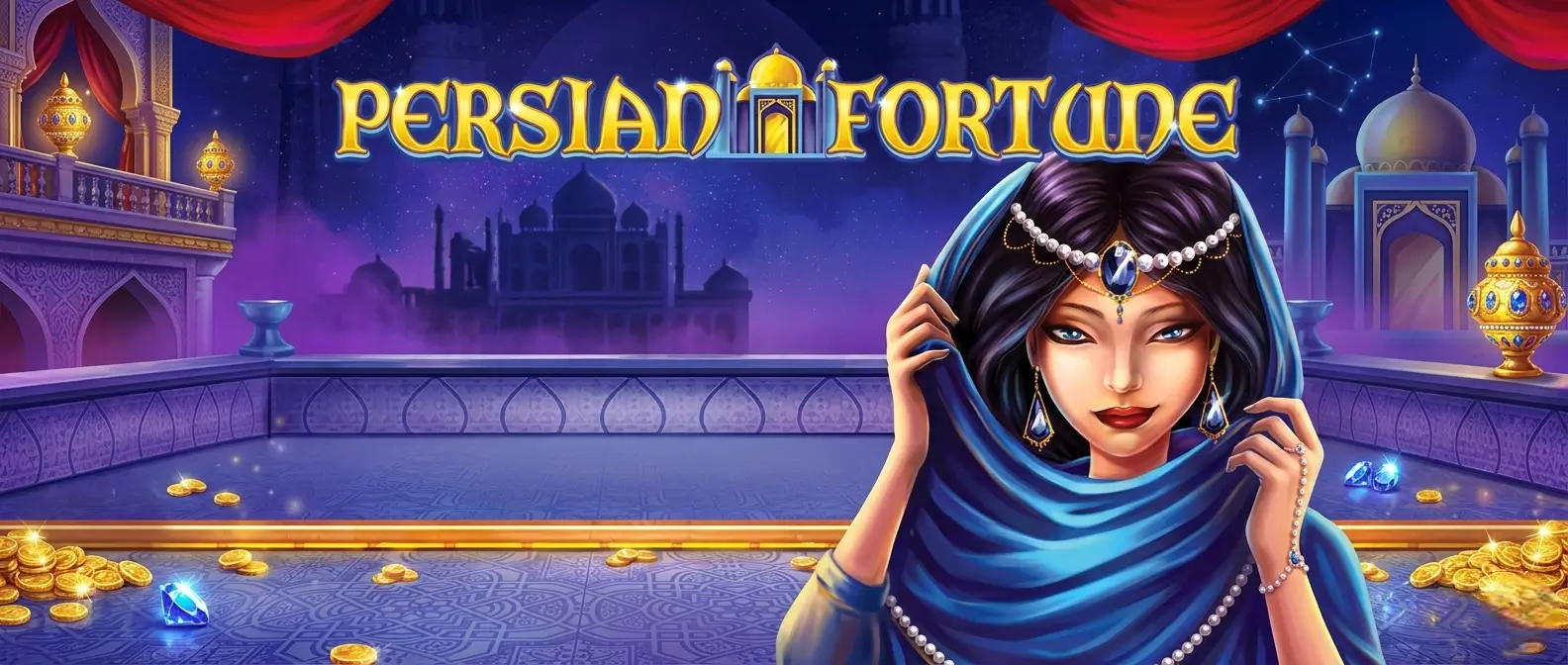
There is a peculiar kind of staying power some slots develop when the industry wasn’t looking. Persian Fortune dropped back in October 2016 — a time when Red Tiger was still a newcomer trying to claw space away from NetEnt and Microgaming. Nearly a decade on, the game still circulates through casino lobbies. That alone is worth pulling apart. What makes a slot from 2016 relevant in early 2026, and more importantly, what are you actually getting into when you sit down with it?
This is not a puff piece. Persian Fortune has real qualities, real limitations, and at least one honest comparison problem that plenty of reviewers have skated around for years. Let us go through all of it properly.
A Brief History of Red Tiger and Where This Game Fits
Red Tiger Gaming was founded in 2014 on the Isle of Man, which makes the company young by the standards of the industry heavyweights it was competing against from day one. In their first two years, they were building catalogue, establishing relationships with operators, and proving that they could produce games that justified shelf space alongside established names.
Persian Fortune, released in October 2016, came during that early catalogue-building phase. It was one of the titles that demonstrated what Red Tiger’s design philosophy looked like in practice: a strong central mechanic (cascading reels with multipliers), an accessible theme, genuine feature variety without overcomplicating the base rules, and enough visual polish to not look embarrassing in a lobby alongside NetEnt and Microgaming titles.
The company was acquired by NetEnt in 2020, and subsequently became part of the Evolution Gaming group when Evolution acquired NetEnt later that same year. This is now Persian Fortune’s corporate context: a game built by an independent studio that is now part of the largest live casino provider in the world. The practical effect on Persian Fortune itself has been distribution — access to a vastly wider network of operator partners means more casino lobbies carry the game than would have been possible under the original Red Tiger independently.
Red Tiger went on to build a substantial and award-winning catalogue after Persian Fortune. Games like Gonzo’s Gold, Dragon’s Fire, and their Megaways collaborations showed significant mechanical and visual evolution from what was possible in 2016. Persian Fortune, viewed from 2026, represents the studio’s early period — technically sound and commercially viable, but preceding the design iterations that would define their reputation in the early 2020s.
The Theme: Persia, Sort Of
Red Tiger set the stage inside an ornate balcony framed by carved stone pillars, drenched in the kind of soft moonlight that makes everything look like a fantasy illustration. The colour palette leans heavily on deep blues and purples — rich, nocturnal, with the faint suggestion of something valuable sitting just out of reach.
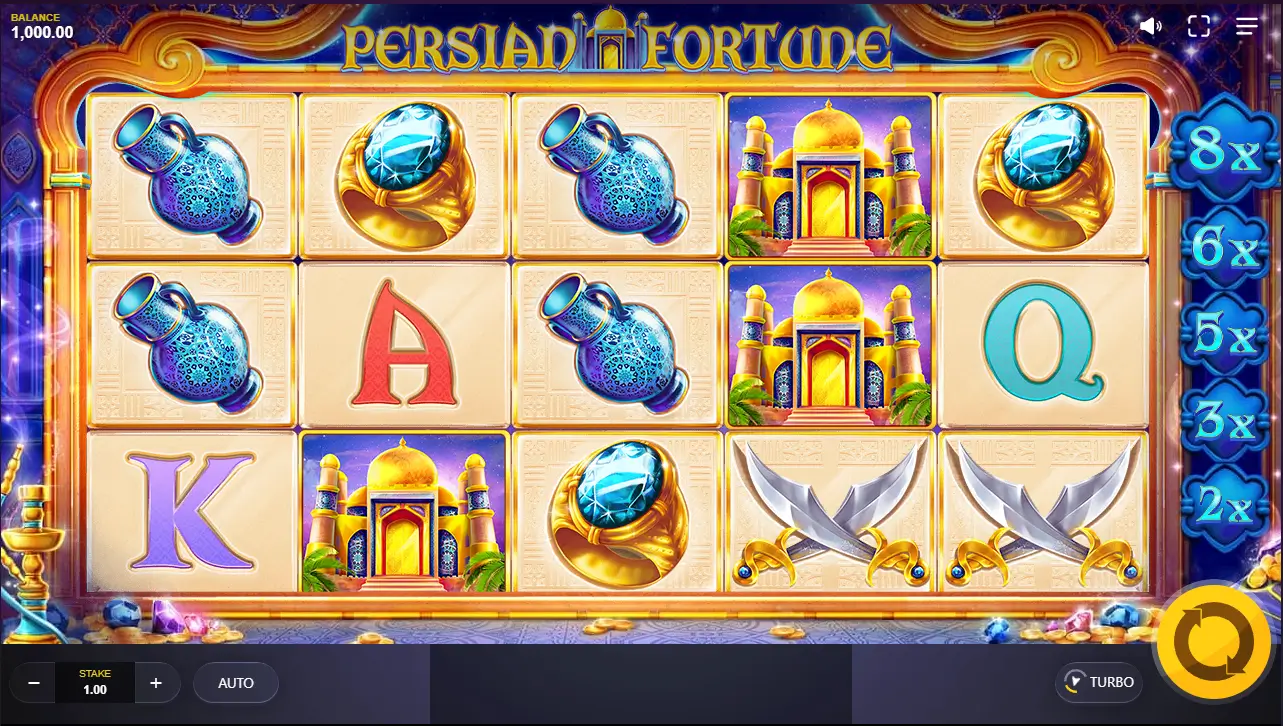
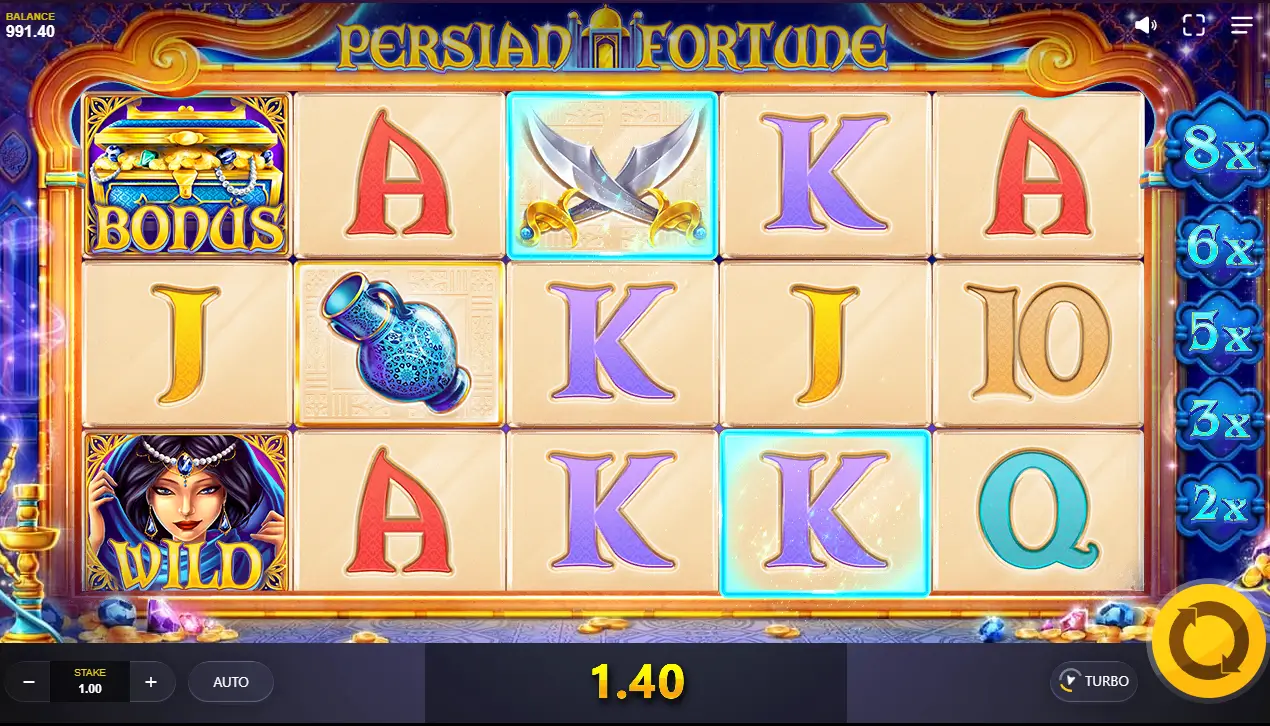
The symbol set does a reasonable job of selling the aesthetic. You get a Persian palace, two crossed scimitars, a diamond-encrusted golden ring, an ornate blue vase, and the standard card ranks from ten through Ace. The wild is a Persian princess rendered in proper portrait style, and the scatter is a carved treasure chest. The visual quality holds up better than you might expect for a game of this age — Red Tiger always invested more in their art direction than the genre typically demanded.
One thing worth noting: several review sources describe elements as “Indian” rather than Persian — temples, jewellery, the princess. There is a degree of geographic blurring here that the studio probably could have avoided, but the general atmosphere of ancient Middle Eastern wealth comes through clearly enough. Nobody opens this game expecting a history lecture.
The soundtrack is ambient, loops without becoming grating, and sits at a volume level that does not require immediate muting. These are small mercies, but experienced players will appreciate them.
Symbol Payouts and What They Actually Pay
Understanding the paytable of Persian Fortune is worth more than a quick glance because the numbers are calibrated around the multiplier system — base symbol values are deliberately modest precisely because the game expects you to collect those wins across cascades rather than in a single hit.
The highest-paying symbol is the Persian princess, who doubles as the wild. Five of her on a payline returns 200 coins at base bet level. Four returns 80 coins. Three returns 40. The second-ranked symbol, the palace, pays 160 coins for five, 60 for four, 30 for three. The golden ring slots in below that at 120/50/24, and the crossed scimitars follow at 80/40/20. The blue vase and the card rank symbols (10 through Ace) fill the lower end, with five of the same card rank paying between 30 and 50 coins.
These numbers look unremarkable in isolation. The context that matters is the multiplier. A 200-coin base win on the princess symbol at the 8× multiplier stage of the Chain Reaction Bar becomes 1,600 coins on that single combination. Layer in that this can happen while a Mega Tile of the same symbol is covering multiple reel positions simultaneously, and the arithmetic changes substantially. That is the game’s entire mathematical argument for sitting through sessions where the base game pays conservatively: the combination of cascades, multipliers, and Mega Tiles can concentrate a lot of value into a short burst.
The practical tension in any session is that you will spend a majority of your time in the lower multiplier stages — most winning spins produce only one or two cascades before the chain breaks. Reaching the upper multiplier tiers requires consecutive wins that do not always cooperate. Players who track their sessions report that 5× and 8× cascade sequences are genuinely rare, which aligns with what the medium-to-high volatility profile would predict.
The Mechanics: Cascading Reels Done Properly
The foundational mechanic here is what Red Tiger called “tumbling reels” at the time of release — symbols fall from above rather than spinning, winning symbols disappear, and new ones drop in to fill the gaps. Today you would call these cascading reels, and the concept is everywhere. In 2016 it was still fresh enough to be a genuine differentiator.
The cascade system in Persian Fortune works in a straightforward way. Land a win on the initial drop. Those symbols vanish, new ones fall. If the new formation also creates a win, the cascade continues. This chain can theoretically run for as long as winning combinations keep forming, which is the mechanism that allows for bigger-than-expected payouts from a single spin credit.
The Chain Reaction Bar sits to the right of the reels and is where things get genuinely interesting. The multiplier track runs through the values 1×, 2×, 3×, 5×, 6×, and 8×. Each consecutive winning cascade moves you one step up this bar. Your first win pays at base value. Your second win in the same spin sequence pays at 2×. By the time you reach six or more cascades on the same spin, your wins are being multiplied eightfold. The bar resets when no more winning combinations form, and resets again at the start of each new spin.
This multiplier structure is the primary reason players chase the game. Getting a long cascade chain is relatively uncommon, but when it happens, the payout jump from landing at 8× is felt immediately. The problem — and this is a real one — is that the base game pays in small increments during normal play precisely because the game is calibrated around the possibility of these chain events. Outside of a decent cascade, single-spin returns are modest.
The Features: Three Mechanisms, One Main Event
Mega Tiles
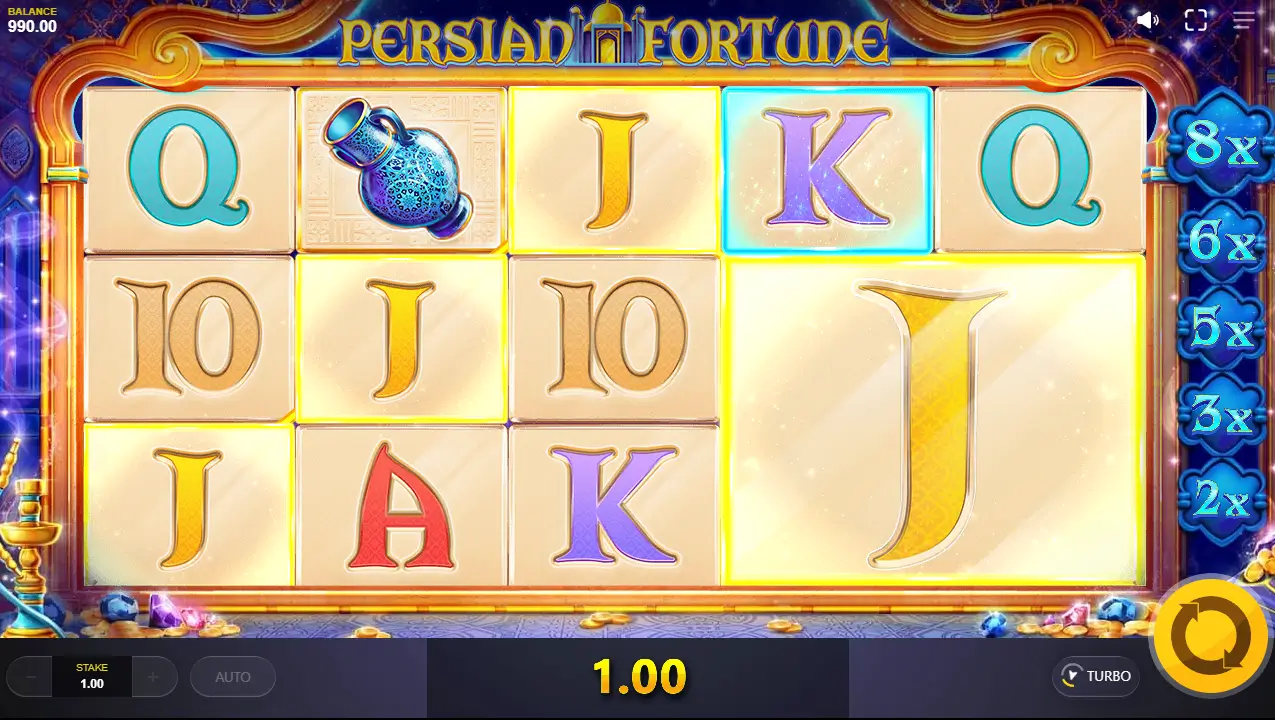
At any point during base game spins, regular symbols can appear as 2×2 or 3×3 blocks. These colossal versions occupy multiple positions simultaneously. Each position counts individually for combination purposes, so a 3×3 mega tile of the palace symbol effectively places nine identical symbols across three reels at once. This creates strong conditions for winning — a single mega tile of a high-value symbol across reels 1 to 3 generates several line wins in one hit.
Mega tiles appear randomly and cannot be triggered intentionally. They are the most dramatic visual event in the base game and account for a significant portion of those sessions where Persian Fortune feels like it is overperforming expectations.
Persian Magic
During any spin, one or more symbols can be highlighted with a glowing magical frame. If that highlighted symbol ends up contributing to a winning combination, two things happen. First, you receive a respin. Second, all previously framed symbols transform into wild symbols for the duration of that respin. The wilds can then complete additional combinations or extend a cascade sequence.
The Persian Magic feature activates randomly and cannot be relied upon, but it fires with enough regularity to become a meaningful session variable. It is the kind of feature that occasionally turns a modest spin into something worth noting, and the wild transformation on the respin is genuinely well-designed — there is actual tension in watching whether the newly created wilds will connect.
Magic Carpet Bonus
This is the main event, and the only feature that requires deliberate triggering through scatter symbols.
Land three or more treasure chest scatters anywhere on the reels simultaneously, and you enter the Magic Carpet Bonus screen. You are presented with 14 gold tiles. Behind each tile lies a gemstone — and the objective is to reveal three matching gemstones. The prize values attached to each gem combination are as follows:
- Three matching purple gems: 18× your bet
- Three matching blue gems: 38× your bet
- Three matching green gems: 138× your bet
- Three matching red gems: 888× your bet
You pick tiles in sequence, and the session ends either when you have collected three of the same gem or when you have eliminated all possibilities. It is possible to collect multiple partial matches before the round concludes, meaning you can leave with more than one payout if you collect two of one type and then continue to find a different matching set.
The top prize of 888× is the listed maximum win for this game. To put that in context with the bet range: at the maximum €60 stake, 888× returns €53,280. At the minimum €0.20 stake, the same multiplier returns €177.60. The bonus is pick-and-reveal style with no skill element — the outcome is determined before you start selecting, and you are navigating toward it rather than influencing it.
The difficulty with this bonus is getting there. Three scatter symbols landing simultaneously across five reels on a 3-row setup is not a frequent occurrence. Many players report extended sessions without triggering the Magic Carpet Bonus at all, which is consistent with the medium-to-high volatility profile of the game.
One critical note: Persian Fortune has no free spins feature. There is no free games round. This is a deliberate design choice by Red Tiger, and it is the single most polarising aspect of the game among players who come to it expecting a traditional free spins mode. You get a pick-and-win bonus or you do not. There is no extended free spins sequence that can recover a dry session.
RTP: The Number That Requires Honesty
Multiple sources publish different RTP figures for Persian Fortune. You will see 94.17% on some platforms, 95.20% and 95.51% on others, and some aggregators cite 96% or 96.14%.
This discrepancy is real and reflects standard industry practice, not errors. Red Tiger licenses its games to operators who may deploy different RTP variants. A casino on a lower-RTP configuration might run this game at 94.17%, while another property on a different contractual tier runs the same title at 96%. The certified RTP from Red Tiger’s own documentation sits around 95–96%, but the version you play at any specific casino may not match that figure.
This matters in practice. A slot with 94.17% RTP and medium-to-high volatility plays meaningfully differently than the same game at 96%. The gap represents a significant difference in expected return over a session of several hundred spins. If you care about this — and you should — checking the specific RTP at the casino you are playing is worth the thirty seconds it takes to look at the game’s help screen.
Volatility and Bankroll Reality
The game is often described as medium volatility in older reviews, but real session data and more recent analysis from multiple sources describes it as leaning toward the higher end of medium, effectively medium-high. The combination of a capped maximum win at 888×, multipliers that only activate on consecutive cascades, and a scatter-triggered bonus that requires three simultaneous hits means that dry stretches are common.
The practical advice that circulates among regular players is consistent: enter with at least 150–200× your intended stake as a bankroll buffer. At €1 per spin, that means €150–€200 minimum. This is not pessimism — it is a reflection of how the variance actually plays out across enough sessions to form a realistic picture. Players who load up with 20–30 spins worth of budget routinely find the game cold before anything meaningful fires.
The flip side is genuine. When the conditions align — a mega tile appearing, Persian Magic activating simultaneously, cascades building up the multiplier chain — the game can produce striking payouts in a short window. The ceiling of 888× is not astronomical by 2025–2026 standards (plenty of modern slots offer 5,000× or more), but it is reachable through normal gameplay without requiring a bonus buy or any specific alignment of moon and stars.
How It Compares to Gonzo’s Quest (and Why This Comparison Never Quite Dies)
The comparison to NetEnt’s Gonzo’s Quest is the one this game cannot escape, and it is worth addressing directly. Both use cascading reels. Both use an ascending multiplier on consecutive wins. Both released within a few years of each other (Gonzo was 2011). The mechanic overlap is real.
Where they differ: Gonzo’s Quest has a free spins round with a multiplier that reaches 15×. Persian Fortune caps base game multipliers at 8× and substitutes the free spins with a pick-and-win bonus. Gonzo’s artwork is more polished in a detailed way; Persian Fortune’s background and pillars are more painterly. The base game hit frequency of Persian Fortune is generally reported as slightly higher, but the absolute maximum win potential in Gonzo’s free spins round (where the 15× multiplier can combine with strong symbol combinations) tends to produce larger single-round results.
If you are a Gonzo loyalist who has never tried Persian Fortune, it is worth a demo session. It plays differently enough to have its own identity despite the mechanical similarities. If you have already spent years with Gonzo and are hoping Persian Fortune fills the same function with a different coat of paint — the answer is partly yes, but the absence of a genuine free spins mode is a meaningful distinction.
Mobile Performance
Persian Fortune is an HTML5 game, which means it runs in any mobile browser without download or installation. The 5×3 grid translates cleanly to portrait mode on standard smartphone screens. The cascading animation looks fine at mobile resolution — individual symbols are large enough to track during a rapid cascade sequence, and the Chain Reaction Bar remains readable on smaller screens.
The bet controls are straightforward: spin, autoplay, and bet adjustment all accessible without navigating menus. Red Tiger’s mobile optimisation across their entire catalogue has historically been a strength, and Persian Fortune — despite predating much of the current mobile-first design era — does not feel awkward on a phone.
What Players Actually Say: Unfiltered Reception
Player opinion on Persian Fortune, collected across review sites and casino forums over the better part of a decade, divides into two fairly distinct camps that have not really shifted since the game launched.
The first camp finds the game genuinely engaging. They like the visual activity — something is always happening, the cascades create a sense of momentum even when the payouts are small, and the Mega Tiles generate the kind of sudden-surprise moments that make a session feel alive. Players in this group often describe Persian Fortune as underrated, capable of delivering unexpectedly large returns during hot cascade sequences, and more interesting than similarly themed competitors. The comparison to Gonzo’s Quest comes up constantly in this camp’s language, and the general consensus is that Persian Fortune pays out with higher frequency in the base game even if the absolute ceiling is lower.
The second camp is more critical. Their objections cluster around a few consistent points: the base game feels flat during cold stretches, the Magic Carpet Bonus is difficult to trigger and underwhelming in structure when it does land, and the absence of any free spins mode leaves a gap that the pick-and-win bonus does not adequately fill. Some players in this camp describe the game as a Gonzo’s Quest imitation that removes the elements that made the original special without adding enough to justify the substitution.
Both perspectives are honest and neither is wrong — they are describing the same game through different expectation frameworks. If you are primarily interested in a dynamic base game with visual variety and a multiplier progression system, Persian Fortune delivers that reliably. If you require a free spins round as the centrepiece of your session experience, you will find its absence consistently frustrating regardless of how other elements perform.
The observation that occasionally appears in older player discussions — that the game’s base spins feel “boring” outside of feature events — is legitimate. There is a meaningful difference between a session in which Mega Tiles and Persian Magic regularly punctuate the action versus one in which neither fires for fifteen consecutive spins. The variance between these two session types is one of the defining characteristics of playing the game.
Honest Assessment: Who Is This Game For in 2026?
Here is the direct version.
Persian Fortune in early 2026 is a nearly ten-year-old slot that remains in active distribution because the core mechanics still function. It is not a game that has aged poorly — the cascading multiplier system, the mega tile feature, and the Persian Magic respin all hold up as coherent design choices. The visual style is dated compared to what studios like Hacksaw, Push Gaming, or Nolimit City produce today, but it does not look broken or cheap.
The absence of free spins is a limitation that matters more now than it did in 2016. Player expectations in the intervening decade have been substantially shaped by games that offer extended free spins sequences where the real entertainment and the bulk of significant wins concentrate. Persian Fortune’s pick-and-win bonus is functional, and the 888× top multiplier through it is meaningful, but it does not generate the kind of prolonged high-engagement bonus round that has become the standard expectation.
The RTP situation is the game’s most significant practical concern for players. Knowing that the deployed version at your casino may sit anywhere between 94% and 96% — and that you probably cannot verify which variant you are playing without examining the help screen — is relevant to any decision about how much time and money to invest here.
What Persian Fortune does offer is a session experience that moves. The cascading system means there is always something happening. The Mega Tiles create genuine visual events. The multiplier bar gives each spin a progression element beyond simple win or lose. It is, even now, a more interesting base game than a large number of more recent slots that dress up thin mechanics in elaborate themes.
For bankroll-conscious casual players, this is a game worth trying at low stakes in demo mode before committing real money, and approaching with a proper bankroll buffer rather than a few quick spins. For players who specifically require a free spins feature as a core part of what makes a slot worthwhile, the genre mismatch is real and will not be resolved by the game’s other qualities.
For anyone who has never played a cascading multiplier slot and wants a starting point — Persian Fortune, despite its age, remains a decent introduction to the format. It does the basics cleanly, does not obscure its rules, and delivers exactly what it describes.
Summary
Persian Fortune is a mid-2010s Red Tiger release that has held its position in casino catalogues longer than most games from its generation. The cascading reels with a progressive multiplier bar, random Mega Tiles, and the Persian Magic respin feature form a base game that remains active and variable. The Magic Carpet Bonus — triggered by three scatter chests — offers a pick-and-win experience with a maximum prize of 888× your stake.
The game’s weaknesses are factual: no free spins, an RTP that varies by operator deployment, and a maximum win that looks modest against the 5,000–10,000× ceilings now common in the market. Its strengths are also factual: a coherent and still-functional cascade mechanic, mobile compatibility, and a proven longevity that suggests the underlying design holds up.
Approach it with realistic bankroll planning, verify the RTP at your specific operator if you can, and do not go in expecting a free spins-driven session. On those terms, it still delivers.