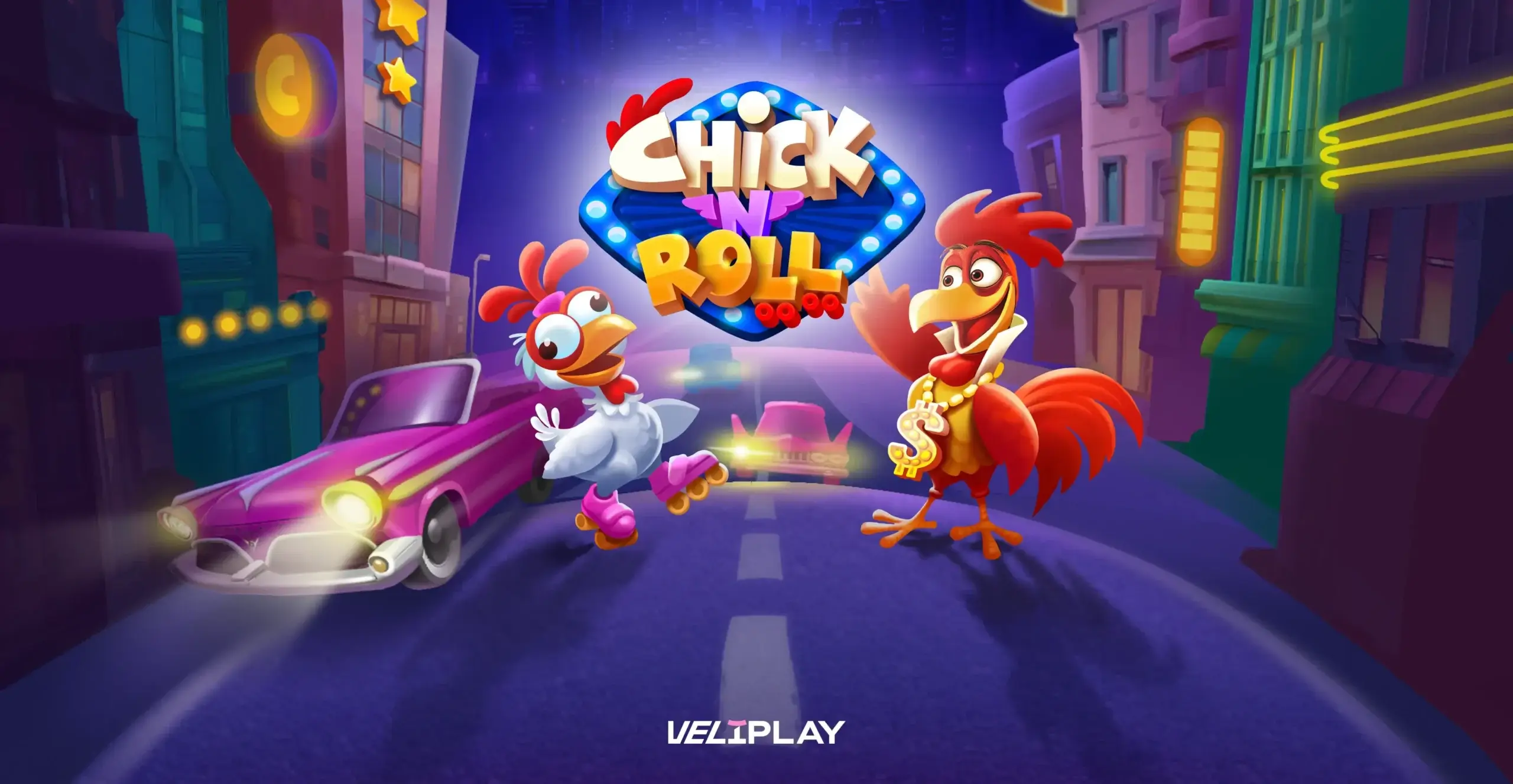
The chicken-crossing-road crash format is crowded. InOut’s Chicken Road has been a lobby fixture since 2019. Chick vs Croc followed. Chicken Road 2 launched in 2025. By the time VeliPlay released Chick’n’Roll in late 2025, the genre had already produced a dozen variants — most of them cosmetic reskins of the same jump-and-cash-out loop.
So why does Chick’n’Roll deserve serious attention rather than a dismissal? Two reasons. First, VeliPlay rebuilt the mechanic rather than copying it: the turn-based lane progression here is structurally different from the frying-pan hop of Chicken Road. Second, the target market is emerging rather than saturated — this was built explicitly for Asia, Africa, and Latin America, where mobile bandwidth matters and the Chicken Road brand has less of a lock on player loyalty.
Whether those two advantages are enough to compete against an incumbent sitting at 97–98% RTP is a different question. That’s what this review answers.
About VeliPlay: the provider behind the game
VeliPlay is the crash and instant game studio within the VeliTech group, a Cyprus-based iGaming technology company. The studio was built as a dedicated crash game operation rather than a generalist content producer — in VeliPlay’s own words, “we don’t build across every category, we refine the one that drives engagement.”
That focus is visible in the portfolio. VeliPlay’s catalogue includes DroneX (aviation crash), Crash For Six (cricket-themed), Pinball Rush, and Chick’n’Roll. Every title operates on the same design philosophy: fast rounds, minimal UI weight, clean cashout mechanics, and mobile-first architecture built for low-bandwidth environments. There is no slots arm, no live casino ambition. The studio is deliberately narrow.
VeliTech distributes VeliPlay content through the VeliGames aggregation platform alongside content from 160+ third-party providers. The B2B positioning means VeliPlay games reach operators through a single API rather than direct individual integrations. This is efficient for operators but can mean slower market penetration than studios that have years of established casino relationships. Confirmed operator partners at the time of writing include BlueChip, BindasBet, W88, and WinsRush — all emerging-market focused platforms, consistent with VeliPlay’s stated geographic priorities.
The studio does not hold a publicly visible player-facing licence. As a B2B game developer, regulatory responsibility passes to the licensed operator hosting the game. For players: the casino you play at, not VeliPlay, holds the accountable licence. Check that your operator is licensed before depositing.
Chick’n’Roll launched in late 2025 based on the upload date of the game’s promotional video on VeliPlay’s website. The game page went live in December 2025. This makes it a recent entry in the crash genre and explains the relative scarcity of third-party player reviews at the time of this article.
Math model and mechanics
RTP at 96%: the gap that matters
VeliPlay publishes a 96% RTP for Chick’n’Roll. That figure is confirmed on the official game page and on the VeliPlay homepage. Only one source — no conflict to report.
The number itself is serviceable but not competitive at the top end of the chicken crash genre. Chicken Road (InOut) runs at 98% in its original and Bonus versions. Aviator sits at 97%. At 96%, Chick’n’Roll has a 4% house edge — meaning for every £100 wagered over long sessions, players theoretically return £96. Against Chicken Road’s 98%, that’s a £2 per £100 difference. Over 500 rounds at £1 per round, the expected loss differential is approximately £10. Not catastrophic, but not nothing either.
One caveat worth noting: VeliPlay’s game page describes RTP as supporting “scalable difficulty and operator control.” The 96% figure may represent a baseline, and specific operator configurations could sit higher or lower. Players should check the in-game help file at whichever casino they’re using — the displayed RTP in the game interface reflects the actual configuration on that platform.
Volatility and hit structure
VeliPlay does not publish a formal volatility classification for Chick’n’Roll. Based on the mechanic — where each lane crossing has an independent crash probability — the experience is player-controlled rather than fixed. Low crossings equals low variance. Pushing further into the lane sequence increases both the multiplier and the crash probability per turn.
This is the defining feature of the turn-based crash format: volatility is not a preset. It’s a function of how far the player chooses to go. Conservative cashouts produce frequent small wins. Aggressive play into high lane counts produces a higher crash rate with rare large multipliers. The math is transparent and sensible.
VeliPlay does not publish a maximum win multiplier for Chick’n’Roll. This is a genuine gap. Competing titles publish theirs prominently: Chicken Road goes to 3,203,384× (with casino-imposed cash caps), Chick vs Croc reaches 3,134×. Without a published ceiling, players cannot assess the theoretical upside before playing. For experienced crash game players, this is a minor irritation. For the emerging-market audience VeliPlay is explicitly targeting, it’s a friction point.
The provably fair system
Chick’n’Roll uses a server-driven, provably fair RNG. Outcomes are determined before the round starts and can be independently verified by the player using the game’s published seed and hash data. This allows any round result to be audited after the fact — a meaningful transparency guarantee that distinguishes legitimate crash games from RNG-based games where the house could theoretically manipulate results post-spin.
Provably fair is standard for credible crash games in 2026. Aviator, Chicken Road, JetX, and Chick vs Croc all use comparable cryptographic verification systems. The absence of a provably fair mechanism would be a red flag; its presence here is a baseline expectation, not a differentiator for Chick’n’Roll specifically. What matters is whether players can actually access and use the verification tools — VeliPlay does not provide a player-facing verification interface on the game’s public page, which is another documentation gap worth noting.
Feature breakdown
Betting Phase
Players set their stake and choose a configuration before each round begins. VeliPlay describes this as “choosing a setup” without specifying whether configuration refers to lane count, risk level, or another parameter. The official game page does not detail bet range minimums or maximums. Given VeliPlay’s explicit focus on emerging markets and low-data mobile play, the bet floor is almost certainly sub-£0.10, but this needs to be confirmed in-game on the specific operator’s version.
Turn Phase
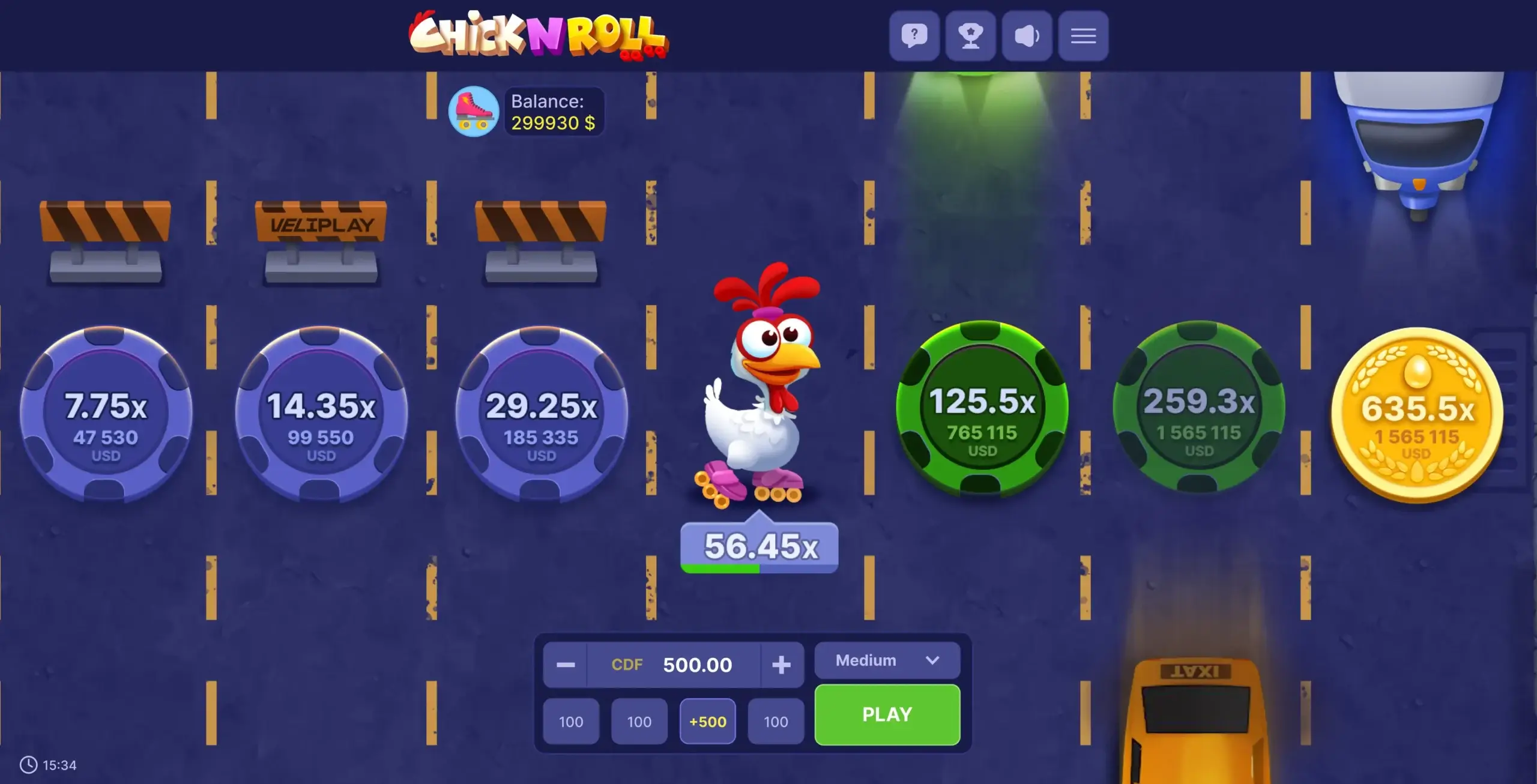
Each turn represents one road crossing. The chicken moves forward one lane, the multiplier increments, and the player faces a binary decision: cash out and secure the current multiplier, or cross the next lane for more.
This is structurally different from the jump-sequence format in Chicken Road, where each step is an animation event rather than a deliberate player-confirmed action. In Chick’n’Roll, the player triggers each individual crossing. That adds a beat of decision-making per move rather than a single cashout button. Whether that’s engaging or fatiguing depends on the player — some will prefer it, others will find the faster tap-and-go format of Chicken Road more fluid.
Crash Events
A collision ends the round immediately and the stake is lost. VeliPlay does not publish the per-lane crash probability distribution. In comparable turn-based crash games, crash probability increases with each crossing — the further the player goes, the higher the per-turn risk. This is standard math for the format. Without published figures, players are working blind on the exact probability curve.
Gamble Feature (Gamble Wheel)
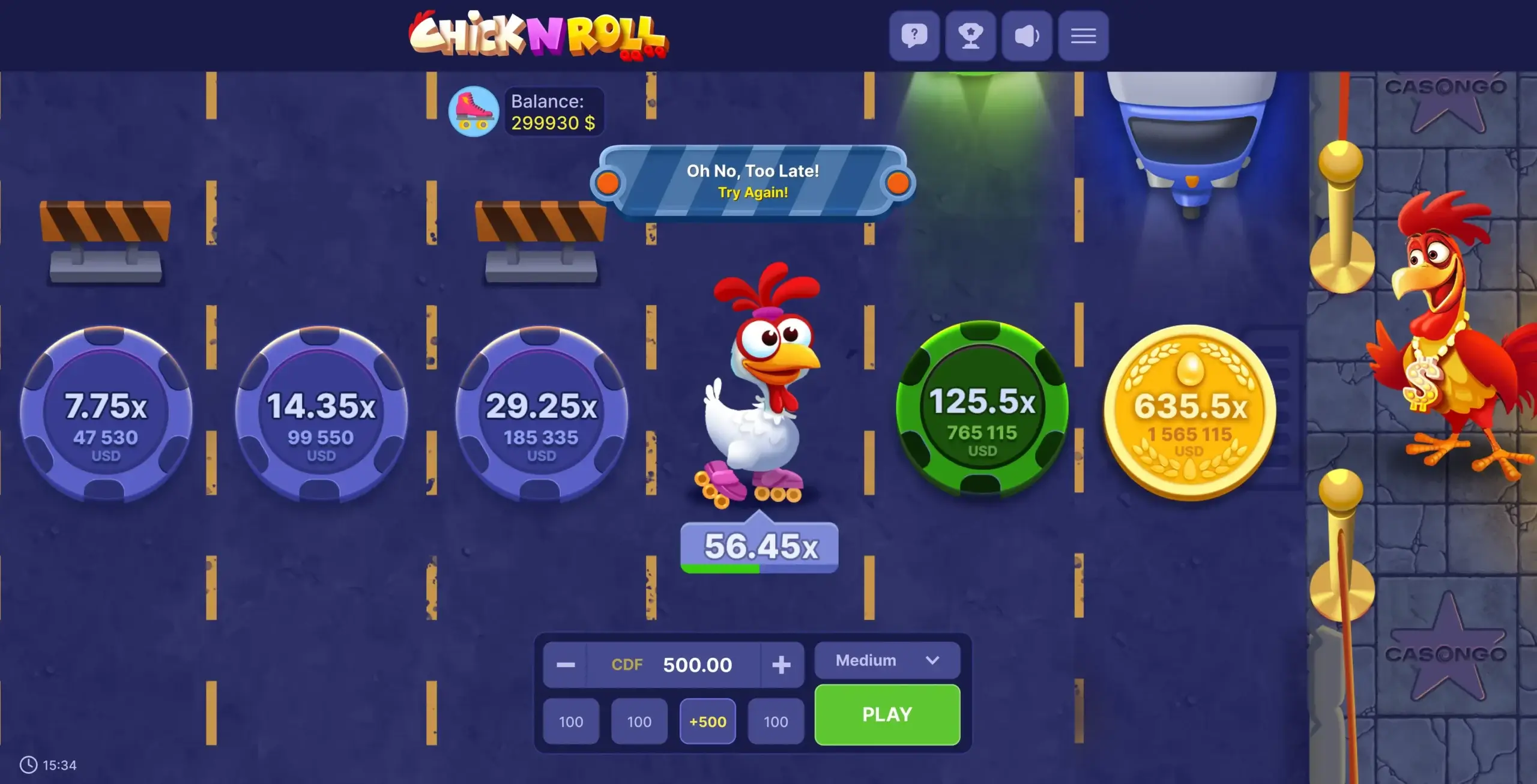
This is the mechanic that genuinely differentiates Chick’n’Roll from most of its competitors. On selected turns — VeliPlay describes this as “memorable turns” without specifying frequency — a Gamble Wheel activates. Players can spin it for additional reward or risk the round entirely.
The honest assessment: this is a forced volatility moment. The player does not choose whether to engage the Gamble Wheel on those turns; it appears and changes the decision calculus. “Skip steps for higher rewards or risk everything” is how VeliPlay describes it. In practice, this means there are specific points in the lane sequence where the standard cash-out option is replaced by a wheel spin that can either accelerate the multiplier progression or immediately end the round.
This adds genuine tension. It also removes player control at specific points, which cuts against the “player-controlled risk” narrative VeliPlay uses elsewhere in the game’s marketing. That tension between the overall design philosophy and the Gamble Wheel’s forced engagement is the most interesting thing about Chick’n’Roll’s design, and also its most divisive potential element. Players who want pure decision-making control will find it intrusive. Players who want volatility spikes may find it the game’s best feature.
The multiplier ceiling on the Gamble Wheel is not published. Neither is its trigger frequency, nor the probability distribution of outcomes on the wheel. These are significant gaps for a review to flag honestly.
Cashout System
Standard crash game cashout: available at any point before the next crossing, or before a Gamble Wheel resolves. No auto-cashout feature is mentioned on the official game page. This is a notable omission compared to Chicken Road and Aviator, both of which include auto-cashout as a core feature. Auto-cashout lets players set a target multiplier and remove the manual decision from the equation — useful for disciplined bankroll management and for players who find in-the-moment cashout decisions emotionally difficult. Its absence, if confirmed, is a meaningful gap.
2026 competitive context
Where Chick’n’Roll sits in the chicken crash landscape
Three comparison points matter in 2026.
Chicken Road (InOut) is the benchmark. The original game runs at 98% RTP. The 2026 Bonus version — released 27 January 2026 — added a buy-bonus feature, golden egg collection mechanics, and live player statistics, while retaining 98% RTP. Its four difficulty modes (Easy, Medium, Hard, Hardcore) provide explicit volatility control, with Hardcore offering the highest multiplier ceiling (theoretically over 3 million×, practically capped by casinos between £10,000 and £20,000). The game is built on a provably fair RNG, licensed via Curacao, and available at hundreds of operators globally. At 96% RTP, Chick’n’Roll gives up two percentage points against this competitor — on £100 wagered, that gap is £2. Over a 300-round session at £0.50 per stake, the expected additional loss from playing Chick’n’Roll versus Chicken Road Bonus is approximately £3. Marginal in isolation; meaningful if you’re a regular player.
Aviator (Spribe) is not a direct thematic competitor but is the genre standard. RTP: 97%. Theoretical max: 100,000×. Social features include a live bet feed showing what other players are winning in real time, a “Rain” feature where players send free bets to others in the chat, and a dual-bet system allowing two simultaneous bets with different cashout targets. Aviator launched in 2019 and had over 10 million monthly active users as of early 2024. It owns Tier 1 regulated markets and crypto-native player bases. VeliPlay is not competing with Aviator for the same audience — Chick’n’Roll is aimed at BlueChip, BindasBet, W88, WinsRush, and similar emerging-market operators where Aviator has a presence but not the same cultural lock-in. The audiences partially overlap, which makes the 96% vs 97% RTP comparison relevant but not decisive.
Chick vs Croc offers three RTP settings at 92%, 95%, and 97%, with a 3,134× max multiplier and four difficulty levels. It’s more volatile and more configurable at the top end than Chick’n’Roll based on published specs, and the 97% RTP configuration is mathematically superior. For players who want difficulty control and are not prioritising the road-crossing theme specifically, this is a stronger option at its highest RTP setting. The caveat: operator RTP configuration varies, and players may encounter Chick vs Croc set to 92% or 95% depending on the platform.
The competitive picture is not flattering for Chick’n’Roll on paper. In practice, the game’s market positioning — targeting operators and players where competitors have thin footprints — narrows the head-to-head comparison to specific geographies rather than the global lobby.
Buy-bonus and progressive jackpot
Neither is available in Chick’n’Roll. This is a significant absence in 2026. Chicken Road Bonus (January 2026) introduced a buy-bonus mechanic that immediately expanded its appeal to players who want to skip base game variance and pay for direct access to the bonus state. Aviator has no buy-bonus either, but Aviator’s social layer compensates. Chick’n’Roll has no buy-bonus and no social layer, which leaves it relying on core crash mechanics and the Gamble Wheel to hold attention.
No progressive jackpot. This is expected for a crash format and not a gap specific to Chick’n’Roll.
Mobile and emerging market positioning
This is Chick’n’Roll’s strongest hand. VeliPlay built the game explicitly for low-data environments. The lightweight design is a meaningful advantage in markets where 4G data is expensive, connections are unreliable, and a game that stutters loses players permanently. The chicken-crossing-road visual theme is culturally neutral and immediately legible across Asia, Africa, and Latin America without translation or localisation beyond language. The seven-second preview clip loads fast. The UI prioritises the crossing decision rather than decorative animation.
For operators in Bangladesh, India, the Philippines, Nigeria, or Kenya — markets where Chicken Road has less penetration than in regulated European lobbies — Chick’n’Roll offers a credible, lightweight alternative with a familiar theme and a mechanic that requires no onboarding explanation. The mobile optimisation alone justifies its slot in a crash game lobby aimed at those markets.
Distribution and availability
VeliPlay lists BlueChip, BindasBet, W88, and WinsRush as confirmed operators. All four are emerging-market focused. This is early-stage distribution — Chick’n’Roll released in late 2025, and the catalogue is building. Players at regulated European casinos are unlikely to find it yet. Players at operators in Asia and Africa connected via the VeliGames aggregation platform have the best access.

Strategies and bankroll management
No strategy in a provably fair crash game changes the underlying mathematics. The RTP is 96% regardless of how you play. What strategy can do is manage variance — how that 96% is distributed across your session — and reduce the frequency of avoidable losing decisions.
Conservative crossing: the low-variance approach
Set a target multiplier before each round — something in the 1.5× to 3× range — and cash out whenever the multiplier crosses it. Do not deviate based on how the previous round went. The game has no memory. A crash on the previous turn has no effect on the probability of a crash on the next.
In practice, conservative crossing produces frequent small wins and infrequent large losses. Your session balance will drift slowly downward at the rate of the house edge (4%), with small positive spikes when rounds go well. This approach maximises the number of rounds you can play per session budget, which is useful if you’re playing for entertainment value rather than trying to hit a single large win.
Aggressive deep crossing: the high-variance approach
Go deeper into the lane sequence, targeting multipliers in the 10× to 50× range. Accept that the majority of rounds will end in a crash before you get there. The few rounds that pay will partially or fully offset the losses.
This approach is mathematically valid — the expected value per round is the same regardless of target multiplier — but it compresses your session timeline dramatically. With a £20 session budget at £1 per stake, aggressive play might end the session in 10 rounds. Conservative play might sustain 80+ rounds. Know which experience you’re paying for.
Managing the Gamble Wheel
This is Chick’n’Roll-specific and genuinely requires a different mindset. When the Gamble Wheel triggers on a selected turn, you face a forced binary: take the wheel spin or leave the session at a predetermined outcome (VeliPlay’s wording implies cashing out is not the only alternative — the Gamble Wheel may resolve the round either way regardless of player action at that point). Until the trigger probability, wheel outcome distribution, and multiplier ranges are published, the only honest advice is this: treat every Gamble Wheel turn as a high-variance event outside your control and size your stake accordingly. If you’re uncomfortable with forced volatility spikes, reduce your stake so that a worst-case Gamble Wheel outcome doesn’t materially damage your session budget.
Session limits in a fast-format game
Crash games run faster than slots. A traditional slot spin takes 2–4 seconds. A Chick’n’Roll round, including the lane-by-lane crossing and cashout decision, might take 15–30 seconds depending on how deep the player goes. At 100 rounds per hour, you can exhaust a session budget significantly faster than you’d expect. Set a hard limit — time or money — before starting. The game’s pace makes it easy to lose track of both.
How to play Chick’n’Roll
For players new to the turn-based crash format, the mechanic is straightforward, but the decision rhythm is different from traditional crash games like Aviator.
Step 1: Place your bet. On the betting panel, set your stake for the round. If configuration options are available at this stage — lane count, difficulty settings — choose them before confirming. Once the round starts, your configuration is locked.
Step 2: The road starts. The chicken stands at the crossing point. The multiplier shows 1×.
Step 3: Trigger each crossing. Tap or click to send the chicken across one lane. If it survives, the multiplier increments and you face the next decision: cross again or cash out.
Step 4: Cash out or continue. At any turn, press the cashout button to collect your current multiplier times your stake. If you cross into a lane with a vehicle, the round ends, the stake is lost.
Step 5: If the Gamble Wheel appears. On selected turns, a Wheel of Fortune activates instead of the standard crossing decision. The wheel determines the outcome — either a multiplier advancement or a round crash. The player’s role at this point is to spin the wheel. Whether refusing to spin is an option is not specified in the published materials.
Step 6: Round ends. Either through a crash event, a Gamble Wheel loss, or a player cashout. The next round begins fresh — no carry-over multipliers, no memory of previous rounds.
Verdict
Chick’n’Roll is a competently built crash game that solves a real problem — lightweight performance in bandwidth-constrained markets — with a familiar theme and a structural mechanic that is genuinely distinct from the InOut Chicken Road formula. The turn-by-turn decision structure rewards patience and gives conservative players meaningful control over session variance.
The case for playing it: if you’re on a mobile connection in an emerging market, if your casino carries it and not Chicken Road, or if the forced Gamble Wheel volatility spikes sound like fun rather than an intrusion, this is a solid choice. The 96% RTP is the only number that sticks in the throat.
The case against: the published RTP is 2 percentage points below Chicken Road (original and Bonus versions) and 1 point below Aviator. No auto-cashout is confirmed. The max win ceiling isn’t published. The Gamble Wheel frequency and odds aren’t published either. For a player trying to make an informed decision, too much data is missing — not because VeliPlay is hiding anything, but because this is a young game from a small studio still building its documentation.
There are also strategic reasons to be optimistic about Chick’n’Roll’s trajectory. VeliPlay operates within the VeliGames aggregation ecosystem, which added 10 new studio partners in April 2026 and is actively expanding across Asia, Africa, and Latin America. As distribution grows, the game will reach more players in markets where its lightweight architecture is a genuine competitive advantage. If VeliPlay updates the game to include auto-cashout, publishes the Gamble Wheel probability tables, and releases a transparent max win figure, several of this review’s criticisms disappear.
The genre itself is growing. Crash games are not a passing format — Aviator’s player numbers held steady from 2023 to 2025, and the entry of InOut, VeliPlay, and other studios confirms institutional confidence that the chicken-road sub-genre has room for multiple players. In a crowded genre, Chick’n’Roll’s differentiation is mobile weight and market positioning rather than maths superiority. That’s a viable strategy if execution stays consistent.
Who should play Chick’n’Roll: mobile-first player in Asia, Africa, or Latin America, at an operator in the VeliGames network, familiar with crash mechanics, comfortable accepting a 4% house edge in exchange for a smooth low-data experience. Session budget under £20. Doesn’t need auto-cashout or published Gamble Wheel stats to feel comfortable.
Who should not: any player who has straightforward access to Chicken Road Bonus at 98% RTP at their current casino. Any player who uses auto-cashout as a core bankroll discipline tool. Any player who wants full mathematical transparency before wagering — the missing max win, missing Gamble Wheel probabilities, and undisclosed per-lane crash rates are legitimate reasons to wait until the documentation catches up with the game’s actual availability.
Chick’n’Roll is not the best crash game in the chicken genre in 2026. It is a legitimate, mobile-optimised alternative for markets where the benchmark doesn’t have a foothold yet. That’s a real value proposition — just a narrower one than VeliPlay’s marketing implies.