Far West launched on 7 February 2024. Two years in, it sits in lobbies across 39 countries, picked up by operators who needed a Western-themed instant-win title with a recognisable RTP. That last part is where the conversation gets complicated. Triple Cherry publishes five RTP tiers for this game — 88%, 90%, 92%, 94%, 96% — and the one your casino loads is not the one advertised in the header. That matters more than the Wild West aesthetic. So does a 10,000× max win that sounds competitive until you place it in the context of what 2026 instant-win design actually delivers.
This is a game worth understanding properly before you put £10 behind it.
What Far West is — and what it isn’t
First, a structural point that some aggregator listings handle badly: Far West is not a video slot. It’s a digital scratch card, or instant-win game, in Triple Cherry’s “Scratch” category. There are no reels, no paylines, no free spins, no cascades. You buy a ticket. You scratch. You either win or you don’t. The outcome is determined the moment you buy the card — the scratch animation is theatre, not RNG in motion.
Understanding that distinction matters because it changes how you think about session management, bankroll, and what “medium-high volatility” actually means in this context. In a slot, medium-high volatility describes the hit frequency of a spinning math model across thousands of spins. In a scratch card, it describes the prize distribution across a finite pool of virtual tickets — some priced close to the house edge, some containing the big prizes. The experience is fundamentally different even when the labels look the same.
Triple Cherry is a Barcelona-based studio founded in 2015, operating primarily in Southern European and Latin American markets. Their portfolio mixes classic-style video slots with a growing catalogue of instant-win scratch cards. Far West is one of their more widely distributed scratch titles, supported across 100+ currencies and 15 languages including English, Spanish, Portuguese, German, French, and Japanese. The game runs on HTML5, plays in portrait or landscape, and is available on desktop, mobile, and smart TV — practical coverage, no friction.
The math model: five RTP tiers and what that means for you
Here is where you need to read carefully.
Triple Cherry publicly lists five configurable RTP values for Far West: 96%, 94%, 92%, 90%, and 88%. The operator selects which tier to deploy. The figure displayed in a casino’s game information panel — if they bother to display it — may or may not reflect the tier actually running. SlotCatalog, which tracks deployed games across hundreds of casinos, shows 94% as the representative figure, suggesting that tier is the most commonly deployed. LiveBet’s database lists 96%.
In practice, unless you verify the specific RTP your chosen casino runs — by checking their game-specific info panel, not the general T&C — you are playing blind. At the 88% floor, Far West takes 12p from every £1 wagered over the long run. At the 96% ceiling, that drops to 4p. On a £50 session, the difference between the best and worst tier is £4 in expected loss. That’s before variance enters the picture.
The hit frequency is 37.43%, confirmed on the official provider page and corroborated by SlotCatalog. Just under four in ten cards produce a payout of some kind. This is a meaningful number — it tells you how often you’ll see any return at all, not how often you’ll win a meaningful amount. The distribution of payouts across that 37.43% is heavily weighted toward small multiples near the ticket price. The 10,000× outcome exists in the prize pool but represents an extreme tail — a single prize or small handful across the entire virtual ticket run. That’s the structural reality of any high-ceiling scratch card with a sub-40% hit rate.
To understand why, consider what the RTP arithmetic requires. At 94% RTP with a 37.43% hit rate, the average winning ticket must return roughly 2.51× the ticket price to achieve that theoretical return across the entire pool. Most winning tickets return far less than that average — 0.5×, 1×, maybe 2× — which means the pool must contain a small number of high-multiple outcomes to bring the average up. The 10,000× prize is one of those balancing weights. How many of them exist across the virtual run is the number Triple Cherry doesn’t publish, and the number that would most directly answer the question players actually care about: how rare is the top prize?
Volatility is classified as medium-high by SlotCatalog. In scratch card terms, this means the prize pool contains meaningful clustering toward the upper end — it’s not a flat distribution where all prizes sit near the ticket price. You will have runs of consecutive non-winning cards. At a 37.43% hit rate, runs of five or more consecutive losses are statistically normal and not unusual at all. Expecting a win every three cards is a misread of what the frequency means in practice; individual card outcomes are independent, and actual runs can deviate substantially from the statistical average in short sessions.
Bet range: £0.50 to £50 per ticket. A maximum bet of £50 against a 10,000× ceiling produces a potential return of £500,000. That figure is theoretical and based on the prize pool structure. At £0.50 minimum, the same 10,000× win produces £5,000 — a meaningful but not extraordinary return at the format’s entry level.
One critical piece of information Triple Cherry does not publish: the total ticket run size. Without that number, you cannot calculate how many maximum-prize tickets exist in circulation, which makes any probability statement about the top prize impossible to verify independently. Regulated lottery operators in most European markets are required to publish this information at the point of sale. Online casino scratch cards operate under different requirements, and providers are not universally obligated to disclose run sizes or prize pool distributions. That gap in transparency is not unique to Far West — it’s an industry-wide problem with digital scratch cards — but it’s worth naming.
How the game plays: mechanics
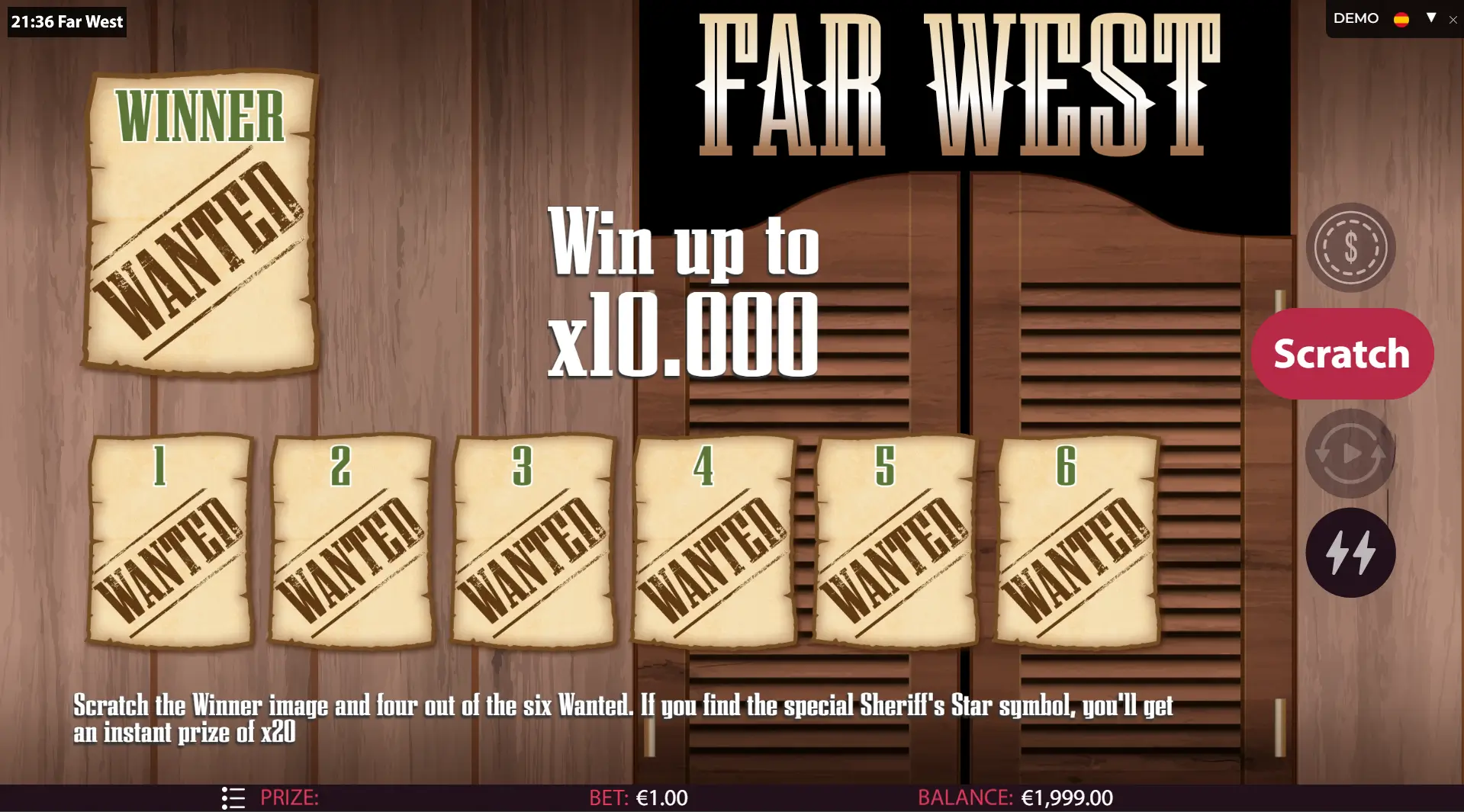
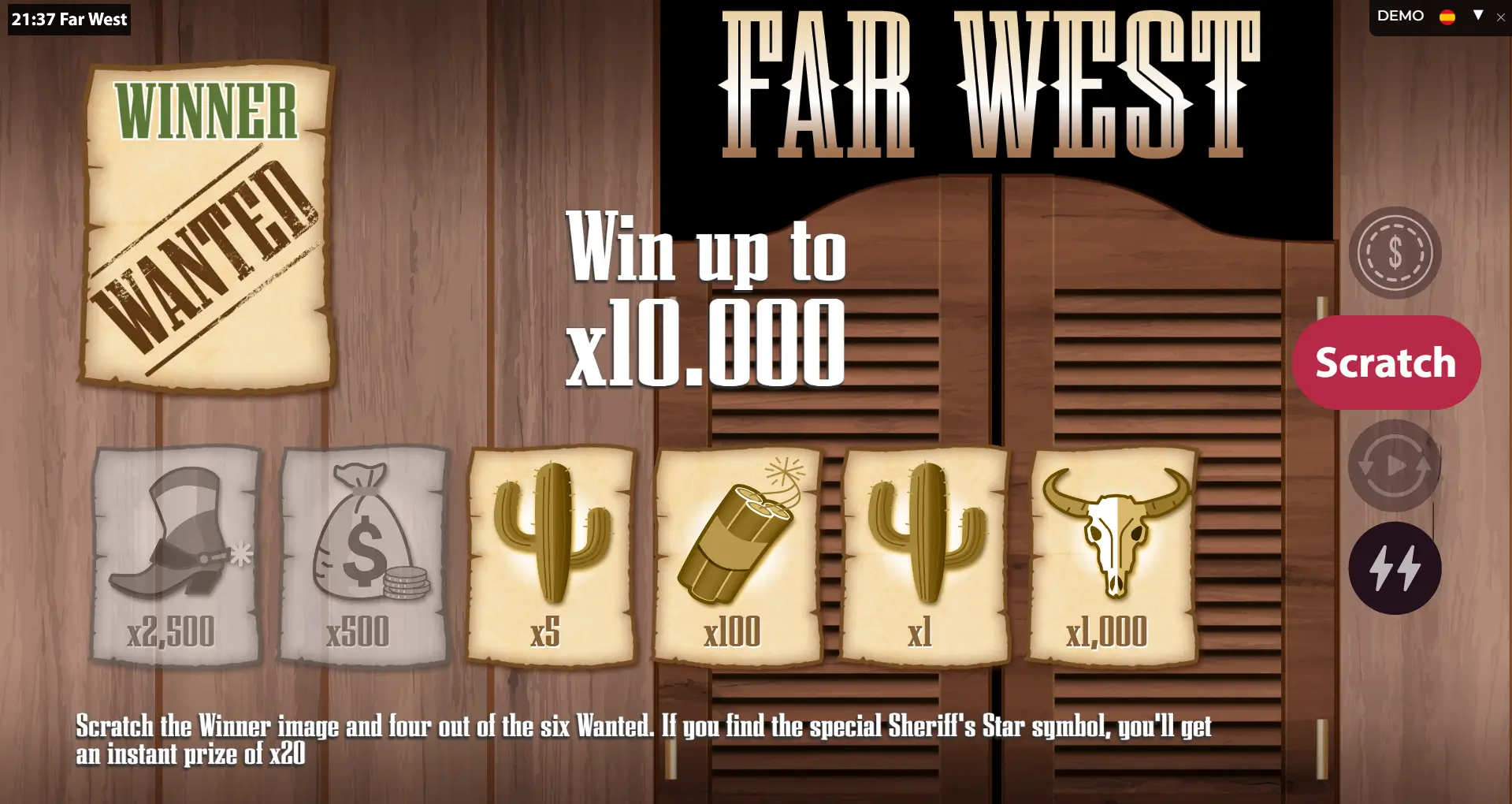
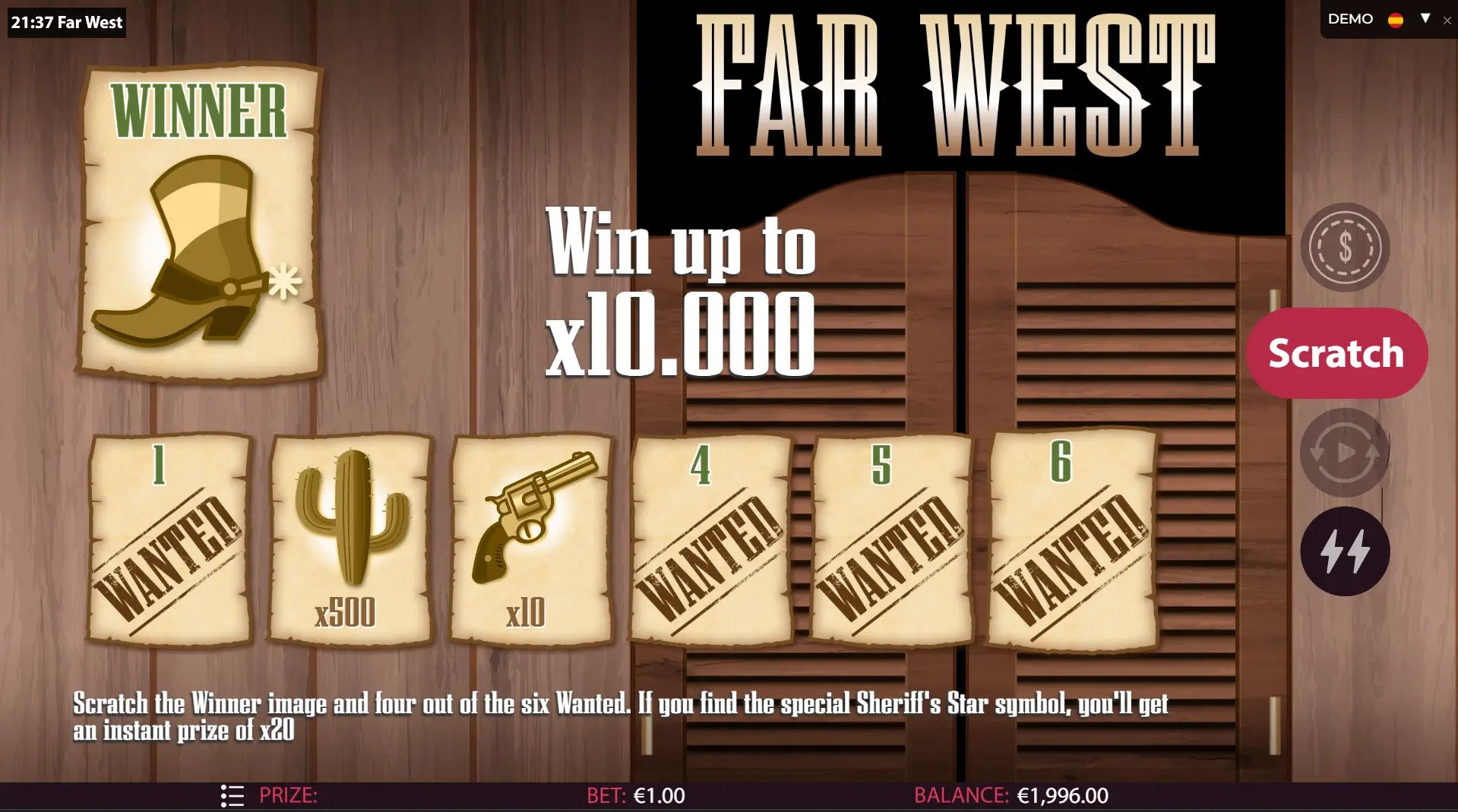
The format is straightforward. Each ticket shows a Winner box at the top and six Wanted poster panels below it. You scratch the Winner box to reveal a target symbol, then scratch four of the six Wanted panels to reveal hidden symbols. If any Wanted panel matches the Winner symbol, you win the corresponding prize. The two unscratched panels remain hidden — their contents are irrelevant to the outcome.
There is one special symbol: the Sheriff Star.
If the Sheriff Star appears on any of the four revealed Wanted panels, it triggers an immediate win of 20× your total bet regardless of whether any symbol matches the Winner box. This is the game’s only bonus mechanic and the sole way to win without landing a match. At a £1 bet, that’s £20. At £50, that’s £1,000. The Sheriff Star win is not cumulative — one appearance means 20×, and the prize is fixed regardless of how many stars might theoretically be present.
That’s the entire feature set. One mechanic, one special symbol. No multiplier progression, no re-triggers, no picking rounds, no jackpot feature, no accumulator.
Whether that simplicity is a feature or a limitation depends entirely on what you want from instant-win content. Far West makes no attempt to complicate itself. Scratch, match (or star), collect, repeat. For players who play scratch cards for exactly that reason — fast, transparent, no cognitive load — that’s a fair proposition.
For players coming from feature-rich instant-win titles expecting layered bonus structures, Far West will feel spartan.
The Sheriff Star in practice
The 20× fixed win on Sheriff Star appearance is the most important number in the game for session planning. At a £2 ticket, that’s £40 back on a star hit. At £10, it’s £200. The frequency with which the star appears is not independently documented in public sources — Triple Cherry does not disclose how many star-containing tickets exist per ticket run, and no independent testing lab has published that breakdown.
What can be inferred from the 37.43% hit frequency and the medium-high volatility classification: the star is not the primary driver of that hit rate. The matching mechanic accounts for the majority of wins. The star is a supplementary win condition, not a frequent event.
In extended play, the star appearing tends to feel disproportionately satisfying relative to its value — 20× is a decent return, but it’s not the path to the 10,000× ceiling. The ceiling requires a matching outcome on high-value symbols, which almost certainly means the two or three top-tier symbol combinations account for the vast majority of the prize pool’s theoretical maximum.
The key practical limitation: there is no way to influence which ticket you receive. Scratch card outcomes are predetermined at ticket issuance. Strategy in the traditional sense does not apply. What you can control is bet sizing, ticket frequency, and which casino’s RTP tier you choose to play on.
Far West in the instant-win landscape of 2026
Let’s be direct about where this game sits competitively.
Max win: 10,000×. In the current market, that is a functional but not outstanding ceiling for a scratch card claiming medium-high volatility. For comparison:
- Hacksaw Gaming’s instant-win portfolio averages around 10,000× across their scratch card catalogue but pushes to 25,000× on newer titles. Hacksaw’s scratch cards also typically carry RTPs above 94%, and their designs integrate multiple visual mechanics — target shooting, multiplier reveals, instant prize panels — rather than a single matching system. Hacksaw spent 2018–2022 building the scratch card market’s most distributed portfolio before pivoting aggressively to slots; their instant-win library remains the reference point for what the format can deliver mechanically.
- Big Time Gaming’s Bonanza Tapcards (2025) delivers a 25,000× max win at a published RTP of 96.45% with a minimum bet of £0.10. That’s a materially higher ceiling at a better base return, released a year after Far West. The tap-card format adds an interaction layer — players trigger cascades through tapping rather than scratching — which creates a different session rhythm even though the outcome remains predetermined at ticket issuance. It’s a stronger offer on raw numbers.
- Hacksaw’s Lucky Shot — a direct Western-themed scratch card comparison — is a different proposition entirely: fixed £2 ticket price, £150,000 jackpot (equivalent to roughly 75,000× on a £2 stake), but an RTP of 64.9%. That’s a lottery-style model, not a casino model. The comparison is useful because it illustrates two completely different philosophies for the same theme. Far West offers a far better RTP structure and meaningful flexibility in bet sizing. Lucky Shot offers a dramatically larger potential jackpot at a punishing expected-return cost. Which serves you better depends entirely on whether you’re playing for expected value preservation or jackpot hunting. Most informed players choose the former.
The question of buy-bonus doesn’t apply here — Far West is an instant-win format, and the concept translates poorly. What could theoretically exist is a “guaranteed win” ticket mechanic (some scratch cards offer a version where a set number of winning tickets are sold per batch cycle) — but Triple Cherry does not offer this in Far West.
Far West also has no progressive jackpot. The 10,000× ceiling is a fixed maximum, not a pool that accumulates. For players who specifically want jackpot mechanics in a Western theme, other options exist, but none from Triple Cherry in this format.
Where Far West does hold a genuine advantage is in its market breadth and currency coverage. Running across 100+ currencies and 15 languages puts it ahead of many boutique instant-win titles that operate in narrow regional lanes. For operators serving multiple markets from a single platform, that flexibility matters — it’s easier to deploy one title across six markets than to source six market-specific alternatives. That’s a B2B advantage that doesn’t directly benefit the end player, but it does explain why a game without exceptional mechanics maintains distribution across 39 countries.
Triple Cherry as a provider
Context on the studio matters when evaluating longevity. Triple Cherry is a Barcelona-based studio founded in 2015, operating across video slots, classic slots, crash games, and scratch cards. They are not publicly traded, do not carry the distribution network of a Hacksaw Gaming or an Evolution, and their SlotRank data on Far West is listed as N/A on SlotCatalog — meaning the game hasn’t generated enough tracked play volume to produce a meaningful ranking. That’s a combination of the format category (scratch cards attract less tracking infrastructure than video slots) and the studio’s relative market reach.
That doesn’t make the game a poor choice. It does mean you’re playing a title from a studio with limited lobby presence in most markets outside Spain, Canada, Norway, Austria, and New Zealand. The practical implication is post-launch support: if a bug or dispute over a ticket outcome emerges, resolution from a smaller studio may move more slowly than from a provider operating at scale. That’s a general caveat for boutique studios, not a specific criticism of Triple Cherry’s track record.
Far West is one of Triple Cherry’s more widely distributed scratch titles, supported across 100+ currencies and 15 languages including English, Spanish, Portuguese, German, French, and Japanese. The game runs on HTML5, plays in portrait or landscape, and works on desktop, mobile, and smart TV.
The game’s available markets — 39 countries, with the strongest casino presence in Canada (50 casinos), Norway (43), Austria (39), and New Zealand (36) — suggest performance is concentrated in Tier 1 English-speaking and Nordic markets where scratch card appetite exists but top-tier studio competition is intense. Holding 39-country distribution two years post-launch is a reasonable result for a studio at Triple Cherry’s scale.
Who Far West is actually for
This game works for a specific type of player.
Best fit: Recreational scratch card players who want an instant-win title with a transparent mechanic, a fair base RTP (assuming the operator deploys the 94–96% tier), and a reasonably high ceiling that justifies medium-high volatility without requiring multi-feature engagement. Players in markets where Triple Cherry titles are well-represented — particularly Norway and New Zealand — will find it available easily. Players who enjoy Western themes and want something lighter than a 5×5 bonus-hunt slot.
Poor fit: Bonus hunters who play scratch cards through casino welcome offers should verify whether Far West contributes to wagering requirements at full value — many casinos weight instant-win games at a reduced rate (10–20% contribution is common). Playing a 5× wagering bonus through scratch cards at reduced contribution is an expensive path to clearing. Verify before claiming any bonus specifically for instant-win play.
High rollers should note the £50 maximum ticket price. It’s not a high-stakes game. A 10,000× return at max bet is £500,000 — that’s not a number that will attract players whose session targets require higher ceiling access.
The RTP tier problem, revisited
Before you play Far West anywhere, check the active RTP. Not the marketing page. The in-game information panel.
The gap between the 96% and 88% tiers is significant. At 88%, Far West’s house edge (12%) is higher than most regulated European video slots and in the range of table game variants with below-average player conditions. There is no legitimate reason a player should accept an 88% RTP tier on a scratch card when alternatives at 94–96% exist — particularly in 2026, when the MGA, UKGC, and most major regulatory bodies expect operators to display active RTP prominently.
If you cannot find the active RTP on the casino’s game panel, that’s the operator’s failing, not the game’s. But your money is still on the line.
SlotCatalog’s representative figure of 94% is a useful baseline. The official provider data confirms 96% is achievable. Treat anything below 94% as an operator-configured penalty and factor it accordingly.
Practical session notes
A few things worth knowing before committing real money.
Ticket price and bankroll: At the minimum £0.50 ticket, a £50 session buys 100 cards. At a 37.43% hit frequency, you’d expect around 37 winning outcomes in 100 cards — in practice, they’ll cluster unpredictably, not distribute evenly. Real sessions don’t look like probability tables. You can go 15 straight cards without a hit and then land three winners in a row. Both are normal within medium-high volatility parameters. At the maximum £50 ticket, a £500 session buys 10 cards. That is aggressive bankroll concentration for a scratch card format and a volatile distribution model.
For most players, the £1–£5 ticket range makes the most sense: enough stake that meaningful wins register as real money, not enough concentration that a bad run turns damaging. At £2 per ticket, a Sheriff Star hit returns £40 — you effectively break even on a 20-card session. That’s a useful way to think about the feature’s practical floor.
No auto-scratch risk: Far West allows automatic play. Auto-scratch at £50 per ticket can drain a session budget faster than the same amount on a bonus-hunt slot, because there’s no feature round to create natural pauses. If you use auto mode, set a session loss limit before you start. The game’s pace is entirely self-determined — don’t let convenience substitute for discipline.
The two-panel discard doesn’t affect outcomes: The Sheriff Star can only be found on revealed panels, so you always want to scratch your four allocated Wanted panels. Beyond that, which panels you choose to reveal is irrelevant — the prize is predetermined at ticket issuance, not influenced by panel selection.
Demo availability: A free demo version is available through Triple Cherry’s official site (3cherry.com). Before playing for real money — to verify the format and see how tickets resolve — the demo is worth running. Demo play uses artificial credits, not a live prize pool, so session outcomes in demo carry no statistical relationship to live conditions.
Currency support is genuine: Over 100 currencies are supported, which is notable for a studio of Triple Cherry’s size. Players in non-EUR/GBP markets are unlikely to face conversion friction.
Responsible gambling
Scratch cards resolve in seconds. Sessions that feel like 20 minutes can run to 40 without natural stopping points. Video slots have feature rounds that mark transitions; scratch cards don’t. The pace is entirely self-determined, and that requires more deliberate session management than many players apply to slot play.
Triple Cherry includes a responsible gaming policy on their site. Whether operators deploying Far West implement deposit limits, session timers, and self-exclusion is operator-dependent, not game-dependent. If you play through a casino that doesn’t surface these tools clearly, that’s a reason to consider where you play, not just what you play.
If gambling is causing concern, GamCare (gamcare.org.uk), BeGambleAware (begambleaware.org), and Gambling Therapy (gamblingtherapy.org) all provide free, confidential support. Warning signs include chasing losses, extending sessions beyond planned limits, and concealing play from others.
Verdict
Far West by Triple Cherry is an honest, well-built instant-win scratch card with a Western theme, a clear mechanic, and a max win potential of 10,000× that is competitive without being exceptional. Released in February 2024, it has established a solid distribution footprint across 39 countries without becoming a market standout.
The configurable RTP range — 88% to 96% — is the game’s most significant variable and the primary factor determining whether it represents a fair proposition at any given casino. At 94–96%, it competes respectably with mid-tier video slots and outperforms much of the broader scratch card market. At 88%, it doesn’t.
The Sheriff Star mechanic (20× on any star reveal) adds one layer of excitement above pure symbol matching, but a single fixed-multiplier feature is a thin bonus structure in a market that increasingly expects more. For the format and the studio, it’s appropriate. For a player stepping from Hacksaw’s more elaborate instant-win catalogue, it will feel limited.
Play it if: You want a fast, no-frills Western scratch card with a fair RTP tier, you understand the prize structure, and you’ve verified the active RTP on your chosen casino. It’s a reasonable occasional play at £1–£5 per ticket where session variance is manageable.
Skip it if: You’re looking for feature depth, buy-bonus mechanics, multiplier stacking, or a ceiling above 10,000×. The format genuinely cannot deliver any of those — not because of design failure, but because it’s a scratch card, and scratch cards have a hard ceiling on mechanical complexity. If you want a Western theme with high-variance feature play, Hacksaw’s Wanted Dead or a Wild (96.38% RTP, 12,500× ceiling, three distinct bonus rounds) is the correct choice — even though it’s a slot, not a scratch card.
The one number that limits Far West most isn’t the 10,000× ceiling. It’s the RTP floor. An 88% base tier on a medium-high volatility instant-win game is a genuinely poor deal. Know which tier your operator serves before you scratch the first poster.