Most online casino reviews call Scratch’em a slot. It is not a slot. That mislabeling alone tells you something about how little attention this game actually gets from reviewers — which is a shame, because there are a few things genuinely worth understanding before you put €2.50 on the table.
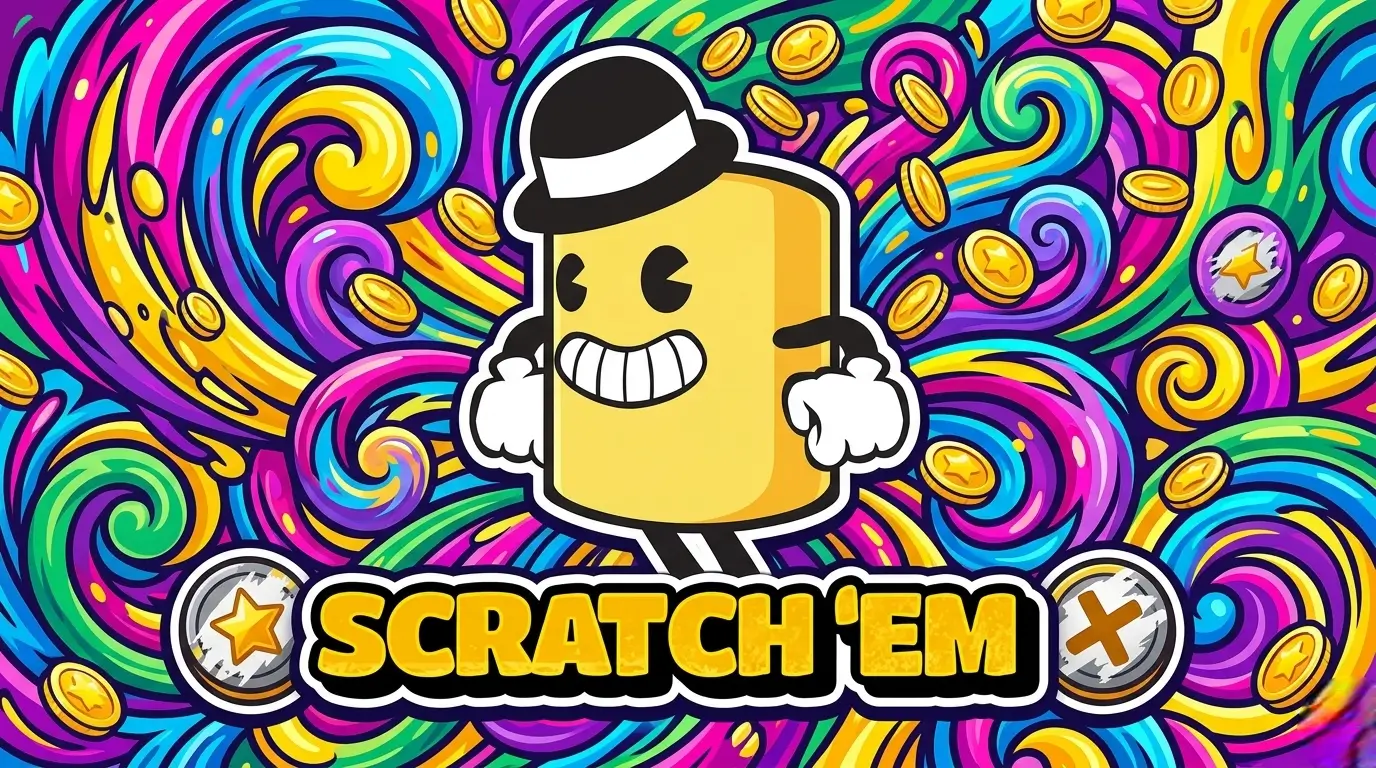
I loaded Scratch’em on my phone on a regular Tuesday afternoon, not expecting much. What I got was a clean, fast digital scratch card built around a character called Canny the Can — the same rubber-hose cartoon mascot that Hacksaw Gaming introduced in their very first slot, Stick’em, back in 2019. Scratch’em is essentially the scratch card companion to that slot. Same visual universe, same character, completely different format.
The purpose of this review is straightforward: tell you what the game actually is, what the RTP of 92.04% means in practice, what you can win and how realistic that is, and who this game is actually built for. There are no multiplier features to decode here and no bonus buy mechanics to weigh up. But there are a few numbers worth understanding — and the prize ceiling, €250,000 from a single €2.50 card, is more interesting than most people realize.
Game Specs
| Field | Detail |
|---|---|
| Provider | Hacksaw Gaming |
| Game Type | Digital scratch card (instant win) — not a slot |
| RTP | 92.04% (certified default) |
| Volatility | Medium |
| Max Prize | €250,000 (100,000x the card price) |
| Overall Win Probability | ~29.82% |
| Card Price | Fixed at €2.50 |
| Mobile Optimized | Yes (vertical layout, HTML5, no download) |
| Context | Scratch card companion to the Stick’em slot; features the same Canny the Can character |
| Bonus Rounds | None |
| Free Spins | None |
| Bonus Buy | None |
What Is Scratch’em, Exactly?
Before anything else: this is a match-3 digital scratch card, not a video slot. That distinction matters because the mechanics, the math, and the session feel are fundamentally different.
In a slot, you spin reels and outcomes are generated in real time on each spin. In Scratch’em, you purchase a virtual card — at a fixed price of €2.50 — and then reveal what’s already underneath the surface. The result of each card is predetermined at the moment of purchase; you’re not generating a new outcome with each scratch, you’re uncovering a result that’s already been set.
The card itself uses a match-3 grid format. You scratch — either manually by dragging your finger or cursor across the card, or instantly with a “Reveal All” button — to uncover symbols in the grid. If three matching symbols appear, you win the prize associated with that symbol. No matching combination means no prize. That’s the entire mechanic.
This is not a criticism. It’s the point. Hacksaw Gaming built Scratch’em as a companion piece to their Stick’em slot — using the same Canny the Can character, the same visual identity — for players who want the aesthetic of that game without the waiting, spinning, and bonus trigger hunting that slots require. A scratch card is inherently faster and more direct.
Now, the practical odds: the overall probability of winning any prize on a single Scratch’em card is approximately 29.82%. That translates to roughly one winning card in every 3.35 purchased. Think about that across a session. If you buy 10 cards at €2.50 each (total spend: €25), you can statistically expect around three of those to return something — though “something” can mean anything from a small return to a mid-table prize. The distribution between prize tiers is where the real math lives, and that brings us to the prize table section.
One important note on terminology: because Scratch’em comes from Hacksaw Gaming’s scratch card catalogue, and Hacksaw started as a scratch card specialist before moving into slots, the game carries their full mobile-first design philosophy. It was built for vertical screens. On a phone, it fills the display cleanly; on desktop, it sits in a portrait frame. There are no spinning reels, no paylines, no wagering sequence. You buy, you scratch, you see the result.
Visual and Audio Identity
Canny the Can is a small, cheerful cartoon tin can with white gloves and a wide grin — drawn in the rubber hose animation style that references American cartoons of the 1930s. He sits at the edge of the card and reacts to what happens: still and neutral during the scratch, animated when a win is revealed.
That reaction animation is the most distinctly Hacksaw thing about this game. It’s not elaborate — Canny bounces, celebrates, maybe does a small jump — but it’s purposeful. On a losing card, he doesn’t react at all. The contrast between a win and a loss is communicated not just through the result text but through whether the character responds. It’s a small design decision and it works better than you’d expect.
The audio follows a similar logic. During scratching, there’s a satisfying surface-scratch sound — paper-against-nail, close enough to the real thing to register in the brain correctly. When a win lands, a short musical cue plays. Nothing overdone. When the card shows no match, the silence is immediate and total. The game doesn’t pad the losing experience with filler sound. You know instantly.
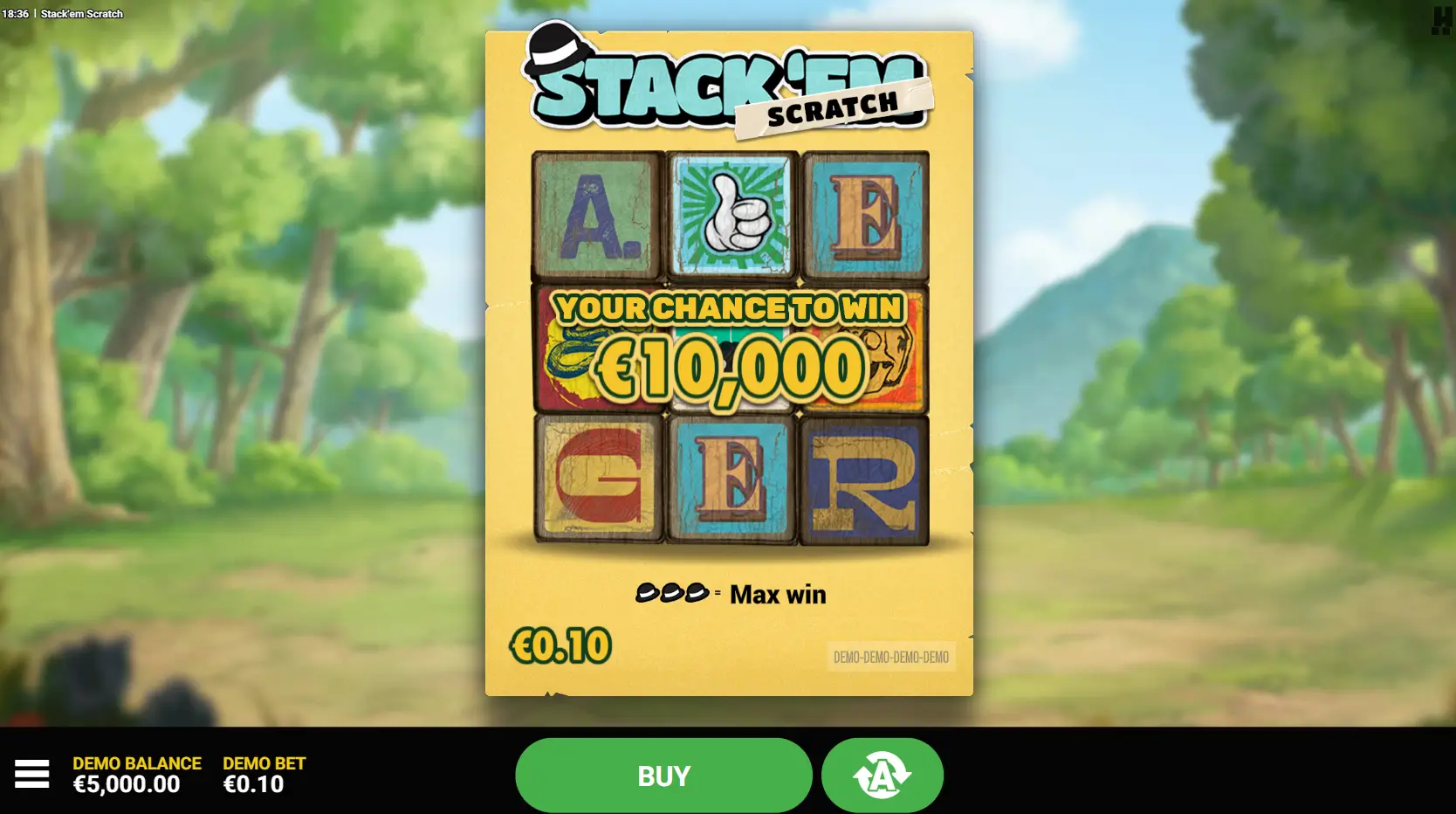
The color palette is warm and relatively muted — this isn’t the neon intensity of Hacksaw’s higher-volatility slots. The card itself is the focus, with the surrounding interface stripped back to only what’s functional: the balance display, the Buy button, the Autoplay option, and the menu access for rules.
On mobile in vertical orientation, this is one of the cleaner scratch card experiences available from a regulated provider. The scratch area is large enough that manual scratching doesn’t feel fiddly, and the “Reveal All” button is positioned where your thumb naturally rests. On desktop, the portrait frame is centered with neutral space around it — functional, if slightly undersized on a large monitor.
The Prize Table
This is the section that actually matters and the one most existing reviews skip. Understanding the prize structure tells you far more about what this game actually delivers than any general description of the mechanics.
The confirmed maximum prize for Scratch’em is €250,000, on a card that costs €2.50. That’s a multiplier of 100,000x the card price. To put that in context: if you were playing a €0.20 spin slot and hit a 100,000x win, you’d collect €20,000. On this €2.50 card, the same multiplier delivers a quarter of a million euros. The prize ceiling is meaningfully large for a fixed-price scratch card.
To claim the maximum prize, you need to reveal three matching top-tier symbols on the same card. There is no progressive component — the prize amount is fixed, not accumulated from player activity. Hacksaw Gaming calls these Fixed Prize Games, and they’ve used this model across their scratch card catalogue. The top prize is always there, always the same amount, and always requires the matching condition to be met.
The prize tiers themselves work from the bottom up. The lowest tier returns a small multiple of the card price — effectively the kind of “you didn’t lose everything” return that keeps the session alive without meaningfully affecting your balance. Mid-tier prizes range upward through several steps. The full prize table is visible in-game under the rules section, and I’d recommend checking it before you start, because understanding what each symbol is worth before you scratch changes how you read the result.
What the prize table doesn’t show you directly is how the 100,000x top prize compares to the frequency of winning it. That probability isn’t publicly published in granular form for Scratch’em specifically. What we do know is that the overall win rate across all tiers is 29.82%, and that the RTP of 92.04% is derived from the full distribution of prizes — meaning the math that produces that RTP includes the relative probability of every tier from bottom to top.
For comparison within Hacksaw’s own scratch card range: Scratch Platinum offers a maximum prize of €500,000 (so double Scratch’em’s ceiling), and Cash Scratch carries a top prize of €400,000 but ships with a certified RTP of 50.29% — significantly lower than Scratch’em’s 92.04%. That’s a meaningful difference. When you’re evaluating which Hacksaw scratch card to play, the RTP gap between Cash Scratch (50.29%) and Scratch’em (92.04%) is not trivial. It represents a significantly different expected return rate per card purchased over any extended session.
The honest summary on the prize table: the maximum prize is substantial. The mid-range tiers are present but not the main event. The bottom tiers exist to produce the ~29.82% overall win rate. Whether you consider the top prize realistically achievable is a question of perspective — but it is a fixed, insured amount, not a theoretical jackpot that depends on accumulation.
RTP Analysis: What 92.04% Actually Means
The RTP figure — Return to Player — describes the theoretical percentage of total wagered money that a game returns to players over a large number of rounds. Scratch’em’s certified default RTP is 92.04%.
Here’s what that means in plain terms: for every €100 spent on cards over a very large sample size, the game is designed to return €92.04. The remaining €7.96 is the house edge. Over a short session, your actual result will swing wildly above or below this figure. Over millions of cards, the aggregate return converges toward 92.04%.
Now, context. Physical scratch cards sold through national lotteries typically return 55–65% of total sales in prizes. That’s the benchmark most players unknowingly carry into digital scratch card play, which is why online scratch cards often feel unexpectedly favorable by comparison. Regulated online scratch cards from established providers range broadly — from around 88–89% at the lower end to 96%+ at the upper end.
At 92.04%, Scratch’em sits in the lower half of that online range. It’s considerably better than lottery scratch tickets, but it’s not the highest RTP you’ll find in this game category. Hacksaw’s own slot portfolio, for comparison, generally runs at 96%+ on default settings. The trade-off for the simplicity and instant-win format comes at a cost in expected return rate.
There’s an additional variable worth understanding: Hacksaw Gaming, like most major providers, allows casinos to configure different RTP settings from the versions they offer. A game might be deployed at 92.04% at one casino and at a lower variant elsewhere. The certified default for Scratch’em is 92.04%, but this is the version you may or may not be playing depending on where you access the game. The only reliable way to check is to open the in-game information panel — usually accessible via the hamburger menu or an info icon — which should display the RTP for the specific version running at that casino. If your casino doesn’t display this, that’s worth noting before you play.
One thing the 92.04% figure does not tell you is how the return is distributed between frequent small wins and rare large ones. A game with a massive top prize and low-frequency mid-tiers can have the same theoretical RTP as a game with a flat prize structure and higher win frequency, but they feel and behave completely differently in session. Scratch’em’s medium volatility designation suggests the distribution is reasonably balanced — not concentrated entirely in the jackpot tier, but not dominated by sub-1x returns either.
Gameplay Experience
There isn’t much complexity to walk through here, which is accurate to the game’s design intent.
You load Scratch’em, and the card is already presented on screen. The Buy button sits at the bottom. Tap or click it, and €2.50 is deducted from your balance. The card activates. At this point you have two choices: scratch manually, or tap Reveal All.
Manual scratching — dragging your finger across the surface areas on mobile, or clicking and dragging on desktop — uncovers symbols progressively. The scratch animation holds up reasonably well and the paper-texture sound responds as you move. Some players prefer this because it extends the moment; each revealed symbol either narrows or opens the possibility of a win before the full result is known.
Reveal All does exactly what the name says. One click, the card opens completely, the result is shown. If you’ve played 30 cards in the last 15 minutes using autoplay, you probably defaulted to this mode a while back.
The autoplay function allows you to set a number of rounds — from 10 up to 1,000 — and the game buys, reveals, and records results automatically. Inside the advanced settings, you can set a loss limit (expressed as a multiple of the card price) that stops autoplay if your balance falls by that amount, and a single-win limit that stops play if any card returns a win above a set threshold. Both options are useful and the responsible gambling rationale for having them is clear.
There are no bonus rounds to trigger. No free cards, no multiplier features, no feature buy option. This is a clean break from how Hacksaw’s slot games operate, where bonus buy mechanics and feature round complexity are often central to the experience. Scratch’em strips all of that away. The session rhythm is: buy, reveal, see result, buy again. If you’re mid-session in a bonus-heavy slot and you load Scratch’em expecting the same kind of escalation, you’ll find it disorienting. If you want a completely linear, result-immediate experience, that’s exactly what this delivers.
The card price is fixed at €2.50. There is no option to adjust stake. This is both a limitation and a feature depending on your approach: you can’t bet more per card to increase potential prize amounts, and you also can’t drop to a smaller stake for a lower-risk session.
Who Is This Game For?
There are specific player types for whom Scratch’em is a reasonable choice, and specific types for whom it clearly isn’t.
It suits:
Players who want instant results. There’s no waiting for bonus triggers, no building toward a feature round. Each card resolves in a few seconds. If your primary frustration with slot games is the time and spend required to reach bonus rounds, a scratch card removes that structure entirely.
Players who already know the Canny the Can character from Hacksaw’s Stick’em, Drop’em, or Stack’em slots and want something from that universe with a lower time commitment. The visual continuity is deliberate and works as an entry point.
Mobile-first players who want a clean, fast session on a phone. The vertical layout is well-executed and the interface requires no adjustment for mobile use.
Players who understand and accept sub-93% RTP on a scratch card in exchange for simplicity, and who are comparing this to lottery scratch tickets (where 92.04% is a significant improvement over the typical 55–65%).
It does not suit:
Players who want multiplier mechanics, escalating features, or the kind of bonus round that can dramatically change the value of a session. None of that exists here.
Players whose primary concern is RTP. If you’re selecting games based on return rate, Hacksaw’s slot portfolio at 96%+ is a better choice. Within the scratch card category, there are titles from regulated providers with higher default RTPs than 92.04%.
Players who want variable stake sizes. The fixed €2.50 card price removes flexibility in both directions.
Players expecting the Hacksaw slot experience in scratch card form — the escalating volatility, the big-win chasing, the feature hunting. The DNA is different even if the aesthetic is shared.
Verdict
Scratch’em is a competently built digital scratch card that does exactly what it’s designed to do. It’s not trying to be a slot, and evaluating it as one — which most existing reviews do, incorrectly — produces a misleading picture.
The 92.04% RTP is the primary point of consideration. It’s better than any lottery scratch card you’d buy at a petrol station, but it’s lower than the best online scratch cards from regulated providers, and significantly lower than the standard RTP floor in Hacksaw’s own slot catalogue. Whether that’s acceptable depends on what you’re playing and why. If you’re here for the format — instant results, no waiting, Canny the Can, €2.50 a card — then it’s a fair entry cost. If RTP is your main variable, look elsewhere in the catalogue.
The maximum prize of €250,000 from a fixed €2.50 card is genuinely notable. That’s a 100,000x multiplier on the card price, and unlike progressive jackpots it’s an insured, fixed amount. You’re not competing with other players for a shared pool.
The mobile execution is among the better scratch card implementations available from a licensed provider as of early 2026. The game loads fast, the interface is clean, and the Canny the Can animations add character without adding noise.
One-sentence recommendation: Scratch’em is worth playing if you want fast, structured instant-win play from a licensed provider and you’re comfortable with a 92.04% RTP — it is not the right game if you’re chasing multiplier features or prioritizing return rate above simplicity.
Frequently Asked Questions
Is Scratch’em a slot or a scratch card?
Scratch’em is a digital scratch card, not a slot. This is a common source of confusion because Hacksaw Gaming is better known for their slot portfolio, and several review sites mislabel the game. In a slot, you spin reels and outcomes are generated on each spin. In Scratch’em, you purchase a fixed-price card (€2.50) and reveal symbols that were already determined at the moment of purchase. The mechanic is match-3: three matching symbols win the prize associated with that symbol. There are no reels, no paylines, no bonus rounds, and no free spins. The only two interactions are “Buy” and “Reveal” (manual or automatic). The game is built as a companion piece to Hacksaw’s Stick’em slot and shares its visual identity, but the format is fundamentally different.
What is the RTP of Scratch’em, and is it good for a scratch card?
The certified default RTP of Scratch’em is 92.04%. Whether this is “good” depends on the comparison point. Physical lottery scratch cards typically return 55–65% of total sales in prizes, which makes 92.04% look favorable by comparison. Online scratch cards from regulated providers generally range from around 88–89% at the low end to 96%+ at the high end, which puts Scratch’em in the lower half of that range. It’s not the highest RTP available in the digital scratch card category. Additionally, Hacksaw Gaming allows operators to configure different RTP settings, so the version you’re playing at a specific casino may differ from the 92.04% default. To check, open the in-game information panel before playing — it should display the RTP for the version running at that particular casino.
What is the maximum prize in Scratch’em?
The maximum prize in Scratch’em is €250,000, on a card that costs €2.50. That’s a multiplier of 100,000x the card price. To win this amount, you need to reveal three matching top-tier symbols on the same card. The prize is fixed and insured — it’s not a progressive jackpot that builds over time or varies with player activity. Hacksaw Gaming refers to these as Fixed Prize Games across their scratch card catalogue. For context within Hacksaw’s own range: Scratch Platinum offers a higher maximum of €500,000, and Cash Scratch offers €400,000, though Cash Scratch carries a significantly lower RTP (50.29%) than Scratch’em. The probability of hitting the top prize in Scratch’em specifically is not published in granular detail, but the overall chance of winning any prize across all tiers is approximately 29.82%.
Can I play Scratch’em on mobile?
Yes. Scratch’em was built with a mobile-first approach from the ground up, which is Hacksaw Gaming’s standard design philosophy across their entire catalogue. The game uses HTML5 technology and runs directly in a mobile browser without any app download or installation. The layout is vertical, designed for portrait orientation on phones and tablets. The scratch area is sized appropriately for touchscreen use, and the “Reveal All” option works well for mobile sessions where manual scratching through a small screen can become repetitive. The interface automatically adjusts to the screen size of your device. Both the demo (free play) version and the real money version are accessible on mobile through any casino that offers Hacksaw Gaming’s scratch card titles.
Does Scratch’em have a bonus buy or free spins feature?
No. Scratch’em has neither a bonus buy option nor a free spins feature. This distinguishes it from Hacksaw Gaming’s slot portfolio, where bonus buy mechanics — paying a fixed multiple of your stake to access the bonus round directly — have become a standard part of the offering. In Scratch’em, there is no feature round to trigger or purchase. The game is a pure instant-win scratch card: one interaction (buy a card, reveal the result), no escalating features, no secondary gameplay phase. The autoplay function allows you to run multiple cards in sequence automatically, with optional loss and win limits in the advanced settings, but this is a convenience tool rather than a feature in the game-design sense. If bonus buy mechanics and feature complexity are central to your game selection, Scratch’em is not the appropriate product — look instead at Hacksaw’s slot catalogue where these mechanics are well developed.