The Storytelling Factor: Why Animation Still Wins in a World Drowning in Content
There is a persistent assumption in the iGaming industry that digital scratchcard games exist purely as filler — low-effort titles tucked into a casino lobby to satisfy wagering-requirement hunters between sessions on the headline slots. Spinmatic’s Love Birds challenges that assumption without making a loud declaration about it. The title simply delivers a degree of visual care that feels conspicuously out of place for the format, and in doing so, it carves out a small but defensible position in an increasingly crowded casual-gaming segment.
Spinmatic, the Malta-headquartered B2B supplier operating under MGA Corporate License MGA/CRP/320/2016, has built its brand identity around what the company describes as “cinematic HTML5 graphical technology.” That language is marketing copy, but it points to a genuine design philosophy. Since the studio’s earliest releases, it has insisted that even its simplest formats — bingo variants, crash games, scratchcards — deserve the same art-direction rigour applied to its flagship video slots. Love Birds is a product of that philosophy, rendered through the lens of a Valentine’s Day brief.
In the broader context of 2026’s gaming landscape, there is a notable consumer shift happening quietly beneath the headline figures. The concept of “cozy gaming” — borrowed from the video game world where titles like Stardew Valley and Animal Crossing redefined what engagement means — has begun influencing how operators think about casual casino content. Players do not always want 10,000x jackpot tension. Sometimes they want something that resolves quickly, looks pleasant, and does not demand sustained emotional investment. Love Birds fits that behavioral profile precisely. It is a product designed for the player who has fifteen minutes, a modest stake, and no patience for dry spells.
Whether that experience justifies the mathematical terms on offer is a separate, and more complicated, question.
Core Mechanics & Grid Structure: The Geometry of a 3×3 Scratchcard
Love Birds is not a reel-based video slot. This distinction matters and is frequently misrepresented in casino lobbies that list the game under generic “slots” categories. The game operates as a 3×3 digital scratchcard — nine positions arranged in a square grid, with 3 active paylines corresponding to the three horizontal rows. Players select a bet denomination, commit to the stake, and reveal all nine symbols beneath the stylised scratch surface.
The mechanical architecture is deliberately minimal:
- Grid: 3 columns × 3 rows
- Paylines: 3 (horizontal rows only)
- Symbol resolution: instant — all positions revealed simultaneously upon play
- Win condition: match three identical symbols across any complete horizontal row
- RNG framework: HTML5-based, running on Spinmatic’s proprietary SpinEngine 3.0 engine, certified to MGA standards
The symbol hierarchy in Love Birds follows a classic scratchcard taxonomy of ascending value. The lowest-tier symbols correspond to the more frequently appearing themed icons — stylised representations built around the Valentine’s Day aesthetic — while the apex symbol is the white egg, which serves as the maximum payout trigger. Landing three white eggs across a single horizontal row constitutes the title’s Max Win condition.
This structure is transparent to the point of being almost pedagogically simple. A player who has never encountered a digital scratchcard in their life can understand the rules within a single round. That accessibility is not incidental — it is the product’s primary commercial argument. Scratchcards occupy a specific conversion funnel role in the operator’s ecosystem: they are the format that converts lottery-adjacent recreational players into casino-adjacent regular players, because the cognitive gap between a physical scratch lottery ticket and Love Birds is negligible.
The hit frequency — meaning the rate at which any winning line appears — is not published by Spinmatic as an explicit figure, which is standard practice for scratchcard products where the winning probability is embedded in the prize matrix rather than derived from reel stop tables. What the published data does tell us is that this is a high-volatility product, which has significant implications for how infrequently meaningful wins land relative to the total number of plays. More on that shortly.
It is worth addressing payout consistency directly here. With three paylines and a 3×3 grid, the probability space is relatively contained compared to a 243-ways or Megaways video slot. There are nine symbols and three possible win lines. Each play is fully independent. The game does not offer auto-expanding wilds, cascading mechanics, or secondary base-game features that alter symbol weighting mid-session. What you see is the complete mechanical picture — the simplicity is both the feature and the limitation.
The absence of a wild symbol is worth noting explicitly. In the scratchcard format, wilds function as probability bridges — increasing the frequency of partial matches that resolve as wins. Without a wild, the nine-position grid resolves purely based on the symbol drawn for each position, with no substitution mechanic to elevate near-miss outcomes into winning combinations. This is a deliberate design choice that maintains the mathematical integrity of the fixed prize structure, but it also removes one of the tools that scratchcard designers can use to moderate volatility. Combined with the high-volatility designation, the absence of wild symbols means the game’s outcome distribution is particularly binary: matching rows appear or they do not, with no mechanic bridging the gap.
Autoplay functionality is available for players who prefer to run through a defined number of plays without manual intervention between each round. This is particularly relevant for players using Love Birds in a bonus-clearing context, where the objective is volume of play rather than individual engagement with each outcome. The autoplay implementation is standard — number of plays can be set, and the sequence executes at the game’s maximum pace without interactive delay.
The Max Win Feature: High Variance Built Into a Simple Frame
Love Birds does not offer a traditional free spins bonus round. This is not an oversight — it is a structural characteristic of the scratchcard format that Spinmatic has deliberately maintained rather than engineering a workaround. Several competitors in the digital instant-win space have bolted free-spin modules or pick-and-win overlays onto scratchcard frames to approximate slot-like bonus depth. Spinmatic chose restraint.
What Love Birds offers instead is the Max Win mechanic — a single-tier jackpot condition triggered exclusively by aligning three white egg symbols on a horizontal payline. The white egg is the game’s premium symbol, positioned at the top of the paytable, and the payout attached to it functions as the primary reason a high-volatility rating is assigned to this product.
The mathematical logic is straightforward: high volatility in a three-payline scratchcard means that the prize distribution is heavily weighted toward the upper tier. Most plays result in either a loss or a low-value match on one of the three lines; a meaningful minority of plays will produce mid-tier symbol matches across multiple rows; and a statistically rare outcome — three white eggs on a single row — delivers the maximum return. The game does not publish an explicit maximum win multiplier figure on its official product page, which limits precise analysis, but the architecture described above is consistent with a model where the majority of statistical return is concentrated in infrequent high-value events.
This concentration of return is what distinguishes the Max Win mechanic from a progressive jackpot or a multiplier-enhanced free spins feature. There is no escalating multiplier, no collected symbols that compound across bonus spins, no pick-me game that allows the player to influence the outcome theatrically. The Max Win is simply the highest rung on a fixed prize ladder, reached by the precise alignment of three identical premium symbols.
For players assessing Love Birds as a wagering vehicle — for instance, in the context of a bonus playthrough requirement — this structure has specific implications. A high-volatility scratchcard does not provide the payout consistency that operators and players typically seek when working through a wagering requirement efficiently. The session variance will be pronounced: stretches of consecutive non-winning plays are mathematically expected, punctuated by the occasional multi-line match or, rarely, the Max Win event. Players who require predictable incremental returns during a wagering session should treat Love Birds as a higher-risk vehicle than its simple interface might suggest.
Conversely, for the player whose session goal is a single meaningful win rather than sustained balance extension, the format delivers an argument. Each play is resolved in seconds. There is no dead spin equivalent — no near-miss cascade or drawn-out bonus reveal. The result is immediate, the stake is consumed, and the next play commences. The tempo is fast by design.
Volatility & Player Profile: Reading the 92% RTP Honestly
The most significant number in any Love Birds analysis is the RTP of 92.00%. It demands honest treatment.
An RTP of 92% positions Love Birds meaningfully below the industry benchmark that informed players typically use as a minimum threshold. The prevailing standard in modern online casino slots sits around 95–96%, with many leading titles from studios like Pragmatic Play, NetEnt, and Play’n GO clustered at 96% or above. Spinmatic’s own video slot portfolio includes products at higher return rates, and the studio’s Xtreme! line is specifically engineered to exceed 99% RTP across all titles. Against that context, 92% represents a house edge of 8% — double the edge of a 96% slot.
It is worth understanding why scratchcards and instant-win products frequently carry lower RTPs than reel-based slots. The format has structural characteristics that alter the expected value calculation from the operator’s perspective. A scratchcard play is resolved in a matter of seconds — far faster than a video slot session of comparable duration. The revenue-per-hour potential is high even with a lower RTP, because the turnover rate compensates for the tighter margin per unit. Operators have historically accepted lower RTP thresholds in the instant-win category precisely because the product dynamic is different from extended video slot sessions.
That does not make a 92% RTP player-friendly in absolute terms. Every one hundred units wagered on Love Birds returns an expected 92 units over a statistically significant volume of play. The 8-unit house advantage is the cost of participation, and it compounds over a long session. Players who are accustomed to managing their bankroll against 4% house edges will find Love Birds significantly more erosive.
High volatility compounds this. The combination of high volatility + 92% RTP produces a player experience profile that is neither the “low-risk, steady erosion” model of a low-volatility scratchcard nor the “slow burn with infrequent large wins” model of a high-RTP video slot. Love Birds occupies a mathematically demanding quadrant: sessions will see significant swings, and the return level when those swings resolve does not fully offset the downside variance.
Who does this profile actually suit?
- Players making small-denomination plays for whom the entertainment value of a quick, visually resolved interaction is the primary metric
- Players in markets where scratchcard formats are culturally familiar (the game targets markets where physical scratch lottery products are widely consumed)
- Recreational players making single-session decisions rather than long-term bankroll calculations
It does not suit players seeking wagering-requirement optimisation, players with limited session budgets who need high payout consistency, or players who expect video slot-equivalent return rates from a casino lobby scratchcard.
Spinmatic does offer adjustable RTP settings for operators — a feature the studio notes across its wider product communications — which means individual deployments of Love Birds may operate at different return levels depending on the operator’s configuration. Players are advised to check the specific RTP displayed in the game information panel at the casino in question, as the 92% figure represents the base configuration rather than a universal guarantee.
Session length and bankroll management become acutely relevant under this mathematical model. A player with a €50 session bankroll playing Love Birds at €1 per play should expect — statistically, over a sufficient volume of play — to exhaust their stake at a rate approximately 8% faster than they would on a 96% RTP video slot. In practical terms, this translates to a shorter expected session duration and a narrower band of profitable outcomes. The high-volatility classification means individual session results will deviate significantly from the expected mean, but that deviation is equally likely to accelerate depletion as it is to produce an outlier positive result.
There is a retention argument for the format that is separate from the return-rate argument. Digital scratchcards generate engagement through resolution speed, not through extended play mechanics. A player who makes twenty plays in the time that a video slot player completes one extended free spins bonus round has experienced a fundamentally different kind of engagement. Neither is inherently superior, but operators targeting players with short attention windows or mobile-first consumption habits will find the scratchcard format’s pace an advantage even where the RTP concession would be unacceptable in a full video slot context.
Love Birds sits within this retention model competently. The pace, the immediacy of resolution, and the absence of any mechanical complexity serve the target player profile. The question is always whether the player has accurately calibrated their expectations against the 92% figure before committing a meaningful session stake.
2026 Visual Benchmark: Does Spinmatic’s Aesthetic Hold Its Ground?
The more interesting question about Love Birds in 2026 is not whether its mathematics are competitive — they are not, relative to the best video slots on the market — but whether its visual execution delivers enough experiential value to justify participation on its own terms.
Spinmatic has built a consistent visual identity across its scratchcard line. The studio’s approach applies what it internally describes as cinematic HTML5 animation to a format that most competitors treat as a purely functional interface. In practical terms, this means that Love Birds does not present as a static grid of symbols behind a grey scratch surface. The Valentine’s Day aesthetic is executed with a layered visual approach: warm colour palette, animated character elements in the surrounding environment frame, and reward animations on winning combinations that go beyond the standard “coins cascade over the screen” implementation.
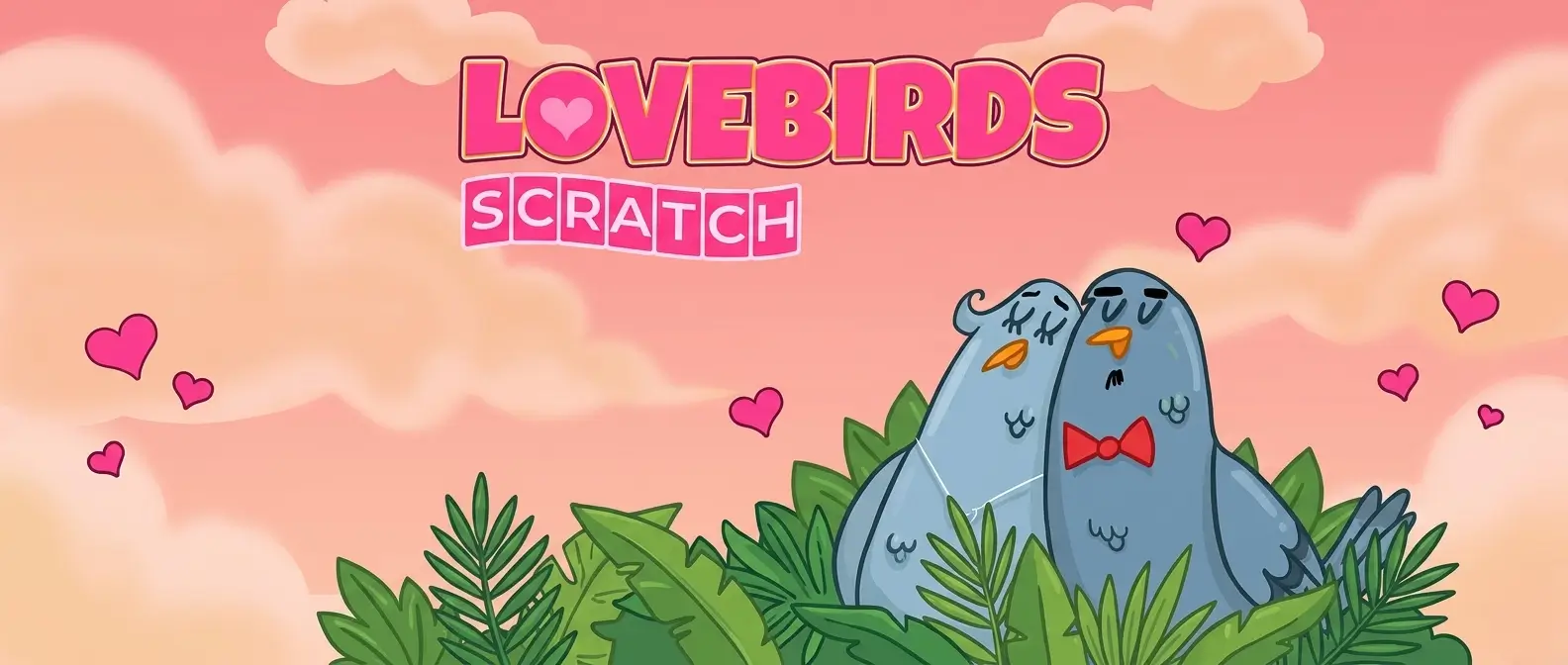
The two central character designs — the pair of stylised birds that give the game its name — are rendered with the illustrative precision that characterises Spinmatic’s best work. They are not clip-art placeholders. The studio’s art team treats character animation as a retention mechanism: idle animations cycle during inactive periods, winning events trigger distinct celebratory sequences, and the overall impression is that the game is alive in a way that most scratchcard competitors are not.
Comparing this to what Thunderkick and Quickspin — the two studios most frequently cited as the industry’s premium visual benchmark — are producing in 2026 requires some calibration for format differences. Thunderkick’s 2025–2026 output in the video slot space, titles like Esqueleto Explosivo 3 and entries in its Unikorns series, operate with shader-rich 3D environments and frame-by-frame character animation that sets a genuinely difficult standard. Quickspin’s design language — clean Scandinavian minimalism applied to character-driven game worlds — remains the default reference point for studios aiming at the premium European market.
Against that benchmark, Spinmatic’s Love Birds occupies a different tier. The gap is partly budgetary — a 3×3 scratchcard does not receive the same animation investment as a studio’s marquee video slot — and partly architectural. A scratchcard’s visual canvas is fundamentally constrained: the grid dominates the centre of the screen, leaving the peripheral environment as the primary space for artistic expression. Spinmatic uses that peripheral space more purposefully than most, but the comparison to Thunderkick’s full-frame reel environments is not a level one.
Within the digital scratchcard category specifically, Love Birds compares more favourably. The HTML5 performance on mobile platforms — Spinmatic’s stated primary deployment environment — is competent and consistent. The SpinEngine 3.0 framework delivers smooth frame rates across mid-range Android devices, and the UI scales appropriately across screen sizes without the element-compression issues that affect some scratchcard products on sub-6-inch displays.
What Love Birds does not have, and what represents its most significant visual limitation relative to 2026 expectations, is adaptive audio design. The audio layer is fixed and looping — a pleasant enough Valentine’s Day ambient track with standard win sound effects — but it does not respond dynamically to session progression, winning streaks, or proximity to the Max Win condition in the way that leading studios now engineer audio to function as an engagement layer. Thunderkick in particular treats sound design as a first-order feature, with audio behaviour that modulates based on game state. Love Birds’ audio execution reads as 2022 rather than 2026 by that standard.
The visual work on the symbol set deserves specific mention. The white egg — the game’s apex symbol and Max Win trigger — is given the most animation investment of any individual element. When three white eggs align on a payline, the win sequence is noticeably more elaborate than the lower-tier reward animations, which creates a clear visual hierarchy that reinforces the mathematical hierarchy of the paytable. This is thoughtful design. Many scratchcard products fail to distinguish win animations by significance, producing the same visual response for a minimum match as for a maximum payout. Spinmatic avoids that mistake.
Professional Verdict
| Parameter | Value |
|---|---|
| Format | Digital Scratchcard |
| Grid | 3×3 |
| Paylines | 3 (horizontal rows) |
| RTP | 92.00% |
| Volatility | High |
| Maximum Win Trigger | Three white egg symbols on a payline |
| Bonus Round | None (Max Win is the primary feature) |
| Platform | HTML5, mobile-first (SpinEngine 3.0) |
| Licence | MGA / Virtual Gaming Technologies Limited |
Strengths
- Visual execution that exceeds the scratchcard format’s typical standard, with considered character animation and a layered aesthetic environment
- Immediate play resolution — no spin delay, no cascading sequences, no extended bonus reveal
- Mobile HTML5 performance is reliable across mid-range devices
- Clear visual hierarchy in win animations distinguishes Max Win events from minor matches
- Format accessibility for players unfamiliar with complex video slot mechanics
Weaknesses
- RTP of 92% is below competitive benchmarks for both video slots and many digital scratchcard alternatives; the 8% house edge requires clear acknowledgment
- High volatility without a structured bonus feature means session variance is pronounced and unmediated by any escalating multiplier mechanic
- No progressive jackpot, no free-play bonus module, and no secondary feature beyond the base prize grid
- Audio design is static and does not reflect 2026 standards for adaptive sound architecture
- Unsuitable for wagering requirement completion or extended low-risk sessions
Bottom line: Love Birds is an honest product. It does not pretend to be a video slot, does not inflate its feature set with mechanics it cannot sustain, and does not dress minimal content in hyperbolic marketing language. The art direction is genuinely competent, and within the specific register of digital instant-win entertainment, the experience is coherent and well-executed. The 92% RTP is the game’s single largest drawback, and no aesthetic quality compensates for that figure in cold mathematical terms. Players who approach Love Birds as a brief, visually pleasant interaction — with stakes sized accordingly — will find a product that delivers on its modest but clearly defined promise. Players who expect video slot-equivalent return rates or structured bonus depth will find the mathematical reality of this product unrewarding regardless of how well the birds are animated.