
RTP: 96.06% (operator-adjusted variants: 95.05% / 93.05% / 91.05%) | Volatility: High | Max Win: x100,000 | Hit Frequency: 17.6% | Reels: 3-4-5-4-3 | Paylines: 20
Why This Game Is Still Relevant
There is a specific type of slot player — the one who does not care about entertainment value, branded IP, or how well the soundtrack matches the theme. They care about one thing: variance ceiling. Where is the absolute top end of what this math model can produce, and what does the road to that number look like?
For years, Rome: The Golden Age has been a reference point in that conversation. Not because it is the flashiest title in the NetEnt catalogue — it is not. Not because the base game is exciting — it rarely is. But because NetEnt, in what remains one of their most architecturally ambitious math designs, engineered a slot where the theoretical maximum of x100,000 the stake is locked behind a progression system that demands patience, deep pockets, and a specific understanding of how collection-phase mechanics interact with bonus math.
This is not a game you drop into for 50 spins. It is not a game you play on a bonus with a 5x wagering cap. It is a game built for players who understand that the progression curve is the product, and that the bonus round without a charged multiplier is essentially worthless.
Understanding why it works — and why it often fails — requires breaking down the system layer by layer.
Quick Reference: Core Technical Parameters
| Parameter | Value |
|---|---|
| Provider | NetEnt (Evolution Group) |
| Reel Layout | 3-4-5-4-3 (diamond configuration) |
| Paylines | 20 fixed |
| Bet Range | €0.10 – €50.00 |
| Default RTP | 96.06% |
| Operator-Reduced RTP Options | 95.05% / 93.05% / 91.05% |
| Volatility | High (medium-high per NetEnt classification) |
| Hit Frequency | 17.6% (~1 in 5.7 spins) |
| Free Spins Trigger Frequency | ~1 in 195 spins |
| Max Win | x100,000 |
| Max Win Frequency (simulated) | ~1 in 166 billion spins |
| Free Spins Multiplier Cap | x1,000 (applied to pooled prize total) |
| All-Position Completion Bonus | x2 applied to all locked symbol prizes |
The Long Game
The architecture of Rome: The Golden Age is built around a single economic principle: delayed gratification with compound payoff. Every element of the base game exists to serve the multiplier meter.
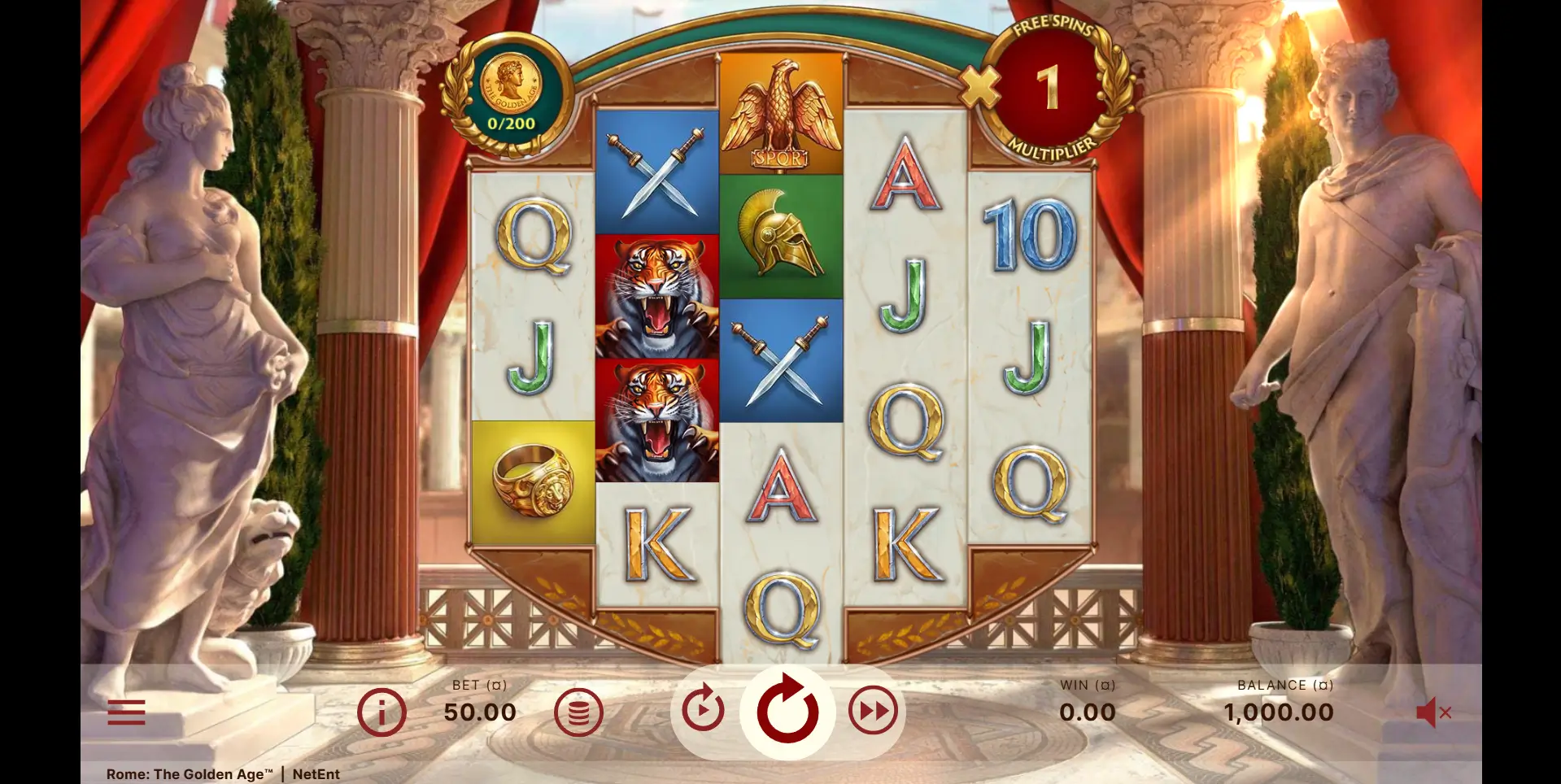
The Golden Age coin symbol drives everything. When it lands, two things happen simultaneously: a golden frame is stamped on that reel position, and 1–4 points are added to the collection meter in the top-left corner of the screen. Those frames are not decoration — they are the delivery mechanism for wilds in the base game. If a Rome symbol lands in or adjacent to a framed position, those frames activate on the next spin, transforming into wild symbols. This creates occasional base-game wins, but their absolute value is low. Five-of-a-kind on the highest regular symbol (the tiger) pays just x5 the stake. Even full-screen wild combinations sit comfortably below the “big win” threshold on most platforms.
The real function of the frame system is acceleration. When a Golden Age coin lands on a position that already carries a frame, the meter receives a boosted 1–5 points instead of the standard 1–4. This is the first instance of compounding in the model — the more frames you accumulate, the faster the meter fills. The meter requires 200 points to advance the multiplier by one step.
The multiplier progression follows a non-linear scale:
x1 → x2 → x3 → x5 → x7 → x10 → x12 → x15 → x20 → x30 → x40 → x50 → x75 → x100 → x200 → x300 → x500 → x750 → x1,000
Nineteen distinct levels. At a collection rate of roughly 100–150 spins per full meter cycle (under standard conditions), reaching x1,000 requires surviving approximately 3,600–4,200 spins without triggering the bonus. The multiplier resets to x1 after every free spins round. That is the fundamental tension this game places on the player.
The psychological trap is precisely constructed. The progression meter is visible at all times. A player who has spent 800 spins collecting and sits at a x75 multiplier is not making a rational decision to continue — they are sunk-cost reasoning dressed up as strategy. NetEnt designed the visual feedback to maximise this effect. The meter fills incrementally. The multiplier upgrades are announced with an audio cue. Every step feels like progress. In practice, the meter represents deferred variance, not guaranteed return.
The progression curve is also non-uniform in a way that benefits the house. At the lower multiplier levels — x2, x3, x5 — the collection phase is relatively quick. A player can reasonably expect to cycle through the first several steps within 400–600 spins, building momentum and a sense of accelerating progress. The visual and audio feedback at each step reinforces this. The trap tightens in the mid-range. Moving from x50 to x75 requires the same 200 points as moving from x1 to x2, but because the player is now deeper into the session — potentially several hundred spins invested — the sunk cost pressure intensifies. The distance to x100 feels shorter than the distance back to zero. It is not. Every step costs the same in terms of spin volume. The game does not discount the cost of progress as the multiplier climbs. It simply makes the payoff look bigger, which it is — in absolute terms, at a proportionally low probability of the trigger arriving at exactly the right moment.
There is a critical operational detail that is rarely highlighted in generic reviews: the collection meter is bet-sensitive. Points accumulated at €1.00 per spin are stored separately from points accumulated at €2.00 per spin. If a player changes their stake mid-session, they effectively abandon their progress at the previous stake level and start building a new meter at the new level. For players managing bankroll across a long session, this is not a minor footnote — it is a constraint that forces commitment to a single stake size from the first spin.
The meter does, however, persist between sessions. A player who closes the game at x75 and returns the following day — at the same stake — continues from where they left off. This is a meaningful design decision. It transforms what would otherwise be an impossible progression requirement into something achievable across multiple sessions.
What the Math Actually Produces
The Free Spins round in Rome: The Golden Age operates on a completely different mechanical principle than the base game. Understanding the gap between theoretical output and practical experience here is essential.
Trigger condition: 3 Scatter symbols on reels 2, 3, and 4 simultaneously. At a hit rate of approximately 1 in 195 spins, the bonus arrives infrequently — but with enough regularity that a 500-spin session typically produces 2–3 triggers. The round begins with 3 free spins.
Before the round starts, a significant pre-calculation occurs: all positions carrying frames or active frames that did not convert to wilds during the triggering spin become locked sticky positions. These positions will reveal prizes at the end of the round, with values ranging from 0.5x to 50x the stake. The distribution skews heavily toward the lower end of this range in practice — the 50x award on a single position is an outlier event.
During the free spins themselves, only Rome symbols land on unlocked reel positions. Each Rome symbol that lands resets the spin counter to 3 and locks that position, assigning it a prize of 0.5x–50x. The round continues until either the player runs out of spins (impossible to avoid if the reels go cold) or all 20 positions are locked.
Filling all 20 positions is itself an outlier event. When it occurs, a x2 multiplier is applied to all locked prize values — doubling an already potentially substantial pool. Without a full-lock completion, this x2 bonus does not apply.
At the conclusion of the round, all prize values are summed and multiplied by the collected Free Spins multiplier. This is where the math model’s upside lives:
- x1 multiplier (no base game collection): Average bonus output sits in the 20x–80x range. Occasionally higher if the position prizes skew toward the 50x end.
- x100 multiplier: That same 20x–80x prize pool becomes 2,000x–8,000x. A genuinely significant result.
- x1,000 multiplier + full-position lock: The full theoretical ceiling opens. Twenty positions at 50x each equals 1,000x in raw prizes, multiplied by 1,000 (the multiplier), multiplied by a further x2 (full-lock bonus) = x2,000,000 equivalent — but this is immediately capped at the x100,000 ceiling.
The math checks out. The obstacle is purely combinatorial: reaching x1,000 before the trigger is a multi-thousand spin exercise, and the trigger itself is random. The odds of triggering at exactly the right multiplier level are compounded against the odds of filling all 20 positions with maximally-valued prizes. NetEnt’s simulation data puts the x100,000 event at once every approximately 166 billion spins. For context, at 10 seconds per spin, 24 hours per day, it would take a single player roughly 52,000 years to see that outcome at statistical expectation.
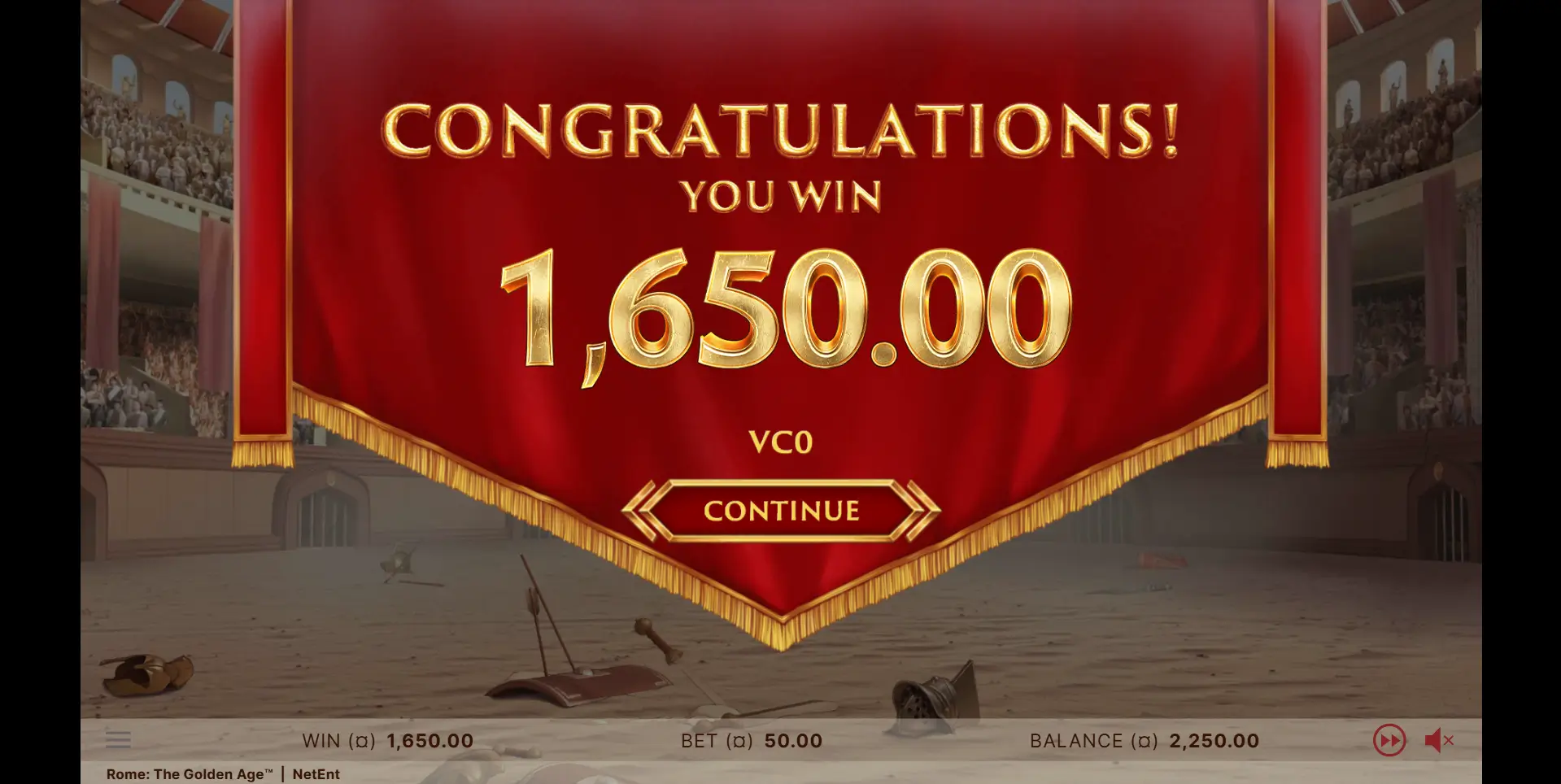
The practical bonus experience for the majority of players is a x2–x20 multiplier applied to a modest prize pool, resulting in a bonus return of 50x–400x. Solid — not extraordinary. Sufficient to extend the session, rarely sufficient to constitute a meaningful win relative to the collection cost incurred.
One critical operator-level consideration: always verify the RTP version before depositing. NetEnt allows operators to deploy Rome: The Golden Age at 91.05%, 93.05%, or 95.05% instead of the advertised 96.06%. At 91.05%, the math model is materially different — the effective volatility profile shifts, and the collection-to-payoff ratio degrades. Check the game’s information panel (help file) before play, not after.
NetEnt vs. The Extreme Volatility Specialists
Rome: The Golden Age launched in 2021. In slot development terms, that is not ancient history, but the competitive landscape has shifted substantially. The question in 2026 is not whether the game is good — it demonstrably is, for the right player type. The question is whether NetEnt’s approach to high-variance design remains competitive when placed against studios that have made extreme volatility their primary product identity.
Nolimit City has established itself as the benchmark provider in this niche. Their xMechanics system — xWays, xNudge, xSplit, xBomb — is now in its third iteration, generating wins that can compound from near-zero to ceiling within seconds of a bonus trigger. San Quentin 2: Death Row carries a x200,000 max win at 96.13% RTP. Mental 2 reaches x99,999 at 96.06%. Fire in the Hole 3 sits at x70,000 with a 22.18% hit frequency. Tombstone R.I.P. peaks at x300,000.
Hacksaw Gaming brings configurable RTP as standard architecture and has built a catalogue of high-ceiling titles aimed specifically at the big-win chaser demographic.
| Title | Provider | Max Win | RTP (default) | Volatility Classification |
|---|---|---|---|---|
| Rome: The Golden Age | NetEnt | x100,000 | 96.06% | High |
| San Quentin 2: Death Row | Nolimit City | x200,000 | 96.13% | Extreme |
| Mental 2 | Nolimit City | x99,999 | 96.06% | Insane |
| Fire in the Hole 3 | Nolimit City | x70,000 | 96.05% | Extreme |
| Tombstone R.I.P. | Nolimit City | x300,000 | 96.08% | Extreme |
The comparison is not flattering to NetEnt on the raw ceiling metric. But the more interesting distinction is mechanic architecture.
Nolimit City’s xMechanics produce their extreme variance through multiplicative stacking — symbols dividing, reels expanding, wilds carrying escalating multipliers. When a Nolimit City bonus hits optimally, the math cascades rapidly through compounding operations. A single bonus round can go from 50x to 50,000x in under 30 seconds. The ceiling is accessed quickly or not at all.
Rome: The Golden Age operates differently. The extreme variance is temporal rather than mechanical. The ceiling requires hundreds or thousands of spins of patient collection before the bonus can theoretically produce it. This is a fundamentally different risk model. Nolimit City’s approach is acute — intense, brief, either/or. NetEnt’s approach is chronic — gradual accumulation followed by a binary event.
For the player with 200 spins and a moderate budget, a Nolimit City bonus buy or naturally-triggered bonus round provides more immediate access to the variance ceiling. For the player running a structured long-game session over multiple days at a consistent stake, Rome: The Golden Age offers something Nolimit City’s titles generally do not: compounding base-game progression that carries across sessions.
In practical terms, NetEnt has not kept pace with the extreme volatility specialists in 2026. Their more recent high-ceiling releases have not replicated the architectural elegance of Rome: The Golden Age. Nolimit City, now operating within the Evolution Group (who also own NetEnt), has effectively absorbed the “innovation” brief that NetEnt once held. Rome: The Golden Age feels like a game from a studio that was pushing the math frontier in 2021 — because it was. In 2026, it is a mature, well-understood model rather than a cutting-edge one.
That is not a reason to dismiss it. A proven math model with documented behavior is often more bankroll-efficient than a novel one whose distribution tails are not yet well-mapped by the player community. But players entering Rome: The Golden Age expecting the mechanical chaos of a Nolimit City title will find a quieter, slower, more deliberate game than they anticipated.
Context Among Themed Competition
Rome: The Golden Age does not compete only with extreme-volatility titles generically — it competes within a specific thematic niche that has attracted multiple major providers. A brief comparison provides useful calibration.
Caesars Triumph (Pragmatic Play) uses a grid mechanic with increasing multipliers through a similar collection-and-trigger structure. Max win sits at x10,000. Significantly lower ceiling, lower volatility, far more accessible.
Rome: Caesar’s Glory (Pragmatic Play) is a standard high-volatility offering with respins and a max win in the x5,000–x15,000 range depending on the variant. Mechanically unremarkable.
Roman Legion (Gamomat) offers straightforward reel mechanics with expanding wilds and modest variance. Not a comparable product.
Among Roman-themed titles with genuine extreme-win credentials, Rome: The Golden Age remains essentially unchallenged. No other provider has built a Roman-themed slot with equivalent architecture and a six-figure max win. For players who combine thematic preference with volatility-hunting, the field remains thin.
Who Should Play This Game
This section requires precision, because Rome: The Golden Age is a genuinely inappropriate game for a significant portion of the slot-playing population.
Who this game is built for:
The player who should engage with Rome: The Golden Age has the following characteristics:
- Extended session capacity. The collection phase is the game. At 100–150 spins per multiplier step and 18 steps to reach x1,000, the full progression requires a four-figure spin count. Sessions of fewer than 200 spins at a consistent stake are unlikely to produce meaningful multiplier advancement.
- Consistent stake commitment. Changing stakes mid-session invalidates accumulated collection progress at the previous stake level. Players who routinely adjust stakes based on session results are poorly served by this model.
- Bankroll sufficient to sustain the hit frequency. At 17.6%, roughly 1 in 5.7 spins returns any win. Extended losing sequences are a mathematical certainty, not an anomaly. A minimum of 200–300 bet units is a reasonable floor for a productive session. At €1.00/spin, that is €200–€300 before the first meaningful bonus becomes statistically expected.
- Understanding of expected value versus individual session variance. The x100,000 ceiling is a mathematical construct, not a realistic session target. The practical goal is entering the free spins at a multiplier of x50 or higher — a significant but achievable objective over multiple sessions — and allowing the prize pool to generate a meaningful return.
Bankroll framework for structured play:
| Stake Level | Recommended Session Bankroll | Multiplier Target (realistic) | Expected Bonus Frequency |
|---|---|---|---|
| €0.10/spin | €30–€50 | x10–x20 | ~1 per 200 spins |
| €0.50/spin | €150–€250 | x20–x50 | ~1 per 200 spins |
| €1.00/spin | €300–€500 | x30–x75 | ~1 per 200 spins |
| €5.00/spin | €1,500–€2,500 | x50–x100 | ~1 per 200 spins |
These figures assume the 96.06% RTP version. At the 91.05% variant, the math degrades significantly — the expected collection cost per multiplier level increases, and the effective house edge on the bonus output rises. The reduced-RTP version is not appropriate for structured play at any stake.
Who should not play this game:
- Players who need base-game entertainment value to sustain interest. The base game between collection events is low-frequency and low-value. Long stretches of sub-threshold spins with occasional small payline wins are the norm.
- Players using bonus funds with playthrough requirements. The collection phase consumes significant wager contribution before a meaningful bonus trigger. Most bonus terms are incompatible with this model.
- Players who do not track their stake level across sessions. Changing stakes without understanding the meter isolation mechanic leads to inadvertent collection loss.
- Players whose bankroll limits them to fewer than 150 spins at a consistent stake. The minimum viable engagement length for this model is roughly 200 spins — enough to see the bonus once and build meaningful multiplier progress.
- Recreational players seeking frequent feedback loops. Hit frequency of 17.6% means more than 80% of spins produce nothing. The psychological load of extended non-winning sequences is substantial.
Final Technical Assessment
Rome: The Golden Age is an architecturally coherent slot with a clearly defined math model, documented behavior across millions of simulated spins, and a genuine — if astronomically unlikely — path to a six-figure multiplier event.
Its principal strength is the persistence mechanic: collection progress carries across sessions, which allows the game to function as a multi-day project rather than a single-session gamble. No major Nolimit City title replicates this specific structure. In that sense, NetEnt built something that has not been directly superseded, only outpaced at the ceiling level.
A secondary strength is the distributional clarity of the prize structure. The free spins pool is deterministic: positions lock, prizes are assigned in a defined range, the multiplier is applied to the sum. There are no mystery multipliers during the bonus, no mid-spin modifiers that can erase an accumulating win, no complex conditional chains that require multiple independent events to resolve favorably within a single bonus sequence. Players know what they are chasing and can calculate the rough expected value of any given bonus entry based on their current multiplier. This is unusually transparent for a high-variance product. It is also what makes the game feel honest in a way that some of the Nolimit City catalogue does not — those titles generate their extreme variance partly through feature chains that are difficult to read in real time, and whose full probability structures are rarely published in accessible form.
Its principal weakness in 2026 is competitive positioning. The extreme-volatility market has moved decisively toward Nolimit City’s mechanical approach — faster resolution, higher ceilings, more frequent bonus access (particularly via bonus buy, where available). Players who entered the high-variance niche through NetEnt’s Dead or Alive 2 or Rome: The Golden Age are now primarily consuming content from Nolimit City and Hacksaw Gaming. NetEnt has not released an equivalent high-architecture title since.
The RTP operator flexibility remains the most underappreciated risk factor. The spread between 96.06% and 91.05% is not an academic difference — at the lower setting, the expected cost of reaching any meaningful multiplier level increases by roughly 5 percentage points per spin. At €1.00/spin over 500 spins, that is approximately €25 in additional expected loss. Always check the version before playing.
The game is not for everyone. For the players it is designed for, it remains one of the most mathematically coherent extreme-variance products in the standard casino catalogue in mid-2026. Whether that population of players still constitutes a primary market, or whether they have migrated to the more visceral products now available from the studios NetEnt’s parent company also owns — that is the open question this game cannot answer itself.