
Ancient Architecture, Modern Scrutiny
Here is a game that launched in August 2016, when Megaways was still a whiteboard idea at Big Time Gaming, when “10,000x” max wins were reserved for progressive jackpot marketing copy, and when a 26.38% hit frequency on a five-reel grid felt genuinely respectable. Fortune House arrived with a confident, almost aristocratic posture — rich lacquer-red aesthetics, a 5×3 grid dressed in gold, and four bonus mechanics that were, at the time, more ambitious than most of what Red Tiger’s contemporaries were releasing.
Nine years and roughly ten thousand new slot titles later, does it still deserve floor space?
That question is harder to answer than it should be. On the one hand, Fortune House is an objectively dated product by the mechanical standards of 2026. On the other, Red Tiger’s math team clearly built something with structural integrity — the kind of game that continues to convert new players who stumble across it in a lobby search, survives aggressive A/B testing by operators, and spawned its own Power Reels sequel in 2021. That sequel made the game significantly more volatile and pushed the max win ceiling to 8,302x, which is a fairly eloquent admission that the original needed horsepower it never had.
Let’s pull the machine apart properly, rather than just admiring the wallpaper.
Where Things Get Complicated
RTP: A Number That Varies More Than It Should
This is where any serious analysis of Fortune House has to navigate some genuine inconsistency across published data. Depending on the source and the operator configuration:
- Red Tiger’s own documentation publishes 96.12% RTP
- Several aggregator sites report figures ranging from 95.25% to 96.12%
- At least one independent review database cites 94.77% in specific market configurations
The variance in published RTP almost certainly reflects two things: operator-selectable RTP tiers (a standard Red Tiger feature, inherited and expanded post-Evolution acquisition) and potential jackpot contribution mechanics. Red Tiger’s Daily Drop jackpot network is active across a significant portion of its catalogue, and where jackpot pool contributions apply, the base game RTP is reduced accordingly. Operators in regulated markets — particularly those under MGA, UKGC, or Spelinspektionen oversight — need to confirm which RTP tier is live in their specific configuration, because the difference between 94.77% and 96.12% is not cosmetic; it represents a meaningful shift in the effective house edge over thousands of player sessions.
For the purposes of this review, the baseline figure of 96.12% is used, as it reflects the most commonly cited operator-default configuration and Red Tiger’s own published spec.
One additional wrinkle worth flagging for anyone playing Fortune House at a regulated European casino: Red Tiger operates as part of the Evolution Group following its 2020 acquisition, and the commercial framework governing RTP configuration has become considerably more operator-flexible since then. A game sold under an 96.12% headline RTP at one casino may be running at a materially lower tier at another, with no player-visible disclosure beyond whatever the operator places in its terms and conditions. If RTP integrity matters to your session planning — and for any serious player, it should — verifying the configured rate directly with the operator’s support team or checking published game certificates on regulated market gambling authority websites is worthwhile effort.
Volatility: A Disputed Classification
The volatility classification of Fortune House is, frankly, a mess across the secondary review ecosystem. You will find it listed as low, medium, medium-high, and even high depending on which site you consult. Red Tiger’s own page simply lists it under volatility without specifying a tier — which is either deliberate ambiguity or an oversight that nobody has corrected in nine years.
The most defensible reading of the available data puts Fortune House in the low-to-medium volatility bracket for the base game:
- Hit frequency of 26.38% — meaning roughly one in four spins produces some kind of return
- Maximum win capped at 697x the stake in the standard 5×3 configuration
- Bonus features that trigger frequently but tend to produce modest returns on individual activations
- A session profile that leans toward session-length sustainability rather than big-swing variance
This is not a high-volatility game by any reasonable 2026 standard. Comparing it to titles like Dead or Alive 2 (typically high variance, sub-10% hit frequency) or even Red Tiger’s own Dragon’s Fire Megaways makes the Fortune House math model look genuinely conservative. The Dragon Wheel’s theoretical ceiling of 80x the bet (on the original game) sounds significant until you factor in the wheel’s probability distribution — the higher multipliers occupy a small arc of the wheel, and most real-money sessions will cluster around the 3x–8x range far more than published marketing copy suggests.
What the 697x Max Win Actually Means
At a maximum bet of €50 per spin, a 697x win equals €34,850. At the minimum bet of €0.10, the same proportional win yields €69.70. These numbers tell you exactly what kind of player Fortune House was designed for: budget players who want extended session time, frequent small confirmations that something is happening, and the occasional bonus feature to break up the monotony. High-rollers chasing meaningful single-session P&L on a €50 stake will find the ceiling frustrating and should look elsewhere.
What Each Mechanic Actually Does
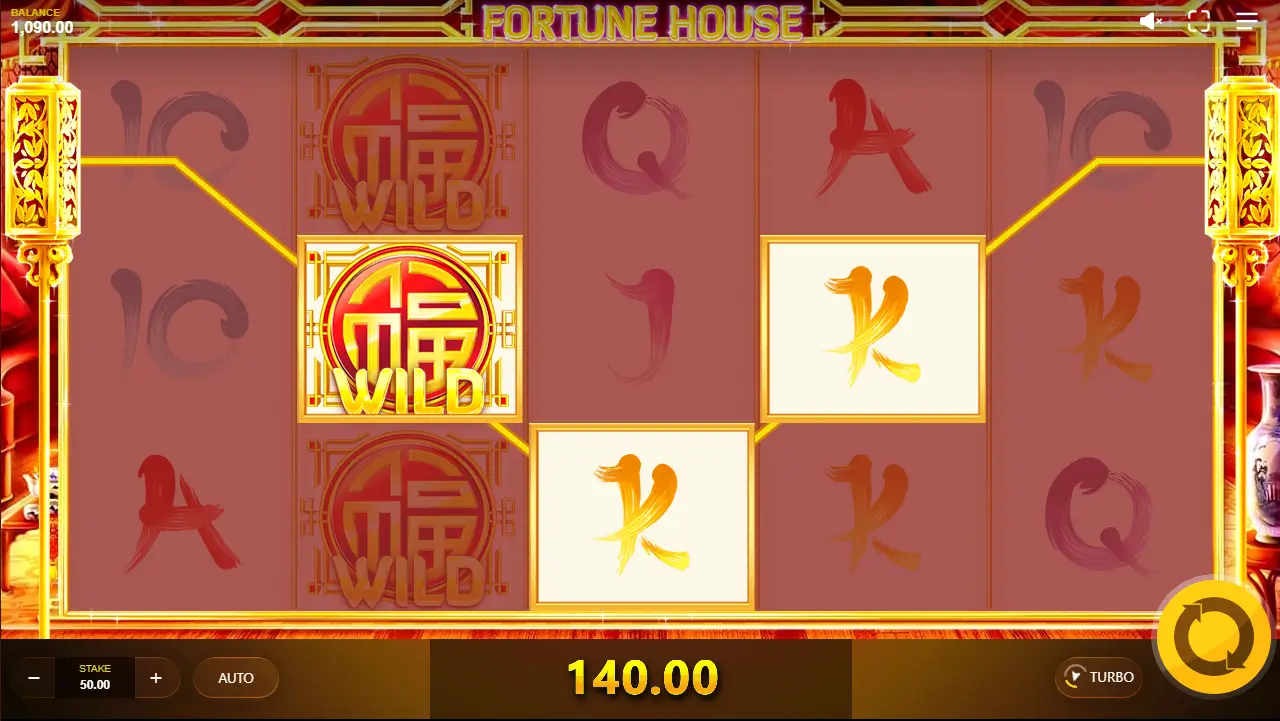
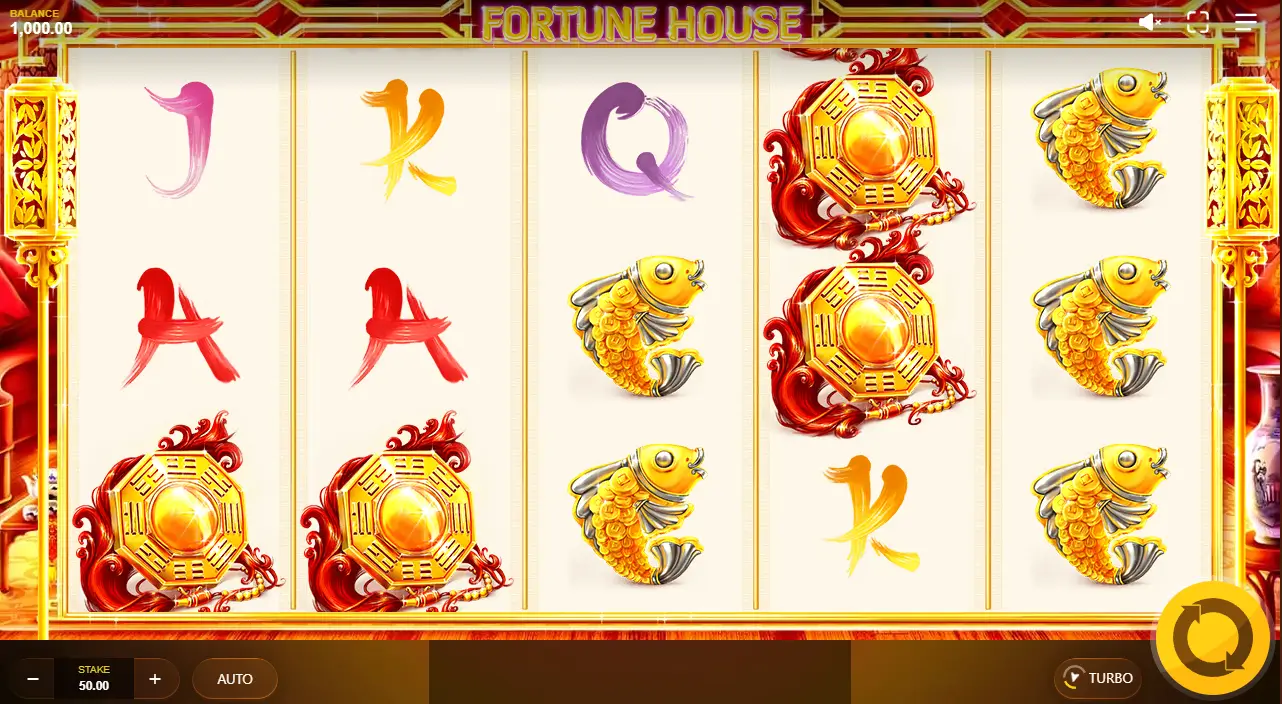
Fortune House runs four distinct bonus mechanics, all delivered via oversized 2×2 “Mega Symbols” that land on the standard 5×3 grid. In theory, four features give the game variety. In practice, they are not equal contributors to long-term return, and understanding the hierarchy matters.
Dragon Wheel
The marquee feature. A 2×2 Dragon Wheel symbol lands on the reels and, when fully visible in the play area, activates a multiplier wheel. The wheel spins — and can be re-triggered randomly any number of times — landing on one of several multiplier values.
Published multiplier tiers for the original Fortune House include 3x, 5x, 8x, 18x, and an upper tier reaching 80x in some configurations. The Dragon Wheel simultaneously converts to a wild symbol, substituting for all standard paying symbols. The awarded multiplier applies to every winning line that uses the wild — which is where the theoretical ceiling gets interesting.
The practical reality: the distribution is heavily weighted toward the lower tiers. Third-party session data from extended play reviews consistently reports most Dragon Wheel activations landing in the 3x–8x range. The 80x outcome exists and is mathematically accessible, but treating it as an expected result rather than an outlier event would be a mistake. The feature’s real value is its wild conversion — a 2×2 wild covering four reel positions on a 5×3 grid is a meaningful symbol density disruption, and even a 3x multiplier applied across multiple paylines touching that block can produce a respectable combined win.
Fortune Tree
A 2×2 tree symbol lands and begins distributing wild symbols to random positions across the grid. The key mechanic detail here is that a single Fortune Tree landing can activate up to five times sequentially, each activation scattering additional wilds. At maximum activation depth, this can produce significant wild density across the reels before the win calculation fires.
The practical reality: Fortune Tree is the feature most likely to generate the session’s biggest single hit in Fortune House. Dense wild coverage on a 20-payline grid, combined with any reasonable premium symbol distribution, can compound quickly. The guarantee of a win on every activation is also worth noting — it functions as a floor protection mechanic that helps sustain session bankrolls. That said, “guaranteed win” in this context means the math model ensures at least one paying combination forms; it does not mean the win will be meaningful. A 0.5x-stake win still qualifies as a guarantee.
Mystery Win (Mystery Tiles)
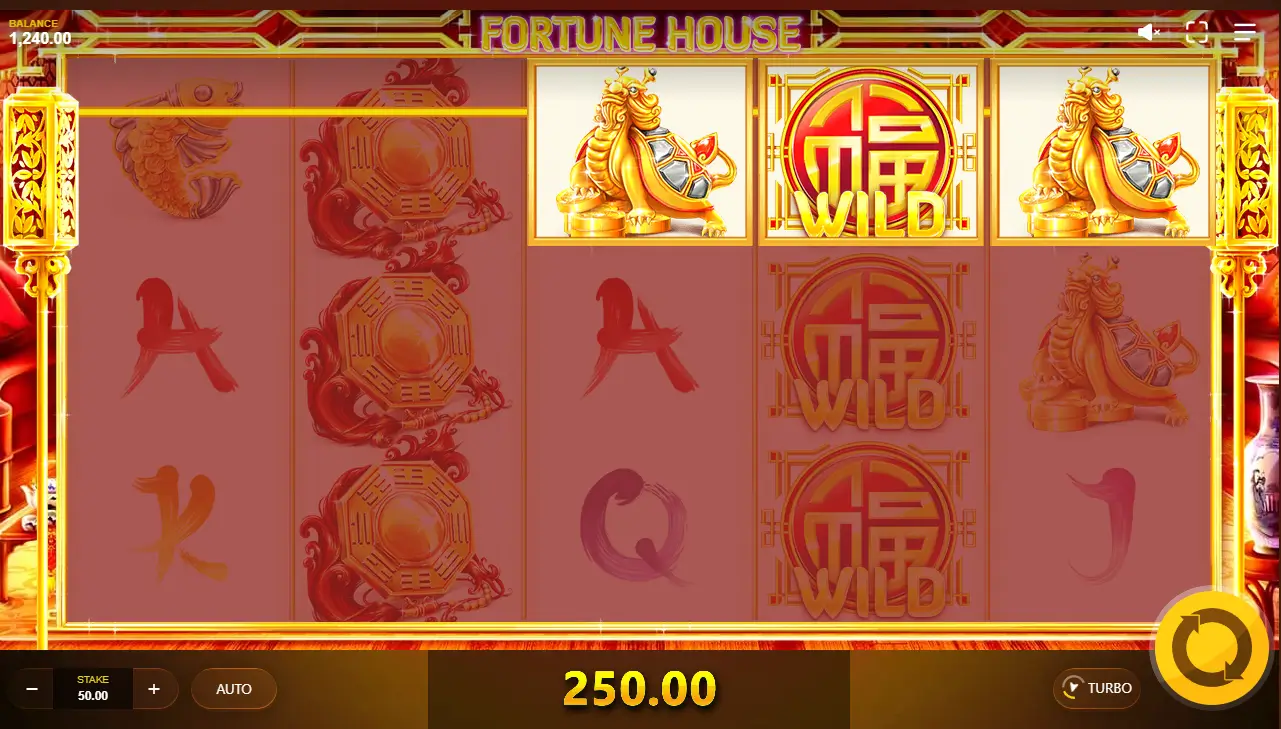
A golden toad 2×2 symbol triggers a sequence where multiple Mystery Symbols are distributed across the reels. All Mystery Symbols then spin simultaneously and reveal a single identical paying symbol. The mechanic can also chain, with up to five activations possible from a single landing.
The practical reality: Mystery Win is fundamentally a symbol alignment forcing mechanic. By converting a random number of reel positions to the same symbol, it artificially creates the conditions for multi-line wins that the spin’s natural outcome would not have produced. The key variable is which symbol the reveal lands on. If the Mystery Symbols convert to a premium (the Buddha, the dragon, the koi fish), even a modest spread of six or eight matching symbols across the grid can generate a meaningful payout. If they convert to a card royal — which happens — the yield is modest at best.
The randomness of the revealed symbol is where this feature’s variance sits. Unlike Dragon Wheel, where the multiplier is the primary variable, Mystery Win’s outcome depends on both the number of converted symbols and which symbol they become. That two-layer randomness makes it the least predictable of the four features — which can work for or against the player in equal measure.
Fortune Respin (Super Tiles / Pot of Gold)
A pot-of-gold 2×2 symbol triggers a respin in which all low-paying symbols — the card royals — are removed from the reel set. Only premium symbols populate the reels during the respin sequence, which continues until a winning combination lands (guaranteed).
The practical reality: this is mechanically the cleanest feature in the game. By eliminating dead symbol weight from the reel strips, the probability of meaningful wins during the respin increases substantially. It is essentially a symbol-weighting adjustment applied temporarily, and on a grid where card royals normally occupy a significant proportion of reel strip positions, their removal creates noticeably richer spin outcomes.
The Fortune Respin is also the feature that most consistently delivered value in published extended session reviews — not because individual activations are spectacular, but because the mechanic is reliable. You land it, you get a useful win at a probability significantly above the base game baseline, and the session continues. For a low-to-medium volatility game oriented toward session sustain, this is precisely the right design choice.
Does Fortune House Still Belong in a Modern Lobby?
This is where the review has to be honest in a way that enthusiasm for craft does not always permit.
Against the Competition
The iGaming market in early 2026 operates at a level of mechanical sophistication that would have been difficult to predict when Fortune House launched. The Megaways format — licensed from Big Time Gaming, deployed across hundreds of titles — offers 117,649 ways to win on a standard 6-reel layout, with cascading wins and expanding reels producing max win potentials regularly exceeding 50,000x the stake. Hacksaw Gaming’s reel modifier catalogue and Nolimit City’s xWays/xNudge mechanic family deliver variance profiles and ceiling heights that Fortune House cannot approach.
Against this backdrop, a 697x max win cap and a 20-payline grid look genuinely limited. The argument that Fortune House compensates with hit frequency and feature density is valid within its own context, but players who have been conditioned by five years of high-volatility, high-ceiling releases may find the game’s reward ceiling actively unsatisfying.
The Power Reels Answer
Red Tiger’s own answer to this problem was Fortune House Power Reels, released in 2021. The upgrade:
- Expanded the grid to 8 reels × 6 rows
- Maintained 30 paylines with a “Pay Anywhere” adjacent wins system
- Pushed the max win to 8,302x the stake
- Applied the same four core feature mechanics with upgraded multiplier tiers (Dragon Wheel now reaching x38 in that version)
- Accepted a RTP reduction to 95.66% (with some operator configurations reporting 94.77%)
- Classified it as a high-volatility title — a meaningful departure from the original’s conservative math model
Power Reels is clearly the superior product for players who want ceiling height and variance. The original Fortune House now functions more as an entry-level introduction to the feature set — a training ground, effectively, for players who may graduate to the sequel once they understand how the mechanics fire.
For High-Rollers Specifically
A high-stakes player depositing at the €50 maximum per spin on Fortune House is capping their theoretical session upside at €34,850. That is not an inconsequential sum, but it is also not a compelling high-roller proposition in a market where a €50 spin on Deadwood (Nolimit City), Jammin’ Jars 2 (Push Gaming), or Money Train 4 (Relax Gaming) can theoretically return multiples of that figure within a single bonus round.
Fortune House was never built for high-rollers. Its stake range, math model, and max win ceiling all point toward the casual and recreational player segment. Positioning it as a serious high-roller title would be misrepresenting what the game actually is.
What It Is Good At
- Consistent engagement mechanics: four distinct features, each with a recognisable trigger, create a session rhythm that holds attention across extended play
- Accessible for new players: the 26.38% hit frequency means new casino players are not sitting through thirty losing spins before seeing any activity
- Mobile performance: Red Tiger’s HTML5 execution has always been solid, and Fortune House runs cleanly across Android and iOS at mid-range device specifications
- Daily Jackpot eligibility: where configured, the Daily Drop/Mega Drop jackpot counters add an aspirational layer that partially compensates for the game’s modest base game ceiling
- Brand familiarity: for operators in markets where the Fortune House IP has player recognition — particularly certain Asian-facing and South Asian markets — the game carries recall value that newer titles have not yet built
Play or Walk?
Play if: you are a recreational player who values session length over max win potential, want to understand how Red Tiger’s bonus tile mechanic family works before committing to higher-variance iterations, or are at a casino where Fortune House carries Daily Drop jackpot eligibility that meaningfully supplements the base game’s limited ceiling.
Walk if: you are a high-volatility player chasing sessions with meaningful ceiling heights, have a budget that makes the 697x max win feel like a cap rather than an aspiration, or are comparing the original against Fortune House Power Reels — in which case, play the Power Reels version. The math model is better, the ceiling is dramatically higher, and the feature mechanics operate in a more rewarding context on the expanded 8×6 grid.
The honest summary: Fortune House is a well-built game for what it was designed to do. It was designed in 2016 for a market segment that valued accessibility and session sustain over big-swing variance. In 2026, that market segment still exists — but it is served by many more competitors, several of them delivering the same player proposition with better math models and higher ceilings.
There is also a legitimate argument that Fortune House occupies a useful structural role in operator lobbies that goes beyond its standalone merit. Casual players who experience the Dragon Wheel and Mystery Tile mechanics here for the first time — in a forgiving, low-volatility environment where the hit frequency keeps sessions alive — are being introduced to a feature language that Red Tiger repeats and amplifies across much of its catalogue. The original Fortune House functions, consciously or not, as an onboarding product. It teaches the mechanic without punishing the player for not understanding it immediately. That has genuine value in a lobby strategy context, even if it does not translate to a compelling proposition for any player who knows what they are looking for.
The original Fortune House is not a bad game. It is a specific game, for a specific player profile, operating in a competitive context that has grown significantly more demanding over nine years. If the profile fits, it delivers. If it does not fit, there is little point in pretending otherwise.
The architecture is beautiful. The ceiling is low. Know which one matters more to you before you spin.