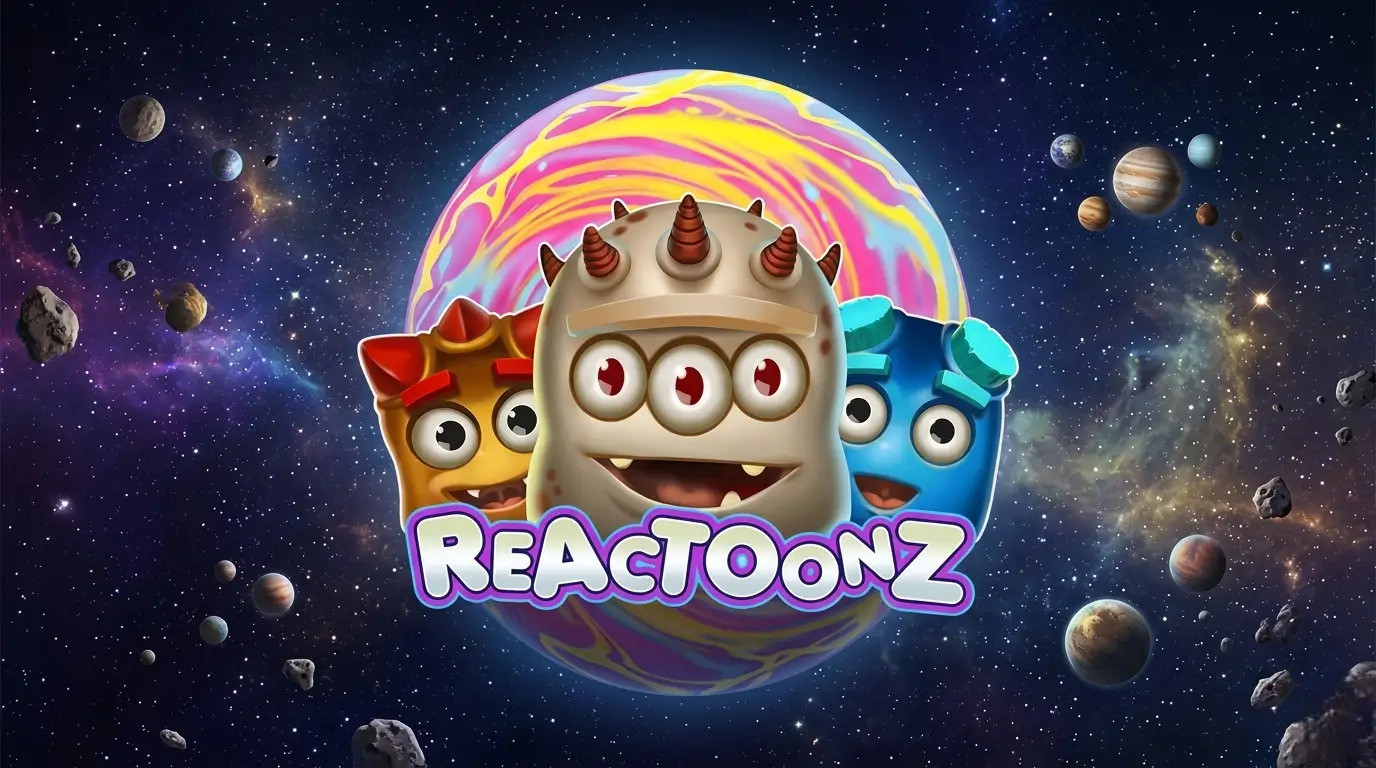
RTP: 96.51% | Max Win: 4,750x | Volatility: 10/10 | Grid: 7×7 | Released: October 2017
Eight-plus years is a geological age in online slots. Titles launched in 2017 are now buried under thousands of newer releases, most of which have bigger win ceilings, flashier bonus rounds, and marketing budgets that dwarf anything Play’n GO spent on a cartoon alien game from their Gothenburg studio. Yet every major casino lobby you open in 2026 still features Reactoonz somewhere near the top of the “popular” filter. Not because operators are lazy. Because players keep choosing it.
That fact alone demands an explanation. This is an attempt to provide one — not by cataloguing what Reactoonz does, but by examining why it works at a mechanical level, what its successors failed to improve upon, and how you should actually think about your bankroll when you sit down at a 10/10 volatility game with no free spins feature.
The “Cluster King” Phenomenon: What Reactoonz Actually Changed
When Reactoonz launched in October 2017, the dominant slot format was still the five-reel, 20-to-25-payline structure that had been standard since the mid-2000s. Cluster Pays was not a new concept — Play’n GO had already experimented with grid mechanics in the earlier Energoonz — but Reactoonz was the moment the format broke into mainstream consciousness.
The 7×7 grid is the key decision that makes everything else possible. At 49 symbol positions, the grid is large enough to accommodate simultaneous multiple winning clusters, layered feature activations, and cascading chain reactions that can cover more than half the board. A 5×5 grid (25 positions) simply cannot generate the same cascade depth or the same volume of qualifying wins needed to charge multiple meters in a single spin sequence. Play’n GO understood this, and they sized the grid accordingly.
What followed was a wave of imitation. Hacksaw Gaming, Nolimit City, BGaming, Pragmatic Play — every serious developer now has cluster-pays titles in their catalogue. The Megaways engine from BTG sparked a similar franchise effect around the same time, but Cluster Pays arguably created more durable gameplay variety, because the absence of paylines forces genuine innovation in how wins are structured and rewarded.
The terminology that Reactoonz popularised — cascading reels, cluster qualification, meter-charged features — is now standard iGaming vocabulary. That is the measure of genuine industry impact. Not marketing awards; borrowed language.
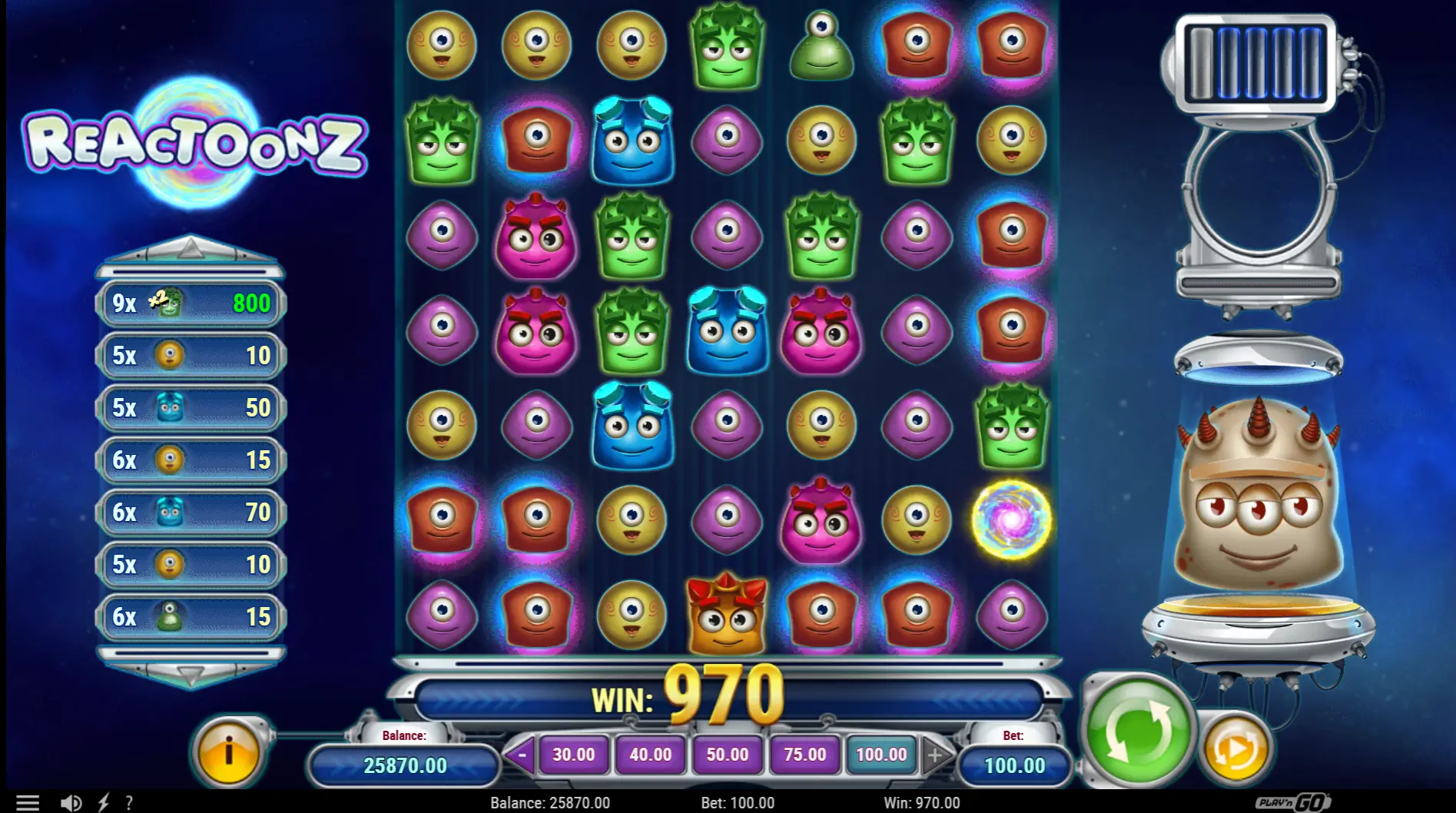
What makes Reactoonz specifically durable, beyond being first? Clarity. The rules are learnable within three spins. Five or more adjacent matching symbols form a cluster. Clusters vanish, new symbols drop, cascades continue until no new clusters form. Wins charge the Quantum Leap meter. Full meter triggers a feature. Five full charges trigger Gargantoon. This is not a complex loop — it is an elegant one, and elegance is what survives the test of time.
Quantum Leap Mechanics: The Engine Under the Hood
The Quantum Leap system is where Reactoonz separates itself from every imitator that adopted the cluster-pays format without understanding why the format works. It is not just a bonus trigger. It is a non-linear gameplay multiplier — a mechanism that transforms a standard cascade sequence into something with genuine dramatic arc.
There are four Quantum features. Each one enters a queue randomly as a charge meter fills. They activate sequentially at the end of a winning cascade sequence — not during it. This sequencing matters enormously because it means features can stack their effects into a single resolution event.
Implosion
Implosion transforms 3 to 6 symbols into Wild orbs and simultaneously destroys all adjacent symbols. The double action is what makes this the most powerful of the four features in isolation. You receive new Wilds on the board and you clear space, which causes a fresh drop of symbols. That drop can generate new qualifying clusters, which extends the cascade and potentially charges another meter. Implosion is a cascade extender disguised as a Wild generator.
The RNG determines both how many symbols become Wilds (3 to 6 is a wide range) and their placement. A maximum-value Implosion dropping six Wilds into the middle of a densely populated grid is among the most impactful single feature activations in the game — capable of touching dozens of positions and cascading several times from a single trigger.
Alteration
Alteration selects one random one-eyed (low-value) symbol and converts all matching instances of that symbol into a different symbol type. If no one-eyed symbols exist on the grid at the time of activation, it targets any available symbol.
In isolation, Alteration looks modest. Its power is contextual. If you have 8 to 12 copies of a targeted one-eyed symbol scattered across the grid, converting them all to a single two-eyed (high-value) symbol can create multiple simultaneous clusters from symbols that were previously isolated and non-qualifying. The conversion happens instantaneously, meaning the cascade evaluation afterward can be dramatic. Alteration’s ceiling is determined entirely by how many copies of the targeted symbol are present — which is why the same feature can produce a 3x result one spin and a cascade that charges two meters the next.
Demolition
Demolition is the most straightforwardly aggressive feature. All one-eyed symbols on the grid are destroyed simultaneously, along with any additional symbols matching the type that triggers the detonation. No Wilds are created. No transformations occur. The grid is simply cleared of its lowest-value inhabitants, and the space is filled by new symbols dropping from above.
The strategic value of Demolition is what it sets up rather than what it directly produces. Removing every one-eyed symbol from a 49-position grid can create a scenario where the replacement drop contains predominantly high-value two-eyed symbols. Whether this translates to large clusters is still RNG-dependent, but the expected value of the replacement drop is meaningfully higher after Demolition than in a standard cascade, because the probability distribution of incoming symbols shifts toward premium tier.
Incision
Incision cuts a Wild into the centre of the grid and creates two intersecting diagonal lines filled with the same randomly selected symbol. Both diagonal lines display identical symbols. The result is an X-shaped formation of matching symbols radiating from a central Wild.
The geometry of this feature is what makes it fascinating. Diagonal lines on a 7×7 grid can touch up to seven positions each. Two intersecting diagonals can create an instant cluster of 14 symbols if the randomly selected symbol is already present in a pocket of the grid. Incision is the feature most likely to generate a large single-cluster win from a previously blank area of the grid, because it introduces a predefined geometric pattern rather than relying on scattered distribution.
How the Queue Creates Chain Reactions
The sequential queue system means that features do not simply fire and resolve independently. Each feature’s outcome changes the grid state before the next feature activates. A Demolition that clears the grid, followed by an Alteration that converts the new drop into high-value clusters, followed by an Implosion that adds Wilds into the resulting formation — this is not a described fantasy scenario. It is a reproducible pattern that players who have logged significant hours with Reactoonz recognise as the architecture of its biggest sessions.
The game does not reveal which features are queued until they activate. You can see how many charges have accumulated, but not what is waiting. This introduces genuine anticipation into the queue resolution — different from the mechanical certainty of watching a free spins counter tick down.
Pro Tip: The feature queue resolves after the winning cascade sequence ends — not during it. This means a long cascade chain can charge multiple meters before any features fire. If you enter a spin with two meters already charged and the cascade adds three more charges, you could queue and resolve five features in a single spin event. Recognising when you are close to multi-feature resolution is the most important read in Reactoonz.
The Gargantoon Factor: Triumph, Tragedy, and Grid Position
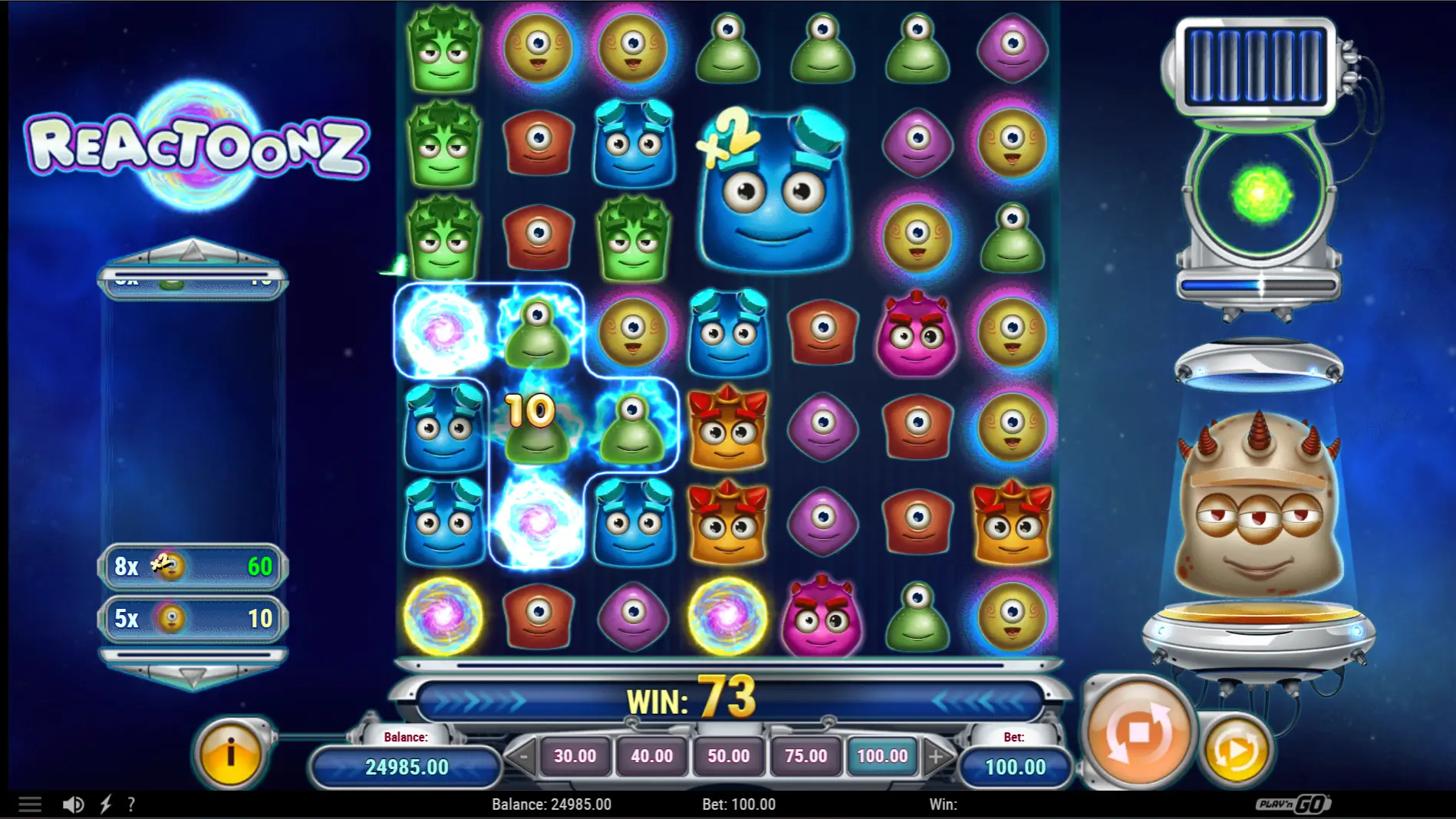
After all four Quantum features have queued and fired, the fifth and final charge of the Quantum Leap meter releases the Gargantoon. This is the centrepiece of the game — a 3×3 Wild symbol that occupies nine grid positions simultaneously and then evolves with each subsequent cascade.
The evolution sequence is precise: the 3×3 Gargantoon splits into two 2×2 Wilds after the cascade it participates in resolves. Those two 2×2 Wilds then split into nine 1×1 Wilds after the next cascade. This split sequence means the Gargantoon is not a single-event Wild; it is a three-stage cascade multiplier that expands Wild coverage rather than contracting it.
The mathematics of grid position make this the most emotionally volatile moment in the game.
A 3×3 Wild placed in the centre of the grid covers positions that touch the maximum number of adjacent symbols — up to 16 border positions, each of which could qualify as part of a cluster if matching symbols are present. A 3×3 Wild placed in a corner covers a maximum of six border positions. This is not a small difference. The expected value of a central Gargantoon placement is meaningfully higher than a corner placement, and the RNG determines grid position without player input.
The community term for a Gargantoon that lands in an unfavourable position — corner, or in a region of the grid already occupied by cluster-forming symbols that exclude it from participation — is the “dead Garg.” The experience is familiar to every Reactoonz regular: watching the entire Quantum sequence build over 20 or 30 spins, seeing the Gargantoon arrive, and watching it resolve for a fraction of its theoretical potential because the surrounding symbols happen to be non-matching.
This is not a design flaw. It is intentional variance. The max win of 4,570x to 4,750x (figures cited vary slightly by source) requires not just a Gargantoon activation but a Gargantoon that lands in a premium position during a cascade sequence that has already generated high-value clusters. The alignment probability is low. The emotional oscillation between “dead Garg” sessions and “the Garg hits perfectly” sessions is what creates the game’s reputation for both frustration and the kind of wins that appear on streaming highlights for years.
Pro Tip: The Gargantoon also activates defensively. On any initial non-winning spin, there is a chance that Gargantoon will drop 4 to 8 Wilds randomly onto the grid. This Instability mechanic (sometimes called the non-winning spin safety net) does not require any meter charge. It is a separate random event that keeps dead-spin sequences from being purely inert — and occasionally converts what would have been a blank spin into the cascade that charges the meter.
2026 Resilience Test: The Original Against Its Own Lineage
Play’n GO built an entire franchise out of Reactoonz’s success. By 2026, the Toonz series includes: Energoonz (2014, the precursor), Reactoonz (2017), Reactoonz 2 (2020), Dr. Toonz (2021), Gigantoonz (2022), Gargantoonz (2023), and Reactoonz 100 (2025). Each title was designed to expand, refine, or complicate the original formula.
None of them consistently beats the original in raw popularity. Here is why.
Reactoonz 2 (2020)
Reactoonz 2 introduced a dual-meter system — the Quantumeter and the Fluctometer — running simultaneously. The Fluctometer generates Wilds at lower charge thresholds, meaning Wild symbols enter the grid more frequently before the Gargantoon activation. Max win potential is 5,083x, marginally higher than the original. The RTP is 96.20%, materially lower than the original’s 96.51%.
The dual meter creates more frequent feature interactions, but also more noise. Players who loved the original’s clean five-stage queue found the sequel harder to read — it is less obvious at a glance how close you are to a significant event. The RTP reduction, small as it appears, matters to experienced players who understand long-run expectation. The sequel is objectively more feature-rich and simultaneously less popular. That should tell you something about how much “more features” is worth to players who know what they are doing.
Dr. Toonz (2021)
Dr. Toonz broke from the grid format entirely, adopting 6 reels with a Dynamic Payways mechanic offering up to 262,144 ways to win. This decision alienated a significant portion of the original’s audience, who came to Reactoonz specifically for grid mechanics. Dr. Toonz plays more like a traditional cascade slot with a Toonz aesthetic. It is not a bad game, but it is a different game — and the community made the distinction clearly in engagement data.
Gigantoonz (2022)
Gigantoonz expanded to an 8×8 grid and introduced Mega Symbols — alien clusters that occupy multiple grid positions natively, before any feature activation. The Charge Meter operates on a cumulative symbol count basis (25, 50, 75, 100 symbols required for successive stages) rather than the original’s cascade-win-count model. Maximum win potential reaches approximately 5,000x.
The larger grid creates more potential positions but also more symbol scatter, which statistically makes large qualifying clusters slightly harder to form in the early cascade stages. Gigantoonz is visually busier than the original, and the Mega Symbol mechanic, while novel, introduces a layer of size-tracking that some players find cognitively heavier than the original’s clean cluster logic.
Gargantoonz (2023)
The most ambitious entry. 7,000x max win, an Experiment Charger mechanic with three distinct experiment types, and a requirement to complete all three experiments before unlocking the Gargantoonz Feature. Win potential is the highest in the series. Pace of play is significantly slower. The build-up to feature activation is longer and more methodical than any previous Toonz title. The RTP is 96.20%.
For high-variance chasers with deep bankrolls, Gargantoonz offers a genuine upgrade in ceiling. For the median player who comes to Reactoonz for the combination of approachable rules and volatile bursts, Gargantoonz can feel like homework.
Reactoonz 100 (2025)
The most recent variant returns to the 7×7 grid and introduces a progressive multiplier — the Energized Toon — that can reach 100x. One-eyed symbols in winning clusters add +1 to the multiplier; two-eyed symbols add +3. The multiplier applies to an energized position on the grid when a winning cluster includes it. The mechanical simplification is deliberate: the original’s four Quantum features are reduced and reorganised to emphasise the multiplier chase. RTP is 96.20%.
Reactoonz 100 arguably has the highest single-spin theoretical ceiling in the series, but it depends on both large cluster formations and an elevated multiplier value coinciding — a compounded probability that makes big wins rarer and potentially more dramatic.
Why the Original Still Wins
The original Reactoonz occupies a position that sequels almost never achieve: it is the most accessible entry in its own franchise while simultaneously having the best base RTP. The four-feature Quantum queue is learnable in minutes. The Gargantoon activation is a clear, visible goal. There are no sub-mechanics to track, no experiment stages to complete, no dual meters to manage. The mathematical model — 96.51% RTP, 10/10 volatility, 4,750x ceiling — is well-calibrated for players who understand high-variance play.
When a franchise proliferates, the original acquires the additional value of familiarity. Players who have logged hundreds of hours with Reactoonz are not interchangeable with players encountering Gargantoonz for the first time. They have pattern recognition, session intuition, and a relationship with the specific rhythm of the 2017 game that no sequel can replicate. Accumulated player expertise is a form of retention that game mechanics alone cannot engineer.
Volatility & Payout Strategy: Managing a 10/10 Game
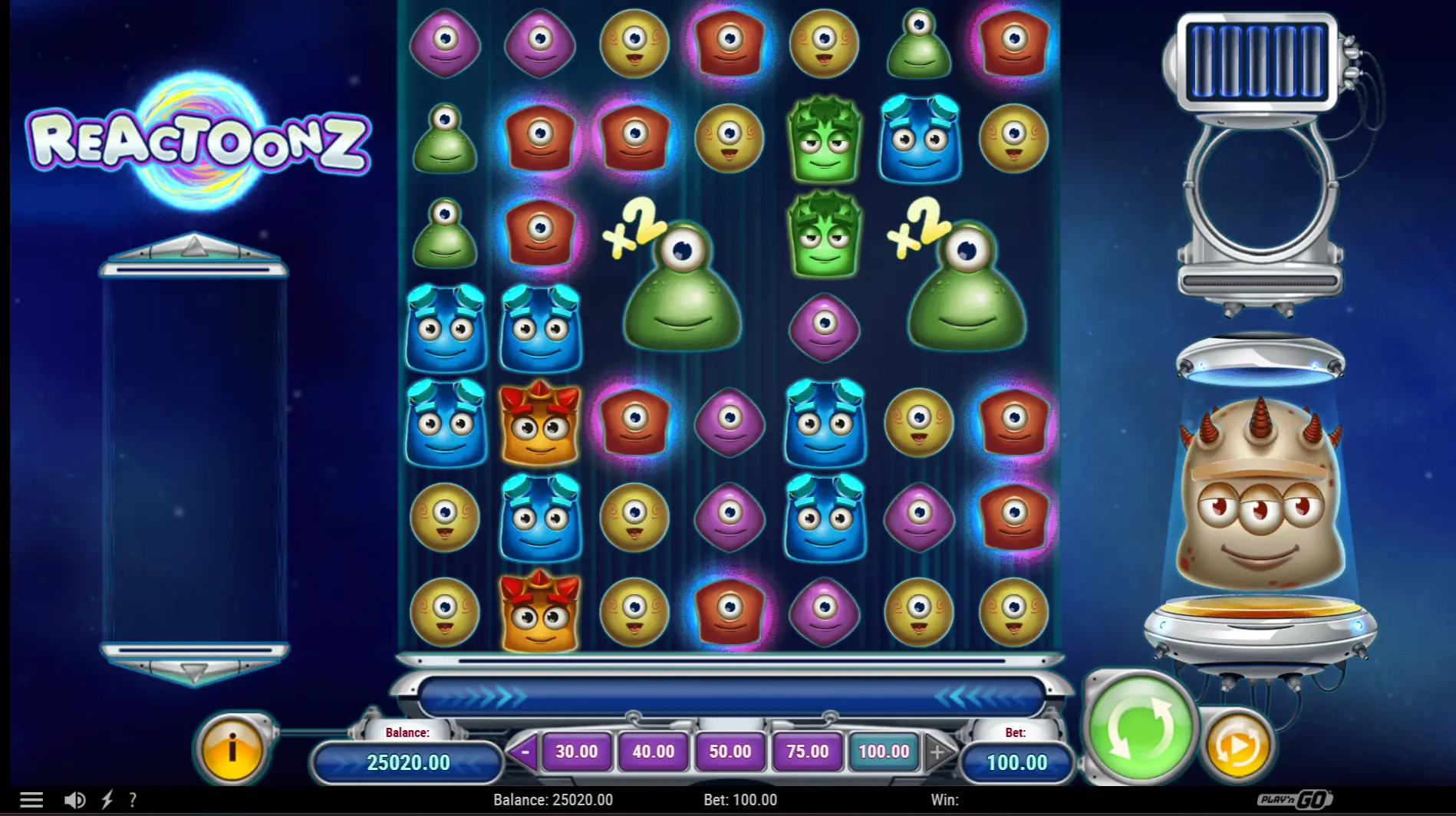
Reactoonz carries a 10/10 volatility rating, which Play’n GO rarely assigns. The practical meaning: win distribution is heavily right-skewed. A large fraction of total payout comes from a small number of high-value sessions, while the majority of sessions at any given stake level will produce below-stake results.
This is not unique to Reactoonz — it is the fundamental tradeoff of high-variance play. But the specific architecture of Reactoonz’s volatility has features worth understanding.
The meter reset mechanism is the primary volatility driver. The Quantum Leap meter resets to zero on any losing cascade sequence — meaning if you charge three of five meters and then fail to form a qualifying cluster, you start over. This creates the characteristic Reactoonz pattern: long cold sequences punctuated by sudden violent meter acceleration when a cascade chain fires deep enough to charge multiple meters in a single spin event.
Bankroll sizing. A commonly cited benchmark for high-volatility slots is 50x your spin stake as a session bankroll. For Reactoonz’s 10/10 volatility, that figure is conservative. Professional-level session management at this volatility profile uses 100x to 200x stake as the minimum viable session bankroll — enough runway to survive multiple meter resets and maintain consistent stake through the cold sequences.
Stake consistency matters. The temptation during cold runs is to reduce bet size. This is the mathematically wrong response if you have not hit your session stop-loss. Reducing stake before a Gargantoon activation that might have occurred in the next 10 spins at the original stake is a form of value destruction. Conversely, increasing stake after a few successful cascades is chasing variance, not exploiting it. The only rational stake adjustments are at the beginning of a session and at explicit stop-loss boundaries.
The one-eyed symbol observation. The Fluctuation mechanic designates one random one-eyed symbol per spin as an energy carrier — if it participates in a winning cluster, it generates two Wilds in the subsequent cascade. This is visible on screen (the symbol glows). When you see a Fluctuation symbol active in a region of the grid where it is likely to form a cluster, the expected value of the current cascade sequence is elevated. This is not strategy — there is no action to take — but recognising it helps calibrate expectations within the session.
Pro Tip: The highest-value symbol in the paytable is the pink two-eyed alien. A cluster of 15 or more pink symbols pays 750x your stake as a base cluster win, before any Gargantoon or Quantum feature interaction. If Gargantoon lands adjacent to or overlapping an active pink cluster, the combined value can represent a significant fraction of the session’s total expected output in a single cascade event. The 4,750x max win requires multiple high-value pink clusters, active Wilds, and Gargantoon participation — all within the same cascade chain.
The Structural Advantage of No Free Spins
Counter-intuitive statement: the absence of a free spins round is a design strength, not a missing feature.
Free spins rounds in high-volatility slots create a binary session experience — the game is either in a free spins bonus or it is not. Value is concentrated in bonus triggers, which means long base-game sequences become inert stretches between bonus events. Players habituate to base-game spin-to-spin action as purely transactional — you spin, hoping for a trigger, and the spin itself holds little intrinsic interest.
Reactoonz has no such binary. Every spin has the potential to be the beginning of a significant event through cascade chain development. The Quantum Leap meter is always accumulating context — a partial charge from a small cascade still has value because it brings the next feature closer. There is no “dead” spin in the sense of a no-bonus trigger. There is only more or less cascade depth, which creates a gradient of engagement rather than a binary one.
This is why Reactoonz sustains attention over long sessions better than many high-volatility free-spins-based alternatives. The game does not ask you to wait for a trigger. It asks you to participate in a continuous, evolving sequence.
Closing Assessment
Reactoonz is not popular in 2026 because players do not know about its sequels. It is popular because Play’n GO’s 2017 design team built a mathematical model and feature architecture that the subsequent eight years of iteration have not materially improved upon — for the combination of accessibility, RTP, and genuine high-variance excitement that most players want from a cluster-pays game.
The 96.51% RTP is the best in the series. The 4,750x ceiling is sufficient for legitimately life-changing wins at meaningful stakes. The four-stage Quantum queue is transparent enough that players can develop real mechanical intuition about session state. And the Gargantoon — for all the dead-Garg heartbreak it occasionally delivers — remains one of the most recognisable and effective climax mechanics in online slots, precisely because its outcome is not guaranteed.
The cluster-pays format that Reactoonz helped legitimise now encompasses hundreds of titles. Most of them are competent. A handful are excellent. The original is still, in most measurable ways, the benchmark.