The Single-Feature Strategy: Why Red Tiger Bet Everything on One Mechanic
There is a design philosophy at work in Mystic Wheel that you either respect immediately or dismiss as undercooked. Red Tiger, since its 2019 release of this title, chose to strip the game down to a single operative feature — no wilds, no free-spin reel mode, no cascading symbols, no scatter pays running parallel to the main bonus. Just the wheel. If it triggers, your session acquires meaning. If it doesn’t, you’ve been grinding a base game that pays out a maximum of 10x your total stake on a single line, or a theoretical maximum of 300x on a full-screen Diamond blanket — neither of which will move your balance in any meaningful way.
By May 2026, this design choice still reads as deliberate rather than lazy. In an era where leading developers are layering mechanics four and five deep — pick bonuses inside free spins, modifiers inside those picks, jackpot meters feeding off all of them — Mystic Wheel occupies a clearly differentiated position. The entire mathematical weight of the game sits on one mechanism. That creates a user experience closer to pure probability theory than entertainment design: you understand the bet you’re making because the bet is structurally simple, and the expected value of any session lives or dies inside the wheel phase.
Whether that is a virtue or a limitation depends on what you’re looking for. For players who want to understand their risk position precisely, this game is unusually transparent. For players who want sustained engagement mechanics and varied win types, it offers nothing between dry spins and wheel explosions. There is no middle ground.
As of 2026, Mystic Wheel remains in active distribution across the Evolution Gaming network (which absorbed Red Tiger in 2020) and continues to appear in casino lobbies that prioritize content longevity over novelty. It has never been updated to a Megaways variant, never received a direct sequel, and has not been revised with additional modifier mechanics. That staying power — unaltered, in an industry that iterates constantly — is itself a data point worth analyzing.
Mystic Wheel Mechanics: A Technical Dissection
Core Parameters
| Parameter | Value |
|---|---|
| Developer | Red Tiger Gaming (Evolution Group) |
| Release Date | August 15, 2019 |
| Grid | 5×4 (20 reel positions) |
| Paylines | 30 fixed |
| RTP | 96.16% |
| Volatility | High |
| Hit Frequency | ~29.65% |
| Max Win | 10,194× stake |
| Bet Range | $0.20 – $10.00 per spin |
| Max Absolute Win | $100,000 (at max bet) |
| Wild Symbol | None |
| Free Spins Reel Mode | None |
The grid is 5×4, meaning 20 symbol positions across five reels, each carrying four rows. Paylines number 30 and run left-to-right, requiring matching symbols on consecutive reels starting from reel 1. The absence of a wild symbol is the structural choice that defines the game’s variance profile. Wilds, in most high-volatility slots, are the mechanism by which small base-game wins are delivered consistently enough to extend sessions. Without them, Mystic Wheel’s base game operates on pure line-match probability — which, with no symbol substitution available, keeps base game payouts genuinely sparse.
Symbol Architecture
The paytable divides into two clear tiers:
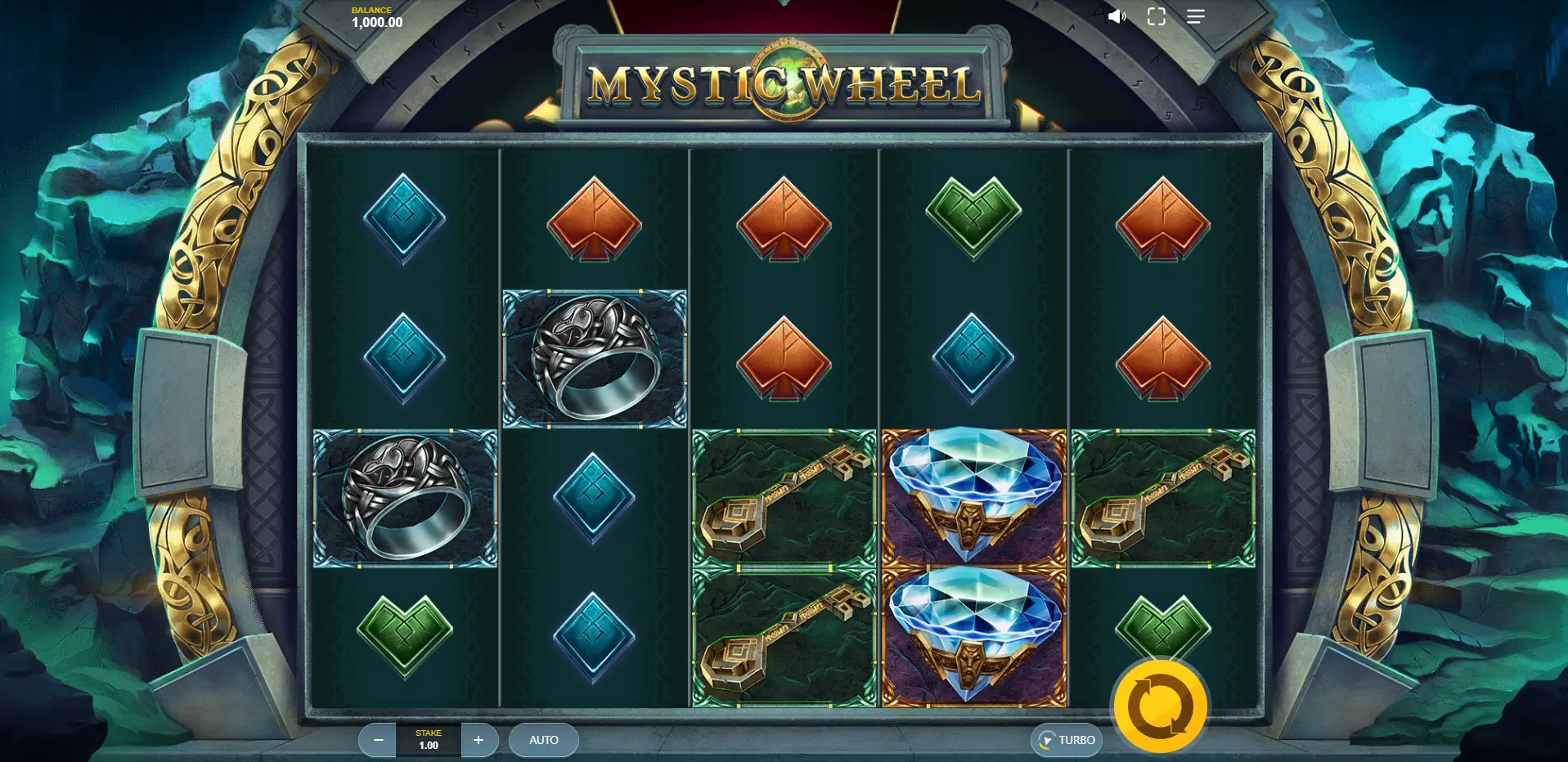
Low-value tier: Card suit symbols — Hearts, Spades, Clubs, Diamonds (styled as carved metallic icons rather than playing card representations). These form the bulk of landing combinations and are the engine of the ~29.65% hit rate. Their individual pay values are minimal and represent the slot’s mechanism for keeping a nominal hit frequency without constituting meaningful return.
High-value tier: Four themed artefacts in ascending value order — the Key, the Ring, the Medallion, and the Diamond. The Diamond is the top standard symbol, paying 10× total stake for a five-of-a-kind on a single payline. A full screen of 20 Diamond positions — which requires all five reels to carry Diamonds in all four rows simultaneously — would theoretically pay 300× total stake, though the mathematical probability of this occurring in a single spin is negligible. These symbols appear without stacking, which is another deliberate design choice: no stacked premium symbols means the base game cannot produce a burst of simultaneous line hits that would create irregular base-game variance. Every high-value hit is an isolated line event.
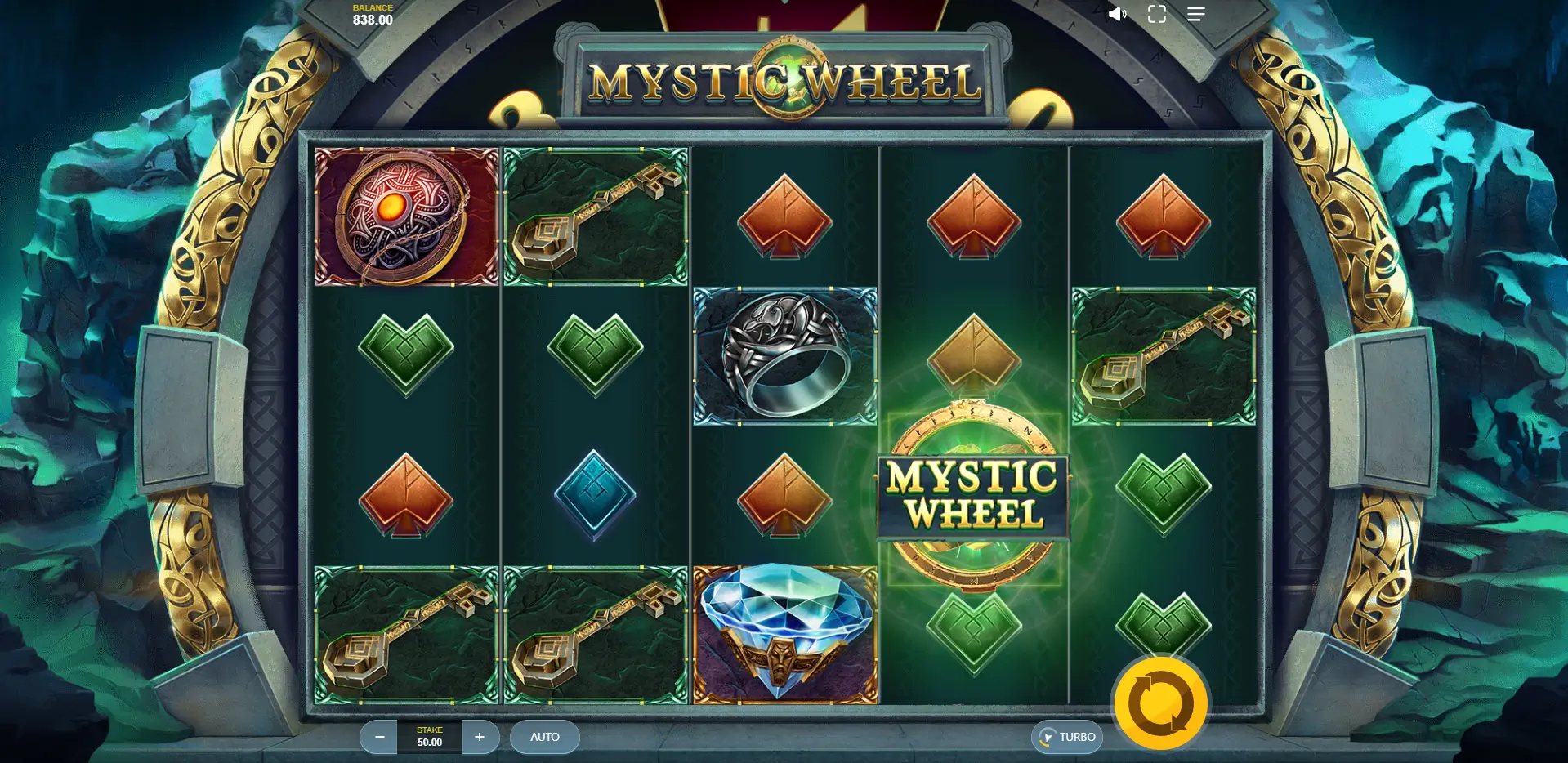
Special symbol: The Mystic Wheel scatter — a glowing, animated representation of the titular wheel. This symbol appears on all five reels, requires no payline alignment, and is the sole mechanism for triggering the bonus phase. Three or more of these anywhere on the grid opens the wheel feature.
Analyst’s Note: The decision to remove both wilds and stacked symbols simultaneously is unusual and worth flagging. Most high-volatility slots use stacked symbols to compensate for lower base-game win frequency — large symbol blocks create multi-line wins during a single resolution. Mystic Wheel takes neither approach. The result is a base game that is perhaps the most arithmetically clean Red Tiger has produced: you know, with reasonable confidence, that your base game return per spin is bounded on the low end by near-zero and on the high end by approximately 300×, with realistic outcomes clustering well below 10× for any given winning spin. Almost all the distribution tail lives in the wheel.
Activation Pathways
There are two ways to enter the Mystic Wheel bonus phase:
1. Standard Scatter Trigger: Land 3, 4, or 5 Mystic Wheel scatter symbols anywhere on the reels during a standard spin. Each scatter symbol awards one wheel spin, so landing exactly 3 scatters starts you with 3 wheel spins; 5 scatters gives you 5 opening spins. This is the primary trigger pathway.
2. Wheel Activator Feature: A randomly triggered modifier that can fire on any base game spin regardless of scatter positions. When activated, it adds scatter symbols to the reels — sufficient to trigger the wheel bonus. This is the secondary, non-deterministic pathway. It fires independently of player action and cannot be predicted or influenced.
The Wheel Activator serves an important mathematical function: it provides an alternative distribution channel for the bonus. Without it, the trigger frequency would depend entirely on the probability of landing 3+ scatters across 20 reel positions on 5 reels with 30 paylines — a figure the developer has not disclosed in public-facing material. The Activator increases expected bonus frequency above what pure scatter probability alone would produce.
Inside the Wheel: Segment Analysis
Once triggered, the slot transitions entirely from reel gameplay to a wheel interface. The wheel itself is a large, multi-segment spinner with a pointer. You have a finite number of spins on the wheel — beginning with 3 to 5 based on scatter count — and each spin resolves onto one of four segment types:
Win Multiplier segments: The wheel stops on a numerical multiplier value. This value is added to a running total that accumulates across all wheel spins. The multiplier is applied to your triggering bet — not to a line win — at the end of the feature when all spins have been consumed.
Multiplier Boost segments (“+X”): These segments carry plus signs with numerical values (+3, +4, etc.). When the pointer lands here, all currently accumulated multipliers across the wheel are increased by the stated amount. If your running total from previous spins is, say, 6×, and a “+3” Boost fires, every individual multiplier on the board increases by 3. This is not a +3 addition to the total — it is a per-multiplier increment, which creates exponential rather than linear growth when combined with the Double All segment.
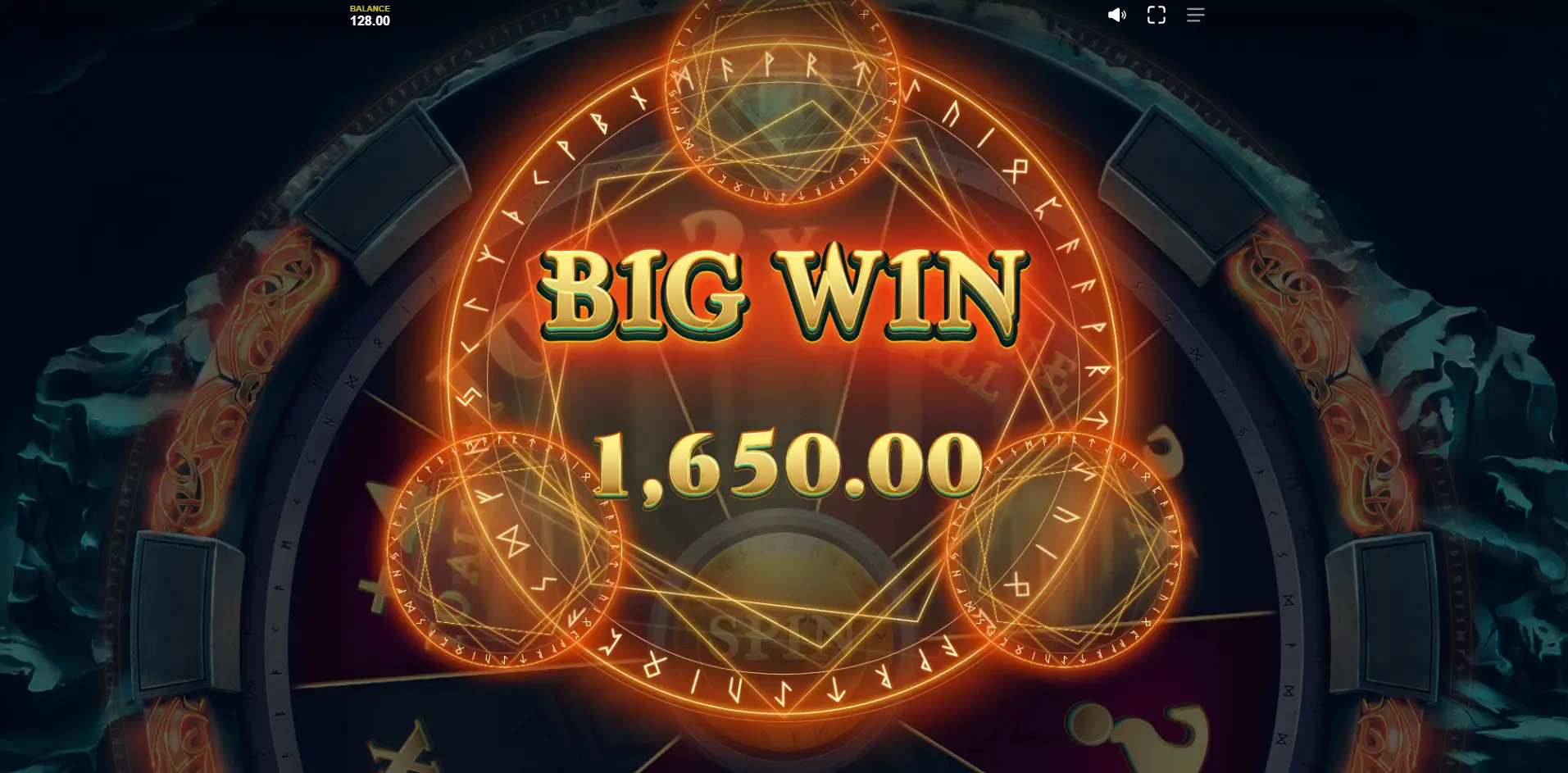
Double All segment: All currently active multipliers are doubled. This is the mechanism responsible for the high end of the win distribution. If the pointer hits Double All at a late stage of the wheel feature, after Multiplier Boosts have already inflated individual values, the doubling effect can compound multipliers into three-digit territory rapidly. The theoretical ceiling of this compounding — across a maximum of 77 wheel spins — produces the 10,194× maximum recorded in actual play.
Extra Spins segment: Awards additional wheel spins, extending the current feature phase. This is how the 77-spin maximum is reached. The base trigger of 3–5 spins cannot, on its own, produce 77 wheel spins; Extra Spin segments must fire repeatedly to extend the feature to its theoretical cap.
Question Mark (Mystery) segment: Resolves to either a random multiplier value or a random number of extra wheel spins. This is the variance wildcard — its range is not documented in the public paytable, making it an element of genuine uncertainty even within the bonus structure.
Multiplier Accumulation: The Core Math
The total payout at the end of the wheel phase is calculated as: sum of all accumulated multipliers × triggering bet. This is a critical distinction from games where multipliers apply to line wins. In Mystic Wheel, the multiplier is applied to the total stake — your bet per spin. This means a 10× wheel segment on a $1.00 bet pays $10.00, and a 500× accumulated total pays $500.00.
The compounding mechanism works as follows: suppose across 20 wheel spins you accumulate multiplier segments reading 2×, 3×, 4×, 2×, 5×. Your running total before any Boosts or Doubling is 16×. If a Double All then fires, the total becomes 32×. If a subsequent +4 Boost fires before another Double All, each segment increments — so the post-Boost total before the second Double is more than 48×, because each individual segment value was boosted first. The exponential character of the Boost + Double All combination is where the mathematical potential for large multipliers accumulates. It requires multiple favorable outcomes in sequence, which is precisely what makes hitting the high end rare and the distribution strongly right-skewed.
Analyst’s Note: The practical median wheel payout — based on community data and aggregator reporting — sits in the range of 20× to 50× total stake for a standard 3-scatter trigger with no Extra Spins fired. This means most triggered features will return between 20 and 50 times your bet. That is a meaningful positive event for your balance but well short of the 10,000× ceiling. The outlier outcomes that produce four-digit multipliers require both Extra Spin accumulation and a favorable Boost/Double All sequence. The probability of this occurring during any given trigger is low — which is mathematically consistent with a high-volatility classification.
Volatility & Hit Frequency: The Patience Tax
Base Game Behaviour
The stated hit frequency of ~29.65% means that, on average, roughly 1 in 3.37 spins will produce some form of win. This is not a low hit rate by slot standards — many high-volatility titles operate at 20–25% or lower. The apparent paradox is that Mystic Wheel carries a high-volatility classification despite a hit frequency that, in isolation, sounds moderately frequent.
The resolution is straightforward: the 29.65% figure includes card suit wins, which return negligible amounts relative to bet size. A win of 0.5× stake from a three-card-suit combination is technically a “hit” in frequency terms but is economically equivalent to a dead spin — it delays balance erosion rather than reversing it. Stripping out sub-1× stake wins from the hit frequency would substantially reduce the figure and align more intuitively with player experience.
This creates a specific session pattern. During base game play, your balance does not crash rapidly — minor card suit hits absorb some of the downward pressure. But it also does not plateau. The trajectory is a gentle, consistent decline punctuated by occasional premium line hits that pause or briefly reverse the slide. The session pattern is not “feast or famine” on a spin-by-spin basis; it is “slow drain, interrupted by occasional minor recoveries, waiting for the wheel.” Without a triggered bonus, a session of 200–400 spins is likely to end at a balance meaningfully below the starting point unless a premium base-game hit sequence occurs.
Bonus Frequency and Dry Spells
Red Tiger has not publicly disclosed the exact bonus trigger frequency for Mystic Wheel. Based on the mathematical structure — five reels, 20 symbol positions, 30 paylines, scatter required on any 3 of 5 reels — the probability of landing 3+ scatters on a single spin in a standard-volatility configuration would typically fall in the 1-in-150 to 1-in-300 spin range, adjusted upward by the Wheel Activator’s supplemental trigger contribution.
In practice, player-reported experiences and aggregate session data suggest bonus frequency closer to 1 in 200–250 spins for the combined trigger (scatter + Activator). At a spin rate of 6 spins per minute, this represents approximately 33–42 minutes of base game play between expected bonuses. At turbo speed, the gap compresses in time but not in cost: a player spinning at $1.00 per spin expecting a bonus every 225 spins is investing approximately $225 per expected trigger event.
This figure does not account for variance in trigger frequency itself. Dry spells of 400–500+ spins between bonus triggers are statistically plausible and will occur across a normal player population. The absence of minor bonus mechanisms — no gamble feature, no respin, no incremental feature — means there is no release valve during these dry stretches. Bankroll erosion during extended non-trigger periods is steady and significant.
Analyst’s Note: This is the defining risk structure of Mystic Wheel. The game is not volatile in the way a “buy feature” slot is volatile — where you purchase a bonus and then experience internal variance within the feature. It is volatile in a more demanding sense: the trigger is neither guaranteed nor purchasable in most jurisdictions, meaning the player must endure the distribution of trigger-free spins before accessing the game’s mathematical core. Players underestimating the cost of reaching the wheel are the most likely to mismanage their bankroll.
Post-Trigger Variance
Once inside the wheel, the variance shifts character. The starting position of 3–5 wheel spins represents a narrow outcome distribution — most short feature runs will land in the 20–50× range. However, Extra Spin segments introduce a recursive expansion mechanism. Each Extra Spin extends the feature and adds one more opportunity for a Boost or Double All to compound existing multipliers. The variance within the wheel feature is therefore a function of Extra Spin frequency: get none, and you’re in the 20–50× range; chain several together with favorable Boost/Double All outcomes, and you enter three- or four-digit multiplier territory.
This internal wheel variance makes Mystic Wheel a game where two triggered bonuses in the same session can produce radically different outcomes. Bonus A triggers, produces three clean multiplier spins with no Extras, and pays 18× stake. Bonus B triggers 400 spins later, chains four Extra Spins, receives two Double All outcomes, and pays 380× stake. Both sequences are consistent with the documented mechanic — neither is anomalous. The resulting session distribution is highly irregular and cannot be estimated accurately from a small sample of individual sessions.
2026 Comparative Analysis: Where Does the Wheel Mechanic Stand?
The Competitive Wheel Landscape
By 2026, the wheel bonus has become a crowded category. Playtech’s Age of Gods series has employed fortune wheels as jackpot selectors for years. IGT’s Wheel of Fortune franchise remains the most recognizable wheel-mechanic brand in land-based and online crossover. Microgaming’s Wheel of Wishes introduced a jackpot wheel with tiered prize categories. More recently, Red Tiger itself released Ultra Rich — a wheel-based slot with tiered Super Wheel and Mega Wheel upgrades, a Prize Multiplier reel, and a Wheel Respin mechanic, carrying a max win of 20,835×.
The comparison with Ultra Rich is instructive. That game introduces wheel upgrades as a progression mechanic — the base Wheel can escalate to a Super Wheel and then a Mega Wheel, each tier offering materially larger prizes. This creates a variable-stakes decision framework absent from Mystic Wheel. It also fragments the bonus phase into a three-tier structure with distinct probability distributions at each tier. The result is a more complex risk architecture but also a more opaque one — the player may understand the rules without having a clear intuition for the probability of reaching Tier 3.
Mystic Wheel, by contrast, is structurally transparent. There is one wheel. The segments are visible. The accumulation mechanic is deterministic given the outcomes: Boost adds fixed amounts, Double All doubles, Extra Spins extend. A player watching 20 wheel spins unfold can track the mathematical state of the feature exactly because there is no hidden multiplier feed or progressive probability shift. This transparency is not universal in the category.
Comparison with Celtic/Mystical Theme Competitors
The mystical/Celtic visual niche is densely populated in the Red Tiger catalogue and industry-wide. Relevant comparators include:
Fortune House (Red Tiger): A game that uses a similar “all-in on one feature” philosophy but deploys a lantern-collecting mechanic rather than a wheel. The bonus requires symbol accumulation across multiple spins, creating a building tension different from Mystic Wheel’s scatter-trigger gate. Fortune House’s mechanic is arguably more engaging during base play because progress toward the bonus is visible, whereas Mystic Wheel’s base game communicates nothing about trigger proximity.
Jack in a Pot (Red Tiger): Introduces a pot-collecting feature alongside a bonus wheel, adding a secondary value mechanism to base game play. Scatter symbols accumulate in pots across sessions, providing a base-game progression layer that Mystic Wheel entirely lacks. The result is a more session-consistent experience, though the wheel-payout ceiling is lower.
Rainbrew (Red Tiger): A Celtic-themed title with multiple feature types — free spins with expanding reels and a separate bonus round — providing variety within the bonus spectrum that Mystic Wheel deliberately withholds.
The pattern across Red Tiger’s own catalogue is that Mystic Wheel occupies the most austere position: one mechanic, no progression, no alternative feature path. This is not a criticism — it is a design choice with clear tradeoffs. For players who want to understand exactly what they’re risking and why, Mystic Wheel’s simplicity is a feature. For players who need engagement during the base game’s extended dry spells, the game offers nothing to hold them.
RTP Context and Operator Variants
The canonical RTP figure is 96.16%, confirmed across the official Red Tiger/Evolution distribution and the majority of regulated operator deployments. Some aggregator sources cite 95.09% — a figure consistent with a reduced-RTP operator variant, which Evolution makes available to licensees. This practice — offering operators a choice of RTP configurations — is standard across the industry and documented for the broader Red Tiger catalogue.
The difference between 96.16% and 95.09% represents approximately 1.07 percentage points of house edge. Over a session of 1,000 spins at $1.00 per spin, the theoretical expected loss differential is approximately $10.70. This is not negligible. Players in jurisdictions where RTP disclosure is mandatory should verify the deployed RTP of the specific operator they are using. A casino running the 95.09% variant without clear disclosure is operating within technical legality in many markets but is not serving player transparency standards.
Analyst’s Note: Red Tiger’s broader RTP clustering in the 95.7–96.1% range, noted in industry reporting as of early 2026, partially reflects jackpot pool contributions in titles that carry Daily Jackpot eligibility. Mystic Wheel does not carry Daily Jackpot eligibility in its standard configuration, so its stated 96.16% base RTP should represent the full return without jackpot feed adjustment. This makes it a comparatively clean RTP figure within the Red Tiger catalogue.
Mobile Performance
The game launched natively on HTML5 in 2019, meaning cross-platform compatibility was baked into the architecture from release. The 5×4 grid renders in a portrait orientation that translates well to mobile screens — the symbol grid occupies the center of the viewport with the wheel visible in the background, and the transition to the wheel bonus phase involves a full-screen takeover that functions identically on mobile and desktop. On mid-range devices — Android handsets in the Snapdragon 6xx class or equivalent — the game runs without frame drops or animation degradation because the visual complexity is deliberately constrained. The wheel animation itself is the most compute-intensive element; it involves a spinning physics simulation that resolves cleanly on modern mobile hardware.
By 2026 standards, the mobile performance is baseline-adequate rather than exemplary. The game does not take advantage of newer mobile UX patterns — no swipe-to-spin alternative, no landscape reflow for widescreen tablets, no haptic feedback integration in the wheel resolution animation. These are quality-of-life absences, not functional failures. Players on contemporary mid-range devices will experience no friction. Players seeking the kind of mobile-first optimization that 2025–2026 releases from Hacksaw Gaming or Push Gaming deliver will notice the gap.
The Professional Verdict: Risk Profile and Bankroll Management
Who This Game Is Designed For
Mystic Wheel is a mathematically honest product for a specific player type: someone who accepts extended low-engagement periods as the cost of accessing concentrated, high-magnitude payouts. The game does not pretend to offer balanced entertainment value across the session. It is, structurally, a bet placed on trigger frequency and wheel outcome quality — two independent probability events that must both resolve favorably for a session to be profitable.
The appropriate risk profile:
- Bankroll depth: A minimum of 150–200× your intended bet size should be considered the floor for a responsible single-session bank. At a $0.50/spin bet, that means entering a session with $75–$100 earmarked for Mystic Wheel, with the psychological and financial discipline to walk away at depletion without top-up. At $1.00/spin, the floor is $150–$200. These figures represent approximately 1× the expected cost of reaching a first bonus trigger plus meaningful variance buffer.
- Session length expectations: The average session to first trigger, at moderate spin speed, is 30–40 minutes. Sessions where two or more bonuses fire within 400 spins are outlier positive events. A four-hour session may produce 3–6 bonuses at standard spin pace, with outcomes distributed across the full wheel payout range.
- Acceptable outcome distribution: The player suited for this game understands that the majority of triggered bonuses will pay 20–80× stake. Sessions ending in profit require either a single high-end wheel outcome (200×+) or multiple mid-range bonuses. Sessions that end in loss despite triggering 3–4 bonuses are not anomalous — they are within the expected distribution.
The player this game does not suit:
- Players who require base-game engagement mechanics to maintain interest. The base game of Mystic Wheel is not interesting. It is a trigger-waiting mechanism.
- Players with session bankrolls below 100× bet size. The trigger frequency means inadequately-funded sessions will terminate before reaching the feature in a statistically meaningful proportion of cases.
- Players in jurisdictions where “feature buy” options are available on comparable games and who want to bypass base-game variance. Mystic Wheel does not offer a bonus buy. Players in the UK, Sweden, or other markets where feature buy is restricted should note that this game’s bonus must be earned through base game play, which is structurally consistent with regulatory intent but represents an added cost vs. a purchasable-feature equivalent.
Bankroll Management Framework
| Bet Size | Minimum Session Bank | Comfortable Session Bank |
|---|---|---|
| $0.20 | $30 | $60 |
| $0.50 | $75 | $150 |
| $1.00 | $150 | $300 |
| $5.00 | $750 | $1,500 |
| $10.00 | $1,500 | $3,000 |
Stop-loss discipline: Given that the game offers no progressive mechanic (no jackpot meter, no accumulated value), there is no mathematical justification for chasing losses in Mystic Wheel beyond your pre-committed session bank. Unlike a game with a jackpot contribution element where extended play has residual value, each spin of Mystic Wheel is fully independent. A 200-spin losing streak provides no enhanced probability of a win on spin 201. Stop-loss adherence is therefore non-negotiable from a rational bankroll management perspective.
Bet-sizing stability: Because the game’s value is almost entirely concentrated in the wheel feature, and because wheel payouts are expressed as multiples of the triggering bet, there is no mathematical benefit to varying bet size during a session. Reducing bet size before expected triggers and increasing after them is not supported by any game-state information that the player can observe. Bet-size stability across a session is the rational approach.
The 2026 Positioning
Five years into distribution, Mystic Wheel occupies an interesting niche in the current catalogue context. Most 2025–2026 slot releases from major developers lean into complexity: multi-step bonus progressions, sticky wilds with multiplier floors, tumble mechanics with accelerating multipliers, jackpot meters feeding off base game play. Against this backdrop, Mystic Wheel’s single-feature simplicity does not feel dated — it feels like a design statement.
The 29.65% hit rate places it above many high-volatility contemporaries in base-game win frequency, which reduces per-spin frustration without softening the overall variance profile. The 96.16% RTP at its canonical setting is above the Red Tiger portfolio average and competitive with Pragmatic Play and NetEnt’s standard catalogue. The 10,194× maximum win remains aspirationally large without being in the hypervolatile 50,000×+ category that has become fashionable in the crash-game-influenced slot design of 2024–2026.
What Mystic Wheel is not — and was never designed to be — is a session companion. It is a tool for executing a specific bet: that a high-variance wheel mechanic, when triggered, will produce an outcome that materially exceeds session costs. The probability of that outcome per trigger is real but not high. The expected value of the game at 96.16% RTP is defined. The rest is variance, patience, and the discipline to treat the base game as the overhead cost of accessing the only bet that matters.