The “Minimalist Joker” Trend: Why Play’n GO Keeps Building the Same Slot Over and Over Again (And Why That’s Fine)
By the time Love Joker arrived in Play’n GO’s catalogue, the Joker series had already clocked twelve entries. Twelve. That’s not a franchise — that’s a conviction. Fire Joker, Ice Joker, Chronos Joker, Count Jokula, Free Reelin’ Joker, Fire Joker Freeze — each title a variation on the same structural philosophy: strip back the fat, keep the math clean, and let a single core mechanic do all the heavy lifting.
In 2026, with the broader market lurching toward increasingly baroque bonus structures — Megaways, Cluster Pays, cascading multiplier ladders that take a YouTube tutorial to fully explain — Play’n GO’s commitment to the minimalist 3×3 format starts to look less like conservatism and more like a deliberate counter-positioning strategy. The question isn’t whether Love Joker breaks new ground. It doesn’t. The question is whether it executes its specific mathematical mission efficiently enough to justify a session — and for a particular type of player, the answer is yes.
What separates Love Joker from its eleven siblings is the respin mechanic. Where Fire Joker leans on sticky symbol stacks and a multiplier wheel, and Ice Joker builds tension through expanding Joker Wilds and a bonus round with escalating frozen spin counts, Love Joker operates a completely different trigger structure. The Joker doesn’t spin the wheel. The Joker doesn’t stick to a reel. The Joker starts a collection event, and everything from that point forward is determined by how many hearts land in an indeterminate chain of consecutive respins.
It’s a quieter mechanism than fire or ice. It’s also, arguably, a more interesting one if you understand what’s actually happening mathematically — which most players who load this game expecting a Valentine’s experience won’t bother to find out.
Love Re-Spins Mechanics: The Collection Event Explained
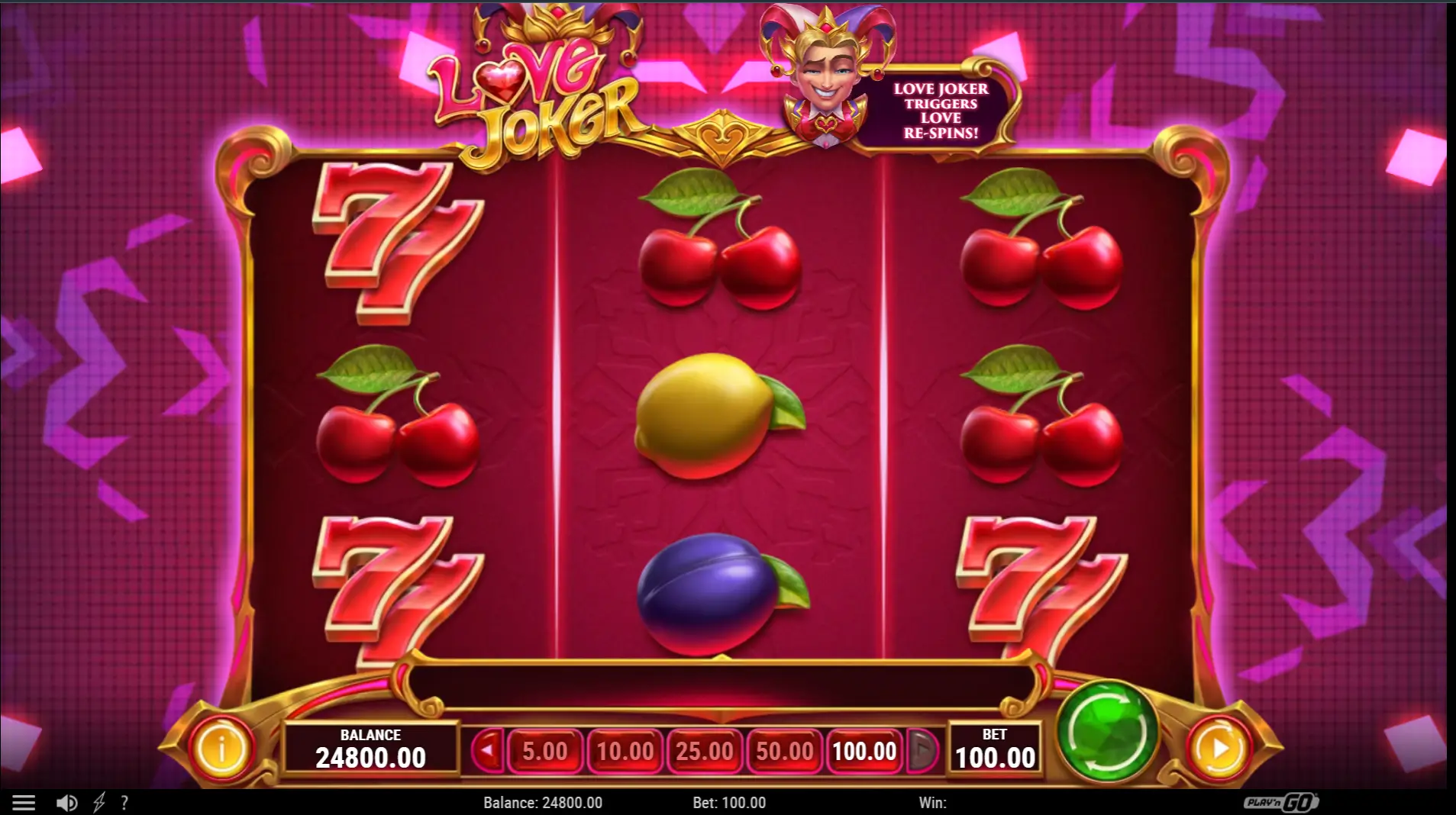
The base game of Love Joker runs on a 3×3 grid with five fixed paylines. Symbols are cherries, lemons, plums, a single purple seven, and a double red seven. Payouts for three-of-a-kind combinations range from 1× (cherries and lemons) up to 10× (double sevens). There are no wild symbols anywhere in the base game. There are no scatter symbols in the conventional sense either — but the Love Joker character himself is a functional scatter, landing exclusively on the centre reel (reel 2), and his presence is the sole respin trigger.
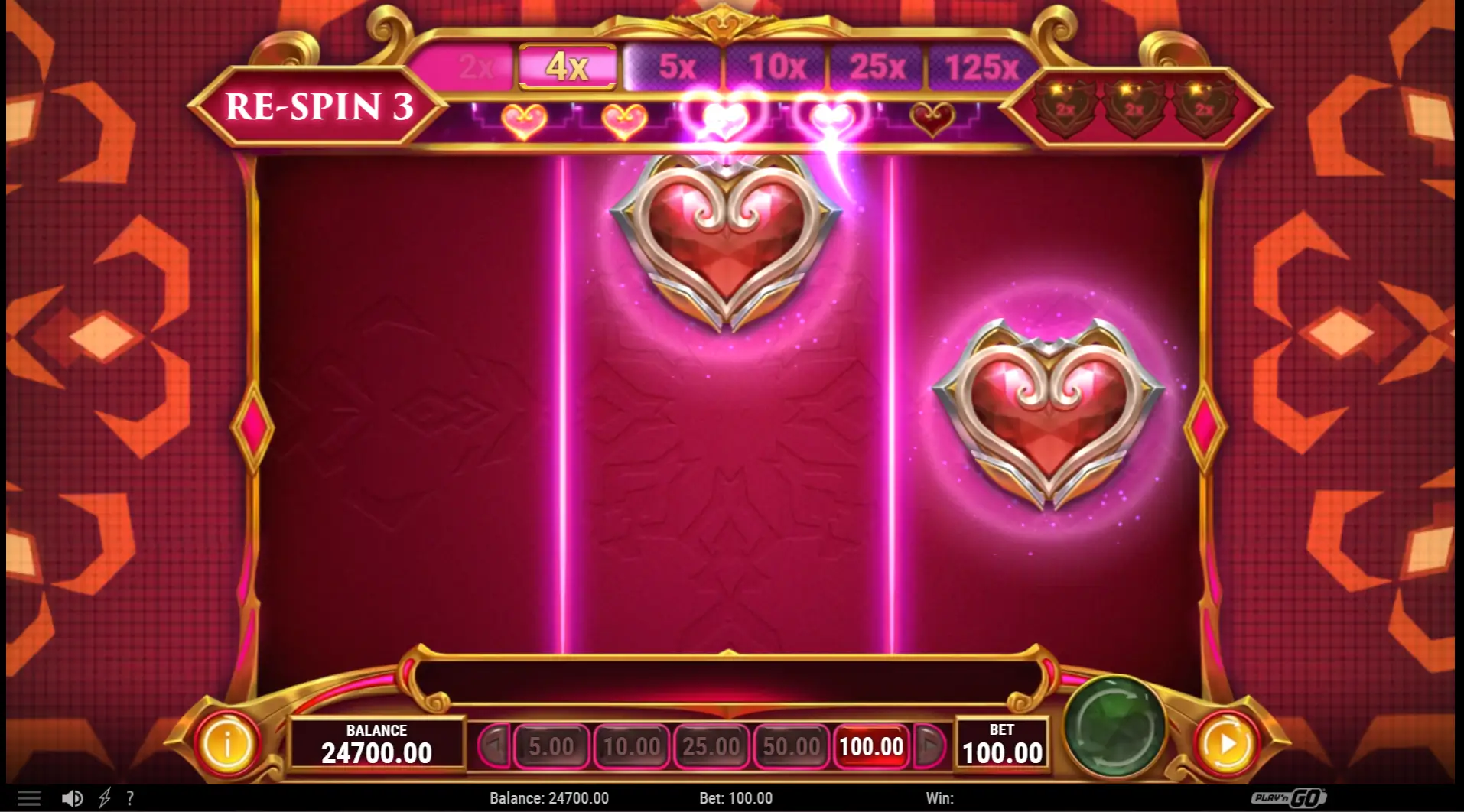
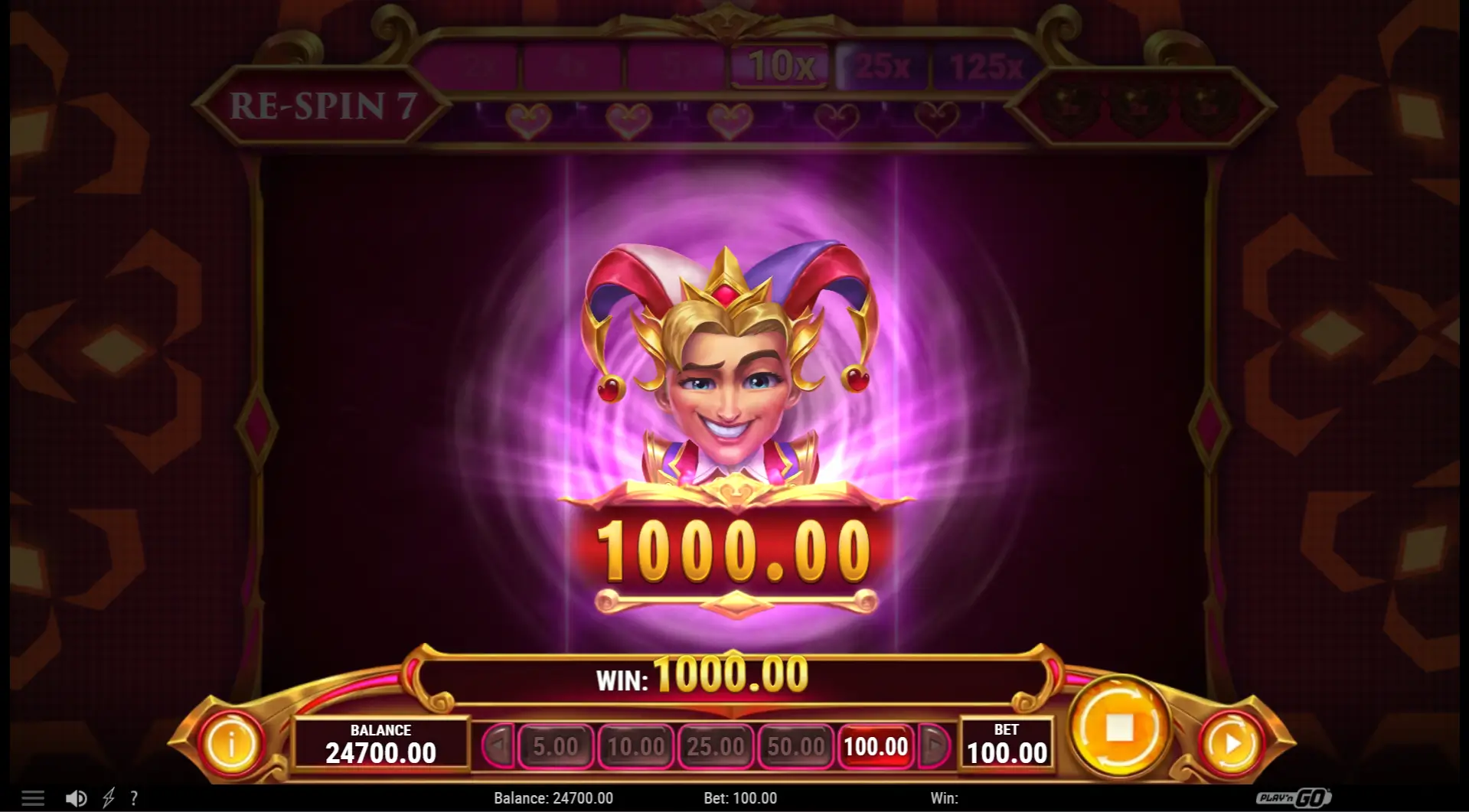
When the Love Joker lands on reel 2, the Love Re-Spins feature activates. All standard fruit symbols are removed from the reel set. From this point on, only three outcomes can appear on the reels: a Silver Heart, a Golden Heart, or a blank space.
Here is where the mechanic gets structurally interesting:
- Every Silver Heart that lands adds to a prize meter. The meter has multiple levels, and each level represents a multiplier value.
- Every Golden Heart that lands doubles all current prize bar multipliers on the meter and simultaneously advances the meter by one position.
- Every symbol that lands — Silver or Gold — awards an additional respin. The chain continues indefinitely as long as new hearts appear. No symbol lands, no respin, feature ends.
- A maximum of three Golden Hearts can be collected per Love Re-Spins session. Each one functions as a doubling event, compounding the multiplier accumulation upward.
- The top prize available through the Golden Heart Collector meter is 1,000× the bet, with the full sequence requiring optimal heart collection across an extended respin chain.
The respin chain has no fixed length. This is the fundamental tension in the mechanic. You can trigger the feature and receive a single Silver Heart before blanks end the run. You can also trigger it and watch the chain extend through eight, ten, fifteen respins as hearts continue to land, the meter climbs, and Golden Hearts compound the multiplier stack. The variance within the feature itself is a microcosm of the game’s broader medium volatility profile — most sessions produce modest meter fills, while the occasional extended chain produces the payouts that anchor the game’s reputation.
The respin trigger frequency is tied directly to how often the Love Joker symbol lands on reel 2. Since the character only occupies one position on a single reel, and the reel set is otherwise populated with standard fruit symbols, the trigger rate is moderate — common enough to maintain engagement, infrequent enough that base game spins feel purposeful rather than incidental.
Expert Verdict — The Mechanic Itself: Love Re-Spins is a well-constructed single-feature slot mechanic. The chain structure creates genuine uncertainty without the artificial complexity of multi-stage bonus systems. The Golden Heart doubling effect introduces a compounding dynamic that turns the meter into something worth watching rather than a progress bar. The absence of a fixed respin count keeps every trigger event genuinely open-ended.
No Scatters, No Wilds — Does It Actually Work?
Let’s be direct about what Play’n GO removed from Love Joker’s base game: everything that conventionally creates short-term volatility cushioning. There are no wild symbols to bridge near-misses into payouts. There are no scatter symbols providing independent wins or free spin triggers. What you have in the base game is a straightforward match-three exercise across five paylines, where every spin either pays or doesn’t, and the only path to meaningful returns is the Love Joker trigger.
In theory, the absence of wilds should make the base game feel starker. In practice on a 3×3 grid with only five paylines, wilds would have been a limited contribution anyway — the grid simply doesn’t have the real estate to make wild substitution feel dramatic. Removing them isn’t the significant design choice it appears to be at first glance. On a 5×3, 20-payline structure, a wild symbol can create a meaningful cascade of altered combinations. On a 3×3 with five paylines, a wild landing in the wrong position does close to nothing.
The absence of scatters is the more consequential omission — specifically because it eliminates any parallel bonus pathway. You cannot trigger free spins independently of the Love Joker symbol. You cannot accumulate bonus qualifying symbols across reels. There is exactly one mechanic, and it activates via exactly one symbol on exactly one reel. This is a brutally linear game structure.
What does this do to the pace of play?
It accelerates it significantly. Without scatter collection mechanics, free spin qualification rounds, or wild-enhanced winning evaluations to process, every non-trigger spin resolves in under two seconds. The game’s hit frequency in the base game is approximately what you’d expect from a pure three-symbol match exercise: not low enough to feel demoralising, not high enough to feel frivolous. You win small amounts from fruit combinations on a consistent enough basis to maintain bankroll float between feature triggers.
The volatility perception shifts based on what you’re tracking. If you’re measuring session-to-session variance, Love Joker feels genuinely medium — the rating of 5/10 on Play’n GO’s own internal volatility scale is accurate. If you’re measuring the variance within the Love Re-Spins feature, the experience is considerably wider. A two-heart respin chain that ends on blanks immediately is a very different outcome from a twelve-heart chain with two Golden Heart doublings. The feature itself is where the game’s actual risk is located, even though the base game profile is classified as medium variance.
For players accustomed to modern multi-mechanism games — Buy Bonus features, linked jackpots, Megaways modifier stacks — Love Joker’s single-pathway structure can initially read as deficient. It isn’t deficient. It’s disciplined. The entire mathematical budget of the game is concentrated into one mechanic rather than distributed across five. That’s a design choice with consequences for session dynamics that are worth understanding before you sit down.
Expert Verdict — Feature Stripping: Removing wilds from a 3×3 game costs less than it appears. Removing a second bonus pathway is a genuine structural decision that concentrates all volatility into the Love Re-Spins event. Whether that’s a positive or negative depends entirely on whether you’re the type of player who wants mechanical complexity or mathematical focus.
Volatility & Bankroll Management: Medium Variance Done Honestly
RTP: 96.20% (default). Play’n GO’s RTP structure is operator-adjustable, and this is worth flagging explicitly: the 96.20% figure applies to the default configuration, but operators can set it as low as 94.20%, 91.19%, or lower depending on their licensing agreement. Always check the game’s help file before playing to verify which RTP version your specific casino is running. This isn’t a Love Joker-specific issue — it’s a Play’n GO platform-wide policy — but it matters here because the difference between 96.20% and 91.19% is not negligible over session length.
Volatility: Medium (5/10 on Play’n GO’s internal scale). The mathematical consequence of medium volatility in a game with this feature structure is relatively predictable: you will receive consistent small returns from the base game, moderate-frequency feature triggers, and a wide but not extreme distribution of outcomes within the feature itself. You are unlikely to run through 200 spins without triggering Love Re-Spins at all. You are also unlikely to hit the 1,000× top of the meter in a standard session.
Maximum win: 1,008× the bet. This figure deserves honest treatment. It is low. For context, Ice Joker — another medium-volatility entry in the same series — caps at 3,000×. Chronos Joker reaches 1,600×. Even Fire Joker, the original series anchor, can deliver up to 800× via its Wheel of Multipliers, with the mathematical structure of its respin-and-wheel pathway offering a more dynamic ceiling approach than Love Joker’s meter fill. The 1,008× cap is not a misprint, and it is not a comfortable number for players whose session expectation involves meaningful upside.
What does this mean practically for bankroll management?
Love Joker is structured for sessions with defined, modest loss limits and realistic win targets. The game’s pace — fast base spins, moderate trigger frequency, feature outcomes concentrated in the lower-to-mid meter range — makes it well-suited for 50–100 spin sessions with a 20–30× bet loss tolerance. At €1 per spin, that’s a €20–€30 drawdown risk for a session with a realistic expectation of several feature triggers and a probable outcome somewhere in the 10–80× return range per trigger.
It is not a game for deep sessions chasing the 1,000× top. The combination of medium volatility and a 1,008× ceiling means the expected value distribution is relatively narrow and relatively stable. You can absorb variance without catastrophic drawdown. You will not accumulate life-changing returns from a base stake of €0.05–€0.10. This is by design.
For recreational players who want a controlled, predictable session — deploy a defined budget, receive consistent small feedback from the base game, get a few feature triggers, and walk away without either a disaster or a jackpot — Love Joker executes this niche with mathematical precision.
Expert Verdict — Bankroll Reality: If your session strategy involves building exposure for a high-multiplier outcome, this game doesn’t have enough ceiling to justify the approach. If your session strategy involves flat-betting at moderate stakes for a defined period with controlled variance, Love Joker’s medium volatility and consistent feature trigger rate make it a competent vehicle. The RTP configuration your operator runs is the single most important variable to verify before playing.
2026 Comparison: Where Does Love Joker Stand in the Joker Series — and Against the Market?
In May 2026, the Play’n GO Joker series has continued accumulating entries beyond Love Joker’s position as the twelfth instalment. The competitive landscape within the series alone warrants a direct comparison across the titles most frequently encountered on active operator platforms.
Fire Joker (the original benchmark)
Fire Joker remains the series’ most widely deployed title, and for understandable reasons. The mechanic — sticky symbol stacks triggering the Re-Spins of Fire, culminating in the Wheel of Multipliers when a full-grid uniform fill occurs — delivers a two-phase tension structure that Love Joker doesn’t attempt to replicate. The wheel outcome is unpredictable, the multipliers can reach significant values, and the base game itself has Joker Wild symbols adding combinatorial flexibility. Fire Joker’s max win is 800×, technically lower than Love Joker’s 1,008×, but its path to top-end outcomes feels more dramatic because the wheel spin is a discrete moment of anticipation rather than a meter fill accumulation.
For players choosing between the two: Fire Joker offers a more cinematically structured feature. Love Joker offers a more mathematically transparent one. Both operate at medium volatility. Fire Joker’s wild-enhanced base game provides slightly better spin-by-spin engagement.
Ice Joker (the series’ highest ceiling)
Ice Joker operates on a meaningfully different mathematical footing. The 5×3 grid and 20 betlines already create a more complex combinatorial base. The Frozen Joker Wild expands across its reel during free spins, and the full bonus round — which can extend to 51 frozen spins — delivers a max win of 3,000× with medium volatility. Ice Joker is the serious mathematical upgrade within the series. It requires more patience to trigger the bonus round fully, but the payoff ceiling is three times that of Love Joker.
For players choosing between the two: If RTP ceiling and bonus depth matter, Ice Joker is the superior vehicle. Love Joker’s simpler trigger structure makes it faster and more immediately accessible, but it cannot compete on potential.
Chronos Joker (the multiplier specialist)
Chronos Joker’s three distinct respin multiplier features — including a super multiplier that doubles all values — deliver a maximum of 1,600× with a top-end feel that edges above Love Joker’s capability. The absence of a standard bonus round is a drawback, but the multiplier architecture is more sophisticated than Love Joker’s heart collection system.
Against the broader market in 2026
The honest assessment of Love Joker in the context of the 2026 slot market is that it is a capable niche product that would have felt entirely at home in 2020 and still delivers its core value proposition in 2026, but offers nothing that the market hasn’t seen and surpassed.
Competing minimalist titles from other developers illustrate the gap. BGaming’s Joker X Love — a direct thematic competitor — operates at very high volatility with a Bonus Game triggering multipliers from 5× to 999×, a far more aggressive mathematical profile for players seeking pure upside. Red Tiger’s 777 Strike offers a 5×3 grid with 10 fixed paylines, a 95.80% RTP, and a more conventional wild + free spin + win spins structure on an expanded grid.
The market for pure classic-format slots has also become more competitive from a feature sophistication standpoint. In 2026, players willing to play on a 3×3 grid have access to games with buy-bonus options, multiple respin variant systems, and max win ceilings well above 1,000×. Love Joker’s decision not to include a bonus buy — common on many contemporary titles even in the minimalist segment — means players cannot access the feature directly, which limits its appeal for high-stakes brief-session players who use bonus purchases as a time-efficiency tool.
That said, Love Joker’s competitive positioning isn’t among high-ceiling variance games. It competes for players who specifically want low cognitive overhead, medium variance, and a clean single-mechanic experience. In that narrower segment, it remains a technically competent option in 2026. The 96.20% RTP default is genuinely above the market average. The feature mechanic is logically coherent. The game runs cleanly on any device at any screen size.
Expert Verdict — Series Placement: Love Joker sits near the bottom of the Joker series in terms of mathematical ambition, which tracks with its position as the Valentine’s-themed entry in a range where visual identity is used to differentiate mechanically similar products. Within the series, Ice Joker and Mystery Joker offer substantially more ceiling for equivalent or lower base volatility. Against the 2026 market, Love Joker is a competent but unambitious product that serves one specific player profile and doesn’t particularly court anyone else.
Symbol Pay Table and Mobile Ergonomics
Pay Table
Love Joker’s pay table is deliberately flat:
| Symbol | 3-of-a-Kind Payout |
|---|---|
| Cherry | 1× bet |
| Lemon | 1× bet |
| Plum | 2× bet |
| Single Seven (Purple) | 4× bet |
| Double Seven (Red) | 10× bet |
The hierarchy is conventional fruit machine orthodoxy. Cherries and lemons function as consolation payouts — at 1× they return your stake and nothing more. Plum at 2× is a marginal gain. The single seven at 4× is the first meaningful return. The double seven at 10× is the only base game symbol that qualifies as a genuine win.
Five paylines on a 3×3 grid means three horizontal lines (top, middle, bottom) plus two diagonal crosses. The diagonal paylines are active, which on a 3×3 means that near-miss visual patterns are frequent — three of the same symbol can appear scattered without forming a valid payline combination, and this is the primary source of what players perceive as base game tightness.
The Silver Heart and Golden Heart, during Love Re-Spins, function as scatter-type prizes that pay independently of payline position — any heart that lands on any position contributes to the meter. This is a structurally important design choice: it means the 3×3 grid during feature play is a 9-position collection space rather than a 5-payline match exercise, significantly improving the effective coverage of each individual respin outcome.
Mobile Ergonomics
Love Joker runs on Play’n GO’s HTML5 engine, which has been stable across device classes since the developer’s platform migration. On a modern mid-range Android device — a Samsung Galaxy A55 or comparable — the game renders cleanly at all standard resolutions. The 3×3 grid occupies approximately 60% of the vertical screen space in portrait mode, leaving the control bar and balance display clearly legible without requiring zoom.
Spin button placement is optimised for single-thumb operation, sitting in the lower centre of the screen. The bet adjustment controls require two taps — tap to open the panel, tap to set value — which is adequate but not particularly elegant compared to swipe-slider implementations on some competing titles.
During Love Re-Spins, the Golden Heart Collector meter appears at the right of the reel grid, occupying a narrow but readable vertical strip. On smaller screens — a 5.5-inch display at 1080p — the meter values are legible but not large. Players running the game at maximum autoplay settings on mobile will find the respin chain sequences can require manual cancellation of autoplay if the feature runs long, which is standard Play’n GO platform behaviour rather than a Love Joker-specific issue.
Battery and data overhead is low. The game’s visual asset weight is modest — the animation set is limited to the Love Joker character entrance animation on trigger, heart landing animations during respins, and a brief win celebration on feature completion. On a standard 4G connection at normal throughput, the game initialises in under four seconds and runs without buffering interruption under typical network conditions.
Final Assessment
Love Joker is a mathematically honest, mechanically compact slot that does exactly what its design specification requires. The 96.20% default RTP is legitimate. The medium variance rating is accurate. The Love Re-Spins mechanic is a logically coherent collection event with genuine open-ended upside within the feature itself, limited to a ceiling that the game is transparent about from the outset.
What it is:
- A fast, low-cognitive-overhead session game for players who want controlled variance
- A reliable vehicle for the 96.20% RTP curve over moderate session lengths
- A competent mobile implementation with no significant ergonomic problems
- A single-mechanic design that concentrates all budget into one clean feature
What it isn’t:
- A game for players chasing meaningful high-multiplier outcomes — the 1,008× ceiling is a genuine constraint, not a conservative marketing figure
- A mechanically competitive title against the broader 2026 market, where its minimalism is increasingly outpaced by games offering equivalent simplicity at higher ceilings
- A title with any secondary entertainment pathway — if the Love Re-Spins mechanic doesn’t engage you, nothing in the base game will
The RTP configuration warning bears repeating one final time: verify which RTP version your operator runs before committing real money. The gap between 96.20% and 91.19% is not academic — it shifts the mathematical expected return of a session by a measurable margin. This information is available in the game’s help file and is not prominently displayed in lobby descriptions on most operator platforms.
Overall Expert Verdict: Love Joker in 2026 is a technically sound, strategically limited product that serves a specific and real player need: fast, clean, medium-variance gambling with a single legible mechanic and a transparent math model. It is not the best entry in its own series, it is not a market-leader in its format category, and it makes no claims to be either. If your session objectives align with what it offers, it delivers. If they don’t, there are stronger options in the catalogue — including from the same developer. Know which player you are before you spin.