Developer: Caleta Gaming | Release: January 2022 | RTP: 96.33% | Volatility: Medium | Max Win: 40,000× stake | Format: 3×3 grid scratch card
The Rise of Digital Scratch Cards: Why the Segment Refuses to Die
There is a persistent assumption in iGaming circles that scratch cards are a gateway product — something operators tack onto their lobby as filler between slots and live tables. In 2026, that assumption is increasingly wrong, and the numbers back it up. Digital instant-win titles now represent one of the fastest-growing subcategories in regulated online gambling, particularly across mobile-first markets in Latin America, Southeast Asia, and parts of Eastern Europe. The appeal is structural, not cosmetic: scratch cards strip away every mechanic that adds friction. No paylines to track, no bonus rounds to wait for, no free spin sequences that stretch to three minutes per round. You place a bet. The outcome resolves in under five seconds. You move on.
Paper lottery scratch cards have always competed on a specific psychological premise — the act of physically removing a latex layer creates a sense of agency that pure chance does not. Online formats replicate this sensation in digital form, but the underlying math works differently. A physical scratch card’s outcome is pre-printed at manufacture; every batch has a fixed, audited prize distribution. A certified digital scratch card runs on an RNG (Random Number Generator) that resolves each card independently, with no batch limits or pre-assigned prize pools. The implications for volatility and variance are significant, and they distinguish digital scratch cards from their paper counterparts more than any visual element.
Caleta Gaming occupies an interesting position in this space. Founded in 2013 in Brazil and headquartered there, with a secondary office in Gibraltar, the studio built its reputation on slots and video bingo before expanding into scratch card formats. Their scratch card portfolio effectively takes existing slot themes and re-formats them as instant-win products — a logical production strategy that keeps development costs low while widening the game library. The Carnaval Scratch Card, released in January 2022, is one of their core entries in this format. Four years after launch, it still circulates in European and Latin American casino lobbies. The question for 2026 is whether its math model and design hold up against the current generation of instant-win competition.
Gameplay Mechanics: The 3×3 Grid Under the Hood
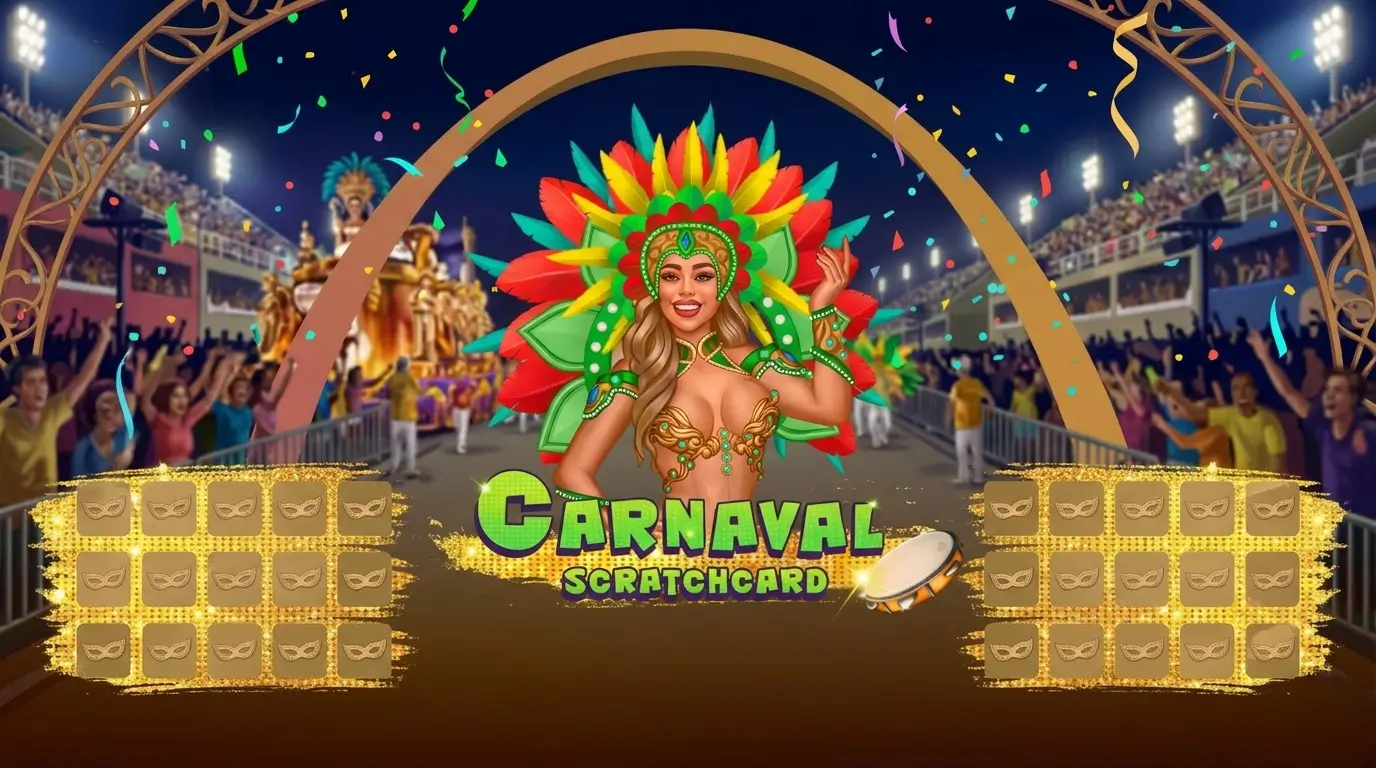
Strip away the thematic dressing and what you have is a nine-cell grid, each cell concealing a symbol. The win condition is binary: match three identical symbols across all nine cells and you collect the corresponding prize. There are no paylines, no clusters, no directional matching requirements. Any three-of-a-kind across the entire grid constitutes a win, regardless of cell position.
The input controls are minimal by design. A bet selector allows players to choose their stake before each card purchase. Once the stake is locked in, the player either:
- Manually scratches each cell using a coin-shaped cursor, revealing symbols one by one, or
- Triggers “Scratch All” (functionally an auto-reveal or “Play Again” button press), which instantly uncovers all nine cells simultaneously.
This distinction matters more than it might initially appear. In practice, the manual scratch sequence is purely theatrical — the RNG has already determined the card’s outcome the moment the round is initiated. The scratching animation is a UI layer, not a decision-making process. From a math standpoint, cell reveal order carries zero weight. Despite this, the manual scratch option persists because it paces the reveal and mimics the tactile experience of physical lottery cards. For players who understand the mechanics, the “Scratch All” function is the practical choice — it converts each round into a sub-five-second event, maximising throughput per session.
There is no autoplay function in the conventional sense, though the rapid cycle of purchasing a new card after each result creates a de facto auto-session rhythm for players who continue without pause. This is a design choice worth noting from a responsible gambling perspective: the absence of an autoplay cap means session length management falls entirely on the player.
Bet sizing is where Caleta gives the product some breadth. The stake range accommodates both casual and higher-volume play, though specific minimum and maximum values vary by operator integration and jurisdiction. The game’s flexible staking structure is confirmed across multiple regulated markets.
Round duration, when using “Scratch All,” sits at roughly three to five seconds per card including the result animation. A player running a sustained session could theoretically complete 700–900 rounds per hour — a pace that no slot game with standard spin intervals approaches. This is not incidental; it is the core format proposition of digital scratch cards. Speed is the product.
Math Model & Payouts: What the Paytable Actually Tells You
The certified RTP of 96.33% is the headline figure, and it places Carnaval Scratch Card comfortably above the digital scratch card average. Most instant-win titles in this category cluster around 92–95% RTP; reaching above 96% is not common, and it represents a genuine competitive advantage for Caleta when the game is distributed through operators who disclose RTP figures per title.
For context: a 96.33% RTP means that, over a statistically significant number of rounds, the game returns €96.33 for every €100 wagered. This is a long-run theoretical figure, not a session guarantee. In the short term — the only term most players actually experience — variance determines outcomes far more than RTP.
Volatility is rated as medium, which is the most informative figure alongside the RTP. In the context of a scratch card with no bonus features, medium volatility means the win distribution is calibrated to produce moderate frequency of smaller wins alongside infrequent larger payouts. It is neither low-variance (frequent tiny returns, bankroll attrition through small losses) nor high-variance (rare wins, high peak potential). Medium volatility scratch cards typically suit players who want sessions with identifiable rhythm — occasional wins that provide enough return to sustain buy-in pace without exhausting a bankroll in three cards.
The paytable structure follows a standard multi-tier architecture, with all symbols themed around the Brazilian carnival motif. While Caleta Gaming does not publish granular per-symbol probability data, the paytable tiers observable in the game correspond to the following structure:
- Low-value symbols (tambourine, confetti cannon, carnival mask lower variants): Three-of-a-kind pays in the range of 1×–5× stake, functioning as frequency wins — the payout barely covers the card cost, but each hit extends session time and registers as a non-loss round psychologically.
- Mid-value symbols (samba dancer, feathered headdress, trophy): Returns step up into the 10×–100× stake range. These are the symbols that define whether a session feels profitable or flat. Their relative rarity determines session tempo more than any other paytable tier.
- High-value symbol (the game’s premium icon, typically the branded logo or highest-tier character): Pays in the hundreds-of-× range on a three-of-a-kind match, serving as the bridge between mid-tier wins and the jackpot territory.
- Top prize symbol: A confirmed maximum of 40,000× stake. This is a single-symbol jackpot trigger — three matching top-prize symbols across the nine-cell grid — with a probability designed to occur rarely enough to fund the RTP allocation from below.
The RTP architecture almost certainly concentrates the majority of return mass in the low-to-mid tier, with the top-prize symbol carrying an extremely small but finite hit probability. This is standard practice across instant-win math models: the headline max win is real but remote, functioning as marketing collateral and a legitimate mathematical ceiling rather than a sessionable expectation.
To quantify why 40,000× matters: at a €1 stake, the peak return is €40,000. At a €0.10 stake, it is €4,000. Comparable titles from other developers frequently cap out at 5,000× to 15,000×. Pragmatic Play’s Queen of Gold Scratchcard, for reference, offers a max win of 10,000× stake. The 40,000× ceiling creates a mathematically real but statistically remote upper boundary that allows Caleta to position the game as a high-ceiling product while maintaining medium volatility at the base distribution layer.
Hit probability — the frequency at which any winning combination appears — is not officially published by Caleta Gaming for this title, which is a transparency gap common across the scratch card segment. In the absence of a certified hit rate figure, observable session data and the medium volatility classification suggest win frequency is in the range of 1-in-3 to 1-in-4 cards for low-tier prizes, with the probability of any given card containing a three-of-a-kind match dropping sharply as the prize tier rises.
RNG vs. Pre-Printed: Why the Distinction Matters to Your Bankroll
One of the most consequential differences between digital RNG scratch cards and their physical counterparts is pool independence. A physical national lottery scratch card is printed as part of a closed batch — the total number of prizes in each denomination is fixed at manufacture, with regulators auditing the prize distribution before a batch goes on sale. This means that as cards are scratched and top prizes are claimed, the pool shrinks. A batch with all jackpots claimed mathematically cannot produce another jackpot, and some lottery operators publish remaining-prize information online precisely to allow informed card selection.
A digital scratch card like Carnaval runs on a stateless RNG — each card is an independent event. There is no pool, no batch, no accumulated prize depletion. The probability of hitting the top symbol on card 1 is identical to the probability on card 1,000. This removes the “stale batch” risk that physical card players occasionally face, but it also removes any ability to infer remaining prize probability from session history. Previous results provide exactly zero information about future outcomes. This is a fundamental property of certified RNG systems, not a platform-specific characteristic.
The certification itself matters for trust. Caleta Gaming achieved GLI (Gaming Laboratories International) certification for its RNG and Remote Gaming Server as part of its regulated market approvals process, confirmed through its December 2024 certification for the Brazilian regulated market. GLI is one of the most widely recognised independent testing laboratories in the iGaming industry. BMM Testlabs independently certified 16 Caleta titles for the Colombian market under the GLI-19 standard. This two-lab audit trail provides a credible foundation for the RNG integrity claim.
How Scratch Card Math Differs from Slot Math
This distinction is worth establishing clearly, because many players carry slot-derived mental models into instant-win formats where they do not apply.
In a video slot, the RNG produces a combination of reel positions that are then filtered through a paytable. Bonus rounds, free spins, and multiplier mechanics all exist as separate probability layers — the hit rate and payout of a base game round is meaningfully different from the hit rate and payout during a bonus. This creates a compound probability structure where a player’s actual return over a session depends on how many bonus triggers they land, which can vary dramatically from the stated RTP over short windows.
In Carnaval Scratch Card, there is only one probability layer. The RNG selects the nine symbols for each card from a defined pool, and the paytable applies directly to the result. There is no secondary event. Every card is resolved by a single RNG call. This simplifies the math model considerably — the RTP is a more direct expression of expected value per round than it is in any slot with multi-stage bonus mechanics.
The absence of bonus features is not a design flaw; it is a format definition. Scratch cards are instant-win products by category. Adding a free-spin sequence or gamble feature would blur the product boundary and undermine the speed proposition that defines the format. The question is not whether Caleta should have added features — it is whether the base math model is strong enough to sustain sessions without them. At 96.33% RTP and medium volatility, the answer is conditional yes: the math model is above average for the category, but the lack of any session variance beyond the raw prize distribution means players with low hit-rate runs have no recovery mechanic.
Strategic Insight: At medium volatility, a session of 50 cards at a fixed stake will produce recognizable hit distribution — approximately 12–18 winning cards statistically, with the vast majority of wins concentrated in the lower paytable tiers. Budget allocation matters more here than in high-volatility titles: there is no “bonus round saved the session” mechanism. Set a card count limit, not a time limit, and treat each card as an isolated bet.
Visual & Audio: A 2022 Asset Deck in a 2026 Lobby
Let’s be direct about the aesthetic context Caleta Gaming was operating in when this game launched. In January 2022, the visual bar for branded casino content was already moving toward dynamic 3D renders, high-frame-rate animations, and cinematic sound design. Caleta’s Carnaval Scratch Card was built with 2D animated assets and a Brazilian carnival motif — a theme that is, as of 2026, one of the most saturated in online casino content globally.
The symbol set follows predictable carnival iconography: percussion instruments, feathered headdresses, mask designs, and associated thematic imagery rendered in bright colour palettes. The confetti background animation plays on each new card. The audio track is upbeat and rhythmically consistent with the theme. None of this is technically deficient — the art direction is competent, the animations run cleanly, and the colour palette reads clearly on both desktop and mobile screens. But none of it is distinctive either. By 2026, a player rotating through a casino lobby has likely encountered three to five visual variants of this exact aesthetic across other providers. There is nothing in Caleta’s execution of the carnival theme that isolates this product from competitors in the player’s memory.
Mobile optimisation is where the product holds its position more reliably. The 3×3 grid format is inherently mobile-compatible — the layout scales to smaller viewports without losing usability. Cell targets are large enough for thumb interaction. The “Scratch All” function eliminates any precision requirement for the manual scratch mechanic that would otherwise become frustrating on smaller touch targets. Load times are low. The game runs on HTML5 and is cross-device compatible without a download requirement.
For a player accessing the game on a mid-range Android device on a 4G connection — the dominant use case in Caleta’s core Latin American and emerging-market audience — the experience is functionally sound. The visual downgrade compared to current-generation slot graphics is apparent, but it does not impair usability. In markets where device specs are often entry-level to mid-tier and data consumption is a real cost consideration, the game’s lightweight architecture is a practical advantage.
The interface layout is clean and uncluttered. Bet controls, card display, and result notification are logically positioned. No navigational friction. For new players encountering scratch cards for the first time, the learning curve is effectively zero.
The Instant Win Verdict: Who This Product Is Actually For
In May 2026, Carnaval Scratch Card by Caleta Gaming competes in a segment that has expanded and specialised considerably since the game’s 2022 release. The honest comparison set includes:
Hacksaw Gaming scratch cards: Hacksaw’s instant-win library is larger, more visually current, and mechanically more varied. Titles like Miami Multiplier and Cash Vault II offer hit frequencies and paytable structures that Hacksaw publishes with more transparency than Caleta does for this product. Hacksaw’s scratch card RTPs generally cluster in the 94–96% range, making Caleta’s 96.33% competitive on paper. However, Hacksaw’s brand identity, streamer visibility, and design investment per title are substantially higher. In any lobby where both providers are represented, Hacksaw’s scratch cards typically occupy more screen real estate and generate more discovery traffic.
Pragmatic Play scratch cards: Pragmatic’s Queen of Gold Scratchcard and comparable titles bring the brand’s considerable operator distribution and marketing infrastructure. RTPs are comparable (the Queen of Gold sits around 96.5%), but max win ceilings are generally lower than Carnaval’s 40,000×. For players who specifically research max win potential as a selection criterion, Caleta’s figure is a genuine differentiator.
Paper lottery scratch cards: The comparison is less direct but worth including. A national lottery scratch card in most markets operates at an RTP between 60% and 75% — the difference being that lottery proceeds fund public programmes and the odds are structured accordingly. A player migrating from physical scratch cards to digital formats is receiving a fundamentally better return proposition at 96.33% RTP, even without fully appreciating what the number means. This is the best argument for digital scratch cards as a category, and Caleta’s title sits at the stronger end of that argument.
For whom does Carnaval Scratch Card make the most sense in 2026?
- Players who want a pure instant-win product with no mechanical learning curve and no session commitment.
- Bankroll managers who prefer to allocate fixed-card-count sessions (50 cards, then stop) rather than time-based sessions, exploiting the medium-volatility distribution.
- Players in markets where Caleta Gaming is the primary or exclusive scratch card provider — particularly Brazil and parts of Latin America where the developer’s GLI certification gives them regulatory priority.
- Users on mobile devices where load speed and interface simplicity matter more than visual spectacle.
For whom does it not make sense?
- Players seeking progressive prize structures, bonus features, or session variance beyond raw symbol matching.
- Players in markets with strong Hacksaw Gaming or Pragmatic Play distribution, where more visually current and mechanically varied alternatives are a single scroll away in the same lobby.
- High-frequency session players without strict stake discipline — the rapid round cadence (700+ cards per hour at “Scratch All” pace) means bankroll can move faster than most slot sessions.
When to Stop: The Responsible Use of Instant Win Mechanics
The instant-win format’s core risk is not its math model — at 96.33% RTP, the house edge is 3.67%, lower than roulette’s standard European house edge of 2.7% on even-money bets but applied to a product with a much faster throughput rate. The risk is the throughput itself. A 3.67% edge applied to 200 cards at €1 per card means an expected loss of €7.34 over that session — a number that feels manageable until you account for how quickly 200 cards pass at “Scratch All” pace.
Stop triggers should be set before the session starts:
- Card count limit (e.g., 100 cards maximum per session)
- Loss limit (e.g., stop at 30% of session bankroll depleted, regardless of card count)
- No “chasing” — medium volatility does not guarantee recovery clusters after loss runs
There is no structural feature in Carnaval Scratch Card that helps with this. No session timer, no net position display, no cool-down between cards. The responsibility sits entirely with the player. GamCare and equivalent regulated-market resources provide self-exclusion tools for players who find instant-win formats specifically difficult to pace.
Conclusion: A Competent Instrument With a Narrow Audience
Carnaval Scratch Card by Caleta Gaming is a well-constructed instant-win product that does what it is designed to do. The 96.33% RTP is above the category average. The 40,000× peak is above what most comparable titles offer. The medium volatility classification is accurate and positions the game appropriately for its format. The mobile experience is fit for purpose. The RNG is GLI-certified as part of Caleta’s broader regulatory compliance process, which provides an appropriate level of third-party verification for fairness.
What it is not: a visually compelling, mechanically rich, or particularly distinctive product in a 2026 lobby. Its four-year-old asset deck and its generic thematic execution mean it competes on math and distribution rather than player experience. In markets where Caleta Gaming holds operator agreements and regulatory certification — particularly in Brazil and select Latin American territories — that is a viable competitive position. In markets with full Hacksaw Gaming or Pragmatic Play scratch card distribution, the gap in perceived quality widens.
The game is a useful, honest product for a specific player profile: fast-decision gamblers who want transparent math, no mechanical complexity, and maximum round throughput. For everyone else, 2026 offers more developed alternatives in the same format category.