Quick Stats
- Developer: Red Tiger Gaming (in collaboration with R7)
- Grid: 5×3 | Paylines: 10 (pays both ways)
- RTP: 95.67% (non-jackpot variant) / 94.79% (jackpot variant)
- Volatility: Medium
- Max Win: 1,050× stake (base cap) | up to 1,000× in Vegas Spins
- Bet Range: $0.10 – $100 per spin (some operators extend to $500)
- Features: Neon Links mechanic (base game), Vegas Spins (free spins)
- Jackpot: Optional Daily Drop network (Hourly / Daily / Super)
The Aesthetic Argument: Why Red Tiger Bet on Minimalism in a World Gone 3D
There is a particular kind of confidence required to release a fruit machine in 2021 — one with flat neon iconography, a Vegas skyline backdrop lifted almost directly from a postcard, and zero CGI ambition — and expect it to compete. Red Tiger made that bet with Neon Links, and the decision was either a cynical play for a reliable demographic or a genuine design statement. Four-plus years later, with the slot still circulating across major European and Asian-facing operators in 2026, the answer appears to be closer to the latter.
The iGaming market around the time of Neon Links’ release was already saturated with high-production 3D slots: cascading reels, animated cutscenes, Hollywood licensing, and increasingly dense mechanic stacks layered atop each other. Megaways was everywhere. Cluster-pays had become standard. Against that backdrop, Red Tiger chose to release something that looked, at first glance, like a slightly upscaled pub slot from 2005 — and dressed it in neon tube lighting to justify the asking price.
What makes this interesting from a design-criticism perspective is how deliberately constrained the visual language is. The reels are clean. The symbol set draws from a single tradition: cherries, grapes, horseshoes, bells, sevens, and the four card suits. No mythology, no branded IP, no animated wilds eating symbols whole. The neon treatment — each standard symbol paired with a glowing neon counterpart — functions as both aesthetic and mechanic, which is a tighter integration than most slot designers attempt.
In 2026, this reads differently than it did at launch. The wave of ultra-complex slots has crested and partially broken. Players who spent three years grinding through Bonus Buy features, ante bets, and multipler trails have developed a measurable appetite for sessions that don’t require a tutorial. Neon Links benefits from this fatigue without having anticipated it. That’s not strategic genius — it’s good timing compounded by competent execution.
The colour palette is worth examining in its own right. Red Tiger leans into a specific frequency range: deep electric blues, acid pinks, sodium yellows, and lime greens against a near-black background. This is not arbitrary. Neon by its nature draws the eye to high-contrast boundaries — the luminous edge against darkness — which is precisely the perceptual trigger that keeps attention locked onto the reels between spins. The dark backdrop also reduces eye fatigue during extended sessions, a practical UX consideration that most slot studios handle clumsily with oversaturated backgrounds. Here, the environment works with the player rather than against them.
The Miami Art Deco architecture framing the reels — Polaroid-style snapshots of Vegas-adjacent hotel facades and signage — adds period texture without demanding attention. It occupies the peripheral field without competing with the play area. Whether that was a conscious UX decision or a happy accident of layout, it works.
Professional Insight: The restrained visual hierarchy in Neon Links — dark field, bright symbols, minimal UI chrome — is closer to good information design than to standard slot aesthetics. It reduces cognitive load during a session, which matters more for retention than most studios acknowledge.
The Neon Links Mechanic: Connect, Expand, Collect
Strip away the aesthetics and you’re left with a single central mechanic that does most of the heavy lifting. Understanding it precisely is worth the effort.
Base Paytable Structure
The game carries nine paying symbols across the 5×3 grid. Every symbol exists in two states: standard and neon. The neon version is mechanically active; the standard version is passive. Both variants pay identically on conventional paylines — the distinction matters only when the linking mechanic triggers.
Low-pay symbols (card suits) — five-of-a-kind values:
- Clubs: 1.1× stake
- Diamonds: 1.3× stake
- Hearts: 1.5× stake
- Spades: 1.8× stake
High-pay symbols — five-of-a-kind values:
- Cherries: 2.5× stake
- Grapes: 4× stake
- Horseshoe: 5× stake
- Bells: 10× stake
- Flaming 7s: 25× stake
These are the raw payline values. On a standard combination they’re unremarkable — a full line of 7s at 25× is a reasonable single-payline return, but it’s not enough to anchor a high-volatility session. The interesting mathematics lives elsewhere.
The Linking Logic
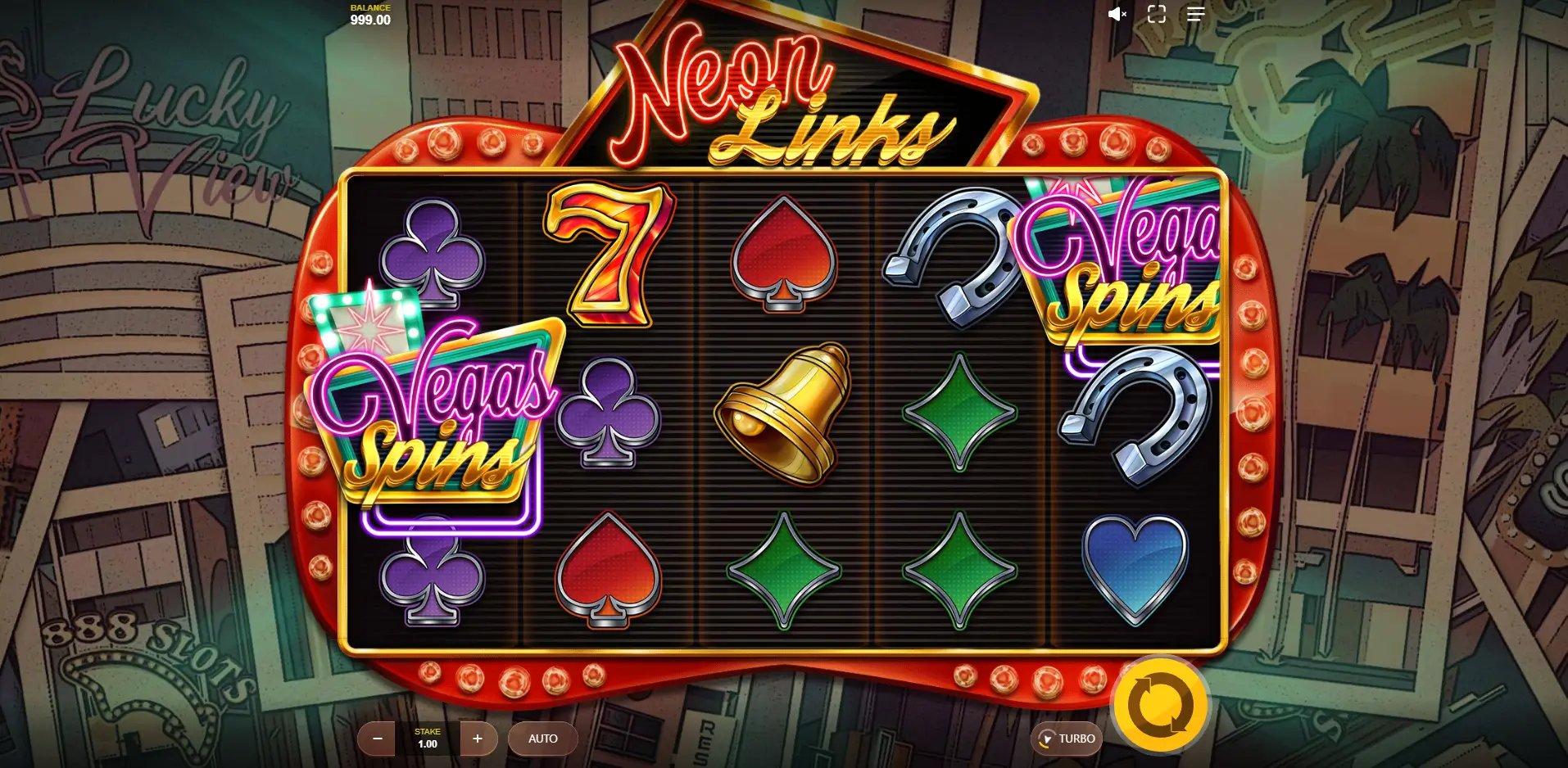
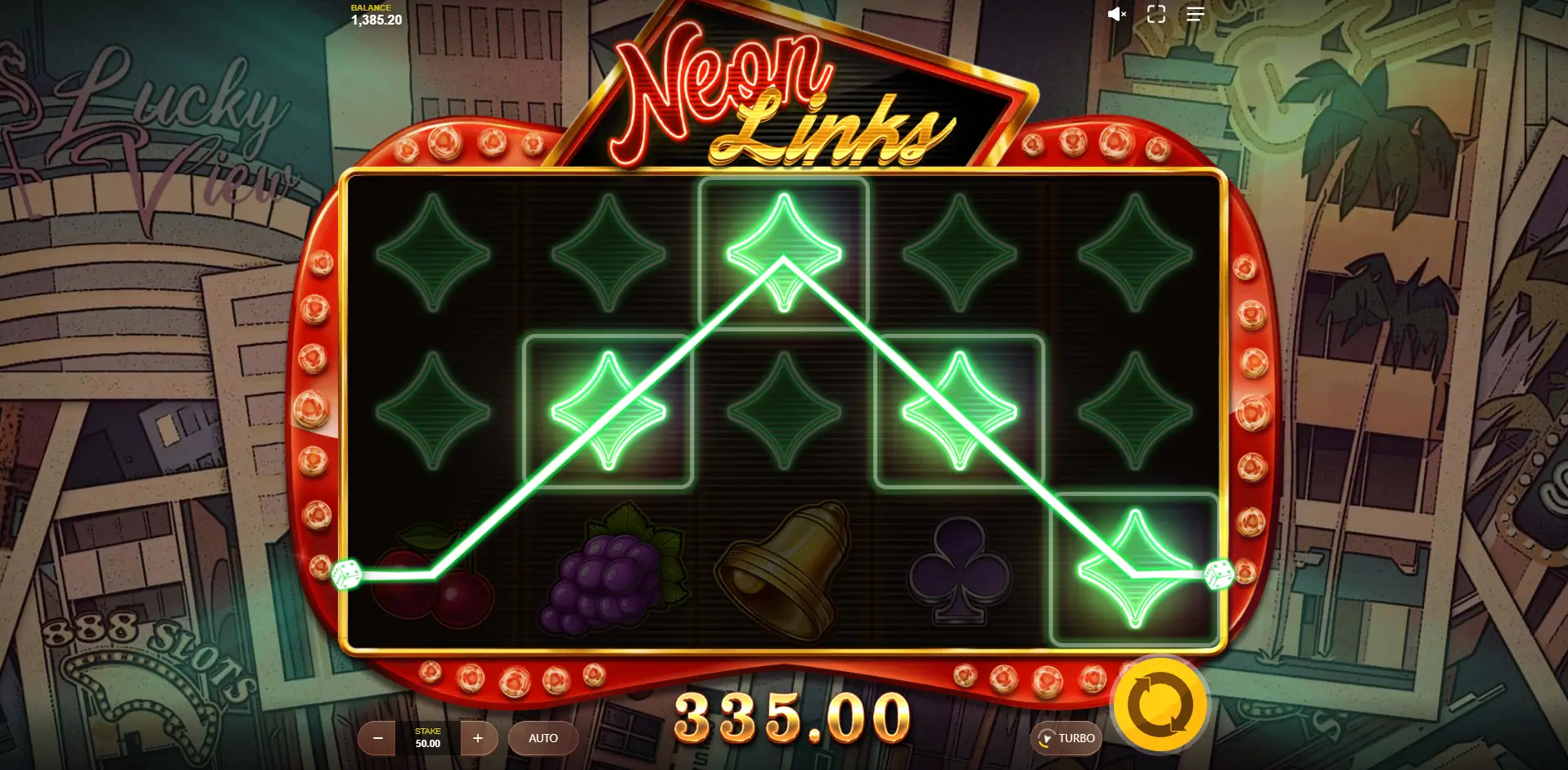
On every spin, the RNG designates one symbol as the active Neon symbol for that round. This selection is displayed subtly before reels stop. When two or more neon versions of that selected symbol land on the same row — crucially, they do not need to be adjacent — every symbol positioned between them on that row transforms into matching neon symbols.
This is the Connect & Expand behaviour, and its implications for payline connectivity are significant.
Consider a practical example: the active symbol is the Horseshoe. A neon Horseshoe lands in row 2 of reel 1, and another lands in row 2 of reel 4. The symbols occupying row 2 on reels 2 and 3 convert to neon Horseshoes. You now have at minimum four matching symbols across a row, potentially spanning multiple active paylines depending on adjacent rows. If additional neon Horseshoes are present on other reels in any row, separate chain reactions fire.
There are no wild symbols in Neon Links. The neon linking mechanic is the functional equivalent — arguably a more contextually coherent one, since its activation is tied to a specific symbol rather than a generic substitute. The absence of wilds is not a gap in the design; it’s a deliberate concentration of bonus potential into a single mechanic that’s visible and comprehensible every spin.
The payline structure (10 fixed lines, paying both left-to-right and right-to-left) means that a linked chain crossing three or more reels in a row can produce wins across multiple lines simultaneously. A full-row link on the 7s symbol — neon 7s on reel 1 and reel 5 in the same row, filling the three intermediate positions — produces five matching symbols on every payline that passes through that row. With ten paylines across a 3-row grid, a full horizontal chain can trigger multiple payline wins from a single linking event.
The mathematical ceiling in the base game sits at 250× stake for a full grid of neon 7s (not achievable through a single chain without stacking — more realistic maximum from a clean full-board is in the 100–150× range for premium symbols). The theoretical maximum of 1,050× referenced in official material accounts for edge cases involving multiple simultaneous chain events on the highest-value symbol tier.
Professional Insight: The mechanic’s elegance is in its legibility. Players understand within two or three spins what to look for, what triggers it, and roughly what to expect. That immediate comprehension loop — spin, observe, evaluate — keeps engagement without demanding the kind of mental overhead that complex multi-modifier systems impose.
Vegas Spins: When the Chosen Symbol Goes Fully Stacked
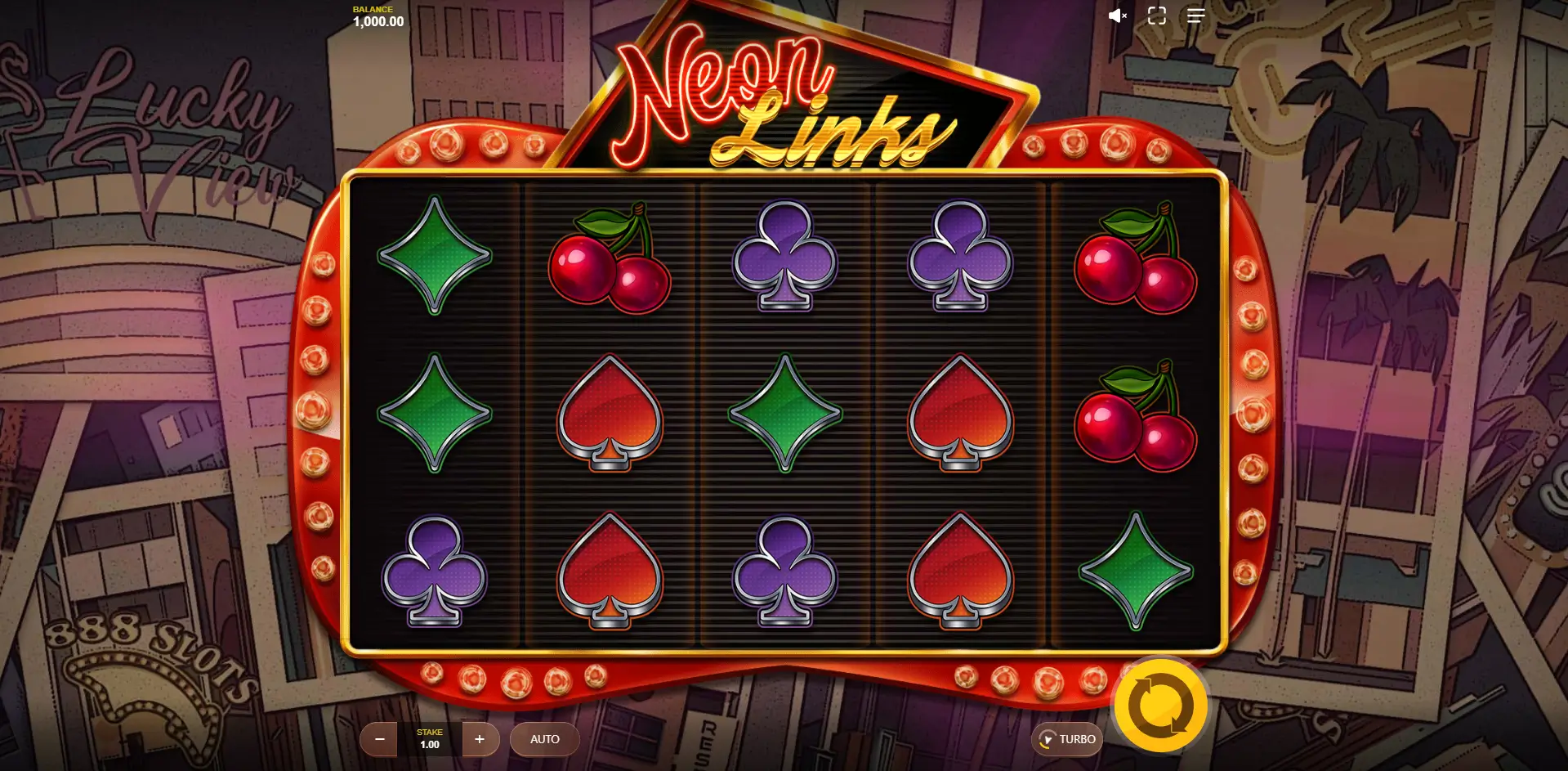
The free spins round in Neon Links is triggered by landing the Vegas Spins scatter symbol on reel 1 and reel 5 simultaneously, on the same row. This is a narrow trigger condition — specifically, a two-scatter requirement with a positional constraint — which means it fires less frequently than a typical three-scatter trigger spread across five reels.
The reward is 10 free spins. There are no retriggers available, which means the round has a fixed upper bound on spin count. What changes during Vegas Spins is the behaviour of the active Neon symbol.
The Stacked Super Neon Mechanic
In the base game, neon symbols land in standard reel positions — single tiles or partial stacks of two. During Vegas Spins, the designated Neon symbol for the round is selected randomly at the start and then always lands fully stacked across all three rows of a reel whenever it appears. A full 3-high stack on a single reel effectively guarantees that any matching neon symbol appearing anywhere on any other reel will connect — because the stacked symbol covers all three rows, every row alignment is automatically satisfied.
This is where the mechanic becomes genuinely interesting from a mathematical standpoint.
A full stack of neon 7s on reel 2, combined with a single neon 7 anywhere on reel 5, produces a link across four reels that fills in reels 3 and 4. That’s a 5-of-a-kind on every row the link touches — up to 10 simultaneous payline wins if the chain spans all three rows.
For the highest symbol (7s), a full grid of neon 7s pays 25× per payline × 10 paylines = 250× stake from that single spin. Multiple such events across 10 free spins push the session maximum toward the 1,000× cap referenced in the game specs.
Why Symbol Selection Defines Session Variance
Here is where the Vegas Spins round introduces meaningful volatility management — or rather, meaningful variance of outcomes that players cannot control.
The symbol chosen at the start of Vegas Spins is random. If that symbol is the flaming 7 (highest pay at 25× per line), the mathematical expected value of the bonus round climbs sharply. If the selected symbol is the Club (lowest pay at 1.1× per line), even a full-board event produces a modest return. The gap between best-case and worst-case symbol selection is roughly 23× per payline — a significant spread that determines whether a Vegas Spins round produces a forgettable 15–30× total or an outlier 200–600× event.
This randomised symbol selection functions as the primary variance driver in the bonus round, substituting for the multiplier trails and cascading mechanics that high-volatility games use to achieve their peak returns. The practical effect is that two identical-looking free spins rounds — same trigger, same spin count — can produce radically different outcomes purely based on which symbol the RNG selects before the first bonus spin begins.
Session implications for the Vegas Spins round:
- Best case symbol (7s selected): Each full-board event = 250× stake; 10 spins with consistent stacked linking could approach or reach the 1,000× cap
- Mid-tier symbol (Horseshoe or Bell selected): Expect 50–150× range for a productive bonus session
- Worst case (card suit selected): Full-board events produce 11–18× stake; a 10-spin bonus round may return less than its trigger cost in EV terms
- No retriggers: The fixed spin count keeps the downside bounded — a bad symbol selection cannot extend a losing bonus round indefinitely
Professional Insight: The lack of player agency over symbol selection is the correct design choice here. It preserves the surprise-value of the bonus round and maintains the game’s low-complexity positioning. The alternative — a Megaways-style symbol picker with player choice — would shift the cognitive burden significantly and alter the audience fit.
Volatility Profile and Hit Rate: Reading the Math Model
Red Tiger classifies Neon Links as medium volatility, and this holds up under observation. The hit rate is not officially disclosed, which is typical for Red Tiger, but behaviour across extended sessions is consistent with a base-game win frequency somewhere in the 25–35% range — meaning roughly one in three spins produces a return before the linking mechanic.
Once the linking mechanic is factored in, win frequency per spin increases meaningfully. Because every spin has an active Neon symbol, any spin where two neon instances of that symbol land on the same row produces a win regardless of initial payline alignment. This creates a modifier layer that generates wins that wouldn’t exist in a conventional fruit machine, softening what would otherwise be a dry base-game experience.
The practical variance profile looks like this:
- Low session variance: Short sessions (50–100 spins) produce relatively predictable outcomes in the 70–130% return range relative to stake
- Medium session variance: Extended sessions (300+ spins) show occasional clusters — multiple consecutive linking events or a productive Vegas Spins trigger — that punctuate otherwise steady losses
- Peak events: The 1,050× theoretical maximum is achievable but rare; realistic outlier sessions sit in the 200–400× range for a single event
The RTP of 95.67% (non-jackpot variant) sits slightly below the current competitive midpoint for online slots. Red Tiger’s slot RTPs cluster in the 95.7–96.1% range, sitting below the 96.0–96.5% headline figures from Pragmatic Play and NetEnt’s top titles — and Neon Links is toward the lower end of that range. For players who track these figures, it’s a relevant consideration. For players who don’t, the medium volatility profile will feel comfortable regardless.
The jackpot variant (RTP 94.79%) reflects the jackpot contribution deducted from the base return. The Daily Drop network — Hourly, Daily, and Super tiers — functions as a separate parallel win layer that pays regardless of reel outcomes. For casual players who value jackpot access, the reduced RTP is a reasonable trade. For mathematically oriented players, the non-jackpot variant at 95.67% is the better choice.
Who this game is mathematically suited for:
- ✅ Players seeking session stability over variance extremes
- ✅ Bankroll-conservative players; the medium volatility and low maximum bet floor ($0.10) enable long sessions at minimal risk exposure
- ✅ Players who find high-volatility bonus buy mechanics stressful or financially dangerous
- ✅ Operators running responsible gambling frameworks — low max-win cap reduces incentive for reckless stake escalation
- ❌ High-variance chasers looking for 5,000× potential
- ❌ Players who need multiplier mechanics to sustain engagement
- ❌ Sessions where the target outcome is a single blow-out event rather than sustained play
The combination of a 1,050× hard cap, no multipliers, and medium volatility makes Neon Links structurally safe for lower-stakes players in a way that high-volatility games with nominally similar RTPs are not. A game with 96% RTP and high volatility can drain a bankroll before the variance resolves in the player’s favour. Neon Links’ medium profile means the mathematical expectation is reached more consistently across shorter sample sizes.
Paytable Deep Dive: Symbol Economics
The nine-symbol paytable is worth examining at each tier, because the spread between symbol values is more pronounced than it appears in summary form.
Low-Pay Tier: Card Suits
The four card suits — Clubs, Diamonds, Hearts, Spades — serve their traditional purpose: frequent small returns that maintain bankroll momentum without contributing meaningfully to session profit.
| Symbol | 3-of-a-kind | 4-of-a-kind | 5-of-a-kind |
|---|---|---|---|
| Clubs | 0.3× | 0.6× | 1.1× |
| Diamonds | 0.4× | 0.8× | 1.3× |
| Hearts | 0.5× | 1.0× | 1.5× |
| Spades | 0.6× | 1.2× | 1.8× |
A five-of-a-kind Clubs win at 1.1× stake returns less than the spin cost on most bet levels. These symbols function as partial loss mitigation rather than genuine wins. Their value in this game comes from their role as potential link participants — a card suit selected as the active Neon symbol during Vegas Spins with a good board state still produces stacked wins, even if the per-line pay is low.
Mid-Pay Tier: Classic Fruits
| Symbol | 3-of-a-kind | 4-of-a-kind | 5-of-a-kind |
|---|---|---|---|
| Cherries | 0.5× | 1.0× | 2.5× |
| Grapes | 1.0× | 2.0× | 4.0× |
Cherries and Grapes occupy the bridge between low-pays and the genuinely profitable symbols. A five-of-a-kind Grapes at 4× is the first symbol value that comfortably clears a single-spin cost in profit. Their linking value is modest — ten full-board linking events on Grapes during Vegas Spins would produce 40× per spin — but they’re not the symbols players hope to see selected at the start of the bonus round.
High-Pay Tier: Lucky Symbols
| Symbol | 3-of-a-kind | 4-of-a-kind | 5-of-a-kind |
|---|---|---|---|
| Horseshoe | 1.0× | 2.5× | 5.0× |
| Bells | 2.0× | 5.0× | 10.0× |
| 7s | 5.0× | 12.5× | 25.0× |
The Bells and Flaming 7s are where the game’s return structure concentrates. A single payline win of 25× from a full line of 7s is meaningful at any stake level. When the linking mechanic fires on 7s in the base game — two neon 7s on the same row, filling in the gap — the multi-payline interaction can produce 50–100× stake from a single spin event.
During Vegas Spins with 7s as the selected symbol, a full-board fill (stacked 7s linking across all five reels on multiple rows) theoretically produces 250× per spin. Even partial events — a three-reel link across two rows — produce 50× or better given the 10-payline both-ways structure.
The 25× single-payline cap for the 7s feels conservative relative to what high-volatility competitors offer in their premium symbol tiers (some exceeding 500× per line in bonus conditions). But this restraint is consistent with the game’s medium-volatility positioning. Red Tiger traded peak event magnitude for consistency — a choice that limits the headline number but produces a more predictable session curve.
Professional Insight: The 23× multiplier gap between the highest and lowest symbol (7s at 25× vs Clubs at 1.1×) is deliberately wide. It creates high dispersion of bonus round outcomes based purely on which symbol is randomly selected — a form of meta-variance that sits above the spin-level RNG but below the player’s awareness threshold in casual play. Players who understand this dynamic will watch the symbol selection at the start of Vegas Spins with the same attention they’d give a Wheel of Fortune pick. Most won’t.
Neon Links in Context: How It Fits the “Neon” Slot Category
The neon aesthetic in iGaming is its own sub-genre at this point. There are close to 500 neon-themed slots in major catalogues, which means positioning within the category requires specificity. Neon Links sits at the fruit-machine end of the spectrum — not the sci-fi cyberpunk end populated by games like NetEnt’s Neon Staxx or Relax Gaming’s more recent neon-inflected releases.
Comparable titles and where Neon Links stands:
Neon Staxx (NetEnt) is the closest structural comparison: a classic-symbol fruit machine with a neon visual treatment and a stacking mechanic. Neon Staxx runs at ~96.9% RTP with medium-high volatility and stacks that can cover entire reels. Neon Links’ 95.67% RTP is less competitive, and Neon Staxx’s mechanic is simpler (stacking, no linking logic) but more visually dramatic. Neon Staxx wins on RTP and production legacy; Neon Links’ linking logic is more mathematically interesting but less kinetic as a visual experience.
Twin Spin (NetEnt) — an earlier touchpoint — shares the dual-symbol synchronisation concept. Twin Spin’s mechanic (two reels spinning identically, with potential expansion to five) creates a different kind of connectivity, but the underlying logic is comparable: force symbol alignment across reels to create outsized payline hits. Multiple reviewers have noted the Twin Spin resemblance, though Neon Links’ explicit gap-filling behaviour is mechanically distinct.
Red Tiger’s own neon-adjacent catalogue includes titles that borrow the colour palette without the fruit-machine grounding. Neon Links remains the most mechanically coherent use of the neon concept within the studio’s output because the aesthetic and the mechanic are genuinely integrated: neon symbols are neon because that’s how you see the linking chain form. The visual language explains the mechanic without tutorial text.
2026 Market Relevance: Has the Neon Dimmed?
The slot is over four years old by mid-2026. In a market releasing dozens of titles monthly, longevity is rarely about absolute quality — it’s about operator relationships, player retention data, and whether a title continues converting on affiliates’ landing pages.
Neon Links continues to appear across major European operators and Asian-facing platforms (particularly those targeting mobile-first markets in South and Southeast Asia). The reasons are practical:
Mobile performance remains a legitimate strength. The 5×3 grid, minimal animation complexity, and high-contrast visuals translate well to smaller screens. On budget Android devices with modest processing power, Neon Links loads faster and runs more smoothly than mechanically complex contemporaries. In markets where mid-range handsets are the primary gaming device, this matters.
Accessibility at the low-stake end ($0.10 minimum) keeps the game viable for recreational players who wouldn’t consider a $1-minimum entry point. Combined with the medium volatility profile, it’s a reasonable first-spin experience for players new to online slots.
The Daily Drop jackpot network adds ongoing incentive for casual players. The jackpot variant’s lower RTP (94.79%) is the trade-off, but the perceived value of jackpot eligibility — even at low probability — maintains engagement for a segment of players that pure-RTP reasoning wouldn’t retain.
Where it shows its age:
The absence of a Bonus Buy function is increasingly conspicuous as that feature becomes standard across the industry. Players who use Bonus Buy to access the Vegas Spins feature directly — common behaviour among medium-stakes players — cannot do so in Neon Links. The only route to the bonus round is organic trigger, which in a game with a positional two-scatter requirement (reel 1 and reel 5, same row) may feel slow relative to competitors.
No multipliers, no progressive mechanics, no cascading reels — none of this disqualifies Neon Links for its target audience, but it limits crossover appeal to players who have built their preferences on high-feature games. A player who describes their session enjoyment in terms of multiplier trails, reaction chains, or escalating bonus mechanics will find Neon Links structurally under-equipped.
The 1,050× maximum win is also now a liability in a market where games routinely advertise 5,000×, 10,000×, or 50,000× theoretical peaks (however rarely reached). For players who select games partly on headline maximum win, Neon Links’ cap is an immediate disqualifier — regardless of whether those players have any realistic probability of reaching either number.
Professional Insight: The correct framing for Neon Links in 2026 is not “can it compete with current releases” but “does it serve the player profile it was designed for.” The answer to the second question remains yes — arguably more clearly than at launch, given how precisely the medium-volatility, low-complexity segment has crystallised as a distinct preference group rather than an underserved residual.
Final Assessment
Neon Links is a competently constructed medium-volatility slot built around a single mechanic that it executes cleanly. The design restraint that looked risky at release looks considered in retrospect. The neon aesthetic does real work rather than decorative work — the visual language directly encodes the game’s core interaction, which is rare enough to merit acknowledgment.
The RTP at 95.67% (non-jackpot) is slightly below where the competitive market has landed for comparable titles, which is an honest criticism. The 1,050× cap will continue to look modest as the market normalises higher theoretical maximums. The absence of a Bonus Buy option limits commercial reach among operators that prioritise feature depth.
None of these are terminal problems for a game that isn’t trying to be those things. Players looking for a low-stress, visually coherent fruit machine with a meaningful central mechanic and a session profile that doesn’t punish recreational bankroll management will find Neon Links holds up. Players chasing outlier events or complex feature interactions will not.
Verdict — What Works:
- ✅ Mechanic-aesthetic integration is genuinely thoughtful
- ✅ Mobile performance and visual clarity are above average for the category
- ✅ Medium volatility makes it viable for extended sessions at low stakes
- ✅ The Vegas Spins stacked-symbol system creates genuine tension without complexity overhead
- ✅ No multiplier dependency means the max win is achievable in the base game as well as the bonus
Verdict — What Doesn’t:
- ❌ 95.67% RTP is below the current market median for quality slot product
- ❌ No Bonus Buy option limits operator and player flexibility
- ❌ 1,050× maximum win is a genuine competitive disadvantage in headline comparisons
- ❌ No retriggers in Vegas Spins creates an abrupt ceiling on bonus round upside
- ❌ The card suit low-pay tier produces nominal returns that barely register as wins