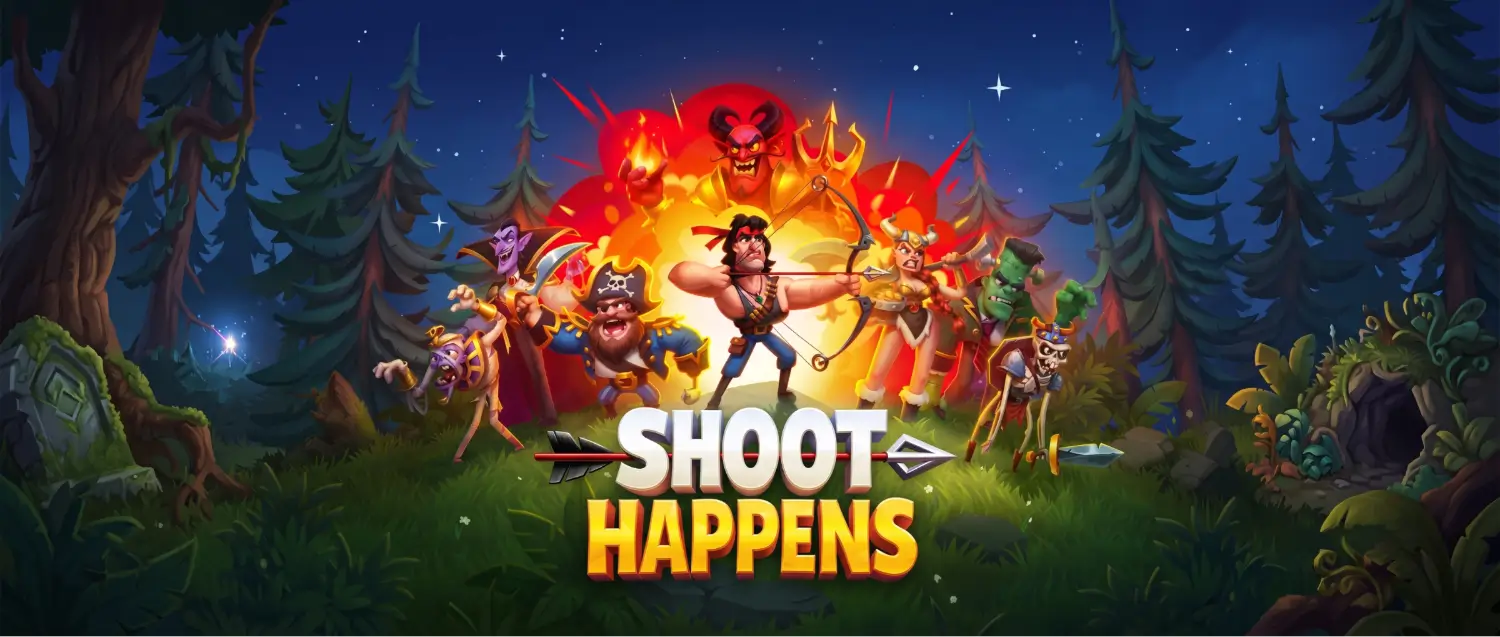
Shoot Happens has been live since August 2025, which makes it a genuine newcomer rather than a proven veteran. That matters here more than usual, because the game isn’t a slot in any traditional sense — it’s a skill-flavoured, crash-style shooter dressed up in jungle monster graphics, and the market for that hybrid is still working out what “good” looks like. ELA Games, the Turkish studio behind it, built its name on exactly this kind of format with its earlier title Bandidos Bang!, so Shoot Happens isn’t an experiment from a first-timer. It’s a second attempt, and the question worth asking is whether the second attempt actually improved on the first.
The headline number is a 95% RTP, sitting below the mainstream slot average and below most of the direct shooter-hybrid competition. The 5,000x max win, capped at €250,000, looks respectable on paper. Whether that ceiling is actually reachable, and whether 95% is a fair price for the privilege of trying, is what the rest of this review works through.
Math model and mechanics
Start with the RTP, because it’s the number every other judgement in this review depends on. ELA Games and every third-party aggregator that’s indexed the game — SlotCatalog, SlotsCalendar, the operator’s own casino integration page — list Shoot Happens at a flat 95%. That figure appears consistently enough that I’m treating it as the reliable one. One aggregator page (CleopatraBets) lists a different figure of 96.8%, alongside a completely different bet range (100–50,000 in-house credits) and wild west branding that doesn’t match this game at all — that page is almost certainly a templated listing that never got updated with Shoot Happens’ real data, and I’m discounting it rather than presenting it as a genuine second RTP figure. There’s no evidence anywhere of operator-configurable RTP bands for this title, which is worth noting because it’s common practice elsewhere in the market. What you see is what every operator gets.
95% is not competitive. Put it against the two closest shooter-hybrid rivals: Evoplay’s Star Guardians runs at 96%, and Funta Gaming’s Space War runs at 97%. Over a long session, that gap compounds. On a £1,000 turnover session, a 95% RTP title theoretically returns £950 across the life of that money; a 97% title returns £970. That’s £20 of difference on a modest bankroll, and it scales linearly with everything you stake. You might ask why a studio would ship a game two points behind its rivals. The likely answer is that Shoot Happens isn’t selling RTP — it’s selling the decision-making loop, and ELA is betting that players will tolerate a lower return ceiling in exchange for more control over when they cash out. Whether that trade is worth it depends entirely on the player profile, which the verdict section deals with properly.
Volatility is where this game stops behaving like a slot altogether. SlotCatalog lists the official variance as “Adjusted,” which is their way of saying the standard low/medium/high framework doesn’t apply. Here’s why: in a conventional slot, volatility is baked into the math model before you ever press spin. In Shoot Happens, the volatility you experience is a direct output of your own decisions. Every kill you bank as WinPot cash locks in that value permanently. Every kill you push for instead carries the full risk of the next three arrows missing and wiping the pot back to zero. This is functionally the same risk architecture as a crash game — you are the one setting your own variance, round by round, not the RNG.
That has a real practical implication most reviews gloss over. If you cash out after the Skeleton Minion and Sheriff every single round, you are playing a low-volatility game — frequent small wins, minimal drawdown, and a session that behaves like a low-stakes grinder. Push toward the Vampire or Pirate Captain tier consistently, and you’re playing something closer to a high-volatility slot, with long stretches of zero return interrupted by the occasional four-figure multiplier hit. The mechanic is identical either way. Only your appetite for risk changes the shape of the outcome. That’s a genuinely interesting design decision, and it’s the one thing about this title that feels deliberately different rather than derivative.
Hit frequency isn’t published by ELA Games, and I couldn’t find a verified figure from any independent testing lab. What I can offer instead is the shape of the mechanic: each of the three arrows per monster has to land, and a miss on any of the three costs you the entire accumulated WinPot for that run, not just that shot. That’s a harsher failure condition than a standard slot’s dry spell, because the loss isn’t gradual — it’s a cliff edge that resets you to zero the moment your third arrow misses. Early monsters (Skeleton Minion, Sheriff) feel forgiving because the payout is small enough that losing it barely registers. By the time you’re several kills deep and sitting on a four-figure multiplier, the same cliff edge suddenly matters a great deal more.
The stake structure is straightforward: 17 stake levels running from €0.10 to €50 per shot, and every shot at that chosen stake costs you the full stake amount regardless of which monster you’re facing. There’s no grid, no paylines, no reel count to speak of — SlotCatalog lists betways as “N/A” because the concept simply doesn’t apply to this format. What you’re actually buying with each stake increment is a bigger WinPot ladder, since every payout multiplier in the paytable scales off your chosen bet.
On the ceiling: 5,000x the bet, capped at €250,000. At the maximum €50 stake, that cap is reached exactly at the theoretical multiplier limit, so high rollers playing top stake are the only ones who’ll actually bump into the euro ceiling rather than the multiplier ceiling. Is 5,000x competitive for 2026? Only just. Star Guardians matches it. Space War triples it at 15,000x. Against the wider high-volatility slot market — where 10,000x-plus ceilings are increasingly the baseline for anything marketed as a big-win title — 5,000x reads as mid-table rather than exceptional. It’s enough to be interesting. It’s not enough to be a headline.
Put some real numbers behind the RTP gap. Say you play a €1 stake and run 500 shots across a session — not 500 rounds, 500 individual arrows, since that’s the actual cost unit here. That’s €500 in turnover. At 95% RTP, the theoretical long-run return is €475, leaving a €25 expected cost to play. The same €500 turnover at Star Guardians’ 96% theoretically returns €480, and at Space War’s 97% it returns €485. None of those numbers describe what will actually happen in any single session — the WinPot mechanic means real outcomes swing far wider than the long-run average, in both directions — but they describe what you’re paying for the format over enough sessions to matter. A two-point RTP gap sounds small until you’re the one funding it.
Session tools and the stake grid
Away from the maths, Shoot Happens runs the functional toolkit you’d expect from any modern HTML5 title: Autoplay for players who want to run a fixed number of shots without manually confirming each one, and a Turbo mode that speeds up the shot animation and WinPot reveal for faster-paced sessions. Neither tool changes the underlying odds — they’re pacing controls, not risk controls, and the WinPot cash-out decision still has to be made manually every round regardless of which mode you’re in. The 17-step stake ladder from €0.10 to €50 gives reasonable granularity at the low end for cautious bankroll management, though the jump to a €50 top stake is a wide one for a game with no configurable volatility setting to soften the ride at higher stakes.
Feature breakdown
Shoot Happens doesn’t have a conventional bonus round structure, and that’s by design rather than by omission. What it has instead is a progression ladder, a resurrection mechanic on the final stage, and a single random multiplier event. Here’s how each one actually works.
The kill ladder and paytable
Trigger mechanics: every round starts at the first of ten monster tiers, the Skeleton Minion. You get three arrows to land a kill. Land it, the payout gets added to your WinPot, and you move to the next tier. Miss all three, and the entire accumulated WinPot for that run is lost — not just the current tier’s payout, the whole thing.
What it does mechanically: each tier pays double the previous one. The full ladder runs Skeleton Minion (1x), Sheriff (2x), Fisherman (4x), Frankenstein (8x), Mummy (16x), Clown (32x), Viking (64x), Vampire (128x), Pirate Captain (256x), and the Demon Final Boss (512x). That’s a clean doubling sequence across ten stages, which makes the maths easy to hold in your head mid-session — every successful kill exactly doubles what the next one is worth.
Payout contribution and honest limitation: the doubling structure means the overwhelming majority of a session’s realistic value sits in the first five or six tiers, because that’s where most runs actually end. Reaching the Vampire or Pirate Captain tier consistently would require stringing together eight or nine clean three-arrow kills in a row with no misses, which is a low-probability outcome by definition. The catch here is one this review’s pros and cons section flags directly: there’s no secondary feature layered on top of the ladder to soften the climb. It’s just the same 3-arrow-per-monster mechanic, repeated ten times, with the stakes rising each time you succeed.
Final Boss resurrection
Trigger mechanics: reaching and killing the Demon Final Boss at the top of the ladder (512x) doesn’t end the round the way a normal top-tier win would.
What it does mechanically: instead, the Final Boss resurrects immediately. Kill it again, and you’re paid a fresh Direct Win — a payout that goes straight into your collected purse rather than staying exposed in the WinPot, meaning it can’t be lost to a subsequent miss. This resurrection loop repeats indefinitely until either you fail a kill attempt or you hit the 5,000x session cap, at which point the round is terminated automatically and you’re paid off at the cap.
Maximum activation and realistic contribution: there’s no stated cap on how many times the Final Boss can resurrect short of the overall 5,000x ceiling, which in principle allows for extended high-value runs once you’ve cleared all ten tiers once. In practice, reaching this stage at all is rare enough that the resurrection loop functions more as the game’s marketing hook — the mechanic that makes for a good highlight clip — than as something the average session will meaningfully interact with. If you do get there, the fact that each Direct Win is locked in immediately rather than sitting exposed in the WinPot is a genuinely player-friendly design choice, and it’s the single best piece of risk management built into this game.
Fire Shot random event (Inferno Arrows)
Trigger mechanics: this is the game’s only bonus feature, and it can fire randomly on any shot, at any tier, with no way to trigger it deliberately.
What it does mechanically: your arrows switch to Inferno Arrows and a x2 multiplier applies to every subsequent kill payout in that run, stacking on top of the base doubling ladder, until you either fail a kill or bank the WinPot. Under an active Inferno Arrows multiplier, a Final Boss kill that would normally pay 512x instead pays 1,024x.
Multiplier range and honest limitation: the multiplier is a flat x2, not a range, and ELA Games hasn’t published an activation rate for it. SlotCatalog’s own tester noted the feature felt “relatively frequent” across a 200-round session, which lines up with my read of the mechanic: it’s common enough to meaningfully boost an average session, but it isn’t guaranteed, and a run can go from Skeleton Minion to Final Boss without ever seeing it. The honest catch is that Fire Shot only multiplies rewards you haven’t banked yet — if it fires after you’ve already collected your WinPot for that run, it does nothing.
One structural discrepancy worth flagging: SlotCatalog’s attribute list tags Shoot Happens with a “Buy Feature” label, which would normally mean players can pay to skip straight into a bonus round. ELA Games’ own official game page, by contrast, explicitly states “Buy Bonus: No.” I couldn’t find a single operator listing or independent review that confirms a working buy-in option for this title, so I’m treating the SlotCatalog tag as a metadata error rather than a real feature — but it’s the kind of inconsistency that’s worth checking directly with your operator before you go looking for a buy-bonus button that almost certainly isn’t there.
There’s no progressive jackpot layered onto any of this. The 5,000x / €250,000 cap is a fixed ceiling, not a pooled prize that grows with player volume, and nothing in ELA’s documentation or third-party coverage suggests that’s changed since launch.
The 2026 perspective
Shoot Happens doesn’t have a sequel, a Power Reels edition, or a Megaways variant, and a direct search turns up nothing in ELA’s pipeline pointing toward one. What it does have is a spiritual predecessor within ELA’s own catalogue: Bandidos Bang!, released in March 2024, roughly eighteen months earlier. Comparing the two tells you more about where ELA is heading than a straight sequel would.
Bandidos Bang! runs a 95.8% RTP with a 750x max win, a Wild West target-shooting theme, and a volatility selector that lets players manually toggle between high and low variance settings before a round starts. Its standout feature, Rage!, triggers randomly and guarantees an instant win across two to three targets simultaneously. Shoot Happens takes the same DNA — shoot targets, bank a pot, watch for a random multiplier event — and pushes it considerably further: ten sequential tiers instead of a flat target grid, a doubling payout ladder instead of fixed per-target values, and a resurrecting final boss that didn’t exist in the earlier game at all.
What the newer game fixed: the ceiling. 750x was a genuinely thin top end for a shooter-hybrid, and 5,000x — nearly seven times higher — brings Shoot Happens into contention with the better-established competition. The progression structure is also more coherent; Bandidos Bang!’s flat target grid didn’t build tension the way a doubling ladder does, and the escalating stakes of Shoot Happens give every round a clearer risk curve.
What it didn’t fix: RTP actually moved in the wrong direction, from 95.8% down to 95%. That’s a small drop in isolation, but it means ELA’s newer, more polished title is mathematically stingier than its own predecessor, which undercuts the narrative that this is a straightforward improvement. Volatility control also took a step backwards — Bandidos Bang! let players manually select their risk profile before a round even started, while Shoot Happens only lets you manage risk in real time, one cash-out decision at a time, with no pre-set option for players who’d rather lock in a low-variance session from the outset.
Against the wider shooter-hybrid field, the picture is mixed. Star Guardians by Evoplay (96% RTP, 5,000x max win, live since October 2021) matches Shoot Happens’ ceiling while beating it on return, and its third-person, walk-around gameplay is a genuinely different flavour of shooter — more video game, less crash mechanic. Space War by Funta Gaming (97% RTP, 15,000x max win) beats Shoot Happens comfortably on both numbers, though its space-combat theme and standard bonus-round structure make it a more conventional slot underneath the visual skin. Evil Bet: Shoot Them All by Mascot Gaming, released within weeks of Shoot Happens in mid-2025, is the closest thematic cousin — undead monster-hunting, session-based rounds, free-shot mechanics — but its RTP is either undisclosed or reported inconsistently depending on the source, which makes it impossible to responsibly rank against the other three on returns. If you’re choosing between recently-launched shooter-hybrids on math alone, Shoot Happens currently sits third out of three where the numbers are actually confirmed.
Buy-bonus availability is a non-factor here, officially at least — ELA’s own page rules it out, and nothing about the resurrection mechanic or the ladder structure would obviously benefit from a buy-in anyway, since the whole appeal is building tension from tier one. There’s no progressive jackpot to weigh either. Neither omission is a mark against the game; a title built around player-controlled cash-out decisions doesn’t really need either mechanic to function.
Worth noting too: none of the three named competitors run a manual volatility selector either, so Bandidos Bang!’s dropped feature isn’t something the wider shooter-hybrid field has standardised on. That takes some of the sting out of the regression — ELA moved away from a feature that, on the evidence of Star Guardians, Space War, and Evil Bet, wasn’t becoming an industry expectation in the first place. It’s a loss specific to ELA’s own back catalogue rather than a gap against the current competitive set.
So where does that leave Shoot Happens in a 2026 lobby? It’s not a high roller’s game — the €250,000 cap and mid-table 5,000x multiplier don’t compete with the true high-ceiling titles dominating that segment this year. It’s also not quite a pure recreational grinder, because the all-or-nothing WinPot mechanic punishes casual, low-attention play harder than a standard low-volatility slot would. What it actually is: a decision-engagement title for players who want to feel like their choices matter round to round, priced at a 95% RTP that asks you to pay for that engagement rather than get it for free. SlotCatalog’s own scan found it live at only 24 casinos across the markets it tracks, concentrated in Canada, Norway, Finland, and New Zealand — that’s a narrow footprint eighteen months after launch, and it tells you this is still very much a niche title rather than one that’s broken into the mainstream lobby rotation.
Verdict
Play it if: you specifically want a crash-style, decision-driven session where cashing out is your call every single round, and you’re not chasing the highest possible RTP or the biggest possible ceiling in the market. The Final Boss resurrection loop and the Fire Shot multiplier give experienced players enough to engage with tactically, and the doubling ladder makes risk genuinely easy to calculate on the fly. If you enjoyed Bandidos Bang! and wanted ELA to push the format further, Shoot Happens delivers on scale even if it slips slightly on return.
Skip it if: RTP is your primary filter, or you’re specifically hunting for a high ceiling. 95% is the number that limits this game more than any other single factor — it sits below both Star Guardians and Space War, its two closest direct competitors, and below its own predecessor. Pair that with a 5,000x cap that’s respectable but not exceptional, and there’s no compelling mathematical reason to pick Shoot Happens over Star Guardians if pure value is what you’re optimising for.
The player profile this suits is someone who treats the shooter mechanic itself as the entertainment, not the RTP. The player profile it doesn’t suit is anyone comparing shooter-hybrids purely on theoretical return — for that comparison, Space War wins on ceiling and Star Guardians wins on RTP, and Shoot Happens currently loses on both to the two games it’s most directly competing against.
FAQ
What is the RTP of Shoot Happens? The confirmed RTP across SlotCatalog, SlotsCalendar, and ELA Games’ own materials is 95%. One aggregator lists a conflicting 96.8% figure alongside mismatched theme details, which reads as a templated listing error rather than a genuine second RTP value.
What is the maximum win on Shoot Happens? 5,000x the bet, capped at €250,000. At the maximum €50 stake, hitting the multiplier cap and the euro cap happen at the same point.
Is there a demo version available? Yes. The game is playable in free demo mode through SlotCatalog and other aggregator sites, with no registration required.
Does Shoot Happens have a buy-bonus feature? No, according to ELA Games’ own product page. A third-party listing tags the game with a “Buy Feature” attribute, but no operator or independent review confirms a working buy-in exists, so treat that tag as unreliable.
Is Shoot Happens available on mobile? Yes. It’s built on HTML5 and runs directly in a mobile browser on Android and iOS without a dedicated app.
How does Shoot Happens compare to Bandidos Bang!, ELA’s earlier shooter? Shoot Happens raises the max win from 750x to 5,000x and adds the Final Boss resurrection loop, but its RTP is slightly lower — 95% against Bandidos Bang!’s 95.8% — and it drops the manual volatility selector that let players pre-set their risk level.
Is Shoot Happens high or low volatility? Officially it’s classified as “Adjusted,” meaning it doesn’t fit the standard scale. Your own cash-out decisions set the effective volatility — bank early and often for a low-variance session, or push deep into the ladder for something closer to high-variance play.