Hacksaw Gaming built its entire reputation on instant-win scratch cards before it ever released a slot. Gold Rush Scratch, launched in September 2018, was part of that founding era — a title from the studio’s scratchcard-first years before Wanted Dead or a Wild and Chaos Crew made Hacksaw a household name in the slot world. Five years on, it still sits in casino lobbies across regulated markets. That persistence raises a legitimate question: does it belong there, or is it coasting on brand familiarity while better-value cards exist?
The honest answer starts with one number: 58.67% RTP. That figure places Gold Rush Scratch below most physical lottery scratch cards in UK newsagents, which typically operate at 60–75%. Online scratch cards generally range between 90% and 97%. The gap between Gold Rush Scratch and those benchmarks is not small. It is the defining fact about this game, and any review that buries it in paragraph three is doing you a disservice.
This review covers what the game actually does, how its math model compares against Hacksaw’s own scratch card range and the broader online market, and which type of player — if any — has a coherent reason to load it.
What Gold Rush Scratch actually is
Gold Rush Scratch is a digital instant-win game. There are no reels, no paylines, no cascades, no bonus rounds triggered by scatter symbols. The game resolves in a single action: you buy a ticket and reveal the result.
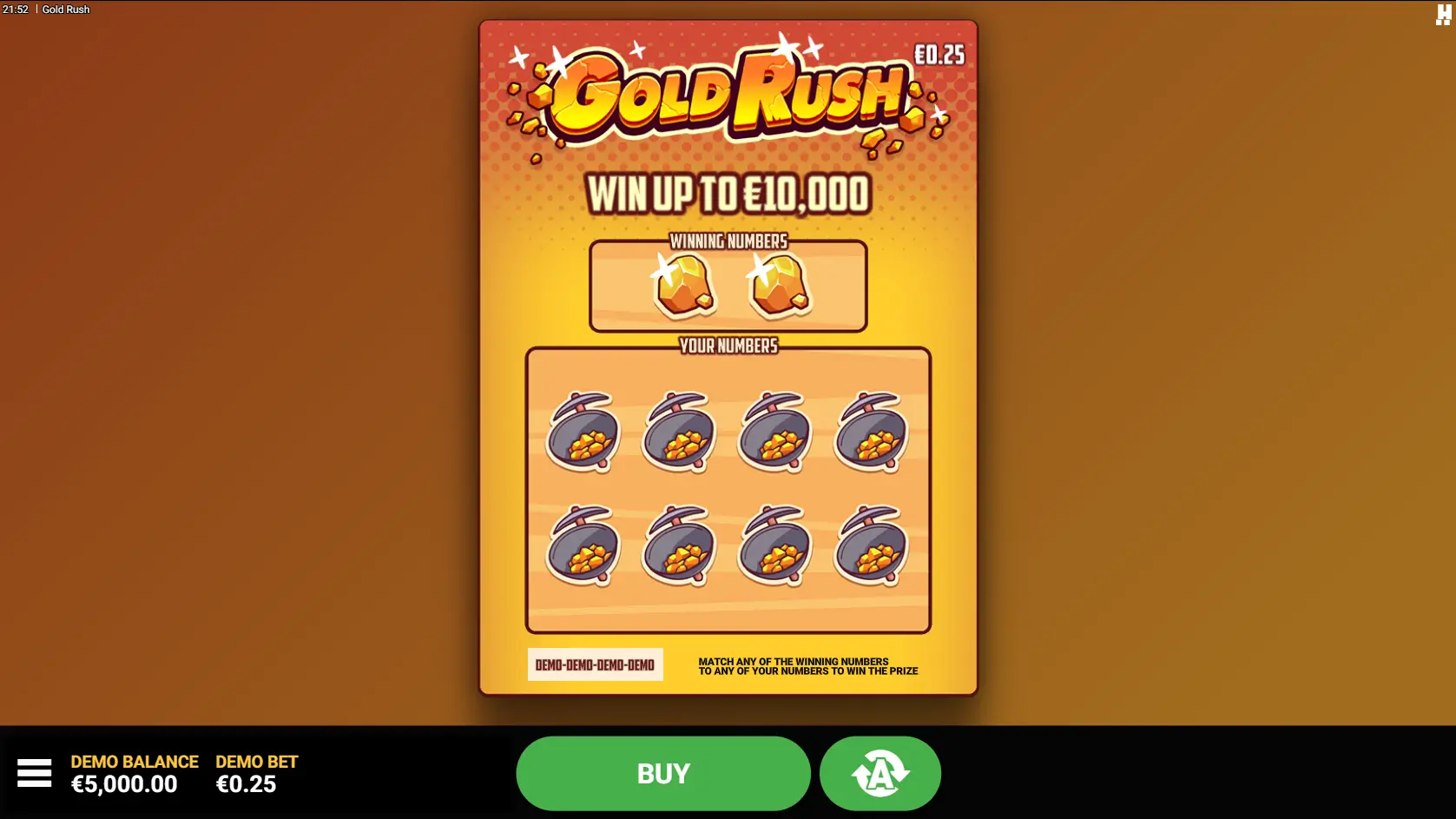
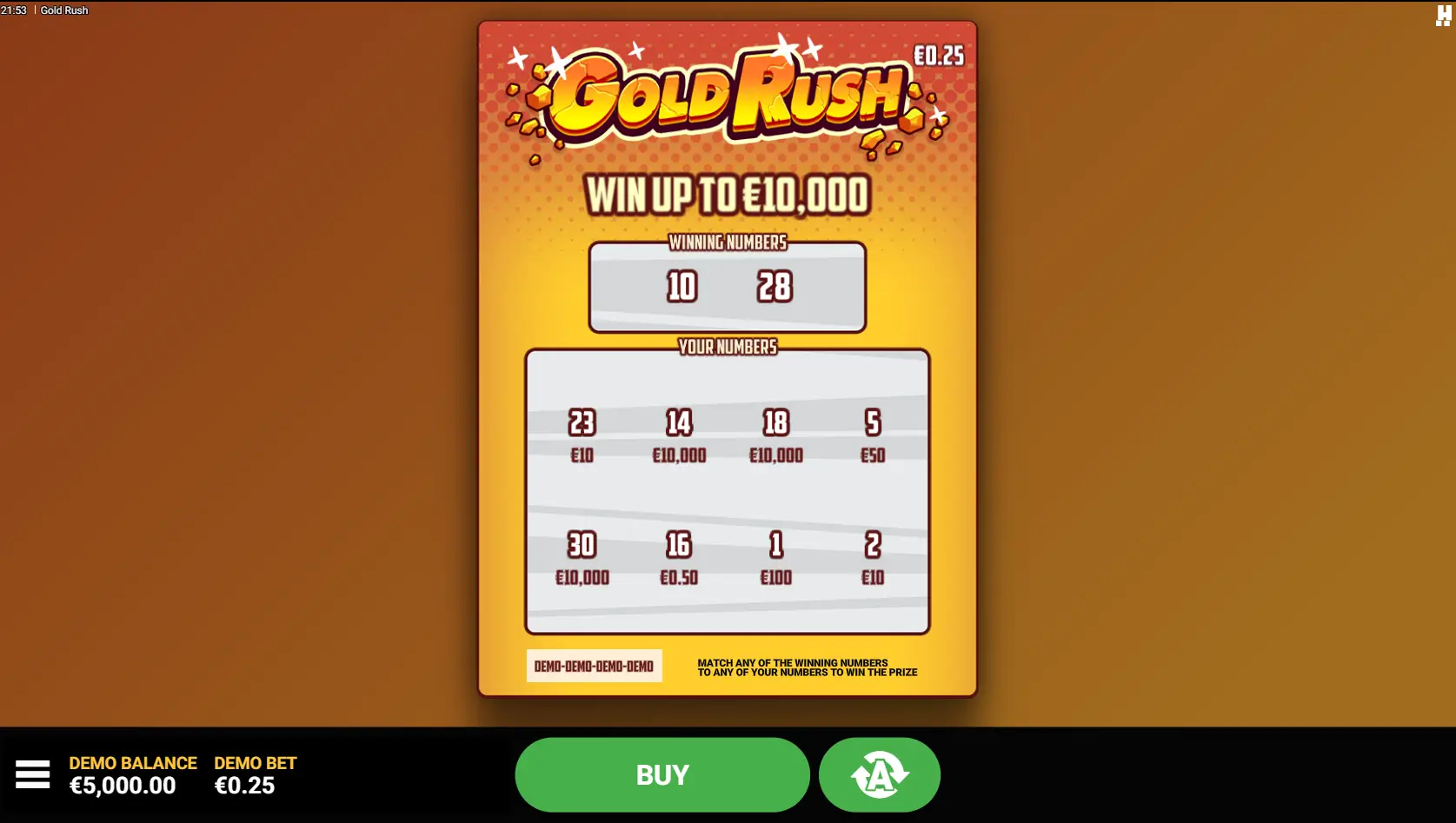
The layout is a 4×2 grid. The top row shows four “Winning Numbers.” The bottom row shows four “Your Numbers.” If any number in your row matches any number in the winning row, you win the corresponding prize. The gold mining theme provides the visual wrapper — pickaxes, gold nuggets, mining carts — but it has no mechanical function. The numbers do the work. The theme is decoration.
Ticket cost is fixed at £0.25. There is no bet slider, no stake adjustment, no way to play at a higher or lower denomination. You pay 25p per card. That is the entire stake structure.
The maximum win is 10,000× your stake, which equals a £2,500 top prize from a 25p ticket. On paper, that is a meaningful multiplier. The practical question is what RTP means for your likelihood of hitting anything close to it — which the math model section addresses directly.
The game supports autoplay, meaning you can queue multiple tickets to reveal consecutively without clicking through each one manually. In a game with this RTP structure, autoplay is worth thinking about carefully before enabling it.
The math model: what 58.67% means in practice
RTP stands for Return to Player. A 58.67% RTP means that for every £100 wagered across the full prize pool, approximately £58.67 returns to players over statistically significant volume. The house keeps 41.33p of every £1 bet.
To put that in concrete terms: if you buy 100 tickets at 25p each — a £25 session — your expected return based on the published RTP is £14.67. You are expected to lose £10.33, or approximately 41% of your stake. That is not a session-by-session guarantee; individual results vary widely due to high volatility. But it is the honest long-run picture.
For comparison:
| Game | Provider | RTP | Max win |
|---|---|---|---|
| Gold Rush Scratch | Hacksaw Gaming | 58.67% | 10,000× |
| Ruby Rush | Hacksaw Gaming | 59.21% | 20,000× |
| Diamond Rush | Hacksaw Gaming | 59.21% | not confirmed |
| Scratch Platinum | Hacksaw Gaming | 76.67% | £500,000 |
| Fishin’ Frenzy Scratchcard | Blueprint Gaming | ~80% | 2,000× |
| Typical online scratch card | Market average | 90–97% | varies |
| Physical lottery scratch card (UK) | Camelot / National Lottery | 60–75% | varies |
Gold Rush Scratch sits at the bottom of this table. It is below even physical scratch cards, which most online players consider the worst-value format available. Hacksaw’s own Scratch Platinum — from the same catalogue, same era — returns 76.67%. There is no obvious justification for the 18-percentage-point gap, and Hacksaw has not published one.
The high-volatility classification matters here. High volatility in a slot means long dry spells punctuated by infrequent larger wins. In a scratch card context, high volatility means the prize distribution is heavily skewed toward the top tier — most tickets are blank or return tiny amounts, and the bulk of the theoretical 58.67% return is concentrated in the rare larger prizes. In practical terms: you will scratch many blank tickets before hitting anything significant, and the few sessions where you do win meaningfully will likely be outliers rather than a reliable pattern.
This has a specific implication that is worth understanding clearly. A 96% RTP slot with medium volatility might produce a return close to the theoretical average across 200–300 spins in a session — the variance is contained. A 58.67% RTP high-volatility scratch card across 40–50 tickets in a session (a £10–£12.50 spend) will produce outcomes that scatter widely from the theoretical average, but that average is already poor. Most sessions will return substantially less than 58.67p per £1. Some sessions will return far more. The expected value of every individual ticket is negative; the variance does not change that.
Here is a concrete session example: a £10 budget at 25p per ticket equals 40 tickets. Expected return at 58.67% RTP: approximately £5.87. Expected loss: approximately £4.13, or 41% of stake. In a single session, actual results will vary widely due to high volatility — you might return £0, you might return £20. But the long-run math consistently removes 41p of every £1 wagered. Across 10 sessions of £10 each (£100 total), the expected loss approaches £41. That is the honest cost of this entertainment.
For comparison, a slot at 96% RTP with the same £100 total stake has an expected long-run loss of approximately £4. The difference is not marginal. It is the difference between a product where the math works reasonably in the player’s favour over extended play and a product that is structured more like a lottery ticket than a casino game.
To put that in concrete terms: if you buy 100 tickets at 25p each — a £25 session — your expected return based on the published RTP is £14.67. You are expected to lose £10.33, or approximately 41% of your stake. That is not a session-by-session guarantee; individual results vary widely due to high volatility. But it is the honest long-run picture.
Ticket mechanics: how the game actually runs
The core mechanic is number matching. Four winning numbers are displayed across the top row. Four player numbers appear across the bottom row. Any match between the two rows triggers a prize based on the matched number’s prize value. Multiple matches in a single ticket can stack prizes.
There are no special symbols that modify the outcome — no wilds that substitute for missing numbers, no multiplier tokens that boost matched prizes, no bonus games that open after a qualifying reveal. What you see on the ticket is the complete game. One reveal, one outcome, done.
The gold mining theme introduces themed symbol art around the number grid — icons representing pickaxes, panning trays, and ore carts. These are cosmetic. They do not affect prize calculation, and they do not map to any bonus mechanic. If you are accustomed to Hacksaw’s slot portfolio — where feature richness is a defining characteristic — the scratch card format will feel stripped back by comparison. That is inherent to the format, not a flaw in this specific title.
One important mechanic to understand before playing: the result of each ticket is pre-determined at purchase, not at reveal. The digital scratch animation — the visual act of uncovering numbers — does not affect the outcome. The RNG has already decided your result when you click “Buy.” Scratching faster or slower, manually revealing versus using auto-reveal, makes no difference to what the ticket contains. This is standard for all certified instant-win games and is how regulatory bodies (the UKGC and MGA, both of which license Hacksaw) verify fairness. Knowing this is relevant because it removes any instinct to “scratch carefully” or to feel that technique matters.
Auto-play functions by purchasing and revealing tickets at a set interval without manual input between each one. The session ends when you cancel it or your balance reaches zero. At 25p per ticket, auto-play can process a meaningful number of tickets quickly — and at 58.67% RTP, the expected value of each auto-play session is consistently negative at a rate that compounds across volume. Auto-play makes the session faster; it does not improve your odds. If you are using auto-play with Gold Rush Scratch, set a hard stop limit and treat it as a session budget enforcer, not a feature that changes the game’s math.
One practical note on ticket pricing: the fixed £0.25 stake means there is no low-denomination entry option for cautious testing below that level, and no high-denomination route for players seeking correspondingly larger top prizes. The £2,500 top prize from a 25p ticket is the only ceiling available. Players wanting a top prize in the five or six figures will need to look elsewhere in the Hacksaw catalogue — Scratch Platinum, for instance, offers prizes to £500,000 at higher stake levels.
The absence of configurable bet levels also means Gold Rush Scratch does not benefit from the standard advice to “lower your stake during the base game.” In slots, varying your bet size can be a session management technique (though it does not affect RTP). In Gold Rush Scratch, your bet is always 25p. Session management here is purely about how many tickets you buy, not how much each ticket costs.
Where Gold Rush Scratch sits in the Hacksaw scratch card range
Hacksaw released over 40 scratch card titles before pivoting to prioritise slots from 2019 onward. Gold Rush Scratch is one of the studio’s earliest and most basic entries — part of a foundational range that included Ruby Rush, Diamond Rush, and Scratch Platinum at launch.
The Rush family shares design language: number-matching mechanics on a compact grid, a mineral or precious-material theme, fixed stake tiers, and RTP figures that cluster around 59–60%. Ruby Rush (59.21% RTP, £0.50 stake, 20,000× max) and Diamond Rush (59.21% RTP) are essentially the same math model at slightly higher price points with larger prize ceilings. Gold Rush is the entry tier: cheapest ticket, lowest max win.
The logic of the Rush series appears to be: consistent math model across tickets with variance in stake and prize ceiling. If that model appeals — lottery-style, high-max-win, buy-in-bulk thinking — Ruby Rush or Diamond Rush offer better max-win potential at a marginally higher stake. Gold Rush’s competitive advantage within the family is strictly the 25p price point.
Scratch Platinum, also from Hacksaw’s early catalogue, is the more interesting comparison. At 76.67% RTP and a £500,000 prize ceiling, it represents meaningfully better value and a more substantial prize target. The gap in RTP between Scratch Platinum and the Rush series is not explained by any obvious difference in game mechanics or prize structure — both are number-matching instant-win cards. It likely reflects different prize pool designs and ticket pricing tiers.
Hacksaw’s slot portfolio, which now dominates the studio’s output and reputation, operates at an average RTP of approximately 96.27% — confirmed across 64 tracked titles. The difference between Hacksaw’s scratch card RTP figures and its slot RTP figures is not subtle. It is the difference between a game designed for the lottery/scratch card market and a game designed for regulated slot players who compare RTPs before choosing where to spin.
The 2026 context: is Gold Rush Scratch still relevant?
The honest answer is that Gold Rush Scratch was always a niche product, and that niche has not grown. It serves players who specifically want the scratch card experience — quick reveal, lottery-style psychology, fixed ticket cost — and who are comfortable with the associated RTP trade-off. That audience exists. But in 2026, that audience has options that this title does not match on value.
The online scratch card market has matured considerably since 2018. Blueprint Gaming, Relax Gaming, and Pragmatic Play all offer scratch card products in the 90–95% RTP range, most with more varied prize structures, some with actual bonus mechanics layered on top of the base reveal. Blueprint’s Fishin’ Frenzy Scratchcard, for example, operates at approximately 80% RTP — low by online standards, but still 21 percentage points above Gold Rush Scratch — and includes a fish-collecting mechanic that gives the reveal a progressive feel rather than a single binary outcome. That is still a bad RTP. The point is that even products generally considered poor-value in the scratch card space outperform Gold Rush Scratch on return.
The argument for Gold Rush Scratch over these alternatives comes down to two things: brand familiarity with Hacksaw, and the 10,000× multiplier ceiling at a 25p entry point.
On the first point: Hacksaw’s slots are excellent. The studio averaged £137 million in revenue in 2024 with an 84% EBIT margin and listed on Nasdaq Stockholm in June 2025 at a £2 billion valuation. Its slots — Wanted Dead or a Wild, Le Cowboy, Chaos Crew 3 — define the high-volatility, streamer-friendly segment. But the scratch card range predates the brand’s current reputation. Players who know Hacksaw from Chaos Crew or Hand of Anubis and follow the name into the scratch card section are being drawn to a product that does not represent the studio’s current design philosophy or math model standards. The slot portfolio averages 96.27% RTP. Gold Rush Scratch returns 58.67%. These are not comparable products under the same brand roof — they are two different businesses operating with two different player expectations.
On the second point: 10,000× is a legitimate headline multiplier, and a £2,500 top prize from a 25p ticket is real. The question is whether the 58.67% RTP makes the path to that prize meaningfully worse than alternatives with higher RTP and comparable multipliers. The answer, mathematically, is yes. Higher RTP does not guarantee you reach the jackpot, but it does mean your expected cost to play a given number of tickets is lower. At 58.67% RTP versus 92% RTP, you are paying roughly 2.5× more per unit of expected value to play the same number of tickets.
There is no buy-bonus mechanic — instant win games do not use that feature by definition. There is no progressive jackpot. There is no linked prize pool with Gold Rush Scratch as the entry point to larger prizes on the same network. What you have is a standalone 25p ticket with a fixed structure, unchanged since September 2018.
The game has not been retired or updated. Hacksaw has not released a revised version with improved maths, expanded features, or a higher RTP. For context: Hacksaw released its first slot, Stick ‘Em, in 2019 — one year after Gold Rush Scratch — and has since released roughly 90 in-house slots plus 46 titles via its OpenRGS platform as of late 2025, several of which are sequels or DuelReels variants with improved math models over their predecessors. The scratch card catalogue has not received the same iterative investment. Gold Rush Scratch in 2026 is exactly what it was in 2018, playing in a market that has moved on without it.
Why does it remain in casino lobbies? Because it fills a price-point slot (25p is genuinely one of the lowest-denomination real-money games available in regulated UK casinos), and because operators who carry the Hacksaw catalogue get the scratch cards bundled alongside the slots. Removal requires effort; retention is passive. That is a distribution explanation, not a quality endorsement.
Verdict
Gold Rush Scratch as a standalone product
Skip it, unless you specifically want a sub-£1 scratch card experience with a 10,000× ceiling and you have made peace with 58.67% RTP. The game delivers exactly what it promises: a fast, simple number-match reveal at 25p per ticket. It does not deceive on mechanics. The RTP figure is published and accessible in the game info panel. But in a market where online scratch cards routinely operate above 90% RTP, choosing Gold Rush Scratch is choosing to pay a significantly higher effective cost per ticket than most alternatives.
The player profile this suits: someone who wants lottery-style scratch card play with a slot studio’s brand backing, is playing for entertainment at minimum cost (25p per ticket is genuinely one of the lowest entry points in digital scratch cards), and has no strong preference on RTP because they are treating scratch cards as lottery tickets rather than casino games where math model matters.
Gold Rush Scratch versus the Hacksaw scratch card range
If you are committed to Hacksaw scratch cards specifically, Scratch Platinum is the better choice on both RTP (76.67% vs 58.67%) and prize ceiling (£500,000 vs £2,500), at the trade-off of a higher stake per ticket. Ruby Rush and Diamond Rush occupy the middle ground: same math model as Gold Rush, marginally higher RTP (59.21%), larger max wins, slightly higher stake. None of these titles compete on value with the broader online scratch card market at 90%+, but within the Rush family, Gold Rush is the worst of three options.
The one number that limits this game most is not the max win multiplier. It is the 58.67% RTP. That figure, more than the fixed stake or the absence of bonus mechanics, defines what this game is. Approach it like a lottery ticket — fast, cheap, and low-expectation — rather than a casino product where return benchmarks matter. On those terms, Gold Rush Scratch is a functional entry-level scratch card. On any other terms, better options are one search away.
Responsible gambling
Scratch cards and instant-win games can encourage rapid consecutive play, particularly with autoplay enabled. At 58.67% RTP, balance depletion is faster per unit staked than almost any other regulated online casino product. Set a fixed budget per session before opening the game, and treat autoplay as a feature to use cautiously rather than a convenience. If scratch card or instant-win play is causing concern, GamCare (gamcare.org.uk), BeGambleAware (begambleaware.org), and Gambling Therapy (gamblingtherapy.org) all provide free support and self-exclusion tools.
FAQ
What is the RTP of Gold Rush Scratch? The certified RTP is 58.67%. For every £100 wagered across the game’s full prize distribution, approximately £58.67 returns to players over statistical volume. This is below the typical range for online scratch cards (90–97%) and below most physical retail scratch cards (60–75%).
What is the maximum win in Gold Rush Scratch? The top prize is 10,000× your stake. At the fixed ticket price of £0.25, the maximum single-ticket win is £2,500.
Can I adjust the stake in Gold Rush Scratch? No. Ticket cost is fixed at £0.25. There is no stake slider and no alternative ticket denomination available in this specific title.
How does the game mechanic work? Four Winning Numbers are revealed across the top row. Four of Your Numbers appear in the bottom row. Any match between the two rows pays the prize associated with that number. Multiple matches in a single ticket stack. There are no wild symbols, multipliers, or bonus rounds.
Is there a demo version? Gold Rush Scratch is available in demo mode at most casinos that carry the title. SlotCatalog lists demo access directly. Playing free before wagering real money is the sensible first step with any scratch card, particularly one at this RTP level.
How does Gold Rush Scratch compare to Ruby Rush and Diamond Rush? All three are Hacksaw instant-win number-matching cards. Ruby Rush (59.21% RTP, 20,000× max, £0.50 stake) and Diamond Rush (59.21% RTP) both offer a marginally higher RTP and a larger prize ceiling. Gold Rush is the entry tier: lowest stake, lowest max win, lowest RTP of the three. If the 25p price point is not a deciding factor, Ruby Rush is the better option within the Rush family.
Which Hacksaw scratch card has the highest RTP? Scratch Platinum at 76.67% RTP is the highest-returning title in Hacksaw’s scratch card catalogue based on published figures. It operates at a significantly higher stake level with a £500,000 prize ceiling.
Does Gold Rush Scratch contribute to casino bonus wagering requirements? This varies by operator. Many UK casino bonus offers either exclude instant-win and scratch card games entirely, or weight them at a reduced contribution rate (10–20% is common versus 100% for slots). Always check the bonus terms before playing Gold Rush Scratch with active bonus funds — assuming it contributes at the same rate as slots is the most common mistake.