
Provider: Red Tiger Gaming | Release Date: July 2017 | RTP: 95.15% – 96.06% (operator-dependent) | Volatility: Medium-High | Max Win: 2,000x | Reels/Rows: 5×4 | Paylines: 40 fixed | Min Bet: €0.20 | Max Bet: €60
Let me be straight with you from the jump: Reel Heist breaks practically every unwritten rule that “successful” online slots are supposed to follow. No free spins. No scatter. No progressive jackpot. No sprawling bonus ladder with three separate levels and a pick-me screen. By every conventional checklist that casino content writers churn out, this game should be a mid-tier footnote — the kind of title that gets three paragraphs and a “worth a try” at the end, then gets buried under a thousand more modern releases.
And yet here we are, years after Red Tiger dropped this title in July 2017, and Reel Heist is still getting traffic, still sitting in casino lobbies, still pulling players back for another chase around the reels. That is not an accident. It is not nostalgia. It is because Red Tiger figured out something that a lot of studios with twice the budget have missed entirely: if your core mechanic is good enough — properly thought-through, visually distinct, emotionally engaging — you do not need to paper over it with bonus bloat.
This review covers everything you need to know before spinning: the real mechanics, the actual volatility picture, the RTP situation (which is messier than most sites let on), the paytable, and a candid take on who will enjoy this and who will bounce within twenty minutes.
The Setup: Cops, Robbers, and a Very Busy Street
The premise is about as old as cinema itself. A cartoonish city street, a bumbling crew of masked crooks, and a determined cop trying to run them down. Red Tiger leaned hard into the comedic register here — this is not Heat, it is more like a Saturday-morning cartoon from the 1990s. The color palette is bright, the robber designs are exaggerated to the point of pantomime, and the whole thing has an up-tempo soundtrack with the kind of siren wail that puts a grin on your face rather than a knot in your stomach.
By day, the street backdrop sits peacefully behind the reels — clean, sunlit, citizens going about their business. The moment a robber symbol appears on the grid, something shifts: the sky darkens, the street lamps flicker on, and the whole scene drops into a kind of comic-book nighttime. That visual transition is not just decoration. It is the game telling you, clearly and immediately, that something is happening. The chase is on.
That day-to-night dynamic is the most underrated piece of design work in Reel Heist. A lot of slots signal “bonus mode” with the same flashing screen, the same trumpet fanfare, the same screen-shake you have seen a hundred times. Red Tiger did something simpler and more effective: they changed the world the game takes place in. Two seconds, no dialogue needed, and you already know the mood has changed.
Grid, Paylines, and Bet Range
The layout is a standard 5×4 grid — five reels, four rows — which gives you a slightly taller playing field than the classic 5×3 setup. That extra row matters, because the game’s main feature depends on symbols moving around the board, and more space means more room for the chase to play out before it resolves.
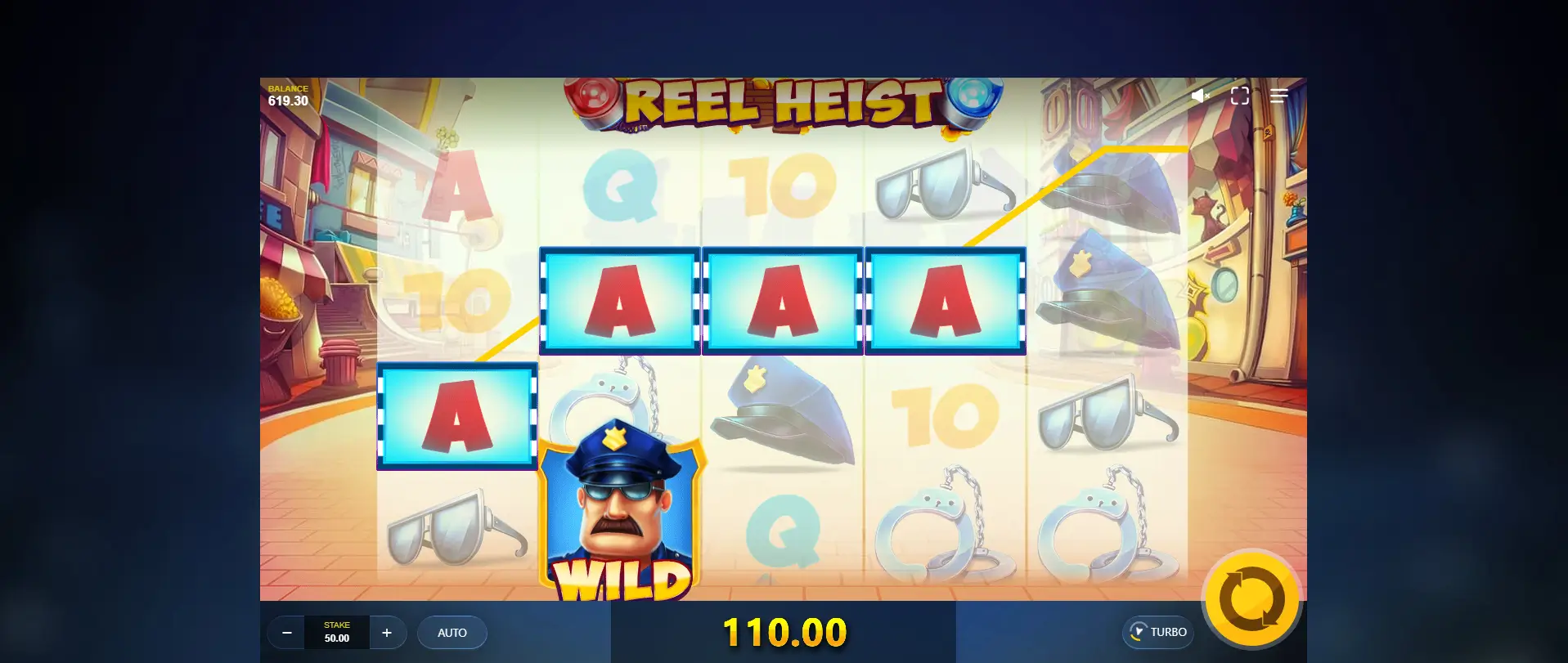
Paylines come in at 40, all fixed. You cannot adjust them, which keeps the math clean and means every spin covers the full grid. For a game built around a moving-wild mechanic, fixed paylines are the right call: you do not want to accidentally lower your line count and miss a capture payout.
Minimum stake is €0.20 per spin, which covers all 40 lines at the lowest denomination. Maximum bet tops out at €60 on most platforms, though figures as high as €500 have been cited on specific operators — check your lobby before you assume you know the ceiling. The €0.20 entry point is player-friendly for anyone who wants to watch the mechanics play out without significant financial exposure, and the structure means multiple payouts can stack from a single spin if the board lines up right.
Symbols and Paytable
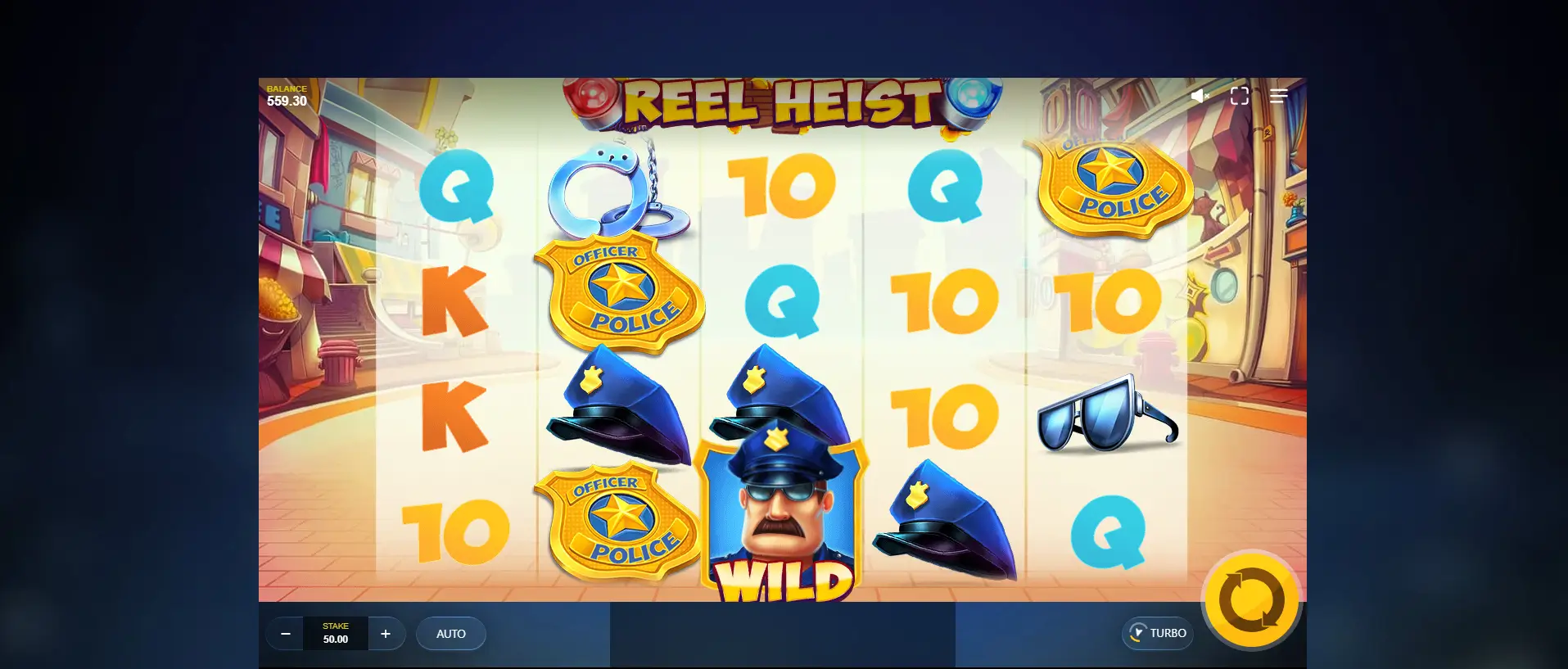
The symbol set is split cleanly into two tiers. Low-value symbols are the standard royal card suite — 10 through Ace — carrying the kind of modest payouts you expect from filler symbols. They are here to fill out the paytable and give you something to land on dead spins, not to excite anyone.
The high-value symbols are where the game earns its keep, and they are split into two distinct categories with very different functions.
Standard high-pays: Police-themed props — handcuffs, a badge, a police cap. These pay out normally when you land matching combinations across the paylines, left to right. Nothing unusual about how they behave; they exist to give the base game some consistent return while you wait for the real action.
The Robber symbols: Here is where Reel Heist diverges from anything resembling a standard paytable setup. The robbers are not just high-paying symbols. Each robber that appears on the reels arrives carrying a Wanted poster — a reward card showing the multiplier attached to that particular criminal. These multipliers range from as low as 7x your stake all the way up to 2,000x. The petty thief, who shows up most frequently, can pay up to 32x your bet. Higher-tier robbers carry bigger rewards but appear less often. Think of it as a tiered bounty system.
This is crucial to understand: the robbers’ multipliers cannot be won simply by landing them in a payline combination. They can only be collected through the chase mechanic. The number on the Wanted poster is not a standard paytable value — it is the prize you collect if the cop catches that specific robber. Which brings us to the mechanic that makes or breaks Reel Heist.
The Wild Cop: The cop symbol is the game’s wild. Like any wild, he substitutes for standard symbols to complete winning combinations. But the cop is not a static wild. He roams.
The Chase: How the Feature Actually Works
This is the one mechanic you need to understand before anything else, because everything interesting that happens in Reel Heist flows through it.
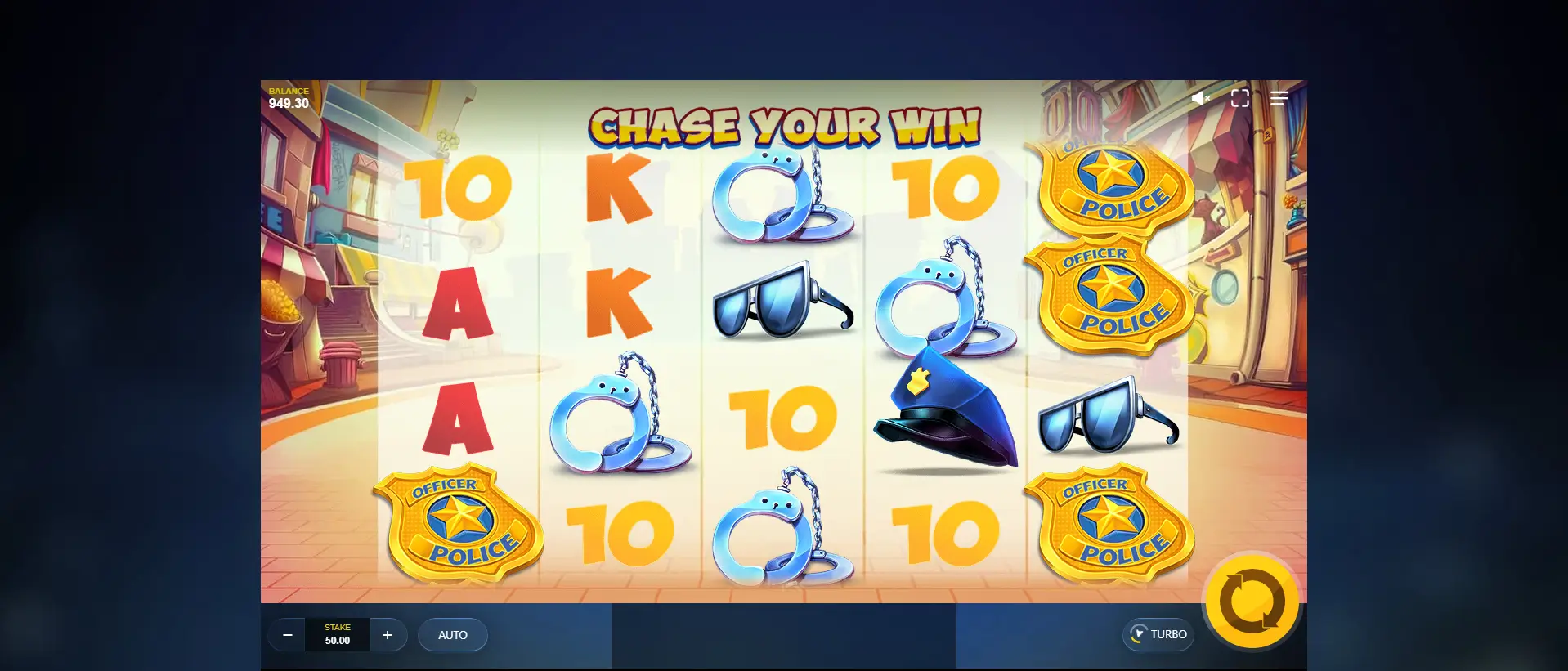
When a robber symbol lands on the reels, night falls. The cop wild enters the scene (or appears on the reels if he is already in play) and begins pursuing the robber. What follows is a dynamic, multi-spin sequence where both the cop and the robber move around the grid. Neither is pinned to a position. Both shift around the reel set, spin by spin.
The cop will not leave the board until he has caught at least one robber. The robber, on the other hand, can escape — he can drift off the reels without being caught, and when that happens, you collect nothing from that particular Wanted poster. The cop, however, stays until justice is served. He will keep hunting on subsequent spins, continuing to act as a wild while he circles the grid looking for a target.
Capture can happen in two ways. The straightforward method: the cop and the robber end up in the same position on the reels after a spin, and the arrest is made. The more dramatic alternative: the cop’s wild symbol gets close enough to throw his baton at the robber, stunning him — and a stunned robber is a guaranteed arrest. When that baton connects, the reward on the robber’s Wanted poster is paid out instantly.
If the cop catches a robber carrying a 2,000x reward, you walk away with the game’s maximum payout in a single arrest. That is not a jackpot in the traditional sense — there is no progressive pool, no separate jackpot game — just a clean, instant win tied to catching the right criminal at the right moment.
Multiple robbers can be active on the board at the same time. When that happens, you can land successive captures across a single chase sequence, stacking the rewards. The cop collects them one by one, which creates those sessions where the board lights up in quick succession and you find yourself staring at a string of multiplier payouts you were not expecting.
What makes this mechanic work is the visibility. You can see the cop. You can see the robber. You can see how many positions separate them. You know what reward is on the Wanted poster. Every spin during the chase has a tangible, traceable outcome — it is not a black-box RNG event producing a number. You are watching it unfold in real time, and that engagement is qualitatively different from spinning three scatters and waiting to see how many free spins you get.
One important caveat: you are paying for every spin during the chase. The cop-wild helps you form winning combinations on the standard paylines, so the spins are not dead, but you are still burning through your bet on each one. If the robber escapes before the cop catches him, those are spins you paid for without collecting the headline prize. This is the mechanical tension that generates the volatility feel.
There is a psychological dimension to this that is worth acknowledging honestly. When you can see the robber on the board with a 400x multiplier on his Wanted poster, and the cop is three positions away, the pull to keep spinning is significant. That proximity, that sense of being almost there — it is not manipulative in any cynical sense, but it is emotionally engaging in a way that a loading bar for free spins simply is not. Red Tiger built something that creates genuine suspense out of grid positions, and that is harder to do than it looks. The flip side is that when the robber drifts off the board uncaught, the deflation is real. You watched the prize evaporate. That is a different feeling from a free-spins round that simply ends with a modest total — it has a narrative quality, a sense of something almost happening, that the standard bonus model never produces.
RTP: A Messier Picture Than Most Reviews Admit
Almost every Reel Heist review you will read quotes a single RTP figure and calls it done. Most cite 96.06%. Some list 95.15%. Fewer mention that both figures can be correct depending on which version your casino is running.
Red Tiger, like many major studios after the NetEnt acquisition era, distributes slots with multiple RTP configurations. Operators choose the profile that suits their commercial setup. Some lobbies run the 96.06% version. Others run at 95.15%, or somewhere in between. The difference between these profiles over a long session is not trivial. Playing at 95.15% versus 96.06% might not feel different spin to spin, but across thousands of spins it represents a meaningful gap in expected return.
The practical advice is simple: open the game’s info panel before you start a real-money session and check the stated RTP. Most regulated markets require casinos to display the configured RTP. If your casino of choice is showing the lower figure and you have options, shop around. The game itself is the same. The math underneath it is not.
Neither figure is catastrophically below market standard — the broader industry average hovers around 96%, so even the 95.15% version is within acceptable territory — but knowing which version you are playing is part of informed gambling. Anyone who reviews slots without flagging this distinction is leaving you half the picture.
Volatility in Practice
The official classification is medium-high, and that tracks with what you experience at the reels. The base game, absent a chase, is not a high-return environment. The low-to-mid symbols pay small amounts with reasonable frequency — enough to keep your bankroll afloat during quiet spells, but not enough to move the needle meaningfully. Red Tiger themselves have been transparent about the game’s hit rate being “frequent,” which is a descriptor that needs unpacking: you will hit small combinations often. The big money lives in the chase.
When a high-value robber appears on the board carrying a three- or four-figure multiplier, and the cop is positioned to chase him down, your expected value for that sequence of spins spikes sharply. That is the volatility engine. Long stretches of modest line hits, punctuated by chase sequences that can pay anywhere from a modest 7x to the game’s 2,000x ceiling. The distance between those two outcomes is what makes Reel Heist feel swingy rather than smooth.
For session management, this means your bankroll will move in lumps rather than increments. You might spin through fifty base-game rounds getting nothing memorable, then a robber lands with a 400x poster and the cop makes the collar in three spins. Whether that 400x covers your accumulated losses depends on bet sizing and luck, and there is no system that changes the underlying probability. But understanding the volatility shape helps you pace yourself: this is not a grind-it-out slot. It is a game where you are playing for the moments.
Bankroll Considerations and Session Management
Given the volatility shape described above, bankroll sizing matters more for Reel Heist than it does for a low-variance daily-grind slot. If you sit down with twenty spins worth of bankroll at maximum bet, you are taking a coin-flip at best — there is a very real chance those twenty spins produce nothing beyond modest line hits, and you walk away before the chase ever delivers. That is not a reflection of the game being bad; it is a reflection of medium-high volatility doing exactly what medium-high volatility is supposed to do.
A more practical approach: size your bets so that you can comfortably absorb sixty to one hundred spins of base-game action before expecting the chase to pay for itself. At the €0.20 minimum, that means entering a session with €12–20 as your comfort floor. At higher bet sizes, the math scales proportionally. The 2,000x max win at €1 per spin returns €2,000, which is a significant session result. The same win at €0.20 per spin returns €400. Both are meaningful; neither changes the underlying probability.
One specific pattern to be aware of: the robber appearing with a low-value Wanted poster (7x to 20x range) during a session where you have been building losses is not the catch you were hoping for. The cop will still chase, the arrest will still happen, and you will collect the multiplier — but a 7x payout on a €0.20 bet is €1.40. That is base-game filler territory, not a chase result. The tiered nature of the Wanted posters means the game can deliver the chase mechanic and still leave you neutral or down. That is variance, and it is worth understanding before you play.
Autoplay is available, which helps players who want to set a session budget and step back from the spin-by-spin decisions. For a game where the best moments involve visible drama on the board, autoplay removes some of the experience — but for disciplined bankroll management, it is a useful option.
Reel Heist was built in HTML5, which means it runs natively on iOS and Android without any download, plugin, or compatibility workaround. The 5×4 grid scales cleanly to smaller screens, the symbols remain readable at mobile dimensions, and the chase animations translate well to touch interaction.
Red Tiger’s design sense throughout this title — the clean lines, the high-contrast symbols, the straightforward UI layout — pays dividends on mobile specifically. The cop and robber positions on the grid need to be readable at a glance, because the whole point of the mechanic is that you are watching and tracking them. On a portrait-orientation phone screen, the board stays legible and the Wanted poster multipliers remain visible. That is not a given for grid-heavy slots with lots of simultaneous visual information.
There is no meaningful difference between the desktop and mobile gameplay experience here. The feature triggers the same way, the chase plays out identically, and the sound design — which is worth a mention, the sirens and up-tempo score hold up — translates through phone speakers without turning into noise.
What Reel Heist Does Not Have (And Why It Matters)
Let us be explicit, because half the player dissatisfaction with this title comes from people who loaded it up expecting a different game.
No free spins round. The absence of a traditional free-spins feature is the most common point of friction in player reviews. If free spins are how you define “bonus mode” — the whole genre of sitting back while the game plays through a predetermined number of spins with enhanced conditions — Reel Heist does not have that. The chase mechanic is the bonus equivalent, but it is embedded in the base game rather than separated into its own mode.
No scatter symbol. No scatter-trigger, no bonus buy, no three-of-a-kind activation event. The chase begins when a robber symbol appears on the grid, which can happen on any spin. There is no specific condition to build toward.
No progressive jackpot. The 2,000x max win is a fixed ceiling, tied to catching the highest-tier robber. No jackpot pool, no networked prize, no separate jackpot game.
For some players — and this is a legitimate preference, not a criticism — these absences make Reel Heist feel thin. Free spins give you a defined, contained experience where you know you are getting X number of spins with Y enhanced conditions. The anticipation of landing three scatters is its own form of engagement. Reel Heist offers no equivalent moment of “I’ve triggered it” satisfaction. The chase can happen on spin one or spin two hundred. It is entirely random.
For other players, this is exactly the appeal. No waiting around for scatter combinations. No ninety-second dead-spin stretches. No mechanics you need a tutorial to understand. Just spin, watch the board, see if anyone appears, and if they do — watch the cop go to work.
Honest Assessment: Who Should Play This
Play Reel Heist if:
You prefer games where you can see the action building in real time rather than abstract RNG events. The chase mechanic gives you visible information — positions, reward values, proximity — that most slots keep hidden behind a curtain. If you want to feel like you are watching something happen rather than just waiting for a result, this is your game.
You are comfortable with medium-high variance and understand what that means for session management. The big wins are real — 2,000x is not a unicorn number attached to a mechanic that never practically delivers. At the same time, you need adequate bankroll depth to ride out the stretches between meaningful chases.
You want something quick to learn. Five minutes with Reel Heist and you understand everything the game has to offer. That accessibility, combined with the 5×4 layout, makes it a good fit for mobile sessions where you want to get into the action without reading three pages of rules.
Look elsewhere if:
Free spins are non-negotiable for your enjoyment. It is not that Reel Heist is poorly designed — it is that it was designed around a different model of entertainment. If a dedicated free-spins round is core to how you enjoy slots, this game will feel incomplete regardless of how good the chase mechanic is.
You need consistent base-game return to feel comfortable at the reels. The base game, when nothing is happening, is workmanlike at best. The low symbols pay small amounts, the high symbols need payline combinations that require the wild’s help, and the real money is locked behind the chase. If you want a slot that gives you something to celebrate every few spins, this is not that game.
Red Tiger’s Context: A Studio That Did Not Follow the Formula
Red Tiger Gaming launched in 2014 and spent its early years building a reputation for tight mathematics, clean HTML5 builds, and game concepts that prioritized mechanical originality over feature bloat. Reel Heist is a product of that era — a game where the studio clearly decided one strong idea, executed properly, was worth more than a checklist of standard bonus features.
NetEnt’s acquisition of Red Tiger in 2020 for reportedly around C$200 million placed the studio within a larger ecosystem, but Red Tiger’s catalog has maintained its technical standards. Reel Heist predates the acquisition and represents Red Tiger’s pre-merger design philosophy at its most concentrated. You can see in the game’s structure the kind of confidence a studio needs to release a slot without free spins in an era when free spins were essentially mandatory.
The transparency around volatility and hit rate — Red Tiger has historically been more forthcoming about these figures than many competitors — is visible in Reel Heist’s design. Medium-high volatility with a frequent hit rate is not a contradiction. It means you hit often, but most of what you hit is small. The outsized rewards require the chase. That is a fair deal if you know what you are signing up for.
Final Verdict
Reel Heist does not look impressive on a spec sheet. No free spins, no scatter, no jackpot, a max win of 2,000x that some studios would not bother releasing without wrapping it in at least three bonus levels. On paper, it is a slim offering.
In practice, it is one of the more distinctive slots Red Tiger ever put out — and given their catalog, that is not a small statement. The chase mechanic is the kind of idea that sounds simple but is genuinely hard to execute: a feature that is embedded in every spin rather than gated behind a specific trigger, that gives you visible information and real-time tension, and that can resolve in a single arrest or stretch across a dozen spins depending on how the board plays out.
The cop catching a robber with a Wanted poster worth 2,000x your stake is not a slow-building jackpot event. It is fast, it is visual, and when it lands it lands cleanly. That clarity is a design virtue. A lot of modern slots bury their best moments under layers of mechanics that require explanation. Reel Heist puts its best moment on the board and lets you watch it happen.
Check the RTP in your lobby before you play. Accept that there is no free-spins mode. Size your bets to match a medium-high volatility game rather than a daily grind slot. And then watch the street go dark, find out what that robber is carrying, and see if your cop is fast enough to close the gap.
He usually is. Eventually.