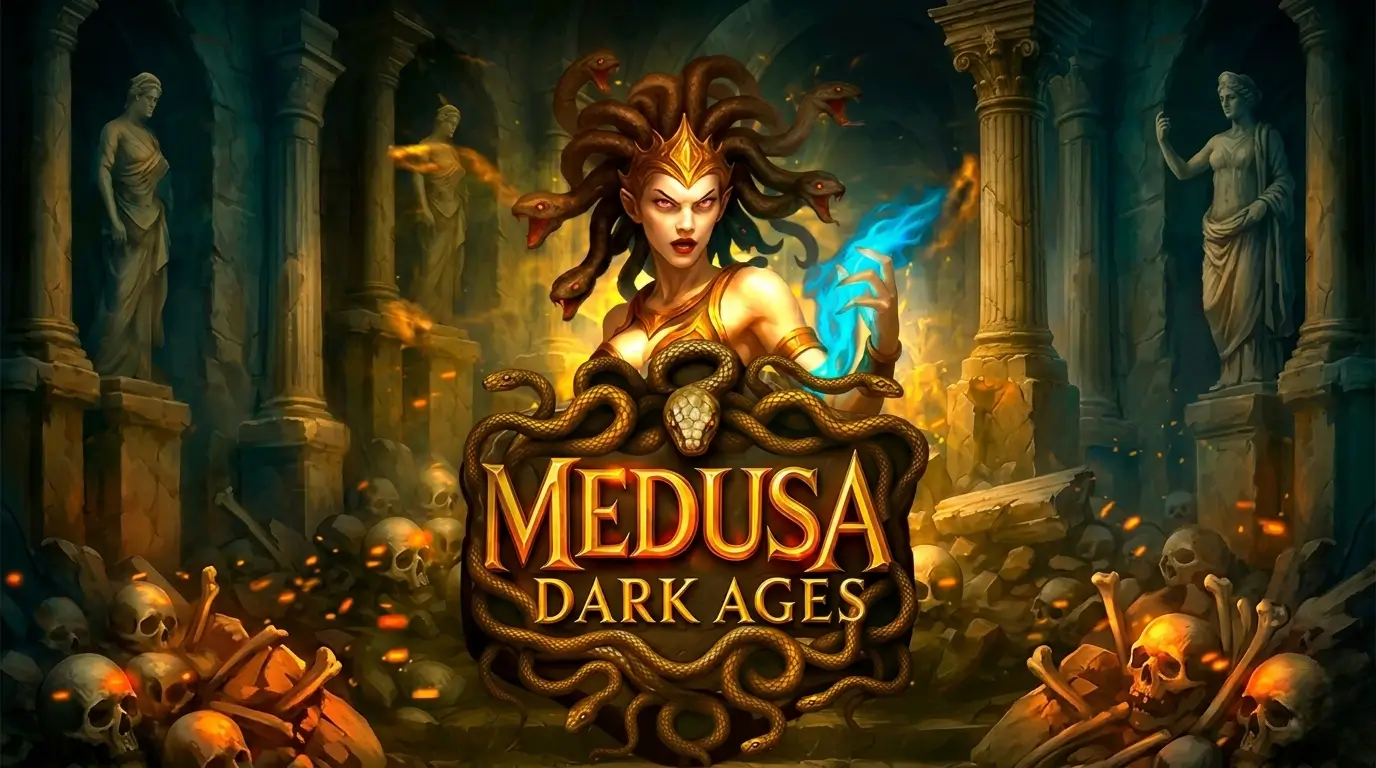
Forget the golden temples, the sun-drenched olive groves, and the toga-clad NPCs milling about in the background. Medusa has had enough of that soft-focus mythology aesthetic, and Skywind Group apparently agrees. Released on March 2, 2026, Medusa Dark Ages drops you into a version of ancient Greece that looks less like a holiday brochure and more like the aftermath of a particularly bad week — stormy skies, crumbling ruins, shadowy battlegrounds, and a general sense that nobody here is doing okay. It’s bleak. It’s gloomy. It is, weirdly, a breath of fresh air in a theme that has been running the same visual playbook since roughly 2012.
The Medusa-themed slot market is not exactly undersupplied. You’ve got Medusa Megaways from NextGen, Eye of Medusa from Hacksaw, Amazing Link Medusa, Medusa Madness, Medusa’s Stone — the Gorgon has had more slot appearances than most A-list actors, and frankly, her agent is probably doing better than yours. So when a new one drops, the only real question is: does it bring anything to the table, or is it just another reskin with new stone column art assets and a slightly different shade of green for the snake hair? In Skywind’s case, the answer is more nuanced than a simple yes or no. There’s real mechanical substance here. The visuals carry some years on them. The Super Free Games can genuinely get loud. And the base game has more going on than you’d expect from a cluster slot where the pitch is basically “eight symbols match, profit.”
Skywind Group has been in the game since 2012 and has built a library of over 300 titles. They’re not a newcomer trying to make noise — they’re a mid-tier provider with a respectable portfolio and a consistent house style. That house style, as fans of their work will already know, leans toward solid mechanics and functional design over the kind of cinematic production that the Relax Gamings and Hacksaws of the world are currently delivering. That context matters for calibrating expectations when you sit down with Medusa Dark Ages.
Let’s get into it properly.
The Setup: A 5×5 Grid That Doesn’t Mess Around
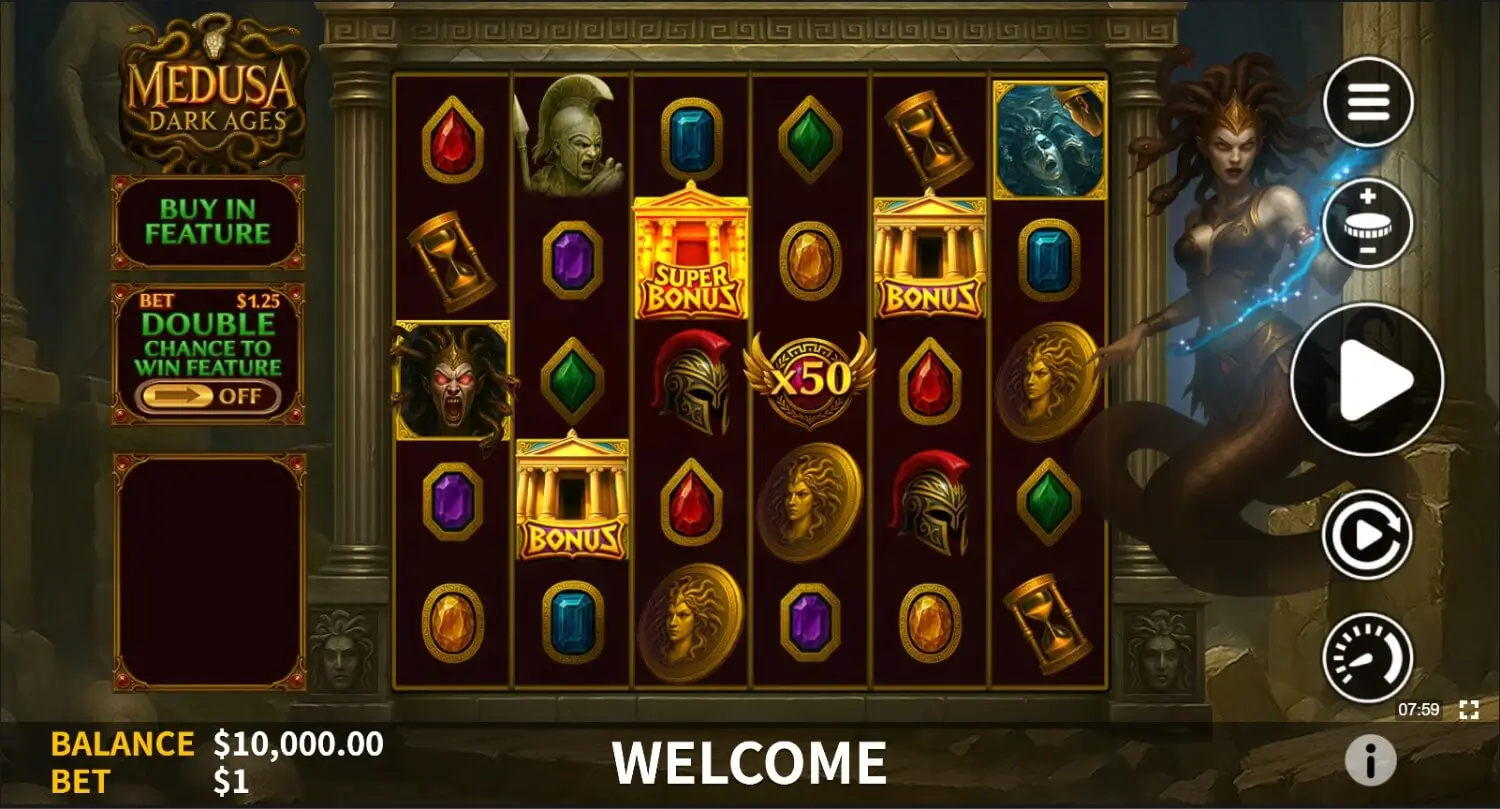
Medusa Dark Ages runs on a 5×5 grid using a Scatter Pays mechanic — no traditional paylines, no left-to-right winning conditions, no counting symbols from the first reel and praying. Instead, you need eight or more matching symbols to land anywhere on the grid to form a winning combination. If you’ve played any cluster-based slot before, this part is familiar territory: symbols match, they disappear, new ones fall from above, and the cascade chain continues until no new wins form. That’s the basic loop, and it’s one that cluster slots live and die by — because when cascades chain well, they chain very well, and when they don’t, a single spin can look like three consecutive nothing-burgers stacked on top of each other.
The eight-symbol threshold for a win is on the standard end for this format. It means smaller clusters don’t pay — you need genuine density on the grid to score, which pushes the game’s natural rhythm toward being cascade-dependent. The flip side is that a good spin where matching symbols are scattered all over the grid can produce a cluster significantly larger than eight, and those large clusters are where the real coin is.
Bets run from €0.20 to €200 per spin, which covers a wide enough range that both the casual player doing €0.50 spins on a Tuesday night and the absolute high-roller doing €100 shots will both find a comfortable position. The top RTP configuration sits at 96.50%, which is a touch above the market average of around 96% — though as we’ll discuss later, the RTP situation here is more complicated than that single headline figure suggests.
Volatility lands at Medium/High. Reviewers who tested this consistently describe it as sitting in a zone where you can expect some base game action without getting completely stonewalled for 200 spins straight — but you’re still going to need patience, and the sessions where it all comes together tend to happen in the bonus. Max win potential is 15,000x your stake. That’s a respectable number for a cluster format. It’s not going to shake the industry, but it beats half the Medusa-themed competition outright.
The Visual Vibe: Bleak, and Correctly So
Let’s talk aesthetics before we go any deeper into mechanics, because the look of this game is actually its strongest personality statement.
Skywind made a deliberate call to strip out everything cozy about ancient Greece. The usual Medusa slot formula goes something like: golden marble columns, blue skies, glowing amber light, maybe some laurel wreaths and sandals in the paytable. It’s Greece as a tourism poster. Medusa Dark Ages goes the opposite direction. The reels are framed by crumbling stone columns. The sky is perpetually stormy. The battlegrounds in the background look like somewhere you’d genuinely not want to be. The mood is closer to a cursed ruin than a temple, and honestly, that’s the right call for a character who turns people to stone for making eye contact.
On the reels themselves, you get Medusa, knights, creatures, and runes — all animated in a dark style. The symbols visibly react during wins, cascades, and feature activations. It’s not static art. Sound effects are atmospheric and contextual without taking over the experience.
Here’s where honesty is required, though: the visuals carry what multiple reviewers consistently describe as a “Skywind issue.” The overall production feels slightly dated compared to what Hacksaw or Relax are putting out in 2026. It’s not ugly — the dark aesthetic is executed well and the theming is coherent — but if you’re coming from playing something like Eye of Medusa, the graphical gap is noticeable. This isn’t a dealbreaker, and it doesn’t affect gameplay, but it’s worth knowing going in.
The Three Medusas: Where the Game Actually Lives
Here’s where Medusa Dark Ages separates itself from the cluster-slot pack, and it’s worth spending real time on this because most coverage breezes past it.
Three different Medusa symbols can appear randomly in the base game. During both bonus modes, at least one is guaranteed every single spin. When multiple Medusa symbols land together, they activate in a fixed sequence — Blast first, then Converter, then Multiplier. That sequencing matters more than it sounds, because each one reshapes the grid before the next one fires.
Medusa Blast
Blast selects between two and four types of standard symbols currently sitting on the reels and removes every instance of those types — then triggers a cascade to fill the empty spaces. Think of this as the board-clearing nuke. In a cluster game, the value of Blast is that it can turn a dead grid into an active one by eliminating low-value or interfering symbols and letting the cascade system do its thing. Even a spin that looked like it was going nowhere gets a second life.
Medusa Converter
Converter picks one to three types of standard symbols on the grid and replaces every instance of those types with a single randomly chosen different standard symbol. The key word here is “higher-value” — Converter is specifically designed to upgrade the symbol composition mid-spin. If your grid is clogged with low-pay symbols that aren’t hitting clusters, Converter can consolidate that chaos into something workable. It’s the mechanic that makes the base game feel less random than it actually is.
Medusa Multiplier
Multiplier chooses one type of standard symbol and turns every instance of that type into random multiplier symbols. Multiplier values run in four tiers from 2x up to 1,000x. At the end of a full cascading sequence, all visible multiplier symbols on the grid are added together, and the combined total is applied to the win from that cascade chain.
That last point is worth re-reading. They’re added, not multiplied together. So if you end a cascade chain with six multiplier symbols on the grid showing values of 5x, 10x, 20x, 50x, 100x, and 200x, your total multiplier for that sequence is 385x applied to the cascade win. That’s a very different math problem than having a single progressive multiplier climb one number at a time.
Why the Order Matters
When two or three Medusa symbols land together, the fixed activation order — Blast, then Converter, then Multiplier — means the grid gets cleared and reshaped before multiplier symbols are added. This isn’t just cosmetic. Blast clears interfering symbols and triggers a cascade. Converter upgrades what’s left. Then Multiplier converts a symbol type into the values that get applied to whatever that cascade sequence eventually produces. If all three fire in one spin, you’re looking at a significantly transformed grid before the final multiplier calculation runs.
This is the depth point that most reviews mention in passing but don’t fully spell out. It’s worth knowing because it explains why back-to-back Medusa activations during the bonus can produce the kind of swing that takes a mediocre bonus round and turns it into the session-defining spin.
Multiplier Symbols in the Base Game
Even without a Medusa Multiplier symbol landing, multiplier symbols can appear organically in the base game — and they follow the same additive logic. When a cascading sequence ends, every multiplier symbol visible on the grid contributes to the final total, and that total multiplies the accumulated win. This means a long base game cascade chain that generates several multiplier symbols along the way can pay out significantly above what the raw cluster math would suggest. It doesn’t happen constantly, but when it does, it’s the kind of thing that makes you immediately check the win counter twice.
Free Games: Standard Bonus, Still Worthwhile
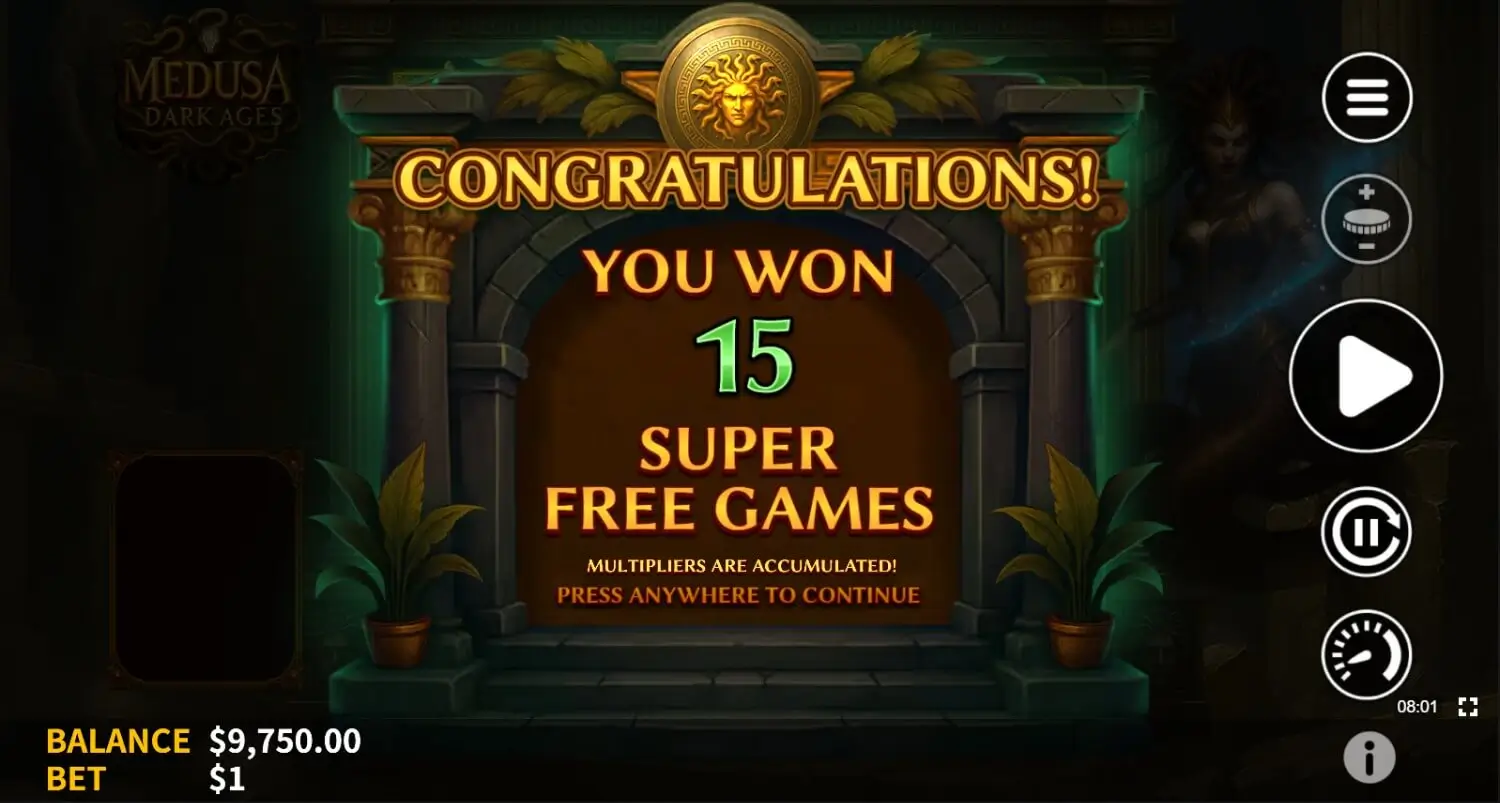
The bonus trigger works off Bonus scatter symbols. Land four Bonus symbols and you get 10 free games. Five gets you 15. Six gets you 25. During the feature, landing three or more Bonus symbols awards five additional games — so retriggering is possible.
The key mechanical addition in Free Games is that at least one Medusa symbol is guaranteed every spin. In the base game, Medusa appearances are random. In Free Games, they’re locked in. That means every single spin of the feature has a Blast, Converter, or Multiplier activating, which fundamentally changes the texture of the gameplay. Dead spins become much rarer. The grid gets continuously reshaped. Cascades chain more frequently.
What Free Games doesn’t have is the Total Multiplier Box. That’s the Super Free Games exclusive, and it’s the reason the gap between the two modes is significant.
Super Free Games: The Real Deal
Super Free Games triggers when three or more combined Bonus and Super Bonus symbols land. The count is three symbols total to get 10, with higher symbol counts awarding 15 or 25 spins.
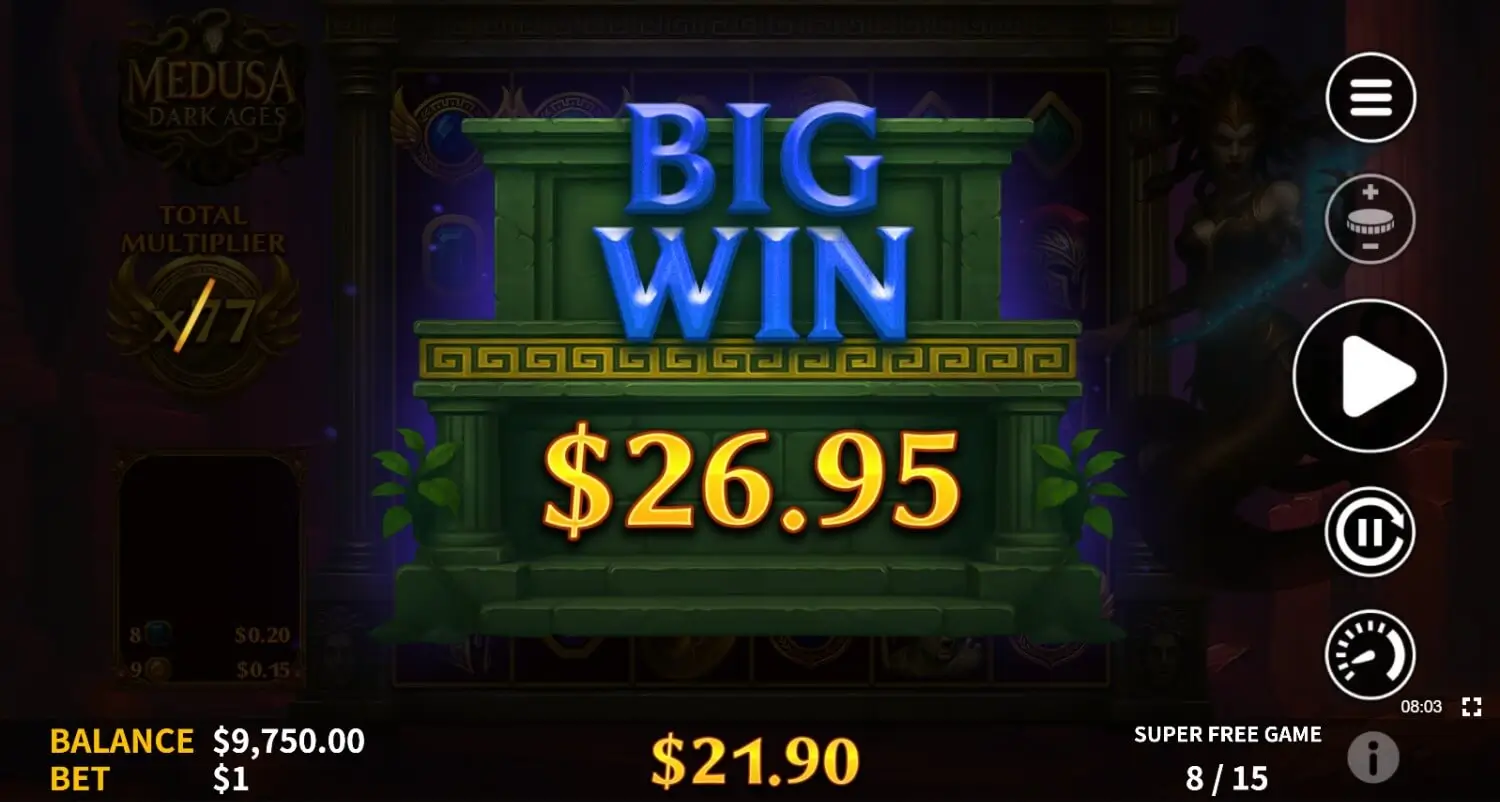
The mechanic difference that separates this from standard Free Games is the Total Multiplier Box. This is a persistent accumulator that runs for the entire duration of the Super Free Games session. Every multiplier symbol that appears across every cascade of every spin contributes its value to the box. Then, any future win that has at least one multiplier symbol visible on the grid gets multiplied by the current box total.
The practical implication: the box builds throughout the feature, and later spins get hit by a progressively larger multiplier. If you’re ten spins into a 25-spin Super Free Games and you’ve been running Medusa Multiplier activations fairly consistently, the box can be carrying a meaningful number — and a single good cascade in spin fourteen plays against that accumulated total. This is where the 15,000x becomes a realistic (if still unlikely) outcome rather than a theoretical one.
The multiplier range of 2x to 1,000x on individual symbols means the box can technically escalate quickly with the right run of Multiplier activations. The 1,000x tier is obviously rare, but the structure means Super Free Games can go from ordinary to session-defining without needing a single enormous symbol value — just sustained Medusa Multiplier activity across multiple spins.
The Buy Feature: Three Options, One Expensive One
Skywind gives you three ways to skip the base game and go straight to the action:
Free Games Buy costs 100x your base stake and guarantees you’ll land a Free Games trigger on the next spin. The number of free spins you actually receive (10, 15, or 25) depends on how many Bonus symbols land.
Super Free Games Buy costs 250x your base stake and guarantees a Super Free Games trigger. Same variable spin count logic applies.
Double Chance adds 25% to your base stake and doubles your probability of triggering a bonus round naturally. It cannot be used simultaneously with either Buy option.
One note on mechanics: on the spin where the buy feature triggers, Medusa symbols don’t appear. The triggering spin itself is clean. Your Medusa action starts from spin one of the actual bonus.
The 250x price tag on Super Free Games is at the steeper end of the market for this type of feature. Whether that’s worth it depends entirely on your session intent and bankroll. If you’re in for a 45-minute session with a specific budget and want to spend the majority of it inside the feature rather than grinding base game, the 100x Free Games buy is the more practical entry point. If you specifically want that Total Multiplier Box experience, the 250x is the only door in.
The RTP Situation (Don’t Skip This Part)
The 96.50% figure gets headlined everywhere, and it’s accurate — but only for the top configuration. Medusa Dark Ages ships with four operator-selectable RTP tiers: 96.50%, 96%, 94%, and 92%.
The casino you’re playing at gets to choose which version you’re running. This is normal industry practice and Skywind isn’t alone in doing it — most major providers offer configurable RTP. The issue is that the player typically has no way of knowing which configuration is active at any given casino unless the operator discloses it. Some do. Most don’t.
The practical upshot: if you’re making decisions about where to play this game, it’s worth checking whether your casino publishes their configured RTP for Skywind titles. The difference between 96.50% and 92% is not trivial over any meaningful number of spins. If you’re being sold “Medusa Dark Ages, 96.50% RTP” on a casino’s game page, that number may or may not reflect your actual playing conditions.
How It Sits in the Medusa Market
This is a genuinely crowded theme, so context helps.
Medusa Megaways (NextGen/Blueprint) is the standard most reviewers use as a benchmark. It carries a published RTP of 97.63%, runs an unlimited win multiplier during free spins, and has significantly broader casino availability than Skywind titles tend to have. If max RTP and distribution reach are your primary criteria, Megaways still wins.
Eye of Medusa (Hacksaw Gaming) is the closest modern competitor in terms of grid format. Also 5×5, also cluster-based, 96.20% RTP top config, 10,000x max win. Where Eye of Medusa has Medusa Wilds that petrify symbols and reveal multipliers underneath them, Dark Ages uses the three distinct Medusa symbols. Eye of Medusa’s visuals are crisper. Dark Ages’ max win potential is higher.
Amazing Link Medusa runs on a traditional 20-payline format, tops out at 5,000x, and plays like a completely different product. The overlap audience is limited.
Where Medusa Dark Ages genuinely holds its own: the three distinct Medusa mechanics give the base game more texture than most cluster slots manage. The Total Multiplier Box in Super Free Games creates a different kind of tension than a simple incrementing multiplier. The dark visual theme is a legitimate differentiator in a field where every other Medusa slot looks like it was rendered in the same golden temple asset pack. And 15,000x beats the direct cluster-format competition.
The distributon point is real though — Skywind doesn’t have the operator relationships that Blueprint or Hacksaw maintain, so this game isn’t going to be sitting at every major casino. That’s worth checking before you get attached to it.
Session Notes: What to Actually Expect
Medium/High volatility means this isn’t a slot you fire up and expect to be immediately fed. The base game has enough Medusa symbol activity and cascade potential to keep things from feeling completely dead, but the honest trajectory for most sessions is: grind the base game, try to catch natural bonus trigger, or buy your way in if you’d rather skip the queue.
The base game isn’t dead time, though. When the Medusa symbols show up mid-spin and fire in sequence, the board reshaping is visually satisfying and the potential chain reaction is real. A Blast followed by a Converter on the same spin can take a grid that looked done and turn it into something that cascades for another three or four drops. When a Multiplier is also involved, and those accumulated multiplier symbols are tallied at cascade’s end, a base game spin can put up numbers that feel well above the par for what cluster slots typically deliver outside of the feature.
That said, the variance is real. Medusa symbols don’t appear every spin, and the cascades don’t always chain the way you want them to. There will be stretches where the grid does the slot equivalent of shrugging its shoulders at you — symbols land, nothing clusters, everything resets. That’s the medium/high volatility experience, and going in with a clear bankroll plan for the base game grind makes the overall session feel less like warfare.
When Free Games hit, the guaranteed-Medusa-per-spin mechanic changes the entire texture of the feature. You’re not waiting to see whether a Medusa symbol lands this spin. One will. That certainty takes the “maybe this spin does something” anxiety of the base game and removes it entirely. Every free spin is moving — boards are being reshaped, cascades are being seeded, and the win potential per spin is consistently higher than anything the base game manages at the same bet.
When Super Free Games hit, the Total Multiplier Box changes the emotional arc of the feature into something with genuine build. Early spins contribute to the box. Mid-feature spins start playing against a meaningful accumulated total. Late-feature spins, if the box has been fed well, carry amplified weight on every cascade win. There’s a reason reviewers specifically single out the Super Free Games as the mode where this game shows its ceiling — that’s where the 15,000x lives.
For players who buy features: 100x for Free Games is a fair entry price for the volatility level and what you get in return. The guaranteed Medusa action across every spin of the feature makes it a decent value relative to comparable buys in the wider cluster slot market. 250x for Super Free Games is the high-variance bet — you’re spending more, and the total multiplier accumulation can produce significantly larger outcomes, but it can also produce a 25-spin run that doesn’t quite hit the numbers you were hoping for. That’s the Super Free Games deal. When it works, it really works. When it doesn’t, you’ve spent 250x finding out.
What Works, What Doesn’t
Works well:
Three mechanically distinct Medusa symbols give the base game genuine depth that most cluster slots don’t have. In a format where the cascade is typically the only real event between spins, having three different board-altering effects that can fire in sequence — sometimes all three on the same spin — creates a game that feels genuinely active rather than passive. The additive multiplier structure is also underrated: it rewards long cascade chains in a way that compounds naturally rather than requiring a separate multiplier mechanic to kick in.
The dark aesthetic is committed and consistent. Skywind made a definitive creative call with this game — no golden temples, no aspirational Greek holiday vibes, just crumbling stone and gloomy skies — and they stuck with it throughout the entire presentation. That consistency gives the game a personality that most Medusa slots, which tend to blend into each other visually, simply don’t have.
The max win of 15,000x is solid for the genre, and the Super Free Games with the accumulating Total Multiplier Box give it a credible structural path to that number rather than just listing a theoretical ceiling that requires a seven-sigma event to approach.
Doesn’t work as well:
The visuals are a step behind what the top-tier providers are currently producing. This is a consistent note across Skywind releases in general — their design language tends to run a cycle or two behind the visual front-runners — and while it doesn’t affect how the game plays, it does affect the overall experience, particularly for players who’ve been spending time with titles from Hacksaw or Relax Gaming. The gap is real, and for a 2026 release, it’s noticeable.
The 250x Super Free Games buy is at the expensive end of what the cluster slot market typically charges for a comparable feature. Not the most expensive buy-in you’ll find, but steep enough to warrant thinking through your bankroll math before clicking it.
Skywind’s distribution is more limited than Blueprint, Hacksaw, or Pragmatic. That means if you’re reading this review and getting interested, there’s a real chance your regular casino doesn’t carry it. Worth checking before building expectations around a game that might not be available where you play.
The four-tier RTP configuration — 96.50% down to 92% — is standard practice in the industry, but the size of that gap is meaningful. A 4.5-percentage-point range between best and worst configuration is significant over any real session volume. It’s not Skywind’s fault that operators configure it this way, but it’s the player’s problem to navigate.
The Bottom Line
Medusa Dark Ages is a better slot than its visual presentation initially suggests, and the presentation is the thing most players will form a first impression from before they’ve seen a single cascade. Give it a few spins, and the mechanical layer reveals itself — the three Medusa symbols don’t just sound interesting on paper, they actually change how the game behaves in practice. The sequencing logic when multiple Medusa symbols fire together produces genuine moments of “wait, this spin might actually be something” that a standard cluster slot rarely delivers from the base game alone.
The Super Free Games Total Multiplier Box is the best version of the “accumulating bonus round” format that Skywind has delivered in recent memory. It’s not a complicated mechanic — box accumulates multiplier values, those values multiply your wins — but the structural effect it has on the feature is significant. It turns 25 spins of enhanced activity into 25 spins with a building arc, where the later spins carry the weight of everything that came before them. That’s a meaningful design decision, and it pays off in how the feature actually plays.
The dark aesthetic is exactly what a character whose power is literally turning things to stone should have. Most Medusa slots make her look like an interior design influencer who happens to have snakes for hair. Dark Ages makes her feel like a genuine hazard in a world where things have gone badly wrong. That’s the right tone for the source material, and the commitment to it throughout the game’s visuals and sound design is something worth acknowledging.
The criticisms are real: the visuals lag behind 2026 standards, the distribution is limited, the 250x buy is steep, and the RTP configuration situation requires active due diligence if you care about playing the best version of this game. None of those are invented problems, and they’re worth factoring in before you load it up at a random casino.
But if you’re on a platform that carries Skywind titles and you have any tolerance for a cluster slot with medium/high volatility, this one is worth the session. Play the demo if you can first — the base game’s three-Medusa mechanic is the kind of thing that’s much clearer in motion than it is described in text, and understanding how it works before you’re watching your actual bankroll move around makes the experience considerably better.
Medusa Dark Ages won’t knock Medusa Megaways off its perch as the category default. The distribution gap alone prevents that. But as a cluster slot with a distinct mechanical identity, a committed aesthetic, and a bonus round that actually builds toward something — it earns its place in a crowded mythology catalogue and then some.