
Hacksaw Gaming dropped Limbo in August 2024, quietly, without the fanfare you’d expect for a game that challenges the crash category’s established giants. Eighteen months later, it’s carved out a serious audience — not by offering more features than Aviator or more spectacle than JetX, but by doing the opposite. Limbo is one of the most mathematically honest games in the instant-win genre right now. The RTP ceiling hits 98% (though operators can, and often do, configure it lower — down to 88%). The max win sits at 10,000× your stake. The whole thing runs on a single mechanic.
What Limbo asks you to decide before going near real money is: are you playing for value, or for the illusion of control? Most crash games give you the latter. Limbo, at its best configuration, gives you the former.
Hacksaw Gaming is a Malta-based studio that listed on the Stockholm NASDAQ in 2025. They are known primarily for high-volatility slots — Wanted Dead or a Wild, Hand of Anubis — but Limbo belongs to a separate product line entirely. The Dare2Win series is Hacksaw’s answer to the instant-win and crash category: Mines launched in 2022, Plinko in 2023, Dice in September 2024, Limbo a few weeks before that. Each game in the series uses the same configurable RTP architecture and adjusted-volatility design. Limbo is the most stripped-back entry in the catalogue, which is a deliberate choice, not a limitation.
The math model — what you are actually agreeing to
Let’s start with the RTP, because this is the number that matters most and the one that creates the most confusion.
Every source confirms the same two bookends: 98% maximum RTP and 88% minimum. That gap is not small. Over a 1,000-spin session at £1 per round, a player at 98% would expect to lose roughly £20 in theory. At 88%, that figure becomes £120. That is six times the theoretical cost for the same session length, at the same stake. Operators set the configuration — not you, and not Hacksaw. Before playing Limbo for real money, check the RTP displayed in the game’s info panel at your casino. Most reputable operators show it there. If you cannot find it, that is itself an answer.
The volatility in Limbo is not a fixed classification. It is player-determined, which is genuinely unusual. Choose a target multiplier of 2× and you are playing a game that pays out roughly 49% of the time — close to a coin flip, with a small house edge built in. Push the target to 3× and your hit probability drops to about 32.67%. Go for 10,000× and the odds of landing it in a single round are 0.009% — roughly one in eleven thousand. That is not a high-frequency grind. That is a lottery ticket with a crash wrapper.
The bet range runs from £0.10 to £100 per round. That is a narrower ceiling than Aviator (which allows higher stakes at some operators) but workable for almost any player profile. The 10,000× max win means a single £100 bet could theoretically return £1,000,000. In practice, the probability is so low that treating it as a realistic target rather than a mathematical ceiling would be a mistake.
Here is the honest assessment of how the math model places Limbo against the category in 2026: the 98% RTP, when actually deployed by operators at that level, is among the best in crash gaming. Aviator runs at a fixed 97% across all operators. JetX sits in the 96.7%–98.8% range depending on operator. Hacksaw’s Dice Dare2Win, released in the same Dare2Win series just a month after Limbo, also advertises 98% max RTP. The theoretical advantage Limbo holds is real — but only if your operator is running the game at the top of its range. That’s the clause every review of this game needs to say louder.
The grid is as minimal as possible: one reel, one row. There are no paylines, no symbols, no cascades, no bonus round to trigger. The entire game resolves in a single outcome per round. At £1 per round and roughly 60 rounds per hour in standard mode (significantly more in Turbo), session volume builds quickly. The faster you play, the more rounds feed through the RTP function. This matters for understanding expected loss across a session. At 98% RTP, 60 rounds at £1 each implies a theoretical loss of roughly £1.20. At 88%, that same session costs roughly £7.20 in theory. Across a three-hour session, the difference accumulates into a figure that would give most players pause.
Feature breakdown
Target Multiplier — the entire game
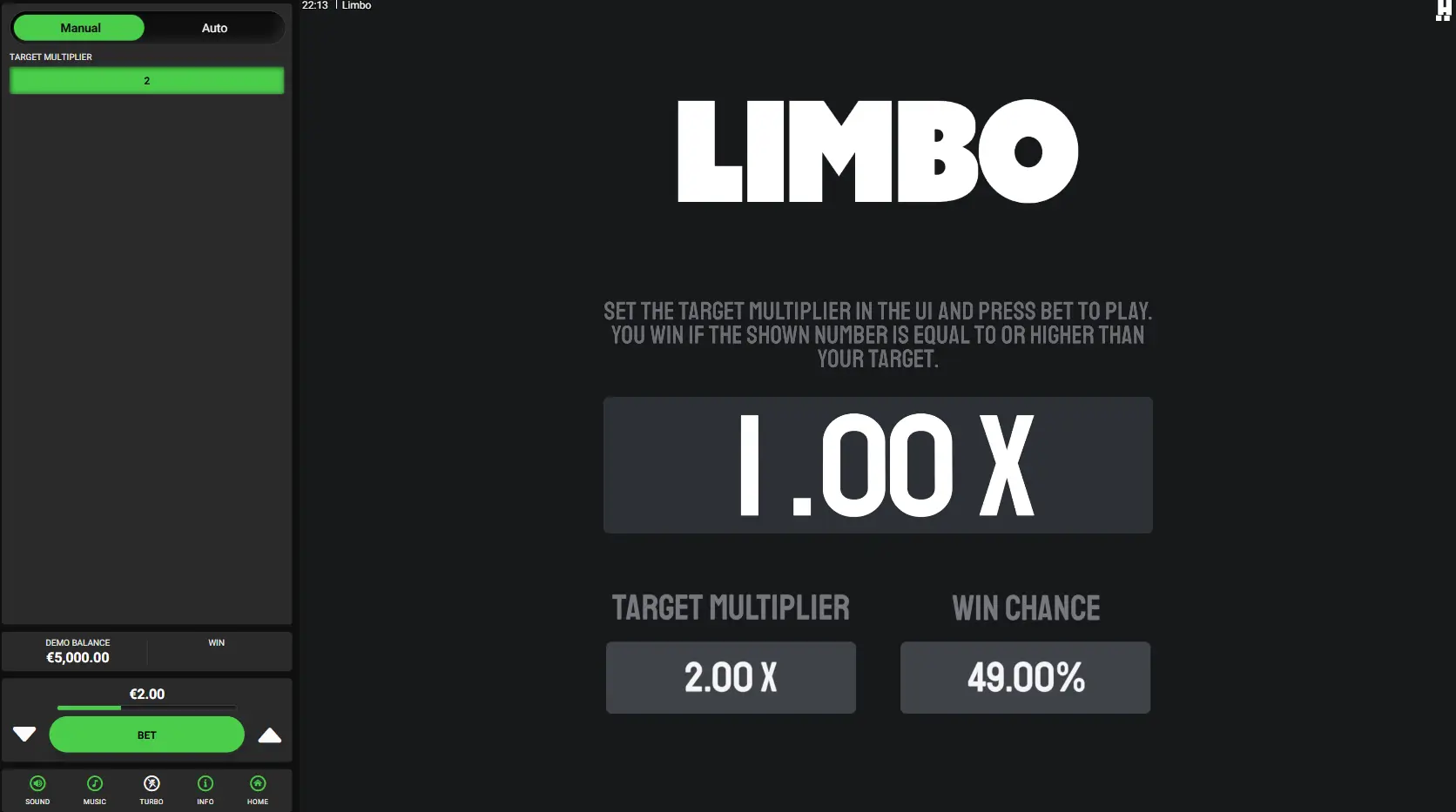
Trigger: Manual selection before each round. Players input any multiplier between 1.05× and 10,000×.
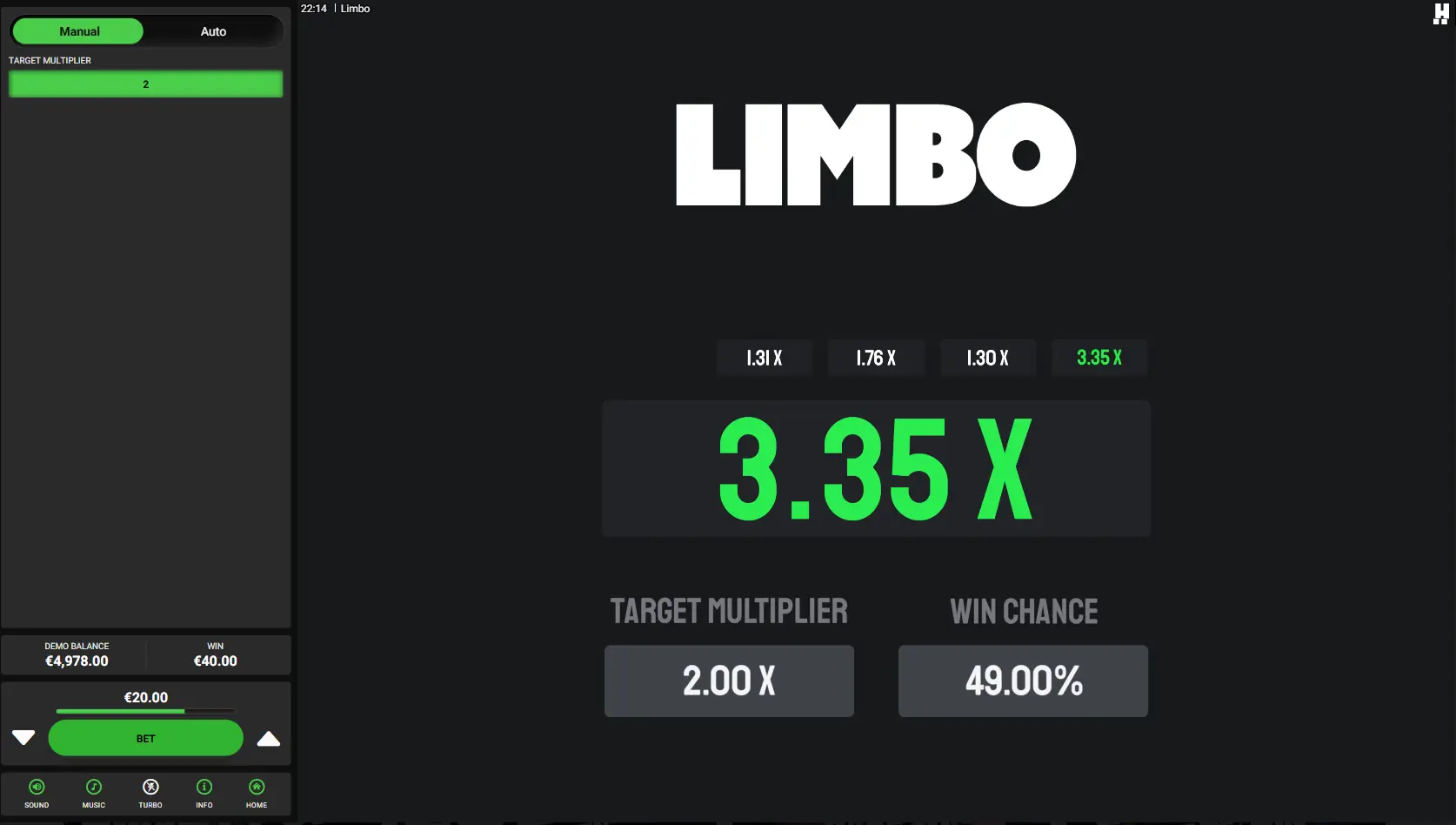
The mechanic is simple by design. A randomly generated number is produced each round. If it meets or exceeds your chosen target, you win your stake multiplied by that target. If it doesn’t, you lose your bet. No partial wins. No cash-out mid-round option. This is the key structural difference from most other crash games.
In Aviator or JetX, you watch the multiplier climb and decide when to exit. That creates an active experience — or the illusion of one. You feel like your timing matters, because you can see the number moving. Studies of crash game psychology suggest this interactive element is a meaningful part of engagement for most players. Limbo removes it entirely. You set your number beforehand and the outcome is instant. There is no “almost cashed out in time” narrative, because the round resolves in under a second. This design choice splits players sharply. Those who are drawn to crash games for the interactive cash-out tension will find Limbo cold. Those who are drawn to the genre for the math model and the transparent probability display will find it refreshingly direct.
The probability for any target is shown on-screen before you commit. Set your target to 5× and the game tells you the win probability is 19.8%. Set it to 100× and you see 0.99%. This transparency is one of Limbo’s genuine differentiators — you are never guessing what you are agreeing to. Compare this to traditional slot games, where the probability of triggering a free spins round or landing a specific symbol combination is typically buried in a game rules document most players never open. Limbo puts the relevant number directly in front of you before every bet.
One honest limitation: because you cannot cash out mid-round, you cannot protect a profit at a lower multiplier than your target. If you set 100× and the counter reaches 97× before crashing, you lose. In a traditional crash game, you could have cashed out at 97× and banked the win. Limbo does not give you that option. Whether that is a feature or a bug depends entirely on your approach to the genre. From a pure expected-value standpoint, the inability to cash out early is not mathematically harmful — the 98% RTP accounts for all outcomes. From a session management standpoint, watching the counter peak just below your target and resolve as a loss is a specific psychological experience that some players find frustrating. Worth knowing about yourself before committing to a session.
Autoplay
Trigger: Manual activation from the interface panel.
Autoplay in Limbo is genuinely well-implemented. Players can set a fixed number of rounds, a total loss limit for the session, and a single-win ceiling that pauses the automation when hit. The stop conditions are what separate a useful autoplay from a dangerous one. Having the option to halt at a single win of, say, 50× is a meaningful bankroll protection tool — it prevents the system from automatically committing more rounds once a large win has occurred.
The practical limitation is that Autoplay does not adjust your target multiplier between rounds. You set one multiplier before the session and it runs until a stop condition triggers. For players experimenting with varying targets across a session, Autoplay becomes less useful. For players with a fixed strategy at a single multiplier, it works well.
Turbo Mode
Trigger: Toggle activation before or during a session.
Turbo Mode speeds up round resolution. What is already a fast game becomes near-instant. The time between rounds in standard mode is roughly two to three seconds including animation. Turbo compresses this significantly. The practical consequence is that Turbo Mode dramatically increases the number of rounds per session per hour, which directly multiplies both potential gains and potential losses at any given bankroll. It is a convenience feature that also functions as a risk amplifier. Worth knowing before enabling it on a £10 session target.
Hot Keys
Trigger: Keyboard shortcuts for multiplier selection.
Allows players to quickly select preset target multipliers using keyboard shortcuts rather than manually adjusting the input. Minor quality-of-life feature, meaningful for desktop players who prefer not to mouse-click between rounds.
How players actually approach Limbo — strategies and the limits of each
Let me be precise about one thing before this section: there is no strategy in Limbo that changes the underlying math. The RTP is fixed by operator configuration. The hit probability for any given target is fixed by the algorithm. No betting system — Martingale, reverse Martingale, flat stakes — changes the expected return over a long enough session. What strategies can do is alter the shape of a session: the distribution of win size versus win frequency.
Low multiplier targeting (1.05× to 2×)
Targeting 1.05× wins roughly 95.2% of rounds. Targeting 2× wins roughly 49%. This is the closest Limbo gets to low-volatility play. With a 2× target at £1 per round, you win £1 on approximately half your rounds and lose £1 on the other half. Over 100 rounds at 98% RTP, you expect to retain approximately £98 of your £100 stake — but in practice you will see long losing runs. The hit rate of 49% does not mean the outcomes alternate neatly. A run of ten consecutive non-hits at 2× has a probability of approximately 0.1% per session — rare but real. Players using this approach should size stakes to absorb at least twenty consecutive losses without exhausting their session bankroll.
Mid-range targeting (3× to 20×)
This is where most players who approach Limbo analytically tend to land. A 3× target hits 32.67% of the time, paying 3× your stake when it does. A 10× target hits roughly 9.9% of rounds. The appeal of this range is that wins are meaningful enough to feel like wins, while the frequency is high enough to sustain a session. Extended testing across the 5×–10× range produces the experience Limbo is probably designed around: most rounds resolve quickly as losses, with periodic wins that reset the session balance.
High multiplier targeting (100× and above)
Targeting 100× hits approximately 0.99% of rounds — once per hundred on average, but with enormous variance. Sessions of 500 rounds without a hit are not statistically unusual. Targeting 1,000× drops the hit probability to 0.099%. At 10,000×, you are waiting for a 0.009% event. Bankrolls erode rapidly in the dry stretches. The only player profile for whom high multiplier targeting in Limbo makes sense is someone who has explicitly allocated a small stake — say, £20 to £50 — to chase a large outcome, understands they will likely lose the entire stake, and is comfortable with that. It is not a grinding strategy. It is a long-shot bet packaged in a crash game wrapper.
The Autoplay question
Using Autoplay with a stop-on-win limit is the most bankroll-disciplined approach available in Limbo. Setting Autoplay to halt after a defined single-win multiplier prevents the system from continuing to bet after a significant hit — a common leakage point for players using manual play, who tend to continue after a win and revert to the mean before ending the session. The combination of a session loss limit and a single-win ceiling makes Autoplay not just a convenience feature but a session management tool worth using deliberately.
Limbo in 2026 — how it sits in a crowded category
Hacksaw Gaming’s Dare2Win series now spans Mines, Plinko, Dice, and Limbo — each offering the same configurable RTP architecture and adjusted-volatility design. The question worth asking in 2026 is whether Limbo has aged well within that family, and how it sits against the category’s heavy-hitters.
Against Aviator (Spribe): Aviator has 77 million monthly active players, a provably fair algorithm, and a fixed 97% RTP. It is the dominant crash game by any commercial measure and has been since roughly 2020 — the category exists largely because Aviator proved the format worked at scale. Limbo has a higher RTP ceiling (98% vs 97%), a higher max win ceiling (10,000×), and a more transparent pre-round probability display. What Limbo doesn’t have is Aviator’s social layer — the shared multiplier experience, the chat, the live round history visible to all players at once, the bet list showing what everyone else at the table has placed. That social dimension is a real part of Aviator’s engagement model and a meaningful reason players return. Aviator’s fixed 97% RTP is also worth noting: unlike Limbo, you cannot get a worse deal at a different operator. The maths are identical everywhere. For players who care about the math and want to skip the theatre, Limbo at a well-configured casino wins this comparison on value. For players who enjoy the social crash format, Aviator wins on experience. For players uncertain about operator RTP configurations, Aviator wins on certainty.
Against JetX (SmartSoft Gaming): JetX launched in 2018 and carries an RTP in the 96.7%–98.8% range. It offers a jackpot feature — a random three-tier prize that Limbo does not have. It also uses the interactive cash-out mechanic Limbo deliberately omits. JetX’s progressive jackpot is the one area where it clearly beats Limbo on headline potential. Whether a random jackpot feature you cannot control in any meaningful way represents value depends on how you approach these games.
Against Dice Dare2Win (Hacksaw Gaming): Hacksaw’s own Dice, released September 2024, uses a slider-based range selection rather than a single target — you define a green range of numbers (on a 0–100 scale) that constitute a win, and adjust the range width to calibrate your risk. The 98% max RTP is the same as Limbo. Dice arguably offers a slightly more interactive pre-round decision (setting a range versus choosing a single number) and visually communicates probability in a more intuitive way for some players — you can literally see how much of the 0–100 bar you’re betting on. Both games occupy similar space in the Dare2Win portfolio. Limbo is the simpler entry point; Dice has marginally more visual clarity about what you’re actually doing. If you are new to the Dare2Win series, Dice is probably the better starting game. If you already understand the mechanic and prefer the minimal target-number interface, Limbo serves the same function with less visual noise.
Buy-bonus availability: Limbo has no buy-bonus mechanic. There is nothing to buy. There is no bonus feature to access. This is not a weakness specific to Limbo — it is a structural property of simple crash games. But it is worth stating explicitly for players who cross over from slots, where buy-bonus has become a standard expectation.
Progressive jackpot: Not present. Maximum theoretical win is 10,000× stake, achieved by targeting 10,000× with the associated 0.009% probability per round.
Where does this leave Limbo in 2026? It is not the most popular crash game — that remains Aviator, decisively. It is not the most feature-rich — JetX’s jackpot gives it an edge there. What Limbo is in 2026 is the crash game with the highest RTP ceiling in the Hacksaw portfolio, the most transparent probability display, and the lowest friction mechanic in the category. For a specific type of player, that is exactly what they want.
A note on how Limbo plays with problem gambling patterns
I am including this because Limbo’s specific design creates conditions worth acknowledging directly.
The game resolves in under a second per round. Turbo Mode compresses that further. At 60–100+ rounds per hour, the psychological pacing is more similar to electronic betting terminals than to traditional slots — and research consistently links high event frequency with elevated risk for players who are susceptible to gambling disorder. The absence of a bonus round or a feature to “stay for” removes one natural pause point that longer-form slot games provide.
The configurable Autoplay with session loss limits and single-win ceilings is genuinely useful here, and I’d recommend using it as a default rather than a convenience feature. Playing 200 rounds manually with a running internal tally of losses is harder than it sounds. Autoplay with a hard stop limit removes the decision point.
If gambling is causing financial stress, distress, or relationship problems, the following organisations provide free, confidential support:
- GamCare — gamcare.org.uk — UK-focused, 24/7 helpline
- BeGambleAware — begambleaware.org — operator responsibility resources
- Gambling Therapy — gamblingtherapy.org — international, available in multiple languages
The absence of built-in deposit limits, session time reminders, or self-exclusion tools within Limbo itself is a function of how instant-win games are structured — these tools live at the operator level, not the game level. Use them there if you need to.
Limbo is available in demo mode at most operators who carry it, and at several aggregator review sites including SlotCatalog. The demo is the correct way to validate whether the mechanic suits you before committing real money. Because Limbo resolves each round instantly and requires no skill to trigger features, the demo experience is essentially identical to the real-money experience — minus the financial stakes. There is no reason not to run fifty rounds in demo mode first, specifically to get a feel for the hit frequency at your intended target multiplier before funding a real session.
Verdict
Limbo — who it works for, who it doesn’t
This is not a game for players who want to feel like their in-round decisions matter. There is no cash-out moment to mistime, no multiplier to watch climb, no social narrative around a shared outcome. If those elements of crash gaming are what you’re chasing, Limbo will feel hollow. The absence of a traditional cash-out mechanic is not a design oversight — it is the point. Hacksaw built a game for players who want to set their number, receive their outcome, and move on. That is a small but real segment of the crash gaming audience.
For players approaching crash games as a pure math exercise — where the only variable they control is their pre-round target multiplier — Limbo is one of the better-positioned games in the category. The 98% RTP at its configured maximum is the single most important number. The 10,000× max win ceiling is genuinely competitive. The probability display gives you more information per round than most comparable games. The Autoplay with stop conditions is implemented thoughtfully.
The one number most limiting this game is not the max win or the RTP ceiling — it is the operator RTP floor of 88%. A 10-point RTP swing in a casino game is substantial. The same £500 bankroll played at 88% will deplete meaningfully faster than at 98%, everything else being equal. Verify the RTP before funding your session. If your casino is running Limbo at 88%–92%, there are better-value options in the same genre — Aviator at a fixed 97% is the obvious alternative.
Limbo also has no buy-bonus, no progressive jackpot, no social layer, and no variant (no Limbo Megaways, no Limbo Power Reels — this is a single-version game as of mid-2026). For some players that simplicity is the sell. For others it is a dealbreaker.
Play Limbo if: you understand the probability model, you want an instant-resolution crash game with a transparent hit rate display, and you are playing at an operator confirmed to be running the game at or near 98% RTP. Used this way, Limbo competes with the best-value crash games in any lobby.
Skip Limbo if: your operator’s RTP configuration is unknown or confirmed low, you value the interactive cash-out dynamic that defines most of the crash genre, or you want jackpot potential beyond the 10,000× max win ceiling. In those cases, JetX or Aviator match the intent better.
One final point: Limbo is the rare crash game where the math is not hidden or obscured. Every probability for every target is displayed before you bet. The RTP range is documented. The odds of hitting 10,000× are published. That transparency does not make it a winning game — no casino game is a winning game in the long run by design. But it makes it a game where you know exactly what you are agreeing to. In 2026, that is worth something.