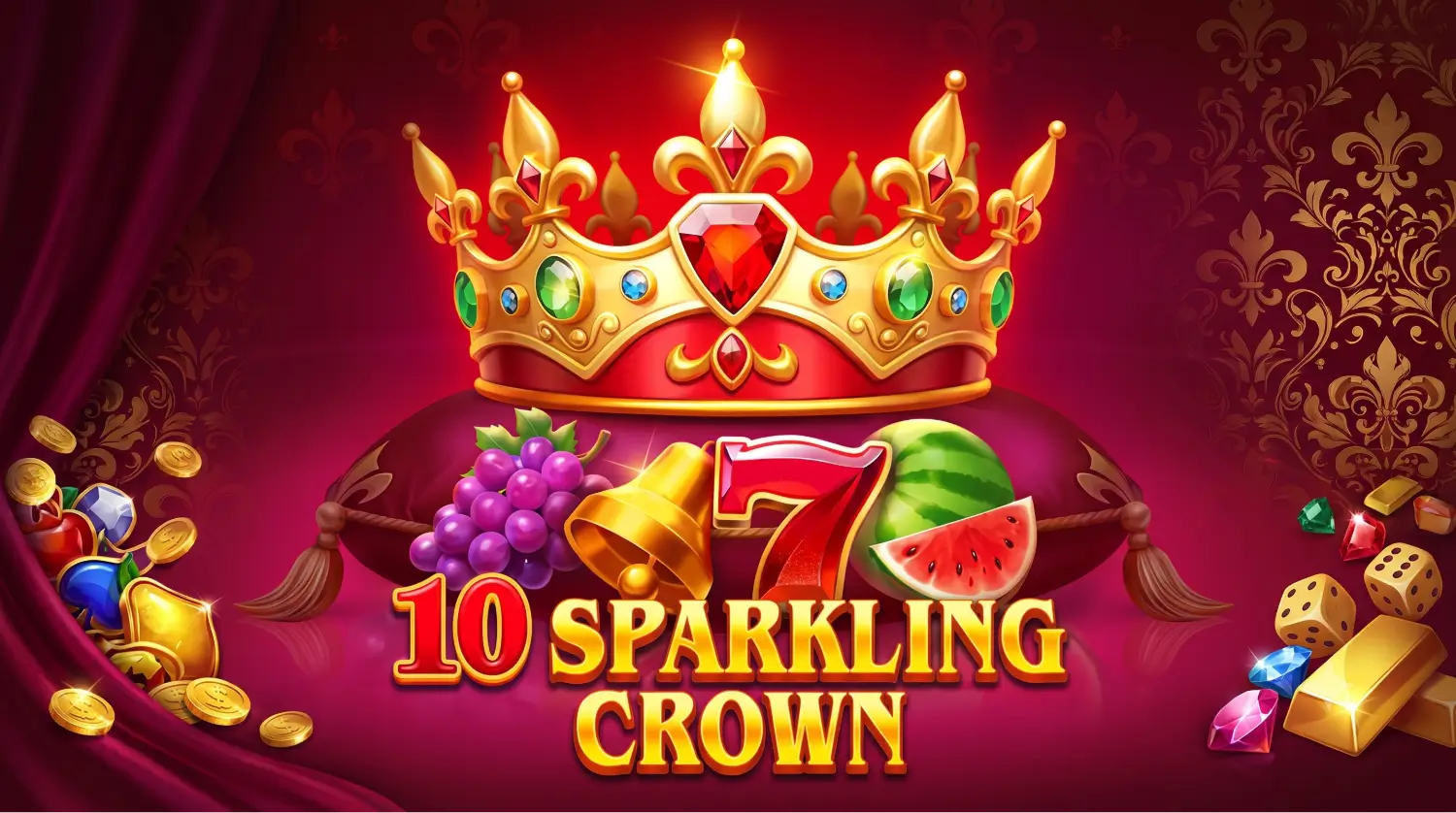
TaDa Gaming released 10 Sparkling Crown back in May 2025, and the studio already had a sequel on shelves by December that same year. That turnaround tells you something before you’ve even loaded the reels: this wasn’t built as a flagship, it was built as a template — a low-risk, low-cost classic that could be iterated on fast if it landed with players.
Whether it landed depends on who you ask. The math sits in a crowded space. Ten fixed paylines, a 10,000x ceiling, and expanding wilds are the same three ingredients half the “crown” and “shining” slot family has used since EGT’s originals defined the genre a decade ago. What separates a good entry from a forgettable one is execution — how the wilds actually behave, how often the bonus game shows up, and whether the RTP figure you’re getting matches what’s published.
On that last point, 10 Sparkling Crown already has a discrepancy worth flagging before we go further. More on that below.
The math model: what TaDa actually built
Five reels, three rows, 10 fixed paylines. That’s the skeleton, and it hasn’t changed since the classic fruit-machine era — TaDa didn’t try to reinvent the wheel here, and to be fair, a Pay Anywhere or cluster mechanic would have felt out of place on a game this deliberately retro.
Bet range is where the sourcing gets messy. TaDa’s own press release states a betting span of 0.02 to 200 in local currency, “to appeal to all player styles.” SlotsLaunch’s aggregator listing gives the min bet as 0.2 instead — a 10x difference from the studio’s own figure. This is exactly the kind of gap that matters at the table, because a game with a genuine 0.02 floor is playable on a coffee-money bankroll, while a 0.2 floor pushes it toward a slightly more committed spend per session. Until a casino’s own bet slider confirms which figure is live in your market, treat the lower number as TaDa’s stated intent and the higher one as the aggregator’s cross-check.
RTP is the bigger conflict. SlotsLaunch lists 10 Sparkling Crown at 96.24%. Other aggregator listings circulating for the title cite figures closer to 97%, but on inspection those numbers match the RTP published for 10 Sparkling Crown 2 (97.16%) and for the unrelated 40 Sparkling Crown (also 97.16%) rather than the original game — a mix-up that happens constantly with same-family slot names. TaDa’s own press release doesn’t state an RTP figure at all. Until the studio or a first-party aggregator confirms otherwise, 96.24% is the only number that traces back to a title-specific listing rather than a neighbouring game. Treat it as the working figure, and treat anything above 97% for this specific title with suspicion.
What that 96.24% means in practice: on a hypothetical $1,000 wagered across a session, the theoretical long-run return is around $962.40, against roughly $971.60 for a slot genuinely running at 97.16%. That’s a real gap over volume — not one that changes a single spin, but one that separates a game sitting mid-table from one sitting near the top of its category. Scale that up to the kind of volume a regular player puts through a favourite title over months, and the difference compounds into real money, not a rounding error.
The symbol set is straight out of the classic fruit-machine playbook: sevens, watermelons, grapes, plums, oranges, lemons, and cherries make up the lower and mid-tier paytable, alongside golden bells sitting near the top. None of that changes the math above — TaDa hasn’t published per-symbol payout values — but it confirms the game is playing the genre straight rather than dressing a different mechanic in fruit-slot clothing. If you’ve played any EGT-style crown slot before, the paytable hierarchy will feel immediately familiar.
Grid structure matters more than it looks. A fixed 5×3, 10-payline layout is one of the most conservative configurations in the current market, where 20-, 40-, and Megaways-style structures dominate new releases. That conservatism is a deliberate design choice for this sub-genre — players who seek out crown-and-fruit slots specifically want the tighter, more traditional paytable logic, not a ways-to-win explosion. It does mean the theoretical hit distribution is narrower than a modern high-line-count slot, which reinforces the medium-volatility read from the sources above.
Volatility is more consistent across sources. TaDa’s press release calls it a “mid volatility game,” and SlotsLaunch’s volatility rating of 3 (on the standard 1–5 aggregator scale) backs that up. Medium volatility here means what it usually means: you’re not going to sit through the bone-dry stretches of a high-variance slot, and you’re not getting fed constant small wins either. The bulk of the return comes from a mix of base-game line hits and the scatter multiplier, with the jackpot bonus sitting on top as the genuine spike.
Hit frequency isn’t published by any source I could confirm, which is common for a mid-tier TaDa release — the studio simply doesn’t disclose it the way Pragmatic Play or Play’n GO sometimes do. Based on the medium-volatility classification and the fixed 10-payline structure, expect base-game wins on a meaningful minority of spins, punctuated by the scatter trigger and the occasional wild-expansion combo. That’s an inference from the volatility band, not a sourced statistic — I’m flagging the distinction because too many reviews present that kind of estimate as fact.
The 10,000x max win ceiling is confirmed everywhere — the press release, SlotsLaunch, and multiple casino listings all agree on this figure. In 2026’s competitive landscape, 10,000x is respectable but no longer exceptional; it’s the same ceiling TaDa reused for the sequel, for 40 Sparkling Crown, and for several other titles in the portfolio. We’ll come back to how that stacks up against named competitors in the 2026 perspective section.
Feature breakdown: what’s actually happening on the reels
Expanding Crown Wilds
The wild symbol is a sparkling crown that appears only on reels two, three, and four — never on reel one or five. When it lands as part of a winning combination, it expands vertically to cover the entire reel, converting every position on that reel to wild for the win evaluation.
That restriction to the three middle reels is a deliberate volatility lever. Capping the expanding wild away from the outer reels keeps the maximum simultaneous coverage at three full wild reels rather than five, which trims the ceiling on any single spin compared to a design that lets wilds expand anywhere. It’s a sensible trade-off for a mid-volatility target, but it does mean the game can never produce the kind of all-reels-wild spectacle some rival crown slots are built around.
Neither TaDa nor the aggregators I checked publish a maximum activation count or confirm whether the expansion can re-trigger within the same spin cycle. That’s a gap in the public documentation, not a feature TaDa is hiding — smaller studios frequently skip publishing mechanic-level detail that bigger providers disclose as standard. Worth knowing before you assume the wild behaves identically to a Play’n GO or Pragmatic title with a published paytable breakdown.
What the mechanic delivers in realistic terms: because the wild can only land on three of the five reels, the biggest single-spin payout it can generate is a three-reel wild combination rather than a five-reel sweep. That caps the base-game contribution from this feature at a meaningfully lower level than crown slots that allow expansion across the full grid. It’s the correct design choice for a game aiming at medium rather than high volatility, but players coming from a high-variance title expecting a full-screen wild moment should recalibrate expectations here — that moment isn’t part of this game’s design.
Gold dollar-sign scatter multipliers
This is the best-documented feature in the game, because TaDa spelled it out directly. Gold dollar-sign scatters can land on any of the five reels. Landing three awards a 5x bet multiplier, four awards 20x, and five delivers the full 100x bet multiplier.
That’s a clean, transparent structure — no ambiguity about what triggers what. In terms of realistic contribution, the three-scatter 5x hit is the one you’ll actually see across a normal session; four and five-scatter hits on a fixed 10-payline, five-reel game are considerably rarer draws. The 100x ceiling on this feature alone is solid for a scatter-pay mechanic, but it’s worth being clear that this is a straight multiplier award, not a bonus round — there’s no pick-me screen or free-spins trigger attached to it based on what TaDa has published.
Jackpot Poker bonus game
This is where the documentation runs thin. TaDa’s press material describes a “randomly triggered Jackpot Poker game” that applies “special win multipliers” to four individual jackpots. That’s the entirety of the public description — no confirmed trigger odds, no published rules for how the poker hand or card-reveal mechanic actually resolves, and no confirmed jackpot value tiers beyond the fact there are four of them.
Here’s the honest limitation: I can tell you this feature exists and that it’s the game’s headline bonus mechanic, but I can’t tell you how often it fires or what a “typical” hit looks like, because that data isn’t in circulation yet. Given the studio’s release cadence — a full sequel within seven months that replaced this exact mechanic with a treasure-chest system — it’s a reasonable read that the poker bonus wasn’t generating enough visible bonus-round content to build marketing around. TaDa’s own promotional copy for the sequel doesn’t reference the poker game at all; it pivots straight to “royal vaults” and treasure chests instead.
That silence is itself informative. When a studio keeps a bonus mechanic in the marketing copy for its follow-up release, it’s usually because the feature performed well and is worth reinforcing as a brand hook. TaDa did the opposite here — the poker game simply doesn’t appear in any of the sequel’s promotional language. Read into that what you will, but it’s a stronger signal than an aggregator complaint thread would be.
Turbo play and wide betting range
Two smaller, confirmed details: TaDa’s release notes a turbo play mode for faster spin speed, and the betting range (0.02–200, per the studio, or 0.2–200 per SlotsLaunch) is genuinely wide for a fixed-payline classic slot. Combined with the 10-payline structure, that width makes the game accessible at penny-stake level while still giving high-stake players room to push toward the 10,000x ceiling on a serious bet size.
Cross-platform support is confirmed across desktop, tablet, and mobile, which is standard for a 2025-era HTML5 release but worth stating plainly since the game gives no indication of a desktop-only legacy build. Crypto deposits are also supported at operators offering the title, with Bitcoin, Bitcoin Cash, Litecoin, and Dash all confirmed as accepted currencies at one listed casino — useful context if crypto-first play is how you approach this genre, though availability will vary by operator rather than being a feature of the game itself.
2026 perspective: sequel, competitors, and where this actually sits
TaDa didn’t wait long to revisit this game. 10 Sparkling Crown 2 launched December 17, 2025 — seven months after the original — and the changes tell you exactly what TaDa thought needed fixing.
The sequel keeps the skeleton (5 reels, 3 rows, 10 fixed paylines, 10,000x max win) but doubles the wild mechanic: instead of one expanding crown wild, there are now two — a purple Crown Wild that behaves like the original (expands on reels two, three, or four when it lands in a winning combo) and a scarlet “X2 Crown Wild” that can land specifically on reel three during a “Royal Spin” feature and applies a 2x multiplier alongside the wild substitution. That’s a genuine mechanical upgrade, not just a reskin — it adds a multiplier layer the original never had.
The bigger change is the bonus game. The Jackpot Poker mechanic is gone entirely, replaced by “Royal vaults” — treasure chests that trigger randomly and let the player choose between them, with a Grand jackpot prize worth 10,000x on offer. TaDa’s own quote about the sequel — “10 Sparkling Crown 2 gives players agency in the choice of treasure chests” — is a direct answer to what the original’s bonus game lacked: player input. The poker mechanic in the original was purely passive; you triggered it and watched. The vault-pick system in the sequel puts a choice in the player’s hands, which is a meaningfully different bonus-round experience even though the headline jackpot value is identical.
RTP on the sequel is confirmed at 97.16% by BigWinBoard’s listing, with a min/max bet of 0.20–100 — narrower on the top end than the original’s stated 200 max. Volatility stays medium. Confirmed figures for the sequel are cleaner across the board than for the original, likely because it’s the newer listing and hasn’t accumulated the same cross-contamination between titles that muddied the original’s RTP data.
The sequel also broadened its market reach on launch — TaDa’s press material states it shipped in 15 languages with support for over 100 currencies, positioning it as a global release rather than a regional test the way the original may have functioned. That distribution scale is a reasonable proxy for how much confidence TaDa put behind the follow-up: a studio doesn’t localise into 15 languages for a title it expects to underperform.
Visually, the sequel swaps the original’s red velvet and gold palette for a royal purple backdrop, which lines up with the shift in wild colour (the new scarlet X2 wild reads clearly against purple in a way it might not against the original’s red). That’s a cosmetic note rather than a mechanical one, but it does mean the two games are easy to tell apart at a glance if you’re scanning a lobby — useful if you specifically want to load the sequel rather than the original by mistake, since the names are otherwise nearly identical.
Bottom line on the pair: if the RTP figures hold as sourced, the sequel is the stronger game mathematically — 97.16% against the original’s 96.24% — and it adds a bonus mechanic with actual player agency. That’s not a marginal difference. Nearly a full percentage point of RTP, over volume, is the kind of gap that should steer you toward the sequel by default unless a specific casino’s original-game listing publishes a materially different, verified number.
Named competitors
Three titles sit in the same “classic fruit machine with expanding wild crowns” family and are worth direct comparison:
Shining Crown (EGT) — RTP 96.37%, max win capped at 5,000x, low-to-medium volatility. This is the game the entire “crown” sub-genre traces back to, and it’s the more conservative option of the three: half the max win ceiling of 10 Sparkling Crown, but a marginally higher RTP and a gentler volatility profile. If you want the archetype rather than a variant, this is it.
VIP Crown (PoggiPlay) — RTP 94.52%, max win 860x, medium volatility, 10 fixed paylines with expanding wilds and a gamble feature. This one loses the comparison on almost every axis: a materially lower RTP and a max win that isn’t in the same league as either TaDa title. It’s the weakest of the three by the numbers, though the added gamble feature gives it a mechanic the TaDa games don’t have.
Crown of Fortune (also TaDa Gaming) — RTP 97.11%, max win 1,000x, medium volatility, 20 betways instead of fixed paylines, with expanding wild crowns that trigger respins rather than a jackpot bonus game. It’s technically a stablemate rather than a rival, but it’s a useful internal comparison: TaDa clearly experiments with different bonus structures across its crown-themed catalogue rather than committing to one system. The respin mechanic here trades a much lower max win ceiling (1,000x versus 10,000x) for a materially higher RTP than the original 10 Sparkling Crown.
Against that field, 10 Sparkling Crown’s 10,000x ceiling is the standout number, but its 96.24% RTP is the weakest of the four crown-family titles compared here if that figure holds. The sequel closes that gap.
Line the four titles up on RTP alone and the order runs: Crown of Fortune (97.11%), 10 Sparkling Crown 2 (97.16%), Shining Crown (96.37%), 10 Sparkling Crown original (96.24%), then VIP Crown trailing at 94.52%. On max win, the order flips almost entirely: 10 Sparkling Crown and its sequel share the top spot at 10,000x, Shining Crown sits a distant second at 5,000x, Crown of Fortune trails at 1,000x, and VIP Crown brings up the rear at 860x. No single title in this comparison wins on both axes — which is the normal pattern in this sub-genre, where studios trade RTP for ceiling depending on what kind of player they’re targeting. TaDa’s original leans hardest into ceiling at the expense of RTP; EGT’s Shining Crown does the reverse.
That trade-off is worth naming directly for anyone choosing between them: if you play for the entertainment of chasing a big multiplier and don’t mind a slightly softer long-run return, the TaDa duo is the better fit. If steady long-run performance matters more than a rare four- or five-figure hit, Shining Crown or Crown of Fortune are the stronger picks in this specific field.
Buy-bonus and progressive jackpot: both absent
Neither the original nor the sequel has a confirmed buy-bonus feature. Nothing in TaDa’s press material, SlotsLaunch’s listing, or BigWinBoard’s sequel entry mentions a bonus-buy option, which puts both games outside one of 2026’s more contested design trends. For players who specifically hunt bonus-buy titles to skip base-game grinding, that’s a real absence worth knowing before you load either version.
Neither game carries a progressive jackpot either. The “four individual jackpots” in the original and the “Grand jackpot” in the sequel are both fixed-value features tied to the stated max win multiplier, not accumulating pots that grow with player activity across a network. If you’re specifically chasing a progressive, this family isn’t it — the 10,000x is the absolute ceiling, spin after spin, casino after casino.
High roller, recreational, or dead weight in a 2026 lobby?
This isn’t a high roller’s game. A 10,000x ceiling with an unconfirmed hit frequency and a documentation gap around the headline bonus mechanic isn’t where serious bankroll gets deployed in 2026 — there are better-documented, higher-ceiling titles competing for that spend. It’s also not dead weight: the wide bet range, clean scatter-multiplier structure, and confirmed medium volatility make it a perfectly reasonable recreational spin, particularly for players who like the classic fruit-machine aesthetic over abstract or licensed themes. Call it a solid mid-lobby recreational title, not a marquee draw.
Verdict
10 Sparkling Crown (original): play it if you want a straightforward, medium-volatility classic slot with a clean, transparent scatter-multiplier structure and don’t mind that the jackpot bonus game is thinly documented. Skip it if RTP is your primary filter — at a sourced 96.24%, it’s the weakest-performing title in its own crown-family comparison set, and the studio’s own sequel already outperforms it on paper. The number that limits this game isn’t the max win, which is competitive at 10,000x — it’s the RTP gap against its closest relatives.
10 Sparkling Crown 2: play it over the original by default. A confirmed 97.16% RTP, the same 10,000x ceiling, an added multiplier-wild layer, and a bonus game that gives players an actual choice make it the better-built game in every dimension that’s verifiable. The one caveat: the max bet dropped to 100 from the original’s stated 200, so high-stake players working toward the ceiling on a single spin have a narrower path than before. For anyone choosing between the two, the sequel is the one to load first.
Player profile for the original: someone who’s already loyal to TaDa’s back catalogue, wants the classic single-wild version of this mechanic, or is playing at an operator where the sequel simply isn’t listed yet — plenty of casinos are still catching up on 2025’s back half of releases. Player profile for the sequel: anyone coming to this family fresh, anyone prioritising RTP over brand history, and anyone who wants a bonus round with an actual decision point rather than a passive trigger-and-watch feature.
Either way, this is a mid-tier recreational slot family, not a headline act. Go in expecting a competent, well-worn classic-slot experience with one genuinely strong number — the 10,000x ceiling shared by both versions — and don’t expect either title to outclass the best-documented, highest-RTP releases currently topping 2026’s new-slot charts. Judged on its own terms, within its own crown-and-fruit sub-genre, it holds up. Judged against the wider market, it’s a solid seat-filler rather than a must-play.