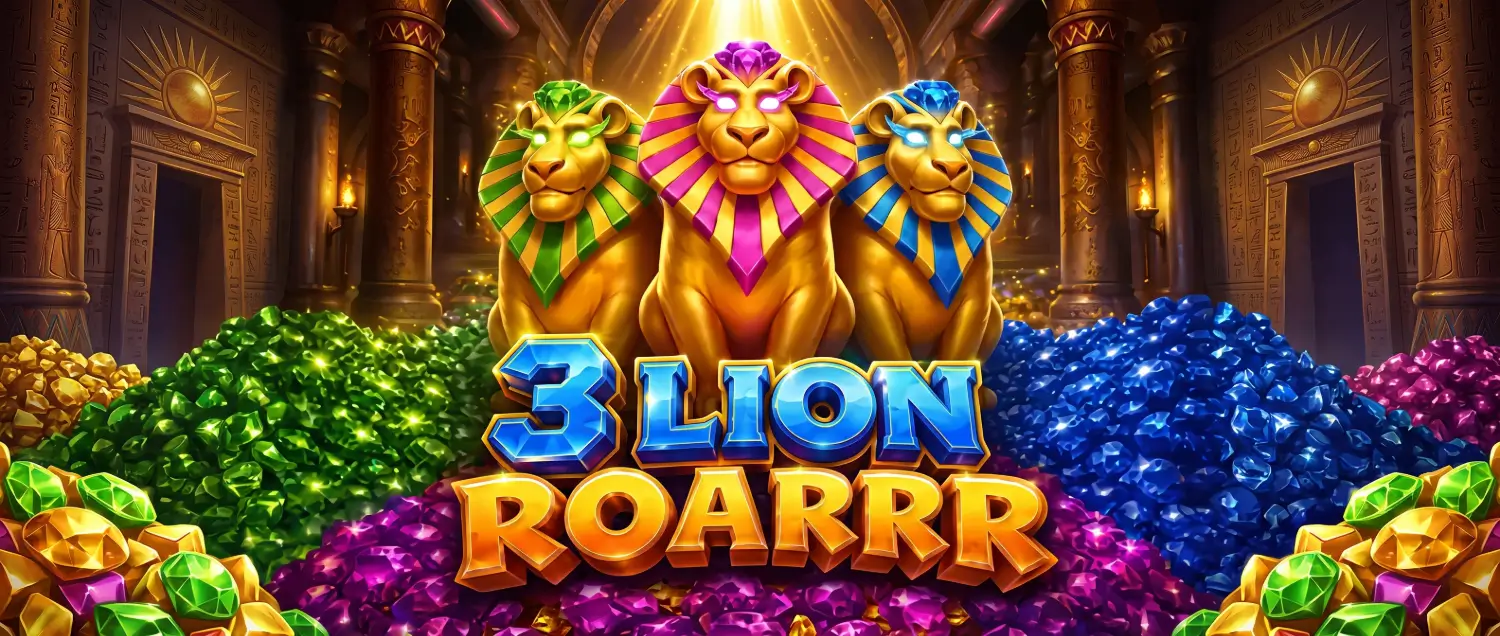
TaDa Gaming has spent the last few years carving out a reputation for Hold and Win titles that lean on collection mechanics rather than pure cascading math, and 3 Lion Roarrr is one of the 2026 releases carrying that identity forward. The game sits on a 5-reel, 40-fixed-payline grid wrapped in an Egyptian treasure-hunt theme, with three colour-coded lion statues doing most of the structural work. TaDa lists a maximum RTP of 97%, which places it comfortably above the market median on paper — but “maximum” is doing a lot of quiet lifting in that sentence, and it’s worth unpacking before anyone treats 97% as the number they’ll actually see at a live casino. The headline win potential, 5,000x the stake, sits mid-pack for a 2026 Hold and Win release. Is that competitive, or is 3 Lion Roarrr coasting on a familiar theme dressed up with a new bonus wrapper? That’s the question this review sets out to answer.
Math model and mechanics
RTP. TaDa Gaming’s own published figure for 3 Lion Roarrr is a maximum of 97%, and that’s the number aggregators including Chipy repeat when they list the game at 97% with medium volatility. What’s missing from the public data is a confirmed floor. TaDa, like most modern studios distributing through multiple aggregator platforms, typically ships titles with more than one configurable RTP tier so operators can select which version they run — and Slot Mania’s own writeup explicitly flags the 97% as an “indicated maximum” rather than a fixed figure, adding that “every casino can offer different configurations.” No lower confirmed value for this specific title turned up in available sources, so treat 97% as a ceiling, not a guarantee, and check the paytable inside whichever casino lobby you’re actually playing from. If the operator is running a lower-tier configuration — which is common practice and not a red flag on its own — the difference between 97% and a hypothetical 94% tier is real money over a long session. On a $500 bankroll played through at typical slot speed, that gap is the difference between roughly $15 and $30 in theoretical average loss per hour. Small on a single spin. Not small over a weekend.
Volatility. Aggregators classify 3 Lion Roarrr as medium volatility. TaDa hasn’t published an official volatility rating for this title, which is worth noting on its own — plenty of providers skip it, but it means the medium tag is an aggregator inference from paytable and feature data rather than a studio-confirmed classification. In practice, medium volatility on a Hold and Win game usually means the base game ticks along with small, forgettable wins from the standard symbol set, while almost all of the actual variance lives inside the bonus round. That tracks with what the feature set here suggests: the base game is described by reviewers as “linear” and the game’s real personality only shows up once the lion scatters start collecting. If you’re the type of player who judges a slot by base-game hit frequency alone, you’ll likely find 3 Lion Roarrr underwhelming outside the feature — which is by design, not a flaw.
Grid and paylines. Five reels, 40 fixed paylines, standard top-to-bottom symbol evaluation. There’s nothing exotic in the structure itself — no Megaways-style variable rows, no cluster pays, no cascading tumble mechanic. The entire design budget went into the bonus system layered on top, which is a reasonable trade-off but means the base game plays like a fairly conventional five-reel slot until the scatters start landing. Forty fixed paylines is a mid-range count for the genre — well below the 4,096 or 10,000-way structures some 2026 releases lean on for marketing purposes, but plenty for a game whose payout variance is engineered to live almost entirely in the bonus round rather than the base spin.
Bet range. No confirmed minimum or maximum stake for 3 Lion Roarrr turned up in provider or aggregator data during research for this review. Bet limits on TaDa titles typically get set per-operator rather than fixed at the studio level, so the practical range you’ll see depends on which casino’s version you load — check the in-game paytable before committing to a session rather than assuming a figure that isn’t published here.
Hit frequency. TaDa hasn’t published a hit-frequency figure for this title, and no aggregator has independently tested and reported one either, so there’s no honest number to give you. What can be said from the mechanic design itself: a triple-meter collection system like TriLuck — where you’re filling three separate scatter counters rather than chasing one — tends to produce a slower base-game rhythm than single-trigger Hold and Win games, because the bonus doesn’t fire the moment any one symbol count is satisfied. You’re waiting for the right combination of statues to activate, not just enough scatters anywhere on the board.
Max win in context. 5,000x the stake is the confirmed ceiling from provider-sourced review data. Contextualise that against the field: Playson’s Lion Gems: Hold and Win — a genuinely comparable title in theme and mechanic — tops out lower, at roughly 3,500x. Pragmatic Play’s 5 Lions Megaways 2 tops out considerably higher, at 8,000x, on a completely different reel engine. A 5,000x ceiling in 2026 is respectable but not chart-topping — it beats the older Playson design it most resembles on paper, but it’s a full 3,000x behind what Pragmatic Play is offering in the same broad “lion-themed, hold-and-win-adjacent” bracket. For a $1 spin, that’s a real-money ceiling of $5,000. Worth knowing before you go in expecting Megaways-scale numbers.
Feature breakdown
The entire identity of 3 Lion Roarrr sits in what TaDa brands the TriLuck system, built around three lion statues on the reel surround, each tied to its own colour and its own function. Coloured scatter symbols land on the reels during the base game and get collected into slots next to their matching statue. Fill the right conditions and the corresponding lion activates, unlocking its function for the bonus phase. This is a collection-based trigger, not a single-scatter-count trigger, which changes the rhythm of play — you’re not just waiting for three scatters anywhere on the grid, you’re tracking three separate meters simultaneously.
You might ask why a studio would complicate a Hold and Win formula that’s worked perfectly well as a single-trigger system for a decade. The answer, based on how the mechanic is described, seems to be pacing. A single-scatter trigger is binary — either you have three scatters or you don’t, and the bonus either fires or it doesn’t. A three-meter system gives players partial progress to track across multiple spins, which is a deliberate engagement lever: you can watch the Green Lion’s counter sit at two out of three for several spins running, which keeps attention on the reels even during a base-game cold streak. Whether that’s a genuine improvement or just a more elaborate way of extending time-on-device is a matter of taste, and it’s fair to flag both readings rather than pretend the mechanic is purely there for the player’s benefit.
Green Lion — free spins. When the Green Lion activates, it adds free spins to the bonus round. Exact spin counts and re-trigger caps weren’t confirmed in available provider or aggregator data, so treat “adds free spins” as the confirmed mechanic without assuming a specific number going in. One honest limitation here: without a published spin count, there’s no way to independently verify whether the Green Lion delivers a strong number of spins or a thin one relative to competitors — that’s a gap in TaDa’s public documentation for this title, not an assumption I’m willing to make on your behalf.
Purple Lion — frame expansion. This is the mechanically interesting one. The Purple Lion expands what TaDa calls the Lion Frame — the bonus play area itself grows, opening up more positions and, by extension, more opportunities for instant prizes, gem symbols, jackpot triggers, and extra spins to land during the feature. Structurally this resembles the “expanding grid” pattern seen in games like Big Time Gaming’s Grand Reef or various Hold and Win expansion mechanics from Red Tiger, where a bigger board directly increases the number of possible hit positions per spin. The catch: an expanding frame only helps if the expansion happens early enough in the bonus round to matter. If the Purple Lion triggers on your last spin of the feature, you’ve expanded a board you don’t get to use.
Blue Lion — the Double function. The Blue Lion introduces a mechanic that increases the presence of prize symbols occupying the same position — effectively stacking or duplicating prize values on a single spot rather than spreading value thin across the frame. This is the feature most directly responsible for spiking a single spin’s payout inside the bonus, since concentrating prize weight on fewer positions raises variance sharply compared to an even spread.
Cash Prize values. Instant cash prizes collected during the bonus round range from 0.2x to 5x the stake per hit, according to provider-sourced figures. That’s a wide band — a 25x difference between the smallest and largest single instant prize — and it’s the mechanism doing the routine, grinding work of the bonus round while the jackpots handle the rare spikes.
Jackpots — Mini, Minor, Major, Grand. Four tiers, confirmed as non-progressive in aggregator feature-tag data, meaning these are fixed-value or fixed-multiplier prizes rather than a networked pot that grows across operators and players. That’s worth being upfront about: non-progressive jackpots pay out at a predetermined level regardless of how long the game’s gone without hitting, which removes the “someone’s overdue” narrative that progressive jackpot slots lean on. It also means the Grand jackpot is realistically the ceiling contributor behind that 5,000x max win figure, not a separately escalating prize pool.
Realistic contribution versus theoretical ceiling. Here’s the honest gap: the 0.2x–5x Cash Prize band is what a typical bonus round actually delivers. The 5,000x max win requires the Purple Lion expanding the frame early, the Blue Lion stacking prize symbols on strong positions, and the Grand jackpot landing — essentially all three lions cooperating in the same bonus trigger. That’s not a one-in-three-spins outcome. Most bonus rounds will land somewhere in the low-to-mid double-or-triple-digit multiplier range, with the four-figure outcomes reserved for the sessions people actually write forum posts about.
Think of it as three separate dice that all need to land favourably in the same round. The Purple Lion needs to trigger early enough in the sequence for the expanded frame to actually accumulate value. The Blue Lion needs to stack its Double function on positions that were already going to pay well, not on empty or low-value spots. And the Grand jackpot — the single biggest contributor to that headline number — is, by definition of being one tier among four non-progressive levels, the least frequent outcome of the four. Line all three up in the same bonus round and you’re looking at the 5,000x territory. Get one or two of them without the third, and you’re looking at a solid, forgettable four-figure or low-five-figure cent win rather than a session-defining one. That’s not a criticism unique to this game — it’s how every multi-layered bonus system in this genre works — but it’s worth spelling out plainly rather than letting the 5,000x figure imply something the average session won’t deliver.
Symbol and theme integration. The Egyptian treasure-hunt dressing — temple stonework, gem symbols, gold ornamentation — is standard genre iconography, and the three lion statues are the one genuinely distinguishing visual element tying the theme to the mechanic rather than sitting decoratively alongside it. That’s worth crediting: a lot of Hold and Win slots bolt an unrelated theme onto an interchangeable collection mechanic, and here the statues are doing double duty as both the visual anchor and the functional trigger points. It’s a small design choice, but it’s the kind of detail that separates a theme built around the mechanic from a mechanic wearing a theme as a costume.
No bonus buy feature. Aggregator feature tagging for 3 Lion Roarrr does not list a Buy Bonus / Feature Buy option, unlike several other TaDa Gaming titles in the same catalogue that do carry that tag. That matters in 2026, where feature-buy has become close to a baseline expectation on Hold and Win-style releases, particularly among players who want to skip base-game grinding and go straight to the TriLuck action. Its apparent absence here means patience through the base game is required — there’s no shortcut being offered.
The 2026 perspective
Sequel and variant status. No Power Reels, Megaways, or numbered sequel version of 3 Lion Roarrr turned up in provider or aggregator searches. As of writing, this is a standalone release with no confirmed expanded variant — worth stating plainly rather than speculating about a “2” that doesn’t currently exist. TaDa does iterate on successful mechanics across its catalogue (the studio’s 3 Coin Treasures line, for instance, got a direct sequel with an expanded TriLuck Chaos mechanic and a 10,000x ceiling), so a follow-up isn’t out of the question if 3 Lion Roarrr performs well — but that’s speculation about studio behaviour, not a confirmed roadmap item.
Named competitors. Three titles make for a fair comparison set, each sharing either the lion motif, the hold-and-win-adjacent bonus structure, or both:
- Lion Gems: Hold and Win (Playson) — RTP 95.55%, medium-to-high volatility, max win around 3,500x the stake, on a 5-reel, 4-row, 30-fixed-payline African savannah theme with a traditional single-tier Hold and Win respin bonus. Playson’s version is the older, simpler design: one hold-and-win layer versus TaDa’s three-lion, multi-function system. 3 Lion Roarrr’s RTP ceiling and max win both edge this one out on paper, though Lion Gems’ bonus is more predictable precisely because it’s simpler.
- Lion Link Horse (Light & Wonder, 2026) — RTP 94%, high volatility, 5×3 grid, 40 paylines, built around a Lion Link hold-and-spin feature with five fixed jackpots plus a separate Free Games bonus with Walking Mystery Symbols. Light & Wonder’s release trades RTP for volatility — a full three percentage points below 3 Lion Roarrr’s maximum — betting that bigger swings sell better than a higher long-run return. Worth knowing if RTP is your primary filter.
- 5 Lions Megaways 2 (Pragmatic Play, 2025) — RTP 96.50%, high volatility, up to 262,144 Megaways ways-to-win, max win 8,000x, wild multipliers up to 100x, and a Feature Buy option. This is the category leader on raw win ceiling by a wide margin, and it’s the one competitor here that does offer a bonus buy — a direct contrast to 3 Lion Roarrr’s apparent lack of one.
Set side by side, 3 Lion Roarrr’s positioning is clear: higher RTP ceiling than all three named competitors, but a max win that sits well below Pragmatic Play’s Megaways offering and roughly 50% ahead of Playson’s older design. It’s a mid-table release dressed in a genuinely more elaborate bonus structure than either of the lower-win competitors, without reaching for the ways-to-win scale that lets Pragmatic Play post the biggest number in the group.
| Title | Provider | RTP | Volatility | Max win | Progressive jackpot | Bonus buy |
|---|---|---|---|---|---|---|
| 3 Lion Roarrr | TaDa Gaming | 97% (max) | Medium (aggregator-tagged) | 5,000x | No | No |
| Lion Gems: Hold and Win | Playson | 95.55% | Medium-high | ~3,500x | No | Not confirmed |
| Lion Link Horse | Light & Wonder | 94% | High | Not confirmed | No | Not confirmed |
| 5 Lions Megaways 2 | Pragmatic Play | 96.50% | High | 8,000x | No | Yes |
Reading that row by row rather than just eyeballing the max-win column tells a more useful story than the ceiling figure alone. Lion Gems is the oldest and simplest design of the four, and it shows — one hold-and-win layer, a lower RTP, and a max win that TaDa’s newer release comfortably clears. Lion Link Horse trades RTP for volatility in the opposite direction to what you might expect from a 2026 release: rather than pushing RTP up alongside the higher variance, Light & Wonder pushed it down to 94%, which is a genuinely below-average figure for a same-year competitor. Whether that’s an intentional trade for bigger swings or simply a lower-tier configuration being surfaced by the aggregator isn’t something this review can settle, but it’s a number worth knowing if you’re comparing the two side by side. And 5 Lions Megaways 2 is doing something structurally different from the other three — its 262,144-ways engine is a different mechanical family entirely from a fixed-payline Hold and Win game, which is part of why its ceiling is so much higher. Comparing a Megaways ways-engine against a fixed-payline collection mechanic is a bit like comparing a lottery wheel to a scratch card — both are gambling products, but the variance profiles come from fundamentally different places.
Progressive jackpot availability. None. The four jackpot tiers here are confirmed non-progressive, which puts 3 Lion Roarrr in the same bracket as most fixed-jackpot Hold and Win titles rather than the network-jackpot category occupied by games like Mega Moolah. If a growing, cross-casino jackpot pool is what draws you to a game, this isn’t that game.
Buy-bonus absence, revisited. Circling back to this because it shapes who the game actually suits: in a 2026 lobby where feature-buy has become close to standard on bonus-heavy slots, not offering one is a genuine differentiator — and not necessarily a negative one. It does mean this is a game built for players willing to earn their way into the TriLuck round through ordinary spins, rather than players who want to pay a premium to skip straight to the feature.
High roller, recreational, or dead weight? Neither high-roller game nor filler. The 97% ceiling RTP and medium volatility classification put 3 Lion Roarrr squarely in recreational territory — a game built for regular sessions at modest stakes where the appeal is watching the TriLuck meters fill up, not chasing a single life-changing spin. High rollers chasing maximum theoretical ceiling have three better-paying options in the comparison set above (5 Lions Megaways 2 most obviously). But it’s not dead weight either — the three-lion collection mechanic is genuinely more engaging to watch build than a standard single-trigger hold-and-win bonus, and the non-progressive jackpot structure means payouts, when they land, are predictable rather than diluted by a shared network pool.
Verdict
3 Lion Roarrr is a solidly built, mid-tier Hold and Win release that does one thing better than most of its direct rivals — the three-lion TriLuck collection system gives the bonus round more moving parts and more moment-to-moment tension than Playson’s older single-trigger Lion Gems design, and the confirmed 97% RTP ceiling beats every named competitor in this review on paper. The number that most limits this game is the 5,000x max win — respectable against Lion Gems’ roughly 3,500x, but a clear step behind 5 Lions Megaways 2’s 8,000x, and there’s no bonus buy option to soften the wait for players who’d rather pay to skip the grind.
Play it if: you like watching a bonus round build in stages rather than resolve in one binary trigger, you’re playing at modest stakes where a 97% ceiling RTP genuinely matters over a long session, and you don’t mind grinding through the base game to get there. The three-lion collection system rewards the kind of player who tracks partial progress across spins and treats that as part of the entertainment rather than an obstacle between them and the feature.
Skip it if: you’re chasing the single biggest number available in this comparison set — 5 Lions Megaways 2’s 8,000x ceiling is the one to check out instead — or if a bonus buy option is close to a dealbreaker for how you like to play. Skip it too if you specifically want a networked progressive jackpot rather than a fixed non-progressive tier; nothing here escalates the way a Mega Moolah-style pot does.
Go in knowing the 97% is a ceiling to verify at your chosen casino, not a fixed guarantee, and the TriLuck system rewards patience more than it rewards impatience.