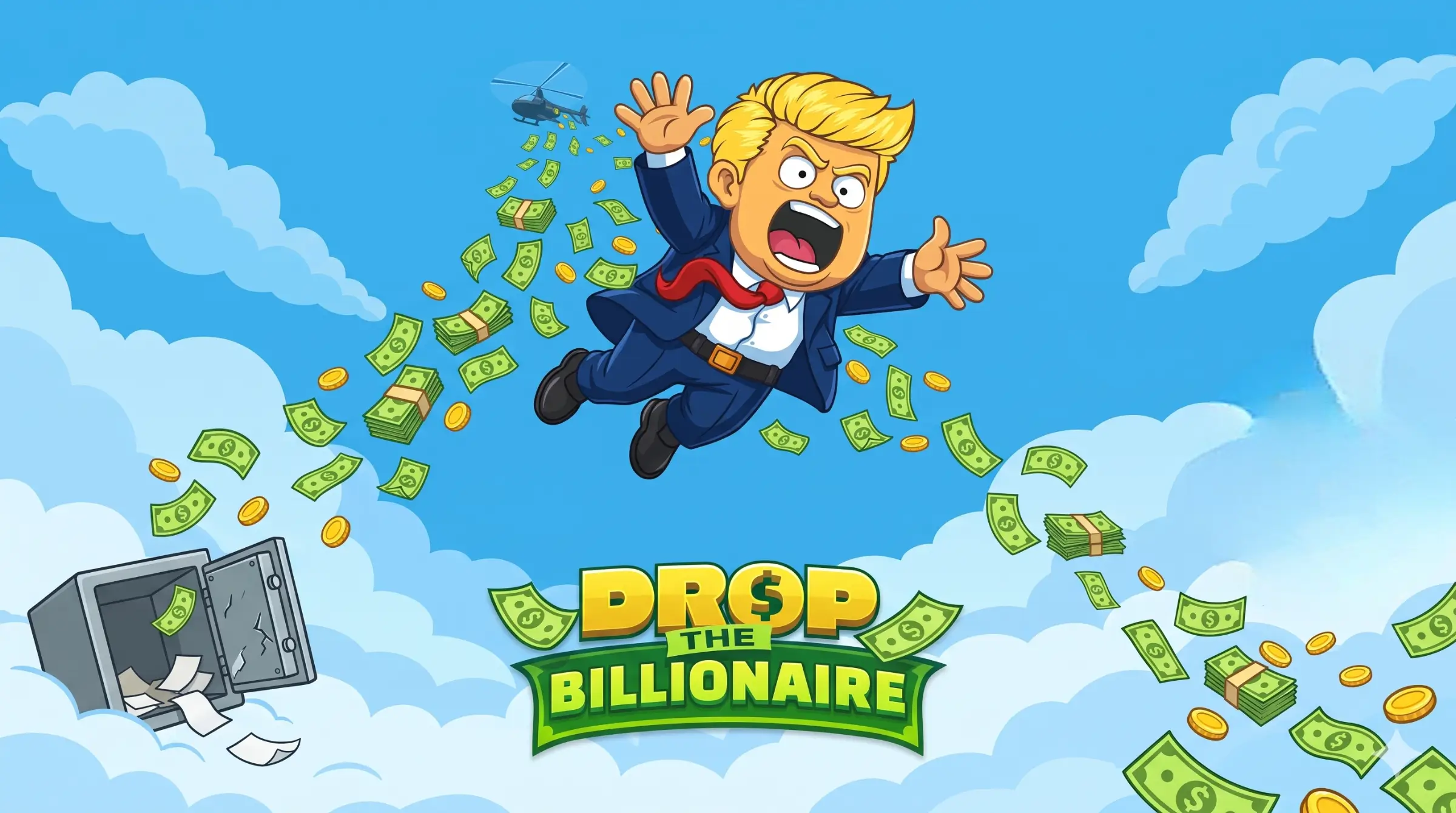
InOut Games has been building its catalogue of instant-win titles for a few years now, mostly flying under the radar while Spribe and Pragmatic Play owned the crash conversation. Drop the Billionaire is the studio’s attempt to break into a different lane — not a rising-multiplier plane, not a chicken crossing a road, but a falling tycoon collecting money clouds on the way down. It launched in 2026 and is already trending on the official InOut site.
The concept is original enough to stop you mid-scroll. A caricature billionaire tumbles from a helicopter through a sequence of symbols: money clouds, multipliers, coins, hamburgers, oil platforms, a black hole. The trajectory decides your payout. Hit premium landing zones and your winnings multiply by up to x20 at the final drop. Land in the wrong place and you’ve collected a fraction of what you were chasing.
It’s a category of one, which is either a strength or a weakness depending on what you’re looking for. The game doesn’t fit cleanly into “crash game” or “slot” or “instant win” — it borrows from all three and lands somewhere in between. That makes it interesting to analyse because the usual benchmarks don’t apply directly.
The RTP sits at 96.0%. Volatility is officially classified as medium-high by InOut Games, though one third-party affiliate source labels it simply “medium” — a discrepancy worth noting because the distinction has real bankroll implications. The max payout is capped at $100,000 on any single round, which translates to roughly x10,000 your stake on a minimum bet of $0.12. Whether that ceiling is competitive in a crash genre where JetX offers x25,000 and Aviator runs to x10,000 is a question we’ll get into.
Math model and mechanics
RTP: 96.0% — confirmed, single figure, no operator-configurable range disclosed
Unlike Aviator, where casino operators can and do configure the RTP anywhere from 94% to 97% (often without disclosing it), InOut Games states a fixed 96.0% for Drop the Billionaire. That’s a meaningful transparency point. If the figure is genuinely fixed and not adjustable per-operator, it’s the same game regardless of which casino hosts it.
In practical terms, 96.0% means the house keeps 4p of every £1 bet over a long enough run. Compare that to Aviator at 97% (3p house edge) or BGaming’s own Crash at 99.02% (1p house edge). The gap between Drop the Billionaire and Aviator is 1 percentage point. That sounds small. Run 100 rounds at £1 per round and the math barely shows. Run 10,000 rounds and you’ve paid roughly £100 more in house edge with Drop the Billionaire than you would have with Aviator. Regular grinders should take that number seriously. Casual players who drop in for 20 rounds? It’s noise.
Volatility: medium-high (official) vs medium (third-party)
InOut Games officially rates this game as medium-high volatility. One third-party review site calls it medium. Both descriptions come from the same game, which tells you the classification is doing a lot of interpretive work here.
What medium-high volatility means in practice for this type of game: you should expect reasonably frequent small collection payouts from the base trajectory, with larger wins coming from bonus mode activations and premium final zone landings. It’s not the bruising variance of a high-volatility slot that can chew through 200 rounds without a meaningful return. But it’s also not the steady-drip comfort of pure medium volatility. Sessions will swing.
The four speed modes — Slow, Normal, Fast, Ultra — don’t change the volatility classification, but they do affect how quickly you cycle through rounds. Ultra mode at £1/spin can drain a £50 bankroll faster than you’d expect on a medium-high variance profile. Worth knowing before you set the speed and look away.
Max win: $100,000 (x10,000 stake on minimum bet)
The $100,000 cap is stated clearly by InOut Games. Against the current crash and instant-win field, that puts it on par with Aviator’s x10,000 ceiling and below JetX’s x25,000. It’s not a high-roller game by max-win standards. At a £10 stake, the maximum return is £100,000. At £100, you’re capped at the same dollar amount regardless.
For high rollers who regularly bet £500+ per round, that ceiling becomes a tangible constraint. At £1,000 per round, you’re chasing a x100 return on the high side. That’s not crash-game territory; that’s roulette territory.
Bet range: $0.12 to $10,000 per round
A genuinely wide range. The $0.12 minimum is accessible for micro-stakes players who want extended sessions on small deposits. The $10,000 ceiling accommodates high-volume operators’ VIP players. Most players will sit somewhere in the £0.50–£10 range where the game’s variance profile makes most sense.
Provably Fair: yes
This matters more than it used to. InOut Games uses Provably Fair technology, meaning you can verify each round’s outcome independently through hash comparison. This is the same transparency standard as Aviator and a step above certified-RNG-only providers like Pragmatic Play’s Spaceman. In an era where some operators have been caught running lower RTPs than advertised, verifiable fairness is a genuine advantage.
Feature breakdown
Money Cloud Bonus mode
Trigger: Manual activation before a round. Costs 100x your standard bet — a £1 round becomes a £100 entry for one trajectory.
Mechanic: Removes all negative and low-value elements from the trajectory path. The ÷2 penalty elements disappear. Caps (which add only +0.2), hamburgers (+0.3), and standard coins (+0.4) are stripped out. What remains is a trajectory populated exclusively with money clouds, multipliers, and premium landing zones.
Maximum activation: One per round (it’s a per-round mode selection, not a stackable feature).
Payout potential: Significantly higher expected value on the trajectory itself because you’re collecting from an edited deck of elements. The base multipliers (x1.5 to x5) stack on a counter fed only by money cloud additions (+0.5 to +5) and the trajectory multipliers. The final zone multiplier then applies to whatever you’ve built.
The honest limitation: You’re paying 100x your stake for an improved path, not a guaranteed win. A trajectory with 12 money clouds and three multipliers that lands in a standard zone still produces a modest return. The big payouts require both a strong collection trajectory and a premium final landing zone. The probability of hitting that combination isn’t published by InOut Games, which makes it impossible to calculate the expected value of the mode with precision. What they’ve disclosed is that the mode exists and that it changes path composition. The specific probability of reaching the White House (x20) landing zone in bonus mode versus base mode is not provided.
Chance Bet mode
Trigger: Manual activation, persistent until disabled or page reload. Costs 1.5x your regular bet per round.
Mechanic: Described by InOut Games as improving odds for reaching premium final zones. The exact mechanism — whether it adjusts landing zone probabilities, trajectory element weightings, or both — is not published.
Realistic payout contribution: At 1.5x cost with undefined probability improvement, this mode is difficult to evaluate quantitatively. If landing in the White House (x20) base probability is, say, 2% per round, and Chance Bet meaningfully increases that, the expected value could favour the mode. Without the underlying probability table, you’re trusting the provider’s characterisation rather than verifiable maths. That’s a weaker position than I’d like for recommending it.
The limitation: The mode name — “Chance Bet” — is honest branding. It’s a chance at better outcomes, not a certified improvement. Use it if you’re going to be playing a long session and want to stay in the mode continuously. Don’t treat it as a strategic edge without knowing the probability shift. There’s a reasonable argument that the mode exists primarily to increase per-round revenue for the operator by lifting average bet size rather than to meaningfully improve player expected value — a common pattern in instant-win game design.
Final zones
Trigger: Every trajectory ends in a final zone. The zone is determined by where the billionaire lands.
Mechanic: Multipliers applied to your total collected counter from the trajectory.
| Final zone | Multiplier |
|---|---|
| White House | x20 |
| Oil Platform | x8 |
| Standard zones | x1–x3 (estimated; exact breakdown not published) |
Landing in the White House is the game’s single biggest payout driver. A trajectory that builds a counter of 15x your stake and then lands in the White House produces a 300x return on your base bet. That’s the ceiling of realistic session variance — not a guaranteed scenario, but the combination that explains why some players report large single-round returns.
The limitation: The probability of landing in each final zone is not published. This is the most material information gap in the game’s design documentation. For a game that markets itself on Provably Fair transparency, the absence of a published landing zone distribution table is a notable omission.
Black Hole mini-game
Trigger: Hitting a Black Hole element during the trajectory.
Mechanic: A mini-game activates mid-trajectory. Additional winnings are calculated from your current counter and added to the total. The specifics of how the mini-game operates — whether it’s a pick-mechanic, a wheel spin, or automatic — are not detailed in the available InOut documentation.
Payout contribution: Described as creating unexpected bonus opportunities within a round. Without mechanic specifics or probability data, this reads as a supplemental payout moment rather than a session-defining feature. It adds variance to individual trajectories rather than restructuring the session’s expected value. Based on the game’s design philosophy — collect through the trajectory, land in a premium zone, apply final multiplier — the Black Hole feels like a mid-trajectory reward moment rather than the game’s primary payout driver. Whether hitting it early (low counter) or late (high counter) meaningfully changes its value depends on the mini-game calculation formula, which InOut Games hasn’t published in the available documentation. This is the second significant information gap alongside the landing zone probability table.
Trajectory elements: the base game economy
The trajectory is built around a set of collectible elements, each adding to or subtracting from your running win counter:
| Element | Effect |
|---|---|
| Money Cloud | +0.5 to +5 to counter |
| Trajectory Multiplier | x1.5 to x5 on current counter |
| Coin | +0.4 to counter |
| Hamburger | +0.3 to counter |
| Cap | +0.2 to counter |
| ÷2 Element | Halves current counter |
| Black Hole | Triggers mini-game |
The ÷2 element is the one that hurts. Hit it late in a strong trajectory and you’ve lost half of what you built. Hit it twice and three-quarters of your counter is gone. This is why the Money Cloud Bonus mode — which removes it — costs 100x your bet. The ÷2 is the game’s primary variance mechanism in the base trajectory.
A trajectory multiplier hitting early, before you’ve built a meaningful counter, does very little. The same x5 multiplier hitting after you’ve collected three money clouds in a row at +5 each changes the trajectory entirely. Sequence matters, and you have no control over it.
2026 perspective
No sequel, no variant — what that means
As of mid-2026, InOut Games has not released a Drop the Billionaire variant. There’s no Power Reels version, no Megaways equivalent, no mega-edition. The game stands alone in its own format.
This is double-edged. On one hand, there’s no “sequel trap” — InOut did exactly this with Chicken Road 2.0, releasing a follow-up with better visuals and a higher win cap but a 95.5% RTP, compared to the original’s 98%. That sequel is mathematically worse despite looking more polished. Drop the Billionaire players don’t have to make that comparison yet. On the other hand, the lack of any variant limits the game’s longevity. Once you know the trajectory, the mechanics, and the landing zones, there’s no evolved version of the experience waiting.
Competitive positioning in 2026
Aviator (Spribe): 97% RTP, x10,000 max multiplier, 97% is operator-configurable between 94–97%
Aviator has a 1% RTP edge over Drop the Billionaire. More importantly, Aviator has been the crash category standard since 2019. Social features — a live feed showing other players’ cashouts, a rain feature for sending free bets — build a community layer around each round that Drop the Billionaire doesn’t attempt. The dual-bet system lets you hedge one bet while taking risk on another, which is a structural strategic advantage Drop the Billionaire can’t match. For most players, Aviator’s combination of higher RTP, social layer, and dual-bet feature means it sits above Drop the Billionaire on pure competitive analysis. One caveat: Aviator’s UK availability was suspended in late 2025 due to a Spribe UKGC licensing issue. That created a temporary gap some operators filled with alternatives, including InOut titles.
JetX (SmartSoft): RTP ranges 96.2–98.9% depending on casino, x25,000 max multiplier, multi-bet up to 3 simultaneous
JetX is the high-ceiling alternative. The x25,000 max multiplier is 2.5x Drop the Billionaire’s cap, and the multi-bet system adds strategic flexibility. RTP can reach 98.9% at the right casino — though it can also go lower, so the operator matters. For high-roller sessions where the theoretical ceiling matters, JetX is the better vehicle. Drop the Billionaire’s $100,000 absolute cap becomes irrelevant in the upper stakes bracket; JetX’s x25,000 multiplier on a £1,000 bet is a £25,000,000 ceiling that will never be reached but indicates a fundamentally different design philosophy.
Spaceman (Pragmatic Play): 96.56% RTP, x5,000 max multiplier
Spaceman sits between Drop the Billionaire and Aviator on RTP (96.56% vs 96.0% vs 97.0%), and below both on max multiplier ceiling. Its main advantage is distribution — Pragmatic Play titles appear in almost every major operator’s lobby, making Spaceman the de facto crash option for players on regulated European platforms that don’t carry Spribe or InOut titles. Drop the Billionaire beats Spaceman on max win ceiling ($100,000 vs $5,000 theoretical top-end) and matches it roughly on RTP. The deciding factor for most players will be which game their casino actually offers.
Buy-bonus: absent
There is no buy-bonus mechanic in Drop the Billionaire. You cannot pay to skip directly into the Money Cloud Bonus mode without making the standard 100x bet commitment per round. In a 2026 market where buy-bonus features have become a standard expectation for bonus hunters — particularly on European platforms where the feature is heavily marketed — the absence is a limitation. Players who specifically search for bonus-buy games won’t find what they’re looking for here.
Progressive jackpot: absent
No network jackpot. No local jackpot. The $100,000 max payout is a fixed ceiling, not a building pool. InOut Games doesn’t offer progressive jackpots across any of its titles, which is a studio-level decision rather than a game-specific one.
InOut Games as a studio in 2026
InOut Games has been operating since around 2020, received its Curaçao B2B licence in 2024, and by mid-2026 claims over three million monthly active players across its catalogue. That’s a meaningful number for a studio that doesn’t carry the brand recognition of Spribe or Pragmatic Play. The integration is through major aggregators including SoftSwiss and Slotegrator, which means Drop the Billionaire is available at a wider range of platforms than you’d expect from a mid-tier provider name.
The Curaçao licence is the standard offshore tier — not MGA, not UKGC. That’s fine for the markets InOut Games primarily targets (crypto casinos, emerging markets, non-regulated or lightly regulated GEOs), but it’s worth knowing the licence context if you’re playing on a platform that doesn’t carry a stronger regulatory badge itself.
What matters for players is whether the games do what they claim to do. The Provably Fair system means you can verify Drop the Billionaire round-by-round. That’s a higher transparency standard than a Curaçao licence alone, and it’s a meaningful distinction from provider RNG certification where you trust a third-party audit you’ve never seen.
Bankroll management in a trajectory game
Drop the Billionaire has a specific session cost problem that doesn’t exist in traditional slots: the Money Cloud Bonus mode costs 100x your base bet. If you’re playing at £1 per round, activating the bonus mode once costs £100. Do that four times in a session and you’ve committed £400 in bonus-mode entries before accounting for your base game rounds. This isn’t a warning against using the mode — it’s the game’s primary high-variance lever and probably where the most interesting payouts come from — but the cost structure requires a different bankroll calculation than you’d make for a standard crash game.
A practical way to frame a session: decide upfront whether you’re playing base game rounds for entertainment or bonus mode rounds for ceiling access. A £50 session of base game rounds at £0.50/round gives you 100 rounds of trajectory play, which is enough to get a genuine feel for how the game distributes its elements and final zones. A £50 session with a single bonus mode entry at £50 (implying a £0.50 base bet at 100x) gives you one enhanced trajectory and then nothing. Neither approach is wrong, but mixing them without a budget for both tends to produce unsatisfying half-sessions.
For the Chance Bet mode (1.5x base bet), the calculus is simpler: if you’re going to play 50 rounds, decide at the start whether you want every round at 1.5x cost. At £1 base, that’s £50 in standard play or £75 in Chance Bet play. The improvement in landing zone probability isn’t quantified by InOut, so you’re paying for an expected improvement that can’t be precisely validated.
Auto-play available but worth treating carefully. In Ultra speed mode, a session can cycle through dozens of rounds before you’ve registered what happened. Set a loss limit before enabling auto-play. The game’s round speed isn’t a trap — it’s a feature — but it removes the natural pause between rounds that helps you track session performance.
Who is actually playing this in 2026?
Drop the Billionaire lands most naturally with three player profiles. Crash game regulars who are bored with the Aviator interface and want something thematically different will find the satirical billionaire aesthetic a genuine change of pace. Mobile-first players on crypto-friendly platforms will appreciate the Provably Fair system and the fast round pacing. And players who like active rather than passive gambling — the trajectory element collection feels more engaged than watching a multiplier climb and pressing cash-out — will find the format suits their style.
The game doesn’t suit players who prioritise RTP optimisation above all else; they should be in Aviator or a high-RTP Mines variant. It doesn’t suit high rollers who need a win ceiling above $100,000. And it doesn’t suit players who want a social layer around their crash game; Drop the Billionaire is a solo experience with no live feed, no community element.
Verdict
Drop the Billionaire (base game)
This is a competently designed instant-win trajectory game with a well-defined theme, Provably Fair transparency, and a genuinely interesting mechanic in the ÷2 element that creates real session variance. The 96.0% RTP is the honest ceiling of its appeal: one point below Aviator, four points below BGaming Crash, and in a game type where that difference accumulates over volume. The Money Cloud Bonus mode is the standout feature, but paying 100x your stake for an improved trajectory path without knowing the landing zone probability distribution is a commitment you’re making on trust rather than maths.
Play this if you’re a crash-adjacent player who wants something other than a rising multiplier line, you’re on a platform where Aviator isn’t available or is running at a reduced RTP, or you value the thematic entertainment of a satirical billionaire falling through hamburgers. The $0.12 minimum entry makes it accessible for bankroll-limited sessions.
Skip this if you’re optimising purely for RTP — Aviator’s 97% and BGaming Crash’s 99.02% are both better long-run choices. Skip it if you need a win ceiling above $100,000. Skip it if you want the dual-bet strategic layer that Aviator offers.
The number that most limits this game: 96.0% RTP and the undisclosed landing zone probability table. Those two together mean you’re playing a game you can verify as fair but can’t fully evaluate as rational.
Sequel outlook
InOut Games hasn’t released a Drop the Billionaire 2.0. Based on what they did with Chicken Road 2.0 — improved visuals, worse RTP — if a sequel arrives, read the small print before assuming it’s an upgrade. The studio’s track record on sequels should make you cautious.
If a sequel does launch with the same 96.0% RTP and published landing zone probabilities, it would be a materially better product than what’s currently available. Until then, the original is what it is: a creative format, a fair RTP for its category, and a game that works better in 20-round sessions than in 200-round grinds.