Lucky Ducky landed in December 2024. That’s seventeen months on the market — enough time to find out whether it holds up once the novelty wears off, and enough time for BGaming to have already built on the same engine twice. The original Merge Up launched in 2023 at 97.25% RTP and 5,000×. Lucky Ducky matched that ceiling exactly. Then Merge Up 2 arrived in October 2025 at 98% RTP and 10,000×. Suddenly, Lucky Ducky’s numbers look like the stepping stone, not the destination. That tension is the honest starting point for this review.
The game’s 97.25% RTP is a genuinely high figure — most of the cluster slots players compare it against sit at 96% to 96.5%. BGaming has made high RTP a brand identity point, and Lucky Ducky delivers on that. But RTP is only one number in a bigger picture that includes volatility classification, max win ceiling, hit frequency, and whether the bonus features can realistically produce the kind of session that justifies the variance you’re absorbing. Those are the things worth examining here.
Math model and mechanics
RTP
The headline figure is 97.25% — confirmed on BGaming’s official game page and consistent across SlotCatalog, AskGamblers, and the X-Mas variant’s AboutSlots review. One outlier exists: BitStarz’s game page lists 96.25%. This is likely an operator-configured reduced RTP, not an error.
Operator-configurable RTP is standard across the industry. A developer publishes a base RTP — 97.25% in Lucky Ducky’s case — but casino operators can request lower configurations. What you actually play at depends on which configuration the specific casino has deployed. The practical implication: a player at Casino A and a player at Casino B can be spinning the same game with different expected returns. If you’re serious about this game, check the in-game information panel before you commit real money.
The difference between 97.25% and 96.25% may sound minor. Over 1,000 spins at £1 per spin, it’s £10 in theoretical edge. At 3,000 spins — a realistic extended session at lower stakes — that’s £30. Not life-changing, but not trivial either.
Volatility and hit frequency
BGaming classifies Lucky Ducky as very high volatility. The hit frequency on the X-Mas variant (mechanically identical) is published by AboutSlots at 32.89%, which means roughly 1 in 3 spins produces some kind of win. That’s on the higher end for a very-high-volatility game — the cluster mechanic generates small base-game wins relatively often. The catches: most of those base-game hits are single-level merges producing single-digit multipliers. The sessions feel active. The balance moves slowly in either direction until a chain reaction or the bonus kicks in.
Free spins trigger at a rate of approximately 1 in 276 spins according to published data. That’s the natural trigger rate — roughly every 9 minutes at a 2-second spin interval. For players who are session-length sensitive, that’s a long wait for the feature that does most of the work.
Grid and win mechanics
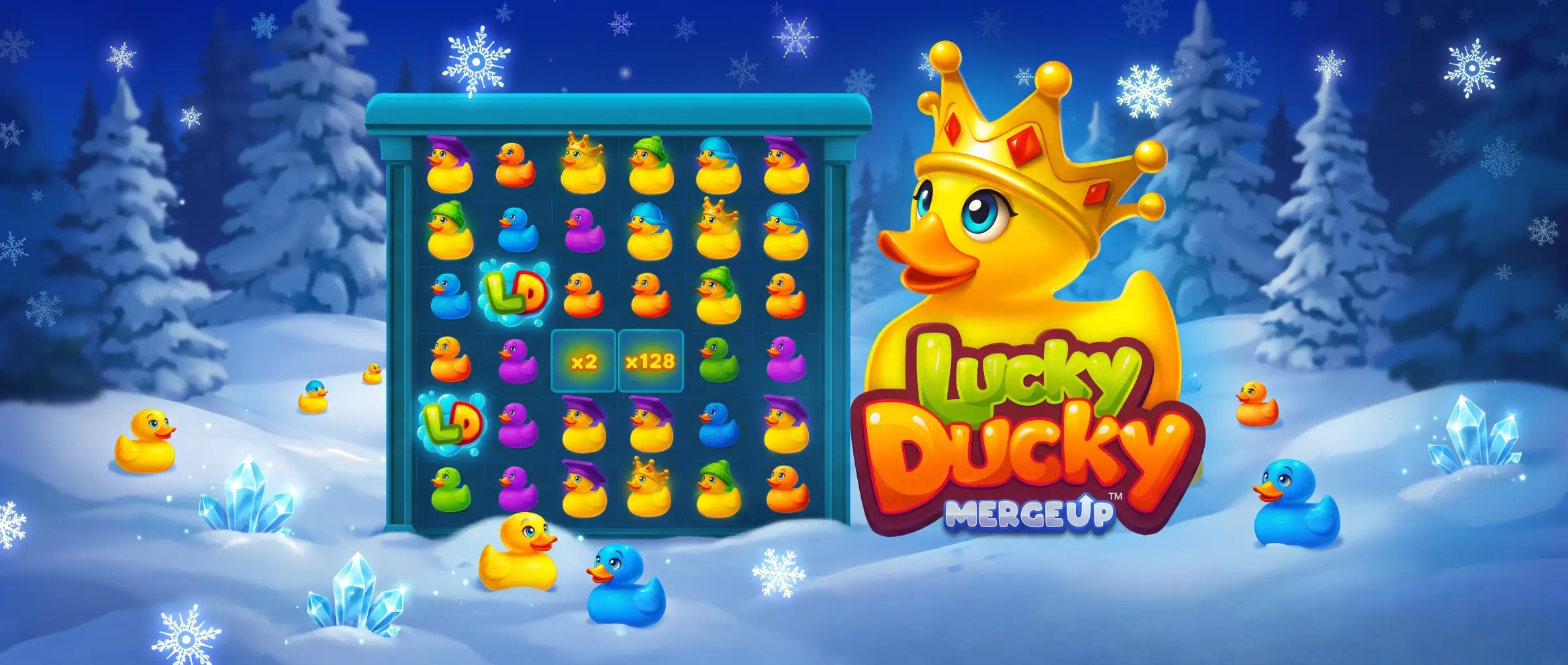
Lucky Ducky plays on a 6×6 grid with no traditional paylines. Wins form when 4 or more identical symbols occupy adjacent positions horizontally or vertically — cluster pays. There is some ambiguity across review sites about whether the grid is 6×5 or 6×6; the official BGaming page and the X-Mas variant’s detailed review on AboutSlots both confirm 6×6. The difference matters slightly because a larger grid increases the probability of clusters forming and chaining.
Bet range: £0.20 to £50 per spin. The ceiling is conservative — Honey Rush Black and Yellow runs to £100 and Sweet Bonanza 2500 reaches £240. If you’re a high roller who wants to push the stake upward, Lucky Ducky’s £50 maximum is a genuine limitation. At £50 a spin, the 5,000× ceiling produces a maximum cashout of £250,000. That’s the same number BGaming publishes as the Max Win in euros.
Max win: 5,000× stake. That ceiling puts Lucky Ducky below the competitive tier of 2026 cluster slots. Sweet Bonanza 2500 reaches 25,000×. Jammin’ Jars 2 peaks at 20,000×. Even Merge Up 2 — the direct sequel from the same developer using the same engine — hits 10,000×. For a player choosing between the two BGaming MergeUP titles in 2026, the ceiling difference is the most important number on the page.
Feature breakdown
MergeUP cluster mechanic
MergeUP is BGaming’s proprietary engine, first introduced in the 2023 game Merge Up and applied here to rubber ducks instead of gems. The mechanic works as follows: clusters of 4 or more identical adjacent symbols form a win. After the win pays, the symbols in the cluster don’t simply disappear — they merge upward into the next duck level. New symbols cascade from above to fill the vacated positions. If those new symbols form another cluster, the process repeats.
There are 9 symbol levels — green duck at the bottom, progressing through increasingly accessorised variants (blue cap, purple doctor’s hat, crown) up to the 8th-level King Duck. The King Duck is the pivot point in the system: when a cluster of King Ducks forms and pays, those symbols don’t merge further — they produce one Scatter (LD) symbol instead. The Scatter is technically level 9 in the symbol hierarchy, and it’s also the free spins trigger.
The mechanic is satisfying to watch. A single spin can generate multiple consecutive wins as cascades reform into new clusters and symbols advance up the hierarchy. In practice, most base-game chains resolve after 2 to 3 cascades. The dramatic long chains that advance multiple symbols to higher levels before producing scatters are the exception, not the pattern.
The nine-level structure creates an internal logic that distinguishes MergeUP from standard cluster pays. In Jammin’ Jars or Sweet Bonanza, each spin is essentially independent of the previous one — clusters form, pay, and disappear, with no memory of what happened before. In Lucky Ducky, there’s progression within a spin: a cascade doesn’t just pay again, it upgrades the symbols so that the next cluster is worth more. A base game spin that starts with a cluster of green ducks and cascades twice might leave you with a 4th-level duck cluster paying several times what the green duck cluster would have produced. The endpoint of that progression — the King Duck producing a Scatter — means the base game has a built-in path to the bonus, not just a random trigger event.
One honest limitation: there are no wild symbols in Lucky Ducky. The merging mechanic compensates for this, but wilds provide a different kind of value — they bridge gaps between clusters and extend chains. Their absence means the base game is somewhat binary: either clusters form or they don’t, and a near-miss doesn’t convert into a win the way a wild can rescue a close call. AboutSlots’ review of the X-Mas variant specifically flagged the absence of wilds as a weakness. I agree with that assessment.
Free spins
Triggered by landing 4 or more Scatter symbols anywhere on the grid. The scatter can land randomly or emerge from a King Duck cluster.
- 4 scatters: 15 free spins
- 5 scatters: 18 free spins
- 6 or more scatters: 20 free spins
During the free spins round, the cell multiplier system activates. Each time a winning cluster forms on a position, that cell is marked. The next time a winning cluster occurs in a marked cell, the cell receives an ×2 multiplier. Every subsequent win on that same marked cell doubles the multiplier again — ×4, ×8, ×16, up to a maximum of ×128 per cell.
The multipliers compound within a spin. A free spin where three winning positions each carry ×16 doesn’t produce ×48 applied to one win — instead, each cluster win resolves at the multiplier value of the cell it occupies. The maximum win of 5,000× requires multiple cells reaching high multiplier values simultaneously on cluster wins of higher-level symbols.
Retriggering is possible: landing 4, 5, or 6 scatters during free spins adds 5, 8, or 10 additional free spins respectively.
The honest limitation here is that reaching ×128 on a single cell requires that cell to be part of winning clusters on 6 consecutive occasions. Getting there on multiple cells in the same session is genuinely exceptional. In extended play, cell multipliers mostly land in the ×2 to ×16 range, with ×32 appearing occasionally. That generates decent wins. It does not generate 5,000×.
To put the free spins maths in practical terms: a 15-spin bonus at a £5 stake with cells averaging ×4 multipliers on winning positions produces somewhere in the £30–£150 range as a common outcome. That’s a 6×–30× return on the bonus round — not bad, but not the session-defining result the theoretical ceiling suggests. The high-end outcomes — pushing toward 500× or beyond on a single bonus — require retriggering to fire and multiple cells to develop above ×32 before the round ends. It happens. It’s not the modal outcome.
A note on the retrigger rate: the free spins frequency itself is roughly 1 in 276 spins. A retrigger means getting 4+ scatters again within the 15–20 spins of the bonus round. The probability compounds against you. In practical sessions, most bonus visits are single triggers that produce their 15 spins and end. Extended rounds with retriggering are the minority — meaningful when they happen, rare enough that you should not budget around them.
Chance x2
An optional bet modifier. Activating Chance x2 increases your stake by roughly 25% and doubles the frequency at which free spins are triggered naturally. Mechanically, it alters the underlying probability of scatter symbols appearing during base game spins.
The tradeoff is straightforward: you burn through your bankroll 25% faster to cut the natural trigger time roughly in half. Whether that’s value depends on your session length and bankroll. Chance x2 is deactivated when Buy Bonus is active — the two features cannot run simultaneously.
Buy Bonus (Feature Buy)
Purchase direct entry to the free spins round for 100× your current bet. At £1 base bet, that’s £100 to skip the base game entirely and start with 15 free spins (the default purchase quantity). The exact configuration — whether the buy always delivers 15 spins or offers a selection — follows the same pattern as the X-Mas variant, where the buy triggers a standard free spins round.
At £50 maximum base bet, the bonus buy costs £5,000 per purchase. That’s the ceiling of the game’s bet range spent on a single bonus access. For that stake, the maximum theoretical return from one bonus session is £250,000 — and that requires hitting close to the mechanical ceiling. The Buy Bonus is available in most markets but is restricted in certain regulated jurisdictions including the UK, where the Gambling Commission banned feature buys in 2021.
2026 perspective
The MergeUP family in 2026
Lucky Ducky is BGaming’s fifth application of the MergeUP engine, after the original Merge Up (2023), Lucky 8 Merge Up, Bahamut Merge Up, and the X-Mas skin of Lucky Ducky itself. In October 2025, Merge Up 2 arrived and changed the calculus considerably.
Merge Up 2 specs: 6×6 cluster pays, very high volatility, 98% RTP, 10,000× max win, multiple Bonus Buy options, plus a new Bomb symbol mechanic that converts certain level-9 positions into explosive cluster triggers rather than straightforward scatter generation.
Compared to Lucky Ducky:
- RTP: 98% vs 97.25% — a 0.75 percentage point gap that represents meaningful additional expected return
- Max win: 10,000× vs 5,000× — double the ceiling
- Bonus Buy: four configurations vs one
- Mechanic: Bomb symbols add a wrinkle the original MergeUP engine lacks
Merge Up 2 is, on paper, a better version of the same experience. BGaming knows this — the studio is explicit that Lucky Ducky is part of a themed application series using the MergeUP base, not a mechanical advancement of it.
The Lucky Ducky X-Mas edition is mechanically identical to the original — same RTP, same grid, same 5,000× ceiling, different art assets. It’s a skin.
Competitive context in the cluster pays category
Sweet Bonanza 2500 (Pragmatic Play): 96.52% RTP, 25,000× max win, bet range £0.20–£240. The scatter pays mechanic differs from cluster pays — wins require 8 or more matching symbols anywhere on the grid rather than adjacent clusters — but the player audience overlaps substantially. Sweet Bonanza 2500’s max win ceiling is 5× higher than Lucky Ducky’s, and its max bet is nearly 5× higher. For players chasing maximum upside, it’s the stronger option. The lower RTP is a cost.
Jammin’ Jars 2 (Push Gaming): 96.7% RTP, 20,000× max win, 8×8 grid with multiplier wilds that accumulate throughout bonus rounds. The mechanic is cluster pays with walking wilds rather than symbol merging. The max win is 4× Lucky Ducky’s ceiling, the RTP is lower, and the visual experience is busier. Players who like persistent multipliers building over a bonus round will find Jammin’ Jars 2 more satisfying than Lucky Ducky’s cell-based system.
Both competitors have lower RTP than Lucky Ducky. Neither has the progression mechanic — the nine-level symbol evolution that Lucky Ducky delivers through MergeUP. If you specifically value that chain-reaction visual progression and the high RTP to go with it, Lucky Ducky remains the right choice in its own narrow category. But “narrow” is the operative word.
There’s a broader point worth making about the cluster pays category as a whole in 2026. The format has moved toward extreme upside. Nolimit City’s recent releases in the high-volatility segment sit at 70,000× max win territory. Even within the friendlier, more casual-facing cluster genre, Pragmatic Play’s escalation from Sweet Bonanza (100× multiplier cap) to Sweet Bonanza 1000 to Sweet Bonanza 2500 shows where player appetite is pulling the category. Lucky Ducky’s 5,000× ceiling was competitive when the original Merge Up set that benchmark in 2023. By the time Lucky Ducky launched in December 2024, that ceiling was already at the lower end of what comparable games offer. In 2026, it sits firmly in the modest tier of cluster pay max wins.
That doesn’t make Lucky Ducky a bad game. It makes it a game that belongs in a specific conversation: high RTP, moderate upside, accessible stakes, satisfying base-game mechanics. That’s a legitimate market segment. Reactoonz from Play’n GO has maintained player loyalty for years on a similar profile — distinctive mechanic, RTP around 96%, max win that’s respectable but not extreme. Lucky Ducky’s stronger RTP edge over that category benchmark (97.25% vs the 96% average) is genuinely meaningful to players who run long sessions and track their theoretical return.
Progressive jackpot: Not present in Lucky Ducky. This isn’t unusual — BGaming’s MergeUP series doesn’t use networked jackpots — but it’s worth stating explicitly for players who look for that feature.
Buy Bonus availability: Present in the game but subject to operator jurisdiction restrictions. UK players at regulated casinos cannot access the feature buy. For UK players, the Chance x2 feature is the only way to increase bonus trigger frequency, at a 25% bet premium.
Verdict
Lucky Ducky (original and X-Mas skin)
This is the right game for a specific player: someone who prioritises RTP above everything else, plays cluster slots at moderate stakes (£1–£10 per spin), and finds the symbol progression mechanic genuinely engaging rather than purely cosmetic. At 97.25% RTP, Lucky Ducky returns more theoretically than any of its cluster pay competitors except BGaming’s own higher-end titles. That matters to players who treat RTP as the primary filter.
The limiting number is 5,000×. It’s not a bad ceiling — Book of Dead sits at 5,000× and has been a top-performing slot for years. But in a 2026 cluster pays context where Sweet Bonanza 2500 reaches 25,000× and Merge Up 2 hits 10,000×, 5,000× doesn’t give you much room for the kind of bonus run that turns a session into a story. The feature is solid. It’s just not built for outlier results.
Skip it if your primary motivation is chasing a transformative win. The math model doesn’t support that outcome at the frequency or magnitude that some competitors in the category can deliver.
Merge Up 2 — the relevant comparison
If you like MergeUP and want the best current version of it, Merge Up 2 is the answer. Higher RTP, higher ceiling, Bomb mechanics that the original engine lacks, and multiple bonus buy entry points. The rubber duck theming is gone, but the engine underneath Lucky Ducky is there — improved. For players who came to Lucky Ducky because of how the mechanic feels, not because of the specific aesthetic, Merge Up 2 is the upgrade that already exists.
Lucky Ducky’s case in 2026 rests on two things: its theme attracting players who wouldn’t otherwise look at a gem-matching game, and its RTP being among the highest in the category. Those are real advantages. They’re just not enough to make it the best cluster slot you can play right now. Pick it for the RTP and the mechanic. Don’t pick it expecting the ceiling to deliver.