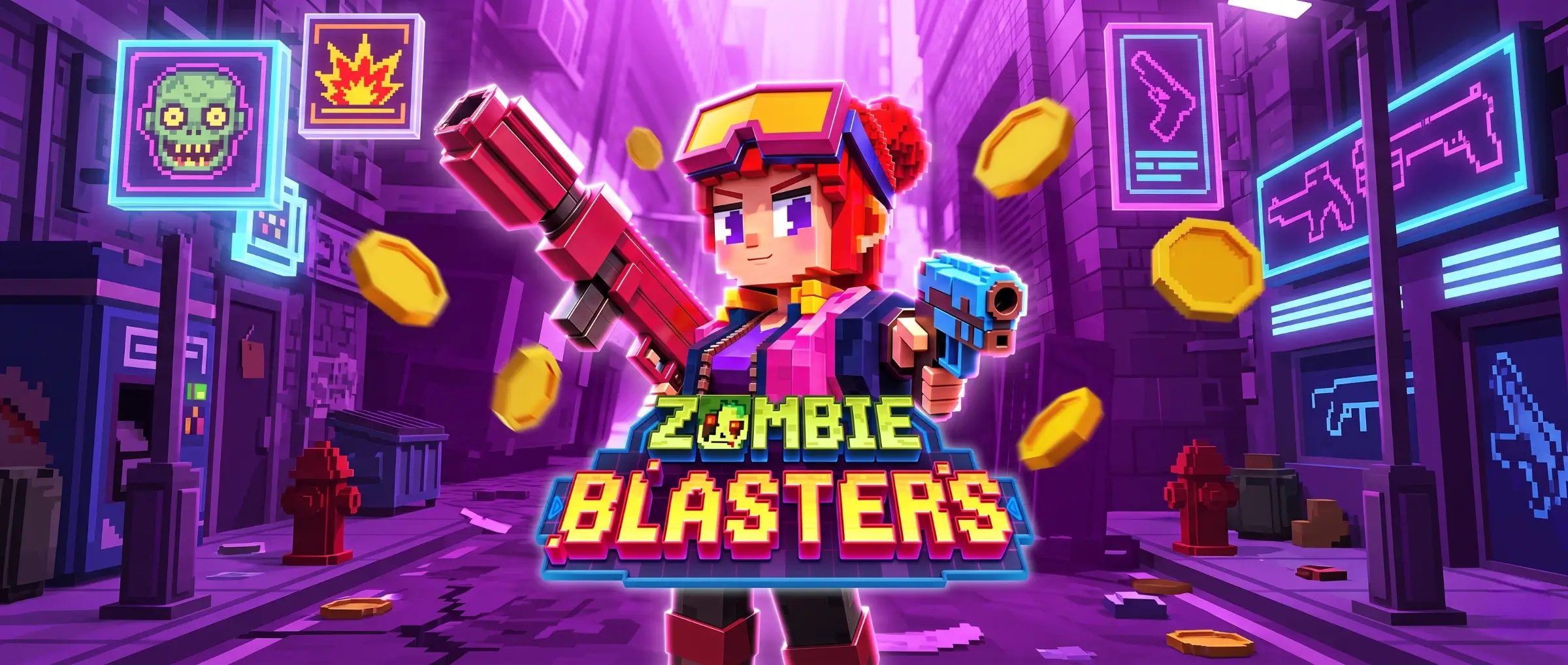
PG Soft launched Zombie Blasters on 22 June 2026 — five days ago at the time of writing. It dropped into a market where 10,000× max wins are no longer a headline. Hacksaw titles regularly exceed that. Nolimit City’s Brute Force: Alien Onslaught, arguably the closest spiritual competitor in the arcade-action space, sits at 80,000×. So before we talk about pixel art and multiplier wheels, the honest question is: does 10,000× still justify attention in mid-2026? The answer is more nuanced than the number alone suggests.
The specs: 5 reels, 6 rows, high volatility, 96.75% default RTP, 10,000× maximum win, bet range £0.60 to £180 per spin. Feature Buy is available. There are no progressive jackpots and no Megaways or Power Reels variant — this is the only version.
Math model and mechanics
RTP and what the number actually means
The published RTP is 96.75%. That figure comes from the official PG Soft release notes and is corroborated by iGamingToday and LiveBet’s catalogue listings. No conflicting figure has appeared in the press release cycle — but the standard caveat applies: PG Soft uses operator-configurable RTP settings. The 96.75% is the default (highest) tier. A casino running a reduced configuration could be serving you 95% or lower. You won’t know from the lobby page. Check the in-game information panel before you play.
What does the difference mean in practice? On a £1 spin over 1,000 spins (£1,000 wagered), the gap between 96.75% and 95% is £17.50 in expected value. Over a session targeting the bonus round, that’s not trivial.
The RTP sits slightly above the PG Soft catalogue average of 96.76% — essentially identical to it. It’s above the Nolimit City portfolio average of 96.05%, though that comparison is complicated by NLC’s dramatically higher win ceilings (which pull expected value calculations in a different direction at the extreme end).
Volatility and hit frequency
High volatility is confirmed across every source reviewed. No specific hit frequency figure has been published in the launch press materials, and given the game launched on 22 June 2026, independent testing data is not yet available.
What we can say from the math structure: a 5×6 grid with cascading mechanics typically generates more frequent small wins than a 5×3 static grid — the extra rows mean more ways to form initial paying combinations, and cascades give a second, third, or fourth chance within the same spin. But PG Soft’s high-volatility designation tells you the distribution isn’t flat. Most spins produce nothing or a small multiple of stake. The rare spins with active Alarm symbols and well-loaded Multiplier Wheels account for a disproportionate share of total return. That’s the definition of high variance — long stretches of marginal outcomes punctuated by occasional significant wins.
For bankroll management purposes: treat this like any high-volatility cascade game. A £50 bankroll at the minimum £0.60 stake gives you 83 spins before you’re out if nothing fires. That’s not a lot of runway on a game that needs the feature round to deliver its best sessions. The minimum stake is low enough to protect against catastrophic runs at low budgets, but the high-volatility classification means don’t mistake “accessible bet range” for “low risk.”
Grid and payline structure
The 5×6 layout is notably taller than PG Soft’s typical format. No payline count has been published in the launch materials — this appears to be a Pay Anywhere or cluster-adjacent mechanic rather than traditional fixed paylines, which is consistent with the cascading reel design. Winning symbols vanish, new symbols drop in, and chain reactions stack from a single spin.
Max win in competitive context
10,000× your stake. On a £1 spin, that’s £10,000. In June 2026, that max win ceiling is mid-table at best. It matches Candy Burst and Fury of Anubis (both also 10,000×). It trails Zombie Outbreak — PG Soft’s own earlier zombie title — which offers 5,000× but with a tighter math model, and it doesn’t approach the territory Nolimit City occupies.
For context: Nolimit City’s Brute Force: Alien Onslaught (the most direct arcade-action competitor with a sci-fi/gaming aesthetic) delivers 80,000× at an RTP of 96.01%. Hacksaw Gaming’s high-volatility arcade-adjacent titles routinely hit 50,000×+. The 10,000× ceiling on Zombie Blasters is functional, not exceptional.
That said — and this is worth sitting with — a 10,000× win requires either an extraordinarily lucky base game multiplier stack or a well-loaded Free Spins run. For most players, the practical ceiling of any given session is a fraction of that figure. Whether 10,000× or 80,000× is the theoretical maximum matters less to most players than how the game feels when the features fire.
Feature breakdown
Cascading reels
Trigger: Every winning spin.
Mechanic: Winning symbols are removed from the 5×6 grid. New symbols drop from above to fill the gaps. Any new winning combination from the replacement symbols pays out, and the process repeats until no new wins form.
Practical contribution: Cascades create the multiple-win-per-spin momentum that underpins the game’s math model. Without a chain reaction, the base game pays relatively little. The feature’s limitation is also the most obvious: a spin that produces no initial win generates no cascade. On a high-volatility game, that happens a lot.
Multiplier symbols
Trigger: Randomly, after any spin — winning or not.
Mechanic: One or more x2 Multiplier symbols land on the reels at the end of a spin. Your total win for that round is multiplied by the combined value of all Multiplier symbols present. Two x2 symbols produce a 4× total multiplier; three produce 8×.
Ceiling: The number of Multiplier symbols that can appear simultaneously hasn’t been specified in published materials. On a 5×6 grid with 30 positions, multiple simultaneous x2 symbols are possible but the probability of getting three or four on the same spin in the base game is low enough that you shouldn’t plan a session around it.
Honest limitation: This multiplier operates on the total win for the round, not as a persistent or accumulating value in the base game. It doesn’t carry forward. Each spin resets — which is what separates this game sharply from the Free Spins version of the same mechanic. The base game multiplier is a pleasant surprise when it fires; it’s not an engine for grinding session value.
Alarm symbol and Multiplier Wheel
Trigger: An Alarm symbol appears on the reels during a winning spin.
Mechanic: The Multiplier Wheel activates and spins to reveal a random multiplier between x5 and x50. Once the wheel lands, the Alarm symbol and any existing x2 Multiplier symbols on the reels are upgraded to the selected Wheel value before payouts are calculated.
What this means in practice: If the Wheel lands x10 and you have two x2 Multipliers already on the grid, both upgrade to x10. Your total win multiplier for that round becomes x100. The wheel landing on x5 or x10 is considerably more likely than landing x50 — the distribution of a randomly spun wheel with a range of x5 to x50 doesn’t weight toward the high end, and PG Soft hasn’t published segment probabilities. In extended testing of similar PG Soft wheel mechanics, players tend to see the lower segments (x5, x10) frequently and the top segments (x30, x50) rarely.
The two-gate problem: This feature requires both a winning spin and an Alarm symbol. Neither is guaranteed on any given spin. Sessions can pass without the wheel triggering at all, particularly in the base game. When it does fire, especially alongside a cascade chain and multiple x2 Multipliers, it produces the game’s most memorable moments. It’s a proper highlight feature — the kind that generates streaming clips. The issue is that those moments are genuinely infrequent, and the base game between them can feel thin.
Free Spins Feature
Trigger: 4, 5, or 6+ Scatter symbols landing anywhere on the reels.
Award: 10, 15, or 20 free spins respectively.
Retrigger: Landing 3+ additional Scatters during Free Spins awards 5 extra spins.
Key mechanic: All multiplier values collected during Free Spins accumulate and remain active at the bottom of the reels until the feature ends. They do not reset between spins. This is the critical structural difference from the base game — instead of each spin’s multiplier being independent and discarded, they stack persistently.
Practical ceiling: The theoretical 10,000× max win depends almost entirely on a well-stacked Free Spins run where multiplier accumulation compounds aggressively. A base game session that never triggers Free Spins is unlikely to produce anything near the ceiling. In practice, moderate Free Spins runs produce solid but not spectacular results. The monster outcomes require both good scatter placement and an Alarm symbol triggering a high Wheel value during the feature — two independent probability gates that need to align.
Honest limitation: Four Scatters is the minimum trigger for Free Spins on a 5×6 grid. That’s a meaningfully harder trigger than a three-scatter requirement. Sessions can run long before the feature fires.
Feature Buy
Available. The price is not confirmed in the launch press materials reviewed. Standard PG Soft Feature Buy pricing typically ranges from 50× to 100× stake for direct Free Spins access. Verify in-game before using it, particularly if your jurisdiction applies restrictions on bonus buy mechanics.
2026 perspective
No sequel, no variant — yet
Zombie Blasters launched five days ago. There is no Power Reels edition, no Megaways version, no sequel. For comparison purposes, PG Soft’s earlier zombie-themed release, Zombie Outbreak, provides the most relevant internal benchmark.
Zombie Outbreak runs on an irregular 4×5×4×5×4 grid with 1,600 ways to win, a 96.76% RTP, and a 5,000× max win. Its mechanic is built around Expanding Wilds on reels 2 and 4, with up to 25× multipliers that accumulate (and reset in the base game but persist during Free Spins). The bonus buy costs 75× stake. Free Spins are triggered by 3 Scatters.
Zombie Blasters doubles Zombie Outbreak’s max win ceiling from 5,000× to 10,000×. It uses a more straightforward multiplier mechanic — wheels and x2 symbols rather than expanding wilds with positional multiplier pots. The cascade mechanic is common to both, but the 5×6 grid versus Zombie Outbreak’s asymmetric 4×5×4×5×4 structure gives Blasters a different visual rhythm and slightly more symbol positions per spin. The Free Spins trigger in Zombie Blasters is harder (4 Scatters minimum versus Outbreak’s 3 Scatters), which is a meaningful trade-off given the extra reel rows — you have more positions for scatters to land, but you also need one more of them to fire the feature.
Neither version is the better game unconditionally. Zombie Blasters has the higher ceiling and the simpler mechanic, which makes it more approachable for players who haven’t played PG Soft before. Zombie Outbreak’s expanding wild system, where multipliers attach to specific reel positions and accumulate during Free Spins without resetting, gives experienced players more to track and rewards a session-management mentality. The bonus buy on Zombie Outbreak costs 75× stake. The Zombie Blasters buy price hasn’t been published in the launch materials, but PG Soft’s typical range puts it at 50–100× stake.
Competitive landscape in June 2026
The comparison that matters most isn’t internal to PG Soft’s zombie catalogue. It’s how Zombie Blasters sits alongside the broader arcade-action high-volatility space — and that’s where the picture becomes more honest than flattering.
Nolimit City’s Brute Force: Alien Onslaught (RTP 96.01%, max win 80,000×): This is the closest thematic competitor — arcade aesthetics, sci-fi/action energy, xNudge mechanics creating exponential multiplier potential. The max win gap is stark. Brute Force is significantly harder to play through (Nolimit City’s typical low-single-digit hit frequency versus the more accessible PG Soft cascade approach), but the payoff potential is in a different category entirely. Players who already know they want an arcade-style high-volatility game and are comparing options have a strong reason to choose Brute Force if the win ceiling matters to them.
Hacksaw Gaming’s Stick Em (RTP 96.09%, max win 25,600×): A simpler multiplier mechanic — symbols stick in position and pay multipliers — lower volatility than Zombie Blasters, but a substantially higher win ceiling and a £0.10 minimum bet that makes it more accessible for small-budget high-variance runs. Players hunting max win potential on a modest bankroll have a competitive alternative here.
BGaming’s Frenzy Clusters (released June 2026, RTP 97.11%, max win 10,000×): A direct contemporary competitor with an importantly higher published RTP and the same theoretical max win. Frenzy Clusters runs on a cluster-pay expanding grid with five selectable character companions. At 97.11%, if both games run at their default RTP settings, BGaming returns significantly more per £100 wagered over a long session. This is Zombie Blasters’ sharpest competition — same ceiling, released the same month, higher return.
The honest assessment of where Zombie Blasters sits: it’s a well-executed, mobile-first cascade slot with a satisfying feature set and a competitive — though not leading — RTP. The 10,000× ceiling isn’t a drawcard for players who care about the max win number, because the 2026 market has trained players to expect considerably more from high-volatility releases. What Zombie Blasters offers instead is PG Soft’s characteristic accessibility — clean mechanics, recognisable feature framework, and a Feature Buy option that removes the scatter wait for players who want to target the bonus directly.
Buy-bonus availability
Yes, Feature Buy is present. This matters in 2026 because players targeting max win attempts increasingly skip the base game entirely and run repeated bonus buys. Without Feature Buy, Zombie Blasters would be a harder sell to that segment of the high-volatility player base. Its presence opens the game to streamers and bonus hunters who otherwise wouldn’t look at it.
Progressive jackpot
None. Not a factor in this game’s value proposition.
Verdict
Zombie Blasters — the only version, as it stands in June 2026
This is a solid, playable cascade slot from a provider that consistently delivers above-average RTPs and clean mobile experiences. The Multiplier Wheel is genuinely fun when it fires — the x5 to x50 range and the upgrade mechanic create moments of real surprise. Persistent multipliers in Free Spins give the bonus round a building tension that the base game lacks.
The limitation the game can’t escape is its win ceiling. At 10,000×, Zombie Blasters competes against BGaming’s Frenzy Clusters (same ceiling, 97.11% RTP) and sits far below Nolimit City’s Brute Force: Alien Onslaught (80,000×) and most Hacksaw releases in the same volatility bracket. If the max win number is what you’re chasing, there are better instruments for that job right now.
Play if: You want a high-volatility slot with an accessible mechanic, a genuine Feature Buy option, and a 96.75% default RTP — and you’re not fixated on the theoretical ceiling. PG Soft’s mobile-first build is excellent, and the game will run cleanly on any device. Budget-conscious players who want a proper high-volatility experience without the brutal dry stretches of NLC’s more extreme releases will find Zombie Blasters approachable.
Skip if: Your sessions are structured around max win potential above 10,000×. The cascade mechanic, without an accumulating persistent multiplier in the base game, means your ceiling is almost entirely determined by Free Spins performance. If you’re buying bonuses repeatedly to hunt a result, Brute Force: Alien Onslaught or Frenzy Clusters offer more upside for the same risk. Come back to Zombie Blasters when PG Soft releases the inevitable sequel — the mechanic framework here has room to grow.