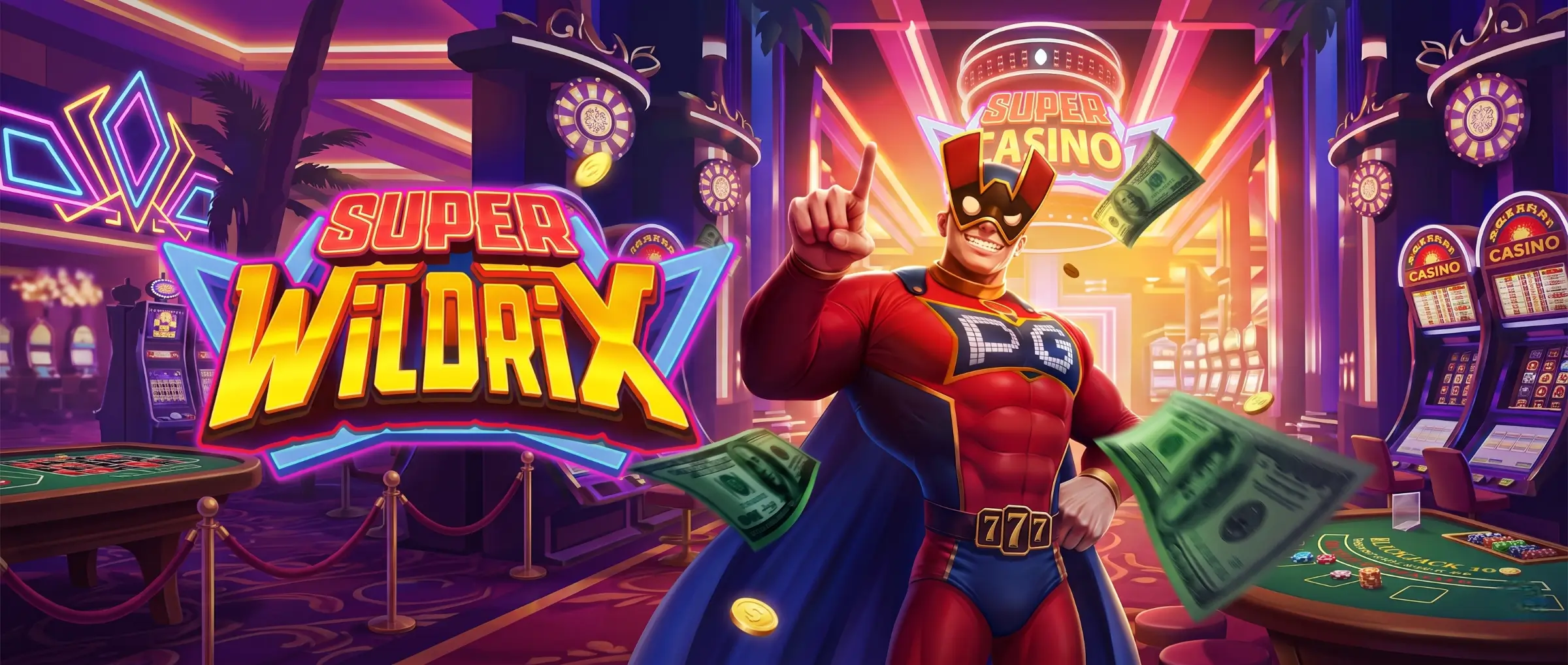
Super Wildrix landed in May 2026 — which makes it one of the freshest entries in PG Soft’s library right now. The studio dropped it into a slot market that has spent the last two years raising the bar on multiplier mechanics, buy-bonus design, and bonus round depth. So the timing matters. A new release from a major provider at a point when players have already played hundreds of expanding-wild variants should carry something that earns its place in a lobby. The question worth asking at the outset: does Super Wildrix bring it?
The headline numbers look reasonable. An RTP of 96.75%, a max win of 20,000×, high volatility, and a 5×5 grid with 25 fixed paylines. That’s a game presenting itself as a proper high-variance title with competitive math. Whether the feature design can actually deliver on those numbers is a different conversation, and it’s one worth having.
One context point before the numbers: PG Soft sits on an MGA licence and a UKGC certification, giving Super Wildrix access to the regulated European market as well as operator networks globally. The studio is established — founded in 2015, over a decade of catalogue — and Super Wildrix benefits from that distribution. It’s available broadly across major operator networks from day one, which matters less for players and more for understanding why a game with this feature set gets shelf space it might not earn purely on novelty.
Design and presentation
The superhero premise is Neonshine City under siege. Armed criminals have stormed the Crystal Casino, police can’t hold them, and the masked Wildrix is the only one with a cape and a multiplier. It’s a decent setup for a slot’s title screen. The problem is it stays on the title screen. The actual reels carry classic fruit symbols — cherries, grapes, horseshoes, bells, lucky 7s — alongside card ranks. The criminals never materialise in the gameplay. The narrative tension the premise suggests has no mechanical expression.
On mobile, the 5×5 grid reads cleanly in portrait mode. The controls sit below the grid with good spacing, the symbol set is sharp and readable at small sizes, and the blurred casino-floor backdrop keeps the visual focus on the reels. On desktop, the same layout occupies less screen real estate than it should; there’s notable dead space on both sides. PG Soft engineered this for the mobile-first market and it shows — it’s the right call for their primary audience but a noticeable concession for desktop players.
The soundtrack is upbeat electronic with hip-hop influence. Reviewers who spent extended sessions with the game note it gets repetitive quickly and several muted it within the first few minutes. That’s not uncommon for a slot soundtrack, and it doesn’t affect the mechanics. Mute button is in the usual place.
Math model and mechanics
Start with the RTP. Every source covering Super Wildrix — SlotCatalog, BigWinBoard, AboutSlots, FruitySlots, iGamingToday — agrees on 96.75%. There’s no reported operator-configurable RTP range for this title, which is less common for a PG Soft release; some of their catalogue allows operators to select from multiple return configurations. Here, sources consistently cite a single figure. Take that at face value unless your operator’s game info panel says otherwise.
The 96.75% RTP sits above PG Soft’s own portfolio average of around 96.73–96.76%, which is itself well above the broader industry average. In practical terms: over 10,000 spins at £1, the theoretical hold is around £32.50 versus the £40–50 you’d expect at 96%. That margin sounds small, but it compounds meaningfully over extended sessions.
Volatility is confirmed high across all reviewed sources. Here’s what that actually means at the table: you will spin through extended stretches — sometimes dozens of spins — with nothing worth mentioning. Then a Wildrix drops, expands, and the maths shifts suddenly. This is not a game that feeds you a steady drip of small wins to keep you comfortable. Hit frequency is 22.03%, meaning roughly one in five spins returns something. The catch: the vast majority of those hits are negligible. The 22.03% figure sounds like it softens the variance; it doesn’t. Small bells and cherries paying 1–2× the bet do not constitute meaningful session support when you’re waiting for expanded Wildrix stacks.
To put the session math in concrete terms: at £1 per spin, 22.03% hit frequency means you’ll see a return on roughly 22 out of every 100 spins. At a 96.75% RTP, your theoretical return over those 100 spins is £96.75. Distributed across 22 hitting spins, the average hit value is around £4.40 — which sounds healthy until you realise that the distribution is wildly skewed. The majority of those 22 hits are £0.60–£2 from card rank and low-premium combinations. A handful carry the weight. This is high variance in practice: long, quiet stretches punctuated by sharp spikes when the Wildrix mechanics align. If you’re playing a £100 session at £1 per spin, you should expect to see 200+ spins before drawing meaningful conclusions about how the math is running for that session. Short sessions on this game are statistically noisy.
The grid is 5 reels, 5 rows, 25 fixed paylines, paying left to right from reel one. Standard construction, no surprises. Bet range is where sources diverge. The two most commonly cited ranges are £0.75–£225 (from FruitySlots, iGamingToday, AboutSlots) and €0.25–€100 (from SlotCatalog). The discrepancy likely reflects different operator configurations or regional denominations — this is common with PG Soft titles where the currency display shifts the displayed range. Check the game’s bet panel before your first spin; do not assume either range applies to your operator’s version.
The 20,000× max win is where this slot tries to make its statement. Placed in context: 20,000× at a £1 stake is £20,000. In 2026, that ceiling is competitive for the high-volatility tier — it matches titles like Hacksaw Gaming’s Duel at Dawn and sits well above the 10,000× ceiling of Spinman. It’s not the upper boundary of what’s available (Chaos Crew 3 hits 30,000×, some Nolimit City titles go higher), but it’s legitimate headroom. The problem is not the number. It’s that reaching 20,000× requires the kind of stacked Wildrix alignment with a high multiplier wheel value that happens rarely enough to be genuinely exceptional. More on that in the feature section.
There’s no buy-bonus cost specified universally across reviewed sources, which is a minor gap in the available data. PG Soft confirmed the Feature Buy exists in their release communication; the cost as a multiple of the stake is something to check in your operator’s game info panel.
Symbol payouts are structured around a bottom tier (card ranks 10 through A, paying 0.6× the bet for a five-of-a-kind) and a premium tier (cherries, grapes, horseshoes, bells, and 7s, paying between 1× and 4× the bet for a five-of-a-kind). Neither tier is meaningful in isolation. This is a game where almost all significant returns flow through the Wildrix mechanic.
Feature breakdown
The Wildrix expanding wild
The Wildrix symbol is the engine the entire game runs on. When it lands on any reel, it expands immediately to fill that reel from top to bottom. It substitutes for all regular symbols. Crucially, every Wildrix carries a built-in ×2 multiplier.
When multiple Wildrix symbols expand on the same spin, their multipliers stack — the total is the sum of all active Wildrix multipliers combined, not the product. So two expanded Wildrix symbols produce ×4, three produce ×6. That stacking logic is clean and easy to follow. It also sets the ceiling for base game action: four simultaneous Wildrix symbols would generate a ×8 multiplier applied to whatever paylines they help form. Given premium symbol pays top out at 4× the bet for five of a kind, the arithmetic on a base game four-Wildrix spin is meaningful but unlikely to approach the theoretical ceiling.
The mechanic is honest about what it is: an expanding wild with additive multipliers. It works. When two or three Wildrix symbols land in the same spin — a moment that does arrive periodically — the effect is striking enough to make the wait feel worthwhile. In extended base game play, the most common Wildrix occurrence is a single expanded reel providing a ×2 multiplier on a moderate payline hit. Useful. Not headline-making.
Worth understanding the multiplier stacking logic precisely, because it shapes your expectations. Two expanded Wildrix symbols produce a combined ×4 multiplier applied to the win. Three expanded Wildrix symbols produce ×6. This is addition, not multiplication — which is the right call for game balance but also limits the ceiling more than a multiplicative system would. If PG Soft had gone multiplicative (×2 × ×2 = ×4, then ×4 × ×2 = ×8), the three-Wildrix outcome would hit ×8 rather than ×6. The difference is modest at three Wildrix, but it compounds the further out you go. With four Wildrix symbols — an unlikely but possible scenario — the additive system gives ×8 while a multiplicative approach would deliver ×16. For a title where the entire value proposition rests on multiplier accumulation, that design choice keeps the base game ceiling conservative.
There is also a standard Wild symbol (a golden W) that substitutes in the same way as the Wildrix but without the expansion or built-in multiplier. Its role is padding — filling paylines in spins where the Wildrix doesn’t appear.
Free spins feature
The free spins trigger follows a graduated structure: 3 Scatter symbols award 10 free spins, 4 award 15, and 5 award 20. Scatters can appear anywhere on the 5×5 grid. Three Scatters is the most likely trigger point; five Scatters would be unusual.
The Multiplier Wheel is the mechanism that theoretically separates the free spins from the base game. Before every free spin, the wheel spins and lands on a value between ×2 and ×100. If any expanded Wildrix symbols land during that spin, the ×2 multiplier on each Wildrix is then multiplied further by the wheel result before the total is applied to wins.
Here’s the mechanic in full: a single Wildrix in a free spin where the wheel lands on ×50 would produce a ×100 effective multiplier (2 × 50). Two expanded Wildrix symbols in the same spin with a ×50 wheel would give ×100 per Wildrix, combined as ×200. This is where the 20,000× lives, theoretically. The probability of a high wheel value coinciding with multiple expanded Wildrix symbols in the same spin is low. Reviews from extended session play note that the wheel most commonly lands in the ×2 to ×10 range, with higher values appearing infrequently. The ×100 wheel outcome is present but rare.
The free spins round has one honest limitation worth stating clearly: the bonus does not dramatically alter the base game dynamic. The Wildrix symbols operate identically. The multiplier wheel is the only added element. If you enter free spins expecting a transformed game mode — cascades, collecting mechanics, symbol upgrades — this round will feel incremental. What it does do is create session-by-session variance: one free spins run delivers a modest return, another lands a ×50 or ×80 wheel value at the right moment and produces something significant.
Thinking through the peak scenario helps calibrate expectations. Maximum free spins (20, triggered by 5 Scatters) with a ×100 wheel value on a spin where two expanded Wildrix symbols land: combined multiplier of ×200 (each Wildrix’s ×2 multiplied by ×100, applied as their sum). Applied to a premium five-of-a-kind paying 4× the bet, you’re looking at ×800 from that single spin. Chain that across several spins in a long retrigger session with consistent wheel values and you approach the 20,000× ceiling. Getting there requires multiple conditions to align independently — scatter count, wheel value, Wildrix count, symbol combination — and each of those conditions is independently unlikely. The ceiling is real. The path to it is narrow.
In practice, a typical free spins entry (10 spins from 3 Scatters) with no retrigger and wheel values landing mostly in the ×2–×10 range will deliver 30–80× the triggering bet at moderate Wildrix frequency. That’s a functional result — not outstanding for a high-variance title, but enough to extend your session. The retrigger adds 3 extra spins per 2 Scatter occurrence; players in extended sessions report chaining this occasionally, which can push a single bonus round to 20+ spins and meaningfully increase exposure to high wheel values.
Retriggering is possible. Landing 2 Scatter symbols during free spins awards 3 additional spins. The feature can be retriggered multiple times, which can extend bonus sessions considerably, though re-triggers don’t land often.
Ante Bet
The Ante Bet increases the total stake by ×10 and guarantees at least one Wildrix symbol on every spin and every free spin in the subsequent feature. On paper, it’s a way to effectively buy higher Wildrix frequency without going straight to the Feature Buy. In practice, the value proposition is questionable. The ×10 stake increase is significant, and a guaranteed single Wildrix doesn’t assure a meaningful payout — it just ensures the mechanic activates. A Wildrix landing on reel three with no supporting paylines delivers a ×2 multiplier on a combination that doesn’t connect. You’ve paid ×10 for the guarantee and received a dressed-up non-event. It’s best treated as a short-term commitment for players who specifically want to accelerate Wildrix frequency during a session, not a mathematically sound long-term mode.
Feature Buy
Super Wildrix includes a Feature Buy option that allows direct access to the free spins round. PG Soft confirmed this in their release communications. The exact cost of the buy is not universally specified in reviewed sources. This is the right way to approach a session for players who find the base game Scatter frequency frustrating — buying directly into the round where the Multiplier Wheel and guaranteed Wildrix activity produce the game’s theoretical ceiling outcomes. In regulated markets where Feature Buy is unavailable (UKGC-licensed sites, for example), this option will be absent from your version.
2026 perspective
Super Wildrix has no direct sequel or Power Reels variant as of this writing — it released in May 2026 and the studio hasn’t announced an evolution of the concept yet. This means there’s no comparison to a “Super Wildrix Megaways” or upgraded version to run against. What exists is the original, and it should be assessed against the market it’s entering.
The immediate competitive pressure comes from two directions. First, from within PG Soft’s own catalogue. The studio has already delivered expanding wild titles with multiplier mechanics, and Super Wildrix doesn’t represent a mechanical leap over earlier PG Soft work. Mahjong Ways (96.92% RTP, 25,000× max win) or Garuda Gems (20,000× max win, similar volatility) offer comparable or stronger ceilings from the same studio. The argument for Super Wildrix over earlier catalogue entries rests on its straightforward execution and mobile-first design, not on feature innovation.
Second, from direct competitors targeting the same mechanical space. Hacksaw Gaming’s Spinman (96.23% RTP, 10,000× max win) covers nearly identical thematic territory — superhero narrative, expanding wild reels, multiplier wheel mechanics — but with a more elaborate free spins structure offering three distinct bonus modes. Spinman’s 10,000× ceiling is lower, which makes Super Wildrix’s 20,000× the clear mathematical advantage. If you’re choosing between the two based purely on payout potential, Super Wildrix wins. If you’re choosing based on bonus round depth and feature variety, Spinman’s tiered bonus structure is more developed.
Hacksaw Gaming’s Duel at Dawn (96.25% RTP, 20,000× max win) is a second useful reference — same volatility tier, same max win ceiling, but a different mechanic family (sticky multiplier wilds rather than expanding). Duel at Dawn’s free spins carry accumulating multipliers that build through the round rather than resetting per spin; that progressive structure creates a different tension arc than the wheel-per-spin approach in Super Wildrix.
The Feature Buy absence is not a concern here — the option is present. That resolves one question that has made other recent releases harder to recommend to bonus-focused players.
The progressive jackpot question: there is none. This is a fixed max win title. 20,000× is the ceiling and there’s no network pool above it. For jackpot hunters, that’s a definitive answer. For players comfortable with fixed ceilings, the 20,000× is sufficient headroom.
The honest assessment of Super Wildrix against the 2026 landscape: it’s a game that does what it says on the label. The RTP is fair, the max win is legitimate, and the Wildrix mechanic works cleanly. What it cannot credibly claim is a distinctive identity. The superhero framing evaporates the moment the title screen closes. The mechanics — expanding wild, additive multipliers, multiplier wheel in free spins — are tools PG Soft and its peers have deployed before, assembled here without a twist that adds something unexpected. In a lobby where players have already cleared similar mechanics dozens of times, Super Wildrix is the option that works but doesn’t pull you back.
One area where it does hold a practical edge is mobile play. PG Soft built this specifically for portrait-mode mobile sessions, and the 5×5 grid with its compact symbol set reads clearly on a phone screen. On desktop, the same grid occupies less screen real estate than you’d want, and the blurred casino-floor backdrop feels like dead space at the sides. This is not a sitting-at-your-desk slot. It was made for commutes and quick sessions on a mobile device, and the interface reflects that — the controls sit cleanly below the grid and every element scales correctly on a mid-range Android or iOS device. For operators targeting mobile-first markets, that’s a meaningful distribution advantage over desktop-first releases.
What the game doesn’t have, and what this competitive set largely does, is a variable or escalating bonus round structure. Most comparable titles offer either: tiered free spins modes with different Wildrix/wild frequencies (Spinman’s three-mode structure), multipliers that accumulate over the bonus rather than resetting each spin (Duel at Dawn), or sticky wilds that persist through the feature (various Nolimit City titles). Super Wildrix’s free spins reset the multiplier wheel on every spin independently. Some runs will deliver three consecutive ×2 wheel values followed by no Wildrix; others will chain a ×60 wheel with a double expanded Wildrix mid-feature. That variance within the bonus round is real. But there’s no escalating mechanism that locks in gains or builds momentum across spins the way a sticky or persistent multiplier does. Mathematically, the ceiling is there. The structure to reach it systematically isn’t.
Verdict
Super Wildrix: the original
This is a well-built, mathematically solid PG Soft release from May 2026. The 96.75% RTP is among the better rates in the high-volatility segment. The 20,000× ceiling is legitimate and competitive. The Wildrix mechanic delivers real moments when multiple wilds stack — those spins have weight. The problem is the space between them. High volatility and a 22.03% hit frequency means significant stretches of low-value hits, and the free spins round’s Multiplier Wheel doesn’t reshape the experience dramatically enough to change that rhythm. The Ante Bet is a costly way to guarantee minimal improvement; the Feature Buy is the tool worth using if you want to shortcut to the game’s ceiling conditions.
The player profile for whom this makes sense: you want clean, high-variance play with a straightforward mechanic, you’re comfortable with the wait between significant hits, and you’re either using the Feature Buy or have the bankroll to find free spins organically. At £1 per spin, you need realistic session funds — several hundred spins before a feature trigger is not unusual. You also need to be the kind of player who can resist the Ante Bet pitch. A ×10 stake increase for a guaranteed single Wildrix is a bad trade most of the time. The guaranteed Wildrix doesn’t guarantee a paying combination around it.
The player profile for whom it doesn’t: you’re looking for a deep or varied bonus round, you want a game that does something different with the expanding wild format, or you’re playing at the minimum stake and expecting the Ante Bet to cover the cost. The bet range — £0.75–£225 per spin as cited across multiple review sources, though SlotCatalog lists €0.25–€100 for their regional version — is wide enough for most bankrolls, but the game rewards patience and session length, not opportunistic short play. Verify the actual range in your operator’s game panel; the discrepancy between sources suggests operator-level configuration differences.
If you’re choosing between Super Wildrix and Hacksaw Gaming’s Spinman at the same stake level: Super Wildrix wins on RTP (96.75% versus 96.23%) and max win ceiling (20,000× versus 10,000×). Spinman wins on bonus round variety and mechanical depth. If you’re choosing between Super Wildrix and Duel at Dawn from the same provider at the same volatility: the max win ceiling is identical at 20,000×, the RTP is nearly matched, but the bonus dynamics differ meaningfully. Duel at Dawn’s accumulating multiplier structure builds through the round; Super Wildrix’s wheel resets independently per spin. Depending on your preference for progressive vs. variance-within-variance bonus design, that distinction matters.
No sequel exists as of June 2026. When PG Soft does build one — and the studio’s pattern suggests they will — the feature request list writes itself: a three-tier free spins mode with increasing Wildrix frequency, multiplier persistence across spins rather than per-spin resets, and a sticky Wildrix variant that holds for the remainder of the bonus. The foundation is sound. The mechanic needs layering. Until that version arrives, the original is what it is: a competent, mobile-first, high-variance slot with honest maths and a feature set that delivers its ceiling infrequently. Play it with the Feature Buy if you want to chase 20,000×. Play the base game if you’re comfortable with the wait. Skip the Ante Bet entirely.