Endorphina released Sloth Game in 2026, and on paper it looks like a studio finally stacking real mechanical depth onto one of its releases. Hold and Win, a Pick Me bonus, a Free Games round, sticky symbols, an energy collection system and a gamble feature all sit on a single 5×3 grid. That’s a lot of moving parts for a developer whose portfolio has historically leaned on two or three features per title.
The question is whether any of that matters when the max win sits at 1,600x stake. In a year where Hold and Win specialists like Hyper Gold push 12,500x and cash-collect titles from smaller studios routinely clear five figures, a sub-2,000x ceiling puts Sloth Game in a specific, narrower lane. At 96.08% RTP and high volatility, this is a game asking players to absorb real variance for a payout structure that doesn’t reach very high. Whether that trade-off works depends entirely on what you’re actually looking for from the Hold and Win round — and that’s the analytical question worth answering properly.
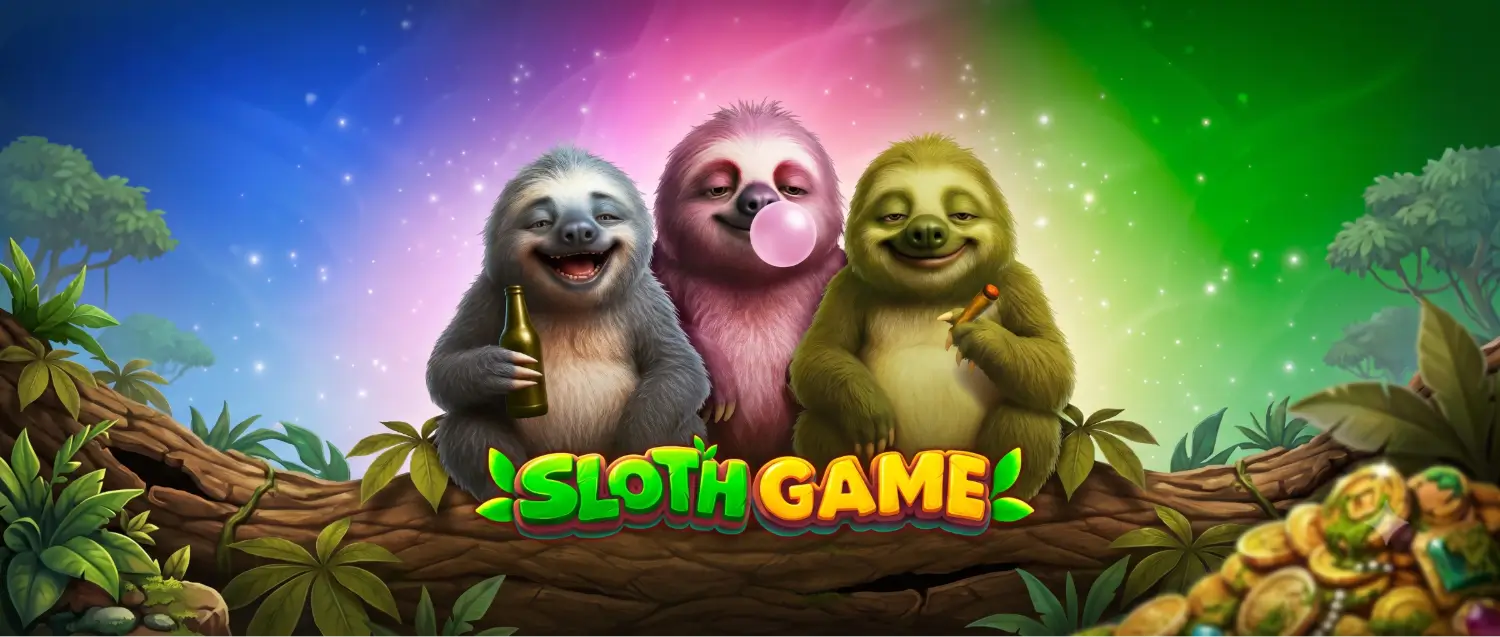
There’s also the theme to reckon with, if only briefly. Endorphina has built a jungle comedy around lethargic sloths hoarding junk food — burgers, popcorn, pizza, beer, cigars — which is a deliberate tonal departure from the mythology and treasure themes that dominate the studio’s back catalogue. That choice doesn’t change the math underneath, but it does frame expectations: this reads, on the surface, like a casual, low-stakes theme wrapped around a genuinely high-variance mechanic stack, and that mismatch is worth flagging before getting into the numbers.
The math model: a familiar RTP wrapped around an unusually crowded feature set
Every source tracking Sloth Game agrees on the headline number: 96.08% RTP. Unlike a lot of 2026 releases where operator-configurable RTP ranges create three or four competing figures, this one is clean — official Endorphina channels, aggregator databases and casino listing pages all cite the same 96.08%. There’s no configurable range to flag here — a genuine exception given how common that practice has become across 2026 releases.
What’s worth sitting with is where 96.08% sits relative to convention. Most experienced players treat 96.10% as an informal floor for “acceptable” return on a high-volatility title, and Sloth Game sits fractionally under that line. On a £100 session, the practical difference between 96.08% and 96.10% is about two pence in theoretical house edge — not something that changes a session outcome. But volatility is where the RTP figure gets tested. High volatility means the 96.08% return isn’t smoothed across regular small wins; it’s concentrated into infrequent larger hits, mostly gated behind the bonus rounds. That combination — high variance, sub-benchmark RTP, and a max win that isn’t especially high either — means Sloth Game is absorbing more risk than it’s compensating for. You’re not being paid extra for the dry spells the way you would be on a title with a genuinely stretched ceiling.
Hit frequency isn’t published for this title, which is a real gap. Every aggregator and review site that’s covered Sloth Game notes the same absence. Without that number, there’s no way to calculate how often the base game should be expected to pay, which makes bankroll planning a guessing exercise rather than a calculation. One tester’s session notes described base game wins landing somewhere between 0.3x and 6x stake, with the top-paying Double Burger symbol needing a full five-of-a-kind to hit its 40x ceiling — infrequent, and not the game’s real engine.
That absence of published hit frequency data isn’t a minor omission. On a game this feature-heavy, hit frequency tells you how long you’re realistically spinning between meaningful triggers, and that number typically shapes whether a high-volatility title feels rewarding or punishing across a normal session length. Endorphina hasn’t published it for Sloth Game at the time of this review, and none of the major aggregators have run enough tracked spins to estimate it independently — Spindex’s own data notes only around 9,000 tracked bets on the title, nowhere near the sample size needed to derive a reliable frequency figure. Until that changes, budget for the base game to do very little on its own and plan your stake size around dry stretches rather than around the paytable’s small-win column.
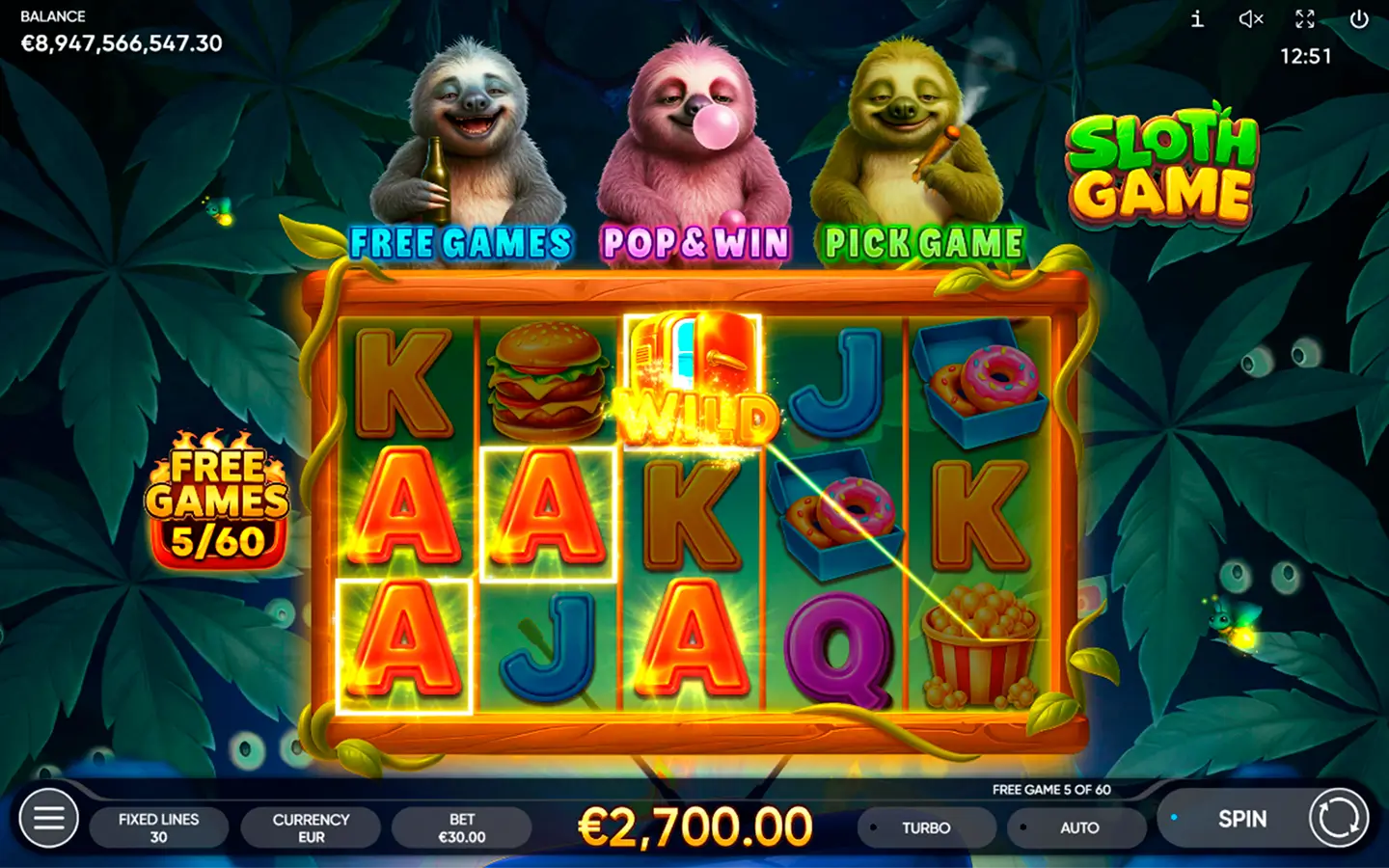
The grid itself is standard Endorphina territory: 5 reels, 3 rows, 30 fixed paylines, left-to-right win evaluation. Nothing unconventional in the structure — the studio hasn’t reinvented the base layout here, and the paylines run the same direction they always do on Endorphina’s flagship releases. Compare that to the studio’s own Fortune Chests, which strips down to a 3-reel, 3-row, 5-payline classic-fruit format, or Thunder Crown, which stretches to a 5×5 grid with 50 fixed lines. Sloth Game sits in the middle of that range structurally, closer to the studio’s default template than to either extreme. The feature stack does the heavy lifting instead.
Bet range specifics aren’t published across the sources reviewed here either. Several Endorphina titles in the same release window list bet ranges from roughly £0.10 up to £87.50 per spin, but nothing on Sloth Game’s official page or the major aggregators confirms that range applies here specifically. Treat any bet ceiling you see quoted for this title as an estimate carried over from a comparable Endorphina release rather than a confirmed figure for this game.
On max win: 1,600x stake is the confirmed ceiling across every source that’s tested the game, with no conflicting figures found. Put in context, Endorphina’s own Troll Faces — also flagged high volatility — caps at 2,000x, and that’s still a modest number by 2026 standards. Wolf Gold, the Pragmatic Play title widely credited with creating the modern Hold and Win template back in 2017, tops out at 2,500x on a lower, medium-volatility profile. Hyper Gold, released by Gameburger Studios in 2021, shares Sloth Game’s exact 96.08% RTP but reaches 12,500x — nearly eight times the ceiling on the same base return. That’s the number that matters here: Sloth Game is charging high-volatility variance without paying high-volatility money.
Feature breakdown: three sloths, three bonuses, one energy meter tying it together
The token and sloth trigger system
Three sloths sit above the reels, and each one is watching for a specific token symbol — beer, gum, or a cigar — to land. Tokens appear across the main game and free games, covering positions on the grid before flying off to reveal whatever symbol sits underneath, which can complete a winning combination on its own. When enough of a given token lands, the matching sloth “grabs” it and fires its associated bonus.
The Blue Sloth is the one to watch for accessibility: landing enough beer tokens triggers the Free Games round directly, no separate scatter requirement layered on top. It’s the most straightforwardly reachable of the three bonus paths, which matters given how thin the base game is on its own.
One honest limitation here: exact trigger counts (how many tokens of each type are required) aren’t published on any source reviewed, official or third-party. That’s a gap worth naming rather than papering over with an invented number.
Free Games — Blue Sloth
Landing the Blue Sloth’s trigger awards 30 free spins. Additional free spins can be won within the round itself, extending play without requiring a full separate retrigger in the traditional sense — the mechanic layers on top of what’s already running rather than resetting it. Sticky symbols apply during this round: high-value symbols that land stay locked in place while the remaining reels continue to spin around them, which is where most of the round’s realistic payout potential lives.
The catch: because sticky symbols only compound value that’s already landed, a Free Games round that opens with weak initial symbols has limited room to recover. This is a round that rewards a strong start more than it rewards patience. Compare that to Hold and Win rounds elsewhere in the Hold and Win category, such as Wolf Gold’s respin structure, where every symbol landing is a fresh independent chance regardless of how the round opened — Sloth Game’s Free Games round doesn’t offer that same reset, which is a real structural difference worth knowing before you’re twenty spins into a cold start.
Hold and Win — the headline mechanic
This is the feature the game is actually built around. Bonus symbols land and lock in place while the remaining positions on the grid respin, continuing until either no new bonus symbols appear for a set number of attempts or the entire grid fills. Fixed jackpot tiers are embedded directly in this round rather than sitting as a separate feature.
Here’s where the sourcing gets genuinely inconsistent, and it’s worth stating plainly rather than picking one figure and moving on. Endorphina’s own official game page lists the tiers as Min, Mid, Max, and Ultra. A separate industry news write-up covering the game’s launch at a crypto casino names them Min, Minor, Major, and Grand. A third aggregator refers to Mini, Minor, and Major with no fourth tier mentioned at all. That’s three different naming conventions for what should be one fixed structure, and none of the sources publish the actual credit values attached to each tier. Endorphina hasn’t made those values public, and no aggregator has pulled them from a certified paytable. Until that changes, treat any specific jackpot value you see quoted elsewhere as unverified.
What is consistent: jackpots here are fixed, not progressive. There’s no pooled, growing prize climbing across the network — every tier pays a set multiplier of stake, which caps how far Hold and Win alone can push a session total. That’s not automatically a weakness (progressive jackpots come with their own long-odds problems), but it does mean the round’s realistic ceiling is closer to the base game’s overall 1,600x cap than the word “jackpot” might suggest.
Compare that structure to Pragmatic Play’s Wolf Gold, where the top Mega jackpot is only awarded for filling all 15 grid positions during the bonus — a genuinely rare outcome that anchors the game’s reputation for suspense. Sloth Game’s respin-until-no-new-symbols structure works similarly in principle: the longer the respin chain runs without stalling, the closer the round gets to its own equivalent of a full-grid outcome. Without published values for the Min, Mid, Max, and Ultra (or Minor, Major, Grand — depending which source you trust) tiers, there’s no way to say how that structure compares in practice. What can be said is that the naming inconsistency across three separate sources for a fixed, unchanging paytable structure is unusual, and it suggests the tier values themselves simply aren’t in general circulation yet.
Pick Me Bonus — Green Sloth
The Green Sloth’s token — gum, in the sources that specify — opens a straightforward pick-and-reveal screen. Players select from a set of hidden prizes until the round resolves. This is the most predictable of the three bonus paths in terms of payout distribution; pick-and-reveal mechanics generally spread value more evenly than Hold and Win’s respin structure.
The one figure that’s actually confirmed here is meaningful: the round’s top single prize, referred to in coverage as the Blaze Award, pays up to 1,000x total bet. That’s the single biggest number attached to any individual feature in the game, and it sits close to the overall 1,600x max win — meaning the Pick Me round, not Hold and Win, is realistically where the game’s headline outcomes come from. That’s a genuinely counterintuitive result for a game marketed around its Hold and Win mechanic: the pick-and-reveal side bonus, not the headline feature, carries the bigger single-hit ceiling. Players chasing the game’s biggest number should be tracking Green Sloth triggers, not respins.
You might ask why a Pick Me round outpaces a dedicated Hold and Win jackpot structure in a game built around the latter. The honest answer is that fixed jackpot tiers, whatever their exact values turn out to be, are capped by design — they exist to deliver a reliable mid-size outcome, not to chase the game’s absolute ceiling. Pick-and-reveal rounds have more room to hide a single outsized prize among a set of smaller ones, which is exactly what the Blaze Award appears to be doing here.
Wilds, symbols, and the random multiplier
An Open Refrigerator wild appears on reels 2 through 5 in both the main game and free games, substituting for everything except the Bonus and Token symbols. The Double Burger is the top-paying regular symbol, worth 40x stake for a five-of-a-kind line hit; the Popcorn Box sits second at 30x. A random multiplier can also apply during ordinary play, though no source publishes its range or trigger frequency — another unconfirmed detail worth flagging rather than guessing at.
The Pile Feature and energy collection
Running alongside the three bonus paths is a Pile Feature — described as the on-screen sloths visibly growing bigger as an underlying energy meter builds toward the feature rounds. This is a collection mechanic layered over the base game rather than a bonus round in its own right, and it’s the piece that gives Sloth Game its “more going on than a typical Endorphina release” reputation. Whether it meaningfully changes payout outcomes or is primarily a pacing and presentation layer isn’t something the available sourcing confirms either way.
Risk Game
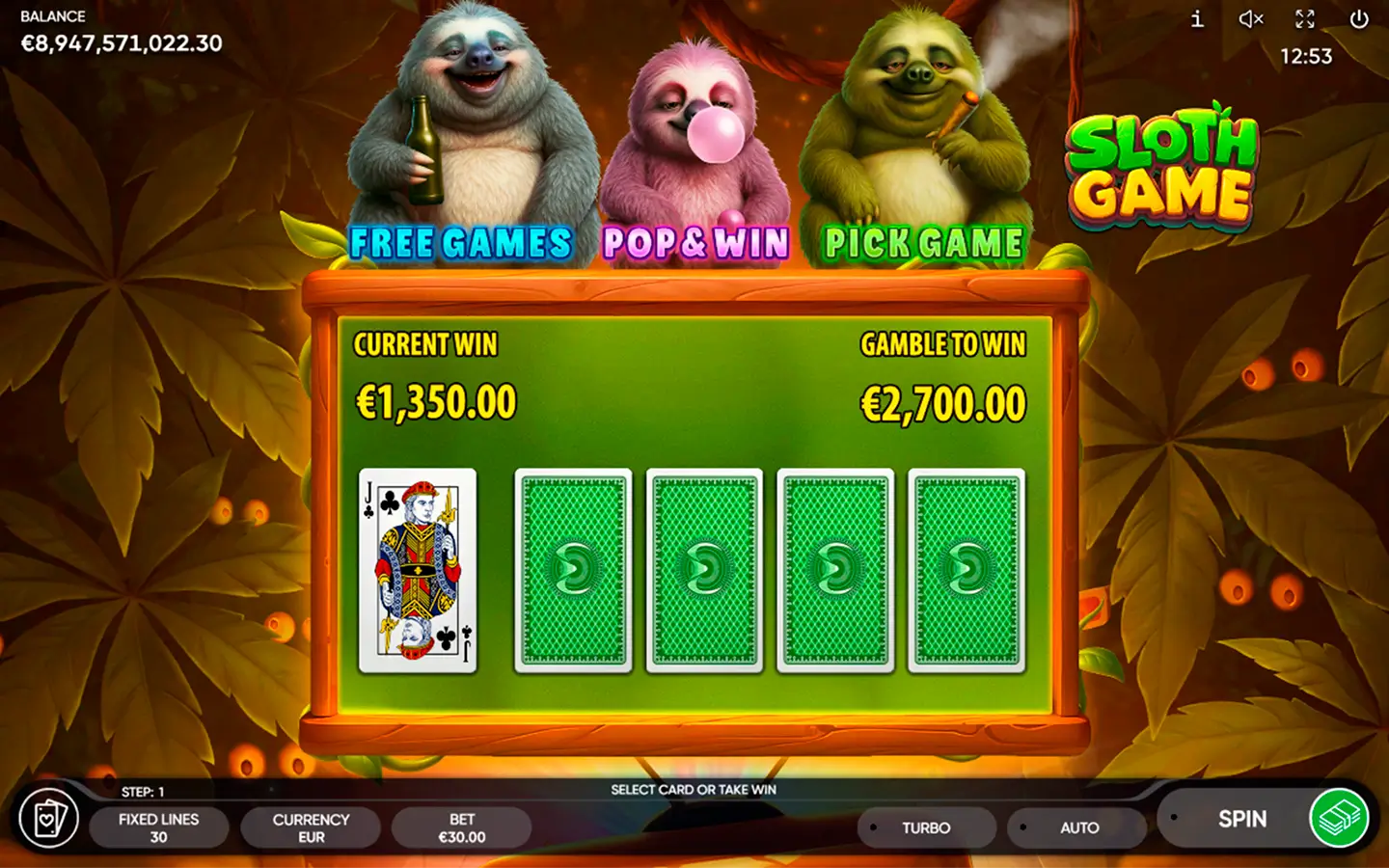
After any base game win, players can opt into a gamble round — a standard higher/lower or colour-guess mechanic that can double the win. It’s entirely optional, runs as a separate math layer from the main 96.08% RTP, and carries its own house edge on top. Endorphina includes some version of this across most of its catalogue, so nothing distinctive here — it’s the studio’s standard inclusion rather than a Sloth Game innovation.
The 2026 perspective: no sequel yet, and a crowded field doing more with the same mechanic
Sloth Game has no Power Reels, Megaways, or direct sequel version as of this review — searches across Endorphina’s own release channels and third-party trackers turn up nothing. That’s not unusual for a same-year release; Endorphina typically waits to see how a base title performs before greenlighting an evolved version, and at #1,000 by tracked play volume with what Spindex characterises as a “cold” trend signal on roughly 9,000 tracked bets, Sloth Game hasn’t generated the kind of traction that usually precedes a Power Reels treatment.
Judged against direct Hold and Win competitors, the picture is mixed. Wolf Gold, the 2017 Pragmatic Play release widely credited as the format’s breakout title, runs medium volatility against Sloth Game’s high, with a lower 96.01% RTP and a 2,500x ceiling — a full 900x higher than Sloth Game despite asking players to absorb less variance to get there. Hyper Gold is the more uncomfortable comparison: identical 96.08% RTP, same 5×3 grid family, and a 12,500x max win — nearly eight times Sloth Game’s ceiling on the exact same underlying return rate. When two games share an RTP down to the decimal point and one pays multiples more at the top end, the maths isn’t in Sloth Game’s favour.
Inside Endorphina’s own catalogue, the comparison holds up a little better. Troll Faces, another high-volatility Endorphina title, caps at 2,000x — still ahead of Sloth Game’s 1,600x, but not by an order of magnitude. Within the studio’s own house style, Sloth Game’s ceiling isn’t an outlier; it’s simply on the lower end of what Endorphina tends to offer even on its higher-variance releases. That’s a studio-wide pattern more than a Sloth Game-specific shortfall, but it doesn’t change what a player actually walks away with.
Widen the lens past Hold and Win specialists and the gap only grows. Booming Games’ 64 Nuggets Hold and Win, also a 2026 release, runs a larger 5×5 grid with the same 30 fixed paylines and reaches 10,000x — more real estate for money symbols to land, and a ceiling more than six times higher. That’s not a fair like-for-like comparison on grid size, but it’s exactly the kind of title a player scanning a 2026 lobby for Hold and Win options will land on next to Sloth Game, and the max win column will do a lot of the deciding for them. None of this means Sloth Game is badly built — the token-and-sloth trigger system genuinely is more layered than what Wolf Gold or most classic Hold and Win titles offer. It means the game is pricing that extra complexity in engagement, not in payout ceiling, and 2026 players increasingly expect both.
There’s no bonus buy option confirmed on Sloth Game in any source reviewed here. Given how standard buy-in mechanics have become on high-volatility 2026 releases — letting players skip straight to the feature round for a flat cost — its apparent absence matters. It means every Hold and Win, Free Games, or Pick Me trigger on Sloth Game has to be earned through natural play, with no fast-track option for players who want to sample the bonus rounds without grinding the base game first. That’s a real point against it for the streamer-and-content-driven audience that’s increasingly shaping how high-volatility titles get marketed in 2026.
Progressive jackpots are also absent — confirmed directly, since the game uses fixed jackpot tiers rather than a pooled, growing prize. For players specifically chasing network-wide progressive pools, that rules Sloth Game out entirely; for everyone else, it’s a neutral detail rather than a flaw, since fixed jackpots are simply a different design choice with more predictable (if lower) ceilings.
So: is this a high roller’s game, a recreational spin, or dead weight in a 2026 lobby? It’s closer to the third than the first two, but not quite dead weight. The feature density — three distinct bonus paths feeding off one token system, plus a collection mechanic layered on top — is genuinely more interesting to engage with than most single-feature Endorphina releases. But the ceiling doesn’t back up the variance being asked of the player, there’s no bonus buy for players who want to skip to the good part, and the base game itself, by every account reviewed, does very little between triggers. This reads as a game built for players who specifically enjoy tracking multiple interacting systems — energy meters, token collection, sticky symbol chains — more than players chasing a big number on a leaderboard.
Verdict: play it for the mechanic stack, not for the ceiling
Sloth Game is a play for Hold and Win specialists who like watching several systems interact, and a skip for anyone chasing a genuinely high max win. The single number that limits this game most is the 1,600x ceiling — modest even against Endorphina’s own catalogue, and well behind the 12,500x that Hyper Gold offers at the identical 96.08% RTP. That gap is the whole story here: you’re taking on high-volatility risk without high-volatility compensation.
Play it if: you’re specifically interested in Hold and Win mechanics with genuine feature density, you don’t need frequent base game action to stay engaged, and you’re going in with a bankroll sized for extended dry spells rather than session-defining hits. The three-sloth trigger system and the layered energy collection give this more to actually think about than most Endorphina releases from the last few years.
Skip it if: you want a max win that matches the volatility you’re absorbing, you rely on a bonus buy to access features without grinding, or you need published hit frequency data to plan a session budget — none of that’s available here, and that gap alone should give cautious players pause before committing real money. For most players outside the Hold and Win niche, Hyper Gold delivers the same RTP with a ceiling worth actually chasing.
There’s no sequel or Power Reels version to weigh against this one — Sloth Game stands alone for now, and at its current tracked play volume, that may not change soon. Judge it on what’s actually live: a well-stacked but under-paying Hold and Win title from a studio that, on this release at least, prioritised mechanical variety over headline numbers.