
Crash games have a problem. There are too many of them. Every mid-tier provider now has three or four in their catalogue, most built on identical math, differentiated only by a coat of paint and a different character standing in for an aeroplane. The genre’s explosive growth between 2021 and 2024 left the market crowded with titles that exist mainly to fill space in B2B portfolios rather than offer players anything genuinely different.
Rede Juu, PopOK Gaming’s latest crash release, sits in that context. The name fuses two languages — “Rede” is Portuguese for network or web, “Juu” is Swahili for up or high — suggesting a deliberate pitch at the Brazilian and African GEOs where PopOK has been expanding aggressively. The studio has been building its crash game library at pace throughout 2025 and into 2026: Hezarfen Crash, Crash Poki, Matatu Juu, and now Rede Juu. Each title follows a consistent formula. The question is whether Rede Juu does anything to stand apart from the rest of the range — or whether it’s the fourth variation of the same product.
One number immediately flags for attention: an 88% RTP appears on at least one operator deployment of Rede Juu. That figure requires explanation before anything else.
RTP and the operator-configuration problem
The 88% RTP figure comes from a single operator source — an Indonesian gaming aggregator that lists PopOK Gaming titles with their configured RTP values. That number is not the base certified RTP.
Here is the practical issue. PopOK Gaming’s crash titles are typically certified at a base RTP of 96–97% — consistent across Crash Poki (97%, confirmed by BTCGosu), Hezarfen Crash (96%, confirmed by Respinix), and Avi. Crash games from any reputable provider, when operating under UK Gambling Commission or Malta Gaming Authority frameworks, would not pass compliance review at 88%. That figure represents an operator-configured reduction — many jurisdictions permit operators to reduce RTP below the base certified setting, and some operators in grey markets do exactly this to increase margin.
What this means practically: if you are playing Rede Juu in a licensed European or UKGC-regulated casino, the RTP is almost certainly in the 96–97% range. If you are playing it on an unlicensed or grey-market platform in a less regulated environment — particularly in Southeast Asia, where the 88% figure was observed — the operator may have reduced it. The in-game information panel is the only reliable source for your specific session’s configured RTP. Check it before you play, every time.
There is no certified base RTP figure for Rede Juu available in public documentation at the time of writing. Based on the pattern across PopOK’s crash portfolio, the base RTP is most likely 96%. That is the figure I will use for the competitive analysis below, with the caveat that it requires verification at your specific operator.
The short version: PopOK crash games run at 96–97% in their default configurations. If your platform shows 88% for Rede Juu, the operator has configured a lower RTP. The difference matters — at 88% versus 96%, the house takes 12 cents per £1 rather than 4 cents. Over a session of £500 in bets, that’s an extra £40 in theoretical losses. It’s not abstract.
What Rede Juu actually is
Before going further into mechanics, it helps to be clear about the format.
Rede Juu is a crash game, not a slot. There are no reels, no paylines, no symbol combinations. A single multiplier starts at 1.00x and climbs upward at a rate determined by the RNG. At an unpredictable point, the multiplier stops — it “crashes.” Your goal is to hit the Cashout button while the multiplier is still climbing. Cash out at 2.50x on a £10 bet and you receive £25. Fail to cash out before the crash and you lose your stake entirely.
If you have played Aviator by Spribe, Crash Poki by PopOK, or any of the dozens of similar titles now in the market, Rede Juu will feel immediately familiar. The core mechanic is identical across the genre.
What differentiates individual crash titles is: the visual theme, any optional features layered on top of the base mechanic (auto-cashout, dual betting, provably fair), and the community/social elements such as visible cashouts from other players.
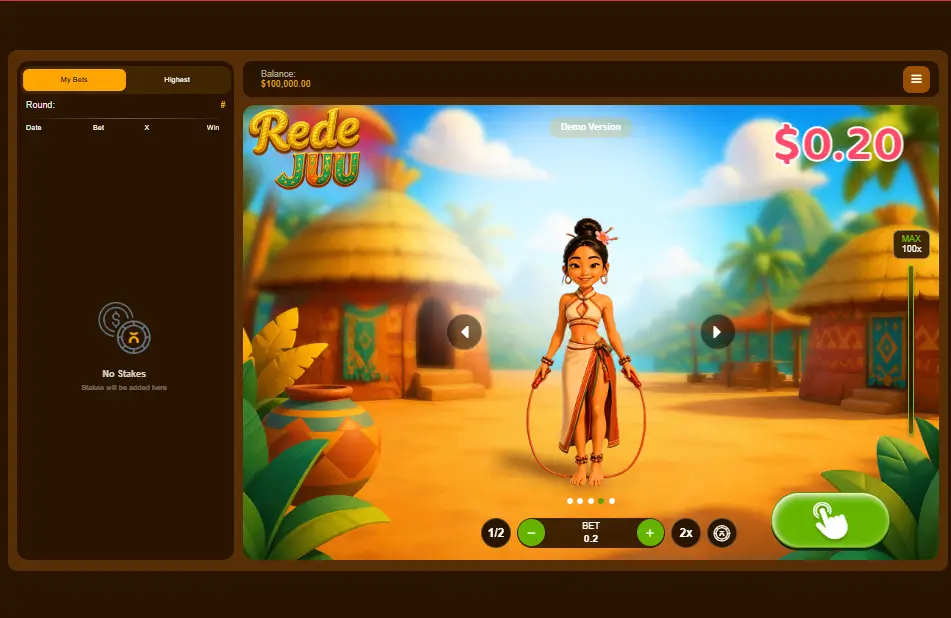
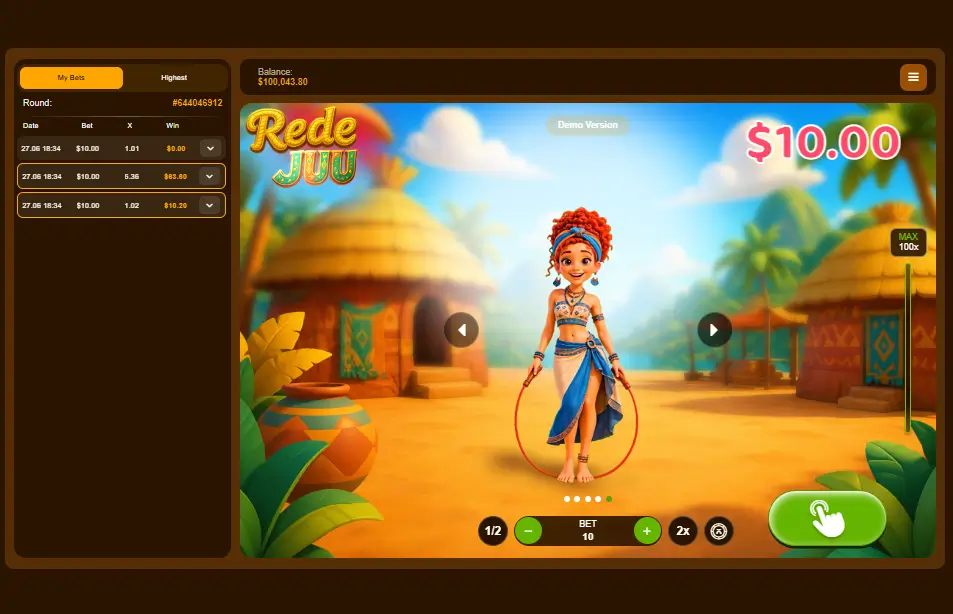
For Rede Juu specifically, the title theme fuses Brazilian/Portuguese imagery (“Rede” referring to a network or web structure) with the upward momentum of “Juu” from East African vernacular. This places it visually alongside Matatu Juu, PopOK’s Kenya-themed crash entry released in April 2026, in a deliberate push to build culturally resonant crash titles for specific geographic markets rather than generic sci-fi visuals.
The core mechanic in detail
Multiplier structure and crash probability
In all crash games built on standard provably fair architecture, the crash point is determined before the round begins. The multiplier rises exponentially rather than linearly — which is why the early stages feel quick and the late multipliers feel drawn out.
The statistical distribution is heavily weighted toward low multipliers. Across the PopOK crash range (and Spribe’s Aviator, which uses similar math), roughly 25–30% of rounds crash at or before 1.50x. Somewhere around 50–55% of rounds crash before 2.00x. Getting to 10x or beyond happens in perhaps 10–12% of rounds. The 10,000x maximum exists as a theoretical ceiling — it represents an event so rare that most players will never see it across thousands of rounds.
This is not a flaw specific to Rede Juu. It is how crash game mathematics work. If the crash probability distribution were less weighted toward low multipliers, the RTP would need to be significantly lower to maintain the house edge. The math is internally consistent.
What it means in practice: strategies built around consistently cashing out at 1.5x or 2x are statistically sound as preservation strategies, but they do not overcome the house edge. They simply distribute your variance differently. More on that in the strategy section.
Cashout mechanics
Rede Juu, consistent with the PopOK crash portfolio, supports auto-cashout. You can set a target multiplier before the round begins, and the system executes the cashout automatically when that value is reached — assuming the round has not already crashed before that point.
PopOK Gaming crash titles also typically support dual betting — placing two separate stakes with different auto-cashout targets in the same round. This allows a hedging approach: one low-value cashout locked in at 1.5x for stake recovery, a second bet left to ride for a larger multiplier. Whether this is genuinely useful depends entirely on your bankroll management philosophy. It does not change the underlying RTP.
No confirmed additional features — bonus rounds, jackpots, or special round mechanics — have been documented for Rede Juu in available sources. The game appears to operate on clean base-mechanic crash gameplay without additional layers. This is consistent with most of PopOK’s crash releases, which follow a design philosophy of simplicity over complexity.
Provably fair verification
PopOK Gaming crash titles include a provably fair checker — a mechanism that allows players to verify the randomness of round outcomes after the fact using cryptographic hash values. This is an important trust signal in the crash game category, where the potential for manipulation is higher than in certified slot play.
The provably fair system does not guarantee any particular outcome. It means that the crash point for each round is determined before the round starts, cannot be altered during play, and can be independently verified by anyone with the game’s hash values after the round ends. It is the industry standard for crash games and a non-negotiable feature for any title worth recommending.
Rede Juu in the 2026 crash game market
Where does 10,000x sit in 2026?
PopOK Gaming’s consistent 10,000x maximum multiplier looks impressive on paper. Context matters.
Spribe’s Aviator, which remains the market-defining crash game, also runs to 10,000x with a 97% RTP and a provably fair architecture. Aviator launched in 2019 and has been the benchmark against which every subsequent crash title is measured. CrashoSaurus by PopOK itself, another entry in the same portfolio, runs to the same ceiling.
Turbo Games’ JetX — probably the second most widely distributed crash title behind Aviator — operates at a 97% base RTP with a theoretical maximum around 25,000x, though the practical difference between 10,000x and 25,000x ceilings is negligible for 99.9% of players. You need to survive long enough at consistently high multipliers for the ceiling to become relevant, and the crash probability distribution means that is extraordinarily rare.
SmartSoft Gaming’s Fortune Crash runs at 96% RTP with a max of 10,000x. BGaming’s Crash Bang reaches similar territory.
Against this field, Rede Juu at 96% base RTP with 10,000x max sits squarely at market standard. It is not differentiated by its math. If you are choosing between Rede Juu and Aviator or JetX purely on numbers, the numbers are functionally identical. The choice then comes down to distribution, theme, and operator availability.
The buy-bonus question
Crash games do not have a buy-bonus mechanic in the traditional sense — there is no “purchase a guaranteed high multiplier” feature equivalent to the buy-feature in video slots. This is a structural characteristic of the genre rather than a specific limitation of Rede Juu.
Some crash titles have introduced hybrid mechanics — guaranteed minimum multiplier rounds at a premium bet, for example — but none of PopOK’s current crash range has confirmed such a feature. If a hybrid mechanic appears in Rede Juu, it was not documented in available sources at time of writing.
Progressive jackpot
PopOK Gaming operates a shared progressive jackpot network across its slot portfolio. Whether Rede Juu connects to that jackpot network is not confirmed in available documentation. Crash games are less commonly integrated into progressive jackpot systems than slots, and the PopOK crash titles reviewed in detail (Crash Poki, Hezarfen Crash) do not mention jackpot integration. Treat jackpot availability as unconfirmed until you verify it in the game itself.
Understanding crash strategies — what works and what doesn’t
Every crash game review eventually hits the strategy section. Let me be direct about what strategies actually do here, which is more useful than listing them uncritically.
Auto-cashout at low multipliers
Setting auto-cashout at 1.5x or 2x reduces variance. You cash out in more rounds than a player waiting for 10x. You also win less per successful cashout. The math balances out to approximately the same long-term return minus the house edge. This is not a winning strategy in the sense of beating the house. It is a bankroll extension strategy — you play more rounds, exhaust your budget more slowly, and experience less dramatic swings.
For sessions with a defined time goal rather than a profit goal, this is reasonable. For players convinced that low-multiplier strategies are somehow mathematically superior, they are not. The house edge applies regardless.
Dual-bet hedging
Placing two bets per round — one set to auto-cashout at 1.3x or 1.5x, one left to ride — distributes risk within a single round. If the multiplier reaches your low target but then crashes before your second bet gets meaningful, you recover partial stake. This can reduce per-session losses in volatile run patterns.
The caveat: both bets face the same house edge. Hedging does not reduce theoretical expected loss. It reduces variance. Whether that matters to you depends entirely on your bankroll size and risk tolerance.
Pattern-based approaches
Some players track previous crash points looking for “patterns” — long sequences of low crashes suggesting a big multiplier is “due.” This is gambler’s fallacy. Each round is independent. The provably fair system confirms the crash point is determined before the round begins, but previous round results provide no information about the next round’s crash point. There is no “due” multiplier in provably fair crash architecture.
Bankroll sizing for crash sessions
Crash games consume bankroll faster than their payout structure suggests, because the frequency of complete stake loss is higher than in most slot formats. In a slot, even a losing spin rarely feels like a total loss — some smaller combination typically appears. In crash, rounds that crash at 1.00x or 1.05x (before you can cash out) are complete losses. They happen.
A workable rule for crash sessions: never allocate more than 5% of your session budget to a single round. With a £100 session bankroll, that means £5 maximum per round. This allows at least 20 rounds before ruin is possible, and in practice the variance means your session will typically last significantly longer than that minimum. With the dual-bet feature, you could split that £5 into a £3 safety bet (auto-cashout 1.5x) and a £2 ride bet, reducing the probability of a complete stake loss per round to something closer to 25–30%.
None of this makes the game profitable over the long run. It makes the session experience more sustainable.
The honest verdict on strategy
Crash games offer genuine decision-making at the cashout moment, which is why they feel more engaging than passive slots. That active element does not change the underlying math. The best approach is: set a clear budget, decide your session target before you start, and use auto-cashout to remove emotion from the cashout decision. Losing a multiplier because you hesitated is psychologically costly even when the financial loss is small.
The most dangerous player behaviour in crash games is chasing. You cash out at 2x, the multiplier continues to 50x, and you spend the next ten rounds holding past your comfort level trying to “catch” a big win. That behavioural trap is structural to the genre. Knowing it exists is the only partial defence against it.
Rede Juu versus the rest of the PopOK crash range
At time of writing, PopOK Gaming operates at least eight crash titles: Avi, Crash Poki, Crash Extreme, CrashoSaurus, Hezarfen Crash, Electric Crash, Matatu Juu, and Rede Juu. The studio clearly sees crash games as a major growth area.
The differentiation between these titles is primarily thematic. Hezarfen Crash goes historical and specifically Turkish. Matatu Juu goes Kenyan urban. Rede Juu goes Portuguese-African fusion. Avi (which drew a copyright complaint from Spribe) goes aviation-generic. Crash Poki uses PopOK’s own mascot character. The math across all of them — based on available data — is largely identical: 96–97% base RTP, 10,000x max, standard cashout structure.
This matters for operators choosing between titles for their lobbies. For players, the choice between PopOK crash titles reduces to: which theme appeals to you, and which title your platform actually offers. There is no mathematical advantage to choosing one over another at the same operator.
There is an argument that having eight crash titles from one studio with functionally identical math dilutes the portfolio rather than strengthening it. An operator running Hezarfen Crash, Matatu Juu, and Rede Juu in the same lobby is essentially offering the same product three times with different wallpaper. From an operator’s perspective this makes sense if the three titles target genuinely distinct player demographics who might not otherwise overlap — Turkish players, East African players, and Brazilian players each responding to their own cultural reference points. From a player’s perspective who is browsing all three, it matters less.
The studio’s strategy here echoes what Pragmatic Play did with crash games in 2022–23: build a range rapidly, target different GEOs with different visual identities, and rely on the sheer distribution advantage of a large UKGC-certified portfolio. Whether PopOK’s crash range achieves the same penetration that Pragmatic’s slot series achieved in slots depends on factors outside any individual title’s quality.
What Rede Juu does that Matatu Juu doesn’t, and vice versa, is target a different cultural register. Matatu Juu is clearly built for Kenyan and East African audiences — matatus are a quintessentially Kenyan transport format. Rede Juu’s Portuguese-Swahili naming points at Brazilian and/or Portuguese-speaking African markets (Mozambique, Angola, Cape Verde), where Portuguese is the primary language and “Juu” might resonate with players familiar with Pan-African gaming culture. This kind of market-specific theming is a credible distribution strategy, even if the game underneath is functionally similar.
For a Brazilian player choosing between Rede Juu and Matatu Juu on the same platform, Rede Juu will feel more locally resonant. Whether that affects engagement is ultimately what PopOK is betting on with this release cadence.
Where to play Rede Juu
Rede Juu is a B2B product available to operators who integrate PopOK Gaming’s portfolio. The studio is certified in 16+ markets including the UK, Malta, Romania, Sweden, Georgia, and Brazil, and its games appear across several hundred casino platforms.
Distribution of Rede Juu specifically is newer and narrower than established titles like Avi or Crash Poki. At time of writing, confirmed availability includes operators in Portuguese-speaking markets and the BetConstruct ecosystem, through which PopOK has distributed since 2021. The list will expand.
Three things to verify at any operator before committing real money to Rede Juu:
1. Confirmed RTP in-game. Open the information panel within the game. If it shows below 95%, the operator has configured a reduced RTP. 88% is the lowest observed figure — that is significantly below what the base certification almost certainly sets. A 96% RTP is your target.
2. Licensing status of the operator. A UKGC, MGA, or MNO-licensed operator is required to disclose configured RTP and is subject to complaint escalation mechanisms if they don’t. A grey-market operator has no such obligation. The difference is not abstract — it is the difference between having recourse and having none.
3. Provably fair checker access. If the operator has disabled the provably fair verification panel, treat that as a significant red flag regardless of what RTP they advertise.
A note on crash games and gambling behaviour
Crash games are deliberately designed to be psychologically engaging in ways that some slot games are not. The active cashout decision, the visibility of other players’ outcomes, the visual representation of a rising multiplier — all of these engage the player more intensely than watching reels spin.
That engagement is also what makes crash games a higher-risk format for players who are vulnerable to problem gambling behaviours. The pace of play is faster than most slots. Rounds resolve in seconds. The cashout moment creates a genuine decision under pressure, and the regret of cashing out early when the multiplier continues — or holding too long when it crashes — activates the same loss-aversion and near-miss psychology that makes gambling problematic for some people.
GamCare (gamcare.org.uk) and Gambling Therapy (gamblingtherapy.org) both provide support specifically relevant to fast-paced digital gambling formats. If crash games feel compulsive rather than recreational — if you find yourself playing rounds you did not plan to play, or chasing losses across sessions — those resources exist and they are genuinely useful.
PopOK Gaming’s platform confirms support for responsible gambling tools at the operator level. The studio is UKGC-certified, which requires RG measures to be available. Whether a specific operator implements them varies. Check for deposit limits, session time limits, and self-exclusion options before you start — not after a difficult session when they are harder to engage with clearly.
Verdict
On Rede Juu as a crash game:
The base product is competent. PopOK Gaming has built a consistent crash game architecture across its portfolio, the provably fair checker is present, and the dual-betting option gives players one more tool to manage their session variance. At 96% base RTP — if that is what your operator has configured — the math is fair and industry-standard.
The max win of 10,000x is competitive but not exceptional. Aviator at 97% RTP delivers effectively the same ceiling. JetX at 97% with a 25,000x theoretical max edges ahead on paper, though in practice the gap is meaningless for most players.
The cultural positioning of Rede Juu is probably its most interesting attribute. The Portuguese-Swahili name pairing is not accidental or arbitrary — PopOK is signalling something about its intended distribution geography. If that targeting works and Rede Juu ends up well-distributed in Brazilian and Lusophone African markets with properly configured RTP, it fills a genuine market positioning role in those regions. Whether the game’s visual execution delivers on that cultural promise is something I cannot verify from available documentation alone; the game is new enough that substantive player reviews have not accumulated.
On the RTP situation:
The 88% configured RTP observed on one operator is the most important data point in this review. Not because it tells us that Rede Juu is a bad game — it doesn’t — but because it illustrates the fundamental risk of crash games in less regulated deployments. Crash game RTPs are configurable in ways that slot RTPs typically are not at the platform level. This shifts responsibility for RTP verification onto the player more heavily than in most game categories.
If your operator shows 88% for this title: it is a meaningful reduction from the probable base certification. At 88% versus 96% across a £200 session, that is roughly £16 in additional expected loss. Not catastrophic, but material. Whether that is acceptable depends on what the operator offers in other respects.
Who should play this:
Players in Brazilian or Portuguese-speaking African markets where Rede Juu is positioned as a locally resonant title, and who have verified the RTP at their specific operator. Players who already enjoy PopOK’s crash range and want visual variety without learning new mechanics. Players with a defined session budget, clear auto-cashout targets set before play begins, and no emotional attachment to chasing multipliers.
Who should not play this:
Players looking for a crash game that offers something mechanically novel — Rede Juu does not. Players encountering this title on an unlicensed operator at a configured 88% RTP who have not checked the in-game panel. Players in regulated markets with access to Aviator or JetX at confirmed 97% RTP have a mathematically preferable option.
The game is not a bad product. It is one of eight crash titles from the same studio on the same math. That is not damning — Pragmatic Play has built an entire slots empire on exactly that model. The question is whether PopOK’s crash range achieves comparable distribution depth and player loyalty over the next two years. Rede Juu alone will not answer that question. The full portfolio will.