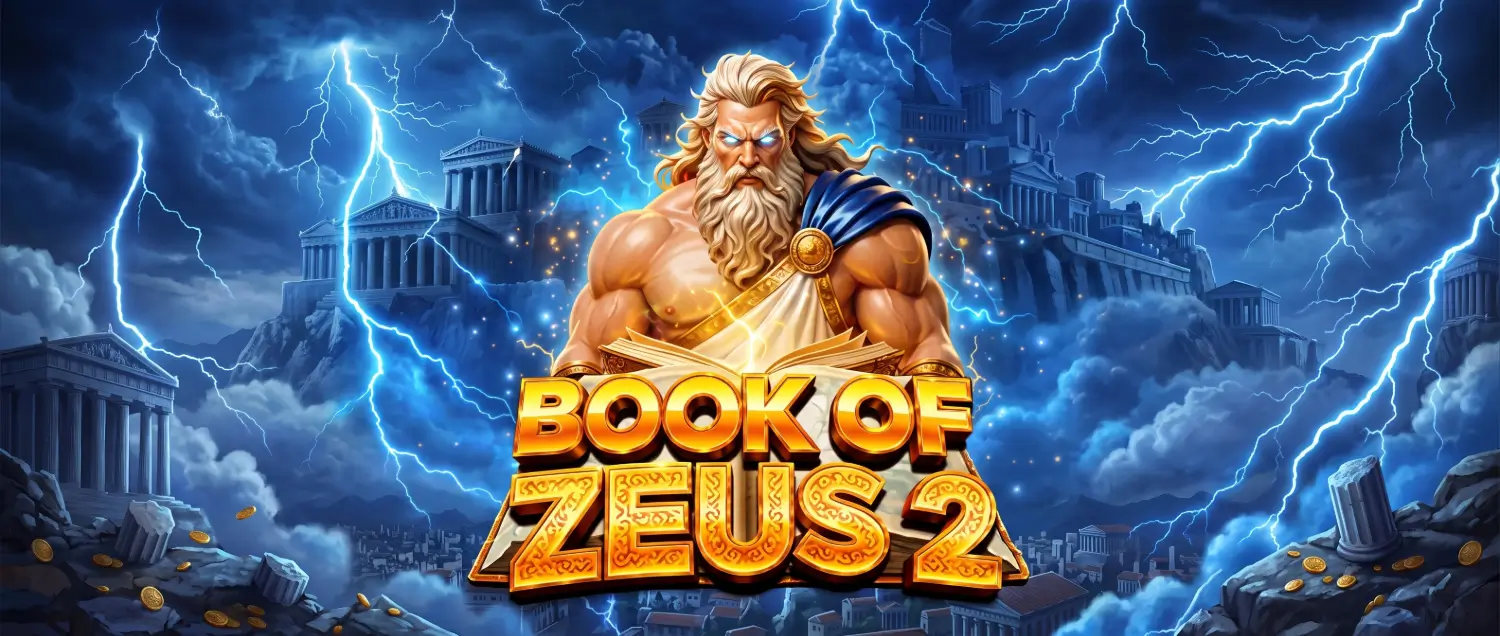
Amigo Gaming’s original Book of Zeus has been sitting in casino lobbies since 2021, quietly outlasting most of the “Book of” clones that chased Book of Dead’s shadow. Five years is a long shelf life for a budget-tier Book slot, and it says more about the gap in Amigo’s back catalogue than about the game’s mechanics, which were always fairly ordinary. Book of Zeus 2 arrived in July 2026 with a rebuilt engine, a wider feature set, and a max win that jumps from 6,000x to 6,500x — on paper, a real upgrade rather than a reskin.
The question worth asking is whether Amigo actually solved the original’s problem, which was a single free spins mode competing against Book of Dead, Legacy of Dead, and a decade of “Book of” imitators with sharper math. A 10-fixed-payline, high-volatility 3×5 grid and three separate bonus rounds is the sequel’s answer. Whether that’s enough in a 2026 lobby stacked with Gates of Olympus and its imitators is the actual analytical question here.
Math model and mechanics
Book of Zeus 2 runs on a classic 3 rows by 5 reels layout with 10 fixed paylines — identical structure to the original, and identical to Book of Dead and Legacy of Dead before it. Amigo hasn’t experimented with Megaways or a pay-anywhere cluster system here. This is deliberate: the fixed-payline Book format is cheap to certify, familiar to operators, and easy to slot into a lobby without spooking Tier 3 players who don’t want to learn a new grid. It’s also, frankly, the least interesting part of the release. Nobody is buying a 2026 sequel for the grid shape.
Amigo’s own game page classifies Book of Zeus 2 as high volatility, matching the original. That tracks with the mechanics: three separate bonus rounds gated behind a random trigger, a Buy Bonus option, and a max win north of 6,000x all point to a game built for long dry spells punctuated by disproportionate hits, not a steady drip of small wins.
Ten fixed paylines is a meaningfully different bet than what most 2026 Greek-mythology releases are running. Gates of Olympus abandoned paylines entirely in 2021 in favour of a pay-anywhere cluster system across a 6×5 grid, and that structural choice is a large part of why it plays faster and feels more generous session-to-session, even at a comparable RTP. A fixed 10-line, 3×5 grid can’t replicate that win-frequency profile — every symbol has to land on one of ten predetermined paths rather than anywhere on the board, which mechanically caps how often a base-game combination can form. Amigo hasn’t tried to disguise this; there’s no ways-to-win marketing angle anywhere in the launch material, and the studio is clearly leaning into the three-bonus-round structure to do the excitement work that a wider grid would otherwise handle.
Here’s the gap I can’t close cleanly: Amigo Gaming has not published an RTP figure for Book of Zeus 2 on its official game page, and no aggregator — SlotCatalog, Casino Guru, or AboutSlots — had an entry with a confirmed number at the time of writing. That’s not unusual for a game barely a few weeks past its commercial launch, and the original Book of Zeus went through the same blank period before 96% became the settled figure across sources. RTP on Amigo titles is typically operator-configurable, meaning the number in front of you can shift depending on which casino you’re spinning at. Don’t take a headline 96% on faith from any single review site until it’s confirmed in the in-game paytable — that’s where the live figure for your specific casino will actually sit.
The max win sits at 6,500x the stake, per Amigo’s own game page. Read that against the category: Book of Dead and Legacy of Dead both cap at 5,000x, Gates of Olympus caps at 5,000x. Book of Zeus 2’s ceiling is 30% higher than all three. That’s a genuine differentiator, but a higher max win multiplier only matters if the probability of reaching it isn’t buried by three layers of random bonus gating — and that’s precisely the number nobody has published yet either.
What I can say with more confidence: the bet range hasn’t been confirmed for Book of Zeus 2 specifically, so I’m not going to invent one. The original Book of Zeus ran from €0.10 up to a top stake of roughly €100 per spin on the operators I checked — a conventional range for the category, nothing that stands out either way. Assume Book of Zeus 2 lands somewhere similar until your casino’s paytable tells you otherwise.
Hit frequency hasn’t been disclosed by Amigo, and no independent tracker has logged enough spin volume yet to produce a reliable figure of its own. I won’t put a number on it — that’s exactly the kind of estimate the no-fabrication standard on this review exists to rule out. What I can say honestly is that the trigger condition itself tells you something: landing three Chest symbols on reels 1, 3, and 5 simultaneously, on a 10-line fixed grid, is a tighter ask than a single scatter-anywhere trigger of the kind Book of Dead or Gates of Olympus use. A three-position trigger on specific reels generally sits toward the rarer end of the bonus-frequency spectrum for this category, though “generally” is doing real work in that sentence until Amigo or an independent tracker publishes the actual figure.
What this means for how you should play it: don’t treat a long cold run on the base game as a signal that something’s broken. High volatility with a multi-reel trigger condition is built around exactly that pattern — extended stretches with nothing, followed by a shot at one of three disproportionate outcomes. Bankroll for the wait, not for a steady drip.
Feature breakdown
Book of Zeus 2 replaces the original’s single free-spins mode with a three-way bonus split, all fed through one trigger mechanic. Here’s how each piece actually works, based on Amigo’s own launch material.
Random Bonus trigger
Trigger: land 3 Chest symbols on reels 1, 3, and 5 in the same spin. This is the gate to all three bonus rounds — there’s no separate scatter for each mode. Instead, the game itself picks which of the three you get. You don’t choose, and Amigo’s copy is explicit that the selection is “chosen by the gods alone,” which in plain English means it’s weighted by the RNG, not the player. If you were hoping to farm a specific bonus mode by stake-sizing or session length, that’s not how this is built.
What this means in practice: unlike a slot with three separately-scattered bonus symbols (where you can at least see which mode is close to triggering), Book of Zeus 2 gives you one combined trigger condition and zero visibility into which round you’re about to enter. That’s a deliberate design choice that increases variance on top of the game’s already high base volatility — you’re not just waiting for a bonus, you’re waiting for a bonus and then gambling on which bonus you got.
There’s a design logic behind bundling three bonus modes under one trigger rather than giving each its own scatter, and it’s worth naming directly: a single shared trigger keeps the base-game math simpler to certify and balance, while still letting the marketing copy claim three distinct bonus experiences. It’s an efficient way to pad out a feature list without redesigning the base reels, and it’s become common practice across the “Book of” genre’s 2020s output. Whether that reads as smart design economy or as three thin bonuses wearing one trigger’s coat depends on how the actual weighting between them turns out — data Amigo hasn’t released.
Pin Win Bonus (Blue Goblet)
Trigger: fill the Blue Goblet with drifting token symbols during base play.
Mechanic: the grid converts into a field of lightning orbs and blank cells. Landing orbs holds regular multipliers plus Min, Mid, or Max Jackpot values, and each new hit resets the spin counter — the classic Pile/Pin Win structure other studios have run under names like Fire Blaze or Fortune Zone. The ceiling here is the Ultra Jackpot at 1,000x the stake.
Honest limitation: Pin Win-style rounds live and die on how generous the reset condition is. Amigo hasn’t disclosed how many empty spins you’re allowed before the round ends, which is the single number that actually determines whether this bonus pays out close to its ceiling or fizzles after two or three cold cells. Until that’s public, treat the 1,000x figure as a theoretical high point, not a typical outcome.
By the way, this is the bonus round doing the most mechanical heavy lifting in the whole game. Pin Win-style structures — filling a grid with sticky value cells and resetting the spin count on every new hit — are the same underlying idea behind several other studios’ “hold and win”-adjacent features, and they tend to reward patience within the round itself more than they reward anything you did beforehand. If Book of Zeus 2 has a genuine standout feature among the three, this is the one to hope for.
Pick Game (Red Goblet)
Trigger: fill the Red Goblet.
Mechanic: you’re dropped into a pick screen of 20 lightning bolts. Matching three identical award symbols locks in a prize of up to 1,000x the total bet.
Honest limitation: pick-style bonuses are inherently lower-variance than a spins-based feature — you know your prize the moment you match three symbols, and there’s no cascading or retrigger path to stretch the win further. It’s the safest of the three bonus rounds in terms of predictable payout size, and also the one with the least room to overdeliver. If you land in the Pick Game instead of the Pin Win round, temper your expectations accordingly.
You might ask: why does it matter which of the three rounds you land in, if they’re all “the bonus”? Because the payout shape is completely different depending on which one the game hands you. Pin Win can theoretically stretch toward the game’s higher end through repeated resets; Pick Game hands you one number and ends; Free Games sits somewhere in between, depending on how many times the expanding symbol lands on a paying position across ten spins. Three bonus rounds sounds like more content, and it is — but it also means the game’s actual payout distribution is now split three ways instead of concentrated in one well-understood mechanic, and Amigo hasn’t disclosed the weighting between them.
Free Games Bonus
Trigger: the same Chest-symbol trigger, third possible outcome.
Mechanic: 10 Free Games, with a random symbol granted expanding powers so it completes winning combinations from any position on the reel it lands on. This is the closest thing to the original Book of Zeus’s core mechanic, carried over largely intact — the 2021 version worked the same way, with a randomly selected symbol expanding to fill its reel during the free spins round.
Honest limitation: Amigo hasn’t stated whether this round retriggers. The original Book of Zeus’s free spins round did allow retriggers on 3+ book symbols; if Book of Zeus 2 dropped that mechanic in favour of the new bonus split, the effective ceiling on this specific round could be lower than the original’s equivalent feature, even with the higher headline max win elsewhere in the game. The single-expanding-symbol structure is also the least mechanically ambitious of the three rounds — it’s the same idea Book of Dead and Legacy of Dead have run since 2016, just carried over from Amigo’s own 2021 title rather than borrowed from Play’n GO directly. If you’ve played any Book-format slot before, this is the one round in Book of Zeus 2 that will feel completely familiar.
Buy Bonus
Book of Zeus 2 ships with an integrated Buy Bonus feature, letting you pay a flat cost to bypass the Chest-symbol wait and jump straight into a random one of the three bonus rounds. Amigo hasn’t published the cost multiplier. As with every buy-bonus mechanic in the category, paying for instant access carries no RTP advantage on its own — you’re purchasing certainty of entry, not better odds once you’re in. Whether that’s worth it depends entirely on the unpublished cost, which makes it impossible to judge fairly at launch. Worth knowing: Buy Bonus features are typically geo-restricted, so UK players in particular should expect this option greyed out regardless of what the demo shows.
The 2026 perspective
Book of Zeus 2 is a straight sequel to a 2021 original, not a Megaways spin-off or a “1000” reskin in the Pragmatic Play mould, so the comparison that matters is directly against the first game.
What changed from Book of Zeus (2021) to Book of Zeus 2 (2026): the grid and payline count stayed put at 3×5 and 10 fixed lines. The max win climbed from 6,000x to 6,500x. The single free-spins bonus became three bonus rounds gated behind one random trigger, adding the Pin Win jackpot ladder and the Pick Game as genuinely new content rather than a lick of paint. Amigo added an integrated Buy Bonus, which the original never had. Volatility is described as high on both versions, and the confirmed RTP figure that eventually settled at 96% on the original hasn’t yet been matched by a confirmed figure on the sequel.
What the sequel didn’t fix: the fixed 10-payline structure is unchanged, meaning Book of Zeus 2 still can’t compete on raw win-frequency with any pay-anywhere or Megaways-style Greek mythology slot. The base game visual identity — Zeus, goblets, temple columns — is the same well-worn iconography every “Book of” and every Greek-themed slot has used since 2016. If you were hoping for a mechanical reinvention on the level of what Play’n GO did going from Book of Dead to Legacy of Dead, this isn’t that; it’s closer to Book of Dead getting a Pin Win bolted onto its free spins.
Against named competitors, the picture is mixed. Book of Dead (Play’n GO) runs a confirmed 96.21% RTP, high volatility, and a 5,000x max win, with betting from 0.10 to 50. Legacy of Dead, its own studio’s sequel to the same lineage, sits at a default 96.58% RTP, high volatility, and the same 5,000x cap, with a wider 0.10 to 100 betting range. Both have years of tracked spin data behind their published numbers — Book of Zeus 2 has none yet. Gates of Olympus (Pragmatic Play) is the more relevant thematic rival, sharing the Zeus-and-Olympus dressing directly: 96.5% RTP, high volatility, 5,000x max win, and a 0.20 to 100 (extending to 125 with Ante Bet) betting range, on a 6×5 pay-anywhere grid rather than fixed paylines.
Put plainly: Book of Zeus 2’s 6,500x ceiling beats all three named competitors’ 5,000x cap by a real margin. But every one of those three competitors has a confirmed, audited RTP figure you can check before you stake a single coin, and Book of Zeus 2 currently doesn’t. A higher max win on an unconfirmed RTP is not automatically a better game — it’s an unknown quantity with a bigger headline number attached.
Hit frequency is where the named competitors pull further ahead on transparency, if not necessarily on excitement. Book of Dead has been independently tracked at a hit frequency of roughly 26–29% across large community spin samples. Gates of Olympus publishes an official hit frequency of 28.82%, with free spins triggering on average once every 448 spins. Legacy of Dead runs cooler, with community tracking putting its hit rate closer to 22%. Those figures exist because these games have had years, in Book of Dead’s case a decade, of tracked real-money spins behind them. Book of Zeus 2 has weeks. That’s not a criticism of the game itself so much as a reminder that “high volatility” on a brand-new release is a design classification from the studio, not yet a verified pattern from actual play.
One point in Book of Zeus 2’s favour that’s easy to miss in a spec comparison: Amigo’s own game page lists the title in roughly 30 languages, including English, Spanish, Portuguese, Ukrainian, Turkish, Korean, Vietnamese, Indonesian, Hindi, and Tagalog, alongside the full spread of Nordic and Central European languages. That’s a wide simultaneous rollout for a single-studio release, and it signals Amigo is pushing this title across LatAm, South Asian, and Southeast Asian operator networks at once rather than launching it as a Europe-first regulated product and expanding later. Practically, that means Book of Zeus 2 is likely to show up in a broader spread of casino lobbies, faster, than a typical Tier 1-first release — worth knowing if you’re an operator deciding whether it’s worth adding to a Tier 2 or Tier 3 GEO catalogue this year.
Buy-bonus availability: confirmed present, cost undisclosed. Progressive jackpot: absent — the “jackpots” inside the Pin Win round are fixed-value tiers (Min, Mid, Max, up to the 1,000x Ultra Jackpot), not a pooled progressive that grows across the network. If you were expecting a Mega Moolah-style seeding pot, this isn’t it; the jackpot language here describes a bonus-round payout tier, nothing more.
Is this a high roller’s game, a recreational spin, or dead weight in a 2026 lobby? It’s built for recreational high-volatility players who already like the Book format and want a slightly bigger ceiling and more bonus variety than the 2021 original offered. It is not built for high rollers chasing the biggest multipliers on the market — Nolimit City and Hacksaw titles routinely clear five-figure multipliers, and 6,500x doesn’t compete at that tier. And it’s not dead weight either: three bonus rounds and a genuine feature upgrade over the original give operators a reasonable reason to keep it in rotation, provided the eventual confirmed RTP lands where Amigo’s other titles typically sit — mid-to-high 96%.
Verdict
Book of Zeus 2: play it if you already have a soft spot for the Book format and want more bonus variety than a single free-spins mode. Skip it if RTP transparency matters to you more than a bigger max win multiplier — right now, you’re betting on an unconfirmed number, and the 6,500x ceiling means nothing if the underlying return sits at the bottom of whatever RTP band Amigo eventually discloses. This is a recreational high-volatility spin for players who accept variance as the cost of entry, not a game for anyone building a bankroll strategy around published statistics that don’t exist yet for this title.
The original Book of Zeus, for comparison: play it only if the sequel isn’t available on your casino, since it offers nothing the sequel doesn’t already improve on — its one advantage over its own successor at the time of writing is a confirmed 96% RTP, simply because that number actually exists. For a lower max win, a single bonus mode, and no buy-bonus option, there’s little reason to pick the original over Book of Zeus 2 once RTP data catches up.
The one number that limits this game right now isn’t the 10 fixed paylines or even the unpublished bonus-buy cost — it’s the missing RTP. Check the in-game paytable before you stake anything. If it’s sitting in the mid-to-high 96% range, Book of Zeus 2 is a reasonable high-volatility pick with a genuinely competitive ceiling. If it’s configured lower, the extra 1,500x of headline max win won’t make up the difference over a real session.
For the player profile question specifically: this suits someone who already plays high-volatility Book slots regularly, has a bankroll built for extended dry spells, and treats a demo spin as mandatory homework before staking real money on a title this new. It does not suit anyone chasing a specific, verifiable long-term return figure, anyone who wants to compare RTP across a shortlist of games before choosing one, or anyone new to high-volatility slots who hasn’t already made peace with the pattern of long waits and disproportionate payouts. Gates of Olympus, Book of Dead, and Legacy of Dead all remain the safer recommendation for that last group, purely on the grounds that what you see in their published stats is what years of tracked play have actually confirmed. Book of Zeus 2 might catch up to that level of transparency within a few months of wider distribution — it just hasn’t yet, and a review written honestly can’t pretend otherwise.