Novomatic released Joker Heist on 30 July 2026. Three weeks later, there’s still no working demo, no confirmed casino listing, and no detailed feature breakdown anywhere online. That’s unusual for a provider with Novomatic’s distribution reach, and it’s worth flagging before we get into what we actually know.
What we do know: a 92.48% RTP, a x5000 max win ceiling, and a robbery theme running on a 243-ways grid. None of those numbers put Joker Heist near the top of its category. This is a first-look piece, not a full review — the mechanics behind the feature list haven’t been documented yet, and I’m not going to invent them to fill space.
What’s confirmed on the spec sheet
Joker Heist runs on a 5×3 reel layout with 243 betways, the standard “any adjacent combination pays” structure rather than fixed paylines. Bets range from $0.20 to $70 per spin — a fairly conventional band for a mid-tier Novomatic release, wide enough for casual and moderate stakes but not built for high rollers chasing volume.
The RTP sits at 92.48%. That’s the number to sit with for a second. Industry benchmark for a 2026 release is closer to 96%, and most Novomatic titles — Mega Joker at 95.05%, Action Joker at 95.12% — land well above where Joker Heist currently sits. A 92.48% return means the house edge here is close to 7.5%, noticeably steeper than what players get on comparable robbery-themed slots from other studios. Whether that figure is fixed or one of several operator-configurable settings hasn’t been published anywhere I could verify, so I’m not going to guess at a range that doesn’t exist in any source.
Max win is x5000 the stake. On a $1 spin, that’s a $5,000 ceiling. Against 2026 competition — where 5,000x to 10,000x has become the norm for anything marketed as high-volatility — x5000 is respectable but not standout. It sits below Book of Ra Deluxe’s 5,000x threshold-matching territory and well under what Pragmatic Play or Hacksaw releases typically offer this year.
Two numbers are simply missing: Variance and Hit Frequency are both marked N/A, even on SlotCatalog’s own attribute table, which is normally the most complete public source for this kind of data. Without a variance rating, there’s no way to honestly tell you whether this plays like a grinder or a big-swing title. I’d rather say that plainly than borrow a number from a similarly-themed game and present it as fact.
Here’s why the RTP figure matters beyond the headline percentage. At 92.48%, the theoretical house edge is 7.52%. Play a realistic session of 500 spins at $1 each — $500 wagered — and the maths says you’d expect roughly $462 back over the long run, against roughly $475 on a 95% RTP title and roughly $480 on Cyberheist City’s 96% return. That’s a $13–18 gap over a single short session, and it compounds the longer you play. None of this means Joker Heist will feel worse spin to spin — RTP is a long-run average, not a per-spin promise — but it does mean the mathematical deck is stacked slightly harder against the player here than on most of its 2026 shelf mates.
The feature list — names confirmed, mechanics not
SlotCatalog’s tag data lists the following features attached to Joker Heist: Wild, Scatter, Free Spins, Free Spins Multiplier, Additional Free Spins, Mystery symbol, Cascading, Avalanche, Gonzo mechanic, Buy Feature.
That’s a real list, not a guess — but it’s also just a tag list. None of it tells you how these features actually trigger, what the multiplier ranges are, or how many times a feature can fire per session. Here’s what those tags mean as general industry mechanics, without pretending I know how Joker Heist implements them specifically:
Cascading / Avalanche typically means winning symbols clear from the grid and new symbols drop in to fill the gaps, letting a single spin chain multiple wins. Whether Joker Heist applies a climbing multiplier to that chain — the way most 2026 avalanche slots do — isn’t stated anywhere.
Gonzo mechanic is industry shorthand (after NetEnt’s Gonzo’s Quest) for exactly that avalanche structure combined with an increasing win multiplier across consecutive tumbles. If Joker Heist is using the term in that sense, it would suggest a multiplier ladder — but I haven’t found a single source confirming the actual steps or the cap.
Mystery symbol usually means one symbol on the reels is disguised and reveals as a single matching symbol across the grid when it lands, a mechanic popularised by titles like Reactoonz. Again — the reveal logic and frequency for this specific game aren’t documented.
Free Spins Multiplier and Additional Free Spins suggest the bonus round carries an escalating or retriggering structure, which is standard for the genre. No confirmed spin count, multiplier cap, or retrigger condition exists in any source I could check.
Buy Feature means the bonus round is purchasable directly rather than earned only through scatters. No price has been published.
I’m listing what’s real — the tag names — and being explicit about what isn’t: the actual math behind each one. A full mechanic breakdown will have to wait until Novomatic publishes a paytable, a demo goes live, or an aggregator gets hands-on access.
There’s a reason I’m not filling those gaps with an educated guess. A wild’s multiplier range, a mystery symbol’s payout table, and a buy-feature price tag aren’t cosmetic details — they’re the numbers that actually decide whether a feature is worth chasing. Get one of those wrong in print and a reader ends up making a bankroll decision on a fabricated figure. That’s a worse outcome than telling you plainly that the data isn’t public yet.
Theme and presentation
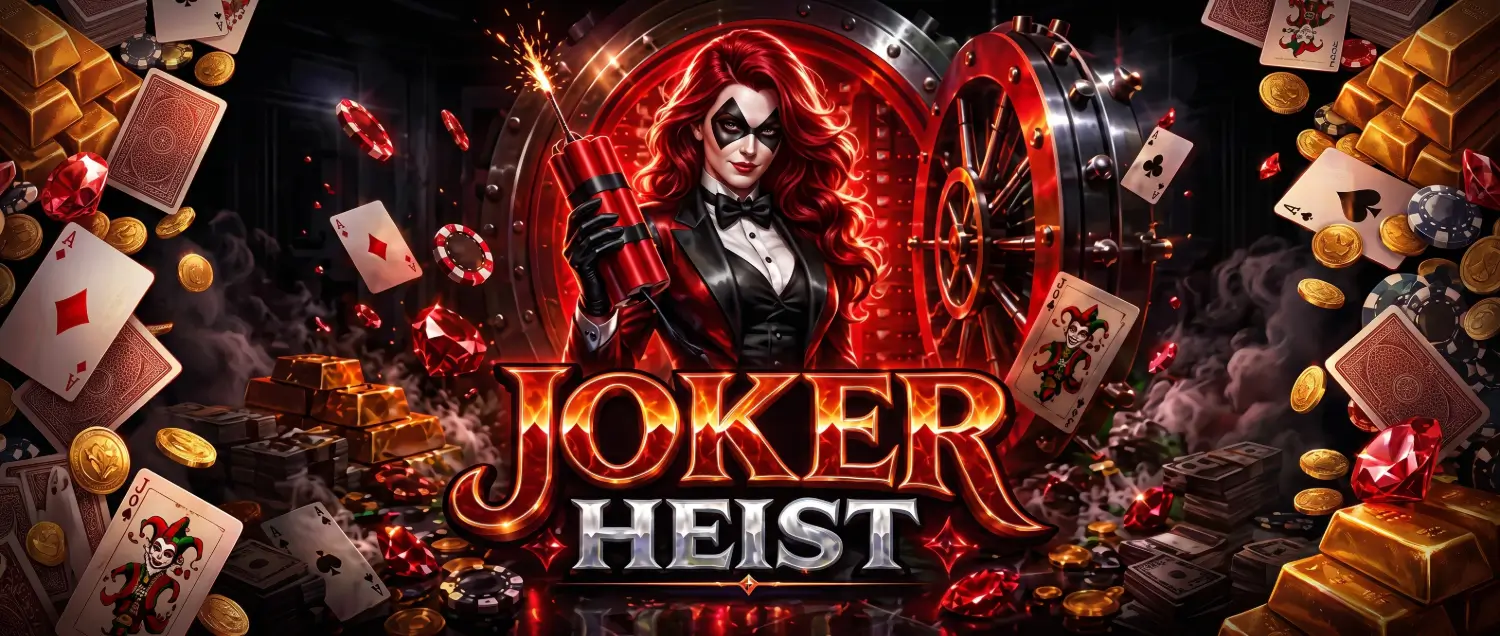
Novomatic frames Joker Heist around a detective-crime setup with a playful, joker-mischief tone rather than the straight-faced heist-thriller angle most competitors take. The theme tags attached to the game — adventure, banks, detective/crime, diamond, gold bars, joker, money, robbery, TNT — point to a fairly dense visual theme: vault doors, explosives, cash stacks, and a joker character running the show. That combination is more playful than Million Dollar Heist Xtreme’s straight crime-drama presentation, and closer in tone to Cyberheist City’s stylised approach, minus the neon sci-fi wrapper. Whether that lighter tone extends to the actual gameplay pacing is, again, something only hands-on play will confirm.
Where does this fit against the competition?
Robbery and heist themes are crowded in 2026, and there’s enough verified data on direct competitors to place Joker Heist honestly.
Million Dollar Heist Xtreme, also by Novomatic, runs the same theme with a 90.1% RTP and high volatility, using Bonus symbols, a Bonus wheel, Free Spins, Scatter, and Wild — a simpler feature set than Joker Heist’s tag list, and an even lower RTP. If Joker Heist is meant to be the more premium in-house alternative, the 92.48% figure supports that positioning, though it’s still a step behind the wider market.
Cyberheist City from Pragmatic Play takes the same genre in a different direction: 243 ways, tumbling reels, and wild multipliers that climb from 2x up to 100x, stacking across a chain of tumbles within a single spin. That’s a documented, specific mechanic — the kind of detail Joker Heist’s own listings don’t yet have. It’s the clearer benchmark for what a “Gonzo mechanic” heist slot can look like when the provider actually publishes the math.
All Ways Joker, from Amatic — Novomatic’s sister studio — also runs 243 ways with joker wilds and a double-up multiplier, aimed at the same classic-meets-modern audience. It’s a useful reminder that Novomatic’s own group already has overlapping products competing for the same shelf space.
Against that field, Joker Heist’s 92.48% RTP is its weakest selling point right now. The theme and feature list suggest ambition — a Gonzo-style avalanche mechanic with mystery symbols and a buy feature is a genuinely modern combination — but the return percentage undercuts it before a single spin is played.
Is this a buy-bonus title, a base-game grinder, or neither?
Too early to say with confidence, and that’s the honest answer. The presence of a Buy Feature points toward bonus-hunting appeal, but without a published buy-in price or a documented multiplier cap on the free spins, there’s no way to calculate whether that purchase is actually good value. A 92.48% RTP base game with an unpriced buy feature is not enough information to recommend the purchase route over natural triggers, or vice versa.
Availability right now
SlotCatalog scanned its tracked casinos and did not find Joker Heist listed at any of them at the time of writing. The demo is also currently unavailable on SlotCatalog itself. For a Novomatic release, that’s a slower rollout than usual — Novomatic titles typically appear across the provider’s network within days of release, not weeks. Whether that’s a staggered regional rollout or something else isn’t something I can determine from public sources.
The honest verdict, for now
Play or skip: neither, yet. There isn’t enough public data to responsibly tell you how this game plays. What’s confirmed — 92.48% RTP, x5000 max win, 243 ways, a genuinely interesting feature list on paper — puts Joker Heist below the 2026 benchmark on the one number that matters most (RTP), with no variance rating, no hit frequency, no live demo, and no casino availability to test any of it against.
The one number that limits it: 92.48% RTP. Until Novomatic either confirms that figure is fixed or discloses an operator-configurable range, treat this as a below-average return in a genre where several direct competitors already clear 95%.
Player profile it might suit, eventually: fans of avalanche-style heist slots who want to try the Gonzo-mechanic-plus-mystery-symbol combination once the demo goes live and the actual multiplier math is published.
Player profile who should look elsewhere right now: anyone chasing a confirmed high-RTP title today. Cyberheist City and All Ways Joker both have documented mechanics and are already playable — Joker Heist, as of this writing, is not.
I’ll revisit this once a demo or a detailed paytable breakdown becomes available, and update the RTP, variance, and feature mechanics with real numbers instead of tag names.