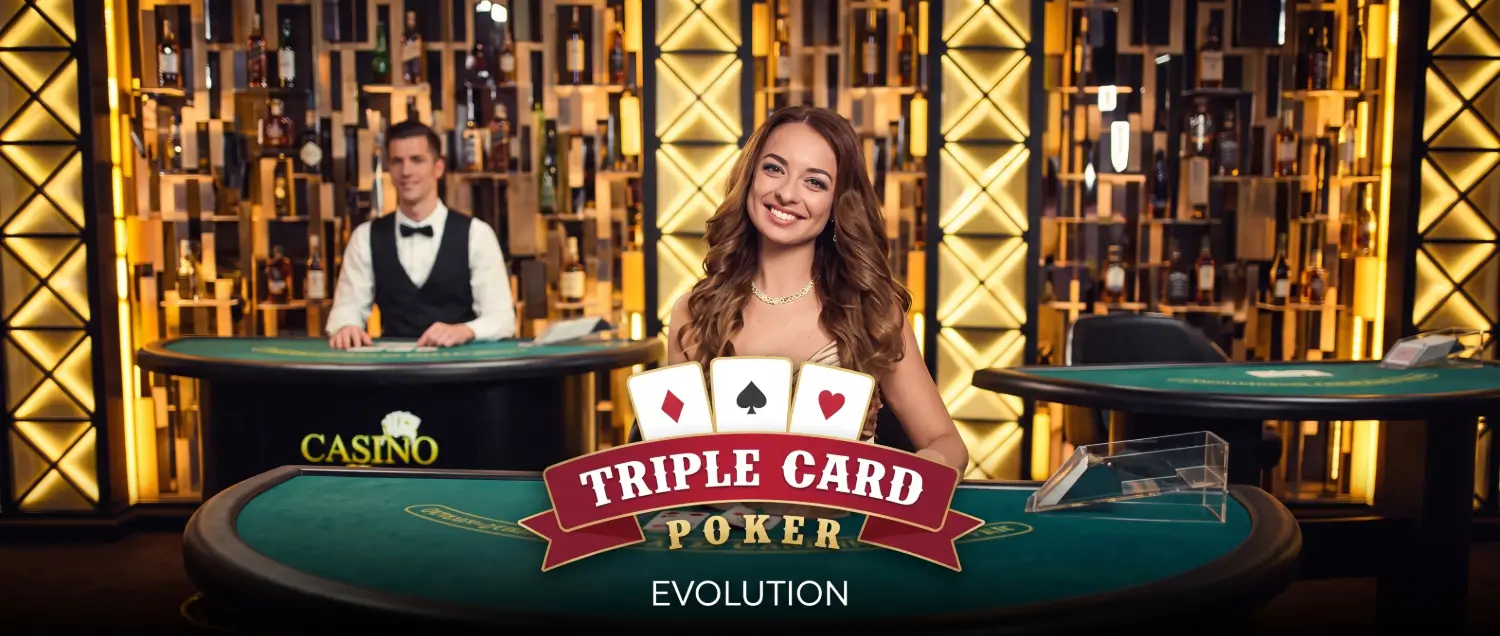
Triple Card Poker — the name Evolution’s game shows up under on several aggregator sites, though the table itself is branded Three Card Poker in the live lobby — has been running since 2015. Eleven years on a live floor is a long time for any table game, and this one has survived without a Megaways-style relaunch or a rules overhaul. It’s still the same single-deck, one-decision format it launched with.
That longevity is worth questioning rather than assuming. A live poker table stays in the lobby because operators keep tables filled, not because the underlying game is generous. At 96.63% RTP on the main Ante bet, Three Card Poker sits below most of Evolution’s other head-to-head poker tables, and its two side bets are considerably worse. Whether that’s a fair trade for the speed and simplicity on offer is the actual question this review answers.
What this game actually is
Three Card Poker is a live dealer table where you play against the dealer, not against other players. Evolution runs it from its studio network with a professional dealer, standard 52-card decks, and the same production quality you’d expect from any of its tables: multiple camera angles, a bet range wide enough for casual and serious players (typically $1 to $1,000 per spot, though exact limits shift by operator), and no download required.
The single deck is shuffled after every round — there’s no card-counting angle here, and nobody claims otherwise. You and the dealer each receive three cards. That’s the entire deal. There’s no draw, no community cards, no multi-street betting. One decision, one outcome, next hand.
Because the format is so stripped-down, rounds move fast. If you’ve played Casino Hold’em or Ultimate Texas Hold’em on Evolution’s other tables, Three Card Poker will feel almost abrupt by comparison — you get through more hands per hour, for better or worse depending on your bankroll management.
On the launch date: sources disagree here, and it’s worth flagging rather than picking one number to sound authoritative. Several established live casino review sites date Evolution’s Three Card Poker to 2015. At least one aggregator lists a late-2018 release instead. Both can’t be right, and I haven’t found an Evolution press release that settles it definitively. Either way, this is not a new table — it predates most of the crash games and Megaways slots currently dominating lobbies, live or otherwise.
Production and studio feel
Evolution’s tables all share a house style — multi-camera coverage, professional dealers, and a studio environment built to feel closer to a land-based pit than a webcam. Three Card Poker gets the same treatment as the rest of the portfolio: no compromise on video quality just because the underlying game is simple. The interface includes a rules tab that runs through the Q-6-4 strategy and paytables directly in-client, which matters more here than on most tables, since the correct play isn’t intuitive to anyone arriving from five-card poker.
Any number of players can sit at the same table simultaneously, and each player’s hand and decisions are independent — nobody’s fold affects anyone else’s outcome, the way it might at a physical table with limited seats. That’s standard for Evolution’s head-to-head poker format, but worth stating plainly for anyone used to seat-limited land-based pits.
How the hand actually plays out
You place an Ante bet to start. You can also place an optional Pair Plus side bet and an optional 6 Card Bonus side bet before cards are dealt — both are independent of how the main hand plays out. Once you’ve seen your three cards, you make the only real decision in the game: place a Play bet equal to your Ante to stay in, or fold and forfeit the Ante.
The dealer then reveals their hand. Here’s the part that trips up newcomers: the dealer needs Queen-high or better to qualify. If they don’t qualify, your Ante pays 1:1 automatically and your Play bet pushes — you neither win nor lose it, regardless of what you were holding. If the dealer does qualify, both Ante and Play pay 1:1 if you beat them, and both lose if you don’t.
One more wrinkle that catches people who’ve played five-card poker: a straight beats a flush in this game. That’s not a house quirk, it’s mathematics — with only three cards, there are fewer possible straights than flushes, so the rarer hand ranks higher. Worth remembering before you fold a straight thinking it’s weak.
There’s also an Ante Bonus running quietly in the background. If your hand is a Straight, Three of a Kind, or Straight Flush (which includes the Mini Royal — a suited Ace-King-Queen), you get paid the bonus regardless of whether the dealer beats you. Evolution’s live paytable runs: Straight 1:1, Three of a Kind 4:1, Straight Flush or better 5:1. It’s a genuinely nice touch — you can lose the hand and still walk away with a bonus payout on it.
Worth noting: some land-based Three Card Poker tables pay considerably more on this bonus — Mini Royal specifically can run as high as 10:1 on physical casino floors, against Evolution’s flat 5:1 treatment of any Straight Flush or better online. If you’ve played the land-based version before and remember bigger Ante Bonus numbers, that’s not misremembering. The online paytable is simply tighter on this particular line.
The full hand ranking in Three Card Poker, highest to lowest: Straight Flush, Three of a Kind, Straight, Flush, Pair, High Card. Read that twice if you’re used to five-card rankings — Straight above Flush is the one that catches people out, for the rarity reason explained below.
RTP, broken down by bet — and why the average figure is misleading
Quoting a single RTP for this game undersells how differently its three wagers perform. Treating them as one number is exactly the kind of shortcut that gets players into the worse side bets without realising it.
Ante bet: 96.63%. This is the figure most listings lead with, and it’s the number that matters if you play with correct strategy (more on that below). It puts Three Card Poker in respectable but unremarkable territory for a live table game — better than most slots, worse than blackjack, and meaningfully worse than Evolution’s own Ultimate Texas Hold’em, which returns up to 99.47% on the total bet with perfect play.
Pair Plus: 95.51%. This side bet pays out based purely on your own three-card hand — pair or better — independent of the dealer entirely. You can win it even after folding the main hand. That independence is the appeal. The catch is the house edge sitting at roughly 4.5%, noticeably worse than the Ante.
6 Card Bonus: 91.44%. This is the weak link. It combines your three cards with the dealer’s three to build the best possible five-card hand, paying from 7:1 for Three of a Kind up to 1,000:1 for a Royal Flush. An 8.56% house edge is a steep price for lottery-style upside, and I’d think twice before making this a habitual side bet rather than an occasional flutter.
If two of your three bets sit meaningfully below the headline figure, the honest read is that this table rewards Ante-only, strategy-correct play far more than it rewards betting all three spots every round.
For context on how that stacks up against the rest of Evolution’s live floor: Casino Hold’em returns 97.84% on the Ante alone and 99.18% on the total bet, both ahead of Three Card Poker’s Ante figure. Blackjack, playable at basic strategy across Evolution’s tables, sits close to 99.5%. None of this makes Three Card Poker a bad bet in isolation — 96.63% is still a perfectly playable number — but it does mean the game is competing for your bankroll against tables that pay back more, on the same studio, under the same brand.
The one decision that decides your edge
Three Card Poker’s entire skill component fits in a single rule: play any hand of Queen-6-4 or better, fold everything weaker. If your highest card is a King or Ace, always play. If it’s a Queen, your second card needs to be a 6 or higher — and if that second card is exactly a 6, your third card needs to be a 4 or higher.
Why does this specific threshold exist? Because the dealer only qualifies with Queen-high or better, the cutoff for your own play decision sits right around that same line. Play weaker than Q-6-4 and you’re contributing money to a Play bet with negative expected value that folding would have avoided. Follow the rule and the house edge on the Ante settles at roughly 3.37% — not spectacular, but a lot better than playing every hand out of impatience.
Here’s the thing worth sitting with: correct strategy here isn’t a skill you develop through repetition, the way you might sharpen your reads at a poker table full of humans. It’s a single memorised threshold. Once you know it, you know it. There’s no meaningful improvement curve after that first session — which is either refreshingly simple or a bit flat, depending on what you’re looking for at a poker table.
A quick worked example, since the rule sounds more abstract than it plays: dealt Queen, 8, 3, you play — the 8 clears the “6 or higher” bar comfortably. Dealt Queen, 6, 3, you fold — the third card falls short of the required 4. Dealt Jack, King, 2 — actually King-high, so you play regardless of the other two cards. That last case is the one people misread most often: it’s easy to glance at the low kicker and assume a fold, when the actual rule only cares about your highest card once it clears Queen.
What about the side bets — is there a strategy there too? Not really, and that’s part of what makes them worse value. Pair Plus and the 6 Card Bonus are settled purely on the cards you’re dealt, with no play-or-fold decision involved. You either place them before the deal or you don’t; there’s no skill component once the cards are down. That absence of a decision point is exactly why their house edges run higher than the Ante’s — there’s no correct-play discount available to claw the number back down, the way Q-6-4 does for the main bet.
Where it sits in Evolution’s live poker lineup
Evolution doesn’t run Three Card Poker in isolation — it’s one entry in a live poker portfolio that also includes Ultimate Texas Hold’em, Casino Hold’em, and Texas Hold’em Bonus Poker. Comparing them directly says a lot about where this table actually fits.
Ultimate Texas Hold’em, launched in 2016, returns up to 99.47% on the total bet with correct strategy and offers a genuine multi-street decision tree: you can raise 3x or 4x pre-flop, 2x after the flop, or 1x after the river, with the size of your available raise shrinking the longer you wait. That’s real strategic depth — the kind of game where getting better at it actually pays off over time.
Texas Hold’em Bonus Poker, a 2017 addition built in partnership with Games Marketing, sits in similar territory — 97.96% on the Ante alone, up to 99.47% on the total bet, with multiple check/raise opportunities across the deal rather than the single raise window Ultimate Texas Hold’em allows.
Casino Hold’em, a longer-standing Evolution table built on regular Texas Hold’em rules with the multiplayer element stripped out, returns 97.84% on the Ante and 99.18% on the total bet — again ahead of Three Card Poker, and with a genuine call-or-fold decision after seeing the flop rather than before any community cards appear at all.
Set next to all three, Three Card Poker’s 96.63% Ante RTP and single fold-or-play decision reads less like a competing product and more like the fast, low-commitment option on the same menu. That’s not automatically a flaw. Not every session calls for a multi-street decision tree, and there’s a real audience for a table where you can sit down, know the entire strategy in thirty seconds, and get through hands quickly. But if maximising return is the actual priority, Ultimate Texas Hold’em or Casino Hold’em are the better seats at the same studio.
It’s also worth being honest about why Three Card Poker still holds a seat on the floor despite the weaker numbers. Speed is a real draw for players who want volume over depth, and the format’s total lack of a learning curve is genuinely appealing to anyone stepping into live poker for the first time. A player who’s intimidated by Ultimate Texas Hold’em’s raise-sizing rules can sit down at Three Card Poker, learn Q-6-4 in one hand, and be playing at close to optimal strategy by their second round. That’s a real advantage even if the ceiling is lower.
Is there a next-generation version of Three Card Poker itself — a Power Reels-style relaunch, an upgraded paytable, a progressive jackpot bolted on? Not from Evolution, and not as of this review. Land-based casinos and some RNG-format operators run a progressive side bet variant with an Envy Bonus for other players at the table, but that variant isn’t part of Evolution’s live build. If you’ve seen progressive Three Card Poker advertised, that’s a different operator’s table, not this one.
Bankroll and session pacing
Because Three Card Poker has no drawing round and no multi-street betting, hands resolve quickly — you’re not waiting through a flop, turn, and river the way you would at Ultimate Texas Hold’em or Casino Hold’em. That pace has a direct bankroll implication: more hands per hour means more total wagered per hour at a given bet size, even though the house edge on any single hand is lower than a lot of side-bet-heavy games.
Practically, that means sizing your Ante to your session length rather than to a single hand in isolation. A $10 Ante at a fast table can burn through a bankroll considerably quicker than the same $10 at a slower-paced game with more decision points per round. None of this is unique to Three Card Poker — it’s true of any fast table game — but it’s worth stating plainly given how often speed gets marketed as a pure positive without the bankroll trade-off attached.
Buy-in, jackpots, and what’s missing
There’s no buy-bonus mechanic here, which isn’t a surprise — buy-in features belong to slots, not table poker, and nobody genuinely expects one on a card table. More relevant: there’s no progressive jackpot on Evolution’s version, unlike the land-based Three Card Poker variants that run an optional $1 progressive side bet with an Envy Bonus. For a table this established, that omission is worth knowing before you sit down expecting a jackpot chase.
What you do get is consistency. The paytables don’t shift, the studio production is Evolution’s usual professional standard, and the dealer qualifies the same way every single round. In a market where new crash games and expanding-reel slots launch every month promising bigger numbers, there’s something almost old-fashioned about a table that hasn’t tried to reinvent itself since 2015. Whether that’s a selling point or a sign of stagnation depends entirely on what you’re after.
Who this table is actually for
Play it if you want a fast, low-decision live table game with a genuinely low barrier to entry. The Q-6-4 rule takes a minute to learn, the Ante Bonus adds a bit of extra upside on strong hands even when you lose to the dealer, and 96.63% on the main bet is a reasonable baseline as long as you’re not funding the side bets every round. It also suits players who enjoy the atmosphere of a live poker table without wanting to think through a multi-street raise structure.
Skip it, or at least stick to Ante-only play, if you’re chasing the best possible return available on Evolution’s poker floor — Ultimate Texas Hold’em’s 99.47% total-bet ceiling makes Three Card Poker look mediocre by direct comparison. It’s also not the table for anyone hoping the 6 Card Bonus becomes a reliable source of value; an 8.56% house edge on that bet is steep, and treating it as a regular part of your session rather than an occasional side flutter will cost you over time.
The one number that limits this game most is the 91.44% RTP on the 6 Card Bonus — not because you have to bet it, but because its presence on the felt tempts players into a habitually bad wager dressed up as extra action. Stick to the Ante, learn Q-6-4, and treat the Pair Plus and 6 Card Bonus as occasional variance rather than core strategy, and Three Card Poker does exactly what it says: a quick, low-friction live table that won’t make you rich, and was never trying to.
If you’re deciding between this and one of Evolution’s other live poker tables for the evening, the honest recommendation depends on what you actually want out of the session. Want the best return the studio offers and don’t mind a slightly slower pace with real decisions to make? Ultimate Texas Hold’em. Want speed, a near-zero learning curve, and a table you can sit down at cold and be playing correctly within a minute? Three Card Poker earns its seat. What it isn’t is the best value play on Evolution’s floor, and no amount of studio polish changes that math.
One last practical point: this table has been available for the better part of a decade without a rules change, a paytable adjustment, or a sequel. That’s unusual longevity for any casino product, live or otherwise. It suggests operators keep filling seats at it, which in turn suggests enough players are happy with the trade-off described above — speed and simplicity over maximum return. That’s a legitimate reason to play a game. It’s just not the same as the game being the best mathematical option on the felt, and a review that pretended otherwise wouldn’t be doing its job.
FAQ
Is Triple Card Poker the same game as Three Card Poker? Yes. “Triple Card Poker” is how some aggregators and casino lobbies list Evolution’s Three Card Poker table. The rules, paytables, and RTP figures are identical — it’s a naming variation, not a separate game.
What’s the house edge with optimal play? Roughly 3.37% on the Ante bet if you follow the Q-6-4 rule correctly. That climbs on both side bets — around 4.5% on Pair Plus and 8.56% on the 6 Card Bonus.
Does a straight really beat a flush here? Yes, and it’s easy to misplay if you’re used to five-card poker rankings. With only three cards in play, flushes are statistically more common than straights, so the rarer hand — the straight — ranks higher.
Can I win the Ante Bonus if the dealer beats my hand? Yes. The Ante Bonus pays on a Straight, Three of a Kind, or Straight Flush regardless of the outcome against the dealer, as long as you’ve placed a Play bet.
Is there a demo version available? Live dealer games generally can’t be played for free the way RNG slots can — you’re watching a real dealer running real cards. Some operators let you observe a table before committing real money, but there’s no standalone demo mode for the live version. Evolution does run RNG “First Person” versions of several of its live tables — Blackjack, Roulette, Baccarat, and Video Poker among them — but Three Card Poker isn’t currently part of that range, so there’s no free-play or self-paced RNG equivalent to fall back on.
Which side bet is the better value if I want to play one anyway? Pair Plus, without much competition. At 95.51% RTP it’s meaningfully better than the 6 Card Bonus’s 91.44%, and it settles purely on your own three cards rather than needing a specific combination with the dealer’s hand. Neither is a good habitual bet compared with the Ante, but if the choice is between the two, Pair Plus loses you less over time.
How does the dealer qualification rule actually affect my odds? It works in your favour more than it might seem. Roughly 44.9% of the time the Ante wins outright, but a meaningful share of hands end with the dealer failing to reach Queen-high — in which case your Ante still pays 1:1 and your Play bet simply pushes back to you, win or lose on the cards themselves. It’s a built-in cushion that reduces variance compared with a format where every hand is settled purely on hand strength.