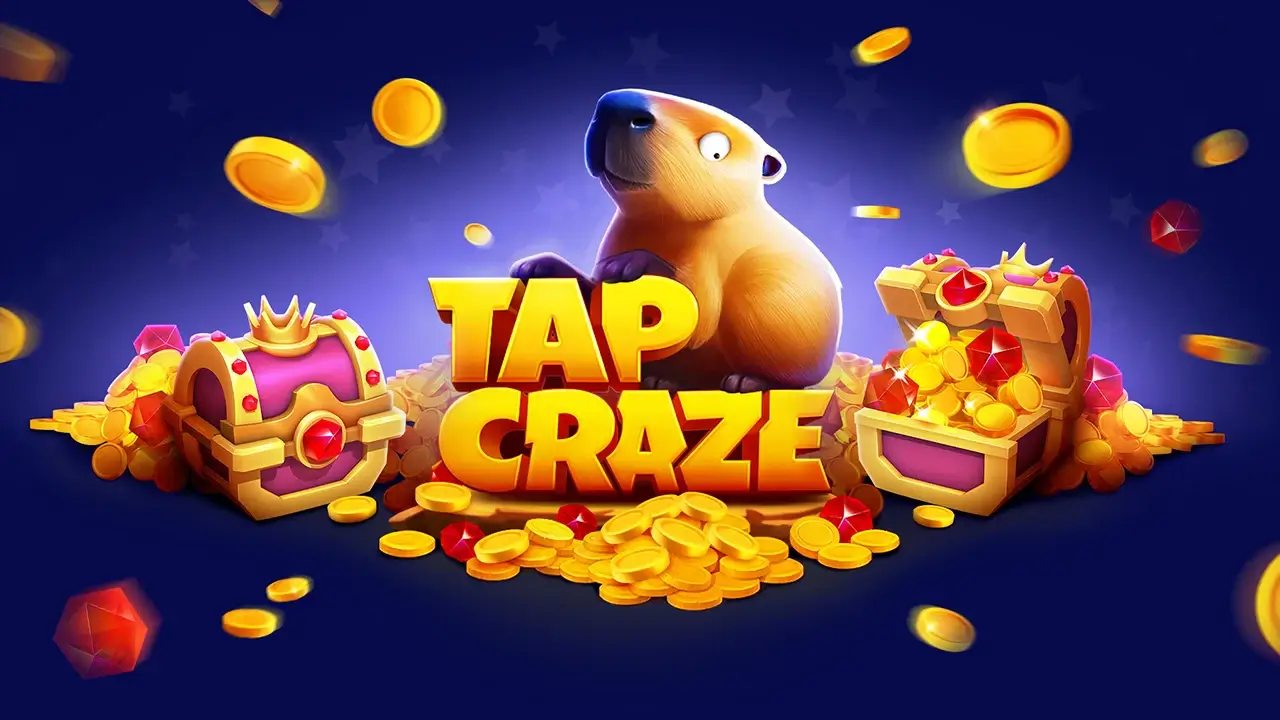
Tap Craze launched in November 2024, which makes it a veteran by instant-game standards — most titles in this category are lucky to hold a lobby slot for six months before the next capybara, hamster, or pickaxe-wielding miner replaces them. It’s still here, still listed at 96.24% RTP, and still built entirely around a happiness meter rather than a spinning reel. That alone should tell you something: Evoplay wasn’t chasing a trend when it built this, it was trying to own one.
Where Tap Craze sits in 2026’s instant-game field is less clear-cut. The category has filled up fast with mining clickers, tap-to-earn spin-offs, and Hamster Combat imitators, and a lot of them share the same DNA — tap, fill a meter, spin a wheel, collect a jackpot. Evoplay wasn’t even the only major studio to spot the opportunity: within weeks of Tap Craze’s release, Turbo Games and Greentube both shipped their own click-driven instant titles, and Platipus followed the same month with a coin-and-jackpot format built on an almost identical premise. That’s an unusually tight cluster of competing releases for a single sub-genre, and it means Tap Craze has spent its entire lifespan with direct rivals sitting one browser tab away.
The question worth asking here isn’t whether Tap Craze is fun. It’s whether a x3000 max win and a 96.24% RTP still hold up against a field that’s since produced titles paying out ten times that ceiling.
Math model and mechanics
Start with what Tap Craze isn’t. There’s no reel grid, no paylines, no cluster pays — SlotCatalog lists layout and betways as N/A, and that’s accurate. This is an instant game in the strictest sense: you place a bet, you interact with a fixed system, and the round resolves. Comparing it directly to a five-reel video slot is comparing apples to a tap-dancing capybara, so don’t expect Megaways-style math here.
RTP is confirmed at 96.24% across every source I checked, including SlotCatalog’s own database — no discrepancy on this figure, which is reassuring on its own, since operator-configurable RTP ranges are the norm for most modern releases and their absence here suggests Evoplay ships this one fixed. At 96.24%, roughly £96.24 comes back for every £100 wagered over a large enough sample. That puts Tap Craze slightly above the wider slot-market average (typically 95–96%), though nothing here separates it from a hundred other Evoplay titles sitting in the same band.
Max win is where the sources start disagreeing, and I’m not going to paper over it. SlotCatalog — the most consistently reliable aggregator for certified figures — lists the max win at x3000, which lines up neatly with the game’s own Grand jackpot value (more on that below). A handful of secondary demo sites quote x3300 or x10,000, figures that don’t match anything in the game’s own jackpot structure and read like copy-paste errors from templated review pages. One source cites an absolute win figure of 750,000 units rather than a multiplier, which is a different kind of number entirely and shouldn’t be read as a competing multiplier claim. Treat x3000 as the reliable figure — it’s the one Evoplay’s own jackpot tiering supports, and it’s the one the primary aggregator confirms.
Volatility isn’t officially rated by the developer — SlotCatalog shows variance as N/A, which is common for instant games that don’t fit the standard reel-based volatility model. One demo aggregator classifies it as low-to-medium, which tracks with what the mechanic suggests: the base tapping loop pays in small, frequent bonus increments, while the Wheel of Fortune and jackpot keys sit on top as the higher-variance layer. You’re not looking at long dry spells punctuated by monster hits. You’re looking at a steady trickle with occasional spikes — closer to a coin-collector mechanic than a high-variance slot.
Hit frequency isn’t independently certified either. One aggregator claims every tap rewards something, which is the kind of unverifiable claim I’d normally strip out entirely — I’m flagging it here only because it matches the mechanic’s design intent (constant small rewards to keep you tapping) rather than treating it as a confirmed statistic.
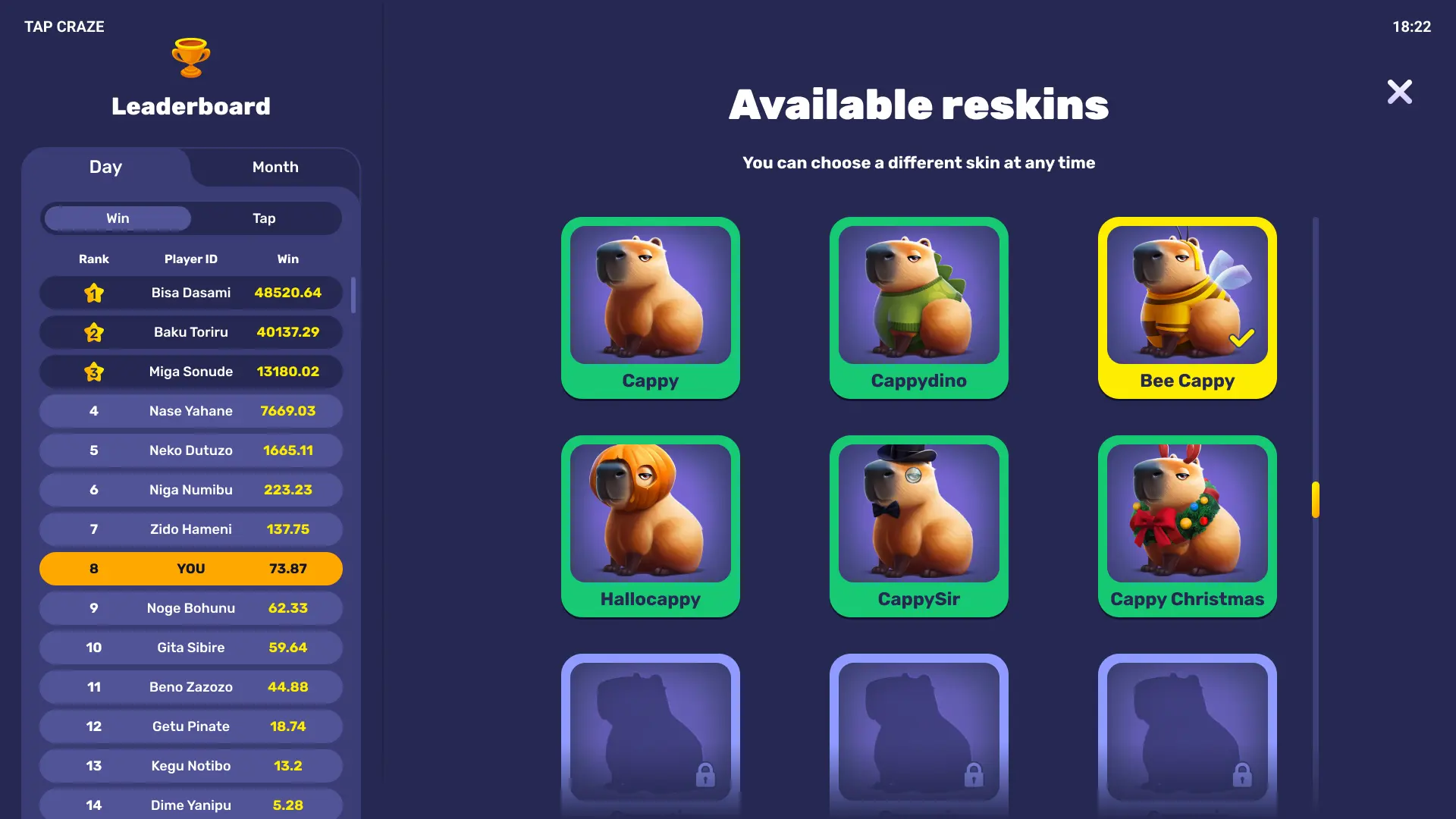
Grid structure and payline logic don’t apply here in any conventional sense, and that’s worth spelling out plainly rather than skipping over. A standard five-reel slot resolves a win the moment the reels stop, evaluated against fixed paylines or a cluster-pay grid. Tap Craze has none of that machinery. The entire “board,” if you can call it one, is the Happiness Scale and the Wheel of Fortune sitting on top of it — there’s no symbol matrix to read, no payline diagram to study before you play. For players used to parsing a slot’s paytable before committing real money, that’s actually a simplification: there’s less to learn, but also less mathematical transparency into how individual outcomes are generated, since Evoplay doesn’t publish the underlying probability tables the way it might for a reel-based title’s symbol weightings.
Betting range sits at $0.10 to $500 per SlotCatalog’s attribute table, though Evoplay’s own game page and several demo aggregators quote figures up to $50,000, which likely reflects currency-conversion display quirks on high-denomination markets rather than a genuine stake ceiling. For most operators and most GEOs, expect the $0.10–$500 range to be what you actually see at the bet slider.
Here’s the number that matters more than any of the above: x3000 max win on a game with no bonus buy and no progressive jackpot means the ceiling is fixed and known in advance. There’s no lottery-style tail event waiting to happen. What you see in the jackpot table is what the game can pay.
Put the RTP gap in real terms. On a £1 stake across a 200-round session — a reasonable length for an interaction-driven game where each “round” is really a stretch of continuous tapping rather than a single spin — a 96.24% RTP theoretically returns around £192.48 against £200 wagered, a £7.52 shortfall over the long run. That’s not dramatically different from a 95% RTP slot, where the same session would theoretically return £190, a £10 shortfall. The half-point RTP edge Tap Craze holds over lower-RTP tapper games is real but modest; it won’t be the deciding factor in whether this game suits you. The x3000 ceiling versus what’s available elsewhere in the same niche is the bigger factor, and it’s covered properly below.
One mechanical detail worth flagging on its own: because the Happiness Scale decays when you stop tapping, session length isn’t purely a function of bankroll the way it is in a standard slot. You can burn through your Happiness progress by pausing to check a notification, which resets accumulated progress toward the next Wheel of Fortune trigger. That’s a genuinely different risk profile from a slot where every spin is independent of the last — here, inattentiveness has an in-game cost, not just an opportunity cost.
Feature breakdown
Happiness Scale
The Happiness Scale is the entire game loop, not a bolt-on feature. Every tap on Capybara Joe fills the bar. Stop tapping and it decreases — there’s no idle-friendly version of this game, which matters if you’re used to slots where you can walk away mid-spin. The scale has no stated maximum activation count because it’s continuous: it fills, triggers the Wheel of Fortune, resets, and starts again for as long as you keep playing. The realistic payout contribution here is modest and consistent — small multipliers and bonus increments per fill, not the game’s headline number. The honest limitation: if your hands (or your attention) drift, the meter punishes you for it, which turns what looks like a relaxed clicker into something closer to a low-stakes reaction game.
Why build a decay mechanic into a casino game at all? Because it’s the one lever Evoplay has to keep a tap-to-earn format from feeling passive. Compare it to Jewel Clicker’s approach below — a pickaxe that can break at any click — and you’ll notice both studios solved the same problem (how do you make repeated tapping feel like it carries stakes) with opposite tools: Tap Craze punishes inattention, Jewel Clicker punishes persistence. Neither is objectively better. They just produce different sessions.
Wheel of Fortune
Once the Happiness Scale maxes out, the Wheel of Fortune activates and multiplies your accumulated bonus by up to x500. That’s the mid-tier engine of the game — not the jackpot ceiling, but the feature you’ll hit most often if you play consistently. The trigger condition is binary: fill the bar, get the spin. There’s no stated re-trigger mechanic beyond simply continuing to tap and refilling the meter for another go. Realistic contribution: this is where most of your session-level upside comes from, since jackpot keys are rarer than a full happiness bar. The catch — and it’s a real one — is that the x500 ceiling is a maximum, not a typical outcome. Wheel results aren’t published with individual segment odds, so there’s no way to confirm how often the wheel actually lands anywhere near that number.
That gap between “maximum stated” and “typical result” runs through most of Tap Craze’s feature set, and it’s worth naming once here rather than repeating it under every heading. None of Evoplay’s published sources break down wheel segment weighting, jackpot key drop rates, or the odds of a full Happiness fill converting into a Wheel spin within a given number of taps. That’s not unusual for the instant-games category — reel slots rarely publish full symbol-weighting tables either — but it does mean any session-level expectation you form has to be built from the headline RTP and max win figures rather than a granular probability model.
Fixed jackpots — Minor, Major, Grand
Tap Craze runs three fixed jackpots: Minor (x1500), Major (x2000), and Grand (x3000). These aren’t triggered randomly in the way a scatter symbol triggers a bonus round — Evoplay’s own game description frames them as being “discovered through keys that Joe finds during play sessions,” which is a treasure-hunt framing layered on top of what’s likely a standard random-trigger system underneath. Maximum activation is once per hit, obviously, since landing the Grand jackpot pays the full x3000 max win and effectively caps the round. The honest limitation: because these are fixed, not progressive, there’s no pooled prize growing over time. Grand jackpot day one pays the same as Grand jackpot in year three. If you’re chasing a number that grows the longer a game goes unclaimed, this isn’t that game.
Work through what that means at stake level. At the confirmed £500 max bet, a Grand jackpot hit pays £1,500,000 in theory — a genuinely significant sum. At a more typical £5 casual stake, the same Grand jackpot pays £15,000, still a meaningful win for a session that started as a low-commitment tapping game. The gap between Minor and Grand — x1500 to x3000, exactly double — is a clean, deliberate design choice rather than an arbitrary spread, and it means the difference between hitting the lowest and highest jackpot tier is a straightforward 2x, not the kind of long-tail gap you’d see in a progressive structure where the top prize can be ten or twenty times the entry tier.
Costume Gallery
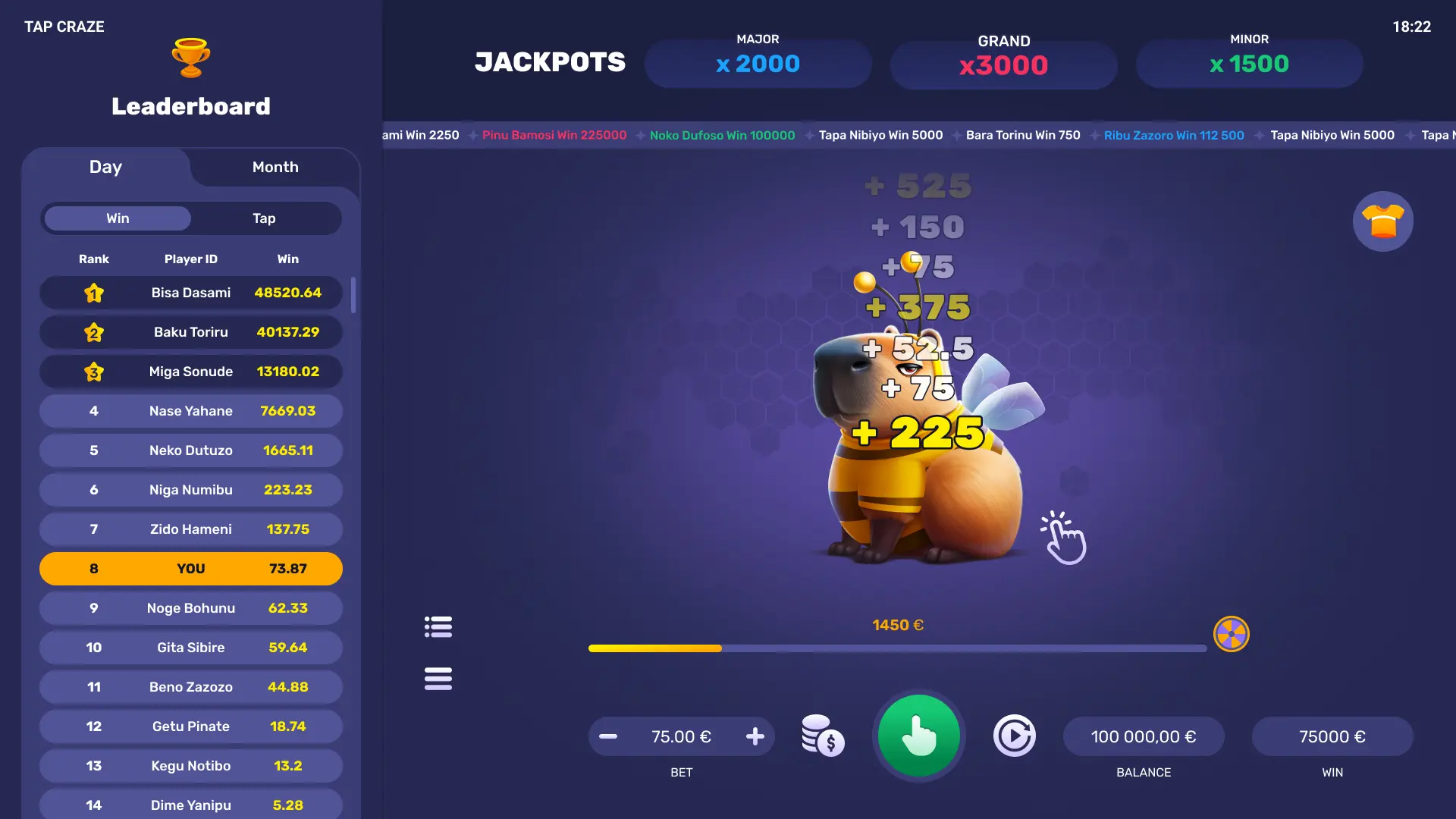
The Costume Gallery unlocks new outfits for Joe with each Wheel of Fortune spin. This is cosmetic, not mechanical — it doesn’t affect RTP, win frequency, or multiplier values. I’ll say what needs saying: this is a retention mechanic dressed as a feature. It gives players a reason to keep tapping beyond the immediate payout, which works fine as a design choice, but don’t mistake collecting outfits for collecting value.
It’s worth contrasting this against how collection mechanics usually work in slots, where unlocking a symbol set or a themed variant often does carry mechanical weight — think progressive multiplier trails or symbol upgrades that persist across spins. Nothing here does that. Every outfit Joe wears is purely visual, which means a completionist chasing the full Costume Gallery is playing for the collection itself, not for any edge it grants. That’s a fair trade if cosmetic progression genuinely appeals to you; it’s a non-factor if you’re evaluating the game purely on its numbers.
Leaderboard and live ticker
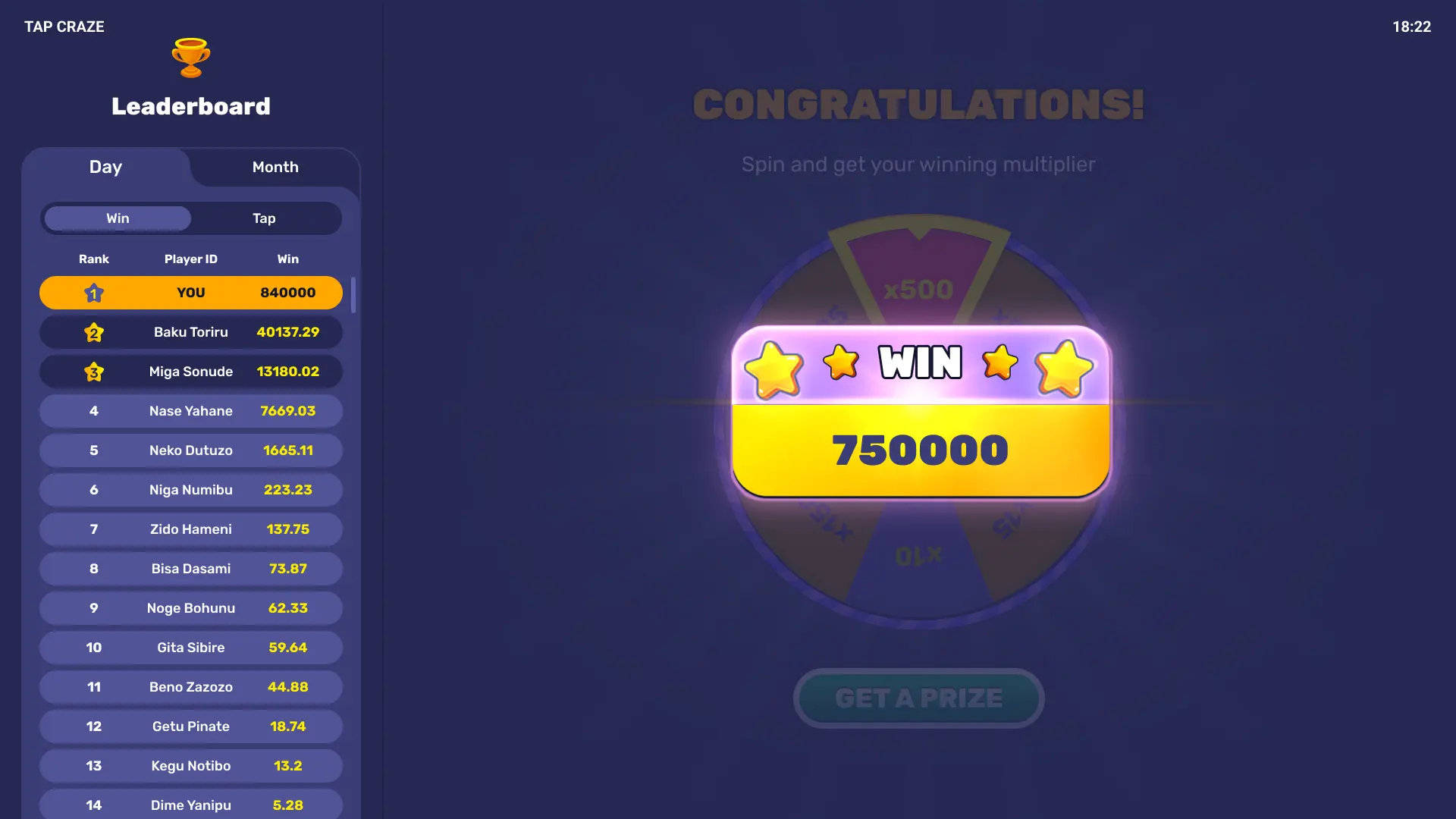
The Top 15 Leaderboard and Information Ticker round out the social layer — daily and monthly rankings, plus a live feed of other players’ wins. Neither changes your own math. They’re context, not mechanics, and worth mentioning only because they shape how the game feels in a crowded lobby: less like a solitary slot session, more like a shared arcade cabinet. If you’re playing purely for the numbers, you can ignore both entirely.
Taken together, the five pieces above form a tighter loop than the feature count suggests. There’s no separate free spins round layered on top of a base game the way you’d find in a five-reel slot — everything in Tap Craze routes back through the same Happiness Scale, which means learning the game takes minutes, not the hour or two you’d spend mapping a Megaways title’s full paytable. That’s a genuine strength for anyone who wants to sit down and understand exactly what they’re playing within the first few rounds.
The 2026 perspective
There’s no Power Reels, Megaways, or numbered sequel version of Tap Craze — I checked specifically for one, given how often Evoplay’s contemporaries iterate on a base title within a year of release, and found nothing beyond the original 2024 build still live in 2026. That’s a notable gap on its own: Evoplay hasn’t felt the need to revisit the math model, which either means the original is performing well enough to leave alone, or the tap-to-earn niche hasn’t generated enough demand for a sequel. Either read is plausible; there’s no public data to confirm which.
What Tap Craze does have is direct competition, and it’s not flattering. Jewel Clicker by Turbo Games runs the same click-driven, no-reels format — strike a stone instead of tapping a capybara — at a nearly identical 96% RTP but a lower x1000 max win. Tap Craze beats it on ceiling. Tap the Pot by Platipus, released the same month as Tap Craze in November 2024, shares the same 96% RTP band but blows both out of the water on max win: x31,140, achieved through a three-tier jackpot bonus game (Minor, Major, Grand) that plays out much like Tap Craze’s own jackpot structure, just with a vastly higher ceiling. Same theme family — instant tap mechanics, coin-and-jackpot structure, no traditional reels — completely different payout tail.
That comparison is the uncomfortable one for Tap Craze. A x3000 ceiling in a genre where a direct competitor released the same month is paying out x31,140 isn’t a marginal gap — it’s an order of magnitude. You might ask: does that actually matter if you’re not chasing the max win anyway? Fair question. For a casual session built around the Happiness Scale and the x500 Wheel of Fortune, the ceiling barely matters — most sessions never get near either game’s max win regardless. But for anyone using max win as a shorthand for a game’s overall ambition, Tap Craze reads as the more conservative build in its own micro-category.
A third data point rounds out the picture: Greentube’s Piñata Blast – Tapper, part of its dedicated Tapper Games series and released within days of Tap Craze in late October 2024, runs a lower 95% RTP but a contested max win figure — SlotCatalog lists x1000, while at least one licensed operator’s own game page quotes x5000. I won’t pretend to resolve that one; it’s the kind of discrepancy that shows up when an aggregator’s certified figure and an operator’s marketing copy don’t match, and it’s worth knowing both numbers exist rather than picking whichever sounds better. What matters for this comparison is the shape of the genre: three tapper-style instant games, all released within about a month of each other in late 2024, all landing in the mid-90s RTP band, with max wins ranging from a confirmed x1000 up to a confirmed x31,140. Tap Craze’s x3000 sits in the lower half of that spread.
Buy-bonus mechanic: absent. There’s no way to purchase direct entry to the Wheel of Fortune or the jackpot game — you build toward both through the Happiness Scale, full stop. In a 2026 lobby where bonus-buy has become close to standard on competitor slots, its absence here isn’t a flaw exactly, since the game’s entire identity is built around sustained interaction rather than instant access. But it does mean impatient players have no shortcut.
Progressive jackpot: also absent. All three jackpot tiers are fixed values, not pooled or growing. If progressive jackpots are your draw, look elsewhere in Evoplay’s catalogue or toward Tap the Pot’s higher fixed ceiling instead.
On the technical side, SlotCatalog lists Tap Craze at a lean 11.5 MB built on JS and HTML5 — light enough to load fast on a mid-range phone over mobile data, which matters more for a tap-driven game than for a standard slot, since every input here is a screen tap rather than a single spin button press. A game that lags on touch input would break the entire premise. There’s no indication from any source that Tap Craze suffers from input lag, though none of the aggregators I checked ran formal latency testing either — this is an area where the marketing claims outrun the independent verification.
So: high roller’s game, recreational game, or dead weight in a 2026 lobby? It’s recreational, and it knows it. The betting range tops out at a modest $500 per SlotCatalog’s confirmed figures, the max win sits well below its closest genre rival, and the core loop rewards session length over stake size. This isn’t a game built for someone trying to turn a big single bet into a life-changing multiplier. It’s built for someone who wants a low-friction, low-ceiling clicker to run in the background of a longer casino session.
Verdict
Tap Craze is a solid, honestly-built instant game let down by one number: the x3000 max win simply can’t compete with Tap the Pot’s x31,140 in the same theme, same RTP band, same release month. If ceiling size is what draws you to instant games in the first place, this isn’t the one to open.
Play it if you’re after a low-stakes, low-volatility session filler — the 96.24% RTP is solid, the fixed jackpot structure means no surprises, and the Happiness Scale mechanic genuinely rewards consistent, attentive play rather than pure luck. It works well on mobile, the bet range is accessible from $0.10, and the absence of a progressive jackpot at least means what you see in the paytable is what’s actually achievable. The theme itself deserves a mention here too — Capybara Joe is a genuinely likeable mascot, and the Costume Gallery gives casual players a reason to keep coming back that has nothing to do with chasing a multiplier. If you play instant games the way some people play mobile puzzle games — for the loop, not the leaderboard — Tap Craze delivers on that specifically.
Skip it if you’re chasing a big multiplier or you specifically want the tap-to-earn genre’s biggest ceiling — Tap the Pot exists, shares the theme family, and pays out ten times more at the same RTP. Skip it too if idle play matters to you: the Happiness Scale punishes you for stepping away, which isn’t a fit for anyone wanting a background game they can half-ignore. And skip it if you’re the kind of player who tracks a game’s competitive standing closely — released the same month as two rivals with higher confirmed ceilings, Tap Craze is the safe, middle-of-the-pack choice in a genre where “middle of the pack” was set unusually high right out of the gate.
For the two sub-audiences this genre actually attracts: recreational players who like Capybara Joe’s charm and don’t mind a modest ceiling will get exactly what they’re promised here — a steady, low-drama session with a fair RTP and no hidden catches in the jackpot structure. High rollers chasing a real number should look one door down at Platipus instead, where the same theme family pays out an order of magnitude more at an equivalent RTP. Neither choice is wrong. They’re just different games wearing similar clothes, and knowing which one you’re actually playing before you commit real money is the whole point of a review like this one.