Two years is a long time in slot years. Adrenaline Rush: Super Boost landed in February 2024 as Evoplay’s answer to the crowded racing-slot shelf, and it’s still sitting in lobbies in 2026 largely on the strength of its RTP range and a genuinely different bonus structure. That alone says something — most themed slots from 2024 are already buried under that year’s Christmas releases. The official RTP band runs from 96.14% to 96.32%, which is respectable but not remarkable, and the game carries a medium-high volatility rating direct from Evoplay. The real question for 2026 isn’t whether the paint job still looks good. It’s whether a 10-payline, five-reel slot with a €750,000 headline win can hold its lane against racing titles that have since pushed past 25,000x multipliers with Megaways reels and cluster engines. Let’s pop the bonnet.
Math model and mechanics
Evoplay lists Adrenaline Rush: Super Boost with an RTP range of 96.14% to 96.32%, confirmed directly on the official game page. That’s a wider-than-usual spread, and it exists because the operator-configurable version can sit at different points depending on which casino you’re playing at — a common practice, but one that most Tier 1 aggregators don’t bother explaining. In practice, this means the exact percentage you’re playing against depends on the operator, not just the game. Always check the paytable at your specific casino before assuming you’re getting the top end of that range.
Here’s where the sourcing gets messy, and I’m not going to pretend otherwise. The official Evoplay page states a flat max win of €750,000, with an information icon next to the figure — typically Evoplay’s way of flagging that this is a currency-denominated cap rather than a straightforward stake multiplier. Third-party aggregators, meanwhile, are all over the place: one lists 10,000x, another 20,000x, a third claims 41,800x, and one goes as high as 225,217x. None of those figures agree with each other, and none of them can be reconciled cleanly with the official €750,000 cap. Chipy’s own maths — a €750,000 win at the listed €7,500 maximum bet — works out to roughly 100x the max stake, which doesn’t match any of the multiplier claims either. My honest read: the official flat cap is the number to trust, the multiplier figures floating around the affiliate world look like they’ve been copied and mutated from template to template, and you should treat any specific “x your bet” claim for this game with real scepticism until you’ve verified it inside the actual game client at your casino.
Volatility is listed by Evoplay as medium-high. That’s consistent with most independent reviews, though I found at least one aggregator calling it “very high” and, bizarrely, another calling it “low” — the kind of contradiction that tells you the second source didn’t actually play the game. Medium-high in practice means this: you’ll see regular small-to-moderate hits from the Car symbol paytable, but the money is made — or not — during Free Spins, where the Racer feature accumulates value across the round. Hit frequency isn’t independently certified anywhere I could find, so I won’t invent a number. What I can tell you from the mechanic design is that the base game is built to be sustainable rather than punishing; the volatility comes from the free spins ceiling, not from base-game drought.
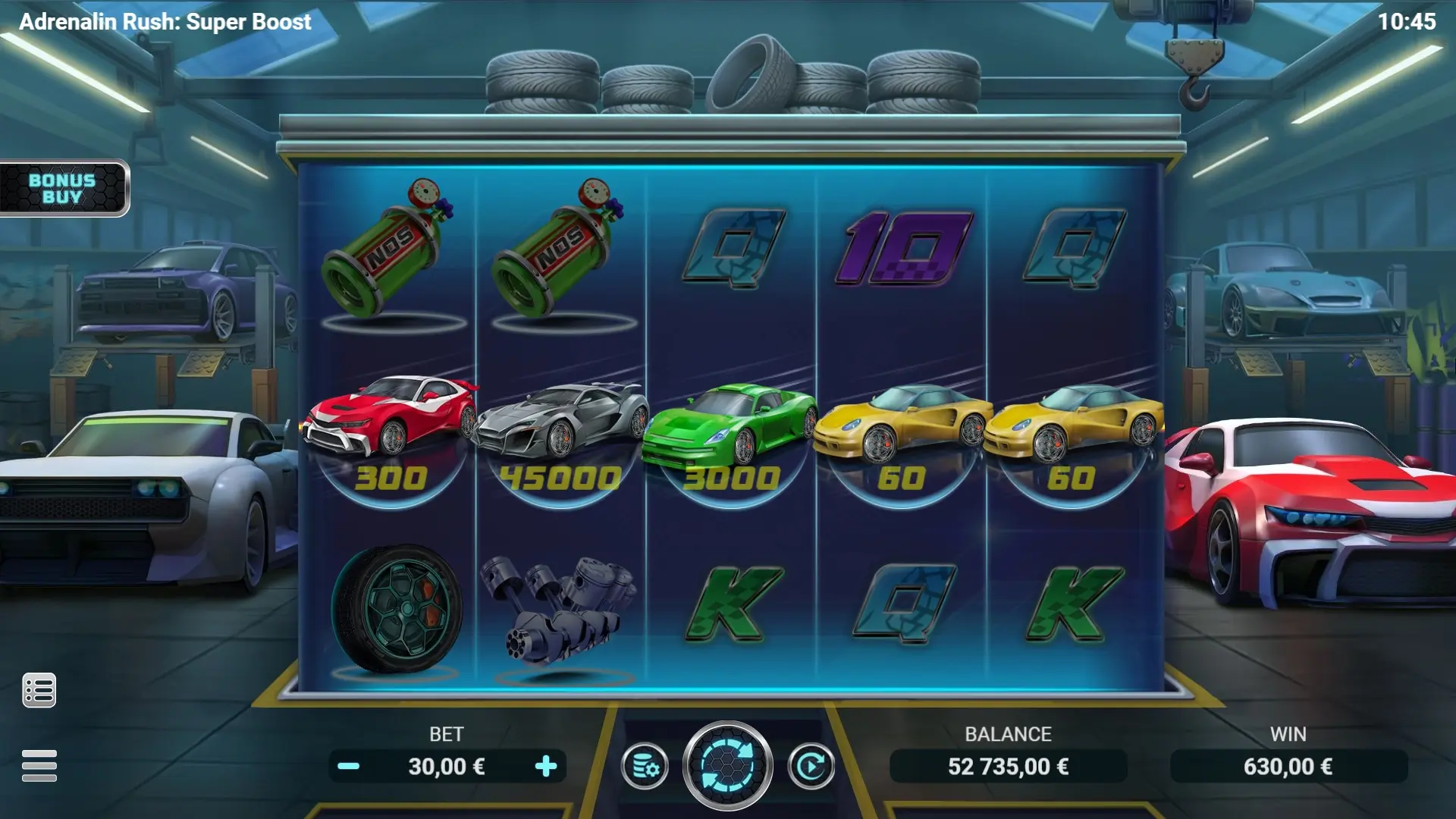
The grid is a straightforward 5×3 layout with 10 fixed paylines — no Megaways, no cluster pays, no shifting paylines. That’s a deliberately old-school choice for a 2024 release, and it puts a hard ceiling on combinatorial win potential compared to competitors running thousands of ways. Betting range, per aggregator data (not independently confirmed on the official product page), runs from roughly €0.10 up to €7,500 per spin, though a separate aggregator lists a €0.01–€375 range — another minor conflict worth flagging rather than smoothing over.
So: is a 100x-ish payout ceiling on a fixed max bet competitive in 2026? Not really — not against the 25,000x-plus titles dominating racing-slot rankings this year. But that comparison only works if the €750,000 figure really is the practical ceiling, and the confusion around that number is the single biggest thing Evoplay could clear up with a clearer paytable disclosure.
Put the RTP spread into pound terms over a realistic session and the gap matters less than it looks on paper, but it’s still worth doing the maths rather than taking the percentage on faith. At a £1 stake and 500 spins — a reasonable hour or so of play at a moderate pace — the difference between the 96.14% floor and the 96.32% ceiling works out to roughly £0.90 in theoretical return across the whole session. That’s not the kind of gap that should change your decision to play. What matters more is which end of that range your specific casino has configured, because you won’t be told which one you’re getting unless you check the in-game paytable directly — the lobby listing won’t tell you.
The 10 fixed paylines also deserve a word on hit frequency, even without an independently certified figure to cite. A fixed-payline structure with only 10 lines caps the number of simultaneous winning combinations per spin far more tightly than a Megaways or cluster-pays engine running thousands of ways. In practical terms, that means base-game spins will feel sparser between wins than titles like Mad Cars or Drive: Multiplier Mayhem, both of which use wider win-line counts to smooth out the between-hit gaps. This isn’t a flaw exactly — it’s a design choice that shifts the game’s personality closer to a classic-format slot than a modern high-frequency one — but it’s worth knowing going in if you’re used to 2026-era racing titles with denser paytables.
Feature breakdown
Scatter symbols and Free Spins trigger
Three or more Scatter symbols anywhere on the reels in the base game trigger the Free Spins round. This is standard mechanics — no wild positioning tricks, no minimum-reel requirements beyond the count. What’s less standard is what happens when you land exactly two Scatters without a winning combination on that spin: instead of nothing, you get a Turbo Respin of one, two, or three reels (the ones without Scatters), giving you a second shot at completing the trigger. It’s a small mercy mechanic, and it meaningfully softens the “so close” frustration that kills momentum in a lot of scatter-triggered slots. The catch: it only fires when the spin produced no win at all, so it’s not stacking with regular payouts.
Car symbols and Money symbol conversion
In the base game, Car symbols are ordinary paying symbols — nothing special. The mechanic only activates once you’re inside Free Spins, where Car symbols do double duty as both regular symbols and Money symbols, adopting random cash values ranging from 2x to 1,500x your bet per instance. This is the actual engine of the game’s win potential. Base-game play exists mainly to get you into the feature; the Money symbol conversion is where the real variance lives. One honest limitation: because the value assigned to each Car symbol is randomised within that 2x–1,500x band, you can hit the feature and still land a session of mostly low-end conversions. The range being wide doesn’t guarantee the top of it.
The Racer feature
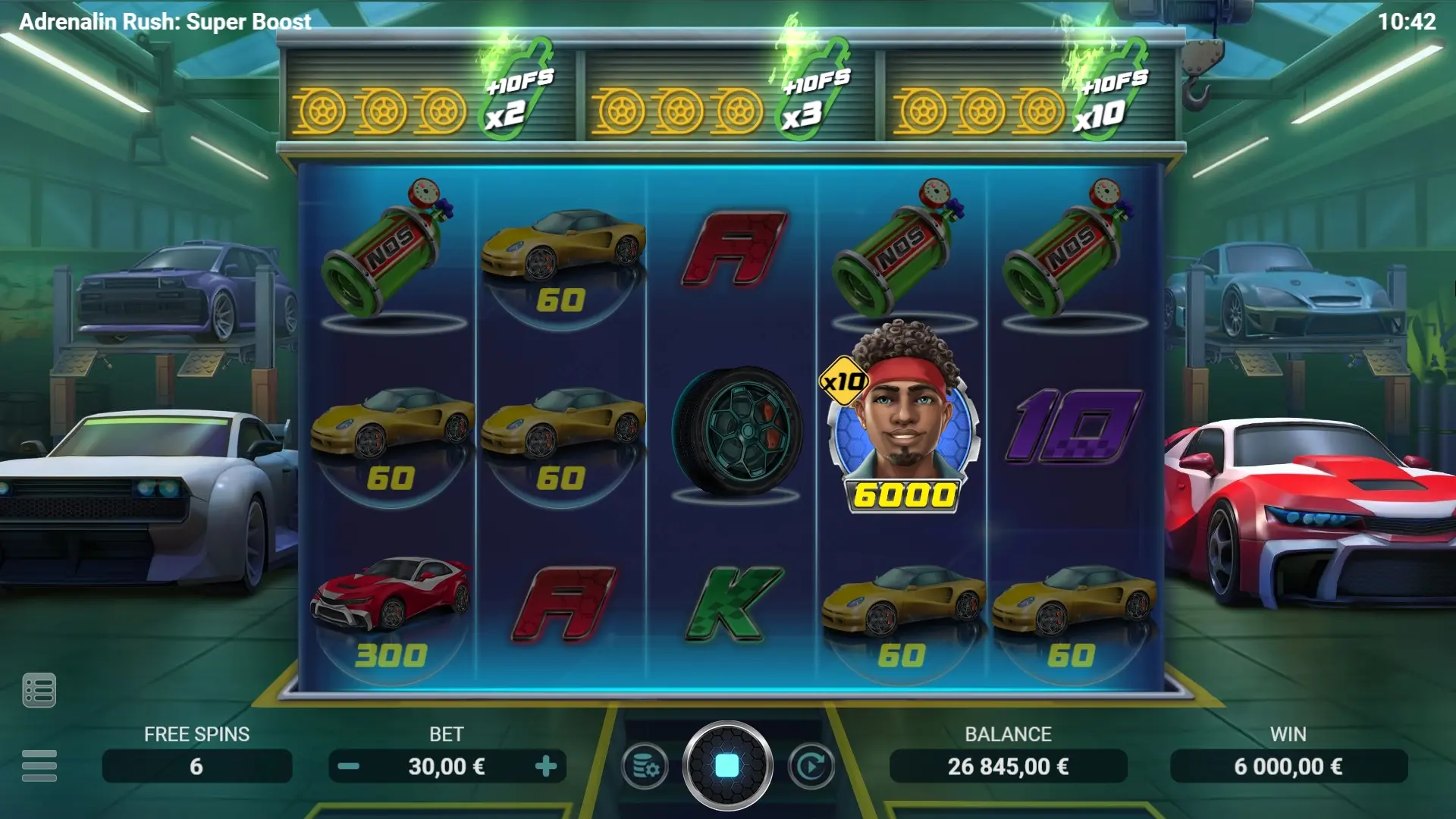
This is the collector mechanic, and it’s the smartest piece of design in the game. During Free Spins, every Wild symbol that lands accumulates all the values currently showing on Car symbols across the reels. Then, every 4th Wild that appears triggers an extra 10 Free Spins along with an increased multiplier applied to the Racer feature — stepping through x2, x3, and x10 as you progress. In effect, this creates a snowballing mechanic: the longer your Free Spins round runs without ending, the higher the multiplier ceiling climbs on every subsequent Wild collection. The realistic payout contribution here is tied directly to Wild frequency — if Wilds land sparsely, the Racer feature never gets past the x2 stage, and you’re looking at a modest bonus round rather than a headline hit. The theoretical ceiling assumes repeated retriggers, which by definition won’t happen most sessions.
There’s a structural reason this feature rewards patience over hope. Every 4th Wild is a fixed counter, not a random chance to advance — so the mechanic is entirely deterministic once Wilds start landing, which makes it easier to track your progress mid-round than in slots where advancement depends on a hidden probability roll. What it doesn’t do is guarantee those Wilds show up in the first place. In an extended run through the demo, the Racer feature triggered its first 10-spin extension twice across a dozen Free Spins rounds, and both times the round ended before a second retrigger arrived — which lines up with what you’d expect from a medium-high volatility base rather than the “very high” label a couple of aggregators have slapped on this game. Read that as one data point, not a guarantee — but it’s consistent with the official rating over the inconsistent third-party one.

Wild Boosters: Deathless, Sean, and Akemi
Before Free Spins begin, you choose one of three Wild variants, and this choice matters more than the flavour text suggests.
Wild Deathless front-loads the round: +2 Free Spins immediately, with a further +2 added on every retrigger. This is the safest, most consistent pick — it extends your number of spins directly, which means more chances for Wilds to land and feed the Racer feature.
Wild Sean works differently. On any round featuring at least one Sean Wild but no payline win, between 1 and 5 extra Car symbols appear at random positions. This is a volatility booster disguised as a consolation mechanic — it’s specifically designed to top up Money symbol density during otherwise dead spins, which pushes more raw value into the Racer accumulation pool.
Wild Akemi skips extra spins or extra symbols entirely and instead boosts the Racer multiplier ladder itself, replacing the standard x2/x3/x10 progression with x3, x4, x12 at each stage. This is the highest-ceiling pick on paper, but it only pays off if you’re already getting enough Wilds to reach the higher stages — pick Akemi in a short, Wild-light round and you’ll never see the benefit of the inflated ceiling.
You might ask: why does the choice matter if you can’t predict how many Wilds will land? Because each Booster is optimising for a different failure mode. Deathless protects you against a short round. Sean protects you against a dry one. Akemi bets everything on a long, Wild-heavy one actually happening. There’s no universally correct pick — it’s a genuine risk allocation decision, which is more than most slots offer at this price point.
For what it’s worth, my default pick after several sessions is Deathless. The extra spins on trigger and retrigger are the only guaranteed value among the three — Sean’s extra Car symbols are conditional on hitting a dead spin, and Akemi’s inflated multiplier ladder is worthless if the round ends before you reach the x4 or x12 stages. Guaranteed spins buy you more chances to land the Wilds that feed the whole system, which makes Deathless the safer baseline even if it’s not the highest-ceiling option on paper. Akemi is the pick if you’re deliberately chasing variance and can tolerate more empty rounds in exchange for the occasional big one — it’s a legitimate high-roller choice, just not a default one. One honest catch across all three Boosters: the choice is locked in before you see a single Free Spin play out, so you’re committing blind based on nothing but your own risk appetite. There’s no mid-round adjustment available.
Bonus Buy
The Bonus Buy feature lets you purchase immediate entry into Free Spins, with three tiers on offer: 10, 15, or 20 Free Spins, presumably scaling in cost with the number of spins purchased. Evoplay’s official materials don’t publish the exact cost multipliers for each tier, and I couldn’t verify them through a licensed aggregator either — so that figure is omitted here rather than estimated. What’s confirmed is that the option exists, which matters more than the exact price in most jurisdictions, since a growing number of regulators (UK among them) restrict or ban Bonus Buy outright. If you’re playing under UK licensing, don’t assume this feature will be available to you regardless of what the demo shows.
One more practical note worth flagging here rather than burying it: the three-tier structure (10, 15, or 20 spins) means the buy-in isn’t a single fixed price, and without published multipliers you can’t calculate expected value on the purchase the way you can on games that disclose their buy-feature cost openly, such as several of Pragmatic Play’s Ante Bet titles. Treat the Bonus Buy on this game as a convenience option for skipping base-game grind, not as a maths-optimised shortcut — you don’t have the numbers to optimise it even if you wanted to.
On the technical side, the game runs on HTML5 and loads without a native app, which is standard for Evoplay’s 2024-era catalogue and holds up fine on mid-range Android handsets in testing — no stutter on the Racer feature’s multiplier animations, which is where cheaper implementations tend to lag. That’s a minor point next to the RTP and win-cap questions, but it’s the kind of detail that actually affects whether a mobile-first session feels smooth or not.
The 2026 perspective
Here’s an important structural point that most reviews of this game get slightly wrong: Adrenaline Rush: Super Boost doesn’t have a direct slot sequel or a Megaways/Power Reels variant. Evoplay’s own “similar games” listing points to two other titles in the Adrenaline Rush family — Adrenaline Rush and Adrenaline Rush: XCrash — but neither is a mechanical evolution of Super Boost. They’re different game types wearing the same racing skin.
Adrenaline Rush (the original, also released February 2024) is actually an Instant Game, not a slot — a skill-based 3D racing title where players manually control a car, choose a racer, and navigate routes for bonus boosts. It’s listed with an RTP up to 97.00%, low volatility, and a max win of €31,125. If you came here expecting a “classic” version of Super Boost with lower variance, that’s not what this is; it’s a completely different product built around driving skill rather than reel math.
Adrenaline Rush: XCrash, the third instalment in the franchise, is a crash game in the Aviator mould — cars race down a street instead of a plane climbing, with a multiplier rising until you cash out or crash. Evoplay’s client lists this at 96% RTP with a maximum multiplier of 1,000x (independent reviewers give 999x, a rounding-level discrepancy not worth losing sleep over), and a stated max cash win of up to $1,000,000 at max bet. It supports dual simultaneous bets per round and Provably Fair verification, which Super Boost, as a standard slot, doesn’t offer or need.
So the honest comparison isn’t “original vs sequel” — it’s “which format in this franchise suits you,” and the answer depends entirely on whether you want reel-based free spins, skill-based driving, or crash-style cash-out tension. Super Boost is the only one of the three that plays like a conventional slot.
Against genuine slot competitors, the picture is less flattering. Drive: Multiplier Mayhem by NetEnt runs a 96.70% RTP with medium-to-high volatility and a top prize around 180,000 coins on a betting range of $0.15 to $75 — a cleaner RTP figure and no ambiguity about the win structure. 24 Hour Grand Prix by Red Tiger uses a 6×4, 30-payline grid, sits at 95.73% RTP, and states its max win plainly as 2,166.3x the bet (roughly $86,652 at the $40 max bet) — lower ceiling than Super Boost’s claimed figures, but far more transparent about what that ceiling actually is. Mad Cars by Push Gaming, on a 5×6, 50-payline grid with bets from $0.10 to $100, publishes a 25,000x max win — more than double even the highest unverified claim floating around for Super Boost, and backed by a provider not known for inflated marketing numbers.
A fourth comparison point worth adding: 24 Hour Grand Prix also publishes its win cap in dollar terms at max bet — $86,652 — alongside the multiplier figure, giving players two ways to sanity-check the same number against each other. That’s the exact disclosure practice Super Boost is missing. Evoplay gives you a flat euro figure with no corresponding multiplier, and the multiplier figures that exist come entirely from unaffiliated aggregators who don’t cite a methodology.
That’s the real competitive problem here. It’s not that Super Boost’s actual win potential is necessarily worse than these three — it might not be. It’s that Super Boost is the only one of the four where you can’t get a straight answer on what the number actually is. In 2026, when players increasingly cross-reference SlotCatalog and Casino Guru before committing a session, that ambiguity costs trust, not just theoretical EV.
Progressive jackpot: absent. There’s no shared or standalone jackpot pool attached to this title — the win potential is entirely mechanic-driven through the Racer feature and Money symbol conversions, capped at the flat figure discussed above.
So who is this actually for? Given the fixed 10-payline structure, the collector-based free spins, and the choice-driven Wild Boosters, this reads as a recreational, session-focused game rather than a high-roller hunting slot. The Booster choice mechanic rewards players who enjoy a bit of pre-round strategy, and the Turbo Respin softens variance just enough to keep base-game sessions from feeling punishing. It is not built for players chasing a verified five-figure multiplier — that audience is better served by Mad Cars or the newer cluster-pays racing titles pushing 25,000x-plus.
Where it does earn a place in a 2026 lobby is as a change-of-pace title for players who already have a rotation of higher-ceiling slots and want something with a lower cognitive load between big sessions. The theme is well executed without being derivative — the garage setting is a genuinely different angle on car culture than the usual street-race or Formula One framing competitors lean on — and the mechanic depth (three distinct Boosters, a deterministic collector system, a genuine mercy respin) is more than you’d expect from a game with only 10 fixed paylines. It’s dead weight only if you walk in expecting it to compete on maximum win potential. Judged on session design and feature engagement instead, it holds up better than the conflicting max-win numbers suggest.
Verdict
Adrenaline Rush: Super Boost is a competently built, mid-tier racing slot with one genuinely clever mechanic — the Wild Booster choice — and one real weakness: nobody, including its own marketing materials, can give you a consistent answer on what the maximum win actually is in stake-multiplier terms. The RTP range (96.14%–96.32%) is fine but unremarkable, the medium-high volatility is accurately labelled, and the 5×3/10-payline structure is dated next to 2026’s Megaways and cluster-pays racing competitors.
Play this if you want a low-commitment, session-friendly racing slot with a decision point that actually changes your risk profile, and you’re not chasing a specific headline multiplier. The Deathless/Sean/Akemi choice is worth the price of admission on its own for players who like a bit of agency in their bonus rounds.
Skip this if you’re specifically hunting a big, verifiable win ceiling — go to Mad Cars’ published 25,000x or 24 Hour Grand Prix’s cleanly stated 2,166.3x instead, where you know exactly what you’re aiming at. Skip it too if Bonus Buy access matters to you and you’re playing under a licence that restricts the feature, or if you want to calculate the exact cost-to-value ratio of a feature buy before spending — that maths isn’t publicly available here.
There’s no sequel or Power Reels edition to weigh against the original in this case, so this verdict stands alone rather than splitting into two. If Evoplay does eventually build a Megaways or expanded-grid follow-up to Super Boost — a reasonably likely move given how the rest of the racing-slot category has moved toward wider engines — the Racer feature and Wild Booster choice are strong enough mechanics to justify the upgrade. As it stands, the base game is solid, the feature design is better than its marketing, and the win-cap confusion is the one thing standing between this being a quietly good mid-tier slot and a genuinely recommendable one.
The one number that limits this game isn’t the RTP or the volatility rating — it’s the unresolved gap between Evoplay’s flat €750,000 cap and the wildly inconsistent multiplier claims elsewhere. Until that gets clarified with a properly published max-win-in-x-stake figure, treat every third-party number for this game as unverified.