
Blast the Bass has been live since 20 February 2025, which makes it a year-plus old in a genre that produces a new fishing slot roughly every fortnight. It landed into a market already owned by Big Bass Bonanza and crowded further by Hacksaw’s Marlin Masters, and it did something most late entries don’t bother with: it gave the fisherman dynamite instead of a rod. The RTP sits at 96.72%, the max win at 5,000x — both numbers that hold up fine against the class of 2026. The question isn’t whether Belatra can make a fishing slot. It’s whether replacing the rod with explosives is a mechanic or a marketing hook, and whether the math model backs up the theme.
Belatra itself is worth a mention before the mechanics, because it’s not a studio most Western players have a mental shorthand for. Originally a Belarusian land-based machine manufacturer, the company transitioned into online development relatively late compared to Pragmatic Play or Hacksaw, and its catalogue leans toward Eastern European design sensibilities — dense feature sets, bright saturated art, and a habit of stacking multiple bonus mechanics into a single title rather than leaning on one signature hook. Blast the Bass fits that pattern: it’s not a minimalist release, and the feature list below reflects that.
Math model and mechanics
Blast the Bass carries a 96.72% RTP, and that figure is consistent across the overwhelming majority of tracking sites — SlotCatalog-style aggregators, Casino Guru-style databases, and Belatra’s own promotional material all land on the same number. One outlier lists 96.4%, which is close enough to be a rounding or regional-configuration quirk rather than a genuine conflict, but it’s worth flagging: if your casino displays something other than 96.72% in the info panel, check it before you commit a session bankroll.
At 96.72%, the game sits comfortably in above-average territory. For every $100 wagered over a long enough sample, the theoretical return is $96.72 — roughly a percentage point better than Big Bass Bonanza’s commonly-deployed 95.67% configuration, and half a point ahead of Marlin Masters’ 96.24%. That difference matters more than it looks. Over a $2,000 session at $2 a spin, the gap between 95.67% and 96.72% works out to roughly $21 in expected value. Not life-changing, but it’s the kind of edge that compounds if fishing slots are your regular rotation.
Volatility is where sources genuinely split. Several trackers call it high, others medium-high. Having watched the free spins round build across multiple sessions, medium-high is the honest label: the base game throws out enough Fish Coin hits and Fisherman Wild collections to keep a balance ticking over, but the 5,000x ceiling only opens up once the Booster panel is fully stacked, which takes patience.
The grid itself is where the sources disagree outright, and it’s a real discrepancy rather than a typo. Some listings describe a 5×4 layout, others a 5×3 — both figures appear across otherwise-credible review sites in roughly equal numbers. Verify the exact row count in the demo before you play for real money, since it directly affects how the 20 fixed paylines are distributed across the grid. What isn’t in dispute: 20 fixed paylines, left-to-right payouts starting from reel one, and wins on 3, 4, or 5 matching symbols.
Bet range is another figure that shifts depending on where you look — some casinos list €0.20 to €250, others cap the top end at €25 or €200, and Belatra’s own credit-based paytable describes 20 to 2,500 credits per spin. This is standard operator-configurable behaviour rather than a Belatra inconsistency: casinos set their own bet ceilings within the range the game engine supports, so check the in-client bet panel rather than any single review site.
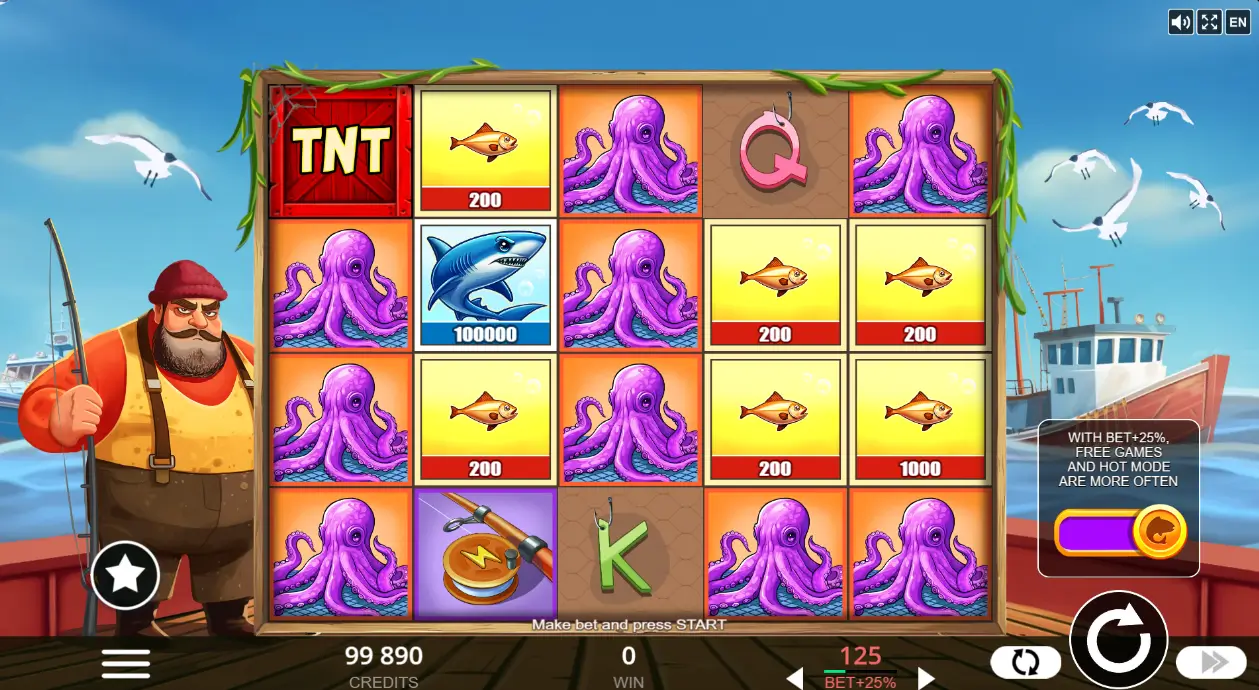
The max win of 5,000x is the number that actually matters for comparison shopping. It undercuts Marlin Masters’ 7,500x by a wide margin but comfortably beats Big Bass Bonanza’s 2,100x ceiling. Where Blast the Bass earns its keep isn’t the top-line multiplier — it’s how many different paths lead there.
Hit frequency isn’t independently verified by a certified lab report in any source I could pull — worth flagging, since Marlin Masters and Fishin’ Frenzy both have publicly quoted figures (around 25–30% and 54% respectively) that Blast the Bass lacks. In extended demo sessions, small wins land often enough to keep a balance moving between bonus triggers, but the rhythm feels closer to Marlin Masters than to Fishin’ Frenzy’s steadier, lower-volatility pace — consistent with the medium-high label rather than the flatter medium rating some trackers assign it.
One structural detail that separates Blast the Bass from the Big Bass template specifically: the Fisherman Wild is active in the base game, not locked to Free Games. Several genre staples — Big Bass Bonanza chief among them — restrict their collector Wild to the bonus round entirely, meaning base-game spins are pure filler between bonus attempts. Blast the Bass and Marlin Masters both buck that trend, letting Wilds collect Fish values from spin one. That single design choice changes the texture of ordinary play: you’re not just spinning toward a trigger, you’re accumulating smaller wins along the way, which softens the dry-spell problem that high-volatility fishing slots are usually criticised for.
Feature breakdown
Fisherman Wild
Trigger and mechanic: the Fisherman Wild lands naturally on any spin, base game or Free Games, with no separate activation condition — it’s a standard reel symbol that happens to carry a collection function. It substitutes for every paying symbol on the grid, standard wild behaviour. Its real job is collection: land it alongside Fish credit symbols and their combined value gets added directly to the Wild’s payout.
What it actually does: multiple Wilds on the same spin each collect independently, so a screen with two or three Fishermen and a scattering of Fish symbols can stack fast — each Wild sweeps the full value of every visible Fish symbol, not a shared pool split between them. That’s a meaningfully player-friendly rule compared to games where multiple collectors divide the spoils.
The catch: and it’s a real one — Fish symbols only pay out their credit value when a Wild is actually present on that spin. A screen full of high-value Fish with no Fisherman in sight is a screen full of decorative symbols worth nothing beyond their own (usually modest) line-pay value. The game is built around waiting for the two symbol types to coincide, and a run of spins with plenty of Fish but no Wild is the most visible form of variance you’ll experience outside the bonus round.
Realistic contribution: expect the occasional double- or triple-digit multiplier hit when a Wild and two or three mid-value Fish line up together. Collections pushing toward the 1,000x ceiling are rare enough in the base game that they function more as a Free Games draw than a realistic base-game expectation.
Fish credit symbol
Trigger and mechanic: the Fish symbol appears as a regular reel symbol on any spin and pays out its credit value only when collected by a Fisherman Wild present on the same screen.
Multiplier range: sources describe this slightly differently — some quote a broad 2x to 1,000x span, others list a fixed ladder of specific values (2x, 5x, 10x, 15x, 20x, 25x, 50x, 100x, 200x, 300x, 400x, 500x, 1,000x). Whichever version your casino’s paytable displays, the practical range is the same: low-value hits are common, four-figure multipliers are the exception that defines a session.
Realistic contribution vs ceiling: most Fish symbol collections in ordinary play land in the low double-digit multiplier range. The 1,000x ceiling exists, but reaching it requires either an unusually favourable random roll or the escalated multiplier stacking available during Free Games’ later Booster tiers — it’s not something the base game delivers with any regularity.
One honest limitation: because payout depends entirely on Wild presence, the symbol’s displayed value on screen can be actively misleading to a new player who doesn’t yet understand the collection mechanic. Seeing a 500x Fish symbol sitting on the grid with no Wild present, and no payout following, is the single most common point of confusion reviewers flag about this game.
Fish Coin
Trigger and mechanic: this is Blast the Bass’s most distinctive base-game feature, and it works differently depending on whether you’re in the base game or Free Games. In the base game, a Fish Coin lands and drops straight to the bottom row in a single move, locking in its value based on how far it travelled — one nudge takes it to 20x, two to 50x, three to 100x your bet, starting from a base value of 10x. In Free Games, the coin nudges down one position per spin instead of falling immediately, which means you can watch its value climb across several consecutive spins before it either cashes in with a Fisherman Wild or drops off the bottom of the reels.
Multiplier range: 10x at landing, escalating to 20x, 50x, and 100x as it descends. There’s no version of this symbol that pays less than 10x, which makes it one of the more reliably valuable symbols in the base game whenever it does connect with a Wild.
Realistic contribution vs ceiling: in the base game, the single-move drop means most Fish Coin hits land somewhere in the 10x–50x range purely by chance — reaching the full 100x requires the coin to start high enough on the grid to complete all three nudges before landing. In Free Games, the multi-spin descent gives every Fish Coin a realistic shot at the full 100x if it survives long enough and a Wild happens to be present when it either peaks or drops off.
Honest limitation: the coin can nudge all the way down and off the bottom of the reels without ever meeting a Fisherman Wild, at which point its accumulated value is lost entirely. It’s a genuine risk mechanic, not a guaranteed escalating payout, and Free Games sessions with plenty of Fish Coin activity but poor Wild timing will feel like watching potential money evaporate spin by spin.
You might ask why the mechanic changes between modes. In the base game, the instant-drop version keeps things quick — you either catch the coin at whatever value it lands on, or you don’t. In Free Games, the gradual descent adds a genuine tension: do you want the coin to keep climbing toward 100x, or would you rather a Fisherman Wild landed right now and banked the current value?
Fish Rain
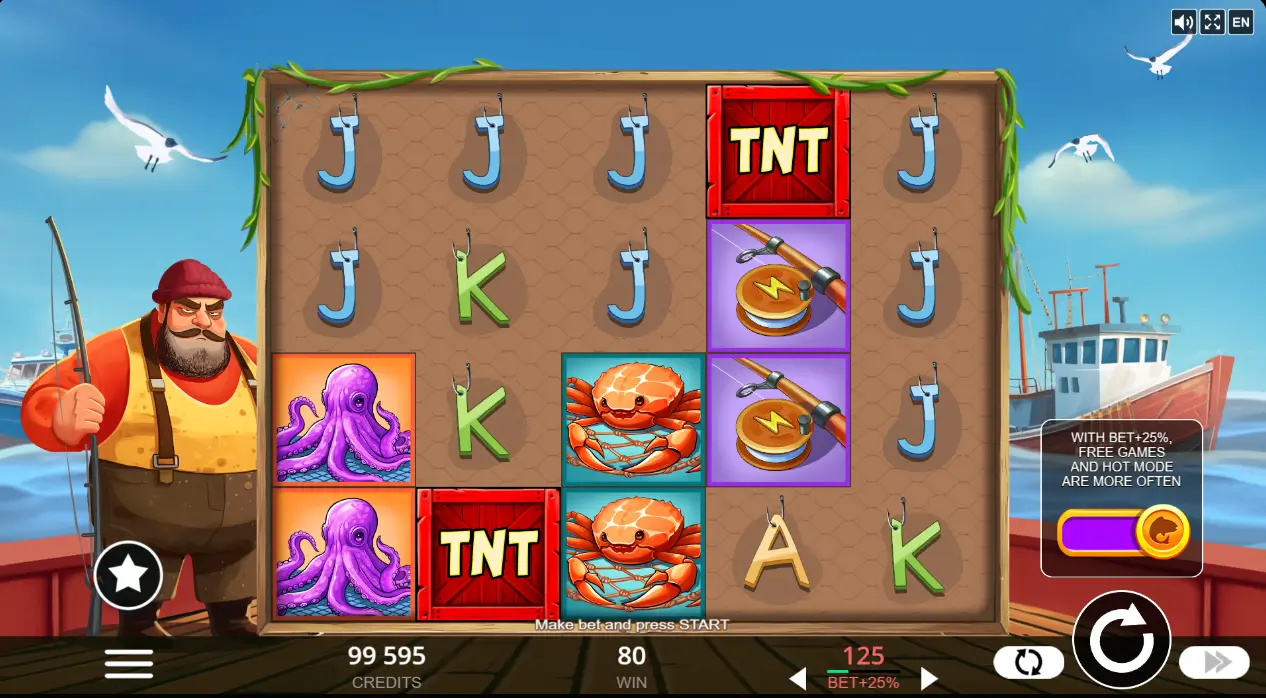
Trigger and mechanic: occasionally the Fisherman Wild throws a stick of dynamite instead of just sitting there as a substitute. When that happens, a random cluster of Fish credit symbols rains onto the grid, filling positions that would otherwise sit empty.
What it does: if a Wild is present when the dust settles, it collects everything that just landed in one payout, using the same collection rules as any other Fish symbol interaction. The difference is volume — Fish Rain can populate several reel positions at once, which means a single lucky trigger can produce a considerably larger collection than a standard spin’s worth of naturally-landed Fish symbols.
Trigger frequency: this is a genuinely random event tied to the Fisherman Wild’s landing animation rather than a tracked, buildable mechanic. You can’t force it, and there’s no visible counter building toward it, which makes it feel more like a bonus surprise than a mechanic you can plan around. It’s also purchasable directly through Buy Bonus, which is the only reliable way to guarantee it happens on demand.
Honest limitation: because the trigger is unpredictable and the payout depends on a Wild being present at the right moment, Fish Rain functions more as a pleasant surprise multiplier on top of an existing session than a mechanic you should factor into expected-value calculations for any single spin.
Free Games and the Booster panel
Trigger condition: three or more TNT Scatter symbols landing anywhere on the grid, in a single spin, in the base game.
What it does mechanically: three Scatters award 10 Free Games outright. Four Scatters adds a Booster on top — an extra 10 spins carrying a x2 multiplier. Five Scatters triggers Hot Mode, which stacks two Boosters at once: 10 spins at x2 and a further 10 at x3. From there, the Booster panel above the reels fills as Fisherman Wilds land during the round — sources differ on whether it takes three or four Wilds to fill each slot, which is worth testing in demo mode before you assume a specific pace, since it directly affects how fast the round escalates in practice.
Multiplier range and maximum activation: what both accounts agree on is the overall escalation curve: multipliers climb from x2 through x3, x10, x20, x30, x40, and x50, capping at x100 for the final Booster tier. That’s eight distinct multiplier stages if you play the round out from the lowest entry point (three Scatters) to full escalation. The maximum length of a single Free Games sequence is capped at 45 spins, so the round can’t run indefinitely even if you’re stacking Wilds efficiently — there’s a hard ceiling on how many chances you get to hit the top-tier multiplier.
Realistic payout contribution vs theoretical ceiling: a typical Free Games round that only reaches three or four scatters will play out mostly at the lower x2–x10 tiers, delivering a respectable but unspectacular multiplier boost on top of whatever Fish and Fish Coin symbols land during the round. Reaching the x50–x100 tiers requires either an unusually Wild-heavy round or entry via Hot Mode, and this is where the bulk of the 5,000x max win realistically comes from — not from any single symbol, but from stacking a high-value Fish Coin or Fish Rain collection against a x50 or x100 round multiplier.
Honest limitation: early Boosters require accumulating multiple Wilds before any multiplier bump kicks in, and low-Wild sessions can feel slow to build. In extended demo testing, rounds triggered from a bare three-Scatter entry regularly finished without ever reaching the higher Booster tiers, simply because the round ran out of spins before enough Wilds landed. The escalating structure rewards a hot streak far more than it rewards patience alone — this isn’t a slow-burn feature that guarantees a payoff if you just wait it out.
Buy Bonus
Trigger condition: available on demand from the base game menu, subject to individual casino availability and any local regulatory restrictions on feature buys.
What it does mechanically: Blast the Bass offers direct purchase into four different entry points — standard Free Games, Fish Rain, the Fish Coin mini-bonus, or Hot Mode with its two pre-loaded Boosters. This is a genuinely wider menu than most direct competitors offer, several of which limit Buy Bonus to a single generic “skip to Free Games” option.
Pricing: figures vary by source and likely by operator configuration, but the pattern that emerges is: an Ante Bet-style option around 1.25x your stake per spin for improved natural trigger odds, a guaranteed Fish Rain purchase around 20x bet, and a guaranteed Fish Coins entry around 50x bet, with Hot Mode priced at the top of the range given it skips straight to the stacked-multiplier stage. Always confirm exact pricing in your casino’s Buy Bonus menu before committing, since these figures scale with your base stake and can vary by jurisdiction.
Maximum activation and realistic use: there’s no limit on how often Buy Bonus can be used in a session beyond your bankroll, which makes bankroll management the real constraint rather than any in-game cap.
Honest limitation: Buy Bonus features are, by design, a worse long-run value proposition than natural triggers in the vast majority of slot math models — you’re paying a premium for guaranteed access, and that premium is baked into the price. There’s also a Bet+25% toggle that raises your stake by a quarter in exchange for a better chance of triggering Free Games or Hot Mode naturally, which is a cheaper middle ground for players who don’t want to commit to a full bonus buy but want better odds than the base game offers on its own.
The 2026 perspective
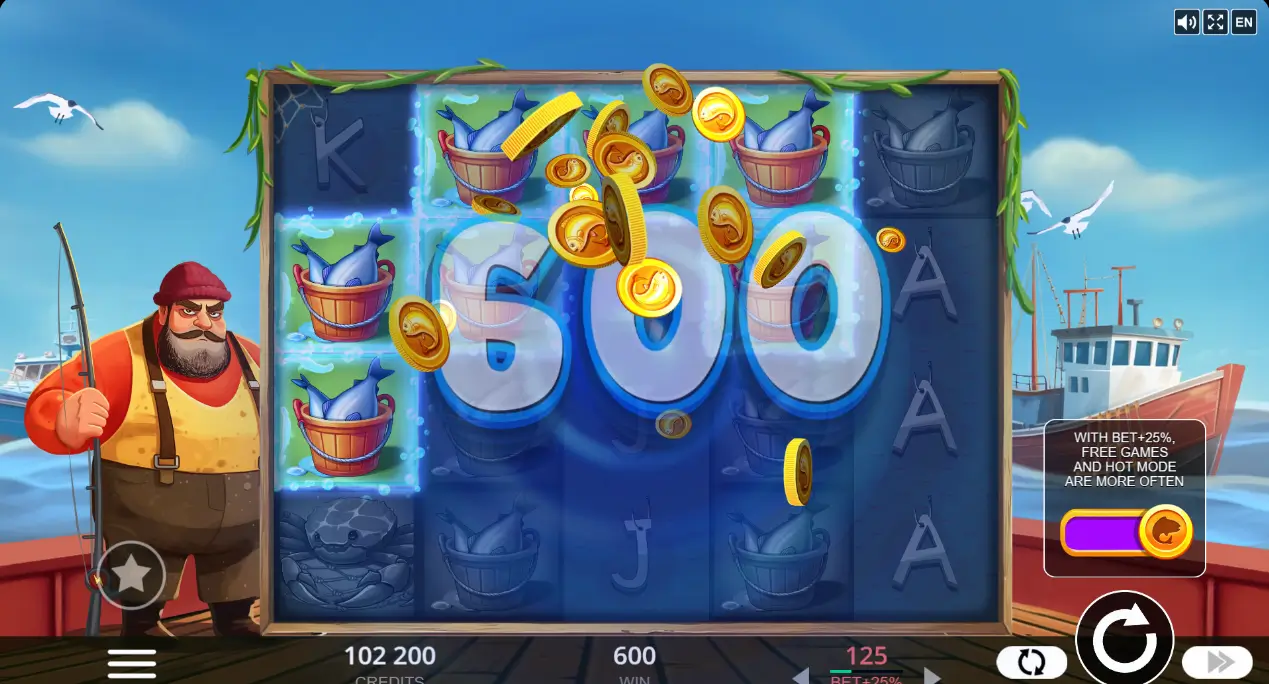
Belatra released a direct sequel, Ice Bass, on 19 February 2026 — almost exactly a year after the original. The setting moves from open water to a frozen lake, with the fisherman drilling through ice instead of casting from a boat, and the RTP drops slightly to 96.05%, a small but real step down from the original’s 96.72%. The max win holds steady at 5,000x, and the core structure — Booster panel, Fisherman Wild collection, escalating multipliers — carries over largely intact. What Ice Bass adds is a pre-game fishing phase before the main Free Games round even starts, where early boosters can add extra Fishermen or guarantee Fish symbols on every spin, ending when a specific Old Boot symbol gets hooked. Five Scatters in the base game still trigger Hot Mode, described in Belatra’s own material as the premium tier, and the escalating Booster structure is retained largely unchanged. It’s a meaningful structural addition rather than a reskin, but the RTP cut means Ice Bass isn’t a strict upgrade — it’s a sibling with a different risk profile, not a replacement.
Against the genre’s established names, Blast the Bass holds a respectable middle position. Big Bass Bonanza remains the reference point by sheer market presence — it’s spawned over a dozen thematic variants, from Christmas editions to a football-themed release timed for the 2026 World Cup — but its base configuration’s 2,100x max win looks thin next to Blast the Bass’s 5,000x, even accounting for Big Bass Bonanza’s slightly higher headline RTP at its best-configured 96.71%. That RTP is frequently deployed at a lower 95.67% or even 94.5% configuration depending on the operator, which narrows or reverses the gap entirely — check the specific configuration live at your casino rather than assuming the headline figure applies. A newer variant, Big Bass Bonanza 1000, pushes the ceiling to 20,000x via a rare 1,000x prize symbol, putting real distance between it and Blast the Bass on raw win potential, at the cost of a steep 450x Super Bonus buy price.
Marlin Masters from Hacksaw Gaming outguns Blast the Bass on ceiling at 7,500x — with bonus-buy-enhanced configurations cited as high as 10,000x — and a comparable 96.24% RTP. Its Lootlines feature lets Marlin cash symbols pay via paylines even without a Wild present, something Blast the Bass’s Fish symbols can’t do: a genuine structural advantage, since Marlin Masters doesn’t punish a Wild-less spin the way Blast the Bass does. Hacksaw has since diluted the line-up with Marlin Masters OG and Marlin Masters Atlantis, both criticised as safe rehashes rather than meaningful evolutions.
Fishin’ Frenzy, the franchise most credited with starting this genre back in 2014, sits at 96.12% RTP with a 5,000x bonus-round ceiling that matches Blast the Bass almost exactly, though its base mechanics are considerably simpler and its volatility generally rated lower — medium rather than medium-high. It remains relevant on search volume and ubiquity rather than mechanical depth; its sprawling sequel tree (The Big Catch, Megaways, Prize Lines, several jackpot variants) shows a franchise leaning on brand recognition more than innovation at this stage.
Buy-bonus is present and reasonably flexible, with four separate entry points rather than a single generic “skip to bonus” button — a genuine point in its favour against competitors that only offer one buy option. There’s no progressive jackpot here, and that’s worth stating plainly: if you’re chasing a life-changing progressive prize, this isn’t that game, and neither is Marlin Masters or standard Big Bass Bonanza — only Fishin’ Frenzy’s dedicated Jackpot King variant offers that path, at the cost of a reduced base RTP around 95.32%. The fixed 5,000x ceiling is the entire ceiling for Blast the Bass, full stop.
Is this a high roller’s game, a recreational spin, or dead weight in a 2026 lobby? It’s neither extreme. The bet range flexibility — whatever the exact top figure your casino sets — puts it in reach of casual players, while the multi-path Buy Bonus menu gives higher-stakes players a way to skip straight to the mechanics that interest them. It’s not dead weight, but it’s also not going to dethrone Big Bass Bonanza’s search volume or Marlin Masters’ higher ceiling. It’s a solid mid-table release with one genuinely distinctive base-game mechanic — the dual-mode Fish Coin — that none of its direct competitors currently replicate. The absence of a progressive jackpot won’t bother the majority of the player base this game is realistically built for, since the fixed-ceiling, feature-rich structure is a different proposition entirely from a jackpot hunt.
There’s also the question of longevity. Belatra doesn’t have the release cadence of Reel Kingdom, which pushes out a new Big Bass variant almost monthly, or Hacksaw, which has already produced three Marlin Masters entries in under eighteen months. Blast the Bass got exactly one direct sequel in its first year. That’s either a sign of quality-over-quantity restraint or a sign the franchise doesn’t have the commercial pull to justify constant iteration — probably a bit of both, and it’s too early to say definitively which way that leans.
Verdict
Blast the Bass (original): play it if you want a fishing slot with an above-average RTP and a base-game mechanic that actually does something different from the genre’s collect-and-multiply template. The Fish Coin’s mode-dependent behaviour is a legitimate point of difference, and 96.72% beats most of the field on paper — including Big Bass Bonanza’s commonly-deployed configuration and Marlin Masters’ default setting. The number that limits it: 5,000x is a real ceiling, not a marketing rounding, and it sits below Marlin Masters’ 7,500x if raw win potential is your only criterion. There’s also the structural quirk worth remembering before you deposit — Fish symbols pay nothing without a Fisherman Wild present, which makes this a game where variance is concentrated in symbol coincidence rather than spread evenly across the paytable. This suits players who want steady above-average returns with occasional bonus-round spikes, and who don’t mind a collector mechanic with a hard dependency built in. It’s a weaker fit for players chasing the single biggest number on the page, or for anyone who wants every symbol on the paytable to mean something on its own.
Ice Bass (sequel): worth a look for the added pre-game phase and winter reskin, but go in aware the RTP is 0.67 percentage points lower than the original. If you’ve already got Blast the Bass in your rotation and want variety, Ice Bass earns a spin — the pre-game fishing phase adds a layer of anticipation the original doesn’t have. If you’re choosing between the two from scratch with no loyalty either way, the original’s higher RTP makes it the better default pick — Ice Bass is the variant, not the upgrade, and Belatra hasn’t given players a mechanical reason strong enough to justify the lower return.