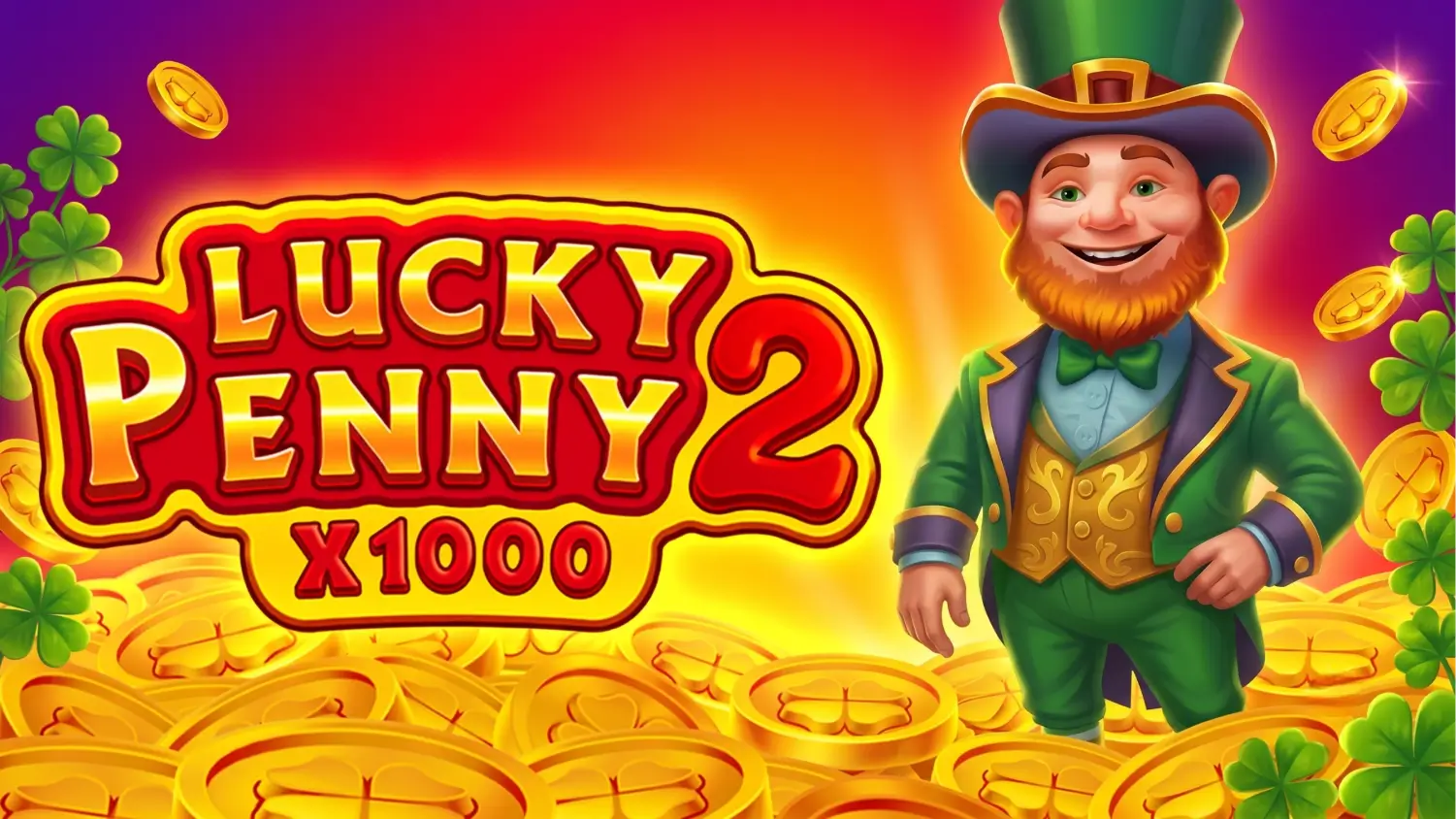
A year is a long time in the scatter-pays business. Lucky Penny launched in August 2024 and quietly became one of 3 Oaks Gaming’s most-played titles, riding the Gates of Olympus wave without ever bothering to hide it. Lucky Penny 2 arrived on 28 August 2025 to the exact same day of the month, and on paper it’s carrying the same 20,000x ceiling as its predecessor. The question worth asking a year on: did 3 Oaks actually build a sequel, or just reskin the leprechaun and call it a launch?
I’ve spent time with both games, and the honest answer sits somewhere uncomfortable. Lucky Penny 2 is not a bad slot. It’s also barely a new one. Before getting into why, there’s a more basic problem to deal with first: 3 Oaks still won’t tell you the RTP.
3 Oaks isn’t a small studio cutting corners on transparency because it doesn’t know better, either. This is a provider with more than a hundred titles in its catalogue and a release cadence fast enough that it can afford to launch a sequel exactly twelve months after the original, day for day. That level of operational discipline makes the missing RTP figure harder to excuse, not easier — this is a deliberate choice about what information reaches the player, not an oversight.
Math model and mechanics
Start with the number that should anchor every slot review and, in this case, doesn’t exist. SlotCatalog — the aggregator with the most complete technical listing for this title — records RTP, variance, and hit frequency for Lucky Penny 2 as N/A. 3 Oaks has not published a theoretical return figure for this game at the time of writing.
That hasn’t stopped a chorus of casino and demo sites from quoting 95.64% as the RTP, the exact figure that circulates for the original Lucky Penny. Several of these pages state outright that Lucky Penny 2 “has the same RTP” as the first game, which is an assumption, not a confirmation — no operator or provider page I found actually states a certified figure for the sequel specifically. I’m not going to pretend that 95.64% is verified when it isn’t. Treat it as a plausible carry-over from the original title, not as a number you can rely on when picking a casino. If you want the real figure, check the in-game info screen at your specific operator — RTP can and does vary by jurisdiction and licensee even when a provider doesn’t publish a baseline.
3 Oaks isn’t unique in withholding this figure — its own recent release, Lucky Penny Power Scatter, shipped with the same “RTP unavailable” status, so this reads less like a one-off oversight and more like a studio policy. That doesn’t make it acceptable, but it does change the framing: this isn’t a bug in the Lucky Penny 2 listing specifically, it’s how 3 Oaks currently handles disclosure across its newer catalogue. If RTP transparency is a genuine priority for you rather than a nice-to-have, that’s a pattern worth remembering the next time a 3 Oaks title crosses your lobby, not just a one-time asterisk against this game.
Volatility is the same story. No official classification exists, but the mechanical fingerprint — Pay Anywhere clusters, a 1,000x multiplier ceiling, and a free spins round that can snowball or produce almost nothing — points to high volatility. Third-party testing on the original Lucky Penny found a slightly gentler curve than the “high” label suggests: one detailed 200-spin session logged a win roughly every four spins rather than the eight-plus gap typical of genuinely high-variance math models. I’d treat that as one data point rather than a pattern, but it’s worth knowing the game can play softer than its reputation in short bursts, even if the long-run curve is still built around rare, large payouts rather than steady grinding.
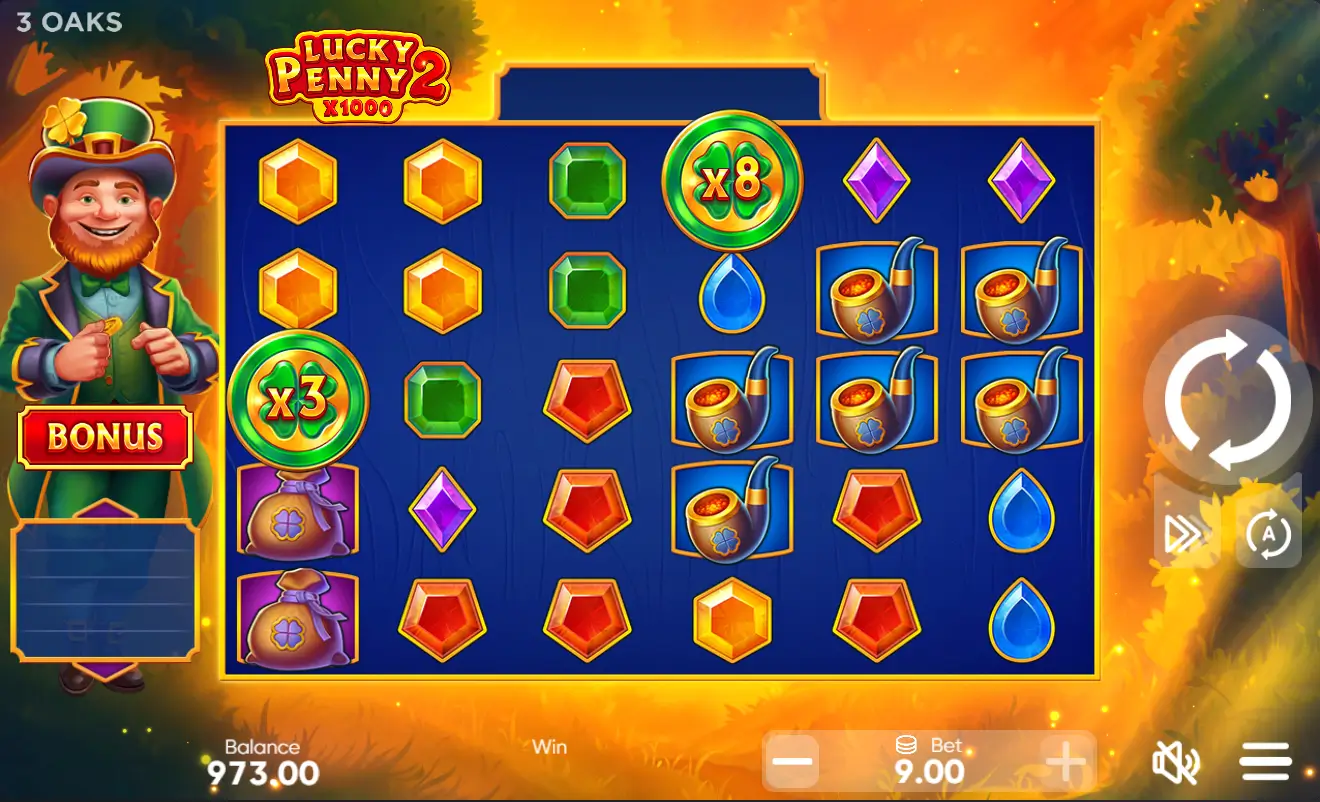
What isn’t in dispute: the 20,000x max win, confirmed by SlotCatalog and repeated consistently across every aggregator and demo site I checked. At a £5 stake, that’s a £100,000 ceiling — competitive with, though not class-leading against, the Gates of Olympus-style field it’s competing in (more on that below).
The grid is a 6×5 layout running on a Pay Anywhere engine — no paylines, no adjacency requirement. Land eight or more matching symbols anywhere on the board and they pay, then collapse to make room for a cascade. There’s a genuine data conflict on bet range worth flagging: SlotCatalog’s own structured attribute table lists a $0.20 to $9 betting range, while the same page’s written review states €0.20 to €25 per spin. Every other aggregator I checked — including listings for the original Lucky Penny, which shares an identical betting engine — lands on the wider €0.20–€25 figure. My best read is that the $9 max is a data-entry error in SlotCatalog’s attribute table rather than the actual cap, but I can’t confirm which is right without a live operator session, so take the upper end of your bet size with a pinch of caution until you’ve checked the paytable at your casino.
Hit frequency isn’t published either. Cascading, scatter-pays games like this one tend to generate a high count of small collapses in the base game — the “something is always happening” feeling — while the meaningful money sits almost entirely in the free spins round. Don’t mistake base-game activity for base-game payout. On a game built this way, the base spin is mostly there to keep you seated until the scatters land.
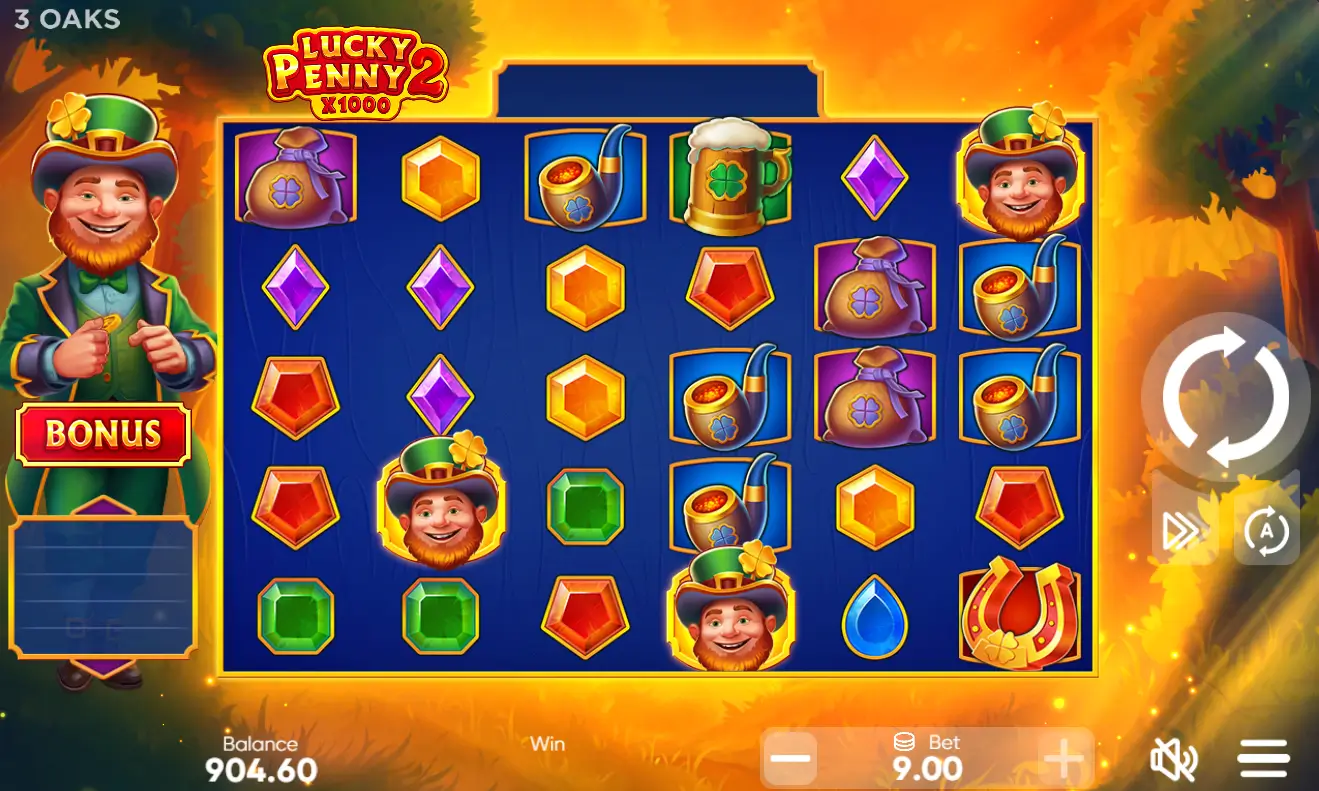
Symbol design follows the same low-effort logic as everything else about this sequel. The paytable is built around Irish stock imagery — clovers, beer mugs, gold coins, gems, and a horseshoe that ranks among the higher payers, rewarding up to roughly 450 coins for 12 or more landing in a single cluster. A wild symbol substitutes for standard paying icons but not for scatters or multiplier coins, which is the conventional split for this mechanic and doesn’t change how you’d approach a session. None of the symbol values are dramatic on their own; the entire payout structure is designed to funnel value through the multiplier and free spins systems rather than through base symbol combinations, which is worth knowing if you’re the type of player who studies a paytable before committing a bankroll. Here, the paytable tells you almost nothing about what a session will actually feel like — the multiplier distribution does that, and 3 Oaks hasn’t published it.
Bonuses and special features
Multiplier symbols
Coloured multiplier coins land at random across the grid during both the base game and free spins. Values run from 2x to 1,000x. When a multiplier coin is part of a winning cascade, it sticks around until the sequence finishes; once the cascade ends, every visible multiplier is added together and applied to the total win for that spin.
That summing mechanic is the entire engine of this genre, and it’s worth being precise about the implication, because “multipliers up to 1,000x” oversells what usually happens. A single 1,000x coin landing in isolation is a genuine jackpot moment — but the realistic path to a big win is several smaller coins (say a 10x, a 25x, and a 50x) landing across one long cascade chain and stacking to 85x. The headline number is the ceiling, not the median outcome. Multiple coins landing in the same sequence is what actually moves the payout, not one lucky symbol.
The full published value set for the multiplier coin runs 2x, 3x, 4x, 5x, 6x, 8x, 10x, 12x, 15x, 20x, 25x, 30x, 50x, 100x, 250x, 500x, and 1,000x — seventeen possible values, weighted, as with every game in this format, toward the low end. That’s not a criticism unique to Lucky Penny 2; it’s how every scatter-pays multiplier slot has to work mathematically, or the RTP would run away from the operator entirely. But it does mean that seeing a coin land doesn’t tell you much about its likely value. A coin appearing on your screen is far more likely to be worth 2x or 3x than 1,000x, and treating every coin as a near-miss on the jackpot is the fastest way to misjudge how a session is actually going.
Mystery Multiplier — the one genuine addition
This is the feature 3 Oaks is selling as the reason Lucky Penny 2 exists. The Mystery Multiplier lands like a regular coin but shows no value until the cascade sequence ends, at which point it reveals a random multiplier and is added to the total exactly like a normal coin.
Here’s the catch, and it’s worth saying plainly: mechanically, this changes nothing about the payout math. A hidden 250x coin pays exactly the same as a visible 250x coin. The Mystery Multiplier is a presentation layer — a moment of suspense bolted onto an existing calculation — not a new way to win or a shift in the odds. SlotCatalog’s own review calls it “essentially just a multiplier symbol that is hidden until the end,” and I don’t have grounds to disagree. If you’re choosing between Lucky Penny and Lucky Penny 2 based on expected mathematical difference, there isn’t one to speak of. You’re choosing based on whether you enjoy the reveal animation.
I’d still push back slightly on writing it off entirely. Suspense mechanics are a real design lever in slot psychology — the moment between a symbol landing and its value being revealed is when engagement spikes, and providers know it. It’s a legitimate reason a sequel can feel more satisfying to play even when the underlying maths hasn’t moved. What it isn’t is a reason to expect a different result over a long session. Keep those two things separate: the feature can be fun without being meaningful, and Lucky Penny 2 is a clean example of that distinction.
Free spins
Land 4, 5, or 6 scatter symbols in the base game and you’re awarded 15, 20, or 25 free spins respectively. During the feature, landing three or more additional scatters retriggers the round for +5 extra spins — no cap on retriggers stated by any source I checked, so in theory a hot free spins session can run long.
The mechanic that actually matters here is the total multiplier meter. Unlike the base game, where multipliers reset after every spin, free spins accumulate every multiplier value that contributes to a win into a running total that persists for the rest of the feature. That’s the structural reason the free spins round carries almost all of this game’s win potential — a coin that lands on spin three of twenty stays relevant on spin nineteen. If you’re chasing the big number, the free spins round is where it lives, not the base game, regardless of how busy the base game feels in the moment.
This is also where the gap between a good free spins round and a disappointing one becomes obvious fast. A round that opens with two or three low-value coins in the first five spins and nothing further is a genuinely flat outcome — you’ll cash out somewhere in the 20x–50x range of your total bet and move on. A round where a mid-value coin lands early and then keeps getting multiplied by subsequent coins across a long cascade chain is where the format earns its reputation. There’s no way to influence which of those two sessions you get; the retrigger mechanic (three or more scatters during the feature adding five spins) is the only lever that extends your chances of hitting the better outcome, and it’s random on top of random. Patience genuinely matters more here than in a fixed-payline slot, because the entire value proposition is backloaded into a feature you might not reach for dozens of spins.
Bonus Buy
Two paths to skip the wait. Regular Free Spins cost 100x your current bet and start you at the standard multiplier pool (2x–1,000x). Super Free Spins cost 500x your bet and raise the multiplier floor — coins start at a minimum of 10x instead of 2x, meaningfully shifting the expected value of the round upward in exchange for a five-times-larger buy-in.
Whether Bonus Buy is even available to you depends entirely on your operator and jurisdiction — it’s restricted or disabled outright under several licensing regimes, the UK among them. Don’t assume it’s on the table; check before you plan a session around it.
Technical footprint
Lucky Penny 2 is built on JavaScript and HTML5, with a file size around 21.3MB according to SlotCatalog’s listing — light enough to load quickly on a mid-range mobile connection, which matters given how much of this genre’s traffic now comes through phones rather than desktop browsers. There’s nothing unusual about the technical build; it runs the same way most current-generation cascading slots do, with no separate mobile-specific version needed. Availability is patchy in a handful of regulated markets — SlotCatalog’s own casino-scan data shows no US New Jersey listings for the title at the time of writing, though it’s confirmed live in more than fifty countries overall, with Canada, Austria, New Zealand, and Norway showing the heaviest casino coverage.

The 2026 perspective: a genre eating itself
Here’s where Lucky Penny 2 gets genuinely interesting, and not for reasons 3 Oaks would necessarily choose to highlight. The direct comparison to the original is almost not worth doing in isolation — SlotCatalog’s own verdict calls the sequel “pretty much a mirror match” of the first game, same 6×5 grid, same Pay Anywhere engine, same 2x–1,000x multiplier pool, same 20,000x ceiling, same free spins structure down to the retrigger count. The only functional difference across the two games is the Mystery Multiplier reveal animation covered above. If you’ve played the original, you’ve played the sequel. If you haven’t, the choice between them comes down to which set of visuals you’d rather look at for the next hour — the games play identically.
What makes this worth 500 more words than a simple “same game, new coat of paint” verdict is what happened around Lucky Penny 2, not to it. Three weeks after its release, Playson launched Golden Penny x1000 — a 6×5, Pay Anywhere, 2x–1,000x-multiplier, 20,000x-max-win Irish-themed slot with a near-identical free spins structure and an identical 100x/500x Bonus Buy split. Then in January 2026, Playson released x1000 Golden Penny 2, which added — I’m not making this up — its own Mystery Multiplier, revealing a hidden value between 10x and 1,000x after each cascade. Two competing providers, two sequels, the same “hidden multiplier” innovation landing within months of each other. That’s not coincidence; that’s a genre where every studio is copying the same three or four levers (grid size, multiplier ceiling, hidden-reveal gimmick, bonus buy tiers) because the format is proven to convert.
Against that backdrop, Lucky Penny 2’s 20,000x max win is competitive but not remarkable — it matches Golden Penny x1000 and x1000 Golden Penny 2 exactly, and it comfortably beats Pragmatic Play’s Gates of Olympus 1000 (RTP 96.5% across three configurable settings, 15,000x max win, very high volatility), which is the title that arguably created this entire sub-genre and remains the most-played slot in it globally. What Gates of Olympus 1000 has that Lucky Penny 2 doesn’t is a published, certified RTP. That’s not a small thing. A player choosing between a 15,000x game with a confirmed 96.5% return and a 20,000x game with an unconfirmed, industry-average-adjacent return is choosing between a known quantity and a guess — and the bigger number on the sequel doesn’t automatically make it the better bet.
Zoom out further and the pattern gets almost comedic. Four studios, four Irish-or-Greek-themed cascading slots, all built on a 6×5 Pay Anywhere grid, all capping multipliers within touching distance of 1,000x, all offering a two-tier bonus buy priced at roughly 100x and 500x the bet. The differentiation between Gates of Olympus 1000, Golden Penny x1000, x1000 Golden Penny 2, and Lucky Penny 2 has narrowed down to theme skin, marginally different max wins, and whichever studio ships its hidden-multiplier gimmick first. For a player, that’s actually useful information rather than a complaint about the industry: if you like this format, you have four functionally similar options, and the deciding factor should be the one thing that does differ between them — published, verifiable RTP. On that single axis, Gates of Olympus 1000 wins outright, and Lucky Penny 2 currently has nothing to compete with.
There’s no progressive jackpot on Lucky Penny 2, and there’s no indication one is planned — the win structure is entirely multiplier-driven, capped hard at 20,000x with no tail beyond it. That’s standard for this format; Gates of Olympus 1000 and both Golden Penny titles work the same way. Buy-bonus is present, at the same 100x/500x pricing as the entire genre appears to have settled on, which tells you the market has more or less standardised pricing for skip-to-bonus access on this mechanic.
3 Oaks isn’t just competing with Pragmatic Play and Playson on this exact formula, either — the studio has been running the same base engine across several of its own releases. Lady Fortune, an earlier 3 Oaks title with comparable dynamics, caps its multiplier at a lower 250x and its max win at 10,000x — roughly half of what Lucky Penny 2 offers on both counts, but built on what testers describe as an almost identical feel in practice. That’s a pattern worth flagging on its own: 3 Oaks has now shipped at least three titles (Lady Fortune, Lucky Penny, Lucky Penny 2) built on close variations of the same cascading, multiplier-summing chassis. Sequels within a single studio’s catalogue competing against each other for the same player attention is a slightly different problem to the cross-studio copying above, but it points the same direction — this mechanic has become the industry’s safe default, and originality is not what any of these releases are selling.
So who is this for in 2026? Not the RTP-conscious player — the missing figure rules that group out immediately, and there are certified alternatives (Gates of Olympus 1000 chief among them) that don’t ask you to take a number on faith. Not the player looking for a genuinely new mechanic — the Mystery Multiplier is a skin, and a widely copied one at that. This is squarely a game for players who already like the Lucky Penny format specifically and want fresh art assets while they play it. It’s a recreational, high-volatility spin for people who’ve made peace with variance and aren’t choosing casino games on the strength of a paytable spreadsheet.
Verdict
Lucky Penny 2 — play it if you enjoyed the original and want a change of scenery without relearning the math; skip it if you’re comparing games on RTP transparency, because the number simply isn’t there. The one figure that limits this game isn’t the multiplier ceiling, which is genuinely strong at 20,000x — it’s the missing RTP. Until 3 Oaks publishes a certified figure, you’re betting on an assumption borrowed from a different release. Fine for a casual, high-variance session with money you’re comfortable losing. Not the pick if transparency matters to your bankroll decisions, in which case Gates of Olympus 1000’s published 96.5% is the more defensible choice even at a lower max win.
The original Lucky Penny doesn’t get a separate recommendation, because there’s no practical reason to choose between the two on gameplay grounds — they’re mathematically identical as far as any published or inferred data shows. Pick whichever art style you prefer. If you’re deciding purely on the numbers, there’s genuinely nothing here to decide.
For high rollers specifically: the €25 top bet (assuming SlotCatalog’s own review text is correct over its conflicting attribute table) puts a realistic session ceiling around €500,000 on a max-win spin — big, but not the biggest in this now-crowded sub-genre, and delivered with less transparency than most of the competition offers. That combination — strong ceiling, weak disclosure — is the whole story of Lucky Penny 2 in one sentence.
Play it if: you already enjoy the Lucky Penny format, you want the new visual details and the Mystery Multiplier reveal, and you’re playing recreationally with a bankroll you’ve already budgeted for high-volatility swings. Skip it if: you compare games on published RTP before anything else, you’re specifically hunting for a mechanically new experience rather than a reskin, or you’re a high roller who needs bet-range clarity before sizing a session — go and confirm the actual max stake at your operator first, given the conflict in the published data. Either way, don’t mistake the bigger max-win number for a bigger edge. On the numbers 3 Oaks has actually chosen to publish, there isn’t one.