
Type “Don Juan Peppers” into a search bar and you’ll get three different slot machines back, from three different studios, with three different RTPs. That’s not a great sign for a game trying to build brand recognition. Evoplay’s version launched on 19 August 2025, and a year on it’s worth asking whether the mechanics underneath the name confusion actually hold up.
The game sits in a crowded lane. Mexican fiesta themes with chili-collecting bonus symbols have been a slot subgenre of their own since Pragmatic Play’s Chilli Heat, and Evoplay is a late arrival building on well-trodden Hold and Win foundations rather than inventing anything new. What it does bring is a double-trigger structure — Free Spins and a separate Hold and Win Bonus Game — stacked with four fixed jackpots topping out at 3,000x the bet. The question is whether that’s enough to matter in a 2026 lobby already stuffed with chili-themed Hold and Win machines.
The math model and what it actually pays
Start with the RTP, because it’s the first thing that gets muddled in coverage of this game. Evoplay’s own game page and the operator BetFury both list 95.7% as the return figure. SlotCatalog’s aggregator listing, by contrast, cites 96.09% and separately notes that Don Juan Peppers “has RTP ranges” — aggregator shorthand for operator-configurable math models, where the licensed casino you’re playing at can select from a set of certified RTP tiers rather than running a single fixed figure.
Neither figure is wrong, necessarily. They’re likely two different configuration tiers being reported by two different sources. What matters practically: you cannot assume you’re getting 95.7% just because that’s the headline figure on Evoplay’s own site. The operator you play through selects the build. Check the paytable or info screen in-client before you commit a session bankroll, because the gap between 95.7% and 96.09% compounds over volume. On $10,000 in total wagering, that’s roughly $39 in expected value difference — not enough to change your life, enough to notice over a long session.
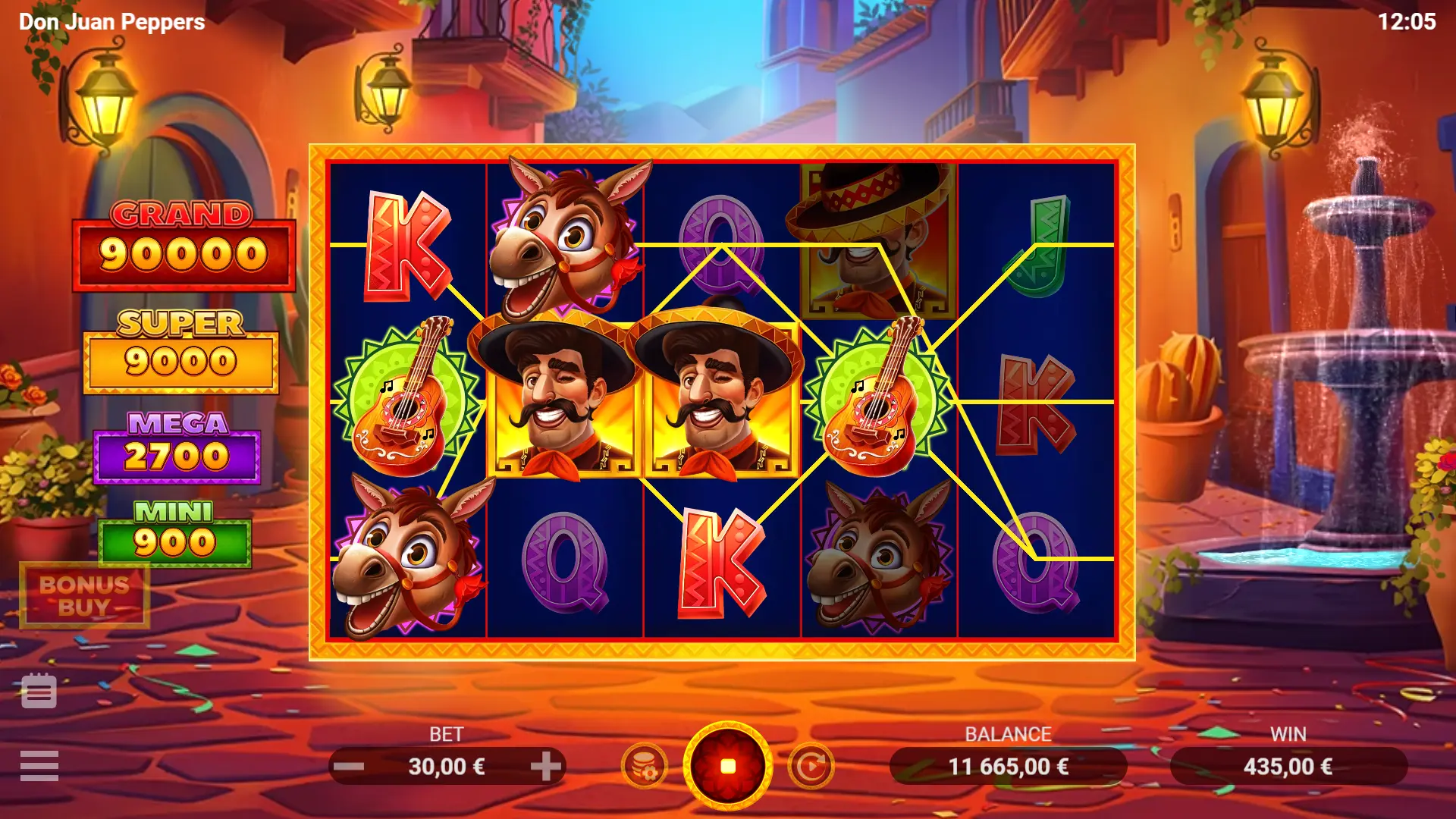
Volatility is more settled. Every source that covers this game — Evoplay’s own listing, BetFury, bettorsinsider’s hands-on review — calls it high volatility, and the mechanics back that up. The base game runs a standard 5×3 grid with 20 fixed paylines, reading left to right in the conventional way. There’s no cluster pay, no cascading reels, no Megaways multiplier grid to soften the variance. Wins come from lining up symbols on fixed lines, full stop.
That structural simplicity is exactly why the volatility bites. With no mechanic to smooth out dry spells, the entire win distribution gets pushed toward the two bonus features. Line wins on regular symbols exist, but bettorsinsider’s testing described the base game as feeling like “filler” between feature triggers — a fair assessment for any high-volatility Hold and Win title, but worth saying plainly rather than dressing it up.
Hit frequency isn’t independently certified anywhere I could find, which is itself worth flagging — a lot of high-volatility slots from smaller studios simply don’t publish this figure, and Evoplay hasn’t here either. What you can infer from the trigger conditions: the Free Spins round needs three specific symbols on three specific reels (2, 3, and 4), and the Bonus Game needs six Bonus symbols landing anywhere across a 15-position grid. Neither is a low bar. Expect stretches of thin base-game returns punctuated by feature hits, not a steady trickle.
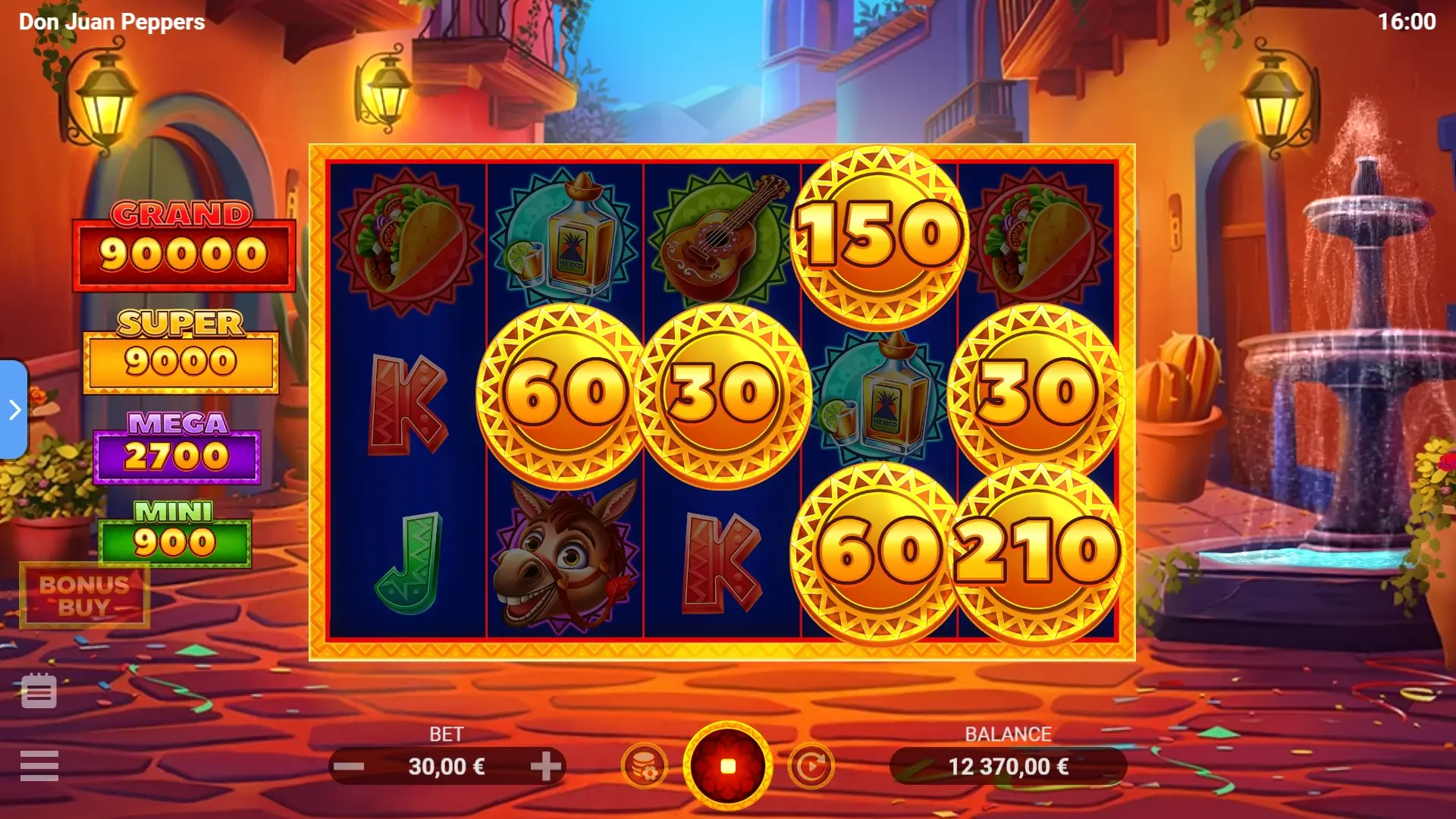
The regular paytable leans on nine standard symbols — tacos, tequila bottles, guitars, and a run of themed low-to-mid icons, none of which carry the value density that the two bonus symbol types do. That’s a deliberate design choice in this genre: the line-pay symbols exist mostly to keep the reels moving between feature attempts, not to deliver meaningful returns on their own. If you’re tracking a session purely by watching regular symbol combinations land, you’re watching the wrong part of the screen. The Bonus and Chili Bonus symbols are where the math model actually lives, and everything else is scaffolding.
Worth sitting with for a second: a high-volatility, 20-fixed-payline game with no cascading or cluster mechanic is a fairly old-school math model dressed in a 2025 skin. That’s not a criticism by itself — fixed paylines are simple to read and the variance is honest, unlike some cluster-pay titles that dress up mediocre hit rates with flashy tumble animations. But it does mean Don Juan Peppers isn’t doing anything structurally new at the reel level. The entire value proposition sits in the two bonus triggers and the value-stacking wrinkle inside the Bonus Game, covered below.
The bet range reported across sweepstakes-casino listings runs from 0.10 up to 200 per spin, though the exact denomination and limits will shift depending on which platform you’re playing through — Evoplay distributes to both real-money and sweepstakes operators, and each sets its own stake structure. Don’t assume the 200 ceiling applies at every casino carrying this title; confirm it in the client before you sit down to chase the jackpot tier.
On the max win: the GRAND jackpot pays 3,000x your bet, confirmed consistently across Evoplay’s own game page, the launch press coverage from iGB and Yogonet, and third-party reviews. Is 3,000x competitive for a 2026 release? It’s respectable but not exceptional. Chilli Heat, the genre’s best-known reference point, caps at 2,512x — so Don Juan Peppers edges it. But Tom Horn Gaming’s near-identically named Don Juan’s Peppers reaches 8,000x, nearly triple the ceiling. If maximum win potential is your primary filter, the name similarity here is going to cost you money if you pick the wrong game by accident.
Put the RTP gap in real terms before moving on. At a $1 average stake across a 1,000-spin session — a modest but realistic sample for a high-volatility slot — the 95.7% configuration returns roughly $957 in expected value against $1,000 wagered, while the 96.09% configuration returns about $961. That’s a $4 difference on this sample size, growing linearly with volume. It won’t change which game you pick, but it does mean two players running identical strategy at two different operators carrying Don Juan Peppers are not, strictly speaking, playing the same game underneath the identical branding. That’s the practical cost of an operator-configurable RTP model, and it’s a reason to actually check the in-client info screen rather than trust whichever RTP figure a review site happens to quote — including this one.
Feature breakdown: two triggers, one grid
Don Juan Peppers runs two distinct bonus mechanisms on top of the base paylines, plus a buy-in option for both. Here’s how each one actually works.
The Wild symbol
Don Juan himself is the Wild, and he substitutes for all regular paying symbols in winning combinations. He does not appear on reel one — Wild only lands on reels two through five, in both the base game and Free Spins. That’s a standard restriction for high-volatility math models; it caps the frequency of five-symbol Wild lines without eliminating them. Nothing unusual here, just worth knowing before you assume every reel carries equal Wild density.
Bonus symbols
Bonus symbols carry a random cash value between 1x and 15x your stake, or — instead of a cash value — they can display one of the MINI, MEGA, or SUPER jackpot labels. Landing six or more Bonus symbols anywhere on the 5×3 grid during the base game triggers the Bonus Game (more on that below). This is the higher of the two trigger thresholds, and given the grid only has 15 total positions, six matching symbols landing simultaneously is a genuinely rare base-game event.
Chili Bonus symbols and Free Spins
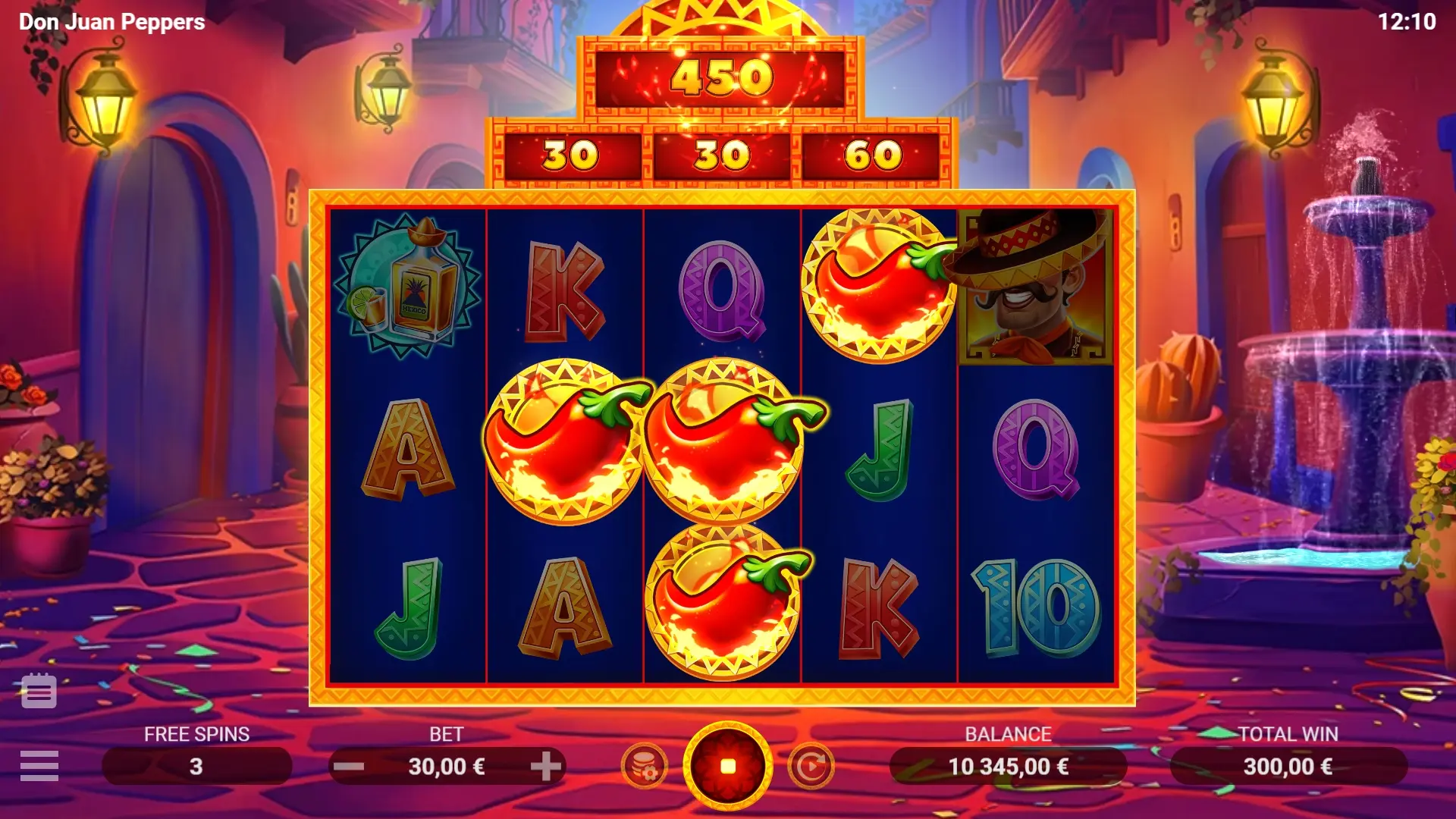
Chili Bonus symbols also carry random values from 1x to 15x bet, but they’re restricted to reels two, three, and four only — they will never land on reel one or reel five. Landing three Chili Bonus symbols across those middle three reels triggers seven Free Spins.
Here’s the mechanic that actually differentiates this from a generic chili-slot template: at the moment Free Spins starts, the values shown on the triggering Chili Bonus symbols are locked into mini-counters displayed above reels two, three, and four. Every additional Chili Bonus symbol landing on those reels during the round adds an Instant Chili Prize — paid immediately, based on the value stored in that reel’s counter. Regular payline wins stay active throughout, so a single Free Spin can combine a line win with one or more instant chili payouts landing in the same spin.
The realistic payout contribution here is modest rather than spectacular. Seven spins isn’t a long runway, and the Instant Chili Prizes are capped by the same 1x–15x range as the base game symbols. This is a feature that supplements the round rather than carrying it — the real ceiling sits in the Bonus Game.
The Bonus Game — Hold and Win
Six or more Bonus symbols on the base grid opens a separate screen running a classic Hold and Win structure, with an Evoplay-specific twist layered on top. The round starts with three respins remaining. Only Bonus and Chili Bonus symbols can land on this screen — no blanks, no regular symbols. Every time a new one lands, it locks in place permanently and the counter resets back to three.
The twist: when a Chili Bonus symbol lands during this round, its value doesn’t just sit there — it gets added to the values of one to four random Bonus symbols already on the grid, and the Chili Bonus symbol itself then converts into a regular Bonus symbol. That means the Chili Bonus isn’t a separate prize pool during the Bonus Game; it’s actively inflating the value of the symbols you’ve already collected. This is the one mechanical wrinkle that separates Don Juan Peppers from a paint-by-numbers Hold and Win clone, and it rewards patience — the longer the round runs, the more those locked positions are worth.
The round ends one of two ways: the respin counter hits zero, in which case you collect the sum of every locked Bonus symbol’s value, or you fill all 15 grid positions, which triggers the GRAND jackpot at 3,000x bet. Below that sit three fixed tiers: SUPER at 300x, MEGA at 90x, and MINI at 30x — all four are fixed prizes, not progressives, so there’s no pooled jackpot growing across the player base. If you were hoping for a life-changing progressive number, it isn’t here; the ceiling is fixed and known in advance.
One honest limitation: filling all 15 positions in a single Bonus Game is a genuinely difficult target, functionally comparable to any Hold and Win slot’s grand jackpot condition. Most triggers of the Bonus Game will realistically land you somewhere in the MINI-to-MEGA range from accumulated symbol values, not the GRAND. That’s not a flaw — it’s how the format is supposed to work — but the marketing emphasis on the 3,000x figure can obscure how rarely it actually pays out relative to smaller collected sums.
You might ask: why does the value-stacking twist matter more than the raw jackpot tiers? Because it changes what you’re actually rooting for once the Bonus Game starts. In a plain Hold and Win format, every new symbol is either a small win or dead air. Here, a Chili Bonus landing late in the round — even on a respin where the counter’s about to expire — still does useful work, because its value redistributes into up to four symbols you’ve already banked rather than simply adding one more isolated prize to the pile. Practically, that means a round that looks like it’s fizzling out with a low counter can still meaningfully grow in total value on the very last spin. It’s a small design choice, but it’s the one genuine point of difference between this and a template Hold and Win release.
Bonus Buy
Evoplay includes a Bonus Buy option letting players purchase direct entry into either the Free Spins round or the Bonus Game, bypassing the natural trigger conditions. bettorsinsider’s testing put the cost at upwards of 100x the stake, though Evoplay hasn’t published an exact multiplier on its own game page, so treat that figure as directional rather than certified. For a high-volatility title where natural triggers are infrequent, a buy-in option is a reasonable inclusion — but at over 100x stake per attempt, it’s not a casual way to sample the feature. You’re paying a serious premium to skip the grind, and the underlying volatility of the feature itself doesn’t change just because you bought your way in.
Where this sits in a 2026 lobby
No sequel, Power Reels edition, or Megaways variant of Evoplay’s Don Juan Peppers exists as of this review — it’s a standalone August 2025 release with no expanded portfolio around it. That’s worth stating plainly rather than leaving as an assumption, because several other games in this exact niche do have sequel structures worth comparing against.
The more useful comparison is competitive, not generational, and the naming collision makes it unavoidable.
Tom Horn Gaming’s Don Juan’s Peppers is the game most likely to get bought by accident when someone searches the wrong exact title. It runs a wider 40-payline structure against Evoplay’s 20, carries a 96.08% RTP against Evoplay’s disputed 95.7%–96.09%, and sits at medium volatility rather than high — a materially different session experience. Its ceiling is the bigger differentiator: 8,000x bet, nearly triple Evoplay’s 3,000x GRAND jackpot. The mechanic is different too — sticky wilds during Free Spins, triggered by three or more Red Chili Peppers, with a stacked Wild symbol in the base game — rather than the Hold and Win structure Evoplay built. If raw ceiling is what you’re chasing, this is the better math model. If you specifically want Evoplay’s Hold and Win jackpot structure, make sure the provider name on the game tile actually says Evoplay before you load it.
Pragmatic Play’s Chilli Heat remains the genre’s reference point, and it’s aged reasonably well. RTP sits at 96.5%, comfortably ahead of either Don Juan game, running medium volatility with a 2,512x max win — lower than Evoplay’s ceiling, but delivered through a gentler variance curve and a simpler three-scatter Free Spins trigger. It’s the safer, more predictable choice; Don Juan Peppers is the higher-variance swing for a similar theme.
Triple Cherry’s El Chile Caliente is the closest thing to a genuine RTP-range peer. VegasSlotsOnline lists its configurable range at 88.23% to 96.29% — a wider operator-selectable band than anything reported for Don Juan Peppers, and a useful reminder of how far configurable math models can actually stretch in this niche. It runs 40 paylines, high volatility, and a chili-drop collection mechanic distinct from Hold and Win, with no progressive jackpot on offer either.
None of the three competitors here have a buy-bonus feature quite as expensive as Evoplay’s reported 100x-plus entry cost, for what it’s worth — most sit in the 80–100x range typical of the category.
Zoom out one more level and the pattern across all three competitors is consistent: every established alternative in this exact niche either beats Don Juan Peppers on RTP, beats it on max win, or offers a gentler volatility curve for a similar theme. None of them lose on all three axes simultaneously the way a genuinely weak release would. What Evoplay is competing on instead is the specific mechanical texture of the Bonus Game — the Chili-value redistribution isn’t available anywhere else in this comparison set — and on availability, since it’s a newer title likely to appear in more current lobby rotations and promotional slots than a legacy game like Chilli Heat. That’s a real but narrow edge, not a decisive one.
There’s also a fair question about whether four fixed jackpot tiers still make sense in a 2026 lobby increasingly dominated by progressive and near-progressive mechanics at the top end of the genre. Fixed jackpots are honest — the number you see is the number you can win, with none of the psychological pull (or added variance) of a pot that grows with other players’ losses. But they also mean Don Juan Peppers has a hard, known ceiling that never moves, which is a genuine trade-off against titles offering pooled or seeded progressives in the same theme space. If you specifically want the chance at a jackpot that’s bigger today than it was yesterday, this format won’t deliver that regardless of how long the game’s been live.
So: is Don Juan Peppers a high roller’s game, a recreational spin, or dead weight in a crowded 2026 lobby? It’s neither extreme. The 3,000x ceiling and fixed (non-progressive) jackpot structure put a real limit on high-roller appeal — serious bankroll players chasing five-figure multipliers should look at Tom Horn’s version or genuinely progressive titles instead. But it’s too volatile and too feature-gated for a purely recreational, low-stakes session either; the base game genuinely does feel thin between triggers, exactly as the volatility rating suggests it should. The niche this actually fills is the mid-stakes Hold and Win regular who wants the added texture of the Chili-value-stacking mechanic and doesn’t mind paying a steep buy-in price to get there faster.
Demo access and where it’s actually live
Free demo play is available through Evoplay’s own game page, Casino Guru, and several affiliate demo aggregators, so there’s no reason to stake real money before you’ve watched the Bonus Game trigger at least a handful of times in practice mode. That matters more here than in a lot of reviews, because the value-stacking mechanic inside the Hold and Win round is genuinely hard to picture from a written description alone — watching two or three rounds play out in demo mode will tell you more about the actual pacing than any paytable screenshot.
Real-money availability is narrower than Evoplay’s broader 250-plus game portfolio might suggest. Aggregator scans by review sites have reported the game absent from several regulated US state markets at various points since launch, which is fairly typical for a niche-studio release in its first year — distribution to individual regulated casinos takes longer than distribution to the sweepstakes-casino channel, where this title appears to have found its earliest and most consistent footing. If you’re in a regulated real-money market, confirm the operator you’re using actually carries this specific title, from this specific studio, before assuming it’s universally available.
Verdict
Play it if you’re already a Hold and Win regular looking for a variant on the format rather than something that reinvents it, and if the value-stacking twist on the Chili Bonus symbols during the Bonus Game appeals to you specifically — that’s the one mechanical idea here that isn’t copied wholesale from elsewhere in the genre. The number that limits it most is the 3,000x fixed GRAND jackpot: not bad, but comfortably beaten by Tom Horn’s similarly-named competitor at 8,000x, and delivered through fixed rather than progressive jackpot tiers, so there’s a hard ceiling on what any single Bonus Game trigger can pay regardless of how long the game’s been live. Pair that with an RTP that shifts depending on which operator’s build you land on — 95.7% at some, closer to 96.09% at others — and the honest read is that this is a solid mid-table entry in its genre rather than a standout.
The player profile this suits: someone who already understands Hold and Win pacing, wants a high-volatility session with real teeth, and is drawn to the Mexican fiesta theme specifically through Evoplay’s take on it rather than any of the three named alternatives. The player profile it doesn’t suit: anyone chasing the biggest possible multiplier in this theme (go to Tom Horn’s version), anyone who wants a calmer variance curve at a similar theme and higher base RTP (Chilli Heat), or anyone new to Hold and Win mechanics who’d rather learn the format on a title with a more forgiving hit pattern.
Skip it, or at least check the RTP configuration before you commit real money, if you’re chasing the highest possible ceiling in this exact theme — go to the 8,000x competitor instead — or if you want a calmer, more predictable session, in which case Chilli Heat’s medium volatility and higher base RTP will serve you better. And regardless of which camp you’re in: verify you’re loading Evoplay’s build and not one of the two other same-themed, similarly-named slots before you deposit. The confusion here isn’t hypothetical — it’s baked into the search results, and it’s the single most avoidable mistake a player can make with this particular title.