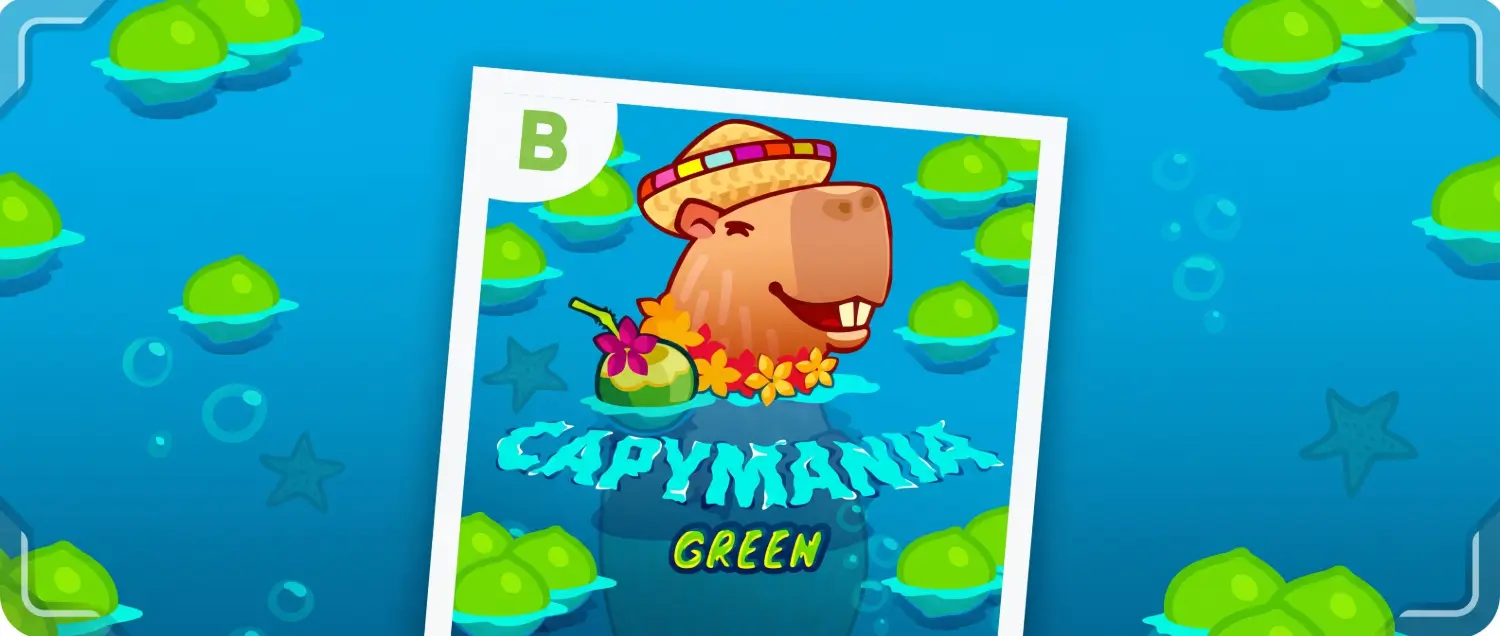
Capymania Green has been sitting in BGaming lobbies since 2 January 2024, which puts it past the two-year mark most instant-win titles never reach before they’re quietly dropped from a casino’s front page. Scratch cards and crash games have spent the last two years eating into slot playtime, and BGaming has leaned into that shift harder than most studios, so the question isn’t whether Capymania Green is still live — it clearly is — but whether it’s still doing anything a newer scratch title doesn’t do better.
The game sits at a fixed €1 stake, a 97% RTP, and a maximum win of 100,000x, or €100,000 on a single card. That RTP figure is the one worth pausing on, because it’s a full seven points above BGaming’s own first scratch collection. Whether that gap actually changes anything for a player scratching nine cells at a time is the real analytical question here, and it’s where this review starts.
It also lands at an interesting moment for the category. Scratch cards spent years as a footnote in casino lobbies — a single tile buried under “Other Games” while slots and live tables took the front page. That’s shifted. Instant-win titles now sit alongside crash games as the go-to option for players who want a result in under three seconds, and studios have responded by pushing RTP and ceiling numbers harder than they used to, since a scratch card without a competitive payout table has nothing else to sell — no reels, no theme mechanics, no bonus round to fall back on. Capymania Green is a useful test case for that trend, because BGaming built it as a direct, numbers-only follow-up to a game of their own that undershot the market.
The math model: what a 3×3 grid and a fixed stake actually mean
Capymania Green isn’t a slot dressed up as a scratch card. There are no reels, no paylines, and no bet range — you buy a card for €1, scratch nine covered cells arranged in a 3×3 block, and match three identical values to win whatever those values show. That’s the entire mechanic. It’s closer to a physical lottery ticket than to anything with a spin button.
RTP is 97%, confirmed on BGaming’s own Players’ Hub and echoed by SlotCatalog and AskGamblers-style aggregators. Over a long session, that means roughly €97 comes back for every €100 fed into cards, statistically. At €1 a card, that’s about 97 cards’ worth of stake returned per 100 cards bought — not per spin, per card, since there’s no smaller unit of play here. Compare that to the average online slot sitting around 96%, and Capymania Green is a point above the norm, which matters more on a game this volatile than it would on a low-variance slot.
One aggregator (rocketpot.io) lists a different figure — 96.3% RTP, medium volatility, and even claims free spins, wild symbols, and a progressive jackpot. None of that exists in this game. There’s no free-spins mechanic on a 3×3 scratch card, there’s no wild symbol to speak of, and the maximum win is a fixed 100,000x ceiling, not a progressive pot that grows with stakes. Treat that page as noise — the 97% figure from BGaming’s own game data and the independent aggregators that mirror it is the one to trust.
Volatility is officially rated very high, and the hit rate sits at 8.17% — meaning roughly 8 cards in 100 land a win of some size. That’s a genuinely thin hit frequency. You might ask: why does a sub-10% hit rate matter more here than on a slot with a similar volatility label? Because there’s no free-spins bonus and no scatter-triggered feature to smooth out the dry spells. Every single card is an independent, all-or-nothing event. When the wins come, they can be substantial — but the gaps between them are long, and there’s no secondary mechanic waiting to soften the run.
The grid itself is worth being precise about, because “3×3” gets used loosely across review sites. This is nine covered cells, each hiding a value. Scratch (or auto-reveal) all nine, and if three of them match, you’re paid the amount shown on those three cells. There’s no directionality, no adjacent-pay logic, and no read-across rows or columns — it’s a flat match-three check across the whole card, closer to keno-adjacent instant-win logic than to any payline system.
Put a session in real numbers and the shape of the game gets clearer. Buy 100 cards at €1 each and, on paper, roughly 8 of them will land a match. That’s the theoretical hit rate, not a guarantee — a real run can go 40 cards without a single match and still land inside the expected long-run average, because 8.17% on a small sample swings hard in both directions. Regular payouts on Capymania Green’s pay table run between $1.00 and $100.00 for the smaller matches, so most of those 8 hits will be modest returns, not the headline 100,000x. The big multiplier exists, and it’s real, but it’s sitting at the extreme tail of a distribution most sessions never touch.
That’s worth sitting with for a second, because it’s the actual mechanical difference between “very high volatility” as a label and what it does to your balance in practice. A high-volatility slot usually still pays you something on a meaningful share of spins even when the big win doesn’t land — a small line hit here, a scatter tease there. Capymania Green doesn’t have that softening layer. Roughly 92 cards out of every 100 return nothing at all. The 97% RTP is real and it’s honestly stated, but it’s paid out across a small number of hits rather than smoothed across the whole session, and that distinction matters more for bankroll planning than the headline percentage does on its own.
On the ceiling: 100,000x on a €1 card gives a maximum single-card win of €100,000. In 2026’s instant-win field, that’s respectable but not exceptional. Rainbow Riches Piles of Cash tops out with a Cash Drop bonus paying 3,665x — nowhere close in raw multiplier, though its overall prize structure spreads differently across five tickets. Monopoly Scratchcard Empire caps at 3,000x. Against those two, Capymania Green’s 100,000x looks enormous. Against BGaming’s own sister title, Scratch Alpaca Gold, which uses the identical 100,000x ceiling at a €2.50 stake for a €250,000 max win, Capymania Green’s €100,000 ceiling is the mid-tier result of a mid-tier stake — competitive within its own family, not class-leading against the wider market.
It’s worth being clear about what “100,000x” actually requires, too. That ceiling only pays out if the top value on the pay table lands on all three matched cells in a single card, and the pay table’s day-to-day range sits between $1.00 and $100.00 — meaning the jump from a typical win to the maximum prize isn’t gradual. There’s no mid-tier multiplier ladder building toward it the way a slot’s bonus round often escalates a win step by step. On Capymania Green, you’re either in the regular pay band or you’ve hit the single top value; there isn’t much in between.
Feature breakdown: what’s actually adjustable in this game
There’s no bonus round to explain here, no scatter trigger, no free-spins retrigger chain. What Capymania Green offers instead is a small set of session-control tools layered on top of a single repeatable mechanic. That’s worth walking through properly, because “scratch card” undersells how much control BGaming has actually built into the wrapper.
Scratch-and-match core mechanic
The trigger is simply buying a card for €1. Scratching (manually, by clicking and dragging) or letting the card auto-complete once roughly 80% of the surface is cleared reveals all nine cells at once. Matching three identical values anywhere on the card pays the amount those three cells display. There’s no re-trigger, no cascading wins, and no interaction between cards — every purchase is a fresh, independent 8.17% shot at a payout. In my testing across a run of cards, most wins landed on the lower end of the pay table; the card doesn’t telegraph anything before you scratch, so there’s genuinely no read on a card before it’s cleared.
Worth flagging the “Scratch All” shortcut here too, since it’s easy to miss: instead of manually dragging across the surface, a single click clears the whole card and jumps straight to the result. Functionally it’s identical odds-wise to scratching by hand — the outcome is decided the moment the card is bought, not while you’re revealing it — but it’s the one part of the base mechanic that lets you control pacing without touching Autoplay at all. The honest limitation is that neither scratching manually nor using Scratch All changes anything about the underlying 8.17% hit rate; it’s presentation, not mechanic.
Card price and payout table
Because the stake is fixed rather than adjustable, the pay table itself does the work a bet slider would normally do on a slot. Regular symbol values run from $1.00 up to $100.00 per matched trio, meaning most non-jackpot wins on a €1 card return somewhere between roughly 1x and 100x the stake. The realistic payout contribution of a typical session comes almost entirely from this regular pay table, not from the 100,000x ceiling — that top prize is a genuine possibility on any given card, but it sits so far into the tail of the distribution that treating it as part of expected session return would be misleading. The honest limitation: a fixed €1 price means there’s no way to size the stake down mid-session if a run goes cold, short of switching to the Orange skin entirely.
Turbo mode
Turbo mode is available inside Autoplay and does exactly one thing: it removes the scratching animation and shows the result instantly. This isn’t a feature that changes math or hit rate — it’s pure speed, useful if you’re running through cards to reach a specific win or loss limit and don’t want the visual layer slowing you down. The catch is that it also removes the only pacing mechanism the game has. Without the scratch animation, sessions accelerate fast, and a very-high-volatility, 8.17%-hit-rate game rewards patience more than speed.
Autoplay with win and loss limits
Autoplay lets you queue up a set number of card purchases and step back from manual clicking, buying multiple cards in a single run instead of clicking “buy” nine times over. Layered on top are two limit tools: a win limit, which stops the run once a set profit is hit, and a loss limit, which stops it once a set loss threshold is reached. Both are configured as a multiple of the card price, so on Capymania Green that’s multiples of €1. This is one of the more genuinely useful pieces of the package — on a game with this much variance, a hard stop that isn’t dependent on the player’s own discipline is worth having, and it’s built into the base game rather than bolted on as a responsible-gambling afterthought.
The honest limitation is that these limits only function inside Autoplay. Buying cards one at a time manually, the way I ran most of my test session, means there’s no automatic stop watching your balance — the win and loss limits exist, but they’re opt-in tools tied to a specific play mode, not a persistent safety net across every way of playing the game. A player who never touches Autoplay never sees them.
The three-tier stake structure
Capymania Green doesn’t stand alone — it’s the middle entry in a three-card set. Capymania Orange runs at €0.10 per card with a €10,000 max win, and Capymania Yellow sits at €2.50 per card with a €250,000 ceiling. All three share the identical 97% RTP, very-high volatility rating, and 8.17% hit rate; the only variable across the set is stake size and the resulting cash ceiling. That’s effectively BGaming’s answer to a bet-range slider — instead of adjusting stake within one game, you pick a different Capymania skin. It works, but it does mean Green specifically is a mid-stake compromise rather than either the accessible entry point or the high-roller version.
Switching between the three isn’t a single click in every lobby, either. Orange, Green, and Yellow are listed as separate game entries rather than a single title with a stake selector, so moving from a losing run on Green down to Orange means backing out to the lobby and loading a different game rather than dragging a slider. It’s a minor friction point, but it’s a real one compared to how a standard slot handles stake changes.
The 2026 perspective: how Capymania Green holds up against its own family and its rivals
Capymania Green didn’t arrive first. BGaming’s original scratch collection, Scratch Alpaca, launched three months earlier on 19 October 2023, using the exact same structure — Bronze at €0.10, Silver at €1, Gold at €2.50, identical 100,000x ceiling, identical 8.17% hit rate, identical very-high volatility rating. The one number BGaming changed for the follow-up: RTP jumped from 90% on every Scratch Alpaca tier to 97% across all three Capymania skins.
That’s not a cosmetic reskin with a capybara instead of an alpaca. A 7-point RTP jump on a fixed-stake, high-frequency instant-win game is a meaningful correction, and it tells you BGaming’s first attempt landed too far into house-edge territory for a game with this little else going on — no bonus round, no feature layer, nothing to distract from the raw math. Capymania Green is what Scratch Alpaca Silver should have been from the start. If you’re choosing between the two purely on numbers, Capymania Green wins outright; there’s no scenario where Scratch Alpaca Silver’s 90% RTP is the better pick at the same €1 stake and identical volatility profile.
Against the wider scratch-card field, Capymania Green’s 97% RTP puts it ahead of most named competitors currently active. Rainbow Riches Piles of Cash, Light & Wonder’s licensed scratch title built on the Rainbow Riches slot brand, runs at 87.82% RTP with a Cash Drop bonus maxing at 3,665x — lower on both RTP and ceiling, though its five-ticket structure and branded IP pull a different audience entirely. Monopoly Scratchcard Empire sits at 93% RTP with a 3,000x cap. Hacksaw Gaming’s Witch Pickings Scratch, one of the better-regarded titles in the category, runs 95.7% RTP, and The Golden Grand sits close behind at 95.6% RTP. Capymania Green beats all four on RTP and dwarfs three of them on maximum multiplier, which is a genuinely strong competitive position for a game this simple.
What that comparison also exposes is a split in how the scratch-card category is built in 2026. Branded titles like Rainbow Riches Piles of Cash and Monopoly Scratchcard Empire lean on licensed IP and multi-ticket structures to hold player attention, trading raw RTP for recognisable themes and a busier layout — more tickets, more symbols, more visual noise per purchase. Capymania Green sits in the opposite camp with Scratch Alpaca, Witch Pickings, and The Golden Grand: no license, one card, one mechanic, and the RTP number doing most of the selling. Neither approach is wrong, but they’re not really competing for the same player. Anyone drawn to Capymania Green for the branded-IP experience will be disappointed; anyone drawn to it for a clean, high-RTP, no-frills instant win is in the right place.
What it doesn’t have is anything resembling a bonus buy. There’s no option to purchase direct entry into a feature, because there’s no feature to buy into — the entire game is the base mechanic. In 2026, where bonus-buy has become close to standard on volatile slots, that absence is worth naming plainly. Players who’ve grown used to skipping straight to the good part on a Pragmatic or Hacksaw slot won’t find that shortcut here; every card is bought at full variance with no acceleration option beyond Turbo mode’s visual skip.
There’s also no progressive jackpot, despite what one low-quality aggregator claims. The 100,000x ceiling is fixed and doesn’t grow with player volume or time since last hit. That’s consistent with how BGaming built the entire Scratch Alpaca and Capymania lineup — flat, predictable ceilings rather than a pot that swells and drains.
So who is this actually for in a 2026 lobby crowded with crash games, Megaways slots, and bonus-buy specialty titles? Capymania Green suits a player who wants a fast, no-thinking-required session at a moderate stake with a real shot at a five-figure win, and who’s comfortable with a thin hit rate in exchange for a fixed 97% return. It’s a poor fit for anyone chasing frequent action — an 8.17% hit rate on a game with no feature layer means long stretches of nothing between cards. It’s also not the game for a player who wants stake flexibility within a single title; that flexibility exists, but only by switching to a different-coloured Capymania skin.
Format and where it actually runs
Capymania Green is built for both desktop and mobile, with an HD asset set that holds up on a phone screen without the interface feeling cramped — a fair test for any instant-win game, since the entire point of the format is a fast round played one-handed between other things. There’s no dedicated app requirement; it runs through a casino’s standard game client the same way any BGaming title does, and the 3×3 card scales cleanly to a small screen without needing pinch-to-zoom or landscape mode.
Availability is the one practical catch worth naming plainly: BGaming’s own Players’ Hub notes that Capymania Green runs on limited servers, meaning it isn’t automatically live at every casino carrying the BGaming catalogue. A brand needs the game specifically enabled by its account manager. In practice that means checking the lobby search bar before assuming it’s there — a five-second check, but one that a slot with wider default distribution wouldn’t require.
Verdict
Capymania Green, on its own terms, is a solid mid-stake scratch card and one of BGaming’s better instant-win releases. The 97% RTP is genuinely competitive against named rivals in the category, the 100,000x ceiling is high for the format, and the win/loss limit tools built into Autoplay are a real, usable safeguard rather than decoration. The number that limits it is the 8.17% hit rate: this is a game built for players who can sit through long dry runs for the chance at a big card, not for anyone who wants steady, frequent action. Play it if you want a fast, fixed-stake instant-win session with better-than-average math and you’re fine with variance doing most of the talking. Skip it if you need feature layers, bonus buys, or a hit rate that keeps a session feeling alive between wins.
On the tier choice — Green versus its Orange and Yellow siblings — there’s no real “which is better” question, since all three share identical RTP, volatility, and hit rate; the only decision is stake tolerance. Orange (€0.10, €10,000 max) is the sensible entry point for anyone testing the mechanic before committing real money to it. Yellow (€2.50, €250,000 max) is the version for players who want Green’s exact math profile with a meaningfully bigger ceiling and can stomach the higher card price. Green itself is the compromise stake — pick it if €1 per card is your comfortable ceiling and you don’t need the extra headroom Yellow offers.
Set against BGaming’s own back catalogue, the instruction is simpler still: if a lobby offers both Capymania Green and Scratch Alpaca Silver side by side at the same €1 price point, take Capymania Green. Same grid, same hit rate, same volatility label, seven points more RTP — there’s no version of that comparison where the older game wins. And against the branded scratch titles crowding 2026 lobbies, Capymania Green’s case is data over decoration: no license fee baked into the pay table, no five-ticket structure to learn, just a higher RTP and a bigger ceiling than most of what it’s shelved next to. Go in knowing the hit rate will test your patience before it tests your bankroll, and set a loss limit through Autoplay before you start — on a game this volatile, that one setting does more for your session than any amount of card-picking instinct ever will.