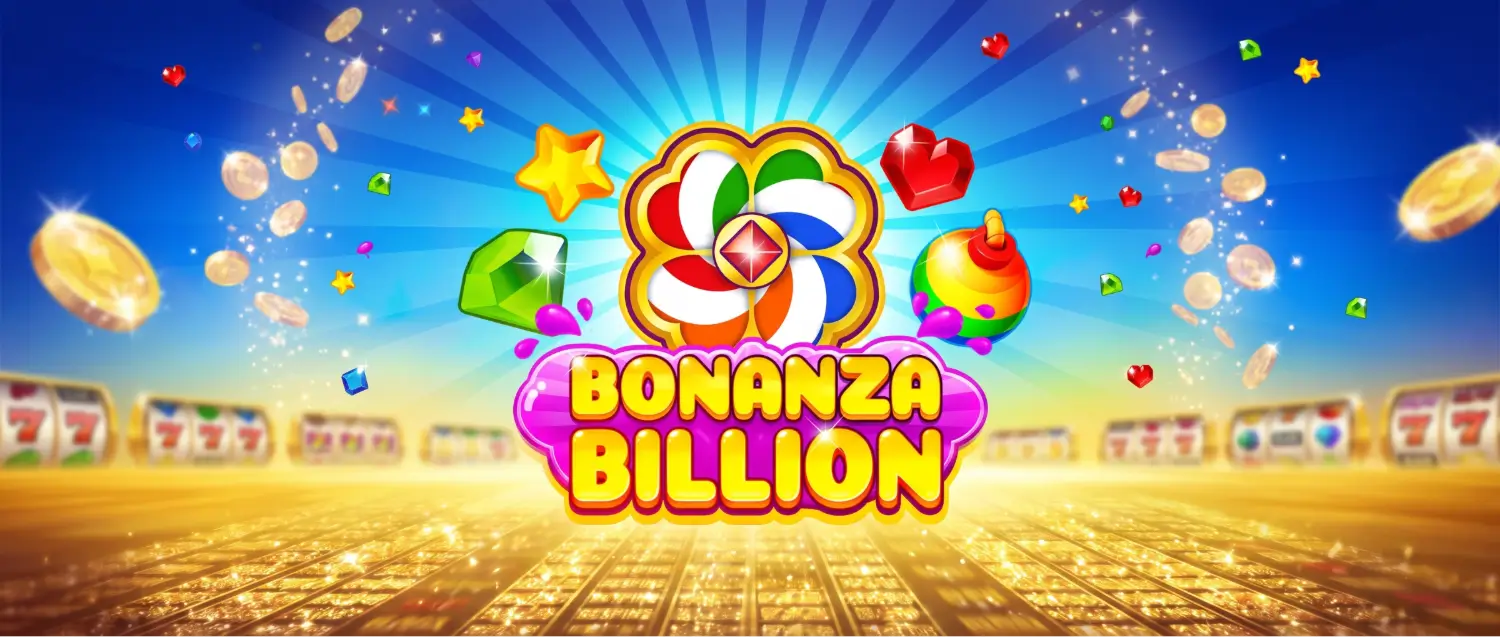
Bonanza Billion has been on the market since 2021, which in slot years makes it a genuine veteran of the cluster pays category. It launched into a field that Pragmatic Play and Push Gaming already dominated, and it never quite pulled ahead of either. Five years on, BGaming has released two direct successors — Bonanza Trillion and Bonanza Billion Xtreme — which tells you the studio itself thinks the original needs backup.
The question worth asking in 2026 isn’t whether Bonanza Billion is a bad slot. It isn’t. The question is whether a 15,000x max win and a 95.97% RTP hold up in a lobby where Sweet Bonanza pays 21,175x and Jammin’ Jars 2 pays 50,000x on comparable stakes. That’s the analytical thread running through this review — math model first, features second, then a straight answer on whether the original or the Xtreme sequel deserves your bankroll.
BGaming built its reputation on a handful of high-volatility hits, and Bonanza Billion was one of the studio’s early attempts to compete directly with Pragmatic Play’s fruit-and-candy cluster format rather than carve out its own niche. That’s worth keeping in mind going in: this isn’t a game trying to reinvent scatter pays mechanics, it’s a game trying to execute the established formula competently enough to hold a spot in operator lobbies next to the genre leaders. Whether it manages that in 2026, five years and two sequels later, is the real subject of this review.
Math model and mechanics
Start with the RTP, because it’s the one figure sources can’t agree on. BGaming’s own game page lists Bonanza Billion at 95.97%. Several aggregators, including AboutSlots and SlotCatalog listings pulled from operator feeds, round it to a flat 96%. Both numbers likely describe the same base configuration — the discrepancy is probably rounding rather than a genuine operator-side RTP swap, but BGaming does support configurable RTP tiers on several of its titles, so it’s worth checking the info screen at your specific casino rather than assuming the headline figure applies. On a £1 stake over a 1,000-spin session, the difference between 95.97% and 96% works out to about 40 pence — not something to lose sleep over, but the kind of gap that shouldn’t exist in official marketing copy for the same game.
Volatility is high, and the hit frequency data backs that up without ambiguity: 38.61% of spins produce some kind of win, but the Free Spins round itself only fires naturally once every 395 spins on average. That’s a long gap. If you’re playing at £1 a spin, you’re looking at roughly £395 in turnover before you can expect to see the bonus round without paying for it — and that’s an average, not a guarantee. Plenty of sessions will run twice that long before a natural trigger.
The grid is a 6-reel, 5-row layout with no fixed paylines. Bonanza Billion uses a scatter pays system — land 8 or more matching symbols anywhere on the grid and they pay, regardless of position or adjacency. This is a looser structure than true cluster pays, which typically requires matching symbols to be physically connected. Scatter pays means BGaming doesn’t have to worry about symbol placement luck; you either have 8+ of a kind on screen or you don’t.
That 30-position grid (6 reels x 5 rows) is worth comparing directly to the competition, because grid size has a real effect on how volatility feels in practice, independent of the headline RTP and max win figures. Sweet Bonanza runs the identical 6×5 layout, which is why the two games feel closest in session pacing despite different studios. Jammin’ Jars and its sequel use a much larger 8×8 board — 64 positions instead of 30 — which mathematically makes it easier to land the symbol counts needed for a win, but also spreads multiplier symbols across a wider space during the bonus round. More positions generally means more chances for a multiplier to land, which partly explains why the Jammin’ Jars titles can support such extreme max-win ceilings without the maths becoming unplayable.
The max win ceiling is 15,000x your stake. In competitive terms, that’s the weakest link in the original’s spec sheet. Sweet Bonanza tops out at 21,175x on the same 6×5 layout. Jammin’ Jars sits at 20,000x on an 8×8 grid, and its sequel doubles that to 50,000x. Fruit Party and Reactoonz cap lower, at roughly 5,000x, so Bonanza Billion isn’t at the bottom of the category — it’s just solidly mid-table in a genre where the top end has moved well past where it sat in 2021.
Betting range runs from £0.20 to £12 per spin at most operators, though a few casinos list the ceiling closer to £16–£20 depending on currency and jurisdiction. That’s a narrower top-end stake than some competitors offer, which matters if you’re a higher-volume player who likes to push bet size rather than session length.
Here’s what the hit frequency numbers actually mean at the table. A 38.61% overall hit rate sounds reasonable until you separate it from the Free Spins figure — most of those base-game wins are small, cluster-clearing hits that barely dent your stake, not the multiplier-driven payouts the game is actually built around. The real engine of Bonanza Billion sits behind a gate that opens once every 395 spins on average. At £2 a spin, that’s roughly £790 in turnover before the bonus round shows up unpaid for. Bankroll planning matters more here than in a medium-volatility slot: budget for at least two or three natural trigger cycles per session, or accept upfront that you’re likely paying for entry via Buy Bonus or Chance x2 instead.
There’s also a structural point worth making about the scatter pays format itself. Because wins don’t depend on adjacency, BGaming’s math model can be more forgiving in one specific way — a scattered handful of matching symbols across the grid still counts, where a strict cluster mechanic would require them to be touching. In practice this nudges the base-game hit frequency up slightly compared to true cluster pays titles like Reactoonz, without meaningfully changing the top-end payout potential. It’s a small mercy for session length, not a fix for the long gaps between features.
Feature breakdown
Refilling reels (cascade mechanic)
Every winning combination clears from the grid, and new symbols drop in to fill the gaps. If the new symbols create another win, the process repeats — there’s no cap on how many refills can chain from a single spin. All wins from a chain accumulate before they’re added to your balance. This is standard cascade mechanics, executed competently but without any twist that separates it from a dozen other cluster and scatter pays titles. The honest limitation here: refilling reels increase win frequency within a spin, but they don’t touch the RTP or the underlying odds of hitting a big multiplier. It’s a presentation mechanic as much as a mathematical one.
The symbol set splits into low-value fruits — cherries, plums, oranges, and watermelons — and higher-value gems, with the game’s ruby, sapphire, and emerald symbols paying noticeably more per cluster than the fruit tier. Nothing about the paytable spread is unusual for the genre; it’s the same low-tier/high-tier split you’ll find in Sweet Bonanza and Fruit Party. What differs slightly is how often a base-game cascade chain runs three or four links deep before drying up — in extended demo sessions, chains beyond two consecutive refills were the exception rather than the rule outside the Free Spins round, which tracks with the stated 38.61% hit frequency rather than something more generous.
Wild symbol
BGaming’s own materials and one aggregator list a Wild symbol among Bonanza Billion’s features, but the mechanic isn’t detailed consistently across sources, and gameplay walkthroughs from BGaming’s Players Hub and third-party demos don’t show it functioning as a distinct feature separate from the standard scatter pays symbols. Treat this one with caution — if a Wild is present, its role appears minor compared with the Multiplier symbol and Free Spins structure that actually drive the game’s payout potential.
Chance x2
This feature increases your effective bet by roughly a quarter and, in exchange, doubles your odds of triggering Free Spins naturally on that spin. It’s not a bonus buy — you’re still relying on the base RNG, just with better odds stacked in your favour. Given the 1-in-395 natural trigger rate, Chance x2 is the more bankroll-friendly way to chase the bonus round if a full buy-in feels too steep. The catch: doubling your odds from a 1-in-395 baseline still leaves you around 1-in-198, which is a long way from “guaranteed.” Treat it as odds improvement, not a shortcut.
Free Spins and the Multiplier symbol
Land 4, 5, or 6 Scatter symbols anywhere on the grid and you trigger 10, 20, or 30 Free Spins respectively. During the round, three or more additional Scatters retrigger an extra 5 spins — a modest retrigger compared to some competitors, but a retrigger nonetheless.
The Multiplier symbol only appears during Free Spins. When it lands, it locks in place and takes a random value between 2x and 100x. It stays on screen through the entire refill sequence for that spin. Once the cascades stop, every multiplier symbol present on the grid gets added together, and that combined figure multiplies the total win from the sequence. Land three multiplier symbols worth 20x, 35x, and 50x in a single sequence, and your sequence win gets multiplied by 105x combined — that’s where the 15,000x ceiling actually comes from, not from any single symbol landing.
Realistic contribution: in an average Free Spins round, expect one or two multiplier hits in the 2x–20x range rather than the 100x extreme. The math model needs several multiplier symbols stacking in the same sequence to reach anywhere near the theoretical ceiling, and that’s a low-probability event even within an already low-probability bonus round. This is the honest gap between what the paytable promises and what most sessions deliver.
Buy Bonus (Feature Buy)
Skip the wait entirely and purchase direct entry into Free Spins. The price scales with your current bet — expect somewhere in the region of 100x your stake, consistent with what BGaming charges on the Xtreme sequel’s equivalent feature, though exact pricing varies by operator and jurisdiction. Bonus buy availability isn’t universal — some regulated markets restrict or remove the feature entirely, so don’t assume it’ll be sitting there at every casino that lists the game.
The 2026 perspective
BGaming clearly saw the same gap in Bonanza Billion’s spec sheet that any analyst would: a 15,000x ceiling in a genre where 20,000x-plus has become the expected benchmark. The response came in two waves.
Bonanza Trillion, released in 2025, pushed RTP up to 97.17% — the highest in the mini-series — but actually reduced the max win ceiling to 5,000x. That’s a strange trade-off on paper, and it tells you Trillion is aimed at a different player entirely: someone who wants smoother, more sustainable volatility rather than lottery-ticket variance. It compensates with three separate Buy Bonus tiers, including options with guaranteed starting multipliers of 50x and 100x, and its multiplier range during play runs from 2x up to a much larger 500x. If you found the original’s variance draining but liked the theme, Trillion is the softer landing.
Bonanza Billion Xtreme, released in March 2026, went the other direction entirely. RTP climbs to 96.97%, and the max win jumps to 20,000x — finally putting a Bonanza-branded title in the same bracket as Jammin’ Jars and within range of Sweet Bonanza. The core mechanics carry over almost unchanged: same 6×5 grid, same Pays Anywhere structure, near-identical hit frequency at roughly 1-in-395 for a natural Free Spins trigger. What Xtreme adds is a Super Free Spins tier, purchasable for around 500x your stake, which guarantees multiplier symbols in the 20x–1,000x range instead of the standard 2x–100x band. The standard Free Spins purchase sits at roughly 100x, and Chance x2 costs a 25% bet increase — both consistent with the original’s pricing logic.
What Xtreme didn’t fix: the retrigger mechanic is unchanged, the base game feel is nearly identical, and the natural trigger rate is still a long grind. If your complaint about the original was variance and boredom between features rather than the payout ceiling, Xtreme won’t solve it. It’s a bigger number on the same skeleton.
Against the wider category, Bonanza Billion — original or Xtreme — is competing with genuinely tough company. Sweet Bonanza still sets the benchmark for accessibility in this exact format: same 6×5 grid, similar RTP band around 96.5%, and a max win of 21,175x that beats even Xtreme’s upgraded ceiling. Jammin’ Jars and Jammin’ Jars 2 operate on a larger 8×8 grid with max wins of 20,000x and 50,000x respectively, aimed squarely at players who want the biggest possible number on the paytable and don’t mind the extra variance that comes with a bigger grid. Fruit Party sits below all of these at roughly 5,000x, which makes it the more forgiving option if high volatility isn’t your thing, and Reactoonz — a cluster pays title rather than scatter pays, but a natural comparison in the wider category — caps at a similar 5,000x with a genuinely different alien theme if fruit and gems have worn thin.
Buy-bonus pricing is where the comparison gets more interesting than the max-win table alone suggests. Bonanza Billion’s Free Spins purchase at roughly 100x stake is in line with what Sweet Bonanza and most Pragmatic Play titles charge for equivalent entry. Where Xtreme’s Super Free Spins tier stands out is the guaranteed multiplier floor — paying 500x to lock in a minimum 20x multiplier on every symbol that lands is a materially different value proposition from a standard buy that guarantees entry but nothing about what happens once you’re in. Sugar Rush 1000, another high-ceiling cluster title in this bracket, charges comparably for its top-tier buy option and pushes its max win to 25,000x — a reminder that even Xtreme’s 20,000x, an improvement over the original, still isn’t chasing the very top of the category.
No progressive jackpot exists on any version of Bonanza Billion — the win potential is entirely fixed-multiplier based, which is standard for this slot family and not a mark against it. Buy Bonus is present across all three versions of the game, which matters in 2026 when feature-buy availability has become close to a baseline expectation for high-volatility titles rather than a bonus extra.
So who is this actually for? Bonanza Billion in its original form makes sense for players who already like BGaming’s house style and want a slightly less extreme variance profile than Xtreme or Trillion offer, and who aren’t chasing the absolute highest max win on the market. It’s a recreational high-volatility slot, not a high-roller showpiece — the 15,000x ceiling and £12 typical bet cap keep it out of that conversation. For anyone specifically hunting the biggest number available in the cluster/scatter pays category, this isn’t that game, and hasn’t been since Sweet Bonanza and Jammin’ Jars set the current bar.
It’s also worth being honest about what “dead weight in a 2026 lobby” would actually look like, because Bonanza Billion doesn’t quite meet that bar either. A genuinely obsolete title in this category would have an RTP below 95%, a max win under 5,000x, and no Buy Bonus option — think early-2010s fruit slots still running on fixed paylines. Bonanza Billion clears all three of those thresholds comfortably. It’s not a must-play, and it’s not the game to reach for if maximum ceiling is the deciding factor, but it’s a functional, competently built mid-tier release that BGaming has actively supported with two follow-ups rather than left to fade out. That support pattern — Trillion for lower variance, Xtreme for higher ceiling — is itself a signal that the studio still sees commercial life in the format, even if the original entry needed help to stay competitive five years on.
Verdict
Bonanza Billion (original): Play it if you like the fruit and gem theme, want high volatility without the most extreme variance in the category, and don’t mind a max win that sits a tier below the current market leaders. The number that limits this game is the 15,000x ceiling — respectable in 2021, mid-table by 2026 standards. Skip it if you’re specifically chasing the biggest possible multiplier; Sweet Bonanza and either Jammin’ Jars title will get you further on comparable stakes. Recreational players who enjoy BGaming’s cascade format and don’t treat max win as the deciding factor will get a fair, if unremarkable, experience here. The one practical advantage the original retains over both sequels: it’s had five years to spread across operator lobbies, so availability at smaller or regional casinos tends to be better than for Xtreme, which is still rolling out post-launch.
Bonanza Billion Xtreme: This is the version worth choosing over the original in almost every case where both are available. The 20,000x max win and 96.97% RTP close most of the gap with the category leaders while keeping the same core mechanics players already know — same grid, same trigger logic, same near-identical hit frequency. The limiting factor here is the Super Free Spins purchase price — 500x your stake is a serious commitment for a guaranteed 20x-plus multiplier floor, and it’s not a realistic strategy for smaller bankrolls chasing a single session’s entertainment rather than a genuine shot at the ceiling. High-volatility players with a bankroll built for extended sessions, and who specifically want a Bonanza-themed title rather than jumping to Sweet Bonanza or Jammin’ Jars outright, should default to Xtreme over the original.
Players with tighter budgets or a preference for smoother sessions are better served by Bonanza Trillion’s softer, higher-RTP profile instead — that’s genuinely a different game for a different player, not just a third option to round out the family. And for anyone weighing all three purely on ceiling, the honest instruction is this: if 20,000x from Xtreme still isn’t enough, the category has titles that go further, and BGaming’s own line-up tops out there. Don’t expect a fourth Bonanza release to suddenly out-math Jammin’ Jars 2 — nothing in the pattern of these three releases suggests that’s the direction BGaming is heading.
FAQ
Is Bonanza Billion’s RTP 96% or 95.97%? BGaming’s official game page lists 95.97%. Several third-party aggregators round the figure to 96%. Both likely describe the same base build, but confirm the exact RTP on your chosen operator’s info screen, since BGaming supports configurable RTP tiers on some titles.
What’s the difference between Bonanza Billion and Bonanza Billion Xtreme? Xtreme raises the max win from 15,000x to 20,000x and RTP from 95.97% to 96.97%. It adds a Super Free Spins purchase tier with a 20x–1,000x guaranteed multiplier range, on top of the standard 2x–100x band both games share. Core mechanics — grid, trigger structure, hit frequency — are almost identical between the two.
Does Bonanza Billion have a progressive jackpot? No. The game’s win potential is entirely fixed-multiplier based, topping out at 15,000x for the original and 20,000x for Xtreme. Some third-party sweepstakes platforms layer their own promotional jackpots on top, but that’s a site-level addition, not a feature of the game itself.
Can I buy the bonus round on Bonanza Billion? Yes. Buy Bonus is available on all versions of the game, with pricing that scales to your current bet — typically in the region of 100x stake for standard Free Spins. Availability depends on your casino’s licence and jurisdiction, since bonus buy features are restricted in some regulated markets.
How often does Free Spins trigger naturally? On average, once every 395 spins across both the original and Xtreme versions. That’s a long natural gap, which is why Chance x2 and Buy Bonus exist as alternate routes into the feature.
Is Bonanza Billion or Bonanza Billion Xtreme the better choice? Xtreme, for most players. It raises the max win to 20,000x and the RTP to 96.97% while keeping the same grid, trigger structure, and hit frequency as the original. The exception is players who specifically want lower variance and a higher baseline RTP without chasing a bigger ceiling — Bonanza Trillion, not either Billion version, suits that profile better.
What’s the minimum bankroll to play Bonanza Billion sensibly? There’s no fixed figure, but given the roughly 1-in-395 natural trigger rate for Free Spins, a bankroll that can absorb at least 500–800 spins at your chosen stake gives you a realistic shot at seeing the feature without relying entirely on Buy Bonus. Anything shorter and you’re largely playing base game with occasional small cluster wins.