BGaming launched this on 8 June 2026 — three days before the FIFA World Cup kicked off in the United States. The timing was deliberate. This is the headline casual title in a four-game football pack BGaming built around the tournament, and the Júlio César collaboration carries a specific regional agenda: the provider entered Brazil as a new market in 2025 and wants a recognisable Brazilian name attached to its flagship casual format. That context matters when you’re evaluating whether the game has genuine merit or is riding a licensing deal to easy placement.
The core question is simpler: does bringing in a legendary goalkeeper change anything about how this game plays? The original Penalty Duel shipped in July 2025 with a 96.14% RTP, a 4,860× max win, and an instant-win mechanic built around penalty kicks. Eleven months later, the Júlio César variant ships with an identical 96.14% RTP and an identical 4,860× max win. The math model did not change. What changed is the face on the other side of the goal — and whether that justifies a second look depends entirely on where you sit as a player.
Math model and mechanics
The technical foundation is the same across both variants of Penalty Duel, so let’s be precise about what you’re working with.
RTP: 96.14%. This figure is consistent across BGaming’s official product page, press releases, and every reliable review published at launch. One low-quality aggregator site circulates a 96.25% figure — that appears to be fabricated. The confirmed number is 96.14%, and because this is not an operator-configurable slot in the traditional sense, the figure should be stable across most deployments. Still worth checking the casino’s listed RTP if you care about the decimal.
Volatility: low-to-medium. BGaming’s own press releases and product positioning describe the game as “low to medium volatility.” A number of affiliate review sites have independently classified it as “medium.” The practical difference matters. Low-to-medium means frequent small wins with rare larger payouts; medium means a shift toward less frequent hits with more meaningful swings. BGaming’s classification is the authoritative one here — though gameplay in the striker role, where you’re chasing ×12 or ×15 multipliers, can feel noticeably higher-variance than the label suggests.
Max win: 4,860×. At £50 maximum bet, that’s a £243,000 ceiling — competitive for casual/instant-win formats. The catch: 4,860× is a mathematical function of five consecutive multiplier hits in the Buy Bonus mode, where each multiplier is applied to the running total rather than to your base stake individually. The path to that number is five consecutive multiplied strikes in the bonus sequence. In organic play, without the Buy Bonus, the ceiling is far lower.
Bet range: £0.10–£50. Standard for BGaming’s casual catalogue.
Format: this is not a slot. There are no reels, no paylines, no symbol combinations. Penalty Duel with Júlio César is an instant-win casual game structured around a single interactive action per round: you take a penalty kick (striker mode) or attempt a save (goalkeeper mode). The multiplier structure determines payouts, not symbol matching. Players who expect spin mechanics will need to recalibrate expectations — this sits in the same product category as BGaming’s Aviamasters and Lucky Birds crash games, not alongside their traditional reel titles like Elvis Frog or Book of Cats.
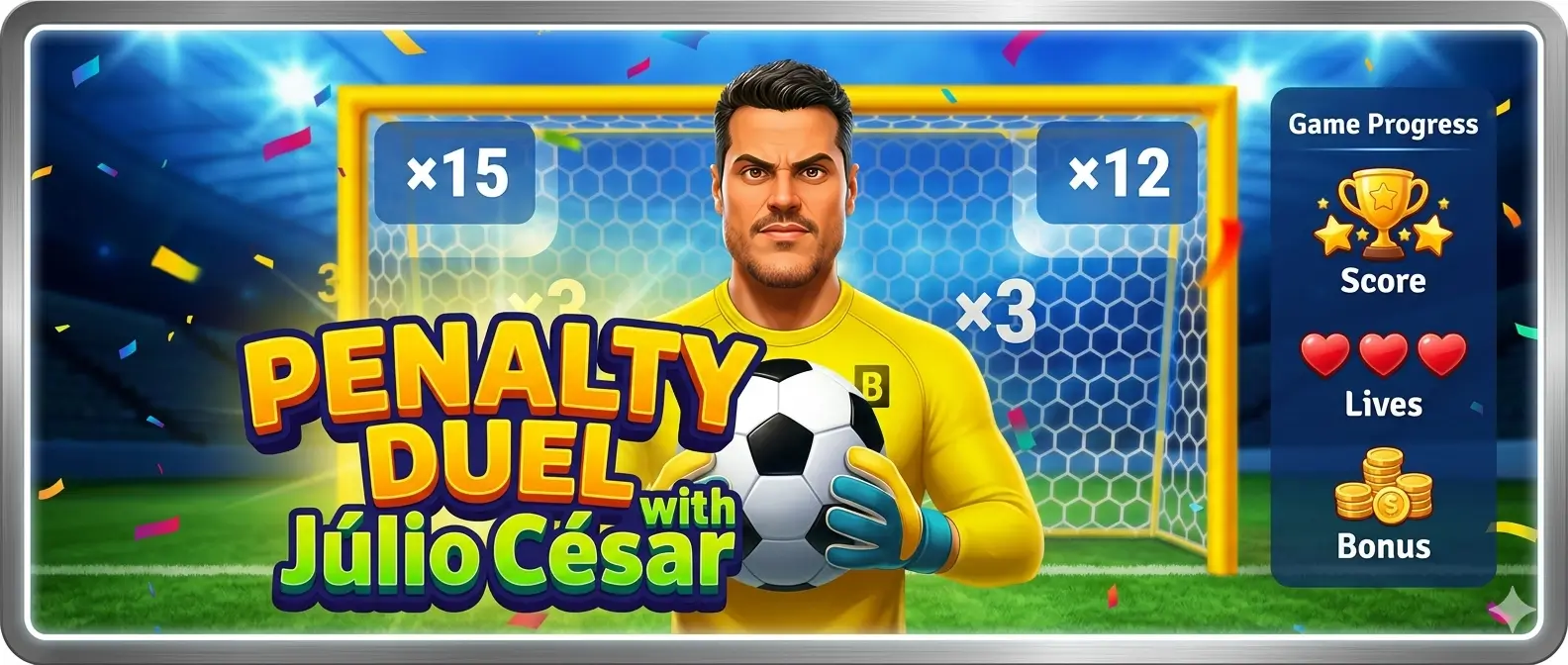
Striker mode multiplier grid. The goal face displays ten target zones mapped to fixed multipliers: ×2, ×3, ×4, ×6, ×8, ×9, ×12, and ×15. You either click a specific zone to target it directly or hit the ball button for a randomised kick. Júlio César attempts to block each shot. A save costs you the bet. A scored goal pays the zone’s multiplier.
The zone selection question matters more than it appears. The RNG determines whether your chosen zone is saved or scored regardless of which zone you pick — Júlio César’s save direction is determined by the same randomisation engine, not by your shot placement relative to where he dives. You can click ×15 every time and the probability distribution doesn’t change. What zone selection does affect is payout size if the shot goes in — which is why targeting high-multiplier zones aggressively isn’t irrationally optimistic, but it also isn’t a strategy. It’s an aesthetic preference.
Goalkeeper mode multiplier range: ×1.2–×2.5. The goalkeeper role inverts the action — you predict which direction an incoming shot will come and attempt the save. Multipliers are significantly lower here (the ceiling drops from ×15 to ×2.5), but so does the miss rate. This is a lower-risk, lower-ceiling mode. Worth knowing before assuming both roles offer comparable win potential — they do not.
At £1 per kick in goalkeeper mode, a successful save at the maximum ×2.5 returns £2.50. That’s a 150% payout on a win. At £1 in striker mode, a successful ×15 zone hit returns £15, and hitting the ×2 zone returns £2 — less than the goalkeeper ceiling but with the upside of ×15 on those kicks that do land. The expected value per kick should be roughly equivalent given the shared 96.14% RTP, but the distribution of outcomes is materially different. Goalkeeper mode compresses variance. Striker mode expands it.
The asymmetry between striker and goalkeeper is the most interesting design decision in the game. BGaming has built in a genuine risk-preference lever at the format level, not just the feature level. Most slots offer volatility calibration only through bet size. This game offers it through role selection — you can shift the session experience from consistent small returns to infrequent larger ones without changing your stake. That’s a more elegant solution than it looks on paper.
Hit frequency. BGaming hasn’t published a specific hit rate for either mode. What sources confirm from play patterns is that in striker mode, the low-to-medium volatility classification translates to more missed shots than successful ones in the higher-multiplier zones, with the game paying out small multipliers (×2, ×3) with meaningful regularity. You will miss. In real penalty shootouts, elite goalkeepers save roughly 20–30% of penalties. BGaming’s RNG obviously doesn’t replicate that exact split, but the hit rate feels tuned to prevent the absolute frustration of consecutive misses that high-variance formats can deliver. That’s a deliberate design choice for the casual audience this game targets.
Feature breakdown
Golden Ball
The Golden Ball triggers randomly during any kick in striker mode. When it activates, the ball turns gold and all zone multipliers on the goal face are amplified by ×5. A zone worth ×3 becomes ×15. The ×15 zone becomes ×75 — which, in one hit, significantly exceeds what standard play can deliver. The multiplier jump is substantial enough that a single Golden Ball kick landing on a high zone can represent a session’s worth of accumulated small wins.
The mechanic is pure RNG. You cannot influence it through zone selection, session length, or bet size (in standard play). BGaming hasn’t published trigger frequency data, and none of the verified review sources that appeared at launch provide independently measured rates. What the math implies, working backward from the RTP and the rest of the feature set, is that Golden Ball triggers are relatively infrequent in default mode. A session of 50–100 kicks might see two or three activations — or none. The distribution is genuinely unpredictable, which is both the appeal and the frustration.
In striker mode, there’s also the question of what zone you’re targeting when Golden Ball fires. Hitting ×2 during a Golden Ball activation yields ×10. Hitting ×15 yields ×75. If you’re playing with specific zone targeting rather than random kicks, the Golden Ball calculates against whichever zone you’re aiming for. That’s not a strategic advantage — the save/score outcome is still RNG — but it means zone preference has an outsize payout implication during Golden Ball activations specifically.
The honest limitation: you cannot control when this triggers. It fires less often than players hoping for it will want.
Chance ×5
This is a side bet option. Activating it costs an additional 0.50× your current stake per round. In return, the probability of the Golden Ball triggering on that kick increases materially. BGaming hasn’t published exact probability figures, but the cost structure implies a meaningful uplift or the feature would be obviously bad value.
The catch is compounding bet size. At a £1 base bet, Chance ×5 adds £0.50 per round — a 50% bet increase per kick for an unquantified probability boost on a feature that itself doesn’t guarantee a hit on a high multiplier. Over a session, that adds up. The Chance ×5 option makes more sense as a deliberate decision before a specific kick (particularly when targeting ×12 or ×15 zones) than as a permanent session setting.
It’s also worth noting that Chance ×5 is the only feature that persists through role switching. If you swap between striker and goalkeeper mid-session with Chance ×5 active, the side bet remains engaged. This caught me off guard — check your active bets when switching modes.
Buy Bonus
The Buy Bonus costs 100× your stake and transports the game to a beach setting. BGaming’s description frames this as a change of pace; the mechanical reality is that it’s the only path to the 4,860× max win that the marketing headline promotes.
In Buy Bonus mode, you receive five automatic kicks. The key difference from the base game: multipliers compound — each scored multiplier is multiplied by the previous one rather than applied independently to your base stake. The math: if you hit ×3 on kick one, ×4 on kick two, and ×6 on kick three, the running total at kick three is 3 × 4 × 6 = ×72. Continue that logic through five hits in the highest possible zones and you get the headline number. The actual calculation to reach ×4,860 requires hitting a specific sequence of multiplier combinations across all five kicks. BGaming hasn’t published the exact required chain — 4,860 factors as roughly 15 × 12 × 9 × 6 × ×4, or various other combinations of the available zone values that multiply to 4,860.
Miss any single kick in the sequence and the chain breaks at whatever multiplier the last successful hit produced. Five kicks in Buy Bonus mode with a mix of hits and misses will typically return significantly less than the headline figure — the compounding only works if all five connect.
The structural limitation is obvious: at £1 stake, the Buy Bonus costs £100. At £0.10 minimum bet, it costs £10. The maximum 4,860× on a £0.10 stake returns £486. The “up to £243,000” headline number requires a £50 stake Buy Bonus, which costs £5,000 to trigger. That’s not a criticism of the feature — it’s a mathematical fact players should understand before purchasing.
The chain mechanic in Buy Bonus is the game’s only genuinely novel mechanism relative to the base game. Five shots where multipliers multiply rather than sum creates a fundamentally different payout curve. In testing, a complete five-kick chain with all hits produced the only sessions where the Buy Bonus delivered above-average value. A three-of-five hit chain at medium multipliers returned roughly 60–80× the base stake from a 100× investment — below breakeven. The feature rewards complete chains disproportionately over partial ones, which means the Buy Bonus is a high-variance gamble within an already casual game. You can buy your way into a feature and still walk out below what the base game’s session RTP would have returned at the same investment.
Whether that risk is worth taking depends on session intent. Players who want guaranteed access to the chain mechanic and can absorb the 100× entry cost: the Buy Bonus delivers an experience the base game can’t replicate. Players who are budget-conscious and measuring every pound: stay in organic play and hope for the Golden Ball.
Easter eggs
BGaming’s press materials reference hidden animations triggered by specific in-game actions. The specific triggers have not been published by BGaming or independently verified in the week since launch. These appear to be engagement mechanics for streamers and long-session players rather than payout mechanics — BGaming explicitly framed them around content creator opportunities. Treat them as cosmetic entertainment, not as mechanics that affect the RTP or win probability.
2026 perspective: is this a meaningful release or a licensed reskin?
This requires an honest comparison with the original Penalty Duel (July 2025), the broader casual game competitive picture, and a direct assessment of what the World Cup context adds or doesn’t.
Who is Júlio César and why does it matter commercially. Born in Rio de Janeiro in 1979, Júlio César spent the peak years of his career at Inter Milan (2005–2012), winning five Scudetti, the 2009–10 UEFA Champions League, and the 2010 FIFA Club World Cup. He earned 87 caps for Brazil, appeared in three World Cups (2006, 2010, 2014), and won the Golden Glove at the 2013 FIFA Confederations Cup. In Brazil, his name carries weight among football fans who were watching the sport during his prime. BGaming entered Brazil as a new market in 2025 and this collaboration is explicitly framed as part of that push. The commercial logic is coherent. Whether it translates to meaningful acquisition uplift for operators in Latin American markets is something engagement analytics will answer over the coming months — it’s not something a game mechanic review can determine.
Original Penalty Duel vs. Júlio César variant. The mechanical specs are identical: 96.14% RTP, 4,860× max win, same multiplier grid, same feature set (Golden Ball, Chance ×5, Buy Bonus), same bet range. The original game released July 2025 with a beach setting and a generic animated goalkeeper. The Júlio César variant places a digitised recreation of the actual goalkeeper in a stadium environment, with the Buy Bonus switching to a beach location — a neat inversion of the original’s primary setting. The Easter egg system appears exclusive to the Júlio César variant based on BGaming’s communications, though no specific triggers have been published.
For players who experienced the original and want a reason to return: the game mechanics will feel identical. The draw is entirely the brand. From a pure math-model standpoint, the two games are the same product with different presentation layers.
What neither variant resolved. The goalkeeper mode ceiling of ×2.5 remains low for anyone interested in meaningful payout potential. If you want to play goalkeeper, you want the low-variance, frequent-small-return experience — and that’s fine as a design choice, but it means most players will eventually migrate to striker mode for the same reasons. The Golden Ball and Buy Bonus are both striker-mode features. The goalkeeper mode is a side dish, not the main course. BGaming knows this — their press materials and the product page both lead with striker gameplay.
More substantively: the Buy Bonus remains the only route to the headline max win, and the headline max win requires a perfect five-kick chain. The base game’s organic payout ceiling is ×75 (a Golden Ball activation on the ×15 zone). That’s genuinely useful for session play, but it’s a different number than 4,860×. Both figures are real. Knowing which is achievable through which path matters before you put money in.
Kicker Mania (arriving 30 June 2026). BGaming’s closing World Cup casual title uses a different format — players target floating footballs carrying multipliers — with a reported ceiling of ×64. At the time of writing, full Kicker Mania specs aren’t confirmed. What the ×64 ceiling implies is a different volatility profile from Penalty Duel’s ×15 single-kick organic maximum. If Kicker Mania ships at a competitive RTP alongside that ceiling, operators carrying both should watch engagement metrics carefully during July. The Júlio César title has a narrow window of exclusivity as the football pack’s marquee branded release before that fourth title arrives.
Competition outside BGaming’s catalogue. Pragmatic Play’s Penalty Shoot-out runs at 96.38% RTP — marginally higher than this game’s 96.14% — with a different bonus mechanic built around progressive knockout rounds. It lacks the interactive zone-targeting element that makes Penalty Duel feel more engaged than a passive spin, but it offers a higher RTP for players purely optimising on that number. Push Gaming’s Football: Champions Cup includes progressive jackpot functionality that neither Penalty Duel variant provides. For players specifically targeting football themes with jackpot potential, that’s a real gap.
Progressive jackpot: absent. No jackpot mechanic exists in either Penalty Duel variant. Branded collaborations increasingly ship with progressive overlays or tournament integration — this one doesn’t. That’s a product decision BGaming made consciously (jackpot mechanics and the casual short-session format work against each other structurally), but it means operators wanting a headline prize structure attached to their World Cup promotion need to look elsewhere.
Mobile play. BGaming built this in HTML5 with explicit mobile optimisation. The game loads fast on mid-range Android hardware — a relevant consideration in the Latin American and South Asian markets BGaming is actively developing. The tap-to-kick mechanic translates cleanly to touchscreen. Single action per round, minimal data usage per session. For operators in markets where data costs are a real player concern, that’s not a trivial advantage over feature-dense video slots that take several seconds to load a bonus round.
Verdict
Penalty Duel with Júlio César
The game is technically sound. 96.14% RTP with low-to-medium volatility makes it appropriate for casual session play without the bankroll punishment of a high-variance slot. The interactive format — choosing zones, watching the save attempt, reacting to the Golden Ball — creates genuine engagement that passive spin mechanics don’t. For the World Cup period, the branding lands well.
The audience for this game is a casual football fan who wants a quick, themed experience during the tournament. Sessions are short by design. The game loads fast (BGaming confirmed mobile-first HTML5). The £0.10 minimum bet makes it accessible. Buy Bonus is optional.
The audience for whom this doesn’t work: anyone chasing the 4,860× headline figure through organic play. It’s not going to happen that way. Anyone who wants traditional slot mechanics (wilds, scatter triggers, free spins) will find none of them here. High-volatility players looking for the psychological tension of a long drought before a major hit will find the low-to-medium classification accurate — this game pays out often at small multipliers, and the big swings require the Buy Bonus.
Original Penalty Duel (July 2025) vs. the Júlio César variant
If you haven’t played the original, start with the Júlio César version — the stadium presentation is stronger and the Easter egg content adds texture. If you played the original and are hoping for mechanical evolution, there isn’t any. Same game, different skin, famous face.
BGaming’s football pack gives operators something to put in front of players during the World Cup. The Júlio César title delivers that. It doesn’t reinvent casual gaming and wasn’t trying to. For the audience it’s designed for — casual players wanting a low-stakes, football-themed distraction — 96.14% RTP at £0.10 minimum is a reasonable deal. Just don’t spend £5,000 on Buy Bonuses chasing £243,000. That maths is available to anyone willing to multiply.