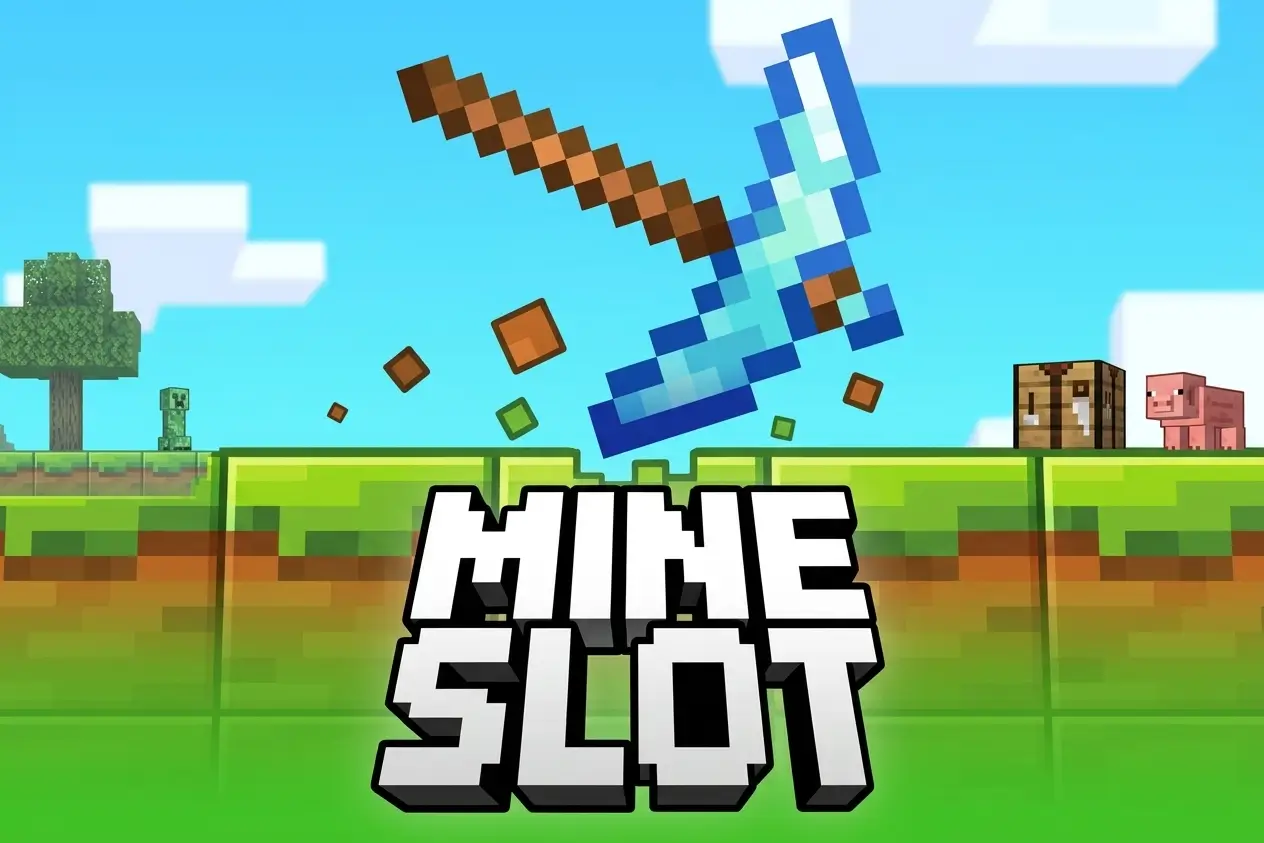
Mine Slot went live on 24 December 2025, so it is roughly nine months old, and InOut Games shipped a sequel less than three months later. Studios do that when a format sells. Nine months in, the open question is whether this is a format with legs or a novelty spike coasting on the Minecraft look. In a market crowded with 10,000x-plus releases, it trades on novelty rather than ceiling. The listed RTP is 96%, and the max win is a figure InOut says it does not publish.
That gap frames the whole review. Is a Minecraft-style dig, where pickaxes fall through a block field towards multiplier chests, a real slot or an instant-win game in a slot costume? And is it worth a stake when you cannot see the top prize?
The maths: RTP, volatility and a max win that isn’t there
SlotCatalog lists Mine Slot at a 96% RTP, and that is the figure I use throughout. InOut’s own game page is less helpful. It says RTP is shown in the rules screen at each casino, can vary by integration, and is not published as one universal value. A few affiliate pages quote 96.5%. I could not trace that number to InOut or to any casino rules screen, so treat 96% as the working figure and 96.5% as unconfirmed.
What does the difference mean in practice? At 96%, every £100 wagered returns £96 on average. Play 500 spins at £1 and you push £500 through the game for an expected loss of £20; at 96.5% it would be £17.50. That £2.50 gap is smaller than the swing of one decent round. The bigger risk is a lower-RTP build at your particular casino, and the only way to know is the info button. Press it before you deposit.
Volatility has no official label either. InOut publishes none, SlotCatalog marks it N/A, and affiliate pages variously say medium, medium-high and high, often within the same page family. Ignore all of them and read the pay table instead.
| Block | Hits to break | Payout | Payout per hit |
|---|---|---|---|
| Dirt | 1 | 0x | 0x |
| Stone | 2 | 0.1x | 0.05x |
| Ore | 4 | 1x | 0.25x |
| Gold | 5 | 3x | 0.6x |
| Diamond | 6 | 5x | 0.83x |
| Obsidian | 7 | 25x | 3.57x |
The last column is the volatility argument. An obsidian block returns roughly 70 times more per hit than a stone block, and hits are the scarce resource, because a pickaxe carries between one and four of them. Every hit spent on the upper layers is a hit not spent on the layers that pay. My read is high volatility, and a rather lopsided kind: pennies from dirt and stone for long stretches, then spikes when a column clears and a chest opens.
That suits a bankroll of 200 stakes or more. It punishes a £10 deposit at £0.50 a spin, because you will spend the whole session in the stone layer. Put numbers on it: at £0.50 a spin, 200 stakes is £100. At the £3 Bonus Bet price, the same £100 buys about 33 spins, which is barely a session.
Hit frequency is another blank. InOut publishes nothing and SlotCatalog lists N/A. Structurally, a stone block pays 0.1x, which is a win on the screen and a loss in your balance. One reviewer’s base-game log at SlotsMate shows returns mostly between 0.2x and 0.7x every few spins, and SlotCatalog’s own list of cons opens with the number of low-value blocks in the way. Lots of movement. Not much money.
You might ask why hit frequency matters more here than in a normal slot. Because nothing carries over. Every base-game spin starts from a fresh field, so ten dull spins leave you exactly where one dull spin does.
The grid is unusual. The 5×3 reel set carries no paylines and no betways. The reels only decide which tools drop, and any pickaxe that lands falls into the matching column of a 5×7 block field underneath. On the stated rules, one spin can deliver at most three enchanted pickaxes to a column, which is 12 hits. Now picture a column with one block of each type: 1 + 2 + 4 + 5 + 6 + 7 is 25 hits before you touch the chest. InOut does not publish how the field is generated, so that column is an illustration, not the real layout. But it explains why SlotCatalog says the serious winning potential sits in the free spins, where the field stops resetting.
Then there is the max win. InOut’s page says it does not publish a fixed figure because the ceiling can depend on casino configuration and jurisdiction. Chests multiply each other and each can reach 100x, so the theoretical product across five columns is absurd. That means a cap exists somewhere and nobody will tell you where. Affiliate pages fill the silence with 5,000x, 15,000x, 20,000x and 21,100x for this same game, plus one that says 100x. I am not repeating any of them.
Is that competitive in 2026? Minedrop publishes 5,000x. Pickaxe Drop publishes 10,000x. Even the sequel, Mine Slot 2, publishes 1,000x with a $100,000 hard cap. Against that field, an unpublished ceiling is worse than a low one, because a low one at least lets you price the risk.
How the features work, and where each one lets you down
Six moving parts. Each is simple on its own; the interest is in how they stack.
Pickaxes
Pickaxes land on the reels on any spin and drop into the matching column. There are four kinds: wooden (1 hit), stone (2), golden (3) and enchanted (4). They pay nothing themselves. Every payout comes from the blocks they break, so a wooden pickaxe that lands on dirt has done nothing for you.
With three cells per reel, the ceiling is three pickaxes per column per spin. The catch is composition. Most of what sits at the top of the field pays 0x or 0.1x, so a typical spin spends most of its hits on filler.
Here is a worked round on an invented layout. Two golden pickaxes drop into column three, which gives 6 hits. The column runs dirt (1 hit, 0x), stone (2 hits, 0.1x), then ore (4 hits, 1x). Six hits break the dirt and the stone, then leave the ore one hit short. The round pays 0.1x. With one more hit it pays 1.1x. A single extra hit is worth ten times what the whole round paid, which is the shape of the maths in one example.
Treasure chests
The treasure chest at the foot of each column opens when you clear every block above it. It reveals a multiplier of 2x, 3x, 4x, 5x, 10x, 25x, 50x or 100x, applied to the total win from that round. Open more than one chest and the multipliers multiply each other rather than add, so two 50x chests give 2,500x. With five columns, five chests is the maximum activation.
But a multiplier only scales what the round already collected. A 100x chest over a round that broke five stone blocks (0.5x in total) pays 50x. The same chest over a round that also cracked an obsidian block (25x) pays over 2,500x. The multiplier is a lever. It still needs something to lift.
InOut does not publish how often each chest value appears, which is the number I would most like to see. If all eight values were equally likely the average chest would be about 24.9x. Nobody says they are, and I would not bet on it.
TNT
TNT symbols wait until every pickaxe has finished, then drop and explode, dealing 2 damage to all adjacent blocks. That makes them a finisher. Two damage clears a stone block outright and shaves two-sevenths off an obsidian one, which is not much against the top of the pay table.
The catch is timing. TNT arrives last, so it cannot open a path for the pickaxes; it can only tidy up after them. Useful when a block is one hit from breaking. Not something to build a spin around.
Enchantment Book
The Enchantment Book upgrades every pickaxe on its own reel to a five-hit enchanted pickaxe, one hit better than the standard enchanted kind. It is the biggest single-symbol swing in the game, because it turns a weak reel into a strong one. A book with two wooden pickaxes gives 10 hits where those pickaxes alone would give 2.
The limits are structural. The book occupies a cell, so it displaces a pickaxe, and it only touches its own reel. A book on an empty reel does nothing. That also means three plain enchanted pickaxes (12 hits) beat a book with two upgraded ones (10 hits).
Free spins
Three Eye of Ender scatters in a single spin trigger the free spins round. You get 4 spins, and the block field does not reset between them. Progress from the triggering spin carries over too. This is the feature that makes the game, because it turns a lottery into a dig: you can plan around a column and finish it.
In principle, the early spins do the groundwork and the later ones cash it in: spin one might open the top layers, spin two the middle, and spins three and four are the ones that can reach chests. That order is my reading of the rules, not a published pattern. SlotCatalog’s reviewer places nearly all the serious win potential here, and I agree. I found no mention of a retrigger, so treat four as the total. Four spins is a tight window for a 5×7 field, and the trigger frequency is not published.
Bonus Bet and Buy Feature
The Bonus Bet costs 3x your stake per spin and raises the chance of landing three Eyes. The Buy Feature costs 100x your stake and guarantees the round. At a £1 base stake, that is £3 a spin on the Bonus Bet (£300 over 100 spins, against £100 without it) or £100 to buy four spins, which works out at £25 per free spin.
For context, at a 96% return each of those four spins would need to average about 24x your stake just to break even, and that assumes the bought round carries the same RTP as the base game. Minedrop states that both of its equivalent options leave RTP unchanged. For Mine Slot I found no such statement.
The 2026 perspective: a borrowed formula and a sequel that barely moved
Mine Slot did not invent this format. Minedrop, from Paperclip Gaming (Stake’s in-house studio), launched in September 2025, and SlotCatalog says it appears to be the first game of the type. Put the two block tables side by side and they match line for line: same hit counts, same payouts, dirt through obsidian. Both give four free spins on a field that does not reset, a 3x ante bet and a 100x buy.
InOut’s changes are real but modest. The field is taller, 5×7 against Minedrop’s 5×6. The chest multipliers are published, from 2x to 100x, where SlotCatalog’s Minedrop tester only saw 2x and 3x. And distribution is wider: Minedrop launched exclusively on Stake, while SlotCatalog’s scan puts Mine Slot in 34 countries and Minedrop in 15. In practice this is the Minedrop you can play elsewhere. That is not an insult. It is the whole product.
The sequel
Mine Slot 2 arrived on 11 March 2026 (SlotCatalog flags the date as approximate) with the same 5×3 reels, the same 5×7 field, the same pickaxes and the same block table. The RTP is still 96%. Here is how the games compare.
| Game | Provider | RTP | Max win | Free spins |
|---|---|---|---|---|
| Mine Slot | InOut Games | 96% | Not published | 4, fixed |
| Mine Slot 2 | InOut Games | 96% | 1,000x, capped at $100,000 | 3, 4 or 5 via scratchcard |
| Minedrop | Paperclip Gaming | 96% | 5,000x | 4, fixed |
| Pickaxe Drop | Kouple | 96% | 10,000x | None |
What changed is the bonus. Three scatters now bring up a 3×3 scratchcard, called the Block Bonus, that awards 3, 4 or 5 spins. The field stays persistent, chests apply at the end of the round, and the game runs on a Provably Fair engine where you can check client and server seeds for every round. SlotCatalog’s original Mine Slot review does not mention that feature.
Provably Fair, for anyone new to it, means each round’s result derives from a server seed and a client seed you can inspect afterwards and check with an independent tool. It proves a result was not altered after you bet. It does not change the RTP or make the game easier to beat.
What it did not fix is the maths. SlotCatalog’s reviewer reckons the average spin count stays at four, so the card adds variance rather than value. Because the buy price is fixed at 100x, a three-spin card costs you £33.33 per spin at a £1 base stake, against £20 for a five-spin one. The same reviewer reported audio problems in testing. And the published 1,000x cap is the lowest in the table: one 100x chest over a round that banked 10x in blocks already touches it.
The $100,000 limit adds a wrinkle. It equals 1,000x only at a $100 stake. SlotCatalog’s attribute table lists $100 as the maximum stake, while its review quotes $10,000 from the game rules, and operators set their own limits. If a casino does allow $10,000 stakes, the $100,000 cap overrides the multiplier and the effective max win drops to 10x. Check the ceiling in currency terms as well as multiples.
The rivals
Minedrop is the closest competitor and the better-documented one. It is capped at 5,000x, has a published RTP and the same feature set, but it began life on Stake and its spread is narrower. Pickaxe Drop, from Kouple, goes the other way. It is a 5×5 game where you place up to five pickaxes and dig row by row, with a 10,000x ceiling and no bonus features at all. Its dynamite works against you, cutting your accumulated total. It has the biggest ceiling in the group and the least going on.
Buy feature and jackpots
Mine Slot has a buy feature at 100x, as covered above. It has no progressive jackpot, and SlotCatalog’s feature list shows no jackpot of any kind. In 2026 the buy option matters because it turns the game into a price list, and this one asks £100 at a £1 stake for four spins of a 35-block field.
Does the format have legs?
Zoom out and the genre looks crowded for something so new. Minedrop arrived in September 2025, Pickaxe Drop soon after, Mine Slot on Christmas Eve and its sequel in March, all sharing a pixel-art dig and a 96% RTP. When every entry returns the same 96%, RTP stops being a selling point, and the decision falls on ceiling, bonus structure and where you can actually play. On those three, Mine Slot’s edge is distribution and published chest values. Its weakness is the one number every rival either publishes or beats. Novelty has a short half-life in a lobby. Players try a new mechanic, and the ones who stay do so for the maths. Here the maths is the part InOut has kept in the drawer.
Who is it for?
Not high rollers. The ceiling is unpublished and the bonus is four spins, which is not a structure that rewards big stakes. Not dead weight either: the mechanic is fun to watch, the demo is free, and the distribution is wider than the game it borrowed from. My answer is that Mine Slot is a recreational, small-stakes novelty. Try it because the mechanic is different, not because the maths is better.
If you do use the demo, track three things over 200 spins: how many spins pass before three Eyes land, how often a base-game column reaches its chest, and what your average round pays. Two hundred spins prove nothing statistically. They will show you whether the pace suits you.
Verdict
Original Mine Slot
Play it, at small stakes, and leave the buy feature alone. It suits patient, low-stakes players who like watching a mechanic unfold and can absorb long runs of stone-layer pennies on a bankroll of 200 stakes or more. The number that limits it most is the four free spins: a narrow window on a big field, with no published trigger rate to help you plan.
It does not suit anyone who wants a stated ceiling before committing money, or anyone chasing 10,000x-plus headlines. Check the max win on your casino’s info screen. If it does not show one, treat this as a demo-only game.
Mine Slot 2
Skip it for real money. The scratchcard changes the spin count without changing the average, and the published cap of 1,000x is the smallest ceiling among the games compared here. The one thing it adds that the original lacks is verifiable fairness, and that is a fair reason to play if you care about seeds and hashes more than headline wins.
It is for players who want to check every round. It is not for anyone who came for the 100x chests, because one of them over a decent round hits the cap. Load the demo, watch ten spins, and stop there unless the info screen tells you exactly what the top prize is.