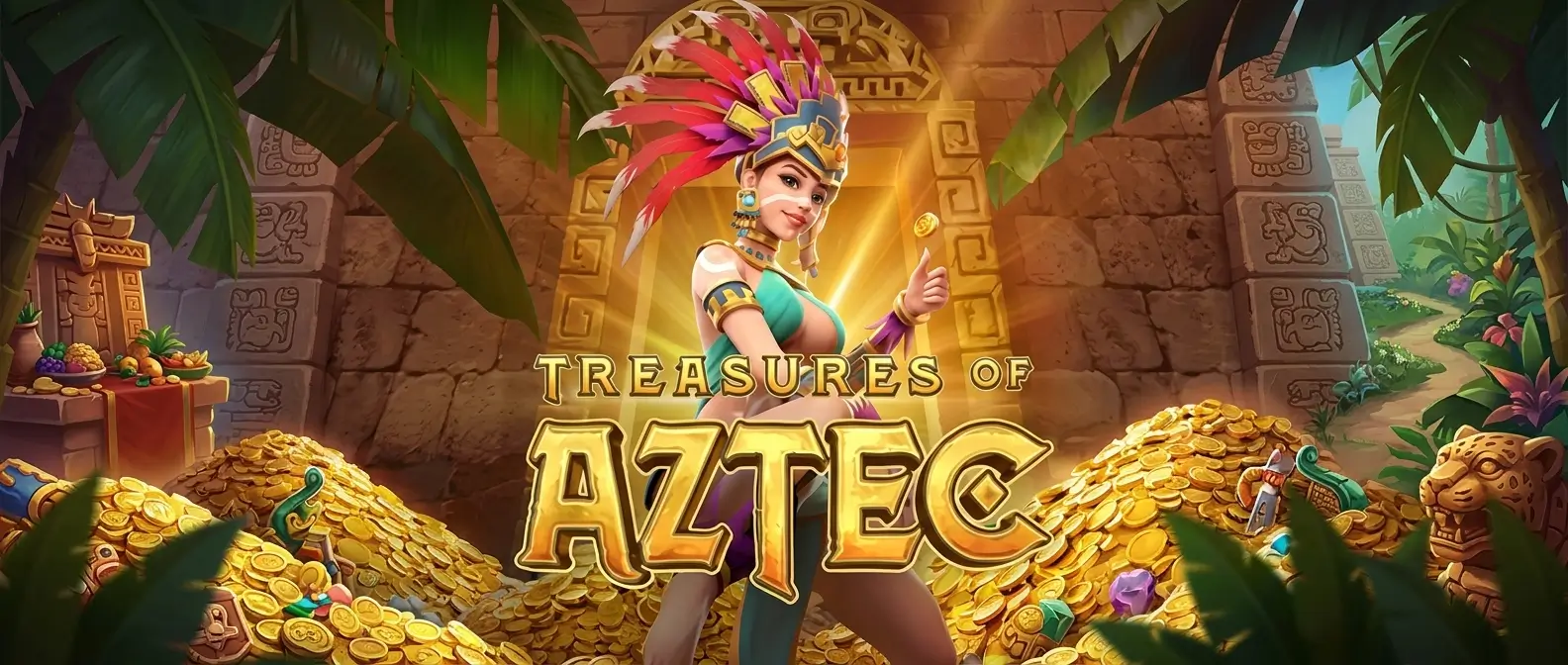
Treasures of Aztec has been in operator lobbies since November 2020, which makes it nearly six years old. PG Soft never followed it up, and it has not faded either: SlotCatalog’s casino scan finds it in 59 markets. That is a long shelf life for a cascade slot, in a market where every studio owns a tumbling-reels Aztec game.
So where does it sit now? It is a medium-volatility slot with a 96.71% RTP, released into a market that mostly sells cascade games as high-volatility gambles with five-figure ceilings. The number that frames this whole review is the max win. PG Soft’s own game sheet advertises 100,000×, and the same sheet records a highest simulated result of 9,071× across one billion spins. Those describe two very different games, and the rest of this review works out which one you are actually playing.
The maths: 96.71% RTP, medium volatility and two max wins
The RTP is the one figure every source agrees on. PG Soft’s game information sheet (last updated 8 July 2025), SlotCatalog, Bigwinboard and every aggregator I checked give 96.71%, and SlotCatalog states that the game has no configurable RTP ranges. No operator-setting caveat is needed here, which is unusual enough to be worth saying.
The split matters more than the total. PG Soft attributes 69.59% of the return to the base game and 27.12% to free spins, so roughly 72% of your expected return arrives without the bonus. That matters because the bonus is rare, and a game that needed it to deliver its RTP would be miserable to play without it.
In money terms: 1,000 spins at £1 is £1,000 staked, and the theoretical return is £967.10. The cost of playing is £32.90. Aztec Gold Megaways at 95.99% costs £40.10 for the same volume, so the RTP edge here is worth £7.20 per £1,000 wagered. Small gap. Real money over a long session.
Hit frequency and volatility
PG Soft publishes a hit rate of 29.07% overall, split into 28.51% for the base game and 0.56% for the free-spins trigger. Roughly one spin in three and a half returns something. That figure counts every winning spin regardless of size, so read it as rhythm rather than profit.
The 0.56% is the number I care about. It works out to one free-spins trigger every 179 spins on average, and over 100 spins your chance of seeing at least one is about 43%. More than half of 100-spin sessions finish without the bonus.
Stake size turns that into a budget. At £0.50 a spin, the average wait for a trigger costs £89.50 in wagering. At £2 it costs £358. Neither figure is a promise, because the trigger is random and a bonus can land on spin 15 or spin 400, but they tell you how much bankroll a bonus-hunting session needs before the average has a chance to show up.
PG Soft rates session volatility as medium, which it labels “engaging”, the middle band on its own three-step scale. Sources disagree slightly. Respinix calls the game high volatility, and SlotCatalog’s FAQ says “highly volatile” while its own spec table says medium. SiGMA World, LiveCasinoComparer and Bigwinboard all say medium.
I side with the provider, with a caveat. Medium describes the rhythm: frequent small wins and no long deserts. It does not describe the payout curve. PG Soft’s figures put a Big Win (20× to 35× your stake) at 1 in 334 spins, a Mega Win (35× to 50×) at 1 in 1,130, and anything from 50× upwards at 1 in 1,272. At £1 a spin, that is £1,272 of wagering per 50× hit. Frequent small wins, rare big ones: a medium-high profile wearing a medium label.
Grid and ways
The layout is six reels of five rows, plus an extra horizontal reel sitting on top of reels 2 to 5. When the four middle reels all show six positions, the grid runs 5-6-6-6-6-5, which multiplies out to 32,400 ways (5 × 6 × 6 × 6 × 6 × 5). The minimum is 2,025. Wins pay left to right from reel 1, need matching symbols on at least three consecutive reels, and the number of matching symbols on each reel is multiplied together.
It is not licensed Megaways, but reviewers keep making the comparison. SlotCatalog calls it a Megaways copycat, and Bigwinboard calls it a streamlined Megaways-style slot. One detail from PG Soft’s rules deserves more attention than it gets: symbols on reels 2 to 5 can be two to four positions tall, yet each counts as a single symbol when the win is calculated. A tall symbol looks like a ways multiplier. It is not.
Stakes run from €0.20 to €20 (PG Soft builds the bet from a size of 0.01, 0.05 or 0.10, a level of 1 to 10, and a base of 20). That is a 100-to-1 range, narrower than most slots at the high end, and Bigwinboard flags the €20 cap as a limit on appeal for bigger players. The top symbol is the gold mask, which pays 80× for six of a kind according to SlotCatalog and Slots Temple. Demoslot lists the same payout as 8×, so treat the paytable inside the game as the final word.
Two max wins, and which one to believe
100,000× is the advertised maximum. 9,071× is the maximum exposure PG Soft recorded when it simulated one billion spins. SlotCatalog and Bigwinboard publish the lower figure. SiGMA World, Respinix, SlotsUp and a long tail of Asian-market sites publish the higher one, and none of them mention the simulation result. The 100,000× is not invented, since PG Soft’s own sheet leads with it. It is simply the less useful of the two numbers.
At the €20 top stake, that is €181,420 against €2,000,000. Same game, a gap of roughly €1.8 million. If a billion simulated spins never produced anything above 9,071×, I read 100,000× as a mathematical ceiling that real players will not touch. I would plan around the lower number and treat the higher one as the marketing figure.
Is 9,071× competitive in 2026? Mid-table, and no better. It beats Temple Tumble from Relax Gaming (7,767×) and trails Aztec Gold Megaways from iSoftBet (19,200×). Bigwinboard’s complaint is that a five-figure ceiling would suit a slot built around escalating multipliers, and I share it. PG Soft’s own chart lists Treasures of Aztec at 100,000× against 25,000× for Mahjong Ways and 8,000× for Journey to the Wealth, but that chart compares advertised ceilings, and only for this game do we have the simulated figure sitting next to it.
Availability data suggests the game has held its place. SlotCatalog’s scan found it at 155 of 407 casinos in Canada, 95 of 300 in Finland, 92 of 264 in New Zealand and 89 of 207 in Austria. That is a lot of lobbies for a game from 2020, and it is the clearest sign that operators have not retired it.
Numbers settled, the more interesting question is how the game gets anywhere near them. That comes down to three mechanics.
Feature breakdown
The game runs on cascades, framed symbols that become wilds, and a free-spins round with a multiplier that does not reset. Each one has a catch.
Cascading reels and the base multiplier
Cascading reels trigger on any winning spin. The winning symbols vanish, new ones drop in, and the process repeats until a drop produces no win. Layered on top is a base multiplier that starts at ×1 on every spin and rises by +1 after each winning cascade. SlotCatalog reports no upper limit on it.
The multiplier is slower than it sounds. Five winning cascades in a single spin get you to ×6, and PG Soft’s rules reset it to ×1 at the start of the next spin, so nothing carries over. You need a long chain before it changes a payout in any way you would notice, and the same five cascades in the free spins would already be at ×12.
The base game carries 69.59% of the RTP, and chained cascades under a rising multiplier are the engine behind that share. It works. It is also the least distinctive part of the game, since cascade slots have used some version of a rising multiplier for years.
Wilds on the Way
This is the original idea in the game. Some symbols on reels 2 to 5 land with a silver frame. When a silver-framed symbol takes part in a win, then after the next cascade it turns into a randomly chosen symbol (never a wild or a scatter) with a gold frame. If that gold symbol takes part in another win, it becomes a wild. Wilds appear on reels 2 to 5 only and substitute for everything except scatters.
PG Soft does not state a cap on how many frames can convert in one spin, and it does not publish what share of the RTP this feature accounts for, so I will not invent one. Reviewers describe it as the thing that keeps cascades alive, and that fits the mechanic: a wild on a middle reel extends a chain that would otherwise stop.
The catch is in the two-step design. A framed symbol needs to be involved in two separate wins to become a wild, and the gold step re-rolls the symbol, so a gold mask that helped you win can come back as a card symbol. You are paying a small tax on the first conversion for a chance at the second. Fun to watch, and less reliable than the animation suggests. Say a silver-framed symbol lands on reel 3 and joins a win. After the cascade it reappears gold-framed, and possibly as a different symbol. Only if that gold symbol wins again does it turn wild, and by then the base multiplier has climbed, which is the real payoff: a wild arriving in the fourth cascade is worth more than one arriving in the first.
Free spins
Four scatters anywhere on the reels trigger the free spins. You get 10 spins, plus 2 more for each extra scatter, so five scatters give 12, which matches what SlotCatalog’s testers received in their 200-spin video. The round can be retriggered, and PG Soft’s sheet states no limit on retriggers.
The multiplier is what makes the round. It starts at ×2, rises by +2 after every winning cascade, and does not reset between spins. SlotCatalog reports no upper limit on it. Ten winning cascades across the round take it to ×22, compared with a base-game multiplier that dies at the end of every spin. This persistence is the reason the round can pay far more than its trigger rate suggests. It also means timing matters: extra spins from a retrigger late in the round run at a multiplier of ×20 or more, while the opening spins run at ×2 to ×6, so a late retrigger is worth far more than an early one.
Now the realistic contribution. Free spins carry 27.12% of the RTP and trigger at 0.56% of spins. Divide one by the other and the average round is worth about 48× your stake. That is my arithmetic from PG Soft’s two published figures, and it is a mean, dragged upwards by rare huge rounds. With a persistent multiplier the payout distribution is skewed, so I would expect a typical round to land well below 48×.
Reviewer experience points the same way. SlotsUp’s tester needed around 120 spins to trigger the bonus and found the round itself paid modestly, with most of the profit coming from base-game cascades. SlotCatalog’s tester reached a ×16 multiplier in a 200-spin session.
The honest limitation is the price of admission. At £1 a spin, the average wait for a trigger is 179 spins, or £179 of wagering, and the average return on that trigger is about £48. Those figures are consistent with the 27.12% share, and they tell you what the bonus really is: a rare event that you fund from the base game, not something you can plan a session around.
With the mechanics laid out, the 2026 question is whether any of this still competes.
The 2026 perspective
No sequel, but two relatives
There is no Power Reels or Megaways version, and I found no direct sequel from PG Soft. The nearest relatives come from other studios.
Playstar’s Treasures of Aztec Z (August 2023) keeps the 96.71% RTP and the frame-evolution idea, then changes almost everything else. It uses six reels of four rows with a top reel, 10,000 ways, high volatility, stakes from €0.50 to €6, a 10,000× ceiling, and, according to Respinix, buy options priced between 30× and 60× the stake. Wins hinge on symbols on reel 1 connecting across the grid. SlotsLaunch quotes its RTP as around 96.5%, so verify the figure in-game. It is not a fixed version of the original. It is a different game with a similar skin, and its stated ceiling lands close to the original’s simulated one.
Pragmatic Play’s Fortune of Aztec, built by Fat Panda, is closer to a straight clone. iGamingToday reports the same 5-6-6-6-6-5 layout, the same 32,400 ways and the same 100,000× headline, with 96.50% RTP, high volatility and stakes up to $240.
The competitors
| Slot | Provider | RTP | Max win | Volatility | Top stake |
|---|---|---|---|---|---|
| Treasures of Aztec | PG Soft | 96.71% | 9,071× simulated, 100,000× advertised | Medium | €20 |
| Fortune of Aztec | Pragmatic Play | 96.50% | 100,000× | High | $240 |
| Aztec Gold Megaways | iSoftBet | 95.99% | 19,200× | Medium-high | £20 |
| Temple Tumble | Relax Gaming | 96.25% | 7,767× | High | £100 |
Treasures of Aztec has the best RTP of the four, and that is a real advantage: £32.90 per £1,000 staked, against £35.00 for Fortune of Aztec, £37.50 for Temple Tumble and £40.10 for Aztec Gold Megaways. It loses on ceiling to Aztec Gold Megaways, ties it on top stake, and trails the other two on stake range. Fortune of Aztec advertises the same headline at twelve times the top stake, which is the more coherent proposition for a high roller.
Two of the others carry features that Treasures of Aztec lacks or may lack. Aztec Gold Megaways has three fixed jackpots, with the Major at 1,000× according to SlotCatalog, and two aggregator sites list a buy feature for Temple Tumble. RTP is worth a second check on Temple Tumble too: a Relax Gaming developer page shows the studio ships lower-RTP variants, including a 90% configuration for Germany, so 96.25% is the top setting rather than a guarantee.
Buy bonus, jackpots and mobile
Buy-bonus availability is unclear. PG Soft’s game information sheet describes a Feature Buy menu for the free spins and gives no price. Reviews that describe the game as it appears in casino lobbies say there is no bonus buy. I cannot settle that from outside, so look for a Feature Buy button on the game screen before planning around it. If it is missing, you are waiting for the 1-in-179 trigger like everyone else, and in 2026 that wait is what separates this game from the buy-enabled competitors.
There is no progressive jackpot, and no fixed jackpot either. PG Soft’s sheet lists none and SlotCatalog’s feature tags show none.
This is a phone-first game. PG Soft’s sheet gives 1080×2340 as the optimal display, with a required 19.5:9 aspect ratio, and SlotCatalog warns that desktop play is not optimised. On a laptop it looks like a phone screen dropped into a browser window.
Who is this for?
Not high rollers. The €20 cap limits the single-spin ceiling to €181,420 on the simulated figure, and two of the three competitors above let you stake more.
Not dead weight either. A 96.71% RTP beats every competitor in the table, the base game carries 72% of the return, and a free-spins multiplier that survives dead spins is a real mechanical advantage over a bonus that resets every time. This is a recreational game for players staking £0.20 to £2 who want steady cascades and a real chance at a bonus that builds, without paying for volatility they do not need.
Verdict
Play Treasures of Aztec if you stake between £0.20 and £2 a spin, want a base game that pays out regularly, and can live with a bonus that arrives once every 179 spins on average. The 96.71% RTP is the best in its class here, the ×2 free-spins multiplier climbing by +2 without a reset is the strongest mechanic in the game, and the base game does most of the work of returning your money. There is no sequel to wait for, and Playstar’s Treasures of Aztec Z is a different design rather than an upgrade.
Skip it if you are chasing a five-figure win. The one number that limits this game is 9,071×, the simulated maximum, and the 100,000× on the promotional pages is a theoretical ceiling that a billion simulated spins did not approach. High rollers get a €20 stake cap and a ceiling below Aztec Gold Megaways’ 19,200×. Anyone who needs a jackpot or a guaranteed bonus route should look elsewhere, since there is no jackpot and the buy feature depends on the version you find.
Two things would change my mind: a published simulated maximum above 20,000×, or a confirmed buy feature at a fair price. Neither exists in the sources I found. Until then, pick your stake so that 179 spins fit comfortably inside your session budget: at £0.50 that is about £90 of wagering per average bonus. Treat 9,071× as the real top prize, and 179 spins as the price of the bonus.