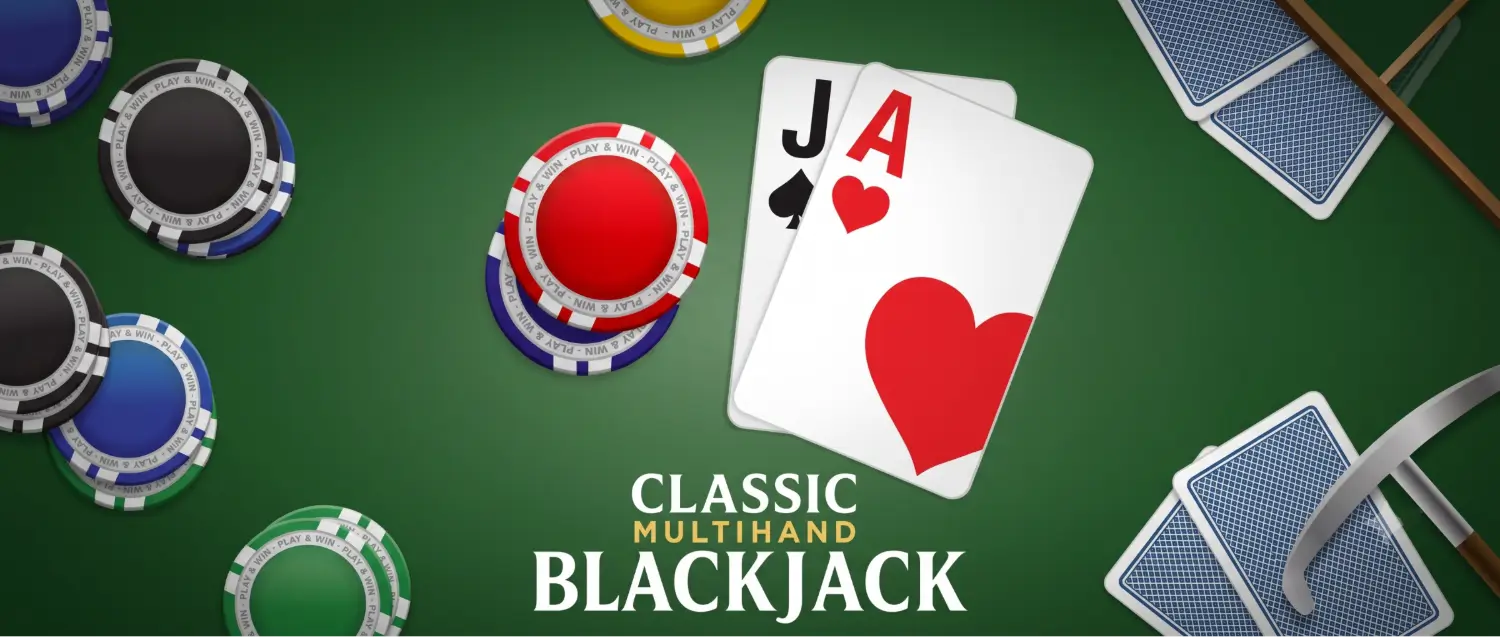
Classic Multihand Blackjack has been sitting in BGaming’s table games lobby since somewhere around 2024–2025 — aggregators disagree on the exact launch date, which tells you more about how little marketing push this title got than anything about the game itself. It’s not trying to reinvent blackjack. Three hands, a Hints button, a green felt table, and a 99.4% theoretical RTP that BGaming quotes on its own site (third-party trackers list it a fraction lower, at 99.38%). That gap is small enough to be rounding, but it’s the first thing worth explaining, because with blackjack — unlike a slot — the RTP figure is not really a property of the game. It’s a property of how well you play it.
That timing gap matters more than it looks. BGaming’s own site frames the title as a refresh — “a new viewing angle compared to BGaming’s previous blackjack games” — which places it in the middle of a small internal family rather than as a standalone launch. Whether it landed in early 2024 or late 2025, it’s arriving into a lobby already crowded with RNG blackjack from Pragmatic Play, Evolution, and Play’n GO, none of which needed a refresh to stay relevant. The question this review actually has to answer isn’t “is this a good blackjack game” — basic blackjack with standard rules is always a fair game by definition — but whether BGaming’s specific implementation, tools, and RTP hold up against a genre where the underlying rules rarely change and the differences that matter are all in the margins.
Why this isn’t a slot review, and why that matters
The house edge on a blackjack table doesn’t move because of a math model baked into the reels. It moves because of your decisions. Hit when you should stand, skip a double you should take, and the theoretical 99.4% becomes irrelevant to your actual session. That single fact reframes everything else in this review: the “math model” section here isn’t about RTP tiers or volatility bands in the slot sense. It’s about how tight the ruleset is, and whether the tools BGaming built around it (Hints, in particular) actually close the gap between theoretical and effective RTP for an average player.
RTP, house edge, and what “low volatility” actually means here
99.4% is the number BGaming publishes for Classic Multihand Blackjack. SlotCatalog and several aggregators list 99.38%, and one operator promo listed the game at 99.4% with a “max multiplier win: x3.00” tag — a leftover from templated slot-tracking software that doesn’t map cleanly onto a table game. Both RTP figures point to the same practical reality: a 0.6% house edge, achievable only with perfect basic strategy. Deviate — take insurance out of habit, stand on a stiff 16 against a dealer 10 instead of hitting, skip a double on 11 — and your effective RTP drops below both published numbers immediately.
Classic Multihand Blackjack’s rules follow standard blackjack: the dealer stands on 17 (soft and hard), blackjack pays 3:2, insurance is offered at 50% of your stake when the dealer’s up-card is an Ace, and you can split any pair of equal rank into two hands. Doubling is available on the initial two cards. None of this is unusual — it’s the same ruleset that defines a fair table game rather than a house-favoring one. What’s low here isn’t the house edge in the sense a slot player would recognize as “low volatility” (long dry spells, big rare wins). It’s low variance in a different sense: outcomes cluster around break-even because the game mathematically resists big swings. You don’t get a bonus round that pays 500x. You get a 1:1 win, a 3:2 blackjack, or a loss, repeated at speed.
Hit frequency in a hand-based game isn’t really the right metric either, but the closest equivalent — how often you see a playable decision versus an automatic resolution — is high. Every hand gets at least one decision point (hit, stand, split, or double), and with three hands running simultaneously, a single round can generate six to nine individual choices. That’s the actual engagement mechanic, not a bonus feature waiting to trigger.
The grid here is a single table, three betting spots. There’s no reel structure, no payline logic, no Pay Anywhere mechanic to explain — the entire game is dealt from what’s presumably a standard multi-deck shoe. BGaming doesn’t publish the exact deck count for this specific title on its official product page, which is a gap worth flagging rather than guessing around: the company’s other Multihand Blackjack Pro release explicitly runs 6 decks of 52 cards, and it’s reasonable to assume Classic Multihand Blackjack uses a comparable shoe, but I’m not going to state that as confirmed fact for this title specifically.
There’s no ceiling figure to place in competitive context the way a slot’s max win multiplier works. The closest comparable metric across blackjack variants is the blackjack payout ratio itself — 3:2 here, matching the market standard. Some rival releases (Pragmatic Play’s American Blackjack) squeeze out a marginally better RTP by trimming the deck count, which is the actual lever in this genre, not a bonus feature ceiling.
What does 0.6% actually cost you over a session? Take a player betting $10 a hand across all three spots — $30 per round — for 200 rounds, a reasonably fast hour at this speed of dealing. That’s $6,000 in total action. At a perfect 0.6% house edge, the expected loss over that session is $36. Bump your effective house edge to 1.5% through a handful of insurance bets and a couple of missed doubles — a realistic outcome for someone playing on instinct rather than strategy — and expected loss climbs to $90. The gap between 99.4% and “roughly 98.5% in practice” isn’t dramatic on a single hand, but across a full session it’s the difference between a controlled, predictable grind and a noticeably worse one. This is the actual argument for using Hints rather than skipping it out of overconfidence.
It’s also worth being specific about where players tend to lose the most ground against basic strategy. The two most common deviations, by a wide margin, are standing on stiff hands (12 through 16) against a dealer’s strong up-card out of fear of busting, and taking insurance whenever it’s offered because 2:1 sounds like good value in isolation. Both instincts are wrong often enough to matter. Standing on a 16 against a dealer’s 10 loses more on average than hitting does, even though hitting feels riskier in the moment. Insurance, taken across every eligible hand rather than selectively, is a guaranteed long-run loss dressed up as a hedge.
Feature breakdown: what actually changes your session
Hints
Trigger: Available on every two-card hand, toggled on with a lightbulb icon at any point during play.
Mechanic: The system suggests Stand, Hit, or Split based on basic strategy tables, calculated from your hand value and the dealer’s up-card. It updates as the hand develops.
Limitation: Hints covers the standard decision tree but doesn’t account for card-counting-adjusted strategy or bankroll-based deviations — it’s basic strategy, not optimal strategy for every bankroll situation. It also won’t stop you from ignoring it, which is the point: you can always act against the suggestion.
Realistic contribution: This is the single feature that moves the needle on effective RTP for a casual player. A new player using Hints consistently will play far closer to the theoretical 99.4% than one guessing at every 16-versus-10 decision. It’s a genuine tool, not decoration.
Insurance
Trigger: Offered whenever the dealer’s face-up card is an Ace.
Mechanic: You can insure some or all of your active hands for 50% of your original stake. If the dealer has blackjack, insurance pays 2:1, offsetting the loss on your main bet. If not, the insurance stake is lost.
Limitation: Basic strategy says skip insurance almost every time — it’s a bet with a built-in house edge north of 7% on its own, regardless of what the rest of the table is doing. BGaming’s interface offers it because the rules require it be available, not because it’s advisable.
Realistic contribution: Correctly skipping insurance (tap Skip) every single time is one of the easiest, highest-value strategy corrections a player can make on this game. It costs nothing to learn and directly protects the 99.4% ceiling.
Double
Trigger: Available during the playing stage on your initial two cards.
Mechanic: Doubles your original bet and deals exactly one additional card, ending your turn on that hand regardless of the result.
Limitation: No option to double after a split is confirmed in BGaming’s published rules for this title, and no “double for less” flexibility — it’s a full second stake or nothing.
Realistic contribution: Doubling on 9, 10, or 11 against a weak dealer up-card is one of the largest single-decision swings in basic strategy. Skipping profitable doubles out of caution is a slower way to bleed the same edge insurance mistakes cost you faster.
Split
Trigger: Available when your first two cards share the same rank.
Mechanic: Separates the pair into two independent hands, each carrying a bet equal to your original stake. Each hand is then played out separately, including further hits, stands, or doubles.
Limitation: The game doesn’t specify support for re-splitting a third time if you draw another matching pair — treat each split as producing exactly two hands unless the interface tells you otherwise mid-round.
Realistic contribution: Splitting Aces and 8s correctly (both are near-automatic in basic strategy) recovers value that a hesitant player leaves on the table. Splitting 10-value pairs, conversely, is a common beginner mistake the Hints tool actively corrects.
Three simultaneous hands
Trigger: Available every round — you’re not required to fill all three betting spots.
Mechanic: Each hand is dealt, played, and resolved independently against the same dealer hand, meaning you can win on one spot and lose on another in the same round.
Limitation: Running three hands at once multiplies your total exposure per round three-fold. It speeds up variance in both directions without changing the underlying 0.6% edge on any individual hand.
Realistic contribution: For a player who wants faster sessions without touching a slot, three-hand play is the actual appeal — more decisions per minute, same math per hand. It’s not a bankroll-friendly feature for anyone playing all three spots at max stake; it’s a pacing feature.
Turbo / Lightning mode
Trigger: Toggled manually via an on-screen button.
Mechanic: Speeds up dealing and animation between rounds and decisions.
Limitation: Doesn’t change any odds, obviously, but it does compress the time between betting decisions, which matters more for bankroll discipline in a low-volatility, high-frequency game like this than it would in a slot.
Realistic contribution: Faster rounds mean more hands per hour, which mathematically means the same 0.6% edge (or whatever your effective edge actually is) grinds through your bankroll faster in absolute time, even though nothing about the per-hand math changes. Turbo mode is a convenience feature that quietly raises the stakes of playing with a bad effective RTP.
Rebet
Trigger: Available at the start of any new round once a previous bet has been placed.
Mechanic: Repeats your exact stake and hand configuration from the prior round with a single tap, skipping manual chip selection.
Limitation: It repeats stakes, not strategy — Rebet has no bearing on the actual hand outcomes and won’t protect you from repeating a strategic mistake alongside a repeated bet.
Realistic contribution: Minor, but it does reduce dead time between rounds, which — paired with Turbo mode — is the main lever BGaming has pulled to make a fundamentally simple ruleset feel like a faster-paced product than the strategy itself would suggest.
Rotation-mode and device support
Trigger: Passive — available automatically across devices.
Mechanic: The table layout adapts to any screen rotation on mobile as well as desktop, and BGaming markets a repositioned camera angle compared to its earlier blackjack titles for a clearer view of all three hands at once.
Limitation: This is presentation, not mechanics — it has zero effect on RTP, house edge, or hand outcomes, and shouldn’t be weighed against titles that offer side bets or additional hands.
Realistic contribution: For a genre that lives or dies on how easily a player can track three simultaneous hands and a dealer hand on a phone screen, a clearer layout is a real usability improvement even if it changes nothing about the underlying math.
The 2026 perspective: where this sits in BGaming’s own lineup, and against the field
BGaming doesn’t have a literal “sequel” to Classic Multihand Blackjack, but it does have a family of closely related titles that function the same way a slot’s Power Reels or Megaways variant would — same core game, different math and features layered on top.
Multihand Blackjack (BGaming’s earlier, plainer release, out since 2018) runs at 99.23% RTP with a bonus bet tied to drawing Jacks, capable of paying up to x101 on the side wager. It’s the predecessor in spirit if not in name — three hands, classic rules, no Hints system as prominently marketed.
Multihand Blackjack Pro sits at the same 99.23% RTP, uses a confirmed 6-deck, 52-card shoe, and adds the same Jacks-based bonus bet with a headline x100 multiplier for landing two Jacks of Spades. It leans into Vegas Strip-era rules lineage rather than the stripped-down “classic” branding.
Multihand Blackjack Pro 2 is the closest thing to an actual evolution of the format: 99.4% RTP, five main hands instead of three, and two proper side bets — 21+3 and Perfect Pair — available on each hand. This is the version built for players who’ve outgrown basic strategy and want the side-bet variance that Classic Multihand Blackjack deliberately avoids.
Compared against that lineup, Classic Multihand Blackjack is the restrained middle option: better RTP than the original Multihand Blackjack and Pro version, but without the side-bet ceiling or the five-hand capacity of Pro 2. It’s built for players who want clean basic-strategy blackjack with a training-wheel Hints system, not players chasing a 21+3 side-bet spike.
Against the wider market, the picture is less flattering. Pragmatic Play’s Multihand Blackjack runs an 8-deck shoe at 99.51% RTP, and its American Blackjack variant — a 4-deck game — pushes to 99.60% RTP with volatility rated 1/5. Both beat Classic Multihand Blackjack’s 99.4% on the one number most experienced players actually compare across blackjack titles. The gap is small in absolute terms (roughly 0.1–0.2 percentage points), but for a player rotating bankroll through thousands of hands, that difference compounds. Fewer decks generally means a marginally lower house edge in standard blackjack, and Pragmatic Play’s American variant demonstrates that directly.
Beyond Pragmatic Play, the wider RNG blackjack field in 2026 includes Evolution’s RNG-based blackjack tables and various six- and eight-deck “Classic” or “Multi Hand” releases from smaller studios like Switch Studios, whose Multi Hand Classic 6 Deck Blackjack runs the same basic structure — double down, insurance, split — without a comparably marketed strategy-assist tool. That’s the actual gap Classic Multihand Blackjack is trying to close: not RTP leadership, which it doesn’t have, but accessibility for a player who wants to learn correct play while betting real money, without switching tabs to a strategy chart. Whether that’s worth 0.1–0.2 percentage points of RTP depends entirely on how much you value the Hints feature versus squeezing the last fraction of edge out of a four-deck shoe.
There’s no buy-bonus mechanic here, and there shouldn’t be — that’s a slot convention with no place in a fair table game, and its absence isn’t a weakness. There’s no progressive jackpot either; blackjack variants rarely carry one without a dedicated side bet built for it, and Classic Multihand Blackjack doesn’t offer that side bet at all. If you want jackpot-chasing blackjack, this isn’t the title, and BGaming doesn’t pretend otherwise. What it does offer that a jackpot-chasing player wouldn’t get from a side-bet-heavy alternative is a lower, steadier variance profile — the trade-off is explicit, not hidden in fine print.
One more comparison worth making explicit: BGaming’s positioning of Classic Multihand Blackjack alongside its stablemates suggests the company is treating “Classic” as the accessible entry point in a tiered lineup, similar to how a slot studio might position a base game against a Megaways upgrade. Multihand Blackjack (2018) is the legacy version nobody’s actively promoting anymore. Multihand Blackjack Pro brings Vegas Strip lineage and a bonus bet for players who want a side wager without going all the way to a full side-bet table. Pro 2 is the side-bet-forward flagship. Classic Multihand Blackjack sits deliberately apart from that ladder — it’s not trying to out-earn Pro 2, it’s trying to be the cleanest possible on-ramp into BGaming’s blackjack catalogue, with Hints as the actual product differentiator rather than RTP or side-bet variety.
So: is this a high roller’s game, a recreational game, or dead weight in a 2026 lobby? It’s recreational-to-intermediate. The stake range and the absence of side bets keep the ceiling modest by design, and the Hints tool signals this is built for players still cementing basic strategy rather than veterans hunting the best available edge. It’s not dead weight — the RTP is genuinely competitive against most of the market outside Pragmatic Play’s top two releases — but it’s also not the sharpest number on the shelf if edge is your only criterion.
Verdict
Classic Multihand Blackjack: play it if you’re building basic strategy discipline and want a Hints-assisted table that punishes mistakes gently while you learn. The 99.4% RTP (0.6% house edge with perfect play) is solid, the three-hand format keeps pace brisk without overwhelming a beginner, and the absence of side bets means there’s nothing tempting you into higher-variance bets with worse math. Skip it if you already play flawless basic strategy and want every fraction of a percentage point — Pragmatic Play’s American Blackjack, at 99.60% with a four-deck shoe, is the sharper choice for that player.
Multihand Blackjack Pro 2 (the evolved BGaming variant): play it if you’ve outgrown the training-wheel framing and want 21+3 and Perfect Pair side bets alongside a five-hand table — same core 99.4% RTP on the main game, with genuine variance available on top for players who want it. Skip it if side bets aren’t your interest; you’ll be paying attention to two extra wager types every round for no benefit to your base-game edge.
The one number that limits Classic Multihand Blackjack most is the RTP gap against Pragmatic Play’s American Blackjack — 99.4% versus 99.60% is a real, if modest, edge difference for anyone treating this as a serious bankroll grind rather than a casual table. For a strategy-learner using Hints consistently, that gap barely matters. For a high-stakes regular chasing every fraction of a point, it’s the reason to look elsewhere first.
FAQ
Is Classic Multihand Blackjack rigged? No. BGaming states the game runs on certified RNG and is provably fair, which means the shuffle and card draws are auditable and independent of your betting pattern.
What’s the real house edge if I don’t play perfectly? The published 0.6% edge (99.4% RTP) only holds with correct basic strategy on every hand. Skipping insurance is free value; ignoring Hints and hitting or standing incorrectly can push your effective house edge well above 1%.
Can I play all three hands with different bet sizes? Yes — each of the three betting spots is independent, so you can stake them differently or leave spots empty if you’d rather play a single hand per round.
Does the game have side bets like 21+3 or Perfect Pair? No. Classic Multihand Blackjack sticks to standard insurance only. If you want side bets on the same core game, BGaming’s Multihand Blackjack Pro 2 adds both 21+3 and Perfect Pair per hand.
Is this better than Pragmatic Play’s blackjack titles? Not on raw RTP. Pragmatic Play’s Multihand Blackjack (99.51%) and American Blackjack (99.60%) both edge out Classic Multihand Blackjack’s 99.4%, largely due to fewer decks in the shoe. BGaming’s version compensates with the built-in Hints system, which matters more for players still learning correct strategy than for those who already play it perfectly.
Should I always follow the Hints suggestion? For a player without memorized basic strategy, yes — Hints is built on standard strategy tables and will keep your effective RTP closer to the published 99.4% than guessing will. It’s not adjusted for card counting or bankroll-specific deviations, so an advanced player may occasionally choose differently, but for the vast majority of sessions, following it is the higher-value default.
Why does the game show a “max multiplier win” figure like a slot? Some third-party trackers list Classic Multihand Blackjack with slot-style metadata, including a max multiplier tag, because their databases are built primarily for slot games. That figure doesn’t reflect an actual bonus mechanic in this title — the real payout structure is the standard 3:2 blackjack, 1:1 win, 2:1 insurance ratios described above. Treat any “max win multiplier” listed for this game as a database artefact, not a feature.