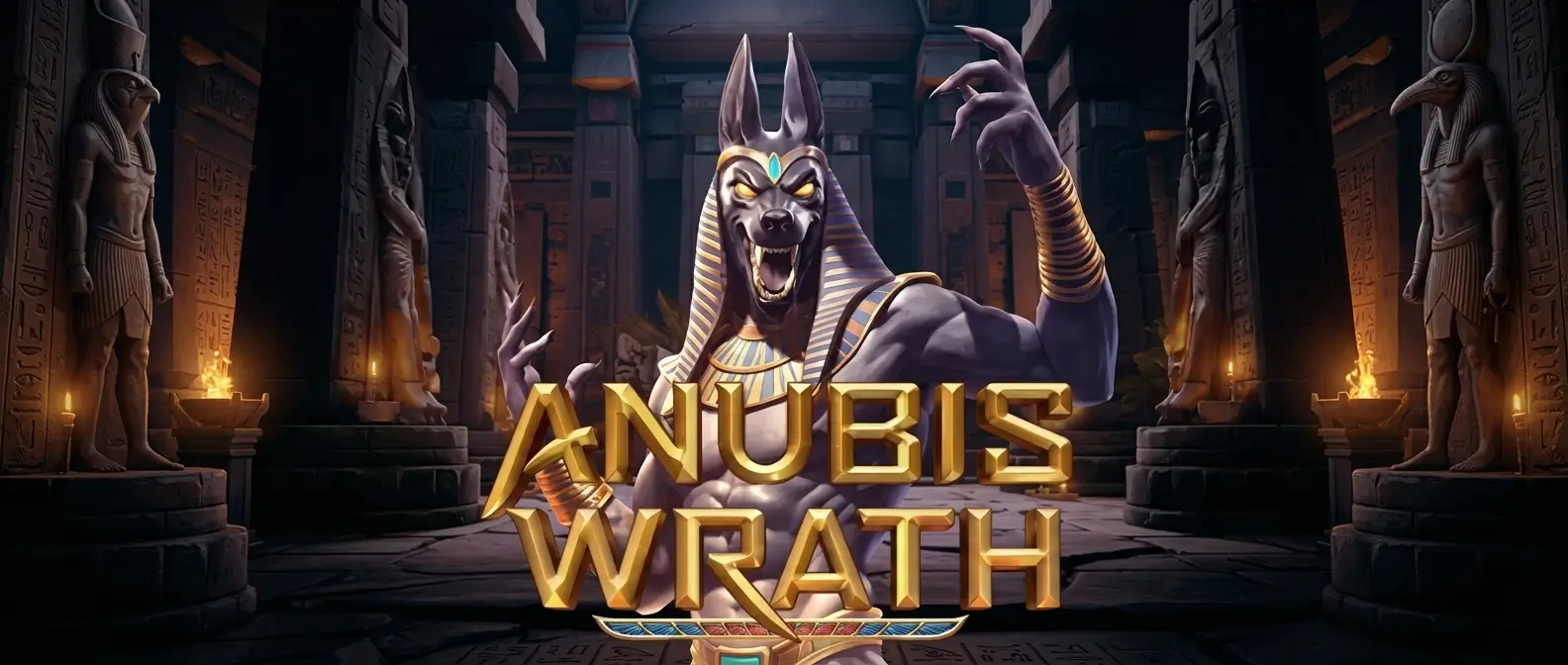
Anubis Wrath launched on 20 May 2024, so it has now been sitting in lobbies for more than two years. That is a long stretch in a high-volatility market where 15,000× headline wins are common and an Egyptian theme is close to the default for a new release. Is it still relevant, or coasting on one multiplier gimmick and a mobile-first build?
The numbers frame the question. The slot posts a 96.75% RTP, high volatility and a 10,000× max win on a 5×4 grid with 1,024 ways. That RTP beats the top setting of all four rivals I compare it with below. The ceiling is lower than three of them. A 3× to 500× Multiplier Reel sits above the grid and does nearly all the work, so the real test is whether one row of multipliers can carry a paytable whose best symbol pays 50× for five of a kind.
The maths: strong RTP, a moderate ceiling and a bonus that arrives late
SlotCatalog puts the RTP at 96.75%, and nine other pages I checked agree. One page, VegasSlots, lists 96.45% and also a 15,000× max win, a figure no other source supports. I’m treating that page as the outlier, but I could not inspect a certificate, so the RTP shown in the game’s info panel at your casino is the number that counts.
The gap matters less than it looks. At 96.75% the house edge is 3.25%; at 96.45% it is 3.55%. Over a £500 session (500 spins at £1) that is an expected loss of £16.25 against £17.75. Across 10,000 spins at £1 the difference is £30. Real, but small next to what volatility does to the same session.
Volatility is high, and the label is honest. SlotCatalog puts hit frequency at 29.97%, so roughly one spin in three returns something, and SlotsUp’s reviewer logged about 32% across a 100-spin test. A hit frequency counts any return above zero, including payouts smaller than your stake. The paytable is thin (five Anubis symbols pay 50×, per SlotCatalog), so those frequent hits mostly keep the balance alive. The real money comes from multipliers.
The rest of the paytable confirms it. Per SlotCatalog, the Balance Scales and Crook & Flail symbols pay 40× for five, the Ankh and Feather pay 20×, the Ace and King 12×, and the Queen, Jack, Ten and Nine between 3× and 5×. A five-symbol win on a ways slot is rare, so most base wins land far below those figures. Without a live multiplier, this is a quiet game. With one, the same win can be worth many times as much.
Then the bonus. SlotCatalog gives free-spins frequency as 0.40%, about one trigger in 250 spins. Averages flatter that number. The chance of 250 spins without a trigger is roughly 37%, and there is about a 6% chance of going 700 spins dry. At a £1 stake, the average wait costs £250 in turnover. PG Soft’s pre-release figures, quoted by SlotCatalog, put a Big Win at 1 in 246 spins. The same page lists Mega Win and Super Mega Win at 1 in 711 and 1 in 662, which are the wrong way round for the tiers, so I won’t lean on them.
Put those numbers into a session plan. At €0.20 a spin, 250 spins cost €50 in turnover; at €1 they cost €250; at €5 they cost €1,250. The average bonus wait scales with your stake, but your bankroll does not scale with your patience. If your session budget is under 250 spins, you are playing a lottery on the bonus round and a slow grind on everything else. I would not call that a flaw, but you need to know which one you’re buying.
The grid is 5×4 with 1,024 ways. Three or more matching symbols on adjacent reels pay, counted from the left, with no paylines involved. It is one-directional, so a group that starts on reel 2 pays nothing.
The ceiling is 10,000×, which SlotCatalog converts to €1,000,000 at the €100 maximum bet. That range, €0.20 to €100, is the default listed by SlotCatalog, Stake and Demoslot; Chipmonkz and 4luck list £0.60 to £180 instead, and SlotCatalog notes that casinos can change it. Is 10,000× competitive in 2026? Mid-table. It clears Book of Dead’s 5,000× but sits below the 15,000× of Le Pharaoh, Ankh of Anubis and Gates of Olympus 1000, and a long way below PG Soft’s own Egypt’s Book of Mystery, which SlotCatalog lists at 100,000×. Adequate, not a headline.
The cap scales with your stake, which is easy to forget. At €0.20 a spin the ceiling is €2,000, at €1 it is €10,000, and at €5 it is €50,000. A player at the bottom of the range is chasing a very different prize from one at the top, while facing the same 1-in-250 bonus odds.
The sources that say where the cap lives all point to the free spins, and the free spins run on the Multiplier Reel. So the feature breakdown starts there.
Features: where the 500× reel earns its keep
Multiplier Reel
The Multiplier Reel is five stone blocks above the grid, one per reel, each showing a random value from 3× to 500× at the start of every spin, and a block goes live when an Anubis symbol lands on that reel. At the end of the spin, after any cascades, the sum of all live multipliers is applied to the total win. Sum, not product: two live blocks of 50× and 100× make 150×, not 5,000×. The theoretical stack is five 500× blocks, or 2,500×, per SlotCatalog.
PG Soft has not published how often each value appears, so the 500× is a ceiling and not an expectation. What is certain is the arithmetic. A multiplier multiplies a win, and a 500× block on a spin that pays nothing pays nothing. The catch runs the other way at the top: a full 2,500× stack on a modest 4× base win already reaches the 10,000× cap, so in the best case the cap trims the multiplier before the multiplier can finish its job.
Where that leaves a normal base-game spin is worth spelling out. Suppose two Anubis symbols land on reels with 8× and 25× blocks, and the spin pays 6× before multipliers. The sum is 33×, so the spin pays 198×. Take one of those blocks away and the same spin pays 48× or 150×. Position and luck matter far more than symbol quality, and that is what makes the game volatile in practice, not just on the label.
Collapsing reels
Any winning combination triggers the collapsing reels: winning symbols vanish, new ones drop from above, and the chain continues until nothing pays. SlotCatalog describes the chain as unlimited; no cap is stated anywhere I looked. The link to the multiplier is the point. An Anubis symbol can land on the first drop or on a later one, and either way it switches its reel’s block on for that spin.
That makes cascades the base game’s route to stacked multipliers, because every extra drop is another chance for Anubis to appear. It also means a long chain of small wins with no Anubis in view pays at face value, which is small. That is why reviewers describe the base game as cold for long stretches between multiplier hits.
Wild
The Wild, a pink gemstone, lands on reels 2 to 5 only and substitutes for every symbol except the scatter, per PG Soft’s launch release. It carries no multiplier of its own. Its job is completing and lengthening ways.
The limitation is structural. Because wins are counted from reel 1 and the Wild never appears there, it cannot start a combination. It helps a win that already exists.
Free Spins and the Total Multiplier Meter
Three golden scarab scatters in view trigger the Free Spins, and SlotCatalog counts scatters that remain on the grid after the last cascade. You get 15 spins for three scatters and 3 more for each extra scatter, and the round can be retriggered on the same terms. I found no retrigger cap stated and won’t invent one. By that rule four scatters give 18 spins and five give 21, so even a lucky trigger adds only a few extra chances for the meter to grow. A retrigger inside the round is worth more, because it extends a meter that is already loaded.
The mechanic that matters is the Total Multiplier Meter under the grid, shown as the Golden Eye of Horus. Every multiplier that activates during the round is added to the meter and stays there until the round ends. It does not reset between spins, including losing ones, so a single 300× block that lands early is still working on spin 15. That is where 10,000× becomes reachable.
Here is the arithmetic, using invented values to show the mechanism. Say Anubis lands on two reels on the first free spin with blocks of 50× and 20×: the meter reads 70×. On spin 4 another Anubis adds a 100× block: the meter reads 170×. A 5× base win from then on pays 850× your stake, and a 60× base win from a long cascade would hit the 10,000× cap outright. Those numbers are illustrations, not reported results, but they show why the meter, not the base game, is the reason to play.
The honest contribution is unknown. PG Soft has not published an average bonus return, and this feature arrives once in roughly 250 spins. The catch is variance inside the round: 15 spins is short, and the meter only grows if Anubis symbols keep landing. One reviewer at Demoslot called the game good but said you have to put in effort to reach the free spins, and SlotsUp lists difficult triggering in short sessions as a con. Both fit the 0.40% frequency. My reading: the base game is a waiting room, and the bonus is where the maths decides whether the wait was worth it.
Buy Feature
The Buy Feature starts the free spins for a fixed price. SlotCatalog and AllSlots put it at 37.50× your stake; Stake’s page says 75×. That is a factor of two between sources, and I could not settle it from PG Soft’s side, so the price shown in your casino’s buy menu is the one that counts.
Availability is the bigger issue. Casinos can disable it, and SlotCatalog notes that regulators including the UK Gambling Commission prohibit it, so UK-licensed players will not see it. At £1 a spin, a 37.50× buy costs £37.50 and 75× costs £75. PG Soft’s RTP for bought spins is not in any source I found, which means you are paying without knowing the return.
Anubis Wrath in 2026: how it stacks up against its rivals
I searched for a sequel, a Power Reels version and a Megaways variant and found none. There is no evolved version to compare, which is itself a signal. Pragmatic Play upgraded Gates of Olympus to a 1,000× multiplier and tripled the cap from 5,000× to 15,000×. Anubis Wrath has not had that treatment.
That comparison is closer than it looks. The original Gates of Olympus topped out at 500× multipliers and a 5,000× cap; Anubis Wrath keeps the 500× peak and doubles the cap to 10,000×. It is the original formula, tuned higher, without the follow-up.
| Slot | Provider | RTP | Volatility | Max win |
|---|---|---|---|---|
| Anubis Wrath | PG Soft | 96.75% | High | 10,000× |
| Gates of Olympus 1000 | Pragmatic Play | 96.50% | High | 15,000× |
| Ankh of Anubis | Play’n GO | up to 96.20% | High | 15,000× |
| Book of Dead | Play’n GO | 96.21% | High | 5,000× |
| Le Pharaoh | Hacksaw Gaming | 96.18% | Medium | 15,000× |
Figures come from SlotCatalog, AboutSlots, OLBG and the operators’ own game pages. Read the RTP column as top settings. Le Pharaoh also ships 94.33%, 92.26% and 88.24% builds, Book of Dead has a 94.25% build and lower, and Gates of Olympus 1000 offers 95.51% and 94.50%. I found no documented lower setting for Anubis Wrath, which is not proof that none exists.
Each rival spends its ceiling differently. Le Pharaoh trades tumbles for sticky re-drops on 19 paylines, lets you choose between Luck of the Pharaoh and Lost Treasures when a bonus triggers, and rates medium volatility; one tester’s 1,000-spin run saw bonuses roughly 160 spins apart. Ankh of Anubis, from Play’n GO, uses 576 ways and a Scatter Collect feature that triggers random Anubis wilds and free spins. Gates of Olympus 1000 is the closest mechanical cousin: scatter pays on a 6×5 grid, tumbles, and multiplier orbs from 2× to 1,000× that feed a total multiplier during free spins. Book of Dead is the old guard, built around one expanding symbol and little else.
Set against those, Anubis Wrath’s identity is clear. It is the cascade-and-accumulate model on a smaller grid: three scatters across 20 positions trigger the bonus, where Gates of Olympus 1000 needs four across 30.
On RTP, Anubis Wrath wins the table outright. On ceiling it loses to three of the four, and the one it beats, Book of Dead, is a 2016 release with 10 paylines and an expanding symbol. Beating that on max win is a low bar.
Feature frequency is the underrated advantage. Sweepsplays puts the Gates of Olympus 1000 free spins at about 1 in 448 spins. Anubis Wrath’s 1 in 250 means its bonus turns up roughly 1.8 times as often, and it does so on a cheaper price of admission: Gates of Olympus 1000’s buy costs 100× against Anubis Wrath’s 37.50×, at least by SlotCatalog’s figure.
The buy feature is present in the game, absent for UK players and at the mercy of each casino’s settings, priced at 37.50× or 75× depending on the source. That matters in 2026 because a player who counts on the buy can land on a casino where it is switched off, and then the 1-in-250 wait is the only way in. There is no progressive jackpot. SlotCatalog says the only jackpot is the win cap, and another reviewer confirms there is no progressive pool. Anyone who wants a life-changing ceiling beyond 10,000× will not find one here.
Is it a high roller’s game, a recreational game or dead weight? Not the first. A €100 stake ceiling and a 10,000× cap put the theoretical top at €1,000,000, and players staking at that level can find higher ceilings elsewhere. SlotsUp flags the betting limits as possibly too low for high rollers, which fits. Not dead weight either: the RTP is top of this group and the bonus is more frequent than Gates of Olympus 1000’s. What it is, is a recreational to mid-stakes game with a high-roller volatility profile. SlotsUp also classes demand as moderate in 2026, so don’t expect it as a lobby anchor.
PG Soft’s own back catalogue shows how much room there was above 10,000×. SlotCatalog lists Egypt’s Book of Mystery at 96.75% RTP, high volatility, 32,400 ways and a 100,000× max win, while the older Symbols of Egypt tops out at 1,080× on a 3×3 grid with a 95.71% RTP. Anubis Wrath lands between the two: more accessible than the first, far bigger than the second. That is a sensible place for a mobile-first studio to sit, but it does mean the ceiling was a design choice, not a limit of the engine.
The practical side helps it. The game is HTML5 and runs in a mobile browser on Android and iOS with no download; SlotCatalog lists the file at 37.2 MB and says the layout suits phones better than desktop. Availability is wide, with SlotCatalog counting it in 70 countries and the densest coverage in Canada, New Zealand, Norway and Finland. SlotCatalog found it at none of the New Jersey casinos it scanned, so US readers should check availability first.
One more number for UK readers. At the £5 stake ceiling that UK-licensed casinos apply to players aged 25 and over, 10,000× is £50,000. Adequate for most, and no bonus buy to speed it along.
Verdict
Play it, but on demo first and at stakes that can absorb roughly 250 spins per expected bonus. The 96.75% RTP is the best in its peer group at the top setting, the multiplier meter is a mechanic worth understanding, and the free spins arrive almost twice as often as in Gates of Olympus 1000. That is a real case for it.
Use the demo for three specific checks. Watch how often Anubis lands on more than one reel in a single spin, how quickly the meter climbs across the first five free spins, and how many spins pass between bonuses. If the gaps make you restless at demo stakes, real money will feel worse.
The number that limits the game is the 10,000× max win. A full 2,500× multiplier stack reaches that cap from a 4× base win, so the multipliers can outrun the ceiling and the ceiling is what you actually play for. In 2026, when three direct rivals list 15,000×, that is the weakness.
It suits players who like cascades and stacking multipliers, stake between roughly £0.20 and £2 a spin, and want the strongest RTP among the Egyptian slots compared here. It does not suit anyone who needs a 15,000× or higher ceiling, anyone whose bankroll cannot survive a 37% chance of no bonus in 250 spins, or UK players who count on the buy feature.
Before your first real spin, open the info panel, confirm whether your casino runs 96.75% or 96.45%, and set the session budget at 250 times your stake. Stop when it’s gone.