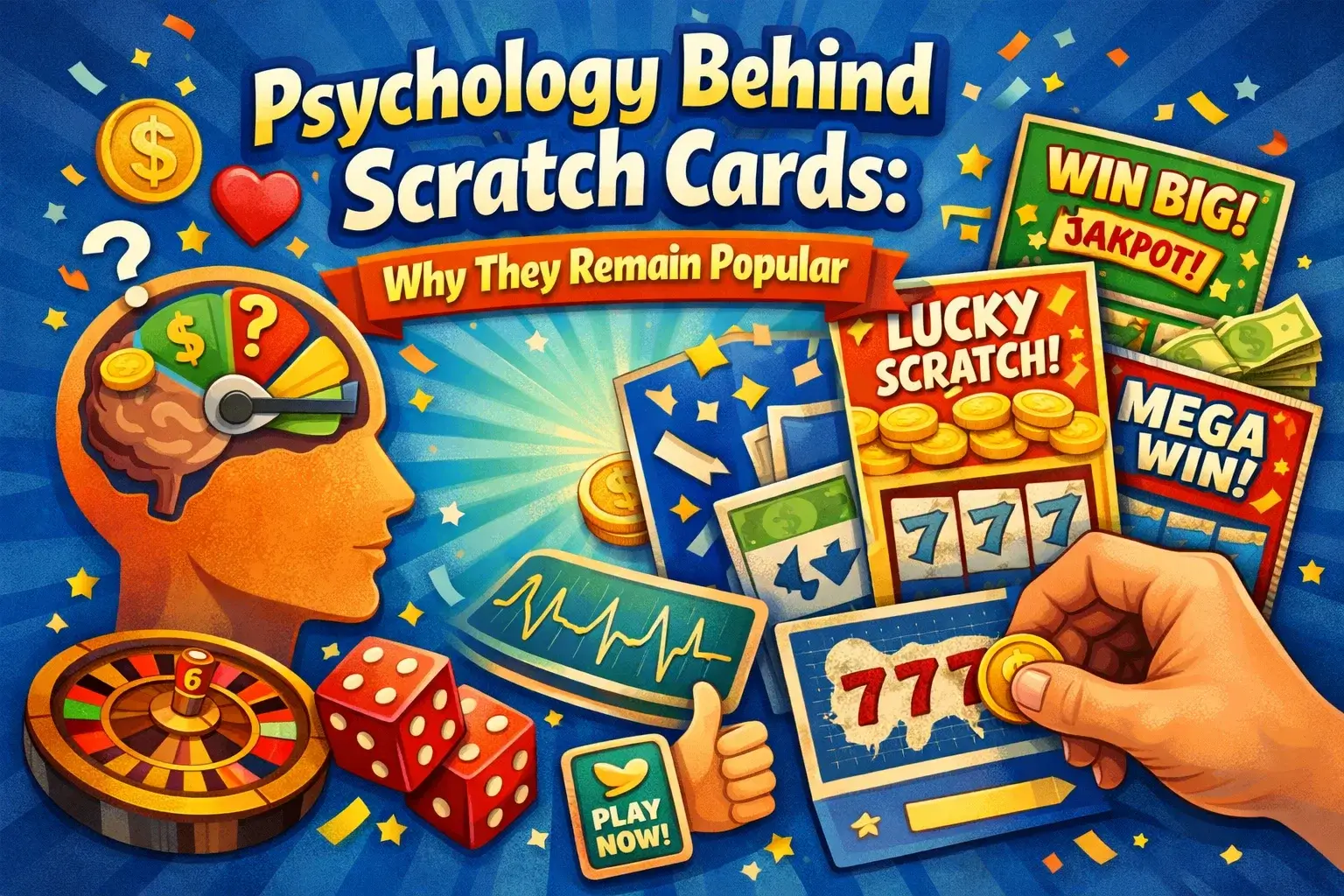
Scratch cards have maintained remarkable staying power in the gambling industry for over five decades. While casino games rise and fall in popularity, and slot machines undergo constant technological evolution, the fundamental appeal of scratch cards remains essentially unchanged since their 1974 introduction. Understanding why these simple games continue attracting millions of players worldwide requires examining the psychological mechanisms that make them so persistently engaging.
The Neuroscience of Instant Gratification: What Happens in Your Brain
When you purchase a scratch card and begin revealing symbols, your brain undergoes a complex sequence of neurochemical events that create the compelling experience scratch card enthusiasts recognize. The process begins before you even scratch the first symbol—anticipation alone triggers measurable brain activity in regions associated with reward processing.
Functional MRI studies of gambling behavior reveal that the ventral striatum, a brain region central to reward processing, activates intensely during the anticipation phase of scratch card play. This activation occurs regardless of whether you ultimately win or lose. The mere possibility of winning triggers dopamine release in the nucleus accumbens, creating pleasurable sensations that reinforce the behavior. This anticipatory pleasure often exceeds the pleasure derived from actual wins, explaining why players continue despite negative overall returns.
The immediacy of scratch cards amplifies these neural responses in ways that differ from other gambling forms. Lottery draws require waiting days for results. Slot machines provide outcomes within seconds but lack the tactile engagement of physical scratching. Sports betting involves extended timeframes between wagers and results. Scratch cards compress the entire gambling cycle—purchase, play, outcome, and potential reward—into 30 seconds or less. This compression creates an intense neurochemical experience within a brief timeframe.
The physical act of scratching engages sensorimotor cortex regions responsible for touch and movement. This engagement creates what neuroscientists call “embodied cognition”—the brain processes the gambling experience as something you’re actively doing rather than passively observing. Research comparing scratch cards to electronic instant-win games with automatic reveals shows significantly higher engagement and reported enjoyment for the physical scratching condition, despite identical mathematical outcomes and prize structures.
Dopamine pathways respond differently to predictable versus unpredictable rewards. Scratch cards exploit this through outcome uncertainty combined with varying prize amounts. Your brain releases more dopamine when reward timing and magnitude remain unpredictable compared to fixed, predictable rewards. This explains why scratch cards with multiple prize tiers and bonus features create stronger engagement than simple win/lose formats.
The temporal immediacy also prevents cognitive processing that might inhibit play. When outcomes arrive instantly, the prefrontal cortex—responsible for impulse control and rational decision-making—has insufficient time to evaluate decisions critically. This creates a “hot” emotional state where immediate gratification seeking overrides longer-term financial considerations. Studies show that introducing even brief delays between purchase and outcome revelation significantly reduces subsequent purchase frequency, demonstrating how immediacy bypasses rational evaluation.
Mirror neuron systems activate when players observe others scratching cards, creating vicarious excitement even before personal play. Watching someone scratch a winning card triggers similar neural responses to winning yourself, though less intensely. This social observation element explains why scratch card purchases often cluster in visible retail environments where potential players observe others engaging with the product.
The brain’s prediction error system plays a crucial role in scratch card appeal. When outcomes differ from expectations—either better or worse—the brain generates prediction error signals that enhance learning and memory formation. Each scratch card provides multiple prediction error opportunities as symbols reveal progressively, creating numerous micro-moments of surprise that keep the brain engaged throughout the brief gameplay duration.
Endogenous opioid systems, separate from dopamine pathways, also contribute to scratch card appeal. The “liking” of winning experiences versus the “wanting” of potential wins involves different neurochemical systems. Research using naloxone (an opioid blocker) shows that while dopamine drives the motivation to play, opioid systems mediate the pleasure of winning. Scratch cards effectively engage both systems through their combination of anticipation and immediate outcome revelation.
Variable Reward Schedules and the Dopamine Connection
B.F. Skinner’s operant conditioning research in the 1950s identified variable ratio reinforcement schedules as the most resistant to extinction. Scratch cards represent near-perfect implementations of variable ratio schedules in commercial gambling contexts. Understanding how these schedules interact with dopamine systems explains much about scratch card persistence.
In fixed ratio schedules, rewards arrive after consistent numbers of responses—every tenth lever press produces food for laboratory animals. These schedules create predictable behavior patterns with pauses after rewards. Variable ratio schedules provide rewards after unpredictable numbers of responses, creating steady, persistent responding without post-reward pauses. Scratch cards exemplify variable ratio schedules: each card might win, and winning frequency varies unpredictably from the player’s perspective.
Dopamine neurons in the ventral tegmental area demonstrate phasic firing patterns that correspond to reward prediction errors. When rewards arrive unexpectedly, dopamine neurons fire intensely. When expected rewards fail to materialize, firing drops below baseline. Scratch cards create constant prediction error signals because outcome unpredictability means each reveal carries genuine uncertainty, even for experienced players who understand overall odds.
The prize structure of scratch cards typically includes high-frequency small wins, medium-frequency moderate wins, and low-frequency large jackpots. This multi-tiered structure ensures that players experience wins sufficiently often to maintain dopamine system engagement while preserving profitability for operators. Data from lottery organizations indicates that optimal scratch card designs produce winning experiences (including prize-less “free ticket” wins) in approximately 25-35% of plays. This frequency sustains engagement without creating unsustainable prize payout obligations.
Different prize magnitudes trigger distinct dopamine responses. Small wins maintain baseline engagement through frequent reinforcement. Moderate wins create elevated dopamine responses that strengthen purchasing behavior. Large jackpot possibilities maintain persistent motivation even during losing streaks—the “what if” factor keeps dopamine systems primed for potential big wins. Neuroimaging studies show that imagining large wins activates reward circuits almost as intensely as actually winning moderate amounts.
The “losses disguised as wins” phenomenon particularly affects scratch card psychology. When a card returns less than the purchase price but frames this as a win—for example, winning $5 on a $10 card—the brain initially processes this as a reward despite the net loss. The positive framing, celebratory design elements, and momentary relief trigger dopamine release before cognitive processing recognizes the actual loss. These pseudo-wins extend play duration by providing reinforcement events that feel rewarding despite negative expected value.
Dopamine system habituation creates tolerance effects requiring escalating stimulation for equivalent pleasure responses. Scratch card manufacturers address this through constant new game introduction. Novel themes, mechanics, and prize structures re-engage habituated dopamine systems by introducing novelty—a primary dopamine trigger separate from reward processing. Players report that new scratch card designs feel more exciting than familiar formats, even with identical odds and prizes, demonstrating how novelty alone enhances dopaminergic engagement.
The gambling industry term “time on device” reflects understanding of these neurological mechanisms. Scratch card designs increasingly incorporate extended play features—bonus rounds, progressive reveals, multiple game areas—specifically to prolong the dopamine-releasing anticipation phase. Extended play maintains elevated dopamine states longer, creating more intense reinforcement of purchasing behavior despite mathematically unchanged expected values.
Individual variation in dopamine system function explains differential scratch card susceptibility. Genetic polymorphisms affecting dopamine D2 receptor density, dopamine transporter function, and COMT enzyme activity influence gambling behavior responsiveness. People with certain genetic profiles experience more intense dopamine responses to gambling stimuli and demonstrate higher addiction vulnerability. This biological variability means scratch cards affect different individuals profoundly differently, with some experiencing minimal engagement while others develop compulsive playing patterns.
The Illusion of Control: Why Scratching Feels Different Than Watching
Scratch cards provide players a sense of agency absent from most gambling forms, creating powerful illusions of control that enhance engagement and perceived winning probability. The physical act of revealing symbols creates subjective feelings of influence over outcomes, despite the complete predetermination of results.
Langer’s seminal research on the illusion of control demonstrated that people overestimate their influence over chance events when they have active participation. In classic experiments, lottery ticket holders who chose their own numbers demanded four times higher prices to sell tickets compared to those assigned random numbers, despite identical mathematical odds. Scratch cards amplify this effect through multiple choice points: selecting which card to purchase, choosing where to start scratching, deciding reveal sequence, and controlling scratching pace.
The reveal sequence creates particularly strong control illusions. Players develop superstitious beliefs about scratching patterns—corner-to-corner, top-to-bottom, saving certain symbols for last. While mathematically irrelevant since outcomes are predetermined, these rituals provide psychological satisfaction through perceived agency. Observational studies at retail locations document that approximately 70% of scratch card players follow consistent personal scratching patterns, often elaborating these into explicit “systems” for maximizing wins.
Skill perception fundamentally differs between scratch cards and pure chance games. When asked to rate skill influence on outcomes, scratch card players consistently rate these games as more skill-dependent than lottery draws or slot machines, despite equivalent randomness. The interactive element tricks intuitive judgment systems into perceiving personal influence. This misperception encourages continued play because players attribute losses to poor technique rather than mathematical inevitability, preserving self-esteem and motivation for “better” future attempts.
Choice abundance enhances control illusions. Retailers typically stock 20-40 different scratch card varieties simultaneously, creating extensive selection processes. Players spend time examining options, comparing price points and potential prizes, and making “strategic” selections. This decision-making investment creates commitment to choices and inflates perceived control. The paradox is that more choices increase satisfaction with the process while having zero impact on expected value—all scratch card variants operate at similar house edges mandated by lottery regulators.
The gradual reveal mechanic differs fundamentally from instant automated results. Each symbol revelation represents a micro-decision and micro-outcome, creating multiple psychological investment points throughout single-card play. Contrast this with automated games where single button presses produce complete outcomes instantly. The extended reveal process allows ongoing hope maintenance—until the final symbol appears, winning remains possible. This sustained hope proves more psychologically rewarding than instant complete information.
Stopping behavior particularly demonstrates control illusions. Players can purchase and play one card, evaluating results before additional purchases. This start-stop capability creates feelings of measured, controlled gambling distinct from continuous games like slots where extended sessions become default patterns. Paradoxically, the perceived control over stopping often enables more problematic behavior because players underestimate cumulative losses spread across many “controlled” individual sessions.
The tangible physical card provides control-enhancing concreteness absent from digital gambling. Holding, examining, and manipulating a physical object creates stronger ownership feelings and perceived influence compared to screen-based interactions. Behavioral research demonstrates that people treat physical objects as more “real” and controllable than digital representations, even when functionally identical. This physicality partially explains why traditional scratch cards maintain popularity despite digital alternatives offering greater convenience.
Partial information revelation strategically amplifies control perceptions. Many scratch card formats reveal some information before requiring complete reveals—showing two of three needed symbols before the crucial final symbol, displaying bonus game eligibility before playing bonus rounds. These partial reveals create decision points where players feel they’re actively participating in outcome determination, despite predetermined results. The dramatic tension of these moments reinforces engagement regardless of ultimate outcomes.
Post-hoc rationalization strengthens control illusions through selective memory. Winners attribute success to their selection and scratching techniques, reinforcing perceived skill. Losers attribute failure to external factors—unlucky card choice, distracted scratching technique, poor timing. This attribution bias maintains motivation for continued play because players believe improved technique will enhance future results. Psychological research consistently demonstrates that gambling participants systematically overestimate skill influence while underestimating pure chance.
Near-Miss Effects and How They Keep Players Coming Back
Near-miss experiences—outcomes that almost win but ultimately lose—create paradoxical psychological responses that intensify scratch card engagement. These almost-wins should logically discourage play by demonstrating how rarely full wins occur, yet they actually increase motivation and play persistence through exploitation of cognitive biases.
A near-miss in scratch cards typically involves matching all required symbols except one—revealing two cherries when three are needed, getting $499,000 when the jackpot requires $500,000, or matching all numbers except the bonus multiplier. These outcomes are mathematically equivalent to complete misses in expected value terms, yet psychologically they feel distinctly different. Brain imaging studies reveal that near-misses activate reward circuitry similarly to actual wins, despite producing no monetary return.
The midbrain dopamine system responds to near-misses with increased activation rather than decreased activity predicted by rational models. This paradoxical response occurs because the brain processes near-misses as “learning experiences” providing information about how to win, rather than as simple losses. This interpretation makes evolutionary sense for genuine skill-based activities where near-successes indicate improving ability, but creates maladaptive responses in chance-based gambling where near-misses contain no predictive information about future outcomes.
Scratch card designers deliberately engineer near-miss frequencies beyond chance expectation. Analysis of losing scratch card distributions reveals near-miss configurations appearing 2-3 times more frequently than pure randomness would produce. Manufacturers manipulate symbol distributions to create illusions of “almost winning” specifically because research demonstrates these configurations increase subsequent purchasing more effectively than clean losses. Regulatory frameworks rarely address this manipulation because outcomes technically remain random even with weighted near-miss frequencies.
The counterfactual thinking triggered by near-misses proves particularly powerful. When players almost win, they immediately generate thoughts about how different choices might have produced wins: “If I’d bought the card beside this one,” “If I’d scratched the symbols in different order,” “If I’d visited the store five minutes earlier.” This counterfactual generation makes losses feel less inevitable and more contingent on correctable factors, encouraging continued play to “get it right” next time.
Regret amplification enhances near-miss impacts. Losing by small margins generates more regret than clear losses because the outcome feels more changeable. Psychological research demonstrates that regret intensity correlates with perceived proximity to alternative outcomes—nearly winning produces more regret than losing badly. Paradoxically, this intensified regret actually increases gambling motivation as players seek to relieve regretful feelings through continued play and potential wins, rather than logically recognizing increased loss probability.
Near-misses exploit the representativeness heuristic—the tendency to judge probability by how representative an outcome appears. Near-winning patterns feel “representative” of winning patterns, leading players to overestimate actual winning probability. Three matching symbols with one non-match feels like it represents a game where wins happen frequently, even when mathematical reality shows wins occurring once per hundred cards. This cognitive shortcut systematically inflates optimism about future outcomes.
The phenomenon of “losses disguised as wins” often incorporates near-miss elements. A scratch card might return $2 on a $5 purchase while displaying this as “winning $2” with celebratory graphics and sounds, even though the net result is a $3 loss. The presentation frames the outcome as a near-win—you won something, just not enough to profit—rather than accurately categorizing it as a loss. This framing manipulates perception and maintains motivation more effectively than honest loss presentation.
Personality factors influence near-miss susceptibility. Individuals high in optimism and openness to experience demonstrate stronger motivational responses to near-misses compared to those high in neuroticism or conscientiousness. This suggests that near-miss effects aren’t universally powerful but interact with individual difference variables to produce stronger effects in certain populations. Marketing strategies increasingly target demographic segments showing higher near-miss responsiveness.
The temporal proximity of near-misses significantly affects their motivational power. Experiencing a near-miss immediately before considering another purchase produces stronger effects than near-misses experienced hours or days earlier. This temporal gradient explains why continuous scratch card availability and immediate repurchase opportunities amplify near-miss exploitation. Retailers strategically position scratch card displays near checkout counters, ensuring minimal time between near-miss experiences and repurchase opportunities.
Cognitive sophistication provides limited protection against near-miss effects. Even gamblers who explicitly understand that near-misses contain no information about future outcomes demonstrate elevated motivation following near-miss experiences. This suggests near-miss responses operate through automatic, subcortical processes rather than conscious reasoning, making them resistant to cognitive intervention. Educational programs explaining near-miss irrelevance show minimal effectiveness in reducing their motivational impact.
Social and Cultural Factors That Drive Scratch Card Appeal
Beyond individual psychology, scratch cards succeed through social and cultural mechanisms that embed them into everyday life in ways that more stigmatized gambling forms cannot achieve. These collective factors create normalized gambling participation that transcends individual decision-making.
The retail distribution model positions scratch cards as ordinary consumer products rather than specialized gambling opportunities. Selling scratch cards alongside newspapers, lottery tickets, and convenience items in gas stations and grocery stores creates casual accessibility that casino gaming cannot match. This normalization particularly affects younger adults whose first gambling experiences frequently involve scratch cards purchased during routine errands rather than deliberate casino visits.
Gift-giving traditions incorporate scratch cards as socially acceptable presents for birthdays, holidays, and celebrations. In many Western cultures, giving scratch cards as birthday gifts has become normalized, even expected, despite explicitly gifting gambling opportunities. This social ritual introduces gambling to recipients who might never purchase scratch cards independently and creates positive associations between gambling and celebratory occasions. Research indicates that approximately 15% of scratch card sales occur as gifts, introducing millions to gambling annually through social channels.
Price point accessibility removes financial barriers that exclude many from casino gambling. While casino visits often involve substantial gambling budgets, transportation costs, and time commitments, scratch cards offer complete gambling experiences for $1-5. This democratization of gambling access enables participation across socioeconomic strata, including populations for whom $50 casino budgets represent prohibitive expenses. The low entry cost creates illusions of low-risk gambling, even as frequent small purchases accumulate into substantial expenditures.
Scratch cards serve important social functions in working-class communities particularly. The shared ritual of purchasing, playing, and discussing outcomes creates social bonds and conversation topics. Retailers become social hubs where regulars exchange information about new releases, big wins, and playing strategies. These social dimensions transform scratch card gambling from isolated personal activity into communal participation that serves relationship maintenance functions beyond the gambling itself.
Media representation affects scratch card normalization significantly. Unlike casino gambling depicted in films as either glamorous or problematic, scratch cards appear in media as mundane background elements—characters casually purchase them during everyday activities, reinforcing perceptions of normalcy. This subtle but pervasive representation conditions audiences to view scratch card gambling as unremarkable behavior rather than risky activity requiring careful consideration.
Charitable lottery framing enhances social acceptability, particularly for government-operated scratch cards. When lottery revenues fund education, infrastructure, or social programs, purchasing scratch cards acquires public service connotations—you’re supporting good causes while entertaining yourself. This framing reduces guilt and social stigma associated with gambling, allowing players to maintain positive self-images as responsible citizens rather than gamblers. Research shows that charitable framing significantly increases purchase likelihood even among individuals opposed to gambling on moral grounds.
Cultural variables create distinct scratch card meanings across societies. In some Asian cultures, scratch cards integrate into New Year traditions and numerology practices, creating culturally specific engagement patterns absent in Western contexts. Mediterranean cultures incorporate scratch cards into café and bar social rituals, while Northern European patterns emphasize solitary consumption. These cultural variations demonstrate how identical products acquire different meanings through social contextualization.
The aspirational lottery jackpot mythology particularly affects lower-income populations. While economically privileged individuals might pursue wealth through education, investment, and career advancement, scratch cards offer accessible wealth-seeking alternatives for populations lacking capital or opportunities. The dream of instant wealth transformation operates as cultural narrative enabling hope maintenance despite long odds. This explains why scratch card sales correlate inversely with median income—highest sales occur in economically struggling communities where alternative paths to wealth feel inaccessible.
Gender dynamics influence scratch card consumption distinctly from other gambling forms. While casino gambling skews male, scratch card purchases show more balanced gender distributions, with some formats actually attracting more female than male players. This gender balance relates partially to retail distribution in spaces women frequent and partially to lower aggressive competition and social performance demands compared to poker rooms or sportsbooks. Marketing increasingly targets female players through themes, price points, and retail placement strategies.
Intergenerational transmission perpetuates scratch card participation. Children observing parents purchasing and playing scratch cards normalize these behaviors, creating next-generation players. Research tracking gambling initiation shows strong correlations between parental scratch card use and offspring gambling participation, demonstrating social learning effects. This transmission occurs even when parents disapprove of gambling generally, suggesting that scratch card normalization creates blind spots regarding transmission of gambling behaviors to children.
Addiction Mechanisms and Why Some Players Can’t Stop
While most scratch card players engage casually without problems, a subset develops compulsive playing patterns meeting clinical gambling disorder criteria. Understanding addiction mechanisms requires examining how scratch card characteristics exploit vulnerable psychological processes in susceptible individuals.
The rapid event frequency inherent to scratch cards creates particular addiction risks. Gambling researchers identify event frequency—how many complete gambling cycles occur per unit time—as a primary addiction risk factor. Scratch cards enable 60+ complete gambling cycles per hour, comparable to electronic gaming machines and far exceeding lottery draws, sports betting, or table games. This rapid frequency enables quick loss accumulation and prevents the cooling-off periods that might interrupt problematic behavior.
Chasing losses becomes particularly problematic with scratch cards due to immediate availability and low individual stakes. After losing $20 across multiple cards, purchasing “just one more” to recoup losses requires minimal commitment—no traveling to casinos, no waiting for events to conclude. This accessibility eliminates natural stopping points, enabling extended losing streaks to continue until funds exhaust. Clinical interviews with problem scratch card gamblers reveal that chasing episodes often involve dozens of sequential purchases in single sessions, something impossible with weekly lottery draws.
The variable ratio reinforcement schedule discussed earlier affects vulnerable individuals more severely. While most players can engage with variable ratio schedules recreationally, individuals with certain psychological profiles—particularly those with impulsivity issues, ADHD, or dopamine system irregularities—show heightened sensitivity to these schedules. For these individuals, the reinforcement schedule creates compulsive behavioral patterns resistant to extinction even after extended losing periods.
Dissociation and trance-like states occur during extended scratch card sessions. Players report losing time awareness, feeling “in the zone,” and experiencing diminished awareness of surroundings—symptoms characteristic of problematic gambling. The repetitive scratching motion, combined with visual focus on cards and rapid succession of outcomes, induces flow states where external concerns fade. While flow states themselves aren’t pathological, in gambling contexts they enable extended play without periodic reality testing about losses and consequences.
Cognitive distortions systematically distort probability assessment among problem scratch card gamblers. The gambler’s fallacy—believing that losses make wins “due”—operates powerfully in scratch card contexts where losing streaks are frequent and statistically expected. The illusion of control described earlier intensifies into genuine delusions of influence over random outcomes. Selective memory amplifies wins while minimizing losses in recall, creating distorted mental accounting that encourages continued play despite negative actual returns.
Scratch cards provide escape functions for individuals experiencing stress, anxiety, or depression. The complete absorption required for play temporarily distracts from psychological distress, creating negative reinforcement through pain relief. This escape motivation differs fundamentally from entertainment-seeking motivation and predicts problematic gambling development more strongly. Clinical assessment of problem gamblers consistently identifies escape motivation as a primary factor, with scratch cards offering particularly accessible escape opportunities.
Accessibility proves especially problematic for recovering problem gamblers attempting abstinence. While avoiding casinos or online gambling sites requires relatively simple environmental modifications, avoiding scratch cards is nearly impossible when they’re sold in every convenience store, gas station, and supermarket. This ubiquitous availability undermines recovery efforts and contributes to high relapse rates among treated gambling disorder patients.
Comorbidity with other addictive disorders creates synergistic risks. Problem scratch card gambling frequently co-occurs with substance use disorders, particularly smoking and alcohol use. The correlation isn’t coincidental—these behaviors share neurobiological substrates involving dopamine and impulsivity systems. Retailers often position scratch card displays near tobacco and alcohol, exploiting these comorbidities. Individuals purchasing cigarettes or alcohol frequently add scratch card purchases through cross-promotion and convenient placement.
The regulatory environment historically treated scratch cards as lower-risk than casino gambling, resulting in minimal consumer protections. Unlike casinos required to implement self-exclusion programs, responsible gambling messaging, and player protection policies, retail scratch card sales involve virtually no intervention infrastructure. Cashiers receive no training in identifying problem gambling signs, no transaction limits exist beyond purchase amount caps, and no self-exclusion mechanisms operate. This regulatory gap enables problematic behavior to escalate undetected and unaddressed.
Financial harm scales differently but can be equally severe as casino gambling harm. While individual scratch card purchases involve small amounts, daily purchasing of 10-20 cards accumulates into substantial monthly expenditures. Problem gamblers spending $50 daily on scratch cards lose $1,500 monthly—comparable to moderate casino gambling losses. The small individual stakes create illusions of manageable spending even as cumulative losses mount to financially devastating levels.
Conclusion
The enduring popularity of scratch cards reflects sophisticated exploitation of human psychological vulnerabilities, social contexts, and neurobiological systems. These simple games succeed not through complex features or innovative technology, but through perfect alignment with human cognitive biases, reward system sensitivities, and social participation patterns.
The neuroscience reveals that scratch cards activate reward anticipation systems intensely while providing immediate gratification that bypasses rational evaluation. The compression of gambling cycles into brief time spans creates neurochemical experiences that exceed responses to larger but delayed rewards. This immediacy, combined with tactile engagement and outcome uncertainty, produces dopamine responses that reinforce purchasing behavior regardless of actual financial outcomes.
Variable reward schedules implement operant conditioning principles identified decades ago but remain remarkably effective. The unpredictability of wins, combined with multi-tiered prize structures and sufficient small-win frequency, maintains player engagement through optimal reinforcement patterns. Dopamine system responses to these schedules explain why players continue despite negative expected values—the anticipation itself provides neurochemical rewards independent of monetary returns.
The illusion of control proves particularly powerful in scratch card contexts. Physical interaction, choice abundance, and gradual reveal mechanics create subjective feelings of influence over predetermined outcomes. These control perceptions maintain motivation by allowing players to attribute losses to correctable factors while crediting wins to personal skill, preserving both self-esteem and continued play motivation.
Near-miss manipulation represents perhaps the most ethically questionable psychological exploitation. By engineering near-winning configurations beyond chance frequency, manufacturers deliberately create experiences that intensify gambling motivation despite providing no value to players. These near-misses exploit cognitive biases and counterfactual thinking patterns to maintain hope and encourage repurchase even after clearly losing outcomes.
Social and cultural factors embed scratch cards into everyday life in ways that normalize gambling participation. Retail distribution, gift-giving traditions, low price points, and charitable framing all contribute to positioning scratch cards as ordinary consumer products rather than gambling opportunities requiring careful consideration. This normalization particularly affects younger people and lower-income populations, creating early gambling exposure and accessible hope maintenance narratives.
For a subset of players, these psychological mechanisms culminate in addiction. Rapid event frequency, accessibility, variable ratio reinforcement, and escape functions combine to create compulsive playing patterns in vulnerable individuals. The regulatory environment historically provided insufficient consumer protections, enabling problematic behavior to develop unchecked.
Understanding these psychological mechanisms doesn’t diminish scratch cards’ appeal for recreational players who engage responsibly. However, this understanding should inform regulatory approaches, consumer education, and harm minimization strategies. The remarkable effectiveness of scratch cards in maintaining popularity across decades ultimately reflects sophisticated—if sometimes ethically questionable—application of psychological principles to commercial gambling design.
The future likely holds continued scratch card popularity as these fundamental psychological mechanisms remain constant even as delivery platforms evolve. Digital scratch cards now recreate these experiences through touchscreens, while maintaining the core psychological elements that made physical cards successful. Whether physical or digital, scratch cards will likely remain popular as long as human brains respond to immediate rewards, variable reinforcement, control illusions, and social participation opportunities—characteristics unlikely to change without fundamental neurobiology alterations.